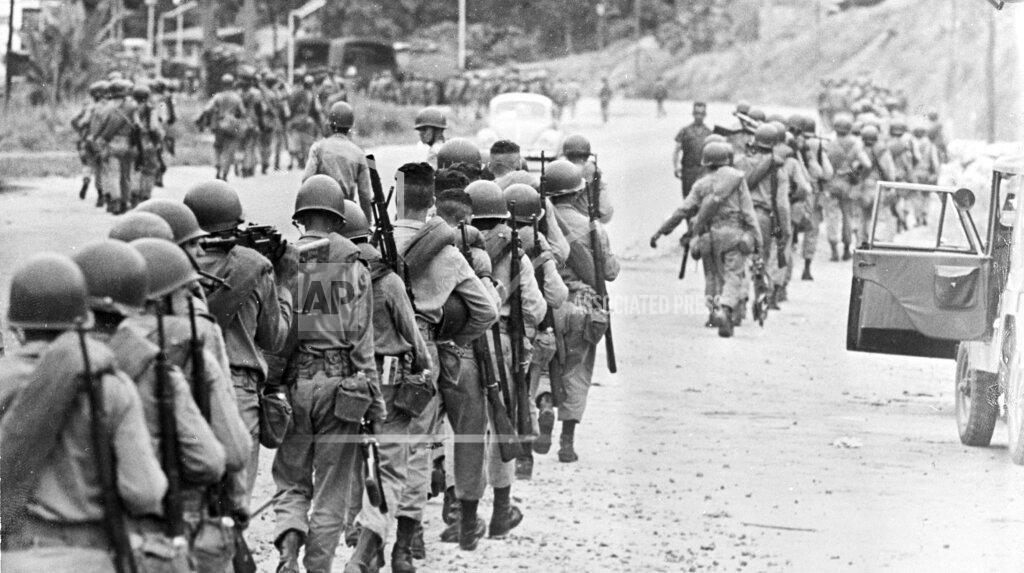
It has been no secret that the North Vietnamese have been developing a network of infiltration trails from North Vietnam through Laos and into South Vietnam which becomes known as the Hồ Chí Minh Trail; some of the routes are capable of handling continuous truck traffic, while others can handle little more than bicycles and foot traffic. Most of the several thousand Communist soldiers and civilian cadres who have been infiltrating into South Vietnam in the years up to now have been indigenous southerners returning to work for the Việt Cộng. In late 1963, the Hanoi leadership seems to have decided to commit units of the North Vietnamese Army (NVA), and by April a large group of North Vietnamese construction battalions has been deployed to further the development of the road network. Furthermore, during April, regular troops of the NVA are undergoing special military and political training for operations in the South, and large units are being formed preparatory to being sent South.
South Vietnam has reached an understanding with the leader of right‐wing forces in Laos that will enable Vietnamese troops to strike inside Laos against Communist guerrilla bases and supply routes, informed sources reported today. This development was said to have resulted from a recent meeting in Đà Lạt, a South Vietnamese hill station, between two of the Indo‐Chinese peninsula’s staunchest anti‐Communists — the rightist Laotian Vice Premier, General Phoumi Nosavan, and South Vietnam’s Premier, Major General Nguyễn Khánh. General Khanh is reported to have won the rightist Vice Premier’s approval to a plan under which Vietnamese raiding parties can strike into Laos against predesignated Communist targets.
Elements of General Phoumi Nosavan’s 50,000‐man rightist army operate along the Vietnamese border. His 33rd Infantry Battalion is at an outpost a stone’s throw from the Vietnamese outpost of Lao Bảo. Informed sources said General Khánh argued that his plan to root the guerrillas out of South Vietnam could succeed only if Communist bases and supply routes in Laos are put out of action. These include the Hồ Chí Minh Trail, an ill‐defined maze of jungle trails named after the North Vietnamese leader that has long been a supply route from the north to the Communist guerrillas in South Vietnam.
General Phoumi Nosavan is reported to have given his consent to General Khánh’s proposals on the condition that the raiding parties were limited in size, were in hot pursuit of the Vietnamese Communists and that the targets were designated in advance. General Phoumi Nosavan is also reported to have insisted that he wanted no part of a military alliance with South Vietnam, an alliance that could result in the collapse of the Laotian coalition Government. For that reason, informed sources said, Laotian troops will not participate in any actions with the South Vietnamese.
Former Vice-President Richard Nixon visits Vietnam and issues a series of statements sharply criticizing U.S. policies for ‘compromises and improvisations,’ calling for continued aid, and promising to make the situation an issue in the forthcoming U.S. presidential campaign. Richard Milhous Nixon and Henry Cabot Lodge conferred today on United States political developments that have made them potential rivals for the Republican Presidential nomination. They approached the subject gingerly and it was understood there was no specific discussion of possible preconvention moves by either man. Both insist that they do not intend to become candidates. The two Republican nominees of 1960 met for the first time in nearly a year shortly after the former Vice President arrived in Saigon for a two‐day visit. Mr. Lodge, Ambassador to South Vietnam, did not go to the airport to meet his former running mate, but Mr. Nixon drove straight to the embassy for a two‐hour conference.
Emerging, Mr. Nixon said that the bulk of the time was taken up in discussion of United States policy in South Vietnam but toward the end the two men turned to domestic politics. “We covered everything significant about this political year,” Mr. Nixon told newsmen. “This was a casual conversation about developments — it had nothing to do with decisions — about what we’re going to do in the political field.” Mr. Lodge, who has carefully avoided discussing United States politics while in a diplomatic post, came out of the embassy a half‐hour after Mr. Nixon had departed. Questioned about his talk, the Ambassador hesitated, then shrugged his shoulders and said: “There really isn’t anything I can say. I’m sorry.”
Asked if he expected Vietnam policy to become an issue in the Presidential campaign, Mr. Nixon replied: “I hope it doesn’t; it will only become an issue if the policy has weaknesses worthy of criticism, if it is plagued with inconsistency, improvisation and uncertainty. That has been the case in the past. “There is no substitute for victory in South Vietnam.”
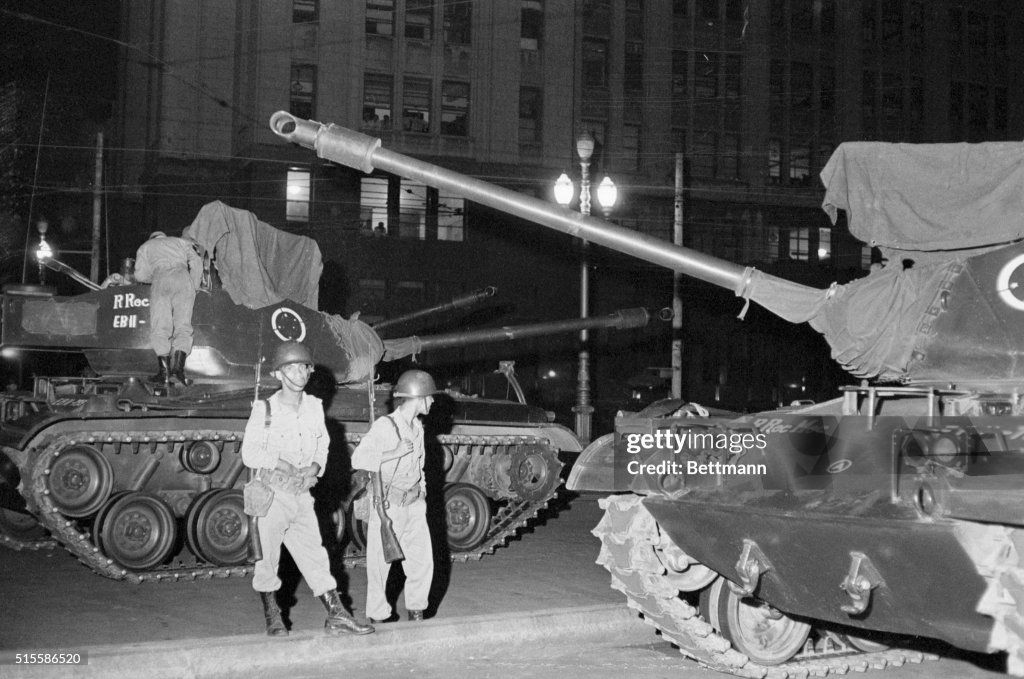
Brazil’s President João Goulart fled from Rio de Janeiro as rebel units of the 2nd Brazilian Army Corps approached the city to carry out a coup d’état. Goulart flew to Brasília, then to his home in Porto Alegre, where he pledged to take command of the Brazilian 3rd Army in a bid to reclaim his office. The War Ministry announced that President Goulart had resigned after a revolt by some of Brazil’s military leaders and state governors. The rebels said that Ranieri Mazzii, president of the Chamber of Deputies, was assuming the presidency of the country as the next in line.
The fast‐moving Brazilian conflict is still confused. As often happens in Latin America, a move to the left brings a reaction from the right. João Goulart was and is a leftist, a sort of parlor‐pink Socialist. But his main trouble is his hopeless ineffectiveness. His influence has been destructive in every sense and in every sphere of government. His enemies cannot prove that he had been turning the country over to Communism, but they can prove that he has been turning Brazil over to chaos.
Once again, the armed forces are showing they are the arbiters of Brazilian politics. This has been the case since the beginnings of the republic in 1889, and especially since the end of the Second World War. Senhor Goulart, who was ousted by the military in 1952 when he was Minister of Labor, and who was almost prevented by the officers from taking the Presidency in 1961, may well live on — politically speaking. He appointed to key military posts men who seemed loyal to him, and he cultivated the support of the non‐coms, but he could not change the structure of the army, which was conservative middle class. Even Getulio Vargas, in his dictatorial years from 1930 to 1945, had to have military support, and in the end the army threw him out anyway.
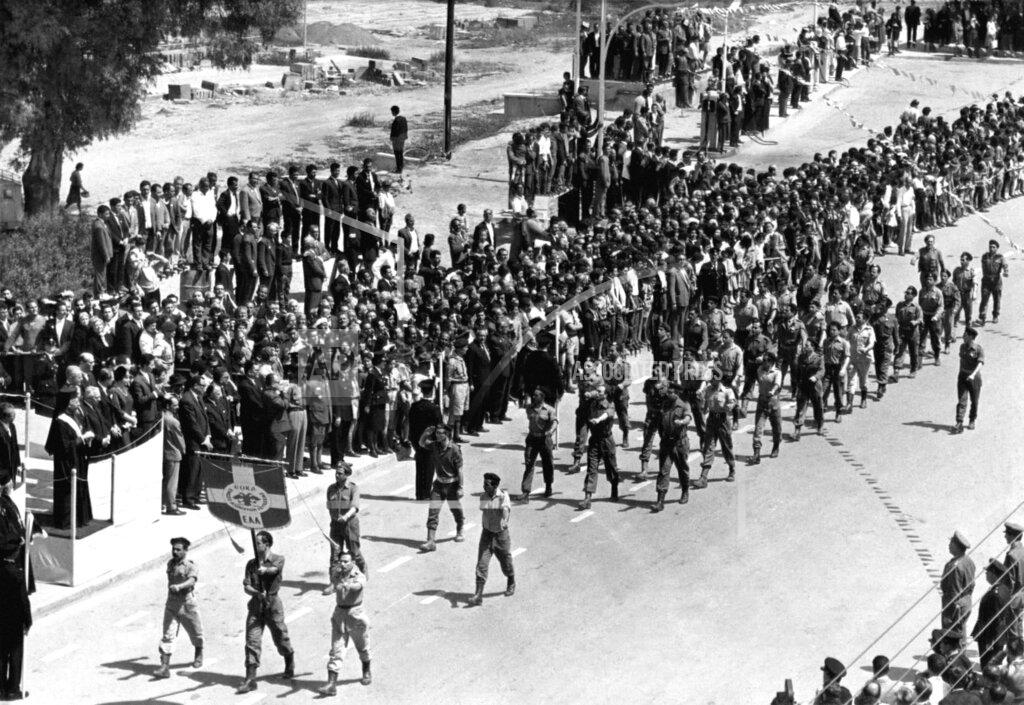
U Thant made public today the arrangements under which the United Nations Cyprus force and Cypriote security forces would aid each other when requested. These provide that the United Nations force will not supply help unless its commander decides that such help is “within the framework” of the Security Council resolution of March 4 establishing the force. On the other hand, Cyprus pledged herself to meet “in a spirit of cooperation” any requests submitted by the United Nations commander for help in carrying out the resolution.
According to reliable sources, this means that if Cypriote security forces go into action against Cypriote Turks, Lieutenant General Prem Singh Gyani, commander of the United Nations force, will not comply with a Cypriote request for help unless he feels it is in accordance with the Council’s decision. Although the Secretary General has instructed the United Nations force not to shoot except in self‐defense, he has also instructed it to interpose itself where necessary to stop fighting between Greek and Turkish Cypriotes. Accordingly, if one of the combatants fired on a United Nations contingent, it would fire back, just as a policeman would if he were trying to separate two fighters and one fired on him.
Dr. François Duvalier had himself installed today as President of Haiti for life. He told army officers who came to the National Palace here: “I am happy that you understand it is necessary to join the revolutionary crowd and come here this morning to render homage to the constitutional chief of the armed forces in a new oath of allegiance.” Dr. Duvalier likes to call himself “Papa Doc” to note that he has a medical degree, and bands throughout the republic were beating out Haiti’s newest rhythmic chant: “Papa Doc forever.” He got his medical degree here and did postgraduate work at the University of Michigan. The President’s voice rose as he told the crowd he considered himself an exceptional man, the kind the country could produce only once every 50 or 75 years.
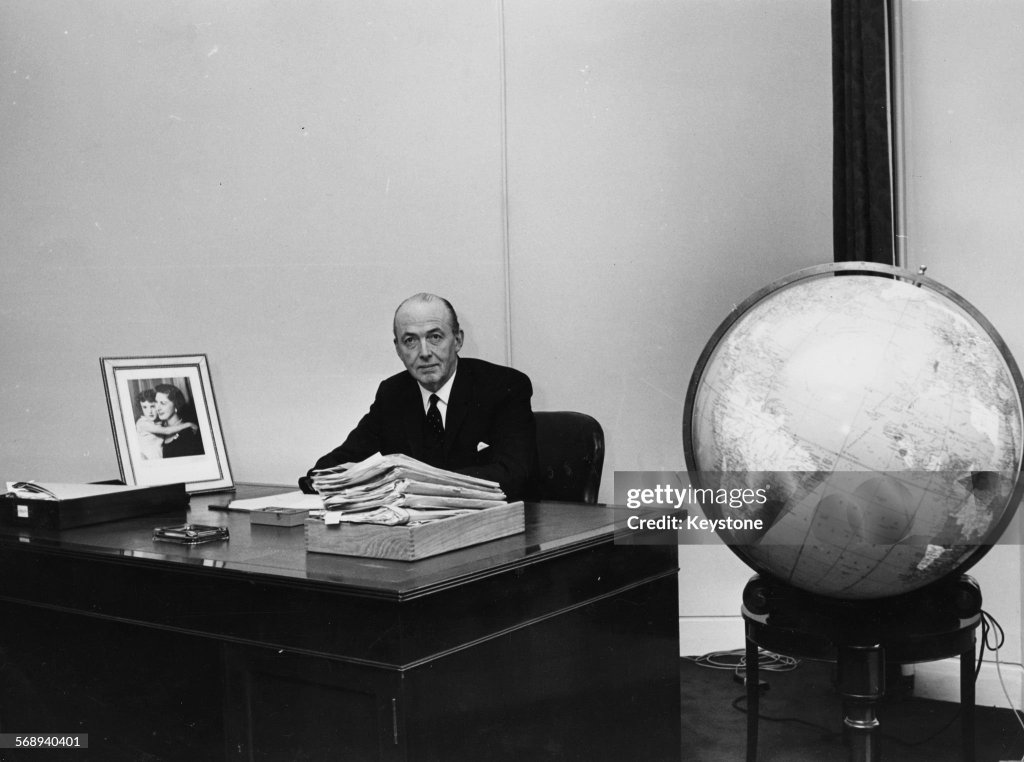
Queen Elizabeth II became the Lord High Admiral of the United Kingdom as part of the reorganization of the defense of the nation. The post of First Lord of the Admiralty, held for the past year by the Earl Jellicoe, was abolished after 163 years. The position of Minister of Defence, held by Peter Thorneycroft, Baron Thorneycroft, became the Secretary of State for Defence.
The Trident jet airliner began regular service, with British European Airways Flight 564 from London to Zürich.
Most of the 12,000 physicians and dentists in Belgium went on strike and refused to treat patients, as a protest against a medical reform program that had gone into effect on January 1. The strike would end after 18 days, after Belgian government mobilization of all doctors benefiting from government assistance.
The Senate’s bipartisan supporters of the civil rights bill began today their promised title‐by‐title analysis of the measure with an attack on dis‐ crimination in voting. The bipartisan captains in charge of Title I, dealing with voting rights, are Senators Kenneth B. Keating, Republican of New York, and Philip A. Hart, Democrat of Michigan. Mr. Keating opened by saying that the adjuration to the nation last week by Senator J. W. Fulbright, Democrat of Arkansas, on foreign affairs — that it was time to abandon cherished myths and face reality — applied “with equal force to the civil rights struggle.” “It is a myth,” he said, “that the Black is not interested in voting in the South and that his own apathy is the cause for low voter registration. The thousands standing in line in Mississippi waiting to be registered, the thousands disqualified because of technical errors in applications, and the thousands subjected to discriminatory literacy tests have blown that myth sky high.”
Senator Hart said: “For a full century, the cry ‘How long, O Lord, how long?’ has had no more poignant meaning than how long before I can walk into a voting booth and in fact and practice be a citizen of these United States.” The mumbled speeches of the two Senators, full of dramatic and even ludicrous examples of discrimination against Blacks by voting registrars in some Southern states, were given on a virtually empty floor and scarcely carried to the public galleries, filled with student visitors to the capital. At no time were there more than six Senators on the floor. As Mr. Keating spoke, the acting general for the civil rights forces, Senator Norris Cotton, Republican of New Hampshire, slept in his chair.
The bill’s voting section would strengthen the 1957 and 1960 Civil Rights Acts by requiring registrars to apply the same standards to both whites and Blacks on literacy tests and by forbidding the disqualification of Blacks for immaterial errors and omissions on voter application forms. It would also require that literacy tests be in writing, except where an applicant requested and the state law allowed an oral test. Copies of questions and answers, whether the test was written or oral, would have to be made available to an applicant on request. In voting suits where literacy was a question, the state would have to prove that a disqualified applicant with a sixth‐grade education or more was, in fact, illiterate.
The civil rights issue keeps pursuing Senator Barry Goldwater of Arizona in his campaign for the Republican Presidential nomination. Wherever he goes in the field these days it is the leading question posed to him by local reporters, and when he, comes back to this city he finds the Senate engaged in debate on the issue. In Detroit, with several Black reporters watching, he is asked why a Black should vote for him. In San Francisco, he is asked if Blacks will support his party. There, too, he is asked why when Governor Rockefeller comes to that city, Mr. Rockefeller lunches with Black leaders, and why doesn’t Mr. Goldwater do that too. Questions and answers on the subject dominate his news conferences. The Senator answers patiently but the subject seems to interest others more than it does him. He leaves the impression that he would prefer to talk about Cuba, or Vietnam or what he believes is a missile problem.
The situation is described by one of his chief supporters as follows: First, said the friend, civil rights is not really a subject that interests or excites the Senator, who comes from Arizona, a state that has generally been outside the mainstream of the Black protest movement. Secondly, according to the friend, the issue can hardly help, and might well hurt, the Senator. Those people already for him or against him will not be changed by anything new he says on the issue and his friends do not think Mr. Goldwater is likely to generate any great appeal to Blacks at this date.
Yesterday, at a 30-minute news conference in San Francisco, almost all of it devoted to civil rights questions, he was asked if the Republicans had a chance at the Black vote this year. His answer was a blunt no. “The Republicans do not have the Negro vote. It is our own fault. We lost it in the thirties and it’s been gone for 30 years. I think we will lose the vote in the big cities, and I don’t think we can change it this year,” he answered.
Arizona Black leaders voiced opposition today to the creation of a state commission on human rights. “I can’t stop the state senators from setting up such a commission if they want to,” the Rev. George Brooks, the local president of the National Association for the Advancement of Colored People said. “But it will be just another instrument to lull people to sleep.”
Mr. Brooks and the leaders of the Congress of Racial Equality called off all demonstrations at the Arizona Capitol late yesterday, indicating that hopes for passage of a stringent public accommodations bill had died. Their announcement followed a conference with Governor Paul Fannin, during which the Governor restated his interest in a new state commission to deal with racial problems. The governor’s interest is not shared by most of the civil rights leaders who have watched the development of the Human Relations Commission in the city of Phoenix.
Cattlemen are receiving lower prices for beef in the stockyards while housewives are paying relatively high prices for beef in the supermarket. This paradox lies at the heart of a proposal sent to Congress today by President Johnson. It also lies at the heart of a little-noticed but potentially explosive debate now under way in Congress, the outcome of which could have important consequences for those who produce beef, those who sell it, and — ultimately — those who consume it. In letters to the House and Senate, Mr. Johnson urged the establishment of a 15‐member commission to study “the changes taking place in the American food industry” and to conduct a detailed inquiry into all the factors influencing food prices. The commission would include five members of the House, five Senators, and five private citizens to be appointed by the President.
A White House study group presented today an optimistic report saying that huge atomic power plants could be developed to produce cheap electricity simultaneously with vast amounts of fresh water. By 1975, it will be economically feasible for a nuclear plant in Southern California, the Southwest or Long Island to supply enough desalinized sea water for up to a million people and electricity for a city with 2 million population, the group said. In some coastal areas, it was suggested, the waste heat from the plants might also be used to warm stretches of water to provide year‐round recreation for swimmers and sports fishermen. The report was presented by an interagency task group that was set up early last year by the White House Office of Science and Technology to study the prospects for providing both electricity and desalted water from very large nuclear plants.
Senator Wayne Morse, Democrat of Oregon, served notice on the Senate Foreign Relations Committee today that he would fight efforts to split up President Johnson’s $3.4 billion foreign aid program. He did so at a hearing on a bill to authorize continuing contributions to United Nations international agencies. Mr. Johnson is asking $134.4 million for that purpose in the fiscal year starting July 1.
NASA astronauts visited St. Louis to conduct an operational evaluation of the Project Gemini translation and docking trainer. They noted minor discrepancies which McDonnell corrected. The company completed engineering evaluation tests on April 6. The trainer was then disassembled for shipment to Manned Spacecraft Center, Houston.
The Plymouth Barracuda was introduced by the Chrysler corporation.
Lowest temperature ever recorded in Cleveland in April, 10°F.
Robert Lowell’s “Benito Cereno” premieres in NYC.
John Lennon is reunited with his father Freddie after 17 years.
At Los Angeles‚ Braves pitcher Bob Sadowski notches a 7-1 win and sets a Braves franchise record of striking out 5 times in a regulation game. The only other Braves to whiff five times was Harry Stovey‚ who did it in extra innings in 1891.
Cleveland Indians manager Birdie Tebbetts suffers a heart attack and will be sidelined until July 5th. Coach George Strickland will manage the Indians in Tebbetts’ absence.
Dow Jones Industrial Average: 816.08 (+2.79).
Born:
Scott Stevens, Canadian NHL defenseman (Hockey Hall of Fame, inducted 2007; NHL All Star, 1985, 1989, 1991-1994, 1996-2001, 2003; NHL Champions, Stanley Cup-Devils, 1995, 2000, 2003; Con Smythe Trophy 2000; Washington Capitals, St. Louis Blues, New Jersey Devils), in Kitchener, Ontario, Canada.
Kevin Duckworth, NBA center (NBA All-Star, 1989, 1991; San Antonio Spurs, Portland Trail Blazers, Washington Bullets, Milwaukee Bucks, Los Angeles Clippers), in Harvey, Illinois (d. 2008).
Walt Harris, NFL defensive back (San Diego Chargers), in Stockton, California.
Erik Breukink, Dutch road cyclist (Tour de France 1990 3rd) and manager (Rabobank), in Rheden, Netherlands.
Died:
Alejandro Lavorante, 27, Argentina heavyweight boxing champion, died 18 months after being knocked out on September 21, 1962. Earlier in the year, he had fought, and been knocked out by, both Archie Moore and Muhammad Ali. Lavorante never woke up after a bout with Johnny Riggins.


 History Diaries