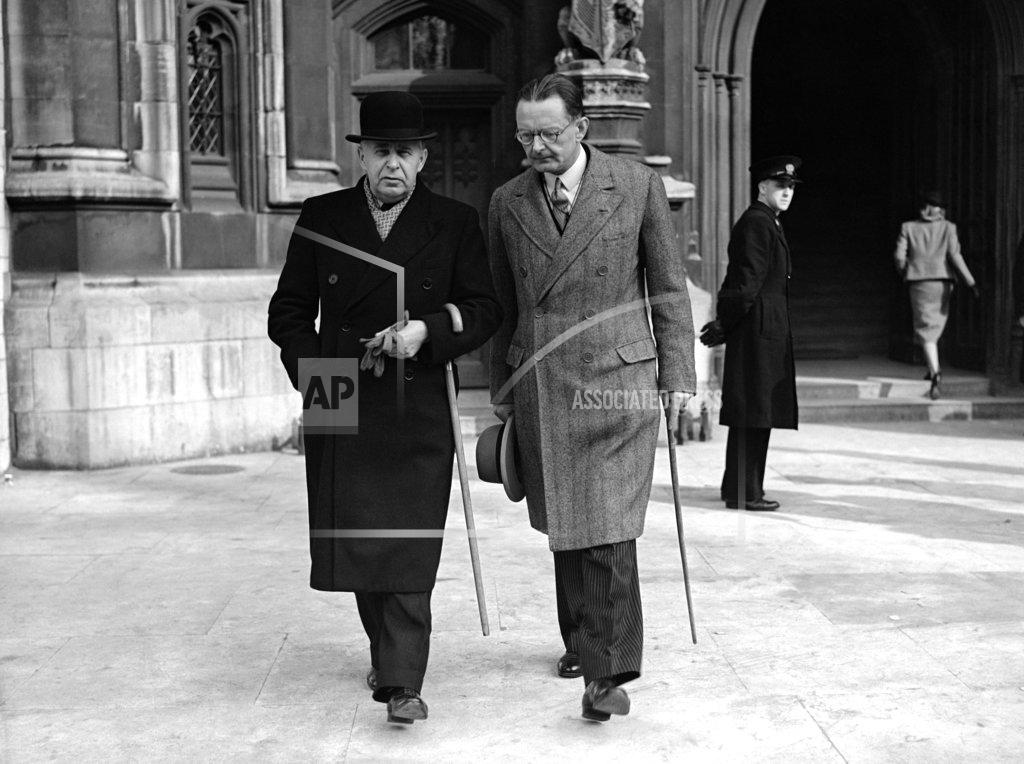
The Chamberlain government pledged Anglo-French support if Polish independence was threatened by Germany. British Prime Minister Neville Chamberlain announced in the House of Commons a “guarantee” of Polish independence, stating that Britain would go to war with Germany if there was an attempt to end Polish independence, though Chamberlain pointedly excluded the borders of Poland from the “guarantee.” The “guarantee” caused much opposition from the Dominions. The British Cabinet acts to stop the Reich, announcing that Britain and France will fight for Poland, if attacked. Chamberlain noted that the United Kingdom and France would guarantee Polish borders, with military force if necessary.
A hushed House of Commons hears Britain’s pledge to fight if Germany attacks Poland. Soviet aid is held certain. The British government, increasingly alarmed by continued German expansion in Europe, pledged Anglo-French military support if the Germans threatened Polish independence. This officially marks the end of Chamberlain’s appeasement policy, after the German annexations of Bohemia, Moravia, and Memel and threats against Poland. The Chamberlain government now undertakes an attempt to build an anti-fascist front. The British concluded agreements with Poland, Greece, Romania, and Turkey. The attempt will be toothless, however, due to British reluctance to make an agreement with the Soviet Union.
Delighted as they are by Prime Minister Neville Chamberlain’s pledge of British assistance, the Poles lost no time in pointing out that they take it for granted that the pledge is unconditional. It covers, they think, every act of aggression and every fait accompli violating Poland’s treaty rights. In Danzig it was learned that Warsaw had definitely informed Berlin that any attempt to give military backing to the Danzig Nazis or to foment an uprising in the Free City would be regarded by Poland as a casus belli and effective steps would be taken by the army to counteract any move in that direction. It was felt in Warsaw that any attack on Poland or any armed conflict in Eastern Europe would inevitably draw in Great Britain. War is indivisible; this is the Polish thesis.
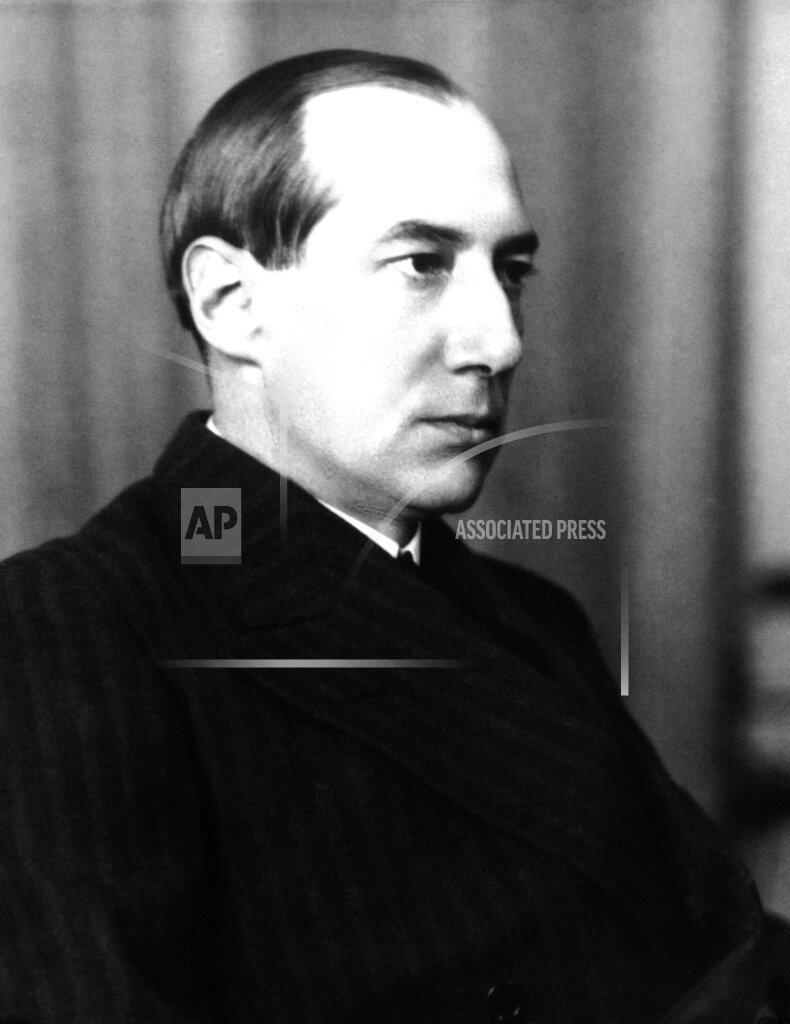
The British guarantee, clearing away all doubts in that respect, especially Germany’s doubts, will have a strong preventive effect, in Polish opinion. It is felt to have dispelled the danger of war. It is understood the government approved Mr. Chamberlain’s declaration yesterday when the British Ambassador informed Foreign Minister Josef Beck it was to be made.
Preliminary discussions as to the ways in which British assistance can be made effective in the event of war are expected to start early next week among British and Polish military and economic experts. Official circles here as usual show great restraint. They do not want to manifest their obvious satisfaction lest they annoy their great neighbor, with whom they have maintained good if not cordial relations for five years. The Poles are ready to negotiate with the Germans over the future status of Danzig, liquidation of League of Nations control over the Free City and even extension of its self-government — but only under normal conditions, through the usual diplomatic channels and on an equal footing. They will resent any kind of pressure from without or any “friendly suggestions” that might come from Poland’s new guarantors.
Later today, the South African High Commissioner to Great Britain, Charles Theodore Te Water and Vincent Massey, the Canadian High Commissioner to Great Britain, both told Chamberlain during a meeting at 10 Downing Street that Germany “had a genuine claim to Danzig,” which made it an “extremely bad reason” to risk a war over.
French Prime Minister Édouard Daladier was furious with Bonnet for granting his approval of the “guarantee”” as he told the French cabinet the next day: “the guarantee goes a long way, indeed further than our own alliance, because the decision to engage Britain’s entire military strength will rest in Warsaw.” With the British “guarantee”, Daladier had lost leverage over Beck who now had two great power allies instead one, and he realized that Bonnet had given his approval of the British “guarantee” as a way to sabotage Daladier’s policy of restructuring the Franco-Polish alliance to confront Germany. Marshal Gamelin likewise complained that Chamberlain should have forced Beck to agree to give the Red Army transit rights across Poland before he gave the “guarantee.”
The formal British and French pledges to defend Poland’s independence with all the means at their power, if the Poles find it necessary to fight for it, announced by Prime Minister Neville Chamberlain today, created a profound impression in German official quarters amounting to consternation. Although immediate cognizance was taken of the fact that these pledges still leave many loopholes for escape, and the satisfaction of any German demands by Poland by “negotiation” is specifically envisaged, nevertheless it was also realized that these pledges go much further than those given to Czecho-Slovakia last year. They are also much more likely to be kept, because another repudiation, however skillfully disguised, would mean not only internal discredit for Mr. Chamberlain personally but would also mark the final abdication of both France and Britain.
Viewed in that light, therefore, the pledges were accepted here as something more than the bluff attempted with the pledges to Czecho-Slovakia last year. In that sense they were also viewed as a long step toward the final turn In British post-war policy generally and Mr. Chamberlain’s appeasement policy particularly, comparable with the end of a similar appeasement policy pursued by Mr. Chamberlain’s father around the century’s turn and the ensuing swing of British policy against Germany, which led to Scapa Flow and Versailles.
The German answer, it is expected, will be given by Chancellor Hitler himself in a speech at the launching of the Admiral von Tirpitz, Germany’s second 35,000-ton battleship, at Wilhelmshaven tomorrow. According to forecasts freely made, it will bristle with anti-British language. The question anxiously asked in diplomatic quarters was, however, whether the answer would be more than talk, because Herr Hitler prides himself on acting while others talk. Some believe he may denounce the Anglo-German naval pact because Mr. Chamberlain’s pledges to Poland are taken to invalidate the no-war declarations exchanged between Herr Hitler and Mr. Chamberlain in Munich.
France supported Britain’s efforts by the announcement of commercial treaties with Poland, Rumania and Yugoslavia to bolster those German-threatened nations.
Italy adopted an extremely cautious attitude, hoping that her German ally would take no warlike steps against Poland.
Russia welcomed the Chamberlain statement. Prime Minister Neville Chamberlain’s statement that Britain and France were pledged to support the integrity of Poland was received here with modified gratification. Modified, that is, by doubt whether the French and British really mean it. Modified also by uncertainty as to just where the Soviet Union comes in.
In London, seven IRA bombs exploded.
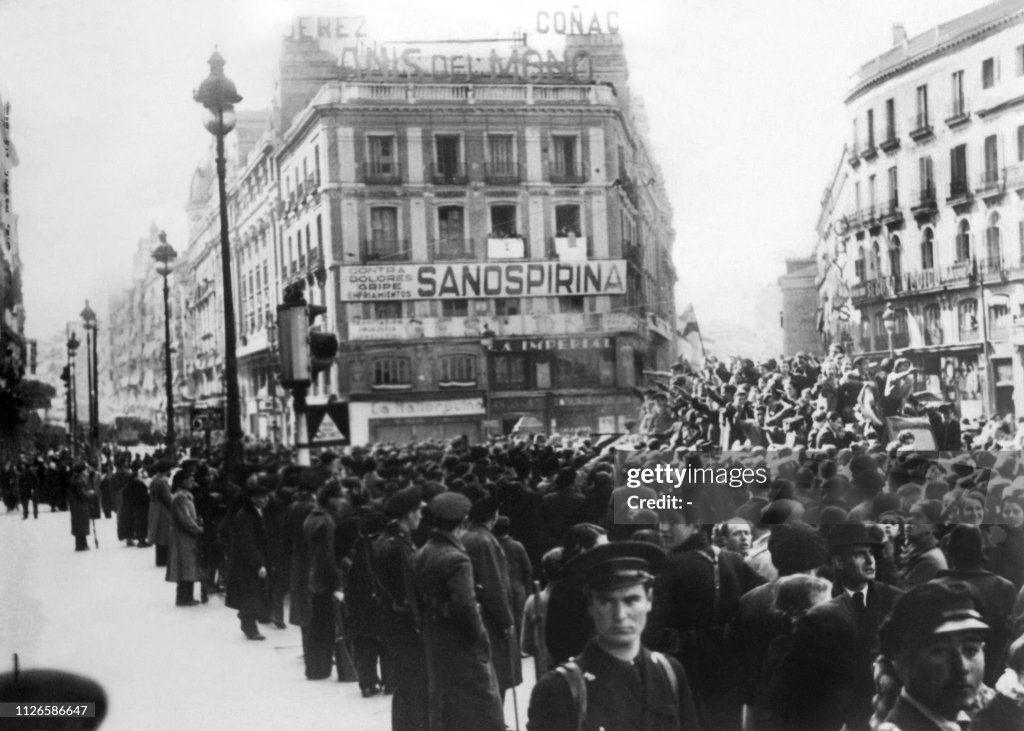
Germany and Spain conclude a Treaty of Friendship
The fighting between Slovakia and Hungary largely ceased. Slovakia gives up 800 square miles; Hungary concedes two villages. Slovakia had signed a protection treaty with Germany, which violated the treaty by refusing to help the country. Germany did not support Slovakia during the Slovak-Hungarian negotiations, either. Hitler values Hungarian troops for his eventual move to the east more than he values the Slovaks.
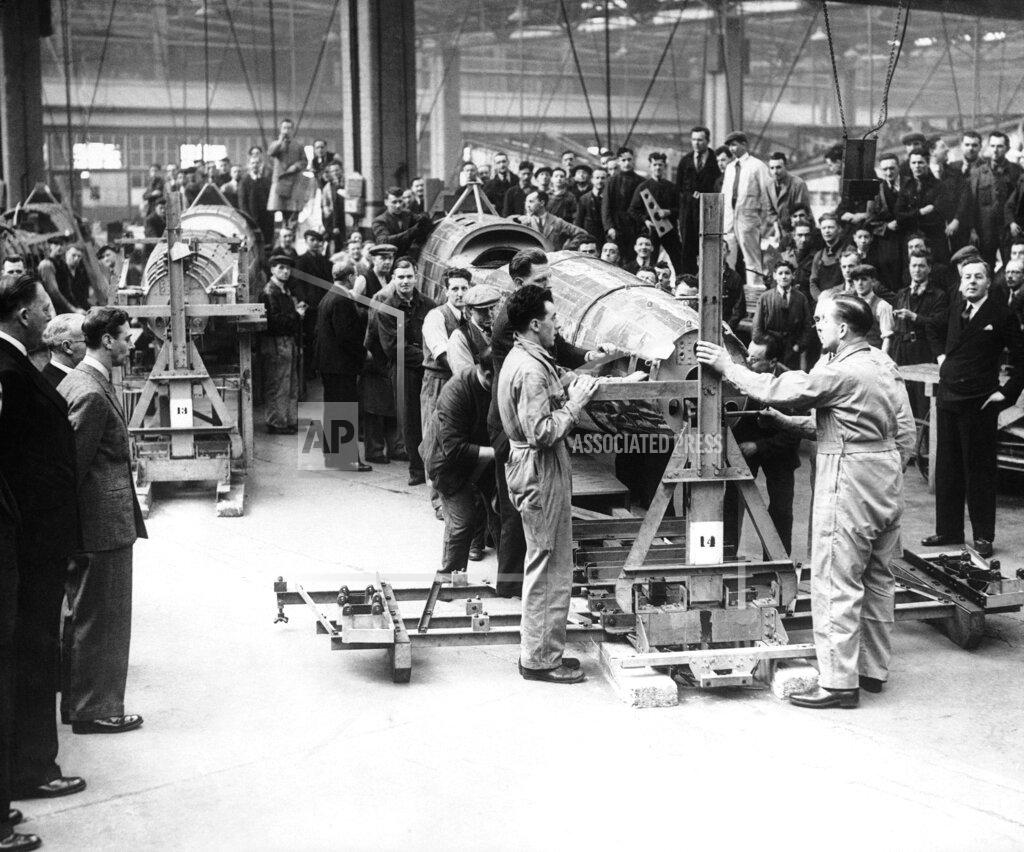
The first Miles M.9A Master aircraft took flight. The Miles M.9 Master was a British two-seat monoplane advanced trainer designed and built by aviation company Miles Aircraft Ltd. It was inducted in large numbers into both the Royal Air Force (RAF) and Fleet Air Arm (FAA) during the Second World War. Some 3,249 aircraft were ultimately built. The Master was a tandem-seat low-wing cantilever monoplane, powered by a single reciprocating engine. Initial models used the Kestrel XXX engine; capable of providing up to 745 hp (555 kW), this powerplant enabled the aircraft to achieve a maximum speed of 296 mph (477 km/h), which reportedly made the Master as fast as the single-seat biplane fighters of 1935. The inverted gull wing of the Master was a major distinguishing factor of the aircraft and was adopted – despite higher production costs – for its performance benefits, permitting the stowage of both the retractable undercarriage and fuel tanks; aside from this shaping, the wing’s design largely conformed with traditional approaches.
Perhaps the most radical use of the aircraft was the M.24 Master Fighter. Armed with six 0.303-inch (7.7mm) machine guns, it was intended for mass production as an emergency fighter during the Battle of Britain; this model did not ultimately see combat. Ordinary trainer models could also be fitted with armaments, including a single .303 in Vickers machine gun and eight bombs, for training purposes only. Beyond the British air services, other nations also chose to adopt the Master, including the South African Air Force, United States Army Air Force, Irish Air Corps, Royal Egyptian Air Force, Turkish Air Force, and the Portuguese Air Force.
As President Roosevelt, in Warm Springs, Georgia, kept in touch by telephone with Europe and the State Department. White House sources indicated he was giving his support to the “stop Hitler” movement. These sources pointed to fears of world domination and took the view that Germany would be clearly responsible if a war broke out. Concerned about the sudden turn of events over Poland, the President told newspaper men at a curbstone press conference that his stay at the “Little White House” might end earlier than he had planned and to be prepared to leave with him for Washington on short notice. Although Mr. Roosevelt’s anxiety over the European situation was obvious as he drove up in front of the newspaper men’s cottage with Secretary Hopkins, he was content to reveal that he had been on the phone most of the forenoon talking with the State Department in Washington and “Europe.” He did not disclose with whom he had talked on the Continent or discuss Prime Minister Chamberlain’s threat of Franco-British reprisals in event of a German invasion of Poland.
The House voted $100,000,000 additional for relief activities today with an implied mandate that the Works Progress Administration reduce its overhead so that the greatest possible amount of the funds would be spent for the actual relief of suffering and want. The House refused to turn either to the right or the left of the course charted by Representative Woodrum of Virginia, termed by one of his colleagues as “the Lord High Executioner” of the WPA, and adopted the resolution reported by the Appropriations Committee without change.
The committee had reduced, by $50,000,000, President Roosevelt’s request for $150,000,000 to carry the WPA through this fiscal year and prevent sharp reductions in the relief rolls. Mr. Woodrum led the fight for retention of the $100,000,000 figure, defeating attempts of New Dealers to increase it to $125,000,000 or to $150,000,000, and likewise defeating efforts of last-ditch economy advocates to reduce the amount to $75,000,000 or to $55,000,000.
The New Dealers, however, were heartened by news that Senator Pepper of Florida had introduced a resolution in the Senate to forbid the WPA to reduce its rolls by more than 5 percent per month until its appropriation was exhausted. This resolution started a heated two-hour debate in the Senate over WPA and relief policies, and gave notice that a fight would be waged there for the full $150,000,000 asked by the President.
The prospect that the Senate might increase the amount had a quick reaction in the House, several economy-minded Democrats observing privately that the Administration should accept the $100,000,000 and leave well enough alone. Otherwise, they said, it was expected that foes of the WPA in the House might block any conference which sought to increase the sum, and that this all might result in House refusal of any more funds for relief.
The U.S. Treasury reports that the debt will surpass the previous record, as the total amount nears $40 billion.
Secretary of Commerce Harry Hopkins presents President Roosevelt with a plan to aid small business.
Postmaster General James A. Farley, chairman of the Democratic National Committee, is an active and aggressive candidate for the Democratic nomination for President, close friends of his said today. The Gallup Survey suggestion of him for second place on a 1940 ticket with Vice President Garner does not meet with the approval of Mr. Farley and those behind his candidacy. Mr. Farley is after first place and has received assurance of widespread support from national committeemen and party workers with whom he has been associated during the last seven years.
The United States predicts that Spain will use Franco’s victory as a wedge to spread fascism to Latin America.
The Non-Sectarian Committee for German Refugee Children plans the placement of 20,000 youth. Quakers in Germany will determine who will come to the United States.
A Washington official predicts a strong debate over the Neutrality Act. British Prime Minister Neville Chamberlain’s speech about Poland is expected to impact the debate.
Penologists urge better education in U.S. prisons, asking for inmates to be classified by educational needs.
President Franklin Roosevelt receives news of his 9th grandchild, a boy.
The World Fair displays new “safety glass” to be used in auto windshields. Two pieces of glass sandwich an inner layer of clear plastic acetate.
The World Fair displays noted French art. Paintings, sculptures, and tapestry are loaned to the United States by museums.
A rare Edgar Allen Poe book is found. The first printing of “The Murders in the Rue Morgue” surfaces.
“The Hound of Baskervilles,” first of 14 films starring Basil Rathbone as Sherlock Holmes and Nigel Bruce as Dr. Watson, is released.
The U.S. Olympic Committee believes Detroit stands a good chance for 1944.
A Nazi plot aimed at the ultimate annexation of Patagonia, Argentina’s southernmost province, was indicated in a secret document published in Buenos Aires. A Nazi plot to seize Patagonia, Argentina, is aired. Germans charge the plot is based on a forged document, but Argentina begins an investigation.
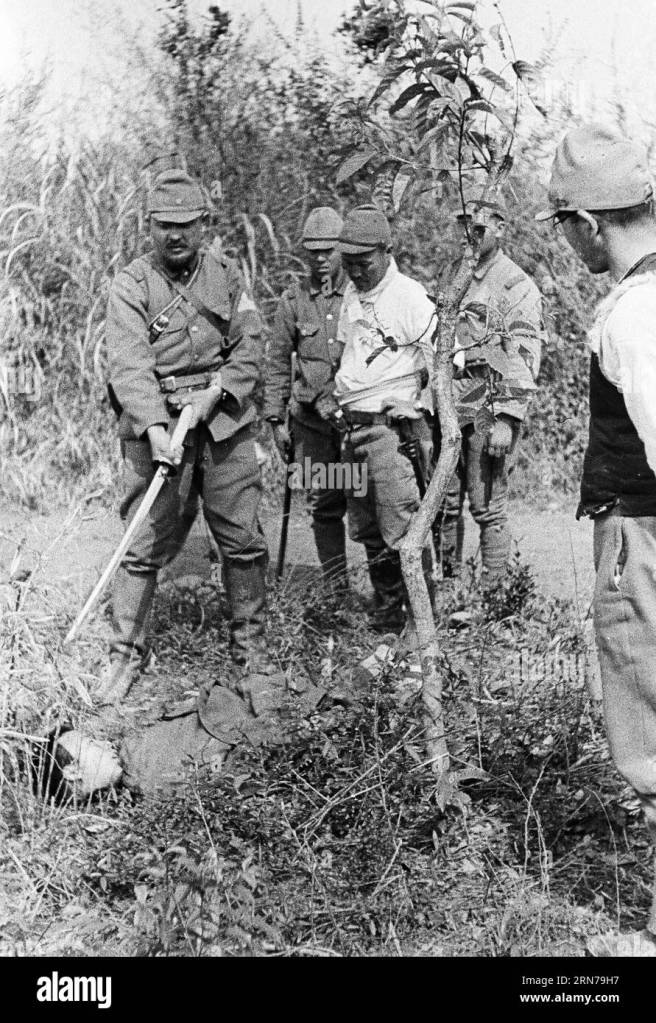
The Chinese attack the Shanghai area and approach Hangchow. The Chinese today reported increased Chinese opposition to the Japanese in the Shanghai and Hangchow Bay areas. In the last forty-eight hours guerrillas moved so close to Shanghai that the firing of machine guns could be heard here. It was said that the Chungking government was launching a broad effort to increase the effectiveness of its hit-and-run fighters, tightening the guerrilla organization and enlisting greater assistance from the populace.
The Chinese Eighty-eighth Division was reported to have crossed the Tsien Tang River from the south bank, aiming at Japanese-held Hangchow, the capital of Chekiang Province, 100 miles southwest of Shanghai. The Chinese said the Japanese had been repulsed in their efforts to cross the river from the north for an invasion of Central Chekiang. Japanese reports from the Kiangsi Province battlefront, about 400 miles west of Shanghai, indicated the invaders were advancing westward and southward after the occupation of Wuning and Nanchang. The Chinese said their forces were withdrawing from the Nanchang area.
Chungking officials said the Chinese had recaptured a strategic highway point twenty-three miles southeast of Nanchang, where the Chinese were concentrating preparatory to drives to cut Japanese lines north and south of Nanchang. Fifteen trainloads of Chinese troops, retreating toward Changsha from Manchang, were bombed during the day by Japanese planes.
In South China, Japanese planes bombed military positions at Pakhoi in Kwangtung Province, and Kinhsien, Kwangsi Province. Japanese naval authorities also reported their aircraft attacked scattered Chinese forces in the Northern area of Hainan Island. The Chinese said their own planes bombed Japanese warships off Funing, Northern Kiangsi Province, damaging two. The new Chinese counter-drive on Sinyang, 100 miles north of Hankow on the Peiping-Hankow Railway, was reported to have isolated Japanese forces there by the severance of communications and supply lines.
Japan announced today that she had annexed the seven Spratly Islands, 700 miles southwest of Manila, which had been formally claimed by France in 1933 and that a “commercial” air service would start next week between Yokohama and Saipan, seventy miles north of Guam, United States naval station, 1,500 miles east of Manila. Saipan, the most important of the Mariannes, mandated islands, is 1,300 miles from Yokohama. A bill for a $5,000,000 appropriation for improvement of the harbor at Guam is pending in Congress.
Japan’s annexation of the Spratly Islands carried her 700 miles south from Hainan, important island off the coast of French Indo-China, 500 miles west of the Northern Philippines. The islands, a small group of reefs in the South China Sea, are about 300 miles from French Indo-China and 350 miles northwest of British Sarawak. The occupation of Hainan was officially explained as a military move in the China war. It increased Japan’s power to check the arms traffic and extended the range of her aviation over South China. The present action lies entirely outside the radius of China hostilities and is officially explained by the claim of Japanese priority in the economic development of the reefs, presumably in working the phosphate deposits. The Foreign Office statement declares the reefs have long been ownerless. In 1917, it declared, the Japanese were the first to begin. their economic development, investing considerable capital and creating permanent establishments.
The United States notes the Japanese menace in the Pacific.
Dow Jones Industrial Average: 131.84 (-4.85).
Born:
Zviad Gamsakhurdia, first President of Georgia, in Tbilisi, Georgia (d. 1993).
Don Mullins, NFL defensive back (Chicago Bears), in Shreveport, Louisiana (d. 2020).
Volker Schlöndorff, filmmaker, in Wiesbaden, Germany.
Died:
Ioannis Tsangaridis, 51 or 52, Greek general.
Naval Construction:
The Kriegsmarine (German Navy) Type VIIB U-boats U-99 and U-101 are laid down by F. Krupp Germaniawerft AG, Kiel (werk 593 and 595).
 History Diaries