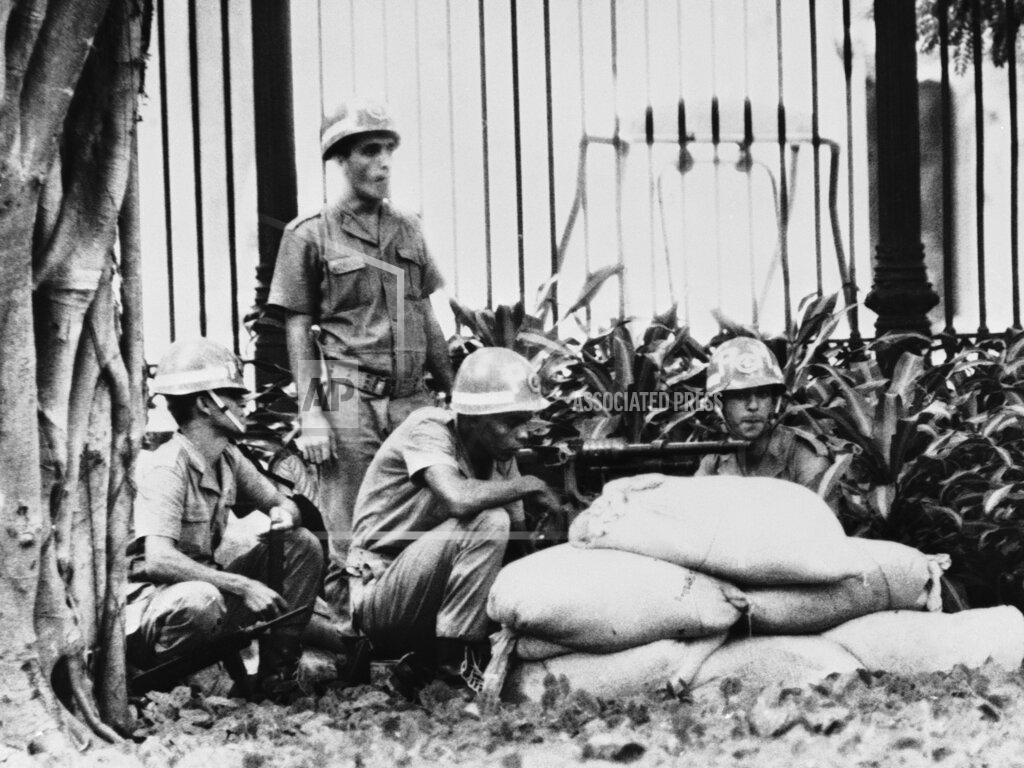
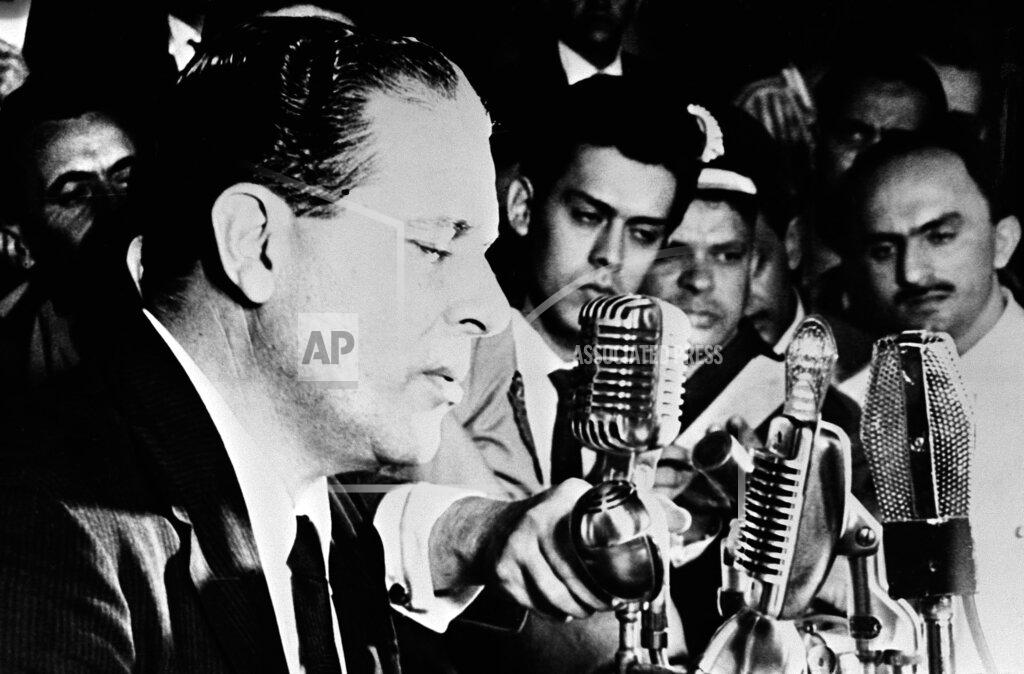
João Goulart, the President of Brazil, found himself having to defend his office against a military coup that began after he announced on national television that he would refuse to punish 1,425 sailors of the Brazilian Navy for a mutiny. José de Magalhães Pinto, the Governor of the State of Minas Gerais, called for Goulart’s ouster and General Amaury Kruel commanded the 2d Army Corps in São Paulo in carrying out the overthrow. Units of the Brazilian military would clash for three days; on April 2, the leader of the Chamber of Deputies, Pascoal Ranieri Mazzilli, would be installed as a caretaker president and Goulart would flee to Argentina. For the next 21 years, Brazil would be ruled by a series of generals.
The Army revolt against President João Goulart’s Government broke out today in Juiz de Fora, an industrial city in the state of Minas Gerais 80 miles north of Rio. President Goulart announced he was sending troops to quell the revolt. The rebels acted to halt what they describe as Brazil’s march to Communism. The commander of the Fourth Military Region, General Olimpio Mourão, proclaimed Juiz de Fora the “revolutionary capital of Brazil.” The general accused the Government of unconstitutional actions.
The rebellion spread from Minas Gerais to the states of São Paulo and Parana. In Sāo Paulo state, General Amaury Kruel, commander of the big Second Army, announced on the radio: “I am going to Rio to depose the President.” Such action, in conjunction with the army in Minas Gerais, would surround Rio, where President Goulart has the support of the leftist General Workers Command, marines and other troops. The revolt received the support of the Governors of Minas Gerais, Sāo Paulo and Parana.
Governor Adhemar de Barros of São Paulo announced that troops from his state were marching on Rio in support of the revolt while the pro‐Government First Army was reported to be attempting to crush the uprising, Reuters reported. The War Minister, General Jair Dantas Ribeiro, who is in a Rio de Janeiro hospital, said he would “act with the greatest energy against the rebels” and alerted his troops. Troops and policemen took positions for a showdown. President Goulart stayed in his hilltop palace most of the day. Military policemen with submachine guns stood guard.
An unidentified U.S. official in Saigon announces that the ‘momentum’ of the Việt Cộng has been checked. A high United States military official said today that the momentum gained by Communist guerrillas in South Vietnam in recent months had been checked. “We are getting up from rock bottom,” he added. The officer, who asked that he not be identified, said that the situation in some areas, especially in the Mekong Delta region south of Saigon, remained critical. But even in these areas, he added, the Government forces have made gains. The American said that emphasis was being placed on training the South Vietnamese forces in night combat in the hope this would result in more night operations against the Việt Cộng guerrillas. The Communists launch most of their attacks at night. The guerrillas stepped up their activity considerably during the turmoil that followed the overthrow of the regime of the late President Ngô Đình Diệm last November. Another coup, in January, brought to power the present Premier, Major General Nguyễn Khánh.
Communist North Vietnam has announced a plan for economic development this year that indicates it expects little assistance from the Communist bloc. “Self‐reliance” is the keynote of the plan, which calls for the building of a “self‐supporting economy” in an atmosphere of diligence and thrift. Communist China has used similar language to describe the economic program it has undertaken following the termination of Soviet economic assistance. The North Vietnamese are believed to have suffered a steady decline in Soviet aid as a result of their increasingly vocal support for Peking’s stand in the ideological quarrel with
China, with its own economic problems, is in no position to give any substantial assistance; analysts here say North Vietnam’s economic position is shaky. The 1964 plan, which was broadcast by the Hanoi radio, called for a settlement of “urgent problems in the economy” to insure a rapid development of industry and agriculture. The plan was submitted to North Vietnam’s National Assembly yesterday by Nguyen Duy Trinh, chairman of the State Planning Commission.
Ernesto Che Guevara, Minister of Industry of Cuba, welcomed today a declaration last week by Senator J. W. Fulbright to the effect that “Cuba is here to stay.” But he said that comment on it by Secretary of State Dean Rusk indicated no change in United States policy. Dr. Guevara said at a news conference here that the Government of Premier Fidel Castro “is completely disposed to engage in a dialogue with the United States.” But Washington, he added, demands “the nonexistence of our government” as a condition for discussions. Dr. Guevara is the chief Cuban delegate to the United Nations Conference on Trade and Development, now in its second week. Dressed in the Castro forces’ green fatigue uniform and smoking a cigar, he was relaxed through 80 minutes of questions. Dr. Guevara asserted that the United States economic blockade of Cuba caused “more trouble for the United States, fighting with its allies, than for us.”
Sakari S. Tuomioja, the United Nations mediator for Cyprus, said today that he did not exclude the possibility he would recommend changes in the Cypriote Constitution and in the treaty that guaranteed it. Mr. Tuomioja said at a news conference that he regarded both the Constitution and the Treaty of Guarantee as valid now, but that both could be changed with the consent of the four states concerned. The mediator declined to comment on a reported statement by Glafkos Clerides, president of the Cypriote Parliament, threatening that Cyprus would ask the United Nations General Assembly to abrogate the Treaty of Guarantee if the mediator failed to achieve a permanent settlement. Mr. Clerides indicated that Cyprus would also ask the Assembly to abrogate the accompanying Treaty of Alliance. Under that agreement Greece, Turkey and Britain were given the right to station troops in Cyprus as part of the arrangements under which it was granted independence in 1960.
Premier Khrushchev arrived in Budapest today without a word, at least in public, about his increasingly bitter quarrel with the Chinese Communists. However, the Soviet leader immediately met with Premier Janos Kadar and other Hungarian leaders for private talks that apparently lasted most of the afternoon. Mr. Khrushchev, who is making an official visit to Hungary in connection with the 19th anniversary of the defeat of Nazi occupation forces in the Country by the Soviet Army, arrived by train just after noon. Thousands of Hungarians led by Mr. Kadar and his principal aides, were present to welcome the Russians. There was no allusion during the ceremony to Communist China’s bitter attack earlier in the day on Mr. Khrushchev. The Chinese Communist party called on Communists everywhere to repudiate and liquidate Khrushchev revisionism.”
A Soviet arms shipment that was landed in Zanzibar last week included light artillery pieces that could be used for antiaircraft purposes, reliable sources reported today. The size of the shipment and exactly what other material it contained are not known, since most of it was unloaded in the night. The ship departed with a cargo of cloves, leaving behind Soviet “technicians” as well as the arms. According to British sources, the political scales in Zanzibar are tipping steadily in favor of the pro‐Communist faction in the new revolutionary government.
Belgian doctors went on strike today against a government medical reform program that they regard as a first step toward socialized medicine. The strike affected most of Belgium’s 10,000 physicians. The reform was adopted by Parliament last year and came into effect January 1 with a one-year probationary period. Most doctors rejected it from the beginning. “From now on, the National Federation of Medical Chambers orders doctors to go on a total and unlimited strike according to the planned dispositions,” a spokesman for the doctors announced.
The UK’s Minister of Labour Joseph Godber appointed Lord Justice Pearson to chair a court of inquiry into the electrical power dispute. Five unions called off the slowdown of their 130,000 members in electrical power plants just as their action was beginning to hurt industry. The unions decided to resume normal work starting tomorrow morning. This was the eighth day of the slowdown and the unions’ ban on overtime. They seek a 40‐hour week, longer holidays and more pay. For the first time, power was reduced in big areas of Britain today as industry started up after the Easter weekend holiday. Generators were overloaded and power was cut by up to 6 percent.
The United States and the Soviet Union have agreed to meet in Geneva in June to discuss cooperation in a satellite communications system. This was learned tonight from official sources. While the development was not regarded at this stage as a new breakthrough in Soviet‐American relations, it was given considerable significance. The discussions undoubtedly will concern in part Soviet participation in some way in the space communications system now being planned by the United States. This involves the Communications Satellite Corporation, a private concern under Government authority now getting established in this country. The offer to the Russians for discussions on global satellite communications was made about a year ago. No reply came from the Soviet Union until recent weeks.
Everett McKinley Dirksen, the Senate Republican leader, said today that he had found substantial support among his party colleagues for amendments he would offer for the civil rights bill. At a luncheon of the Senate Republican Policy Committee, Mr. Dirksen reviewed about 12 changes he would like to make in Title VII of the bill, the section prohibiting discrimination in employment and union membership. At a news conference later in the Senate press gallery, the Illinois Republican told reporters that his proposals had received “very substantial encouragement.” He said further that in discussions with Senate Republicans he had also found support for a substitute he would offer for Title II, the section banning discrimination in motels, hotels, restaurants, theaters, gas stations and sports arenas. In a speech last Thursday, Senator Dirksen indicated where he thought the fair employment practices section should be tightened and clarified. Most of the changes he seeks are technical.
For example, he has doubts about the bill’s requirements for record‐keeping by employers, which he believes would be onerous. And he wants the bill to state explicitly that in those states that already have a fair employment law the jurisdiction of a state commission would not be pre‐empted by the new Federal commission. Senator Dirksen said today that he had “no desire to water down” the fair employment section in the bill passed by the House on February 10. However, he added: “I don’t think any Federal enactment ought to harass business. I believe it [the section] can be substantially improved.”
Mr. Dirksen said a general party conference would be held to see whether a “party position” could be developed on his proposals for the fair employment section. His ideas on the public accommodations section are likely to meet with more resistance. He has not defined those ideas but has made clear he would like a period of voluntary compliance with the ban on discrimination — perhaps a year — before the Attorney General could sue for injunctions.
Governor Rockefeller demands that Ambassador Lodge resign and explain U.S. policy in Vietnam. Governor Rockefeller of New York asserted today that Henry Cabot Lodge owed it to the Republican party and to the nation to resign as Ambassador to South Vietnam. The Governor said Mr. Lodge should then return and explain why policies of the Democratic Administration had failed to eliminate the Communist threat in the Southeast Asian nation and how this could be accomplished. Mr. Rockefeller’s statement, which came at a news conference at the Lane County Fairgrounds in Eugene, the state capital, marked the first time he has openly urged the Ambassador’s resignation. Following Mr. Lodge’s write-in victory in the preferential primary in New Hampshire on March 10, Mr. Rockefeller, who ran third, said he thought the Ambassador should leave Saigon and “come back to express his position on the issues for the benefit of voters.” He urged Mr. Lodge to decide whether he was candidate and, if so, to “come into the race and take a stand on key issues.”
Mr. Rockefeller kept up his attack on the “extremism” of Mr. Goldwater and the Senator’s ultraconservative supporters and struck out at President Johnson’s policies at home and abroad. The main thrusts of his remarks dealt with foreign policy, which he said would be a major issue in the campaigns for the Republican nomination and for the Presidency, and Mr. Lodge’s role as a Republican serving a Democratic Administration. The Governor said Mr. Lodge could not discuss the South Vietnam situation without stepping down from his post. He argued that the Ambassador could not conduct a strong Oregon campaign without answering questions here on this and other issues.
Asked if he considered the Senator an extremist, Mr. Rockefeller said that he did to the extent to which Mr. Goldwater adhered to a list of ultraconservative objectives cited by Mr. Rockfeller last night in a speech to 1,200 persons in Bend. He said then that these proposals, which he called “irresponsible and dangerous,” included getting the United States out of the United Nations, breaking diplomatic relations with the Soviet Union, cutting off all foreign aid, giving control of nuclear weapons to the commander of NATO, halting Federal aid to agriculture, abolishing the income tax and making the Social Security program voluntary.
Senator Barry Goldwater charged Senator J. W. Fulbright today with advocating “the reality of a Munich” for urging a re‐evaluation of what Mr. Fulbright said were the myths of American foreign policy. “The root assumptions of the Fulbright statement are the root assumptions of the Administration’s foreign policy,” Mr. Goldwater declared. The Arizona Republican also leveled a stinging attack on what he termed the Administration’s defeatism. “Neville Chamberlain,” the Senator said, “once made the mistake of assuming that Adolf Hitler really didn’t mean what he had said in ‘Mein Kampf’ This Administration is making the same mistake about Khrushchev today.”
The Consumer Price Index declined in February for the first time since late 1962, the Labor Department reported today. The decline was the smallest possible—one‐tenth of a point. The reversal of the steady upward trend of consumer prices was expected to be temporary. Arnold Chase, assistant commissioner for prices in the Bureau of Labor Statistics, said he believed the March index would show a rise.
Civil rights pickets, locked out of the Arizona State Capitol in Phoenix, paraded today in front of the building, where the State Senate was considering a public accommodations bill. The generally peaceful, all-day demonstration provided a respite for both the Senators and the pickets after a shouting, singing melee yesterday inside the state offices. The pickets tried this morning to move again into the Capitol, but sheriff’s deputies blocked them.
The Federal Aviation Agency is expected to tell the White House this week that work on the design of a supersonic airliner should proceed even though the problem of paying for the plane is still unsolved. The agency is directing a government‐industry program to build a 2,000‐mile‐an‐hour plane by the early nineteen seventies. Its proposals, ready a month ahead of schedule, will follow a pattern set by special study groups, the airlines and the President. All have shown enthusiastic support for the project, despite concern over the cost, estimated at $1 billion.
The agency is expected to inform the President that the designs submitted are promising, and that two aircraft‐engine teams should work another year on refining them. It is also expected to announce a preference for the Boeing Company and the Lockheed Aviation Corporation as the aircraft designers, eliminating North American Aviation, Inc. The plane will cost so much because it is planned to be larger, faster and to fly much higher than the present jets. It will need new engines, metals, manufacturing skills and even new flight techniques. In its report the agency will stress that many technical problems remain. It feels the public may lose sight of this because recent debates have centered on management and financial problems.
General of the Army Douglas MacArthur’s condition remains critical, but, aided by constant medical attention, he is holding his own. This was the latest word this afternoon from Walter Reed Army Medical Center, where the 84‐year‐old general’s doctors reported that his condition remained “essentially the same as it was this morning.” At 9:45 AM, the doctors reported that the general’s condition continued to be critical, but said that there was continued slight improvement in one of the complicating symptoms besetting him‐and no change in another symptom.
The Soviet Union failed twice in the last month to send payloads to Venus, presumably because of a recurring problem with an upper‐stage rocket. Although the failures are not being made public by either the Soviet Union or the United States, the launchings were detected by the electronic network maintained by this country to monitor Soviet space activities. One of the failures occurred late in February, the second in mid‐March. There is a possibility that within the next few weeks the Soviet Union will make a third attempt to probe Venus. The planet will be in a favorable position for a few more weeks, and Soviet tracking ships are still on station in the Pacific.
The Washington Senators send young prospect Lou Piniella to the Baltimore Orioles for Buster Narum and cash. Piniella will play briefly for the O’s before going to minors until the resurfacing with the Cleveland Indians in 1968. The Seattle Pilots will draft him in 1969 and trade him to Kansas City where Sweet Lou, with his 5th team, finally wins Rookie of the Year honors with the Royals.
Dow Jones Industrial Average: 813.29 (-2.00).
Born:
Rod Jones, NFL cornerback (Tampa Bay Buccaneers, Cincinnati Bengals), in Dallas, Texas.
Dave Wyman, NFL linebacker (Seattle Seahawks, Denver Broncos) and broadcaster, in San Diego, California.
David Diaz-Infante, NFL guard and long snapper (NFL Champions, Super Bowl 32 and 33-Denver, 1997, 1998; San Diego Chargers, Denver Broncos, Philadelphia Eagles) and broadcaster (ESPN), in San Jose, California.
Chris Cron, MLB first baseman, pinch hitter, and left fielder (California Angels, Chicago White Sox), in Albuquerque, New Mexico.
Balvino Gálvez, Dominican MLB pitcher (Los Angeles Dodgers), in San Pedro de Macoris, Dominican Republic.
Rafael Montalvo, Puerto Rican MLB pitcher (Houston Astros), in Rio Piedras, Puerto Rico.
Erik Turner, American rock guitarist (Warrant – “Cherry Pie”), in Omaha, Nebraska.
Isabelle Ferrari [Isabella Fogliazza], Italian actress (Italy’s Miss Teenager), in Ponte dell’Olio, Italy.
Oleksandr Turchynov, Ukrainian politician, economist and screenwriter, in Dnipropetrovsk, Ukrainian SSR, Soviet Union.

 History Diaries