
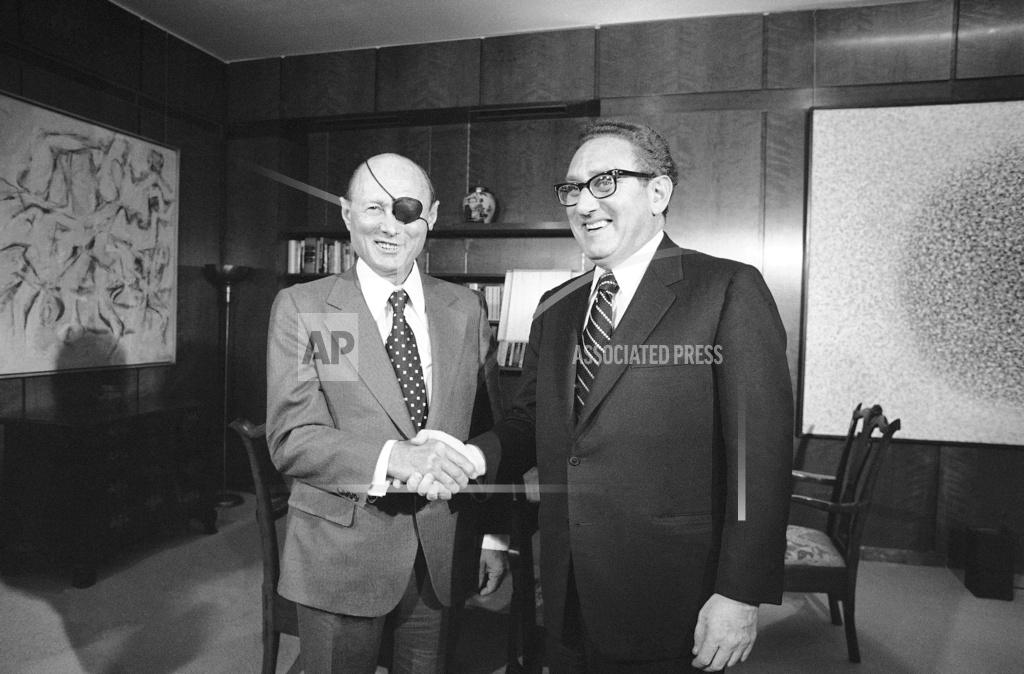
Secretary of State Kissinger ended two days of talks in Washington with the Israeli Defense Minister, Moshe Dayan, and expressed confidence that he would bring about a troop separation agreement between Israel and Syria on the Golan Heights. He told reporters that the formal Israeli proposal for the disengagement of forces, submitted by Mr. Dayan on Friday, provided “a useful basis” for the negotiations he will conduct between Syria and Israel.
Mr. Kissinger married Nancy Maginnes in in Arlington, Virginia, and the couple immediately left for Acapulco for their honeymoon. The wedding was disclosed by former Governor Nelson Rockefeller of New York, who interrupted a speech he was giving in Chicago to say: “I have some news for you — Kissinger is marrying Nancy Maginnes today.” Miss Maginnes had been an aide to Mr. Rockefeller, specializing in foreign policy matters. Mr. Kissinger was a part-time consultant to Mr. Rockefeller before he joined the Nixon administration. The bride’s mother, Mrs. Albert Maginnes, formally announced her daughter’s marriage.
A barren, half-forgotten little island in the Persian Gulf has become a new kind of world power center. It is now a place of financial pilgrimage for chiefs of government, bankers and industrialists who arrive by approved application only to find out how the Shah of Iran plans to spend his new oil billions, and to help him do so if at all possible. The Shah is in his winter palace on Kish Island, formerly a pirates’ hangout. His palace looks like a 20th-century version of the old Persian caravansaries. He is attended by a lighthearted, tanned court, pleasantly relaxed, but pleasantly aware of what the island, Iran and the Shah have come to mean.
Libya has nationalized the entire operations of Royal Dutch Shell, according to a broadcast over Tripoli Radio. Oil experts saw the nationalization as a retaliatory move by Libyan President Muammar Qaddafi because Royal Dutch Shell has rejected an order for partial takeover. Qaddafi last September ordered a 51% nationalization of Oasis Oil Co., but Royal Dutch Shell, a minority shareholder, refused to comply.
Recent American and South Vietnamese intelligence reports indicate that Hanoi has begun sending thousands of young civilian men and women from North Vietnam into the south as part of a program aimed at establishing farms and populating areas under Việt Cộng control. The reports are based almost entirely on interrogations of prisoners and defectors, who say that about 6,000 North Vietnamese have moved southward. If the migration continues, some officials believe it could bolster the Việt Cộng’s contention that they constitute a legitimate government — a claim that has been vulnerable to charges by Saigon and Washington that only a small part of South Vietnam’s population lives in Communist-controlled areas.
Hoàng Đức Nhã, one of President Nguyễn Văn Thiệu’s closest advisers, charged today that North Vietnam was preparing a general offensive aimed at conquering South Vietnam. Speaking at a luncheon in Saigon, Mr. Nhã, Minister of Information, told a gathering of diplomats and Government officials that “the signs are very ominous indeed.” “Insofar as the fate of their regime is concerned, the North Vietnamese have but one option: That is to seek a military victory in the south,” he said. The North Vietnamese, he declared, are afraid that the Vietcong’s National Liberation Front, left on its own, “would probably be willing to get into a political settlement.” “It is this fear which has pushed the North Vietnamese to maintain all of their troops in the south,” he said.
At another point, he maintained that the North Vietnamese did not want “their tools in the south,” the National Liberation Front, “to stand out and compete” with the Saigon Government “in an internationally supervised free and democratic election, an election they know they have no chance to win.” He added: “Once they stood up for the election, the so‐called N.L.F. will then no longer exist since it has to accept the results of the elections.” A lost election, he said, would be “the eraser that will wipe out the N.L.F. as a tool in Hanoi’s war of liberation.”
Nhã said South Vietnam would need as much as $3 billion in U.S. economic aid by 1980 to achieve economic self-sufficiency. Nhã, who also is the nation’s information minister, told a meeting of the Vietnam Council on Foreign Relations that massive U.S. economic aid is needed to break the country’s dependence on foreign aid and keep it strong in the face of continued Communist military threat.
Police in Bangkok, Thailand, hunted for a heavy-set man believed to have fatally stabbed Claudia Ross, 27, an American reporter for the Bangkok Post. The University of Miami graduate was killed in the bedroom of her home.
A U.S.-built Chinese jetliner flew to New York from Peking in the first flight to the United States by a Chinese commercial airliner. The Boeing 707, purchased by China last summer, made its first stop in Tokyo before taking off for New York via Anchorage, Alaska.
Administration officials report that Secretary of State Kissinger told Soviet leaders in Moscow this week that the United States would be prepared to halt further deployment of missiles with multiple warheads, as part of a new agreement on limiting offensive nuclear weapons. But, officials said, a condition was attached to this offer to agree to limits on weapons in which the United States has a decided lead over the Soviet Union. The condition was said to be that the Russians agree to limit their future deployment of such missiles. However, this offer, which reportedly marked a departure from previous policy, did not achieve the breakthrough that Mr. Kissinger had hoped for during the three days of talks, in Moscow. The Soviet leaders, the officials said, did not want to accept any limits on their multiple‐warhead program until they had caught up numerically with the United States in the field. The Russians also disagreed with the Americans, it was said, on what factors should be taken into account in any permanent accord in limiting offensive nuclear arms.
A British fugitive who claims he staged Ireland’s biggest bank robbery on behalf of British military intelligence surfaced in Holland just long enough to do a BBC-TV interview at the Hilton Hotel in The Hague. The Irish government has asked the Dutch to try to trace Kenneth Littlejohn but Dutch police reportedly are less than keen to collar a bank robber who is also wanted by the Irish Republican Army and British security services. Littlejohn claims the bank job in Dublin, which netted $160,000, was a political act because, he says, it was approved by the British. He wants his case to be heard by the Court of Human Rights in Strasbourg, France.
Norway’s Supreme Court in Oslo rejected appeals by four Jews against sentences imposed on them for complicity in the slaying of a suspected Arab guerrilla at a Norwegian ski resort last July. The four Jews, believed to be Israeli agents, had been convicted earlier and given sentences of from 2½ to 5½ years.
Havana Radio quoted Mexican Foreign Minister Emilio O. Rabasa as saying, “Cuba is not alone in her revolutionary determination. Mexico is keeping her company.” Rabasa spoke at the dedication of a technical institute in Cuba named for the late Mexican president, Gen. Lazaro Cardenas.
Foreign Minister Alberto Vignes said that Argentina will express “its preoccupation over the isolation of Cuba” at key meetings in the United States next month. He said the blockade of the Caribbean island was an action that responded to past events but now is “an anachronism that perturbs inter-American relations.”
The Dutch Reformed Church in South Africa has decided to cut the church’s centuries-old ties with the mother churches in Holland because of their alleged financial support for terrorism in southern Africa.
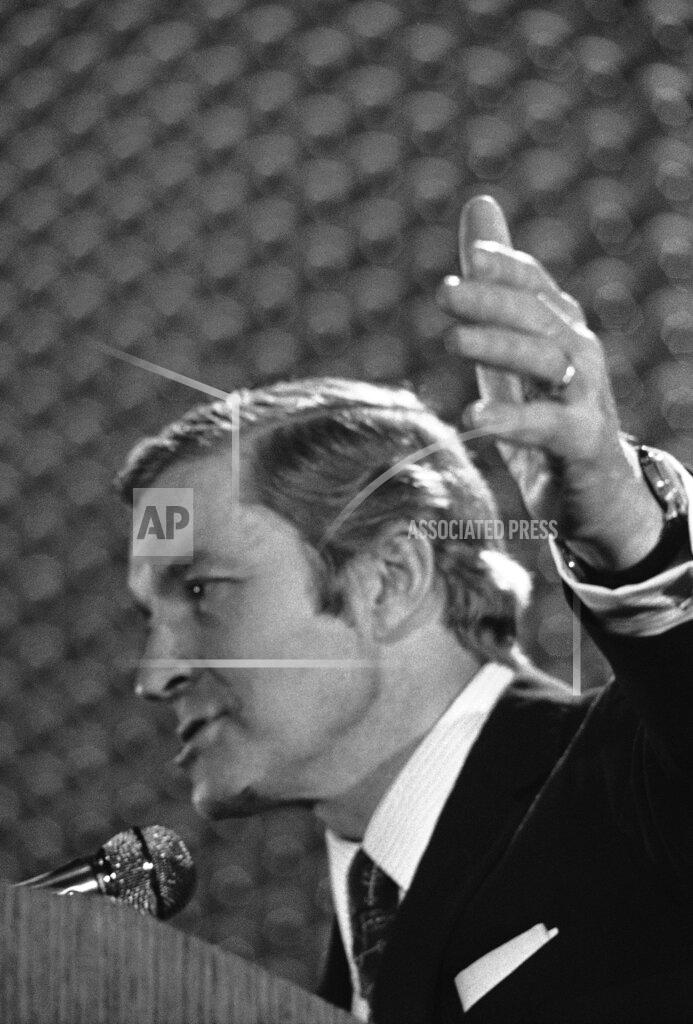
Vice President Ford, in a speech in Chicago to cheering Republican leaders, sharply attacked the Committee for the Re-election of the President as “an arrogant, elite guard of political adolescents.” He warned the Republicans that they could never again allow their presidential candidate to bypass the regular party organization and set up a campaign group that would make its own rules and “dictate the terms of a national election.” The party leaders were from the Middle West.
President Nixon’s leftover campaign funds will no longer be used to pay legal fees of former campaign officials found guilty of misdemeanors. Two trustees of the $3.5 million surplus have decided also to bar a third trustee-Maurice H. Stans from taking part in any decision on whether to pay Stans’ legal fees arising from the current perjury-conspiracy trial in New York. Charles E. Potter and Guilford Dudley Jr. said they had proposed also that aid be denied to former campaign officials acquitted of felony charges if trustees believed they were in fact guilty.
The Democratic party’s spokesmen on education charged that President Nixon’s position on the education bill has “fanned the flames of the busing issue,” provoked discord, and brought “confusion and chaos to thousands of school districts all over America.” The remarks were made by Senator Claiborne Pell of Rhode Island and Representative John Brademas of Indiana in response to the President’s earlier radio address on education. They are, respectively, the Democratic chairmen of the Senate and House education subcommittees.
A long-haired youth, who said he just wanted a ride home to Iowa, was arrested in Bradenton, Florida, on charges of taking an older couple hostage and trying to hijack a National Airlines Boeing 727 jet. Ernest Eugene Smith, 20, of Waterloo was being held without bond on state charges. A National Airlines station agent, Edwin Berniard, 27, had just finished readying the empty jet for a morning flight when the would-be hijacker and hostages entered the plane. Berniard wrested a shotgun from Smith, who escaped but was captured later at a restaurant. The hostages, Paul and Ruth Kerchner of Canton, Ohio, were unharmed.
The torture slayer of two children should be given life in prison rather than the death penalty, a circuit court jury in Jacksonville, Florida, determined. The jury’s recommendation in the sentencing of Ernest John Dobbert Jr., 36, for killing two of his children and beating two others, is not binding. Judge Hudson Oliff scheduled sentencing for April 12. The jury had earlier convicted Dobbert of first-degree murder in the death of his daughter, Kelley Elizabeth, 9, and of second-degree murder in the death of John Ryder, 7. He was also found guilty of torturing Ernest John III, 13, who was blinded, and abusing Honore, 7.
A weed-killing chemical that resembles a soft drink prompted a warning by the Environmental Protection Agency, which said the agent, paraquat, was so toxic that a single sip of it could be fatal. One Hawaii teen-ager died and a California boy became critically ill after drinking the liquid — which can look like a cola drink or apple juice — from unmarked containers. The EPA said paraquat was an ingredient in six weed killers: Chevron Industrial Weed and Grass Killer, Ortho-Gramoxone Dual, Ortho-Spot Weed and Grass Killer, Ortho-Gramoxone C.L., M7212 and Paraquat DCL 2-Lb. LC.
Guilty pleas by seven Norfolk Shipbuilding & Drydock Corp. executives to charges of conspiracy to bribe Navy ship inspectors were accepted by a federal judge even though a jury had already found the defendants guilty of conspiracy. Immediately after the pleas were entered, U.S. Atty. Brian Gettings announced that the government was dropping additional charges of bribery. U.S. Dist. Judge Walter E. Hoffman said that he had allowed the defendants, including shipyard President John L. Roper III and his brother, George L. Roper II, to change their pleas from innocent to guilty because it eliminated, for all practical purposes, the possibility of an appeal.
Only the status of Patricia Hearst remains unchanged. Even though 53 days have passed since her abduction, she is still being held captive and there is still no indication as to when she might be released. But while her fate remains the same, there have been re markable and even puzzling changes in the positions of most other parties involved in the kidnapping. The change that has been most evident involves Randolph A. Hearst, the newspaper publishing executive and father of the 20‐year‐old victim of the kidnapping. But within the last week there have also been noticeable and significant differences in the positions of two jailed members of what they call the Symbionese Liberation Army, the police and even Miss Hearst’s fiancé, who was beaten and hospitalized the night she was abducted. It was just about a month ago that Mr. Hearst was saying that the size of the demands by the Symbionese group, the professed kidnappers, were beyond his financial capability and that therefore the matter was out of his hands.
But after receiving a message from his daughter, in which she scolded him for not doing enough to obtain her release, he personally took charge of the program to distribute food to the poor that the kidnappers demanded. He lobbied vigorously in an attempt to persuade the authorities to grant television time to the two jailed members of the organization. By the end of the week he was saying with some confidence that he felt that his daughter would be returned. He even appeared to disagree with his wife, who had said that she was no longer optimistic. The optimism expressed by Mr. Hearst reflected at least in part the change in position of Joseph Remiro and Russell Little, the two acknowledged members of the Symbionese group who were arrested in mid‐January and later charged and indicted in the murder of Oakland’s superintendent of schools. Mr. Remiro and Mr. Little gave their views in a public letter sent from jail. In the letter, they urged the Symbionese leaders to deal with what they called the primary task of releasing Miss Hearst unharmed to her family.
American colleges, faced with financial pressures they have not known since the Depression, are resorting more and more to the hard sell in search of students. The competition for enrollment and the money it produces is generally polite but fierce. The stakes are millions of dollars nationally and, for some schools, survival. Some will not make it.
The nation needs to start deciding what its energy policies for the long-term future will be and needs to decide not only where the supplies of energy are coming from, but also how much more demand for energy should be permitted to develop. This need for “balancing the nation’s energy budget” by looking at the future demand as well as the future supply was the central theme of the first preliminary report of the Energy Policy project, titled “Exploring Energy Choices,” which was made public today. The project has been financed by the Ford Foundation.
The 2-hour pilot for the proposed “Little House on the Prairie” television series was broadcast on NBC after NBC executive Ed Friendly purchased the exclusive rights to adaptations of the series of eight “Little House” children’s novels written by Laura Ingalls Wilder between 1932 and 1943. Actor Michael Landon starred in and directed the film that was part of “NBC’s Saturday Night at the Movies” feature, while Melissa Gilbert narrated and portrayed Laura Ingalls. The pilot was the third highest-rated TV broadcast of the week of March 25 to 31 in the U.S., and would debut as a weekly TV series on September 11.
The Grand National, England’s most famous steeplechase horse race, was won by Red Rum and jockey Brian Fletcher, who repeated their 1973 win.
Born:
Miho Komatsu, Japanese pop singer and songwriter; in Kobe, Hyōgo Prefecture, Japan.
Paola Iezzi, Italian pop music singer and partner with her sister in the duo Paola e Chiara; in Milan, Italy.
Died:
Lodewijk Rogier, 79, Dutch historian (“Reborn in Freedom”).





 History Diaries