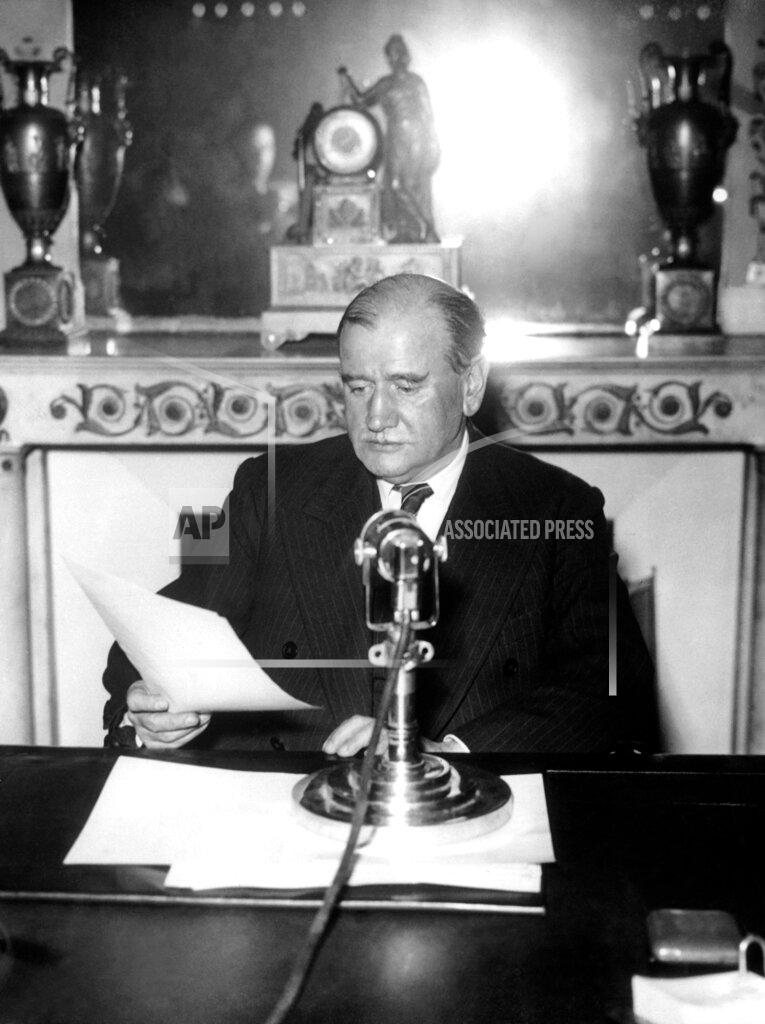
French Premier Édouard Daladier in an anxiously awaited address to France and the world tonight offered to negotiate France’s difficulties with Italy, but put it squarely up to Rome to make the next move by clarifying her demands. Furthermore, he bluntly warned that “we will not cede a foot of our land nor one of our rights.” Moreover, he appealed to all powers “who think as we do” to unite for peace.
M. Daladier was replying to Premier Benito Mussolini’s speech of Sunday, listing Tunisia, Djibouti, and the Suez Canal as “problems of a colonial character” standing between Italy and France. In this reply, a twenty-seven-minute address that was approved by the French Cabinet this morning, M. Daladier combined firmness and diplomacy. He struck at Germany, declaring that although France had made every effort for “lasting collaboration” with Germany, the Nazi dismemberment of Czecho-Slovakia had come as a “heavy blow” to these efforts for peace.
Rome took Premier Daladier’s speech to indicate that he did not want an agreement and the Italians foresaw a deadlock. It is noted that M. Daladier announced his readiness to talk with Rome, but it is also noted that he said quite positively that he had no intention of giving Italy the things she wants. It is asserted that this is a contradiction in terms and is tantamount to saying that M. Daladier does not want to reach an agreement. The emphasis that the French Premier laid on his statement that France would not yield a foot of her territory or any of her rights was interpreted here as placing a serious obstacle before satisfaction of Italy’s aspirations through peaceful negotiations. The impression here tonight was that the speech would not facilitate a solution of the quarrel since M. Daladier seemed to make clear that it was Italy which would have to take the initiative in negotiations.
Britain, meanwhile, replied to Germany’s recent conquests by announcing a doubling of her Territorial Army, which will bring its enrollment to nearly half a million-and this without conscription. Great Britain today delivered her first military answer to Germany’s seizure of Czecho-Slovakia by doubling the size of the Territorial Army, the “citizen army” similar to the National Guard in the United States.
The Territorials’ strength will be brought as speedily as possible to almost 500,000 men by means of an intensive voluntary enlistment campaign. All recruits will be registered even if there is no equipment for them at the moment and they will be called up for training whenever the government needs them. The recruiting will be carried on without the brass bands or ballyhoo that accompanied volunteering in World War days. It will be done. quietly with the cooperation of employers and trade union leaders so that the recruits can have all the necessary time off for training.
But there will be no coercion or compulsion, for as Prime Minister Neville Chamberlain told the House of Commons today, “we have not by any means yet exhausted what can be done by voluntary service.” In this sense today’s decision represents a triumph for the group in the Cabinet that has opposed conscription or compulsory training in spite of the rising clamor from the Conservative party. Compulsory service remains a probability, especially if Germany administers another shock to Europe in the next few months, but Mr. Chamberlain is unlikely to adopt it unless he gets a mandate from the voters at the next general election.
The Prime Minister has been afraid that conscription at the present time might split the country: his move today was welcomed by members of all parties in the House of Commons, not only by Laborites who dreaded conscription but by Conservatives who urged it. Apparently, the decision was taken in a great hurry. The Cabinet approved it only this morning and although skeleton plans have been worked out at the War Office there is a mass of detailed planning to do before the new plan, which provides for an increase to 340,000 field service and 100,000 anti-aircraft Territorials, gets under way.
The British Admiralty asks for a ban on sailor flogging if the punishment is banned for criminals.
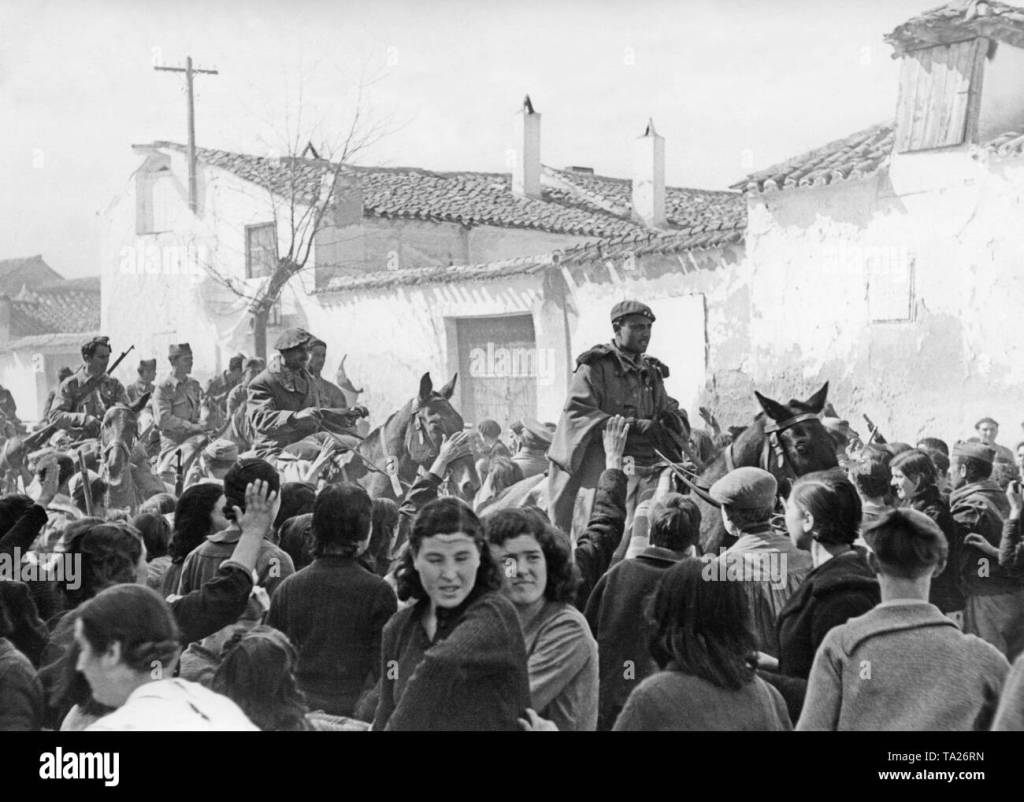
The besieged Spanish Republican garrison in Valencia, Spain surrendered to the Nationalists, ending all hostilities in the country. The Nationalists occupy Cuenca, Ciudad Real, Jaén and Albacete. Cities, towns, and villages throughout Spain hurried to follow the example of Madrid. Ciudad Real and Cuenca were the first to announce their surrender – at one o’clock in the morning. The “fifth column” of Franco sympathizers in the towns had risen and taken control.
Shortly after dawn Falangists (Spanish Fascists) and Civil Guards in Murcia captured the town hall and the public buildings and all the barracks. Then Guadalajara, north-east of Madrid, went over, where two years ago this month the Republicans had inflicted a great defeat on the Italians. Jaen followed in the south, awaiting the arrival of General Queipo de Llano’s troops, which were only a few miles away.
At noon, Valencia surrendered; five hours later General Franco’s troops entered. Valencia was twice in the civil war the capital of Spain. As one of the chief ports through which arms and supplies reached the Republic, it has suffered since January, 1937, numberless shellings from the sea and bombings from the air. In the harbor lie many ships, among them British ships, either sunk or disabled.
Falangists came out of their hiding, rose against the Republicans, and forced the surrender of Alicante. In the evening Cartagena submitted. Albacete was the last important town to go over. The civil population rose against the Republican garrison and forced their surrender. Then they told Burgos by wireless that they would receive Franco’s troops. So, without bloodshed roughly a third of the country went over to Franco yesterday, and last night in nearly all the cities, towns, and villages the red and gold-flag of Nationalist Spain was flying. The revolt that Franco began in July, 1936, was over.
Warsaw reported that Polish-German talks concerning Danzig were under way, but at the same time indicated that Poland would not accept dictation. Poland, reluctant to join France and Britain in a bloc against Germany, has started talks with the Nazis to settle the future status of the Free City of Danzig, it was learned tonight. It was understood that the conversations were intended by the Warsaw and Berlin governments to attempt to give satisfaction to Germany’s desire for greater authority over the Free City and at the same time to guarantee Poland’s heavy. economic interests there.
Danzig, which has a population of more than 400,000, is largely German. To give Poland an outlet to the sea the Baltic port was taken from Germany at the end of the World War and made a free city under the protection of the League of Nations. A slice of former German territory known as Pomorzethe — so-called Polish Corridor — also was given to Poland so that she could have access to the port, which until recent years handled almost all of Poland’s foreign seaborne commerce.
Danzig, which is under the Polish customs system, already is politically dominated by Danzig Nazis. Informed diplomats declared it only “natural that Poland and Germany are discussing the question.” They pointed out that in 1935, when the League of Nations Danzig Commission considered resigning and when the League suggested abolition of the post of League High Commissioner in Danzig, a committee composed of Britain, France and Sweden advised that direct Polish-German negotiations be undertaken to settle the status of the city.
The Polish government news agency today distributed a statement that an understanding with Germany over Danzig was possible because “our people can understand the vital interests of neighbors.” The German Ambassador, Hans Adolf von Moltke, assured Foreign Minister Josef Beck yesterday that Poland had nothing to fear from Germany.
But meanwhile, Baron Ernst von Weizsäcker, the State Secretary of the Auswärtiges Amt, told the Danzig government the Reich would carry out a policy to the Zermürbungspolitik (“point of destruction”) towards Poland, saying a compromise solution was not wanted.
The Reich Protector for Bohemia-Moravia and the State President made a joint appeal for cooperation in developing the new German “colony.” Baron Konstantin von Neurath, Reich protector for the Bohemian-Moravian Protectorate, and Dr. Emil Hácha, State President of the Protectorate, today expressed opinions concerning future cooperation between the Reich and her new territory in joint articles appearing in The European Review. Baron von Neurath says he has complete sympathetic understanding for “the fresh scars and unhealed wounds” that recent events have left on the feelings of the peoples for whom he has been made responsible.
Slovakia looked to Berlin for guidance in her frontier dispute with Hungary. Budapest’s time limit on her demands expires today. The Slovak Government sent a note to Berlin today inquiring as to Germany’s attitude toward the Hungarian territorial demands in view of Germany’s guarantee of the Slovak frontiers. State Secretary Cvrskovec of the Foreign Ministry, one of the delegation of four that negotiated in Budapest, hurried to Vienna this morning for discussions with German officials there. The other delegates conferred with Slovak leaders here. The Slovaks expect the German answer tomorrow in time to deliver a reply to Budapest before expiration of the time limit.
The Slovak leaders desire to resume the negotiations, and it is understood that their attitude has changed since the delegates were sent to Budapest a few days ago with instructions not to surrender a foot of Slovak soil. They are willing to negotiate on a reciprocal basis and would agree to surrender 650 square miles of Eastern Slovakia bordering the Uz Valley, which is occupied by Hungarian troops and through which the railway to Poland runs, if a corresponding area were ceded to them elsewhere.
Hungary undertook new military preparations tonight and announced continued Slovak frontier attacks had been the only answer thus far to her territorial demands. A communiqué said Slovak troops yesterday had attacked Hungarians near Szalanchuta and Legenye on the frontier between German-protected Slovakia and Hungary’s new autonomous district of Carpatho-Ukraine (Ruthenia). No casualties were reported among the Hungarians.
Although no new classes have been called to the colors, partial mobilization in Rumania is proceeding according to plan and reservists are rejoining their units at fixed intervals. Until the movement is completed there can be no question of sending any of the men back to their homes. The total of reserves under arms is officially declared to be 600,000. A number of factories have been forced to close because of depleted staffs.
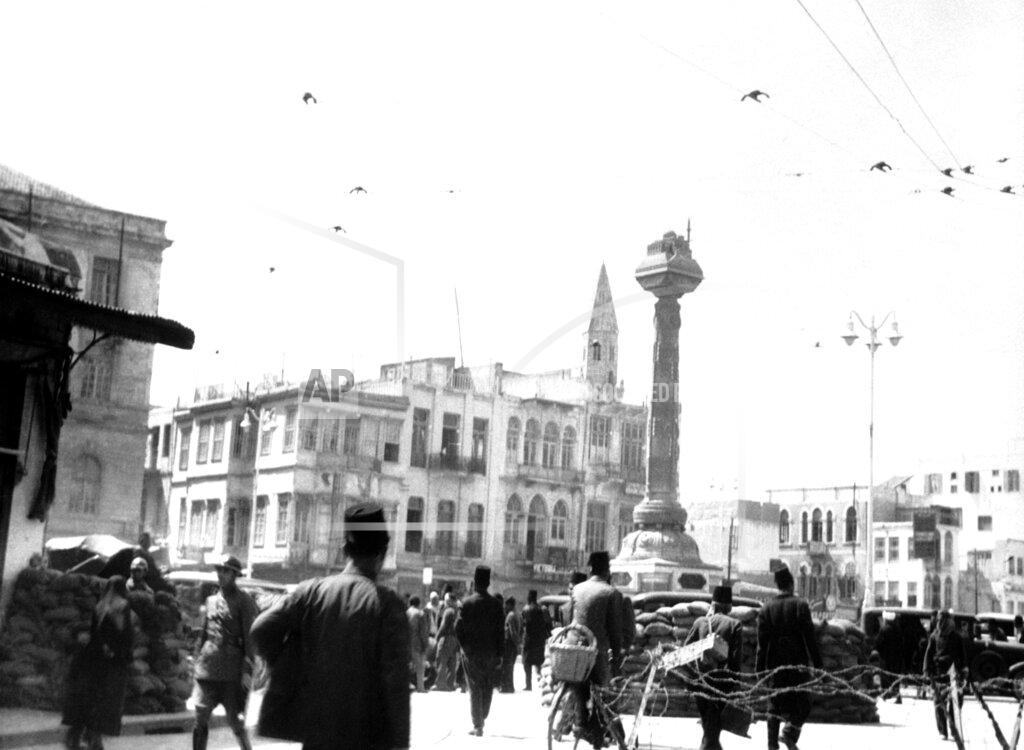
After four days of attempts to form a Syrian Cabinet a deadlock was reached today when Nasoubi el Bokhari, who had accepted the Premiership, admitted failure. Lutfy el Haffar resigned as Premier a fortnight ago. The National bloc, which is the most powerful party, refused to participate in a government until France had yielded to Syrian demands. M. el Bokhari, a non-party man, was asked to form a Cabinet. He could not find anyone willing to cooperate with the government without definite assurance of a change in French policy. Although there have been no serious demonstrations or clashes since the French took over control from the Syrian police, a general strike in the principal cities continues and Syria is without a government.
The Kut Barrage, a new irrigation dam in Iraq waters the spot known as the traditional site of the “Garden of Eden.” The dam opened yesterday in a ceremony presided over by King Ghazi.
The economy group of the House Appropriations Committee forced a reduction by the committee today of $50,000,000 in the $150,000,000 fund requested by President Roosevelt to finance relief for the rest of this fiscal year. It was the second time this session that the committee followed the leadership of its economy-minded members to cut relief funds. Today it reported a bill for $100,000,000, to be considered by the House tomorrow “under circumstances which indicate that a majority of members may support the committee.
The committee asserted that its proposal for the lesser sum is on the side of liberality.” After hearing Works Progress Administration officials, the committee contended that WPA economies were in order, and that an amount even less should suffice. The $100,000,000 probably would not be justified by a more searching inquiry into needs, the committee said, but since “time is the essence” of the situation, it decided to allow the $100,000,000 and proceed later with the WPA inquiry which is expected to develop a new Congressional policy toward relief.
Authority for an inquiry into relief activities was authorized Monday by the House, and this fact probably will influence the Chamber in voting on the deficiency. The explanation by economy leaders, as expressed privately, was that while WPA officials and President Roosevelt did not make out a convincing case for the full amount asked or for the entire amount allowed, they did not want to start an open fight at this time, leaving the issue to be fought out after the inquiry shall have been completed and a permanent relief policy proposed.
They argued that later they could go before the House armed with facts, which they do not have now, to make a convincing case for a permanent policy which they hope will save large amounts of money. The temper of the House, however, may cause rough going. Members from the rural constituencies, whose attempt to vote a $250,000,000 farm-parity fund was defeated yesterday, were seething, their wrath directed at the New Dealers, Republicans and economy-minded Democrats who brought about the rejection of their amendment to the Agricultural Department Supply Bill. It was considered a distinct possibility that they might kick over the traces and defeat the Relief Deficiency Bill.
Should an attempt come from this source to recommit the bill, or vote it down by roll-call, it would put the Republicans and the economy-minded Democrats “on the spot.” The committee’s report would furnish the farm members with plenty of ammunition, it was said, since it condemns the WPA for extravagance in administrative expenses and admits that the $100,000,000 fund was approved even though the committee members contended that they were not convinced by the case made on its behalf.
The Senate Foreign Relations Committee decided today, in an executive session, to begin hearings next. Wednesday, at 10:30 AM, on the six pending proposals concerning the existing Neutrality Act. The hearings, which will be public, are expected to last two weeks. The committee’s session was devoted to a discussion of procedure, it was said, and there were no expressions among its members to indicate how they would vote on the proposals before them. Details of the plans to conduct the hearings were left to a subcommittee made up of Senators Pittman, chairman, Borah and George.
At one stage Mr. Pittman submitted to the full committee a motion that no hearings be held. This was defeated by only a narrow margin, the vote being 11 to 8, according to the best information available. “Nothing any witness could say would change my mind on the subject at all,” Mr. Pittman said afterward in explanation of his motion. He recalled the extended hearings that were held on both sides of the Capitol in 1935, 1936 and 1937, when the legislative ancestors of the present act were discussed.
The U.S. Navy will soon begin the construction of a “mosquito” fleet, the units of which will represent the latest developments in design and equipment. This was disclosed today when Secretary of the Navy Swanson announced the winners in the competition for designs of small craft involving two classes of motor-torpedo boats and two classes of submarine chasers. The $1,000,000,000 naval authorization bill provided $15,000,000 for the development of this arm of the naval service.
Several hundred actors in New York City are on the verge of being forced to leave their permanent homes in the hotels of the Times Square area because of increased room rents during the World’s Fair, it was charged yesterday by the Actors Equity Association in an appeal to Mayor La Guardia and the Hotel Association of New York for protection of its members against any wholesale eviction.
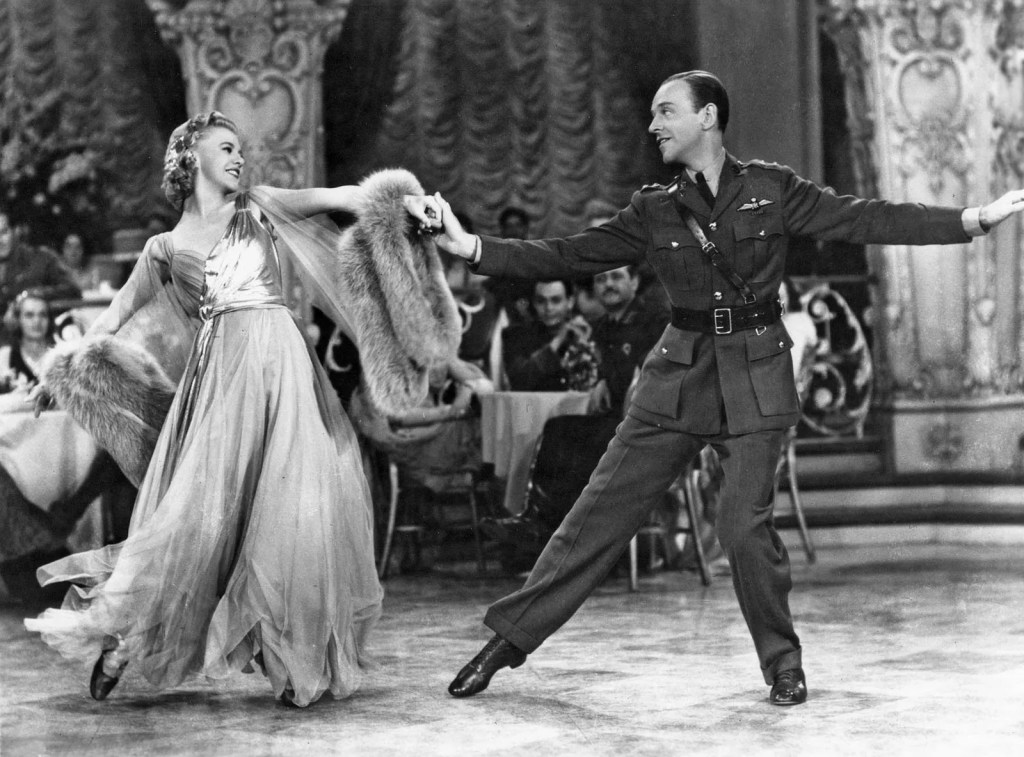
“Gone with the Wind” actor Clark Gable (37) weds actress Carole Lombard (30) at the rectory of Saint John’s Methodist Episcopal Church in Kingman, Arizona.
Japanese 6th Division captured Wuning, Kiangsi (Jiangxi) Province, China. The Japanese Command today reported the capture of Wuning, sixty-five miles northwest of Nanchang, in heavy fighting in central China. Domei, Japanese news agency, said assault troops had encircled the town in darkness and then had forced all gates at daybreak. The Chinese had fought at Wuning after the fall of Nanchang. The campaign represents an effort of the Japanese to clear out a Chinese pocket south of Hankow and north of Canton. The occupation of Nanchang, the Japanese said, was “complete.” Japanese said their troops were driving from Nanchang in an attempt to open a way to Changsha. They asserted “several divisions” of Chinese were trapped northwest of Nanchang and 30,000 were encircled directly to the north on the railway to Kiukiang.
In Nanchang, the Japanese said, fires set by Chinese troops before they left the city were subsiding. Five Americans and several other foreigners were believed to be in the city, but it is not known how they fared. The Chinese repeated what they had said after the fall of Nanking and Hankow, that the loss would not mean loss of the war. They added that the present Japanese drive from the Yangtze River into the interior meant that the limited Japanese strength was being spread over a wider area, lengthening lines against which Chinese regulars and guerrillas might operate. Foreign observers, however, said the Japanese occupation of Nanchang would require rerouting of Chinese guerrilla supply lines and trade routes because Nanchang had been a focal point for the distribution of supplies.
Continuous battles are raging throughout Northern Kiangsi Province. The Japanese reported they were advancing southward along the Kan River after occupying Nanchang in Kiangsi and Wuning, sixty-five miles to the northwest. The Japanese reported that they had occupied Tengchow, an important coastal city in Northern Shantung Province, East Central China, and had gained control of the entire Shantung peninsula. Chinese irregulars, however, were said to dominate inland centers.
A Japanese drive into Chungshan district, between the Portuguese colony of Macao and Canton, appears to be under way. Japanese infantry, supported by warships and planes, was said to have captured Kongmoon, Kwangtung Province port, seventy miles west of Hong Kong. Numerous Japanese warships and troopships were reported in the West River near Canton. Intensified Chinese guerrilla attacks, including one in Chapei, a Shanghai suburb, where irregulars killed ten Japanese sentries, were reported by Chinese today. Another band raided the Hangchow Railway southwest of Shanghai. The Chinese reports said the results were “disastrous” to the Japanese.
Chinese newspapers printed accounts of 500 Chinese soldiers who offered their lives to stop Japanese tank charges by strapping explosives to their bodies and hurling themselves at the machines. When squadrons of heavy tanks plunged through Chinese lines at Nanchang, the newspapers reported, the Chinese commander called for volunteers. Five hundred responded, bound bombs around their bodies and, when the invaders charged again, threw themselves before the approaching tanks. “All the tanks were destroyed,” the Chinese accounts said, “at the sacrifice of the lives of these fearless soldiers.”
Foreign observers in Nanking foresaw an attempt to foment an anti-British drive as Ministers of the Japanese-sponsored Peiping and Nanking governments opened discussions preliminary to a joint session of those regimes, which nominally rule Central and North China. Coinciding with the Nanking government’s observance of its first anniversary, posters appeared on the walls of some Nanking buildings denouncing “British imperialism.” Anti-French and anti-Soviet posters previously had appeared in Nanking.
The Japanese Premier Hiranuma clarifies that his country is neither democratic nor totalitarian and therefore will not confront either bloc.
Dow Jones Industrial Average: 139.75 (+0.42).
Born:
Roland Arnall, American businessman and U.S. Ambassador to the Netherlands, born in Paris, France (d. 2008).
Naval Construction:
The U.S. Navy motor torpedo boat USS PT-7, first of her class of 2, is laid down by the Philadelphia Navy Yard (Philadelphia, Pennsylvania, U.S.A.).
The Royal Navy minelayer HMS Abdiel (M 39), name ship of her class of 6, is laid down by J.S. White & Co. (Cowes, U.K.).
The North German Lloyd cargo/passenger liner MV Hannover is launched by Bremer Vulcan (Bremen, Germany). Captured by the Royal Navy on the outbreak of war, she will be taken in hand and emerge as the Royal Navy escort carrier HMS Audacity (D 10), the very first of the wartime escort carriers.
The Royal Navy Tribal-class destroyer HMS Punjabi (F 21; later G 21) is commissioned. Her first commanding officer is Commander John Trevor Lean, RN.






 History Diaries