
The Soviet Union brushed aside “pessimistic” Western press appraisal of Secretary of State Kissinger’s mission to Moscow and asserted that a new accord on strategic arms limitations could be worked out by the time of President Nixon’s visit to the Soviet Union in June. The Soviet assessment contrasted sharply with the version given American reporters traveling home with Mr. Kissinger after his talks with Leonid Brezhnev. Tonight, the Soviet Government newspaper Izvestia said: “The tone and content of the talks far from correspond to the pessimistic mood music with which some Western organs of information accompanied the Kissinger mission.”
Izvestia cited what it called the “noticeable pressure of the military‐industrial complex” in the United States, but nonetheless also took a positive approach to the prospects for an arms accord. “Mr. Kissinger’s visit showed that given consistency and realistic and constructive approach by both sides, there are possibilities for the attainment of mutually acceptable solutions,” the paper said. American officials have said that Moscow turned down the American proposals for putting brakes on the arms race, especially on multiple, independently guided warheads, known as MIRV’s, and in turn offered proposal that the American side considered unacceptable. The Soviet press dealt with none of these details, but only projected its more positive assessment in broad terms, reflecting the cordial atmosphere that the Soviet officials had conveyed to newsmen at the time of the talks.
Meanwhile, American officials said the Soviet Foreign Minister, Andrei A. Gromyko, would probably go to Washington to carry on the dialogue on such key issues as arms control on about April 9, when he attends the United Nations General Assembly. They also held out some prospect that Mr. Kissinger might come back to Moscow in May for another attempt at breakthrough on the arms accord, despite the failure to achieve, major progress during the latest round of talks in the Kremlin.
The foreign business community in London was in turmoil at the prospect of the end of the international tax haven that Britain has provided for foreign businessmen. The Labor government has closed a loophole that gave foreigners extremely favorable treatment under the tax laws. Foreigners working in Britain for five or more years, under a Labor government proposal, would be taxed on the same basis as British subjects.
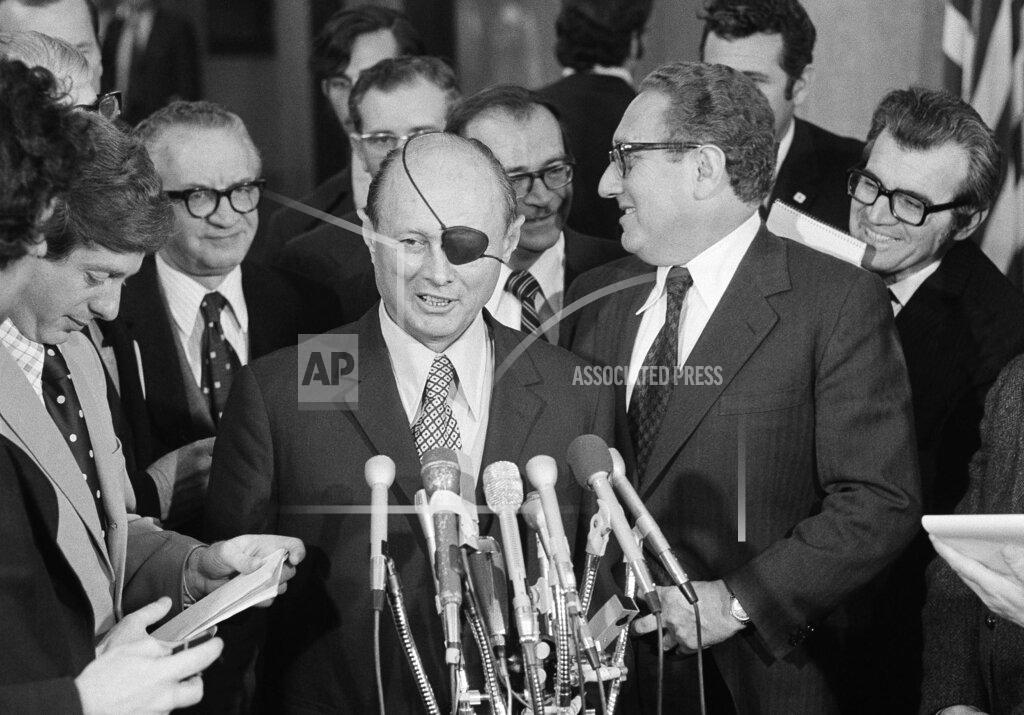
Israel’s principal objective in pursuing a disengagement of troops on the Syrian front is to make it possible to carry forward peace negotiations with Egypt, the Government’s chief spokesman said today. As Defense Minister Moshe Dayan prepared in Washington to present the Israeli proposal for the separation of forces to Secretary of State Kissinger, his colleague, Information Minister Shimon Peres, presented the Government’s assessment in an interview. Mr. Peres offered an unusually optimistic view of the chances of peace with Egypt while indicating no great hope for a similar development between Israel and Syria.
“While we are hopeful with Egypt that the first stage will lead to a second, we think the Syrians are not thinking of any second phase,” said Mr. Peres, who is a member of the inner circle of Premier GoIda Meir’s Government and a political associate of Mr. Dayan. “We think that disengagement with Syria would not only be the first child between Israel and Syria, but for the time being, the only child.” Mr. Peres rated the chances for disengagement on the Syrian front at “50‐50.” He based this on the assumption that Syria would not have given list of Israeli prisoners of war to Mr. Kissinger or allowed the International Red Cross to visit them if she did not have an objective. “They don’t forget our guns could shell the suburbs of Damascus,” Mr. Peres said, explaining an assumed willingness by the Syrians to negotiate disengagement agreement that would place their capital out of artillery range.
The foreign ministers of Israel and France will exchange visits this year in an effort to soothe the strained relations between the two countries, government officials disclosed today. Israel’s Abba Eban will visit France May 15, and his counterpart, Michel Jobert, will come to Jerusalem in a few months, the officials said. The exchange of visits had been under study for some time, but this was the first definite confirmation that it will take place. Mr. Jobert’s visit would be the first by a French foreign minister since Israel’s establishment as a state 26 years ago. No Israeli foreign minister has journeyed to Paris officially since the 1967 Mideast war, which was followed by a period of French‐Israeli animosity.
President Charles de Gaulle then imposed an arms embargo on the Mideast adversaries, but Israel charged that the action was in fact directed only at her. Israel had been France’s sole important arms buyer before the 1967 conflict. However, the Israelis are pleased at France’s positive attitude toward their efforts to win trade benefits from the Common Market. French‐Israeli relations on the non‐political level continue unhindered. Earlier this week France and Israel renewed their treaty fostering cultural and scientific cooperation. Israeli officials said that the visits would ease the strain on the political relationship between the two countries, although France insists that the policy it adopted in 1967 has not changed.
President Anwar el‐Sadat said in an interview published here today that the Soviet Ambassador had incorrectly told him shortly after the Middle East war erupted last Oct. 6 that Syria was requesting an immediate cease‐fire. The Egyptian leader was quoted as having said that the next day he received a denial of this statement directly from Syria’s President, Hafez al‐Assad. Thereupon, the published account said, Mr. Sadat spoke harshly to the Soviet Ambassador, Vladimir M. Vinogradov, adding, “I told him simply that I was satisfied with Mr. Assad’s reply and regarded it as the truth.” The interview, published in the Beirut newspaper Al Anwar and reprinted in the authoritative Cairo daily Al Ahram, suggested that the Egyptian President thought the Soviet Union was trying to induce him to accept a cease‐fire in the early hours of the war by misrepresenting Syria’s position.
All of the Arab oil‐producing nations except Saudi Arabia want to increase the price of oil in July, the secretary general of the Organization of Petroleum Exporting Countries said today. The official, Dr. Abderrahman Khene of Algeria, said that it was his “personal view” that the price of oil should rise at a rate that would “keep pace with world Inflation,” which he put at 12 to 14 percent a year. Dr. Khene said at a news conference that at a meeting in New York next month, the organization would announce details of a special fund to help poorer developing countries combat the economic problems resulting from higher oil prices. The organization’s meeting in New York will be on April 10, the day after the opening of a special session of the General Assembly, called at the request of Algeria, on the issue of raw materials and development.
The Volkswagen Golf was launched in West Germany as a modern front-wheel drive hatchback with a goal of replace the iconic Volkswagen Beetle, holder of the world record for the car with the most units produced.
The Defense Department announced today that nearly one-third of the United States Air Force units stationed in Thailand would be withdrawn soon. As part of an agreement worked out with the Thai Government, the Pentagon said, about 10,000 men in the present 35,000‐man force in Thailand would be withdrawn. The reduction also calls for withdrawal of about one‐third of the B‐52 strategic bombers and fighter-bombers stationed in Thailand. The reduction was agreed upon in discussions in Bangkok between Sanya Dharmasakti, the Thai Premier, and William R. Kintner, the United States Ambassador to Thailand. The air units are stationed on Thai-owned air bases built by the United States, and any increase or decrease in the size of American forces has to be negotiated with the Thai Government. The Air Force has about 600 planes in Thailand now — 50 B‐52 bombers, 300 fighter‐bombers and 250 support aircraft. The air units have been retamed in Thailand largely as a deterrent threat of renewed bombing of North Vietnam — a step that the Defense Department can take only with Congressional approval.
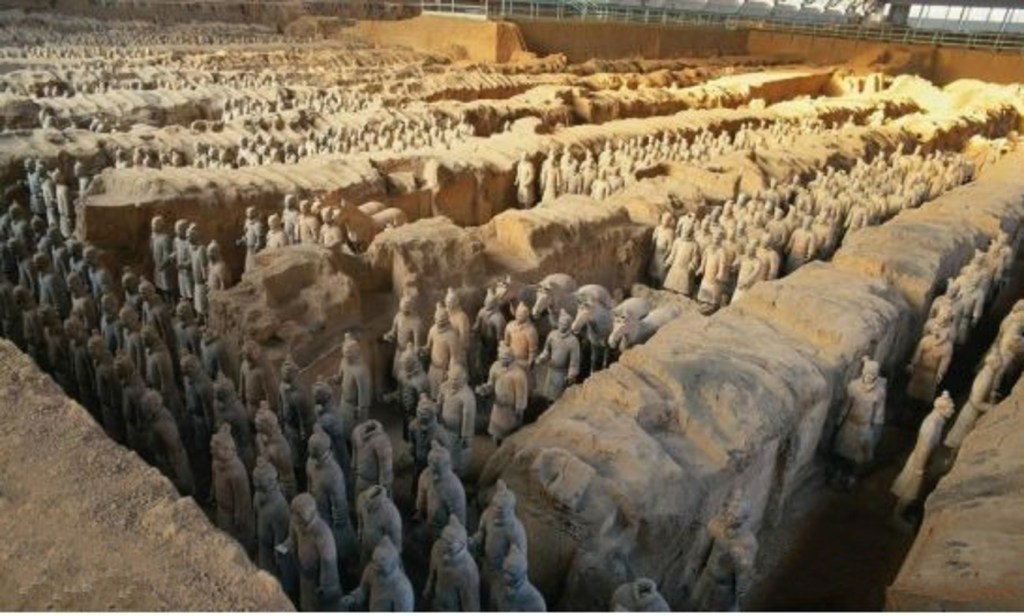
The Terracotta Army of Qin Shi Huang was discovered at Xi’an, China. Chinese farmers discover the Terracotta Army near Xi’an, 8,000 clay warrior statues buried to guard the tomb of China’s 1st emperor, Qin Shi Huang.
The wife of the United States diplomat who was kidnapped a week ago in this northwest Mexican city today urgently appealed to her husband’s captors to make contact with her. “Please let me know that he is well,” Mrs. Ann Patterson said at a news conference, her voice breaking with emotion. “Please contact me.” Sources at the United States Consulate General here said that nothing had been heard from the kidnappers of Vice Consul John Patterson, 31 years old, since a ransom note was delivered three hours after he disappeared last Friday. Other sources disclosed that the note, apparently in Mr. Patterson’s handwriting, demanded $500,000 in ransom and warned that the diplomat’s life would be in danger if the kidnapping was publicized.
The White House agreed to surrender all the materials subpoenaed by the special Watergate prosecutor, Leon Jaworski. President Nixon, in deciding not to fight the subpoena, made an important concession in his efforts to limit, on the ground of executive privilege, the number of documents and tape recordings that may be given Watergate investigators. But the dispute between Mr. Nixon and the House Judiciary Committee, which wants additional material for its impeachment inquiry remains.
President Nixon’s tax lawyers have rejected any suggestion that he voluntarily amend his returns and pay additional taxes, and have asked to argue their case before an investigating Congressional committee, sources close to the inquiry said today. The sources said the Joint Committee on Internal Revenue Taxation would receive within a week a staff report concluding that President Nixon owes substantially more than the $78,651 he paid on income totaling more than $1‐million in the years 1969 through 1972. The suggestion that Mr. Nixon voluntarily file new returns for the years in question was made publicly by Representative Wilbur D. Mills, Democrat of Arkansas, vice-chairman of the Joint Committee and chairman of the House Ways and Means Committee.
President Nixon said today that the Americans who served in Vietnam could be proud that the “American effort was in good conscience, honorably undertaken and honorably ended.” That verdict, he said, is “quite different from the instant analysis we see and hear.” The President spoke at the National War College at Fort McNair to a small gathering of military and civilian leaders and hospitalized war veterans observing the first Vietnam Veterans Day.
George Bradford Cook, one of the government’s chief witnesses in the Mitchell-Stans trial, admitted that he lied under oath on three occasions to the grand jury which investigated the Vesco case and twice to congressional committees. He lied, he said, to protect Maurice Stans and also to protect the reputation of the Securities and Exchange Commission.
John D. Ehrlichman, concerned about a potential conflict of interest with H. R. Haldeman, his former White House colleague, has decided to drop John J. Wilson as his lawyer for the Watergate cover‐up trials, sources close to the case disclosed today. Mr. Ehrlichman was said to have concluded earlier this month that Mr. Wilson’s joint representation of him and Mr. Haldeman “wouldn’t be fair to the court and to himself,” source close to the former White House domestic adviser explained. The identity of Mr. Ehrlichman’s new attorney, who does not practice law in the Washington area, could not be immediately learned.
As Middle Western Republicans gathered in Chicago this foggy week end in search of some way out of Watergate, Senator Charles H. Percy asserted that their most immediate problem was the possibility that President Nixon might be forced out of office. Percy says the party needs to find some way to disassociate itself from the Watergate Scandal.
A U.S. federal grand jury in Cleveland indicted eight members of the Ohio National Guard on civil rights violations for the May 4, 1970 shooting of 13 students at Kent State University, for of whom died of their wounds. Five of the defendants were charged with felonies. However, the jury found no conspiracy among the guardsmen to shoot the students. The indictments would all be dismissed on November 8 on a finding that the prosecution had failed to produce sufficient evidence to support charges.
The Justice Department announced today a 5 percent increase in “serious crime” reported to the police during 1973, including both crimes of violence, such as murder and rape, and property crimes, such as auto theft.
Nelson Gross, the former state Republican chairman in New Jersey, was convicted on five tax fraud and perjury counts that stemmed from his activities as chairman of the 1969 gubernatorial campaign of William Cahill. Mr. Gross, who is 42 years old, faces jail terms of up to 23 years and fines totaling $32,000.
Women’s rights advocates won notable victories in New Jersey and Connecticut. The New Jersey Superior Court in Trenton ruled that girls must be permitted to play Little League baseball with boys. In a decision that is expected to have national impact, a panel of three appellate division judges ruled two to one that the Little League is a public accommodation that under state law cannot discriminate against prospective players on the basis of sex.
The Environmental Protection Agency asked today for the immediate shutdown of one of the nation’s biggest iron mining operations on the ground that its discharges of asbestos‐laden waste into Lake Superior were jeopardizing the health of people in northern Minnesota and Wisconsin.
At 20:47 UTC, the Mariner 10 space probe, launched from the U.S. on November 9, made the closest approach to the planet Mercury up to that time by an Earth spacecraft, coming within 437 miles (703 km) of the surface. The surface, criss‐crossed here and there by strange-looking valleys of unknown origin, bears many resemblances to those of the moon and Mars. Yet it differs in ways that should ultimately be indicative of Mercury’s separate history. Probably the biggest surprise has been in indications that Mercury has a magnetic field with a strength about 1 percent that of the earth’s. Even so weak a field was unexpected, since it is stronger than any magnetism observed near Venus, Mars or the moon. The earth’s magnetism is believed caused by a dynamo effect from the churning of molten material within the core of a spinning planet. The spin rate of Mercury is so slow that little or no field was expected.
The United Kingdom restored the speed limit on its network of M-designated motorways to 70 miles per hour (110 km/h), after having reduced the maximum speed to 50 miles per hour (80 km/h) on December 8 because of the worldwide fuel shortage.
Film adaption of “The Great Gatsby” starring Robert Redford and Mia Farrow with costumes by Ralph Lauren first released
Dow Jones Industrial Average: 846.68 (-7.67, -0.90%).
Born:
Marc Gené, Spanish auto racer (24 Hours of Le Mans, 2009), in Sabadell, Spain.
Died:
Czesław Kukuczka, 38, Polish firefighter, entered Poland’s embassy in East Berlin and threatened to detonate a bomb unless he could receive a visa allowing him to pass through an East German border crossing into West Berlin. Kukuczka was given the travel documents and driven to the crossing at the Friedrichstrasse railway station. As he walked toward the border with his papers, Kukuczka was shot in the back, then taken to the Stasi prison at Hohenschönhausen, 10 kilometers (6.2 mi) away, rather than to the nearby Krankenhaus der Volkspolizei (Hospital of the People’s Police), and he died a few hours later from internal injuries.
Andrea Checchi, 57, Italian film actor known for La ciociara, died of polyarteritis nodosa, a rare autoimmune disorder.
Seton I. Miller, 71, Hollywood screenwriter (“Pete’s Dragon’, “Istanbul”).

 History Diaries