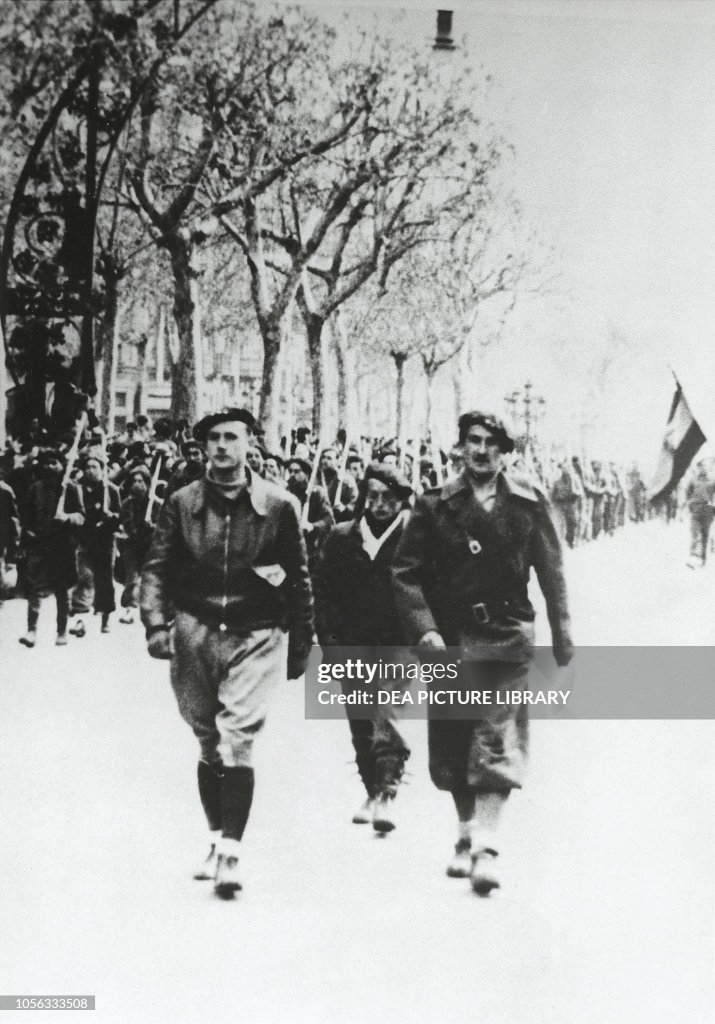
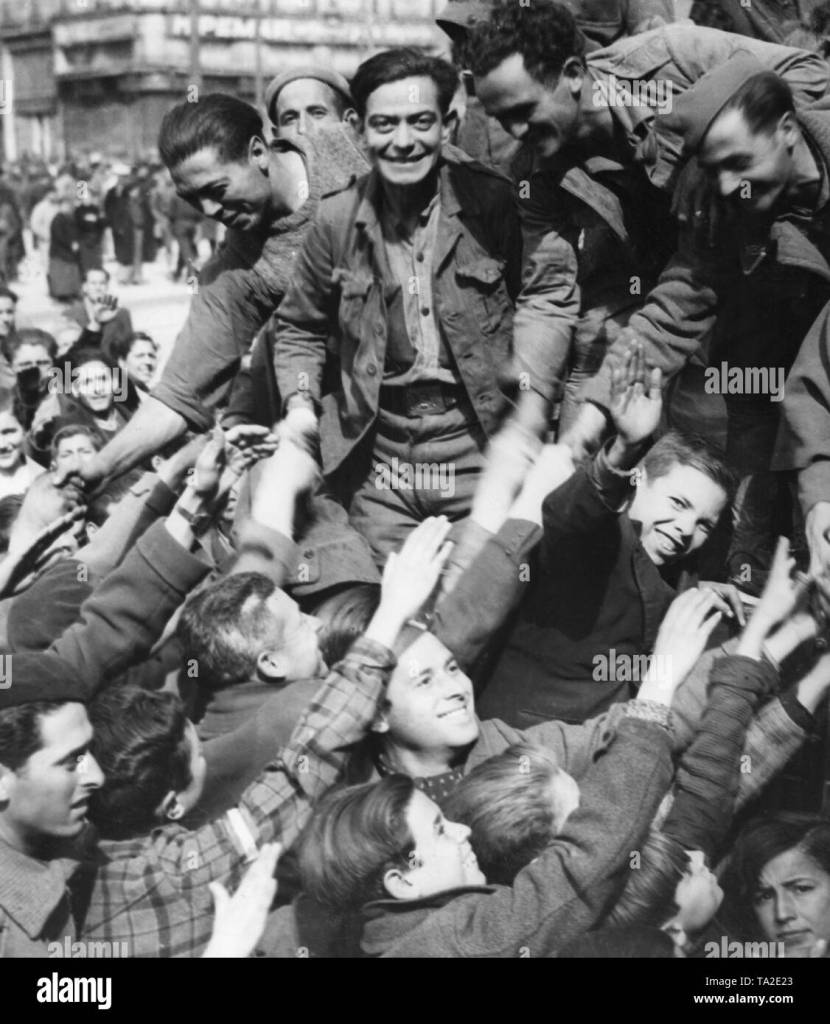
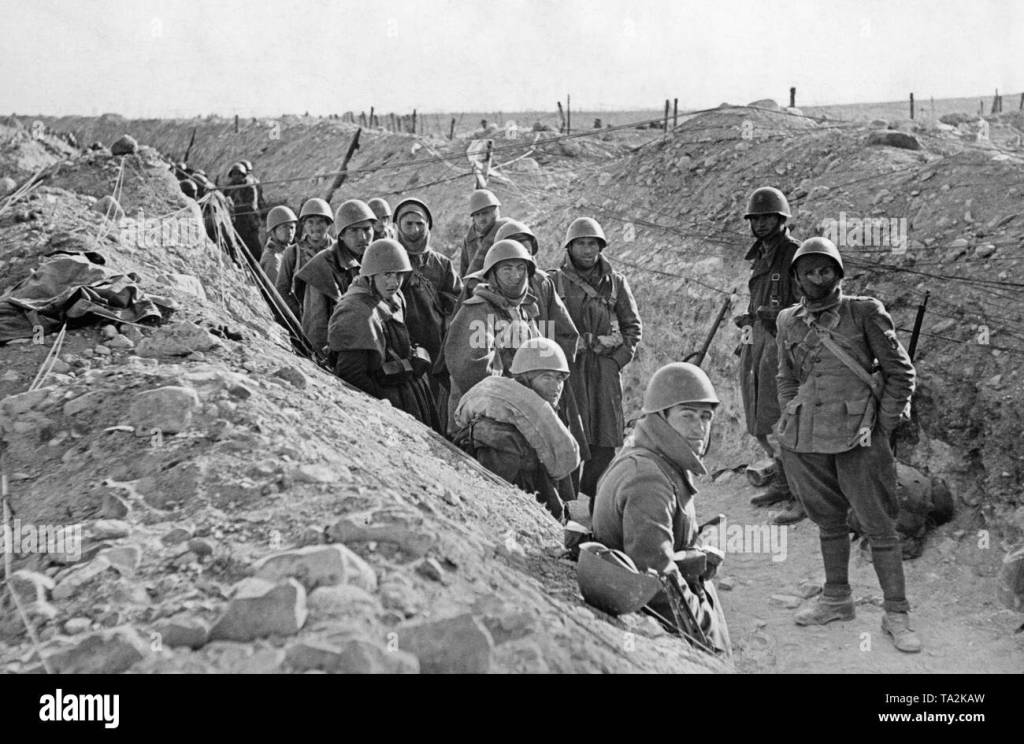
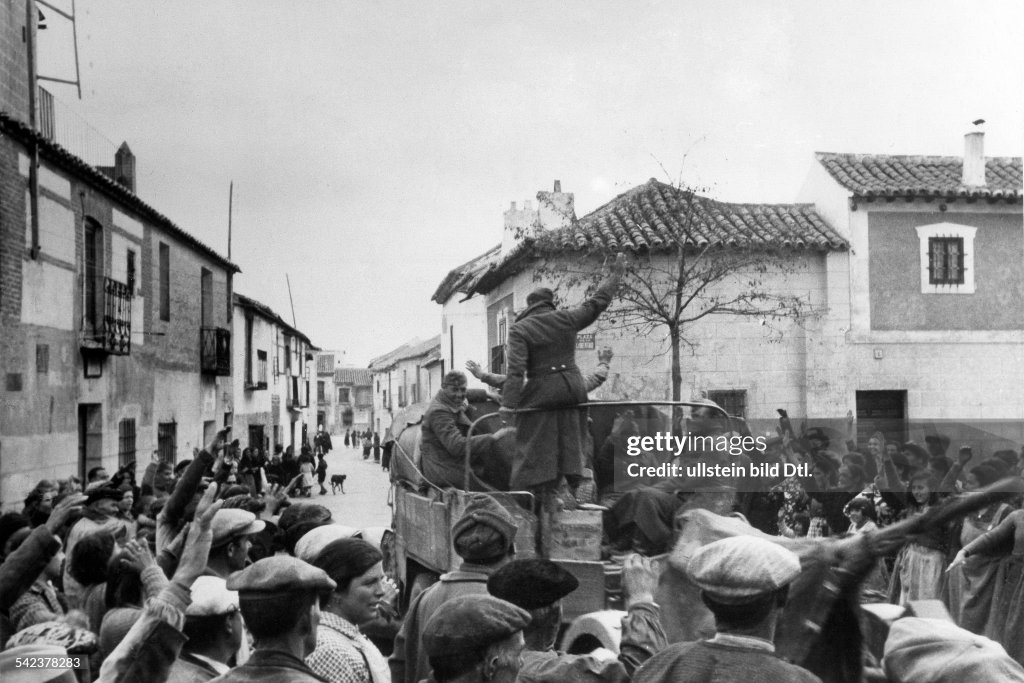
Francisco Franco’s Nationalist forces occupied Madrid, Spain and declared victory in the Spanish Civil War. The fall of Madrid marks the end of the Spanish Civil War, which lasted 32 months. Madrid had been besieged for most of that time.
The rebels, who in November 1936 had fought to enter and failed, walked in yesterday as troops of the generally recognized Spanish Government, and not a shot was fired at them. The supporters of Franco in the city, the “fifth column” he once spoke of, had been waiting for this moment for more than two years. Shell-torn Madrid, symbol of Republican resistance during thirty-two months of civil war, passed today into the hands of Nationalist Generalissimo Francisco Franco. After holding Nationalist forces at the edge of the war-weary, hungering capital for nearly twenty-nine months, the Central Army withdrew from defense lines and hoisted white flags this morning. The fall of the city was regarded as the virtual end of the savage, destructive conflict that had unnerved Europe for so long.
A Nationalist spokesman told of sweeping successes in the Madrid, Cordoba and Toledo sectors and said, “We still have a job of work in cleaning up the Red forces in the remainder of Spain, but it will be a walk-over.” He declared that 40,000 prisoners had been taken in those three areas, boosting the total of prisoners taken by the Nationalists since the war started to 492,000. “The troops are finding resistance hardly anywhere,” the spokesman said. “General Gonzalo Queipo de Llano’s southern army is smashing through in the Cordoba zone at an unprecedented rate.”
The Spanish Civil War ends. With the unconditional surrender of the Miaja government, the Spanish Nationalists / Falange took control of the last Loyalist / Republican strongholds in Madrid and Valencia. The members of the National Defense Council fled Spain. The Spanish Civil War resulted in the loss of 700,000 men in battle, 30,000 executed or assassinated, and 15,000 killed in air raids. The Caudillo, General Francisco Franco, and the Nationalist government immediately set up special tribunals to try hundreds of Republican leaders. Despite pleas for moderation by the British and French governments, a large number of Loyalist leaders were convicted and many were executed.
Spanish war casualties are estimated to total five percent of the population.
Casado’s National Defense Council was dissolved.
Franco supporters struck up Nationalist anthems and took over the capital’s administration as the conquering troops entered the city to find barricades still standing and the people suffering from hunger. The long privations of the people in Republican Spain made them welcome peace.
In jubilant Burgos a spokesman warned the democracies to keep hands off Spain. General Franco’s Interior Minister and brother-in-law, Ramon Serrano Suner, announces the fall of Madrid and warns the world’s democracies to “keep their hands off Spain.”
Premier Mussolini in a brief speech applauded the defeat of “bolshevism” and ordered flags hung out in honor of the victory. In a few words addressed to enthusiastic crowds Premier Benito Mussolini late this evening announced Madrid’s fall. “General Franco’s infantry and Italian legionaries have entered Madrid,” he declared. “Therefore, the Spanish war may be regarded as finished. It has ended with the defeat of Bolshevism. All the enemies of Italy and fascism will come to the same end.” Signor Mussolini spoke to some 10,000 persons who had gathered in the Piazza Venezia as soon as the afternoon newspapers came out with large headlines telling of Madrid’s surrender. The news came too late for the Fascist party to organize a mass demonstration such as the one that greeted the capture of Barcelona. Nevertheless, flags soon appeared in windows and crowds of students singing patriotic songs marched to the Piazza Venezia, where they were joined by thousands of civilians and Fascisti.
Chancellor Hitler sent a congratulatory telegram to Generalissimo Franco.
Franco’s tactics with Madrid earn praise by the French, though coolness still exists in the relationship between the two countries.
A Franco aide says that the general will not attempt to regain Spanish colonies in the Americas.
Poland announces that any German attempt to alter the status of Danzig without Polish consent would lead to war.
Polish Foreign Minister Józef Beck met with the German Ambassador in Poland and warns that any further demand on Danzig by Germany might result in war between Poland and Germany.
Germany in a semi-official statement warned Poland not to heed the calls of “foreign sirens,” but Warsaw felt that the tension with Berlin had abated.
In Berlin the organ of the Elite Guard invited Britain to join with Germany to “dictate the peace of the entire world.”
Prime Minister Neville Chamberlain bars military conscription, not wishing to upset the harmony with labor. Prime Minister Chamberlain definitely rejected military conscription last night after having faced in the House of Commons earlier in the day a demand by thirty-four Conservatives led by Anthony Eden for a coalition government “in view of the grave dangers” threatening Britain. Mr. Chamberlain indicated in the House that efforts to form a “stop-Hitler” bloc had not been abandoned.
Bombs damage the historic Thames River bridge, believed to be a retaliation for the sentencing of nine involved in other Irish Republican Army bombings. Motorists and pedestrians crossing the famous Hammersmith suspension bridge over the Thames, one of the main exits from Western London, had narrow escapes early today when two time-bombs exploded. They were believed to have been dropped from a truck. As part of the superstructure crashed into the roadway, motorists ran into the wreckage and thus escaped the full force of the second explosion, which occurred a few seconds later.
One side of the bridge is now sagging about a foot below its normal level. Windows in a block of flats 100 yards away, on the north side of the river, were shattered and other property was damaged. Policemen immediately surrounded the district. No information regarding casualties was reported. A wave of bombings in various parts of Britain in recent months has been attributed to the outlawed Irish Republican Army. Michael J. Mason, named by the police as “commanding officer of the Irish Republican Army in Britain” and a leader in recent bombing plots, was sentenced to seventeen years’ imprisonment at Old Bailey yesterday.
The frontier negotiations between the Hungarians and the Slovaks were interrupted when Budapest made demands that some observers considered an ultimatum.
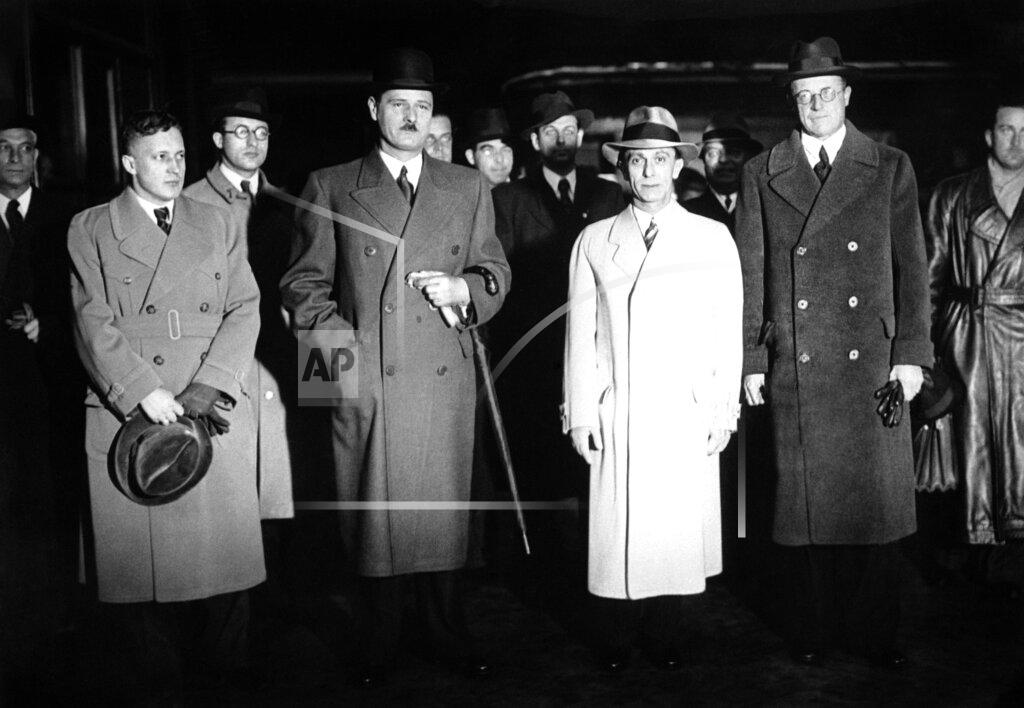
Clashes continue on the Slovak border. Hungary puts strong pressure on Slovak negotiators to settle all matters before Nazi minister Joseph Goebbels arrives for a visit.
To support her contention that Italy’s note of last December 17 did not contain specific demands, France proposes to make the note public. Yet, feeling that Italy is in a perilous situation because of her association with Germany, the French do not wish to close the door to negotiations. It was rumored last night that Foreign Minister Bonnet had offered his resignation.
Rome now favors a deal with Mediterranean territories that favor Italy.
President Franklin Roosevelt speeds the acquisition process for two 45,000-ton battleships. Japan’s situation is cited as one reason for these vessels. Construction by the United States of the two largest and most powerful battleships in the world was virtually assured today when the White House announced that President Roosevelt had approved the plans of the Navy Department for building of such ships. Asked at his press conference if the decision could be ascribed to the refusal of Japan last year to divulge her own plans for battleship construction, Mr. Roosevelt replied that that was one of several reasons that led to the decision.
The new ships will be streamlined giants approaching 900 feet in length but of about the same beam as the six 35,000-ton battleships now under construction, thus assuring easy transit of the Panama Canal. Each of the 45,000-ton ships, which are two of three such vessels provided for in the $1,000,000,000 Naval Authorization Act of 1938, will be about 880 feet long, 108 feet abeam and 36 feet in draught. They are to be 130 feet longer than the Washington, North Carolina, Massachusetts, Indiana, Alabama and South Dakota, the six battleships now under construction.
Each of the latter is estimated to cost between $70,000,000 and $75,000,000. The cost of the 45,000-ton ships has not been disclosed, but it is said to be between $85,000,000 and $100,000,000, probably nearer the first than the latter figure. The fact that the President has told the navy to go ahead with its plans for the larger capital units is interpreted in Washington to mean that the government has evidence of the truth of reports that the Japanese are building three battleships, each of more than 40,000 tons’ displacement. The Japanese Government has refused to confirm these reports.
To prevent leakage of information, the Japanese have established restricted zones which completely encircle all naval construction yards, no unauthorized person being permitted to approach within fifteen miles of such a yard. Japanese yard workmen must live within these areas. It is said that no white person has entered one of the zones since the restrictions were imposed.
Congressmen from urban and rural states battle over funding for agriculture and relief. The House divided tonight more along farm and urban lines than by political parties, and cut from the Agriculture Department’s 1940 supply bill $250,000,000 intended for farm price parity payments. By this action it set the stage for what may prove the deciding battle later in the week over deficiency funds for relief asked by President Roosevelt. After it had been removed by a point of order, the $250,000,000 appropriation for parity payments was restored in committee of the whole by a teller vote of 175 to 171, but when the House moved to final passage of the bill, it voted by roll call 204 to 191 to remove the item again. Then the House passed the supply bill by a voice vote.
The farm bloc, which had repeatedly spurned the offers of urban colleagues to log-roll, was taken by surprise. But the ending of their hopes, at least temporarily, for parity payments caused many of these members to assert privately tonight that they would square matters with their city friends when the relief deficiency bill comes to a vote, probably next Thursday. Then, the House is expected to have before it a bill intended to give the Works Progress Administration additional money for this fiscal year. President Roosevelt has asked for $150,000,000, but the House Appropriations Committee is now engaged in a fight over whether to make it $100,000,000 or $125,000,000.
Few observers of the House for the last week or so have failed to see that the fight would resolve itself into a battle between the rural and urban groups. When the House had adjourned tonight after a seven-and-a-half-hour session, member after member from the farm States indicated privately that they would fight any additional relief appropriation. A comparatively small number of New Dealers furnished the balance of power. They joined with economy-minded Democrats and a large number of Republicans to defeat the parity amendment offered by Representative Cannon of Missouri, who was in charge of the bill as a representative of the Appropriations Committee.
Senators Nye, Clark of Missouri and Bone introduced today amendments to the Neutrality Act intended to lessen the degree of Presidential discretion permitted under the existing law. The measure was referred to the Foreign Relations Committee, which will begin tomorrow consideration of six pending proposals. The sponsors of today’s proposals, with Senator Vandenberg, were the principal advocates in the debates of 1935, 193 and 1937 of a law which would give the President as little leeway as possible in the conduct of foreign policy in time of general war abroad. In their present amendments, they propose that Congress, by joint resolution, or the President could declare that a state of war existed between two or more foreign nations, or that civil strife existed. Once that determination had been made by either agency, it would automatically be illegal to export arms, ammunition or implements of war to any belligerent. It would become automatically unlawful to export any other commodities to belligerents except after all right, title and interest in them had been transferred from American nationals to some foreign national.
President Roosevelt stepped into the cotton surplus problem today with a proposal to employ export bounties to reduce the huge stocks held in this country and reopen the world markets for American-grown fiber. The immediate objective, the President said, was to build a “spillway” for the 11,000,000 bales of surplus cotton now held under government loans and thereby to circumvent the threatened decline of American cotton exports to the lowest point in more than fifty years. He offered a two-point program which would cost, he calculated, around $15,000,000 between now and August 1 and would entail between $60,000,000 and $90,000,000 in additional Federal expenditure during the next full year. The estimates were made by the President in discussing his formal statement with newspaper men at his press conference.
There is “considerable foundation” for the growing confidence of the Republican party that, after eight years of political eclipse, it may be able to turn the tables on the New Deal and elect a President in 1940, according to the results of a survey conducted by the American Institute of Public Opinion, headed by Dr. George Gallup, made public yesterday. With the election still eighteen months away, the cross-section survey indicated that, at the present time, a bare majority of all voters with opinions say they would like to see the Republicans win the Presidency. A similar majority also say that if it came to a race between a Republican ticket composed of Thomas E. Dewey and Senator Robert A. Taft, and a Democratic ticket headed by John N. Garner and James A. Farley, they would be inclined to vote for Dewey and Taft, Dr. Gallup found.
New York Mayor Fiorello La Guardia asks for the abolishment of a lunacy board. He recommends that questions of sanity be turned over to city hospitals.
The American Art Association will sell a Raphael painting, “Madonna of the Pinks.”
Fair officials provide blind children with Braille information about the events.
A man who buys a 65-cent oyster dinner finds 11 pearls.
A University of Pennsylvania student wins a goldfish derby by eating 25 of them whole. He douses them in ketchup and drinks them down with orange juice — and then eats a steak dinner.
Will H. Hays, the president of the Motion Picture Producers and Distributors of America notes a trend away from boy-meets-girl films to those promoting Americanism.
Philip Barry’s comic play “The Philadelphia Story” about a socialite’s impending wedding premieres at the Shubert Theater in NYC; star Katherine Hepburn also led the 1940 film version.
A judge refuses to award Joan Crawford a divorce from Franchot Tone by mail, and insists on a court date.
American Adventurer and author Richard Halliburton disappears in a Pacific typhoon.
The wealthy Maharajah of India marries a U.S. woman who nursed him. He tells subjects his marriage gives him the peace of mind needed to rule.
While the Japanese 101st Division secured Nanchang in Jiangxi Province, China, the 106th Division at Fengxin prepared for an additional offensive whose target was to be Chinese positions further west or the town of Kaoan (today Gao’an).
Japanese troops have faced westward from Nanchang, captured Kiangsi Province stronghold, and are pushing toward Hunan, with Changsha, 200 miles away on the Canton-Hankow Railway, as the probable objective, military reports received here today indicate. The Chinese now admit the Japanese have entered Nanchang, but maintain that Chinese troops are still resisting in bitter street fighting in some sections of the city. While the Japanese are driving westward along the Nanchang-Kaoan trunk highway they also are renewing their attack at Wuning in Northwest Kiangsi. Wuning is an important city on the Kiukiang-Changsha highway. The Chinese say that the last two weeks of fighting in Northern Kiangsi has cost the Japanese 15,000 men. Parts of five divisions with the strength of three divisions were said to have taken part, not including marines.
Dow Jones Industrial Average: 139.33 (-1.81).
Born:
Roy Cicala, American sound engineer (Record Plant Studios (NYC) – Jimi Hendrix; John Lennon; Frank Sinatra), in New Haven, Connecticut (d. 2014).
Died:
Francis Matthew John Baker, 35 or 36, Australian politician (motor accident).
Mario Lertora, 41, Italian artistic gymnast.
Naval Construction:
The Royal Navy Tribal-class destroyer HMS Mashona (L 59; then F 59; later G 59) is commissioned. Her first commanding officer is Commander P. A. McLaughlin, RN.
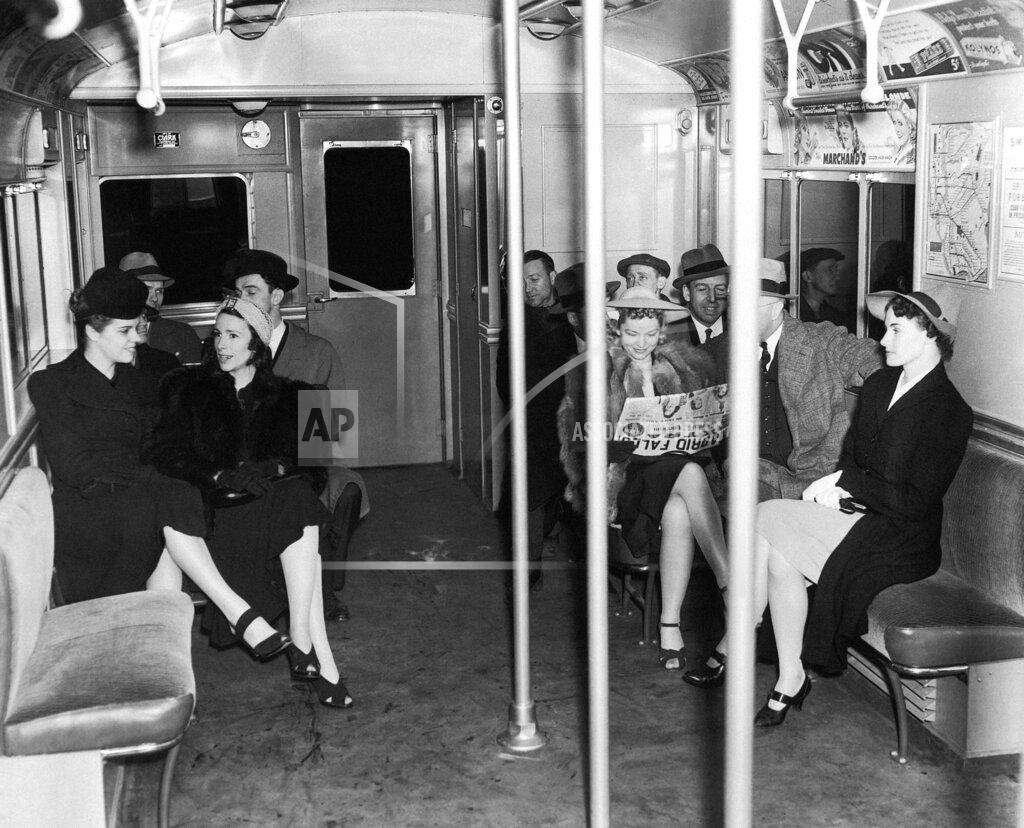
[Ed: And no graffiti. A more civilized age, in many respects.]
 History Diaries