A dispute over the War Powers Act has deeply divided members of Congress and the Reagan Administration. A Republican Senator said that some leaders of the Senate and White House officials had discussed petitioning the Supreme Court to rule on the constitutionality of the disputed statute.
At least 18 Lebanese were killed and more than 100 were wounded as heavy, random shelling of civilian neighborhoods erupted in a wide area of Beirut. The shells, fired by Christian and Muslim militiamen, crashed into apartment blocks and onto the streets and sent terrified residents racing for cover. The shelling appeared to be the worst since political talks ended in Switzerland on March 13 with a call for a cease-fire. Shells slammed into apartment blocks as ambulances careened through the streets. A bomb went off in a classroom at the American University this morning, but no one was hurt.
In southern Lebanon, a Lebanese military unit under Israeli command fired into a crowd of Shiite Muslim demonstrators, killing three people and wounding 10, Israeli military sources said. In Beirut this evening, President Amin Gemayel called the first meeting of the Higher Security Committee, newly formed to try to restore order. Its Muslim members apparently agreed to travel to the presidential palace in Baabda, a southeast suburb in Christian-held territory. In the past, Muslim leaders have refused to attend meetings near the Christian area. The committee is made up of Druze, Shiite, Christian Phalangist and army representatives. Mr. Gemayel is the chairman. The meeting began at 10:30 P.M. and continued into the night.
The four-hour exchange of shells in both sectors of the city produced some frightening scenes. A radio-appliance dealer and his son were killed when a shell struck a traffic circle in West Beirut. A pool of blood and a well-used pair of shoes marked the site of their death.
Israeli elections will be held July 23 under an agreement reached by the governing Likud bloc and the opposition Labor Party after a week of negotiation and compromise. Politicians on both sides said the early date made leadership struggles in either party unlikely.
Egypt took special security precautions following reports that Libyan leader Muammar Qaddafi might order a mass march across the frontier, similar to one he staged in the early 1970s, to press his goal of a merger with Egypt. Qaddafi also announced, despite Egypt’s objections, the reopening of the Egyptian-Libyan border, which has been closed for seven years. “Anybody, whether Egyptian or Libyan, can cross the border as of today,” Qaddafi said in a broadcast. “If someone wants to march to Egypt, he can go ahead.” His announcement came a day after an Egyptian spokesman said his government is determined to keep the border with Libya closed and added that reopening it “is not a unilateral measure.”
Diplomats say Iraq has performed the difficult feat of improving relations with Washington while also repairing a strain with Moscow. Both developments, the diplomats say, seem to be tied to Iranian successes in the Iran-Iraq war. Until President Saddam Hussein threw his country into war against Iran in 1980, Iraq had been one of the Soviet Union’s staunchest friends in the Middle East. The relationship was not based on ideological affinity; the Communist Party is outlawed in Iraq.
For Baghdad, Moscow served principally as the supplier of arms. The war with Iran, particularly in its early phase, largely pitted Soviet arms wielded by Iraq against the American weapons of the Iranian forces. Moreover, Baghdad, a consistent advocate of opposition to Israel and outspoken foe of the American role in the Middle East, found common interests with Moscow. The Iraqis have not restored diplomatic relations with the United States, which they broke in 1967 over the Middle East war. American diplomats function discreetly as a section of the Belgian Embassy, with limited access to Iraqi officials. The relationship with the Soviet Union was the first to be affected by Iraq’s invasion of Iran. Apparently because of concern over losing any possibility of influencing future events in Iran, the Soviet Union suspended arms sales to Iraq. This cast a chill over the longstanding friendship.
A Vietnamese reconnaissance plane was hit and damaged over Chinese territory, the official New China News Agency reported. The agency said the MIG-21 was fired on over Pingxiang near the border in southern China’s Guangxi province. and that it turned back toward Vietnam. It was the first such incident reported this year along the tense Sino-Vietnamese border.
A British diplomat was slain in his car two blocks from his embassy in downtown Athens and one of three Greek women riding with him was wounded seriously by an unidentified gunman. The diplomat was 44-year-old Kenneth T. Whitty, a first secretary at the embassy.
A one-day strike halted London’s subway trains and 90% of its buses, causing massive traffic jams as an estimated 2 million commuters took to their cars or bicycles or walked or jogged to work. Twenty London unions called the strike to protest government plans to abolish the Greater London Council and switch responsibility for public transport to a new government-appointed panel. Union leaders claim that, with the move, subsidies to the system will be cut in half, fares increased, stations closed and up to 16,000 jobs lost.
West Germany’s leading opposition party today demanded a ban on Nazi reunions, and European Jewish groups announced that they would join a demonstration outside a reunion this weekend. The Social Democratic Party in Parliament said in a statement that the government should propose tighter legislation to block reunions such as the one that veterans of the Waffen SS Third Panzer Division plan to begin Friday in a town in Hesse. Similar legislation was shelved recently by the coalition Government.
East Bloc nations, particularly Poland, recorded major economic gains last year, increasing production and exports, the Economic Commission for Europe said. The commission, a U.N. body, reported an overall substantial improvement in Eastern Europe’s financial position, with net debts declining about $7 billion in 1983 to about $60 billion. A 4.5% jump in output in Poland, the country’s first gain in five years, was a key factor, the report said.
Czechoslovakia, which recently renewed its dialogue with the Vatican after a three-year rift, described Pope John Paul II as the most reactionary and anti-Communist pontiff of the century. An article in the Communist Party weekly Tribuna said the Pope’s policy is “to restore anti-communism and passionate anti-Sovietism” and charged him with interfering in the affairs of the state-controlled Czechoslovak church. The article criticized the pontiff for naming two Czech emigres as bishops without state approval.
Defense Secretary Caspar W. Weinberger left on a weeklong trip to Europe focusing on a meeting of North Atlantic Treaty Organization defense ministers in Izmir, Turkey, on Sunday. Weinberger will first stop in the Netherlands for a meeting with Dutch officials in which he will stress the importance of early deployment of cruise missiles, an issue to be decided by the Dutch Parliament in June.
Francois Mitterrand defended Socialism at a lunch in the Pierre Hotel in Manhattan. In three years in office, the French leader pointed out, “we haven’t collectivized our economy, we didn’t create an Iron Curtain. We have chosen freedom.”
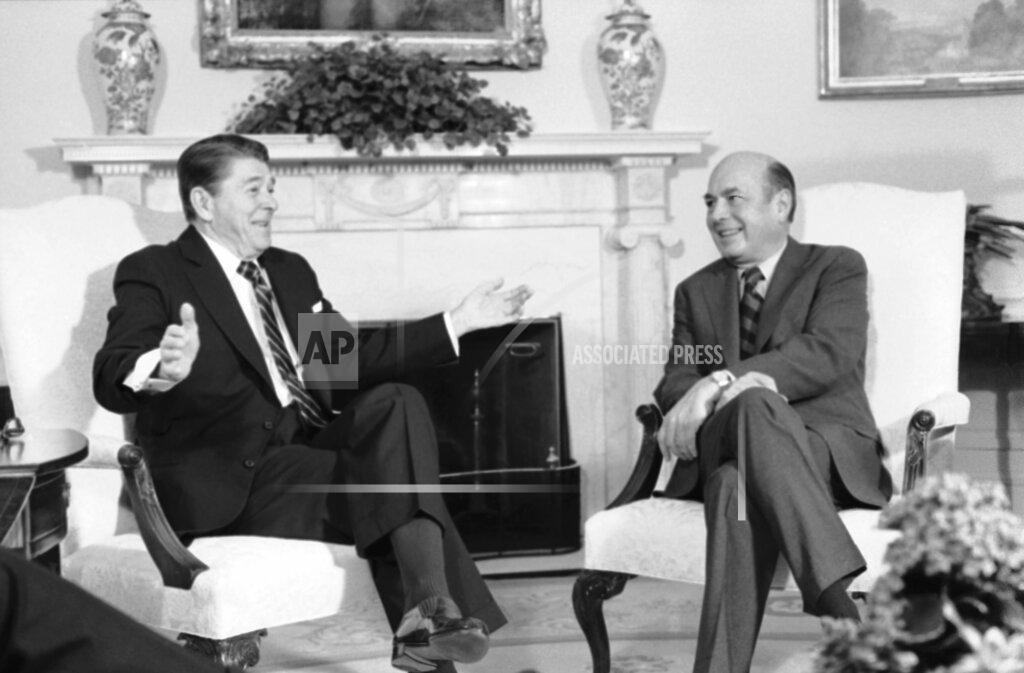
President Reagan meets with the U.S. Ambassador to the U.S.S.R., Arthur A. Hartman.
Sri Lanka Air Force troops fired on a Tamil crowd in a northern town today, killing at least 10 people and wounding 25, official sources said. A Defense Ministry communique said the slayings had occurred at Chunnakam, 200 miles northwest of Colombo. It said troops were returning to their barracks when Tamil-speaking terrorists opened fire from ambush. “Terrorists as well as bystanders numbering seven were killed and several others injured,” the ministry said. Other official sources, who asked not to be identified, said later that 10 people had been killed. Guerrillas demanding independence for Tamil-dominated Northern Province have recently stepped up their attacks on the police. President Junius Richard Jayewardene has been trying to ease ethnic tensions between minority Tamils and majority Sinhalese.
A freighter carrying 10,000 tons of molasses hit a mine and was damaged as it was leaving the Nicaraguan port of Corinto, the Nicaraguan government said. There was no immediate report of injuries aboard the Liberian-registered Inderchaser, but damage to the hull forced the ship to return to port. The Nicaraguan Foreign Ministry said the mine was planted at Corinto, on the Pacific about 55 miles northwest of Managua, by U.S.-supported rebels on “instructions from… the CIA.” Last week, a Soviet tanker was damaged, with five crewmen injured, when it hit a mine at another Nicaraguan port.
A teenage girl died today from a gunshot, raising to five the death toll from anti-Government protests in Chile Tuesday. The Neurosurgical Institute said Erika Sandoval, 15 years old, died after surgery to remove a bullet from her head. She was shot Tuesday night as army troops and riot policemen clashed with demonstrators here. Besides the five killed, at least 15 people were wounded and 400 arrested. The protest was organized by labor groups and centrist and Marxist political parties. It was widely supported by students, bus owners and shopkeepers in Chile’s largest cities — Santiago, Valparaiso and Concepcion. Rock-throwing students clashed anew with the police today at a University of Chile campus in eastern Santiago.
Gary Hart and Walter F. Mondale clashed repeatedly on foreign policy and arms control issues in a nationally-televised debate marked by sharp accusations about campaign tactics in the race for the Democratic Presidential nomination. As the Rev. Jesse Jackson tried to quiet them, Senator Hart and Mr. Mondale engaged in heated exchanges in which the former Vice President protested that Mr. Hart was misrepresenting his position on American military forces in Central America and the Senator insisted that his policies were being misrepresented.
President Reagan participates in an interview with two reporters from the New York Times.
Moving the American Embassy in Israel from Tel Aviv to Jerusalem would be “most unwise,” President Reagan said in a wide-ranging interview. Mr. Reagan suggested strongly he would veto legislation in Congress to require such a move.
Former Interior Secretary James G. Watt said his decision to hire a man who helped Attorney General-designate Edwin Meese III sell his house was made without Meese’s knowledge. Thomas J. Barrack Jr., a real estate developer, was appointed deputy undersecretary of the Interior in December, 1982, three months after Barrack gave a friend $70,000 for a down payment on the house. Also, CBS News reported that Meese failed to turn over a $375 gift of cufflinks from South Korea, as required by law. After CBS’ queries, Meese turned in the cuff links.
House Democrats unveiled a television campaign advertisement that charges the Reagan Administration contains “more scandal-tainted officials than we’ve seen since Richard Nixon and Watergate.” The 30-second ad opens with a color portrait of a smiling President Reagan, described by an announcer as having promised to “bring a new morality to government.” But then the announcer unveils a litany of charges beginning with “sweetheart loans,” accompanied by a photo of Attorney General-designate Edwin Meese III, and “hidden financial deals,” featuring a picture of CIA Director William J. Casey.
Jesse Jackson, at Three Mile Island, called on the nuclear power industry to end a “callous disregard” for the public in operating its plants. The Democratic Presidential aspirant took part in a candlelight vigil on the fifth anniversary of the accident at the Pennsylvania plant.
“Knowledge engineering” is expected by many people to exert a profound influence in the workplace. The process involves interviews with leading experts in each profession to determine how they make judgments that are the core of their expertise. The knowledge is then codified so computers can make similar decisions by emulating human inferential reasoning.
A deficit-reduction plan won the final approval of the House Budget Committee. The plan, backed by the House Democratic leadership, would for the first time require the House to match spending increases with equal increases in taxes or with spending cuts. If implemented, the plan would cut the budget deficits by $182 billion over three years.
The benefits of banning or severely restricting leaded gasoline “substantially exceed the costs,” the Environmental Protection Agency concluded in major report. Lead pollution comes mainly from the burning of gasoline in motor vehicles. EPA Administrator William D. Ruckelshaus said March 12 he is considering accelerating the nationwide “phase-down” in leaded gasoline because of surveys showing about one-fifth of U.S. motorists illegally “misfuel” their cars with leaded gas.
The U.S. Supreme Court cleared the way for a May 5 presidential preference primary in Louisiana. Legislators had canceled the primary to save $2 million, but a three-judge federal court ordered the state to hold it. The action means that, barring further lower court challenges, the state must now hold the primary.
High natural gas prices are generating anger among municipal leaders and residents of Wyoming, one of the nation’s biggest gas-producing states. Casper and a handful of other Wyoming municipalities are considering seizing local gas utilities through condemnation and setting up municipal gas systems as they did during the Depression.
A man with a Spanish accent threatening to ignite a bottle that he claimed was filled with a flammable liquid hijacked a Boeing 727 with 26 persons aboard to Cuba. Delta Flight 357, carrying 19 passengers and a crew of seven from New Orleans to Dallas, was hijacked at 9:47 pm CST, said a Federal Aviation Administration spokesman in Atlanta. The plane landed safely at Havana’s Jose Marti Airport and the hijacker was quickly hustled off the plane and taken into custody by soldiers. The FAA said the plane likely would stop in Miami before heading to Dallas. The hijacking was the second successful air piracy to Cuba in as many days and the 13th since last May 1.
The discovery that wild honeybees make “massive defecation flights” in Southeast Asia helps prove that “yellow rain” is actually bee droppings, not chemical warfare, a Harvard biologist said. Professor Matthew Meselson said after a field trip to Thailand they were bombarded with excrement from thousands of bees. The United States has charged that Soviet-made chemical weapons of fungal toxins known as yellow rain have caused at least 10,000 deaths in Laos, Cambodia and Afghanistan. The Russians have denied the charges.
An estimated 4,000 union members and supporters marched on the Las Vegas “strip” in a pre-strike demonstration of solidarity four days before a possible walkout for more money at 50 major gambling resorts. Union leaders said the march is a prelude of things to come if 30,000 culinary, bartenders, musicians and stagehands strike at midnight Sunday. Marchers chanted “No Way N-R-A,” referring to the Nevada Resort Association, which represents 20 major gambling resorts in contract negotiations.
The Federal Bureau of Investigation today joined the Food and Drug Administration in a nationwide investigation of apparent malicious tampering with Girl Scout cookies. “We’re currently investigating about 30 reports of metal objects found in Girl Scout cookies in Colorado, Virginia, Nebraska, Kentucky, Indiana, Illinois, Ohio, New Jersey and Minnesota,” Jim Greene, a spokesman for the drug agency said. “Two of the incidents were discounted as false alarm.” “The FBI has joined the investigation,” Mr. Greene said. “We have probably several incidents in which someone deliberately injected metal objects into the cookies. We believe the majority of these incidents have been caused by malicious tampering.”
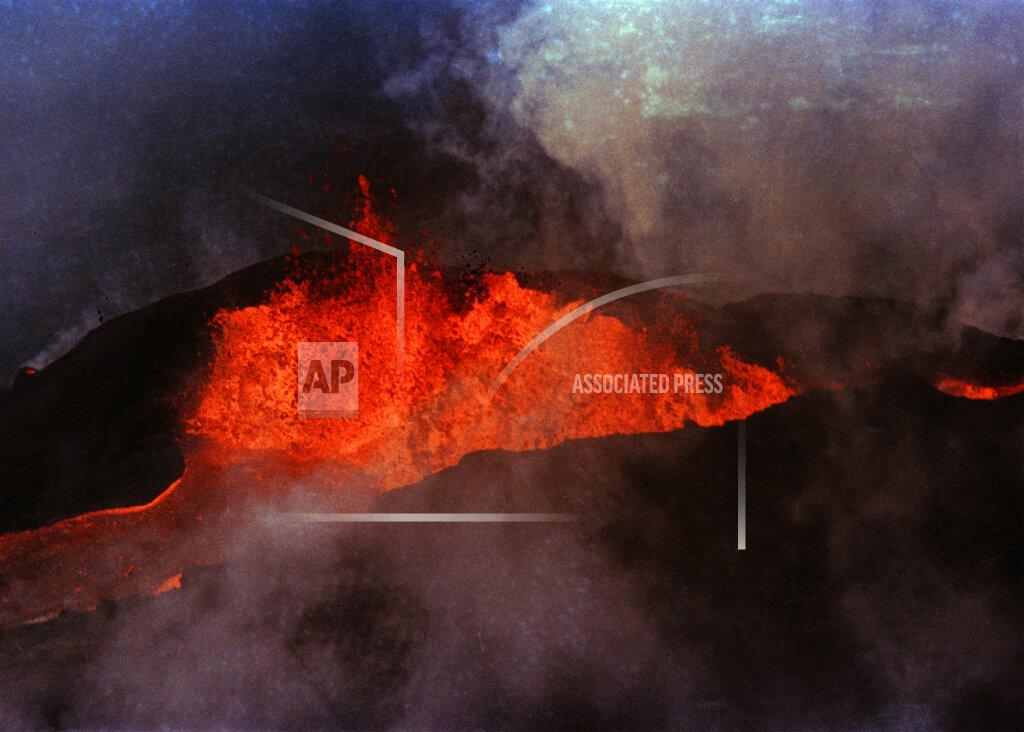
Earthquakes rocked Mount St. Helens an average of 10 times an hour Tuesday and scientists said lava could soon emerge, accompanied by small explosions. The crusty, 80-story-high lava dome inside the crater was swelling rapidly with magma, they said. “Frequent earthquakes and rapid swelling of the dome indicate that a new episode of dome growth is beginning,” said Steve Brantley, a United States Geological Survey scientist. “Current growth is internal,” he said. “If magma continues to rise through the dome, lava will be extruded onto the surface within a few days.” A danger zone around the volcano remained open to people with permits.
Dow Jones Industrial Average: 1174.62 (+20.31).
Born:
Nikki Sanderson, British actress (“Coronation Street”, “Hollyoaks”) and model, in Blackpool, Lancashire, England, United Kingdom.
Stephen Bowen, NFL defensive end (Washington Redskins, Dallas Cowboys, New York Jets), in Holly Ridge, North Carolina.
Ryan Christenson, MLB centerfielder (Oakland A’s, Arizona Diamondbacks, Milwaukee Brewers, Texas Rangers), in Redlands, California.
Hugh Jessiman, NHL right wing (Florida Panthers), in New York, New York.
Died:
Kenneth Whitty, 44, 1st secretary at the British Embassy in Athens, shot dead.
Benjamin Mays, 89, African-American educator (Morehouse, Howard University) and civil rights leader.


 History Diaries