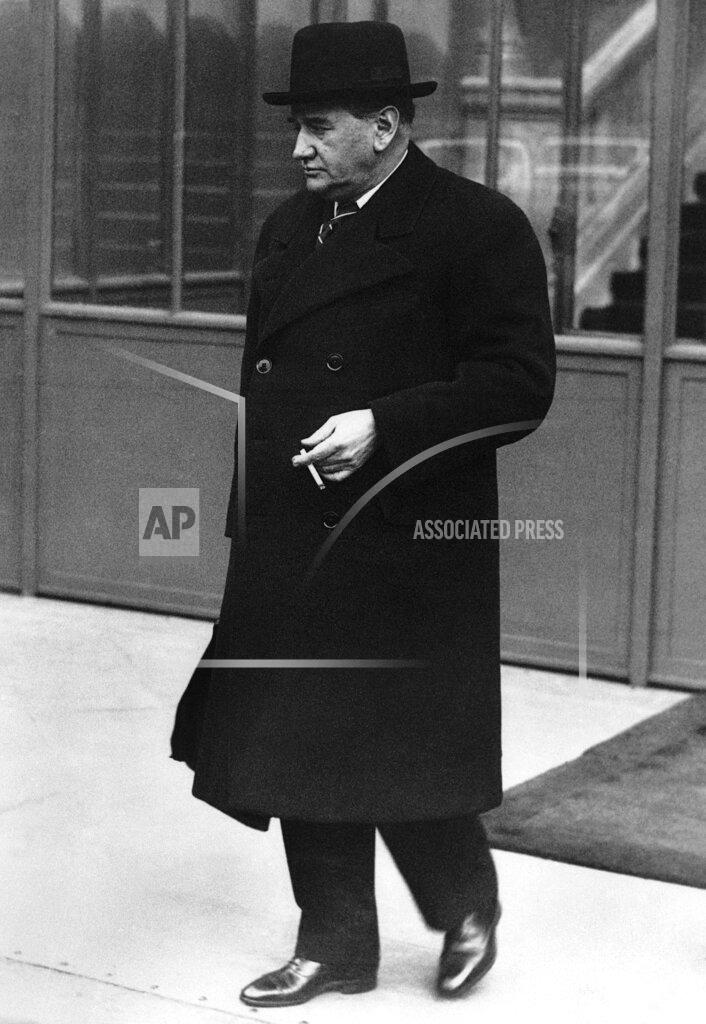
Polish military preparations, which, according to Information from diplomatic quarters in Berlin, entail the mobilization of two classes of reservists and expansion of the Polish Army to 700,000 men, are being watched by German officials with obvious interest. However, there is a stony silence on the subject both in official commentaries and in the press. The Foreign Office categorically denied today reports from Soviet sources that Germany had served an ultimatum on Poland regarding Danzig. In German political quarters the “ultimatum” was modified to a “démarche” in Warsaw, opening preliminary soundings for the return of Danzig. However, pending the arrival in Berlin of Ambassador Hans Adolf von Moltke to report the results, official quarters likewise denied that such a démarche had been made and that any negotiations had been opened beyond some on “normal current matters.” Questions as to whether the Danzig question had become acute were answered with the cryptic statement: “Not In any new sense.” The same silence was observed regarding the extensive anti-German demonstrations in Poland and the defiant statement in the Polish semi-official press warning all concerned that Poland would not repeat the Czecho-Slovak tragedy but would fight even the biggest antagonist.
German General Walter Warlimont of the OKW started working on FALL WEISS (CASE WHITE), the plan for the invasion of Poland, and by the end of the month, the first draft of FALL WEISS was completed. The choice of late August-early September 1939 as the moment for begin FALL WEISS was decided by Hitler himself. Weinberg wrote: “The choice of a fall campaign in 1938 and 1939 was not accidental: Hitler wished to move after the harvest and before bad weather set in; he wanted enough time for his own first campaign, but with a winter immediately afterward separating that campaign from any offensive by the Western powers. In 1938, he had at the last moment recoiled from war; in 1939 the calendar would be more rigid both because Hitler was more determined and because the autumn rains in Poland made any postponement beyond the 1 September date he had tentatively set ‘extremely dangerous.’”
British Foreign Secretary Lord Halifax sends a telegram to H. Kennard of Warsaw, Poland, and R. Hoare of Bucharest, Romania, suggesting England, France, Poland, and Romania agree to help any of the group if attacked by Germany. Hitler has just finished digesting the remains of rump Czechoslovakia, and now turns his attention to the German populated Free City of Danzig, and the Poles. The British, stung by Hitler’s Machiavellian dismemberment of Czechoslovakia, edge towards backing the Poles with the threat of force. The last pre-war Spring of Europe has begun.
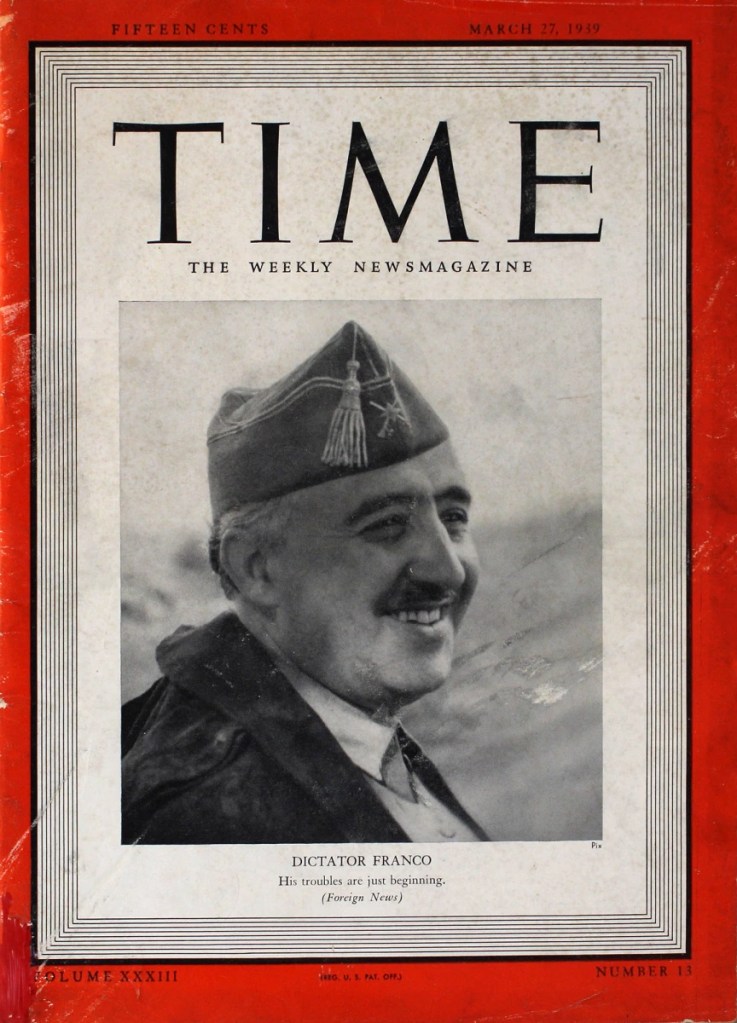
Madrid moves civilians as Franco nears. Nationalists report the capital’s defenses are crumbling. The fall of Madrid to Generalissimo Francisco Franco appeared imminent early today. Possible quick capitulation by the Republican National Defense Council was indicated by two sudden moves late last night. First, the council began assisting the flight of those wishing to escape possible vengeance at the hands of the Nationalists. Later it demobilized recruits who had been called up but who had not yet joined the army. The demobilization move confirmed the belief the Defense Council did not intend to resist the Nationalists, who today opened up an encircling offensive against the besieged capital.
At the same time the council was trying to keep the city orderly, observers believed, as a prelude to peaceful entry by General Franco’s troops. Repeated appeals were broadcast over the Union Radio for the population to remain calm. Among the speakers broadcasting were Colonel Segismundo Casado, Republican Defense Minister, and representatives of the Anarchist and Socialist parties. Colonel Casado, on the radio, declared: “We continue our labors to ensure peace as soon as possible. We want to end the war and attain peace. In the name of all Spaniards, I promise we shall have peace.”
But the Defense Council’s actions indicated peace negotiations had broken down. Several officials addressing the people on the radio indicated that peace negotiations had been at a standstill since Sunday night. They said defense measures were being taken against expected Nationalist offensives. Those negotiations broke down, officials of the council said, when the Nationalists in conversation last Thursday insisted upon delivery of the Republican air force by last Saturday. The Republicans said this “token” surrender proved impossible because of the short time allowed, although Nationalists’ guarantees of treatment of all persons in Republican territory except “criminals” and those “responsible for continuing the war had proved satisfactory.” General Franco launched a new offensive south of Madrid after the council had promised delivery of its air fleet yesterday. Despite these developments, the council had indicated early yesterday it would continue to attempt to carry out its purpose-the obtaining of an “honorable peace.”
In Spain, the Republican Loyalist government is crumbling, as Franco’s nationalist Falangists prepare to enter Madrid. The Spanish Civil War has been long and bloody, and many in Franco’s movement now look to settle accounts. It has been estimated by some that more than 200,000 Spaniards died in the first years of the dictatorship, from 1940–42, as a result of political repression, hunger and disease related to the conflict. The lowest estimates of the number of executions during the first five years after the war are of 50,000.
From the way the Italian press today interprets Premier Mussolini’s speech of yesterday there seems little doubt that Italy’s claims, although “colonial,” are of a territorial nature. In fact, several editorials come out openly with the contention that the time is now ripe for a general revision and adjustment of the Mediterranean situation in Italy’s favor. The reason adduced is that 45,000,000 Italians cannot indefinitely continue to be suffocated in their “own sea” and that the democracies cannot indefinitely continue to be the exclusive owners of Mediterranean “key points.”
The theme the press preferably emphasizes is that France is “only in part” of the Mediterranean, whereas Italy’s entire coastline — a total of 5,000 miles — is on that sea. In other words, France should have a secondary position in the Mediterranean compared with Italy’s — a premise that gives a fair estimate of the extent of Italian aspirations. Although Signor Mussolini has not yet indicated the way that the problems between Italy and France should be settled, there is no hesitation in the minds of some Italian commentators as to what Italy would consider “satisfactory.”
There is evidence everywhere that French patience is beginning to become exhausted by Premier Mussolini’s coquetry. Following yesterday’s speech his note of December 17 has been reexamined by the Quai d’Orsay and the same answer has been found as was found when it was delivered: that it is neither specific in its demands nor are they founded on good juridic reasons. With the best will in the world, the French Government feels that it cannot begin any negotiations on these terms. To do so would amount to replying, says Gallus in the Intransigeant, that “we have read in the newspapers that you want something; come along quick and let’s talk it over.”
So Premier Édouard Daladier is expected to reply in his radio speech, which has been set for Wednesday evening, in effect as follows: “Dear Il Duce, we have an ambassador in Rome and you have an ambassador here. If you want peace and harmony and have anything to say please say it to one or the other of them. Yours sincerely, Édouard Daladier.” Not quite in such blunt words, of course.
German comment today on Premier Benito Mussolini’s speech of yesterday not only emphasizes the Italian leader’s reaffirmation of the solidarity of The Rome-Berlin axis but also pledges moral support of the Italian demands on France. German opinion, as reflected in the press, is that Italy has spoken-it is now up to France to reply.
The Diplomatische Korrespondenz, organ of the German Foreign Office, outlines briefly the reasons for Italy’s claims and states: “Premier Mussolini gave France an opportunity to settle her dispute with Italy and to place their relations on a fair basis in accordance with the rights and interests of the new empire. It will be difficult for France to remain adamant in the face of such common-sense demands or even to make them the object of any political bartering.”
The Foreign Office organ records with satisfaction the following: “Nothing has changed in the mutual understanding of the axis’s duties or functions. It remains-according to Il Duce’s own words to the Führer — an instrument destined to revise the Old World’s reactionary and conservative policies and at the same time ward off the dangers of Bolshevist doctrine.”
A new outbreak between Hungarian and Slovak troops was reported today as negotiators of their border dispute began conversations that some Slovaks feared would end in most of their country’s going to Hungary. A Hungarian communiqué said that a minor clash occurred in the Kiskolon region of the border between Slovakia and Carpatho-Ukraine, two pieces of former Czecho-Slovakia, but made no mention of any casualties.
The skirmish followed three engagements yesterday in which the Budapest government said that eight Slovaks were killed, several wounded and an undisclosed number taken prisoner. An official announcement put at twenty-three dead and fifty-five wounded the Hungarian military and civilian casualties in fighting and air attacks in the Ung Valley. It was also announced that the Hungarian forces captured 360 Slovaks and 211 Czech-Moravian soldiers on the Carpatho-Ukraine frontier. During the negotiations starting today, questions of indemnities and “prisoners of war” were to be raised.
Chief British generals are to be the guests of major French officers today; they are expected to see the Maginot Line
The German chargé in Washington defends the seizure of Czecho-Slovakia as strictly legal and necessary.
Edvard Beneš predicts the Czecho-Slovaks will revolt if they get support of the democracies. The former president of Czechoslovakia sees a revolt if the country is provided with aid. He urges U.S. leadership in the endeavor.
Britain and the Soviet Union agree to open talks in London soon for a trade treaty.
Portugal is returning to Britain’s orbit, distrusting Franco’s German and Italian allies.
Danish royalty tour the Panama Canal area. They will also visit the World Fair exhibits in the United States.
British troops shoot an Arab rebel chief in Jerusalem as he attempts to break through a cordon.
A Syrian revolt may be developing but no demonstrations greet the new Cabinet.
A U.S. House of Representatives group which has long favored an investigation of the Works Progress Administration, and lately has grown strong enough to brook no opposition, won for the Appropriations Committee the needed authority today by a vote of 352 to 27. In adopting the resolution by Representative Cox of Georgia, the House instructed the committee to inquire into the expenditure of funds by the WPA with a view to formulating a policy expected to guide the House, if not the whole. Congress, in future appropriations for relief.
Only those considered “die-hard” New Dealers opposed the resolution after Representative Rayburn, the majority leader, went along with the powerful group, which was believed strong enough to have adopted the resolution regardless of Administration opposition. So overwhelming was the approval that tonight observers were convinced that Representative Taylor of Colorado, chairman of the Appropriations Committee who will name a subcommittee to do the actual work, would include upon it Representative Woodrum, Democrat, of Virginia, leader of the House economy bloc, and Representative Taber, Republican, of New York, arch-foe of the WPA.
Mr. Woodrum is expected by some to be made chairman of the subcommittee, since for several years he has led the fight for an inquiry into relief activities. He recently introduced a bill which put forward the question, “Where is the nation going so far as relief is concerned?” Mr. Taylor, ordinarily ranked as a New Dealer, lately has indicated he was more in accord with the faction of the Appropriations Committee headed by Mr. Woodrum. At least, say those acquainted with the inner affairs of the committee, he has shown no desire to rush forward a bill for the full $150,000,000 for a WPA deficiency appropriation demanded by President Roosevelt. His committee, earlier in the session, had denied the full request of the Chief Executive for $875,000,000 for the remainder of this fiscal year.
The Senate approved the nation’s largest peace-time appropriation for the War Department today without a dissenting vote. Only nineteen members were on the floor when Senator Minton, who was presiding, put the question of final passage, after a perfunctory debate. “Without objection, the bill will be considered passed,” Senator Minton said, and no voice was raised against it.
Just previously, Senator King, Democrat, of Utah, had offered a motion to recommit the measure to the Appropriations Committee with instructions that the total appropriation be cut 10 percent. When Senator Minton put that question to a vote, Senator King forgot to speak up, so there were no votes for his proposal and a few scattered “no’s” dispatched it. The appropriation as approved is larger by $13,330,938 than the amount the House voted, so the bill will be returned to the lower chamber for further consideration.
As adopted by the Senate when it approved without debate the Appropriations Committee’s amendments, the bill would provide $513,188,172 for the War Department during the fiscal year beginning on July 1. This would enable the army to buy 784 airplanes, in addition to 558 on order and 348 to be ordered under existing authorizations, making a total possible increase of 1,690 in air corps planes.
In one of its most far-reaching decisions the U.S. Supreme Court today wiped out the theory of reciprocal immunity which for many decades has prevented the states from placing an income tax on federal salaries and the government from levying upon the pay of state employees. The decision was by six to two, with Justice Stone writing the majority opinion, and Justices Butler and McReynolds dissenting. The Stone opinion specifically overruled the court’s sixty-eight-year-old decision in Collector vs. Day and also the finding in Rogers vs. Graves, only two years old, but likewise of vital importance. The first had barred a government tax on income of a state officer; the second forbade a state tax on a federal employee. On all sides the majority opinion was regarded as a distinct victory for President Roosevelt in his appointment of new justices to the court and in his program to remove the reciprocal tax immunity which federal and state employees have long enjoyed.
A pathologist tells of new ways to grow bone marrow that is helpful in treating blood cancers.
Following the successful experimental refueling of patrol planes by the submarine Nautilus (SS-168), the Commander in Chief U.S. Fleet, directed that Submarine Division Four and Patrol Wing Two conduct refueling tests at frequent intervals and carry out an Advanced Base problem each quarter to develop to the utmost the possibilities for refueling patrol planes under various conditions.
The U.S. professional National Football League plans to expand to 8 or 10 teams from the current six.
First NCAA Men’s Basketball Championship: The University of Oregon beats Ohio State, 46-33; Ohio State forward Jimmy Hull is named the tournament Most Outstanding Player.
The Japanese are expected to capture Nanchang without difficulty and then prepare for a westward march toward Changshi. on the Canton-Hankow Railway in their effort to control that line. The battle for Nanchang, which extends over a line almost 100 miles. long, has involved the heaviest air, artillery and infantry fighting since the capture of Hankow last October. Japanese official reports declared the Seventy-seventh Chinese Division at Wuning had been reduced from 9,000 to 700 men in five days of fighting.
The assault upon Nanchang, which was the most important Chinese concentration point in Kiangsi Province, imperiled the main base of the Chinese regulars and guerrillas south of the Yangtze River. By cutting the east-west Chekiang-Nanchang-Changsa Railway the Japanese disrupted China’s last rail link for coastal supplies of munitions and other imports from abroad. Sixty-five miles to the north Japanese are extending their lines around Wuning which the Chinese evidently intend to attempt to hold. Japanese fliers report large Chinese reinforcements are arriving hourly at Wuning.
Japanese invaders find the city of Nanchang empty. Chinese dynamite bridges and set fire to buildings.
Japanese 101st Division captured Nanchang, Kiangsi (Jiangxi) Province, China. The Japanese smash their way to Nanchang in the Kiangsi province. The battle line is 100 miles long, but fighting now centers around city gates. Japanese troops are fighting at the walls of Nanchang, long a Chinese stronghold in Kiangsi Province, after a dash by mechanized columns from the west and northwest. During part of the swift advance tanks were refueled by planes. The Japanese reached the west bank of the Kan River opposite. Nanchang yesterday morning. Shortly before dusk they crossed the river in junks that had been taken from villagers. They immediately entrenched on the east side of the river under heavy rifle and machine gun fire from the city. Japanese fliers reported that large bodies of Chinese troops started to retreat southward from Nanchang immediately after the invaders captured the Kiukiang-Nanchang Railway station across the river from the city. The retreating troops dynamited part of the railway bridge shortly before noon yesterday.
Dow Jones Industrial Average: 141.14 (-0.41).
Born:
Cale Yarborough, American auto racer (NASCAR Cup Series 1976, 1977, 1978; Daytona 500 1968, 1977, 1983, 1984), in Timmonsville, South Carolina (d. 2023).
Maurice Petty, American auto racing crew chief, engine builder and team owner (Petty Enterprises, International Motorsports & NASCAR Hall of Fame), in Level Cross, North Carolina (d. 2020).
Jim Wright, AFL defensive back (Denver Broncos), in Columbus, Mississippi (d. 2009).
Claude Cyr, Canadian NHL goalie (Montreal Canadiens), in Montreal, Quebec, Canada (d. 1971, of pneumonia).
Charles Lyell, 3rd Baron Lyell, British politician and Conservative member of the House of Lords (d. 2017), in Dundee, Scotland, United Kingdom.
Jay Kim, U.S. House of Representatives from California, in Seoul, South Korea.
Bo Winberg, Swedish instrumental rock guitarist (The Spotnicks – “Hava Nagila”; “Amapola”; “Karelia”), born in Gothenburg, Sweden (d. 2020).
Died:
Constance Lindsay Skinner, 57, Canadian author (Rivers of America).
Naval Construction:
The Kriegsmarine (German Navy) Type 37 torpedo boat T21 is laid down by F. Schichau, Elbing, East Prussia (werk 1448).



 History Diaries