While Madrid is quiet, the Spanish insurgents opened a new round of fighting near Cordoba. Surrender negotiations break down. General Franco accuses the Loyalist leaders of delaying tactics. Military operations, which have been almost completely interrupted since the conquest of Catalonia, were resumed early this morning when the Nationalists opened a big offensive on the Cordoba front in the south of Spain. Because they are reported to have felt that they had insufficient authority to speak for various political and military groups in the Republican zone, the emissaries, who are said to have flown here from Madrid yesterday for a second. parley with the Burgos authorities, apparently were unable to arrange. for the unconditional surrender which the Nationalists demanded. Meanwhile, however, on the Madrid front a truce exists as though by unspoken but mutual consent on both sides, with no clash throughout the day or night.
The Republican National Defense Council has decided to surrender Madrid despite the collapse of peace negotiations with the Nationalists, reports reaching France said today, according to an Associated Press dispatch from Hendaye, at the Spanish frontier.
Deserters from the Republicans are reported to have said that Madrid’s food supplies are almost completely exhausted and the munitions reserve stocks are so low that the city’s defenders could not resist any really heavy blow that Generalissimo Francisco Franco’s troops might strike now. Nationalist officers declare, however, that General Franco does not wish either to kill any of his sympathizers who may be in the capital or to blast away any more of the city. This may explain why the offensive began this morning in Andalusia — to the general surprise of both Spaniards and foreign observers.
A communiqué issued tonight said that the Nationalists had penetrated rapidly to a great depth in Republican territory as only feeble resistance had been encountered. The same Republican Douglas plane that was reported to have brought the peace delegates from Madrid on Thursday was said to have arrived at the airdrome in Burgos again yesterday at 2:40 PM and to have left once more for the capital three hours later. It was piloted by Lieutenant Gorrochano of the Republican air force, and the plenipotentiaries with him were said to have been a lieutenant colonel and a captain from General José Miaja’s staff, but no official version of their visit was available.
According to unofficial reports the plenipotentiaries arrived late because of a snowstorm and were immediately taken to a near-by house where they ate a large meal. Thereafter they were met by the head of the Nationalist secret service and an officer from general headquarters. The time limit that they were reported to have received on Thursday, of seventy-two hours for a surrender of arms, would have ended at midnight tonight.
The Polish rebuff German attempts to negotiate control of the city of Danzig. Polish Ambassador Jozef Lipski in Berlin completely rejects Germany’s proposals of October 1938. Beck refuses to even meet with Hitler, and instructs Lipski to tell German Foreign Minister Joachim von Ribbentrop that if Germany continues to insist on the idea of a German Danzig, it would mean war. Meanwhile, Ribbentrop tells Lipski, that “any violation of Danzig territory by Polish troops would be regarded as aggression against the Reich.”
Ribbentrop was extremely angry with Lipski when the latter gave him a memo saying that Poland was still committed to preserving the status quo with regard to Danzig. A Polish offer made by Lipski for a joint German-Polish guarantee of Danzig and for customs-free travel across the Polish Corridor was rejected by Ribbentrop.
It was learned today that the Polish Government had politely but firmly declined German suggestions for negotiations on Danzig. These suggestions were communicated to the government by Ambassador Josef Lipski, who arrived here from Berlin Thursday after a conversation with Joachim von Ribbentrop, the German Foreign Minister. Herr von Ribbentrop wanted to learn whether Poland was ready to discuss a final settlement of the Danzig problem. This was not the first German proposal for talks on Danzig. In the past the Poles have declined all such proposals without much harm to Polish-German relations. It was understood that after President Ignaz Moscicki conferred with Marshal Edward Rydz-Smigly and Foreign Minister Josef Beck it was decided to give a negative reply this time too.
It is pointed out that the treaty and conventions governing Danzig adequately safeguard Polish interests and that the situation there is quite satisfactory. The Germans in the Free City enjoy full national rights and the National Socialists are in power. Political circles here are confident that Poland’s answer, though negative, will close the exchange of views about Danzig for the time. being. However, in the present circumstances and the tense international situation the government has taken certain precautionary military measures.
Poland, delicately poised between expanding Germany and Soviet Russia, moved today to meet a potential Nazi threat from the west by taking steps toward internal solidarity. One major step in this direction came with a report that the government had permitted the famed peasant leader and ex-Premier, Wincenty Witos, and his aide, one-time Interior Minister Vladislas Kiernik, to return to their homeland after a nine-year exile in Czecho-Slovakia. It was reported reliably that M. Witos already was in Polish territory and his submission to the government’s authority would be announced simultaneously with amnesty for him. The anticipated repatriation of the two prominent political exiles was interpreted here as illustrating the internal consolidation now in process in Poland.
German troops gather near the Swiss line and are believed to be moving toward assisting Italy.
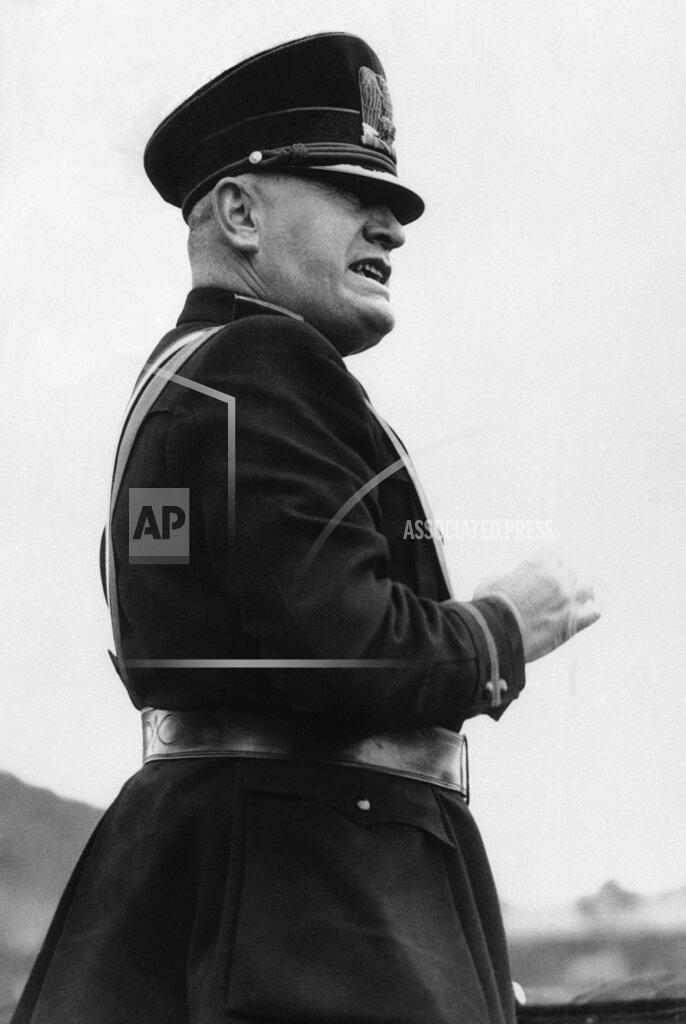
Premier Benito Mussolini sounds mild in a speech celebrating the 20th anniversary of his party. In a speech delivered this morning to an enormous crowd of cheering Fascisti gathered for the celebration of the twentieth anniversary of the founding of the movement, Premier Mussolini invited France to discuss a peaceful settlement of Italo-French problems, which, he said, consisted of Tunisia, Djibouti and the Suez Canal. He added that Italo-French negotiations were impossible during the Spanish civil war, which had raised a barrier between the two countries, but he suggested that conversations interrupted in May, 1938, might be usefully resumed now that the triumph of the Spanish Nationalists was only a matter of days, perhaps hours. France is perfectly at liberty, Signor Mussolini said, to reject the discussion proposed by Italy, but if she does she must not complain when the breach between the two countries becomes too wide to bridge. In any case, he added, Italy refuses to make any contribution to European appeasement until her “sacred rights” have been recognized. Meanwhile she must arm to the utmost possible limits, even if it means “wiping out all that is called civil life.”
Paris found the speech less peremptory than had been expected and indicated a willingness to discuss the problems with Rome.
In London the Italian Premier’s utterances encouraged the school that holds no drastic policy changes are necessary.
The Germans applauded the speech and particularly welcomed its emphasis on the unity of the Rome-Berlin axis.
Moscow, although feeling that Germany was not in a position to give full support to Italy against the Western democracies, was surprised at the mildness of the Italian demands.
Rumania scorns the idea that a trade pact with Germany is equal to surrender and says the country will fight to the limit to protect its independence. With regard to Germany’s expansion aims, the Rumanian Premier asserted that his country would fight against any invasion regardless of what other nations did and denied that the new trade agreement was connected with Germany’s campaign of aggrandizement.
Hungary contended today that she had won a complete victory in the miniature three-day war waged with Slovakia in their frontier dispute as the government prepared to negotiate on the border problem tomorrow with a Slovak mission. The armed conflict was stated to have ended yesterday when the Slovaks accepted the Hungarian proposal to send a commission to Budapest to settle the frontier controversy. An official announcement said all was quiet today on the line between Slovakia and Carpatho-Ukraine, annexed by Hungary from the dismembered Czecho-Slovak republic. The announcement said that Hungarian troops were firmly established in regions west of the Ung River valley, which they occupied last Thursday. It said that all Slovak attempts to dislodge the Hungarians were repulsed, eleven airplanes were brought down and seventeen planes and hangars were destroyed at Iglau (Spišská Nová Ves).
Slovakian forces gathered on the Hungarian border in preparation of a renewed counteroffensive, planning on pushing into Hungary if possible.
Prague officials hurry to adopt anti-Jewish laws similar to the Reich’s.
Congress will continue this week to wrestle with problems of parity payments to farmers, changes in the neutrality laws, revision of the Social Security old-age insurance tax system, deficiency relief appropriations and national defense. It is not expected, however, that the end of the week will see any of these important questions added to this session’s list of completed legislation. It is expected that the Senate will take up tomorrow the $513,188,882 War Department appropriation bill, which its Military Affairs Committee reported out last Friday with some $13,000,000 added to the total approved by the House. Unless the added items are deleted on the Senate floor, it will be necessary to send the bill back to the House for concurrence in Senate changes.
In the House the schedule for tomorrow calls for the usual Monday consideration of calendar bills. Whether the calendar will be curtailed or set aside to permit resumption of debate on the Agriculture Department Appropriation Bill was undecided tonight, as far as could be learned.
If the regular calendar day is allowed to interrupt the debate on the agriculture bill, however, it will permit additional time for jockeying by both sides in the fight to retain in the bill a provision for $250,000,000 in parity payments to farmers. Passage of this bill was expected not later than Tuesday, and leaders of the fight for retention of the parity payments predicted victory.
A behind-the-scenes campaign went on over the week-end to line up votes for the parity payments proposal. The farm forces are divided into two camps, one favoring the $250,000,000 appropriation recommended by the Appropriations Committee and the other advocating increasing it to $500,000,000. Leaders were striving to whip their forces into a solid front in favor of the $250,000,000 provision, believing that passage of the bill with that amount is possible, but that any attempt to increase it would mean defeat of the entire parity payments program. Representative Cannon of Missouri, in charge of the bill on the floor, remained confident today that the bill would pass with the $250,000,000 parity payments item included.
Braniff Flight 1, operating from Chicago to Brownsville, Texas, crashed on takeoff from Oklahoma City Municipal Air Terminal, today known as Will Rogers World Airport. Early that March morning, the aircraft, a Douglas DC-2, registration NC13727, suffered an explosion in the left engine that, in turn, caused the engine’s cowling to open up, creating serious drag on the left wing. The flight’s captain, Claude Seaton, struggled to keep the aircraft stable while turning back for an emergency landing at Oklahoma City. The aircraft’s compromised wing hit an embankment on the section line road forming the airport’s western boundary and cartwheeled across the ground. Seaton ordered the aircraft’s fuel to be cut off, but in vain, as, when the plane came to rest on the ground, fuel came in contact with the still-hot engines and caught fire. Captain Seaton and First Officer Malcolm Wallace were thrown free on impact and survived with serious injuries, which ended the flying career of the captain. Flight attendant Louise Zarr and seven passengers died in the post-crash fire.
Dissolution of the Congress of Industrial Organizations and the return of its members to the American Federation of Labor was the prescription for labor peace in America offered today by William Green, president of the federation, in an address to 500 delegates to the AFL New England conference. Holding CIO leaders responsible for the rift, he said that the federation stood ready to welcome back the “prodigal sons” who left it to form a “rival, rebel union.” He asserted that the structure. and philosophy of the AFL would not be sacrificed to the “whims of any individual,” apparently referring to John L. Lewis, head of the CIO.
Mr. Green commended President Roosevelt for calling on the rival unions to name the committee now. conferring in an attempt to compose their differences. “I think that all working men and women in America wish with all their hearts that we might reestablish an organized, solidified labor movement,” he said. “How shall we accomplish this? Would you have the AFL surrender any of its principles? Would you have it merge with the rebel. movement? I think I know the answer, and it must be in the negative.”
Anti-Semitic radio firebrand Father Coughlin criticizes yesterday’s “Stop Hitler” rally in New York. Americans should express anxiety, the Rev. Charles E. Coughlin said today, because “uninformed thousands are prone to follow a warmongering leadership in New York and elsewhere” instead of working themselves to a point of frenzy on behalf of European democracies. The cry to save democracy, he said in his weekly radio broadcast, “is raised by those who are more interested in destroying Germany than they are in restoring Czecho-Slovakia.” Yesterday’s parade of protest in New York against Germany’s acquisition of Czecho-Slovakia, the priest asserted, was participated in by many innocent people, “duped by propaganda and Leftist leadership.”
A strike of projection room operators in New York could tie up movie distribution nationwide. The strike begins today.
The Phi Alpha fraternity prohibits the paddling of freshman initiates.
Liver cancer is less likely in those with a high yeast diet, research suggests.
Curing foot ailments may help lower blood pressure, experts say.
Sincere admirers of swing music organize an Anti-Jitterbug Club.
A man obtains a divorce at age 94, and dances the night away at a pension meeting.
First flight of the Cessna T-50 aircraft later named the Bobcat.
Captain John H. Towers is named the U.S. Navy Chief of Bureau of Aeronautics with the rank of Rear Admiral.
The African mosquito ravages Brazil with 10 percent of the population killed in some areas. A U.S. invasion by the insects is feared.
The St. Louis Cardinals edge the Yankees, 2-1, to even their spring season with New York at three games apiece. Rookie Bob Bowman allows 1 hit in 5 innings.
Japanese troops captured Wucheng, Jiangxi Province, China. To the southwest, Japanese troops reached the west gate of the primary objective, Nanchang, and began the assault.
The Japanese extend control to the northern Chinese territory. They must eradicate guerillas before exploiting the country’s natural resources.
Fragmentary Japanese dispatches from the central China front reported today that Japanese shock troops had smashed the outer defenses of Nanchang which long had been an important Chinese air base. Japanese were said to have established a spearhead on the outskirts of the city and were attempting to break through its walls. Three hundred and sixty miles southwest of Shanghai, Nanchang is south of the Yangtze River route that the Japanese followed last October to capture Hankow. Earlier Japanese reported that recent battles along the Han River’s eastern shore in Hupeh Province had cost the Chinese forces 4,740 dead, but the Japanese admitted they had been unable to cross the river in their drive northwest of Hankow.
Fighting continued on the Siao River front 100 miles south of Hankow, where heavy Japanese forces are attempting to encircle Nanchang in Kiangsi Province. The Chinese declared they had held the Japanese to the north bank of the Siao and disputed Japanese claims to the capture of Wucheng on Poyang Lake north of Nanchang. Japanese said the roar of artillery, aerial bombs and machine guns echoed through the Siao Valley. In Chekiang Province, south of Shanghai, Japanese aircraft bombed strategic centers, attempting to demoralize Chinese forces, said to total 200,000 men, concentrating to meet a Japanese thrust south of the Chien Tang River.
More than 2,000,000 Chinese and Japanese troops are engaged in fighting on three widely separated fronts along Chinese rivers and in four other sectors, with a steadily mounting toll of casualties, adding to the more than 1,000,000 since the hostilities began twenty months ago. Fighting along the Loki-Wuning-Pinkiang highway, southwest of Nanchang, and incessant air bombings were said to have caused 5,000 Chinese deaths, the wounding of 10,000 and the capture of 1,000. After many months of skirmishes and artillery duels, the Japanese succeeded in crossing the Yellow River north of Chengchow, about 300 miles north of Hankow and at the junction of the vital Peiping-Hankow and Lunghai railways. A Japanese column from Kaifeng reached a point within thirty miles of Chengchow.
Born:
Phillip R. Allen, American stage and screen actor (Harry-“Hardy Boys Mysteries”; Captain Esteban-“Star Trek III”), in Pittsburgh, Pennsylvania (d. 2012).
Ken Petersen, NFL guard (Minnesota Vikings), in Logan, Utah.
Al Neiger, MLB pitcher (Philadelphia Phillies), in Wilmington, Delaware (d. 2022).
Naval Construction:
The Nihon Kaigun (Imperial Japanese Navy) river gunboat HIJMS Fushimi (伏見) is launched by the Fujinagata Shipyards (Osaka, Japan).
 History Diaries