Cambodian Prince Sihanouk continues over the next week to force his demands for reparations and apologies from the United States for the raid on Chantrea while demanding a full-scale conference in Geneva. France intervenes and persuades Sihanouk to soften his demands; he continues to deny that Cambodia provides sanctuaries for the Việt Cộng.
President de Gaulle has promised Prince Norodom Sihanouk to intervene with Britain and the United States in an effort to find a formula for guarantees of Cambodia’s frontiers and neutrality. In a letter delivered yesterday and made public today, the French President gently counseled the Cambodian chief of state to be temperate while he explored the problem. French sources said they expected President de Gaulle to report on the results of his efforts before the Monday deadline Prince Sihanouk has set for a decision on the convening of a Geneva conference on Cambodia. As an inducement to obtain British and American participation in such a conference, the Cambodian Prince softened his position today regarding the possibility of renewing bilateral talks with South Vietnam.
The United States Navy is developing special “river‐war” vessels for possible use on South Vietnam’s waterways. The mission of the heavily armed craft would be to control the rivers, streams and man‐made canals along which the bulk of the South Vietnamese population lives. The waterways are supply routes for both the Government and Communist forces. The Navy said it expected bids to be opened shortly on a contract for building six experimental patrol craft. The steel‐hull vessels will be 36 feet long. To reduce the chance of snagging obstacles, a tunnel-like device will house the twin propellers, each driven by two diesel engines. Both .30 and .50 caliber machine-guns will be mounted. The cockpit and control portion of the boats will be protected by medium armor, sufficient to stop rifle or machine‐gun fire.
The trial of Ngô Đình Cẩn, brother of the late President Ngô Đình Diệm, was postponed today. Ngô Đình Cẩn, who was President Diệm’s viceroy for the northern provinces, was reported under medical treatment in Saigon, 400 miles south of Huế. He has diabetes. The nine‐member revolutionary court, which had been scheduled to begin trying Ngô Đình Cẩn today, went ahead instead with the trial of a codefendant, former Army captain Phan Quang Đông. He had been a political adviser to Ngô Đình Cẩn. The two men face possible death sentences on charges of murder, attempted murder, illegal arrest and detention of persons, misappropriation of state funds and sabotage of the national economy by illegal financial dealings. They were arrested in Huế soon after the overthrow and assassination of President Ngô Đình Diệm and his advisor-brother, Ngô Đình Nhu, last November 1.
The Administration has opened a campaign to help break through bureaucratic, industrial and shipping bottlenecks to hurry the delivery of equipment for the war against Communist guerrillas in South Vietnam. In a program reminiscent of World War II and Korean War procedures, the Administration has produced “pep talk” posters urging all Americans to support the Vietnamese war effort. It will also use a green stripe as a symbol of urgency on all procurement documents involving Vietnam.
Senator J. W. Fulbright urged the United States today to adapt itself to a complex and changing world, to shed old moralistic myths and to dare think “unthinkable things.” His speech in the Senate was designed, in his own words, to explore the long‐accepted “self-evident truths” in the American “national vocabulary” about the Soviet Union and Communism, Cuba and China, Panama and Latin America. Mr. Fulbright, who as chairman of the Foreign Relations Committee is a ranking Administration foreign‐policy leader in the Senate, called for a bold approach of re‐evaluating old ideas and commitments. “We must learn to explore all of the options and possibilities that confront us in a complex and rapidly changing world,” Mr. Fulbright declared. “We must learn to welcome rather than fear the voices of dissent and not to recoil in horror whenever some heretic suggests that Castro may survive or that Khrushchev isn’t as bad a fellow as Stalin was.”
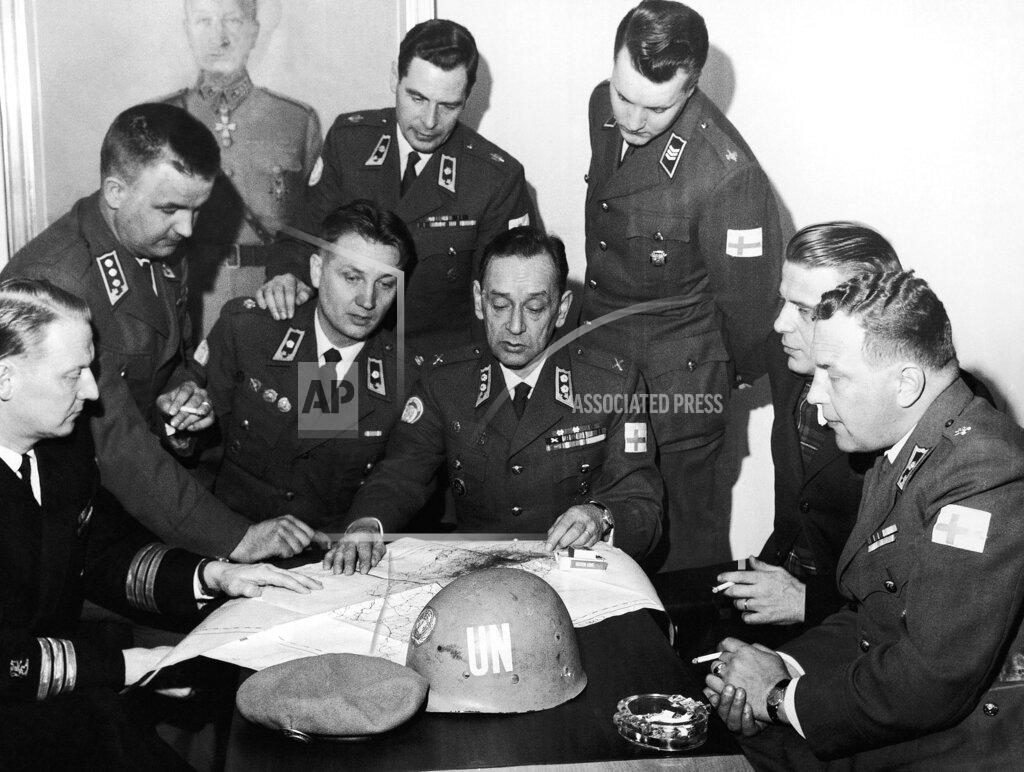
The UN Secretary General, U Thant, returned from Geneva today to complete the instructions for the United Nations force for Cyprus. The force will take over the responsibility of preventing fighting between the Greek and Turkish Cypriotes. Mr. Thant will confer this weekend with Sakari S. Tuomioja, Finnish Ambassador to Sweden, whom he appointed as United Nations mediator for Cyprus early in the day before leaving Geneva. Mr. Tuomioja will go to Cyprus next week to start work on efforts for a permanent solution of the Cyprus problem. United Nations sources said today that the United Nations force would “become operational” within a day or two as soon as the advance parties of its Swedish and Finnish contingents arrived. For the time being, Lieutenant General Prem Singh Gyani, the commander‐designate, will have under his command 3,500 British soldiers, part of the forces sent to Cyprus when fighting broke out in December, and the 1,100-member contingent supplied by Canada. The bulk of the Swedish, Finnish and Irish contingents will not arrive until next month.
Egypt’s President Gamal Abdel Nasser proclaimed the new constitution of the United Arab Republic in force, defining the UAR as “a democratic socialist state”, and giving himself stronger executive powers in a state with one political party, the Arab Socialist Union. Egypt ends the 12-year-old state of siege (1952-1964). For the first time in more than a decade the nation had a man officially in line to take charge in the event of the President’s death or disability. The First Vice President is Field Marshal Abdel Hakim Amer. President Nasser selected Marshal Amer, who is also deputy supreme commander of the country’s armed forces. The draft Constitution sets the pattern for a permanent Constitution to be adopted by the National Assembly, which will convene tomorrow. President Nasser also named three other Vice Presidents: Zacharia Mohieddin, Hussein el-Shafei and Hassan Ibrahim. All were among the officers who took part in the overthrow of King Farouk in 1952.
President Sukarno; in a remark directed at the United States, smilingly said today, “To hell with your aid!” “We can do without aid,” he said. “We’ll never collapse.” The Indonesian President spoke at a ground‐breaking ceremony for a new Government building in the capital. When completed, the 14‐story building will house the general managing board of the Indonesian Government’s commercial banks. Smiling broadly, President Sukarno said, “Indonesia is rich in natural resources. Indonesia is rich in manpower with its 103 million inhabitants — not like Malaysia with its 10 million.” The reference to Malaysia drew a burst of applause from the 2,000 persons at the ceremony.
President Sukarno’s speech followed by one day a statement by Secretary of State Dean Rusk in Washington that the United States would not give any new aid to Indonesia until the Malaysia dispute was settled. So that there would be no misunderstanding about where his remarks were directed, President Sukarno interrupted his speech to ask the United States Ambassador, Howard P. Jones “When was it that you wanted to stop your aid?” Ambassador Jones did not answer.
Defense Secretary Robert S. McNamara told Congress today it jeopardized the nation’s security when it cut $400 million last year from the military foreign aid program asked by the White House. He told a stunned House Foreign Affairs Committee that President Johnson asked only $1 billion for military aid this year, the same as last year’s appropriation, “solely because the Congress has made it crystal clear to the executive branch that it is unwilling to appropriate a larger amount. The Secretary said he could not overemphasize “the absolute chaos” that had resulted from Congress’s action in cutting the military aid request in the seventh month of the fiscal year and making it retroactive to the first month. This affected about 10,000 people in 50 countries dealing with millions of military items, he said.
General Maxwell D. Tayor, Chairman of the Joint Chiefs of Staff, gave an even sterner judgment. He told the panel that experience with last year’s $1 billion program had demonstrated its “inadequacy.” Any military assistance plan limited to that figure, he added, “can only be regarded as a holding operation of borderline adequacy.” Democratic and Republican committee members were stung by what they considered the Secretary’s implication that Congress had acted irresponsibly and could not be relied on to provide adequately for the program. They insisted he should qualify his statement and say how much assistance was really needed. Mr. McNamara said he would do so, but only behind closed doors. Later, at a closed session, the Secretary left the impression with some members that anything less than $1.4 billion, the amount asked last year, would be inadequate.
The Guardianship of Infants Act 1964 was signed into law in the Republic of Ireland.
Britain sets aside a memorial for the late U.S. President John F. Kennedy. An acre of the historic meadow at Runnymede, where the seed of British civil liberties was planted in Magna Carta, is to become United States territory as part of Britain’s memorial to President Kennedy. A scholarship fund will also be established to finance the study of British students at Harvard University, Radcliffe College or the Massachusetts Institute of Technology. The Prime Minister, Sir Alec Douglas‐Home, announced the Government’s plans to the House of Commons today. He said a simple plinth—a stone pedestal—with steps would be built on the land, which will be given in perpetuity to the United States.
After 15 days of unofficial discussion of the civil rights bill, Southern Senators will permit two votes tomorrow to determine whether the Senate will settle down Monday to prolonged, official debate on the measure. Since March 9, the 19 Southerners opposed to the bill have been talking to prevent a vote on a motion by the Democratic leader, Mike Mansfield of Montana, to make the bill the pending business of the Senate. Tomorrow about 11 AM, by agreement of Senator Richard B. Russell, Democrat of Georgia, leader of the Southern bloc, the Senate will finally vote on the motion to take up the bill. Only the Southerners are expected to vote against the motion. This will not mean, however, that the way will automatically be clear for real debate to begin Monday.
Immediately after the vote to call up is taken, Senator Wayne Morse, Democrat of Oregon, will move to send the House‐passed bill to the Judiciary Committee for hearings, with instructions to report the bill back to the Senate in 10 days. The vote of the Morse motion is expected to be close. Although a civil rights advocate, Mr. Morse has supported the Southern argument that to debate the bill without referral to the Judiciary Committee would be a violation of Senate procedure. He also believes that committee hearings will be helpful to the courts later in determining the intentions of Congress on drafting the measure.
Some Senators have agreed with Mr. Morse, not only because they dislike bypassing committees but also because they fear some of their colleagues might later find in the irregular procedure an excuse for voting against closing off Southern debate. A few days ago, nearly half the 33 Republicans in the Senate and about a fourth of the 49 non‐Southern Democrats, including many who favor the bill, were inclined to vote with Mr. Morse and the 19 Southerners. This meant that at that time there were about 48 or 49 votes for the Morse motion and about 50 against it, with one or two absences expected.
However, it is believed that the Southerners have not helped their cause by talking so long against the technical motion to call up the bill. And Mr. Morse, it is thought, did not further his cause by announcing yesterday that he would object to all meetings of committees, including the key Appropriations subcommittees, while the Senate was in session on the civil rights bill. Under the Senate rules, unanimous consent is necessary for committee meetings to be held when the Senate is in session.
President Johnson urged the leaders of one of the most powerful Southern churches today to work for his civil rights bill and for a “new fellowship” after its passage. Addressing about 150 members of a Christian leadership seminar of the Southern Baptist Convention, Mr. Johnson said that “no group of Christians has a greater responsibility in civil rights than Southern Baptists.” That, he continued, is because “your people are part of the power structure in many communities of our land.” “The leaders of states and cities and towns are in your congregations,” Mr. Johnson said, “and they sit there on your boards. Their attitudes are confirmed or changed by the sermons you preach and by the lessons you write and by the examples that you set.”
Mr. Johnson spoke to the seminar group in the White House Rose Garden. He read from a text but no television or sound recordings were made. Calling the struggle to end discrimination and prejudice “the most critical challenge that we face today,” Mr. Johnson said to the Baptists that “there are preachers and there are teachers of injustice and dissension and distrust at work in America this very hour.” “There are those who seek to turn back the rising tide of human hope by sowing half-truths and untruths wherever they find root,” the President said. “There are voices crying peace, peace, peace, where there is no peace.” Mr. Johnson told the ministers that it was their task to “help us to answer them with truth and with action.”
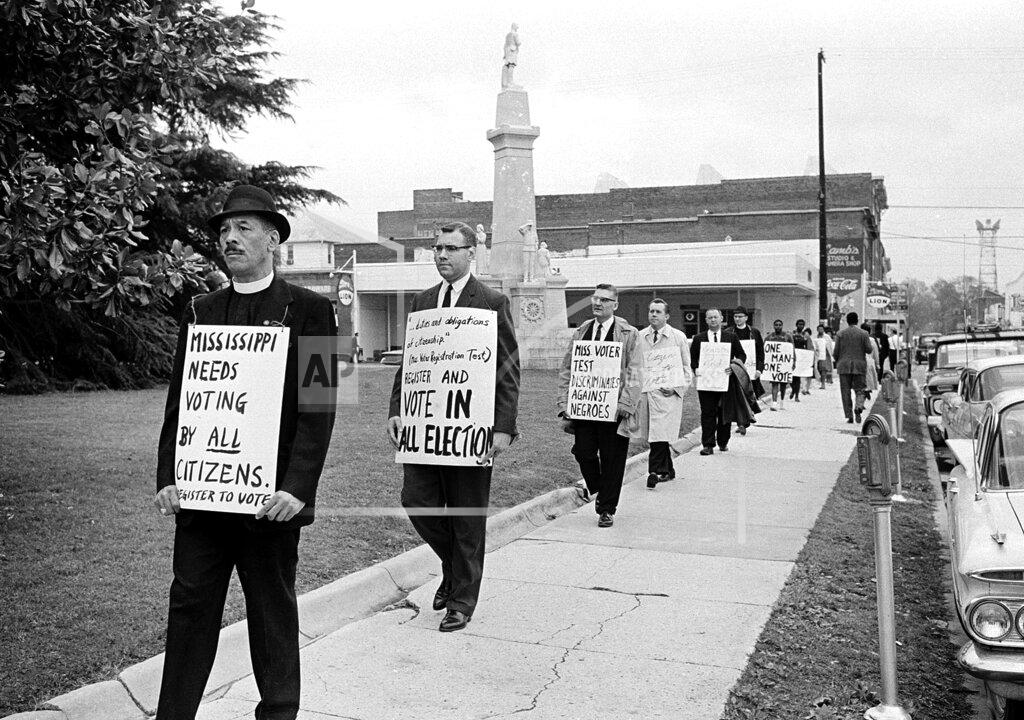
The Rev. Dr. Martin Luther King said tonight that President Johnson was “eminently correct” in citing Southern Baptists as the religious group with the greatest opportunity to “bring about racial justice in our country.” Dr. King, in a statement released in Washington, hailed Mr. Johnson’s speech to a group of Southern Baptist ministers at the White House today. He called it “one of the most passionate and eloquent pleas for the church to live out its ethical commitment in the field of race relations ever made by the President.”
A biracial group of civic, business, and professional leaders moved today to resolve Jacksonville, Florida’s racial crisis following two days of Black rioting. The police reported that, aside from isolated cases of violence and vandalism, the city was quiet. Considerable tension and some fear remained, however. The most serious incident during the day took place in a mixed neighborhood when Blacks attacked Lester Phillips, a 54‐year‐old unemployed welder. Mr. Phillips was struck on the head with a brick and suffered an apparent skull fracture. A spokesman at St. Luke’s Hospital said that although he had regained consciousness tonight, he was still in “bad” condition. The peace efforts and the general easing of the situation raised hope that the 201,000 residents of this northeastern Florida coastal city, 41 percent of whom are Black, would escape a prolonged crisis.
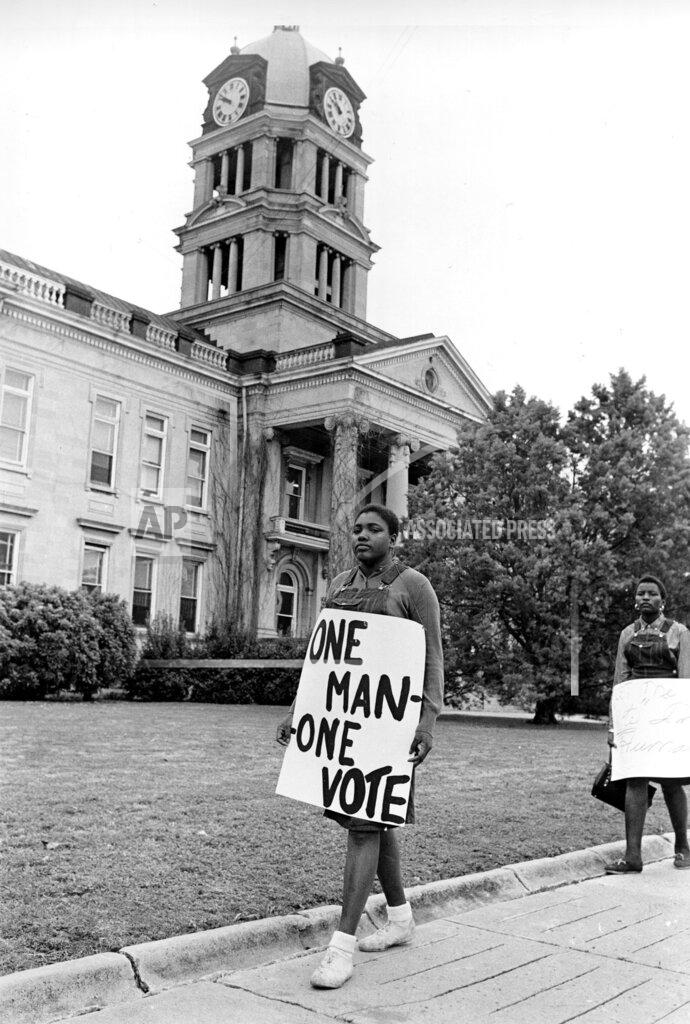
Two white youths from the University of North Carolina at Chapel Hill have joined five integrationists in a Holy Week fast on the lawn of the local post office. One of the recruits is Harry Muir, 18 years old, a freshman from Goldsboro, North Carolina. His companion is Burton V. Smith, 25, an engineer in the local branch of WUNC‐TV, the state’s educational television system. Both said they are not members of any integrationist group but are sympathetic to the ideals of the protest movement. Mr. Muir said he was joining the group because he has no further classes until after the Easter vacation. Mr. Smith said he is working regular hours and spending the rest of his time with the fasters. They are to break the fast Easter afternoon, when a mass meeting is planned in support of them.
The House Rules Committee cleared the Administration’s cotton-wheat subsidy bill today for floor action, but under restrictions that raised protests that a gag had been applied. The major restriction is that the House is to be allowed only 60 minutes of debate before voting on the Senate‐approved legislation. Meanwhile, Secretary of Agriculture Orville L. Freeman denounced opposition to the price-supporting program as “destructive to the fabric of the whole economy.” The House vote on the farm measure was postponed until after the Easter recess, which starts Thursday evening and, ends April 6. It will follow a House vote on the food stamp project, a phase of President Johnson’s war on poverty.
The House of Representatives authorized today a $5,193,810,500 budget for the civilian space agency in the coming fiscal year. The figure is only 2 percent less than requested by the Administration. The House approved the budget authorization for the National Aeronautics and Space Administration by a 283‐73 roll‐call vote after a desultory debate that saw only about 50 members on the floor most of the time. The only spirited discussion developed over a move to eliminate $14 million in funds for the space agency’s new Electronics Research Center in the Boston area. The move, sponsored by Representative Donald Rumsfeld, Republican of Illinois, was eventually defeated by a 116‐66 standing vote, but not before complaints from Midwestern Congressmen about how the Government’s research dollars were flowing largely to a few sections of the country, particularly the East and West Coasts.
The House voted today to take an Easter recess starting at the close of tomorrow’s session and ending at noon April 6. A resolution calling for the vacation was sent to the Senate by voice vote.
Two members of the Senate Commerce Committee introduced legislation today to make it unlawful for radio and television stations to advertise hard liquor. Senator John O. Pastore, Democrat of Rhode Island, chairman of the communications subcommittee, said the legislation was dictated by what he said appears to be an effort to break down “the self-imposed policy” of the broadcasting industry and the Distilled Spirits Institute of refusing to advertise hard liquor on radio and television. The legislation, which Senator Pastore offered with Senator Warren G. Magnuson, Democrat of Washington, chairman of the parent committee, followed the decision of radio station WQXR, owned by The New York Times, to accept commercials for whisky and other hard liquors for broadcast after 10:30 PM.
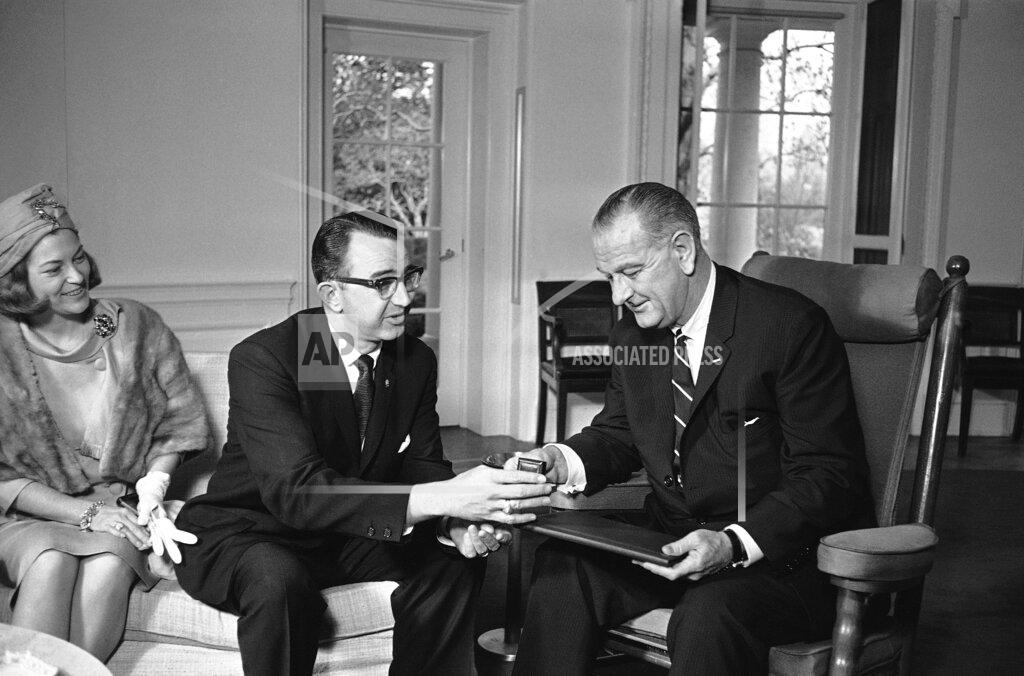
President Johnson received the Big Brother of the Year award today in ceremonies in his White House office. “I don’t know of any award that encourages me more,” Mr. Johnson said. He praised the Big Brother movement as a noble enterprise and said that the Administration’s announced war on poverty was a big brother movement. In another ceremony, he received the Lions International Head of State Medal, the organization’s highest decoration, and also an honorary membership in the Johnson City, Texas, Lions Club. Lions International presents the medal to each President and also to the heads of state in other countries in which it operates. The Big Brothers help fatherless boys between the ages of 8 and 17.
Dow Jones Industrial Average: 813.16 (+1.73).
Born:
Ken Wregget, Canadian NHL goalie (NHL Champions, Stanley Cup-Penguins, 1992; Toronto Maple Leafs, Philadelphia Flyers, Pittsburgh Penguins, Calgary Flames, Detroit Red Wings), in Brandon, Manitoba, Canada.
Jim Ellis, NFL linebacker (Los Angeles Raiders), in Pomona, California.
Alex Solls, American jockey, born in Panama City, Panama.


 History Diaries