President Johnson told a labor union convention today that “the people of this country and the world expect more from their leaders than just a show of brute force.” Speaking with emphasis, the President declared that “general war is impossible” in the nuclear age. He argued strongly against the view that world problems could be solved if the President would “hurry in the Marines” or “order soldiers to march the very moment a disturbance occurred.” The world, he said, “is not the same as it was.”
“The people in this country have more blessed hopes than bitter victory,” the President continued. “Our hope and our purpose is to employ reasoned agreement instead of ready aggression, to preserve our honor without a world in ruins, to substitute, if we can, understanding for retaliation.” “My most fervent prayer is to be a President who can make it possible for every boy in this land to grow to manhood by loving his country — loving his country instead of dying for it,” he concluded. The occasion for the President’s remarks, his most forceful to date on war and peace, was the ninth National Legislative Conference of the Building and Construction Trades Department of the American Federation of Labor and Congress of Industrial Organizations.
Mr. Johnson’s prepared speech dealt wholly with domestic issues and was a strong plea for his program to reduce unemployment, start a war on poverty and related matters. Then as he reached the end of the text, he looked up and said: “I would just like to simply talk to you about your family and mine, about their future and their country.” He said that in church last Sunday, he had thought about “all of the problems that face this world” — the “five or six different wars appearing on the front page of your morning newspaper.” “The world has changed,” Mr. Johnson said, “and so has the method of dealing with disruptions of the peace.”
The ARVN claims two major victories in Kiến Phong and Hậu Nghĩa Provinces, with high casualties for the Việt Cộng, but an U.S. flyer is killed in the supporting action. The government said 137 Communist guerrillas had been killed. The biggest action was in Kiến Phong Province, 75 miles southeast of Saigon, where 126 Việt Cộng guerrillas were reported killed and 16 captured in a two-day operation that ended yesterday. Government losses were put at four dead and 22 wounded. American military sources said the operation was one of the most successful in some time, especially in that it was a counter‐attack. The other operation, in Hậu Nghĩa Province, 20 miles southeast of Saigon, ended Sunday. A spokesman said 11 Việt Cộng guerrillas had been killed and 59 captured, against a government loss of nine wounded.
One American flier was killed today when a Vietnamese fighter plane supporting an action south of Saigon was shot down. The death brought to 121 the number of Americans killed in combat in South Vietnam.
Prince Norodom Sihanouk charged Britain today with “stalling” arrangements for a Geneva conference to guarantee Cambodia’s neutrality and frontiers. The Cambodian chief of state sent a sharp letter to R. A. Butler, the British Foreign Secretary. It ruled out any other diplomatic formula, such as further bilateral talks with South Vietnam or the four‐nation conference in which the United States and Britain have shown interest. Informed sources said Prince Sihanouk made a specific request to France to ask Britain and the United States to accept a full‐scale conference. Talks between Cambodia and South Vietnam collapsed yesterday and the Vietnamese delegation returned home. Prince Sihanouk was said to have asked the French to relay two pledges through diplomatic channels.
The first was that the prince would not use the Geneva conference to attack or criticize South Vietnam or Thailand, the two neighbors with which Cambodia has frontier troubles. The second pledge was that Prince Sihanouk would agree to limit the conference strictly to questions of Cambodian borders and neutrality, and not allow it to broaden into a consideration of other questions concerning Southeast Asia. A major United States reservation about attending a Geneva meeting has been the fear that a neutralist settlement of the war in South Vietnam would also come up for discussion. The American position is that any negotiations on South Vietnam would weaken that country’s effort against the Communist guerrillas. The feeling of diplomats and officials here is that after months of maneuvering the issue of a Geneva conference on Cambodia is approaching a climax.
Prince Sihanouk named next Monday as the deadline for acceptance of his proposal. He declared that if the West rejected a conference, he would go to Peking to seek border guarantees and accords with Communist China and North Vietnam. Observers here take this alternative seriously, though Prince Sihanouk himself has indicated in public speeches that Asian Communists have not shown great eagerness to reach firm agreements with him.
India urged today that the West accept “in principle” a Soviet proposal for a massive destruction of missiles in the first stage of disarmament. The Indian move disconcerted Western delegates at the 17-nation disarmament conference. Adrian S. Fisher of the United States said that he was unable to agree with the Indian view that the Soviet plan could be accepted in principle before its exact contents were known. Semyon K. Tsarapkin, the Soviet delegate, said he was “particularly satisfied” by the Indian statement endorsing the proposal, first made by Andrei A. Gromyko, the Soviet Foreign Minister.
Under the Soviet plan, all missiles capable of carrying nuclear bombs would be destroyed in the first of three projected disarmament stages except for a “strictly limited” number that would be retained by the Soviet Union and the United States. The retained missiles would serve as a so‐called “nuclear umbrella” that would guarantee against aggression during the disarmament process, the Russians contend.
The Soviet Union insists that before there can be any detailed examination of the offer the Western powers must first accept it “in principle.” This the West has refused to do. The Indian delegate, Vishnu C. Trivedi, urged the conference to agree that “we view the nuclear umbrella proposal favorably in principle.” In this way, he continued, the conference would be taking a “useful and constructive step.” A detailed examination of the proposal could lead to a “narrowing of the gap between the two sides,” Mr. Trivedi said.
Sir Paul Mason of Britain objected that the Soviet proposal was too radical for the first stage of disarmament. It did not, he said, permit the balanced approach to arms reductions that was offered in the United States plan for a 30 per cent first‐stage reduction in all major categories of weapons. The West believes that the Soviet plan would shift the balance of military power. in favor of Moscow.
The government of Turkey announced the deportation of all citizens of Greece who had been permitted to live and work, and published its first list of named individuals who were directed to leave with a week. The first group would be forced to sign a statement that they were voluntarily leaving because they had been “involved in illegal economic and political activities”, and would depart Istanbul on March 29 “with very little money and few belongings.”
President Roberto F. Chiari said today that President Johnson’s offer to name a special representative to review outstanding issues with Panama was “very interesting… and in many respects constructive.” But Mr. Chiari reiterated his support of the formula announced in Washington March 15 by the Organization of American States. The plan called for the restoration of diplomatic relations and negotiations to settle differences over the Canal Zone. President Chiari’s statement said President Johnson accurately recognized that “there is no malice in Panama’s claims.” He added that if Mr. Johnson’s suggestion that relations be resumed and special envoys appointed “would take us to a just and equitable agreement I am prepared to act in this respect.”
Panama has been seeking renegotiation of the 1903 treaty under which the United States holds the Canal Zone. The Panamanian leader said that under the O.A.S. formula “we would arrive at a clear solution, a precise definition of obligations and rights of the two nations to solve in this manner all the problems and differences, which would provide a climate of sincerity and close coexistence indispensable for continental security and stability of the democratic system.” President Chiari’s statement noted the common interest of the two countries in the canal but added that there had been serious difficulties because of contractual clauses that “damage the dignity of Panama.”
Edwin O. Reischauer, the United States Ambassador to Japan, was stabbed and seriously wounded by a deranged teenager outside the U.S. Embassy in Tokyo. Norikazu Shioya told police that his motive was to call attention to the problems of co-education, which Shioya saw as a threat to Japanese society, and cited one offense as “making girls and boys sit together at the same desk”.
U Thant, the United Nations Secretary General, is expected to announce tomorrow the appointment of Sakari S. Tuomioja of Finland as mediator in Cyprus. Mr. Thant said today he wished to have Mr. Tuomioja go to Cyprus “as soon as possible.” The Secretary General, who plans to return to New York tomorrow, said he had received the official approval of the Turkish and British Governments for the appointment of Mr. Tuomioja, who is his country’s Ambassador to Sweden. Apparently only the absence of formal notification of agreement by the Greek and Cypriote Governments was delaying the announcement. Their approval is understood to have reached the Secretary General unofficially. According to the United Nations Security Council’s resolution of March 4, the Greek, Turkish, British and Cypriote Governments must all approve Mr. Thant’s choice for mediator.
U.S. Senate debate on the civil rights bill was briefly enlivened today when Senator John O. Pastore, Democrat of Rhode Island, tangled with Southern Senators over the right of the federal government to cut off funds to prevent discrimination in federally-aided programs. The Southerners have bitterly assailed the section, known as Title VI, that would give federal agencies this power. They have argued that to give agency heads authority to withhold funds appropriated by Congress would be an unconstitutional delegation to the executive of both Congressional and judicial powers. They have also contended that such a cutoff would be wantonly cruel because those affected would not be the state and local officials guilty of discrimination but the final recipients of the aid, the poor and needy of both races.
Today Senator Pastore rose and asked Senator Olin D. Johnston, Democrat of South Carolina, whether he thought it was fair to use the money “which belongs to all the taxpayers of the United States” in a discriminatory manner. Senator Pastore said it was wrong for a local agency to give $20 to a white widow with four children and $2 to a Black widow with four children. Senator Johnston protested that if the bill became law, the federal government would be able to tell a hospital in South Carolina receiving federal money “how the hospital is to be operated.” Mr. Pastore denied that the bill would permit this. “But,” he said, “if a man is struck by an automobile and is brought to the hospital, it will not be permissible for the hospital authorities to deny him admission because he is colored.”
Senator Richard B. Russell of Georgia, who has been talking firmly against the civil rights bill, finally said a positive word for it today: He admitted that it might be passed. This occurred when an integrated group of social workers from Georgia called on their Senators to tell them they would like the nation to be integrated, too. The visitors — delegates from the National Association of Social Workers — were received cordially by Senators Russell and Herman E. Talmadge. In the evening, President Johnson met informally with a group of social workers and told them the bill would be passed even if it, took all summer.
Senator Russell stood, friendly and at ease, in the Senate Reception Room and described his opposition to the bill more succinctly than he had just done on the Senate floor. “We want you to know the majority of social workers in Georgia support it,” said Robert Shrider, a worker in a Methodist Community Center in an all-Black section of Atlanta. “You may hear less from groups such ours than you do from others,” he ventured. Not so, the Senator said, revealing a rebel nephew who is studying for the Presbyterian ministry and had been “brainwashed” into believing in integration. “Otherwise, he’s a pretty intelligent boy,” the Senator added. Then he said: “This bill may pass, but I think in the long run it will work to the disadvantage of the country and hurt the people you want most to help.”
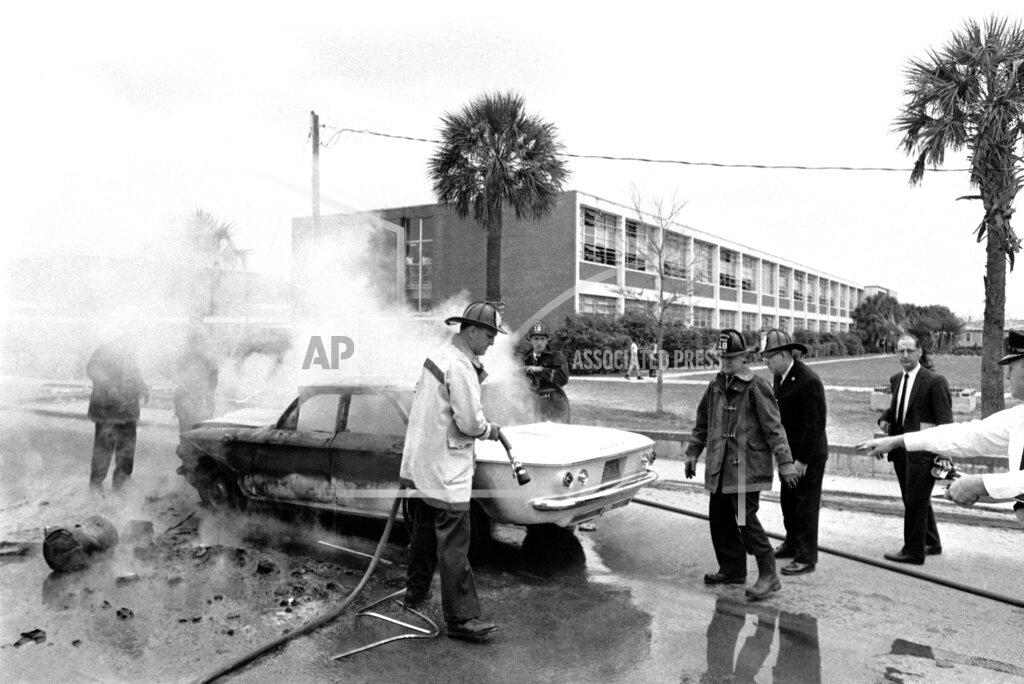
Rioting, marked by numerous injuries and considerable property damage, plagued Jacksonville, Florida for the second consecutive day. The worst outbreak today came at a Black high school. Students and bystanders hurled stones and other missiles at the police, firemen, school officials and newsmen. An automobile owned by The Florida Times‐Union and The Jacksonville Journal, the city’s two daily newspapers, was overturned and burned. Three newsmen in the car escaped. But Mike Durham, a 28-year‐old Life magazine reporter, was cornered by the mob of Blacks and beaten. He was treated for a sprained wrist and head cuts at Baptist Memorial Hospital and released. More than 260 persons had been arrested by tonight in incidents during the two days of violence. During the rioting last night, a Black mother of 11 was killed when shot by an unidentified person in an automobile.
The trouble at the New Stanton Senior High School today began when the police arrived to search the building after a bomb threat had been telephoned by an anonymous caller. No bomb was found. After the police had arrested one man at the school and put him in a police cruiser, members of the mob took him out of the car and released him. Its driver, a Black patrolman, fired his revolver into the air, to no avail. The patrolman then radioed for help, according to William R. Rice, a teacher at the school. The mob standing in the schoolyard became enraged as the additional policemen moved in with riot guns at the ready to aid the patrolman. Three Black ministers contended the policemen had fired into the air as they advanced. After the officers had withdrawn from the schoolyard into the street, a volley of stones, bricks and bottles began raining down on them. They pulled out of the area when it became apparent that their presence was further arousing the mob. The attack on the newsmen followed.
The Supreme Court indicated today that it would cut through an Alabama procedural tangle and decide whether the National Association for the Advancement of Colored People may resume operations in that state. Chief Justice Earl Warren made a surprise statement to that effect at the close of oral argument on the case today. The comment came after a recess and evidently had the concurrence of his colleagues. The NAACP has been barred from Alabama since June 1, 1956, by a series of state court orders. It has never been able to get a final determination on the merits from the, Alabama courts on whether it is legally entitled to resume operating there. The Alabama Supreme court has avoided deciding the question by ruling that the NAACP’s lawyers have made procedural mistakes. Including the present round, the case has been to the United States Supreme Court four times.
Five members of civil rights groups have completed the third day of a scheduled eight-day fast in front of the post office in the college town of Chapel Hill, North Carolina. They were dizzy from hunger today, but determined to last until Easter morning on Sunday. The group, with containers of water, a supply of cigarettes, sleeping bags and blankets, is protesting the refusal of; the Chapel Hill Board of Aldermen to adopt a public accommodations law for this largely integrated town. About 25 of 200 places of business still practice segregation openly. But tension has been mounting over another point of friction — an alleged breach by local officials of last summer’s truce between demonstrators and law enforcement officials. Chapel Hill has long been considered a center of liberal thought in the South. The campus of the University of North Carolina occupies most of the middle of the tree‐shaded town, 15 miles southwest of Durham. Duke University is nearby.
The Joint Chiefs of Staff are “not happy” about President Johnson’s ceiling of $1 billion on foreign military aid in the new fiscal year, the House Foreign Affairs Committee was told today. The foreign aid administrator, David E. Bell, told the committee that the figure “reflects the President’s decision to cut the aid program to the bare bones” in view of mounting Congressional opposition. The Defense Department had planned to reduce military aid to $1 billion by the fiscal year 1968 but last year Congress held the appropriation to that amount. At the Pentagon, Mr. Bell’s reference to the Joint Chiefs’ position was called the understatement of the year. The Chiefs were described as genuinely concerned about the effect of the ceiling on the readiness of forces in Greece and Turkey as well as on the mutual assistance effort in Southeast Asia.
Dr. Glenn T. Seaborg, chairman of the Atomic Energy Commission, may become the first man to hold a patent on a chemical element. In fact, he will probably be granted patents for two. They are americium and curium, short‐lived man‐made elements produced in a nuclear reactor or in bombardments by an atom smasher. Dr. Seaborg’s claims stem from his World War II work in developing techniques for producing and isolating the elements. He has been supported in his patent efforts by the United States Court of Customs and Patent Appeals. The elements have no known practical uses although they are of great scientific interest in understanding the nature of matter. While Dr. Seaborg would have his name on the patents, all the rights would be assigned to the government. As Dr. Seaborg explained, he was “just a name” that the Atomic Energy Commission was using on the patents.
In effect, he said, they are government patents, taken out to protect the public against the possibility that some individual would lay a patent claim to the elements and their production methods and then attempt to force payment of royalties. Curium and americium are trans‐uranium elements, having an atomic number — the number of protons in their nuclei — greater than uranium, the heaviest naturally occurring element. Uranium has an atomic number of 92, americium 95 and curium 96. Since the first trans‐uranium element, neptunium, was produced by a University of California research group in 1940, eleven of the synthetic elements have been identified, ranging up to atomic number 103.
The first Kennedy half-dollar is issued.
“Dutchman,” an off-Broadway play by African-American playwright LeRoi Jones (later Amiri Baraka) premiered at the Cherry Lane Theatre in New York’s Greenwich Village. It would win the Obie Award for Best American Play later in the year and be turned into a film in 1967.
Dow Jones Industrial Average: 811.43 (-2.17).
Born:
Bart Kofoed, NBA shooting guard (Utah Jazz, Golden State Warriors, Seattle SuperSonics, Boston Celtics), in Omaha, Nebraska.
Patterson Hood, American rock singer-songwriter, and guitarist (Drive-By Truckers-“Southern Rock Opera”, “The Unraveling”), in Muscle Shoals, Alabama.


 History Diaries