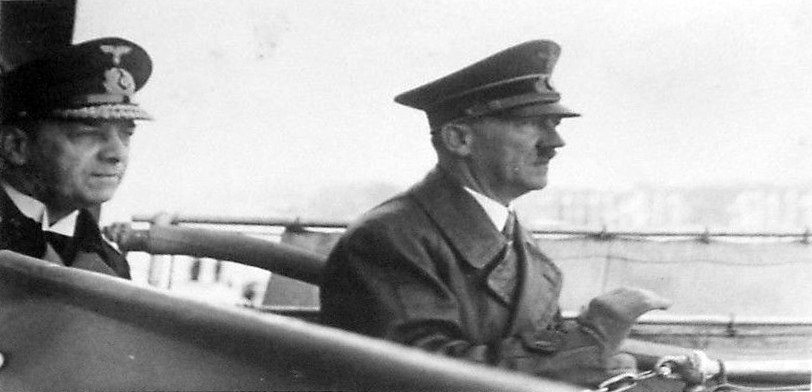
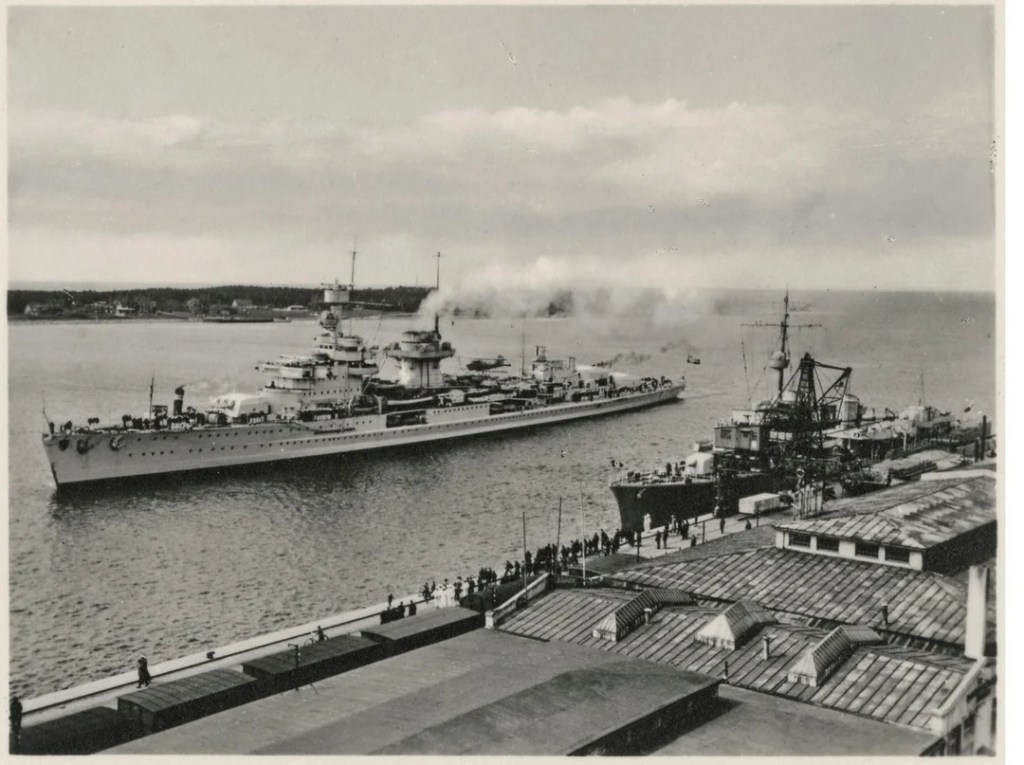
The Lithuanian representatives aboard German heavy cruiser Deutschland gave in to German demands, signing the city of Klaipeda, Lithuania, known as Memel in German, to Germany in the early hours of the day. In the afternoon, Adolf Hitler visited the newly gained territory.
Joachim von Ribbentrop and Vojtech Tuka signed the official document in Berlin, Germany that declared Slovakia as an independent nation under German protection. At 1:00 a.m. on 23 March 1939 Urbšys and Ribbentrop signed a treaty, effective 22 March 1939, stating that Lithuania was voluntarily transferring the Klaipėda Region to Germany. The treaty comprised five articles:
Article I: The Klaipėda Region, cut off from Germany by the Treaty of Versailles, is reunited with the German Reich, effective today.

Article II: The Klaipėda Region is to be evacuated immediately by Lithuanian military and police forces. The Lithuanian Government will take care that the territory is left in orderly condition through the evacuation.

Both sides will name commissioners, so far as it will prove necessary, who are able to carry out the handing over of administration not held in the hands of autonomous authorities of the Klaipėda Region.

Regulations of the rest of the questions resulting from the exchange of State sovereignty, especially economic and financial questions, questions of officials as well as citizenship, are reserved for special agreements.

Article III: In order to make allowance for her economic needs, a Lithuanian free-port zone will be established for Lithuania in Klaipėda. Details will be expressively regulated in accordance with directions of an enclosure attached to this agreement.

Article IV: In order to strengthen their decision and to safeguard the friendly development of relations between Germany and Lithuania, both sides assume the obligation neither to proceed against the other by force nor to support an attack from a third side against one of the two sides.

Article V: This agreement becomes effective upon signature. In witness, whereof, the plenipotentiaries of both sides sign this treaty, prepared double in double original in the German and in the Lithuanian languages.

  Berlin, March 22, 1939
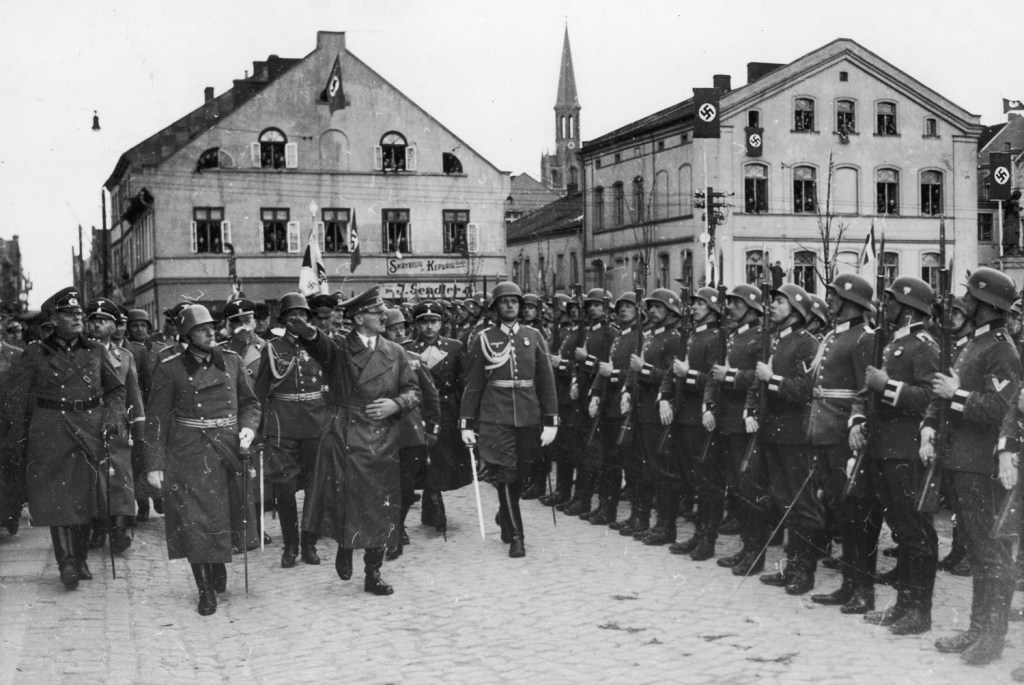
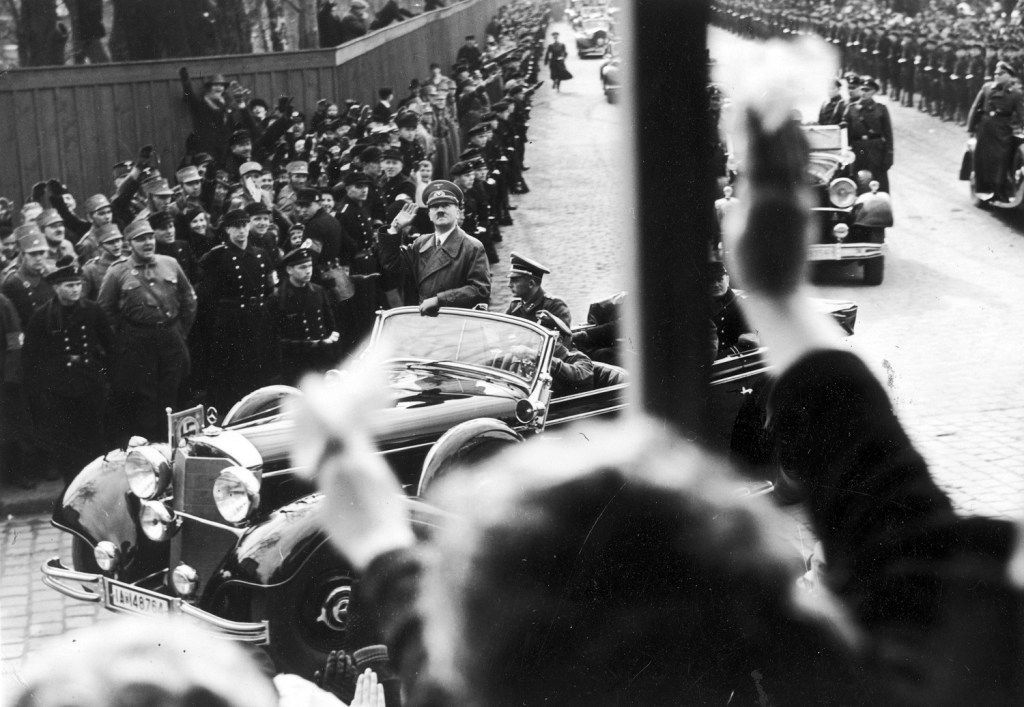
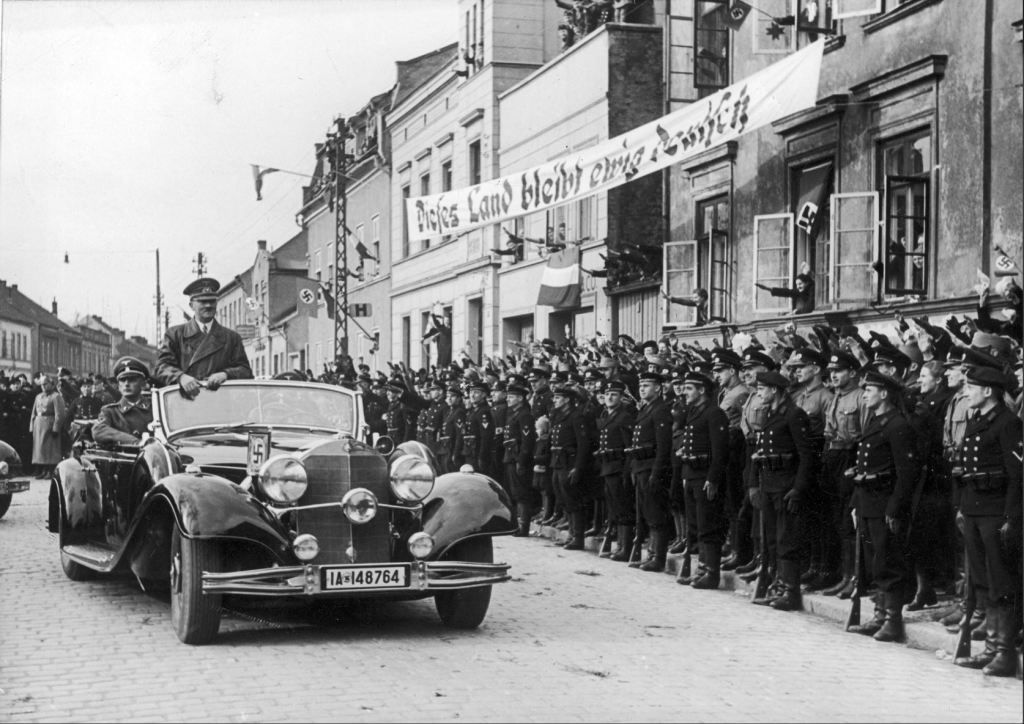
Nazis hail the return of the Memel Corridor. Germany was preoccupied with taking over Memel, where Chancellor Hitler welcomed his new citizens. He said in his speech that the reparation of Germany’s “sufferings” was “at a conclusion,” but when the official version of the speech was issued this statement was mysteriously omitted. Berlin, within twenty-four hours, had concluded treaties with Lithuania, with Slovakia, whose “independence” was guaranteed, and with Rumania, which was brought within the Reich’s orbit, economically at least.
Hitler drives slowly through frenzied crowds at Memel, taking over the city in triumph. Cheered by throngs in a beflagged Memel, Herr Hitler remained there only a brief two hours, then boarded a battleship to return to Swinemünde. Adolf Hitler returned to Berlin.
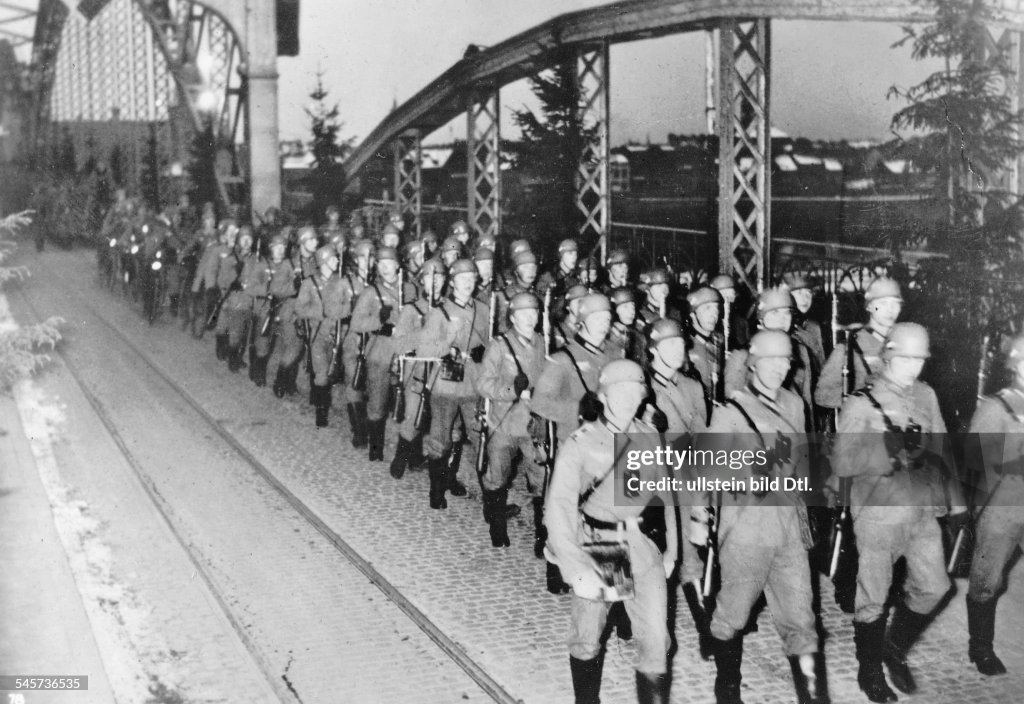
Before the treaty was signed, German soldiers had already entered the port of Klaipėda. Adolf Hitler, arriving on board the cruiser Deutschland, personally toured the city and gave a short speech. The armada sailing to Klaipėda included the cruiser Admiral Graf Spee, the light cruisers Nürnberg, Leipzig, and Köln, two destroyer squadrons, three torpedo boat flotillas, and one tender flotilla. At the time the Lithuanian navy had only one warship, the Prezidentas Smetona, a 580-ton converted minesweeper. While the Germans were celebrating the return of the city, European politicians expressed fears that the Free City of Danzig would be Hitler’s next target.
The Polish government rejects Germany’s proposals for Danzig and warns Germany that any attempt to seize Danzig as they have seized the Memel Territory would mean war.
Britain’s Prime Minister again warned that Britain would resist “by all the means in our power” any attempt at world domination. The British attempt to align the powers seemed bogged down; Russia agreed to a joint declaration provided three other powers did likewise, but Poland was still holding back. Warsaw’s attitude was that an anti-German bloc would be acceptable if it contained automatic guarantees for assistance.
An economic agreement between Germany and Rumania gives Hitler access to Rumanian oil. King Carol capitated to Helmuth Wohlthat of the German Four Year Plan organization and signed a new German-Rumanian economic treaty that virtually turned Rumania into a German economic colony with Rumania to sell exclusive its oil and agriculture to Germany. The terms of the new German-Rumanian agreement were so favorable to the Reich that both the Hungarians and the Bulgarians who had territorial claims against Rumania believed that Carol had only signed the treaty because he bartered his country’s economic independence in exchange for a German guarantee of Rumania’s borders.
In Bucharest, simultaneously with the signing of the trade agreement, it was revealed that Germany would carry out an arms contract previously made with Czecho-Slovakia, and this news eased tension in that capital.
The German penal code will apply to Czechs.
German Chancellor Adolf Hitler signs the “Treaty of Protection” in Prague and calls for German control of the Czech economy.
The Slovak-Hungarian War, also known as the Little War, began. Weakened Slovakia was invaded yesterday by Hungarian troops, which fought minor skirmishes with Hlinka Guards. Slovakia promptly protested to Budapest. At dawn on 23 March 1939, Hungary suddenly attacked Slovakia from Carpatho-Ukraine, with instructions being to “proceed as far to the west as possible.” Hungary attacked Slovakia without any declaration of war, catching the Slovak army unprepared because many Slovak soldiers were in transit from the Czech region and had not yet reached their Slovak units. Czech soldiers were leaving the new Slovakia, but many of them decided to remain with their former units in Slovakia after the Hungarian attack. Hungarian troops moved westward (stopping just east of Snina). The first village to be occupied was Ubla, surprising and capturing a company of the 16th infantry Regiment of the Slovak Army. They attacked a line from Velky Bereznyj to Ulic and from Vysne Nemecke to Sobrance. the Slovak Army attempted to repel this invasion with two Army groups, “Stakcin” and “Michalovce.” Despite the “Treaty of Protection,” Hungary attacks with Hitler’s knowledge and he supports their demands.
A Hungarian earthquake starts a war scare along the borders.
Erwin Rommel returned to his position as the commanding officer of the military academy at Wiener Neustadt in southern Germany.
Italy’s King delivered a speech that was regarded as not unfriendly to France, and Paris was hopeful that an understanding might be reached.
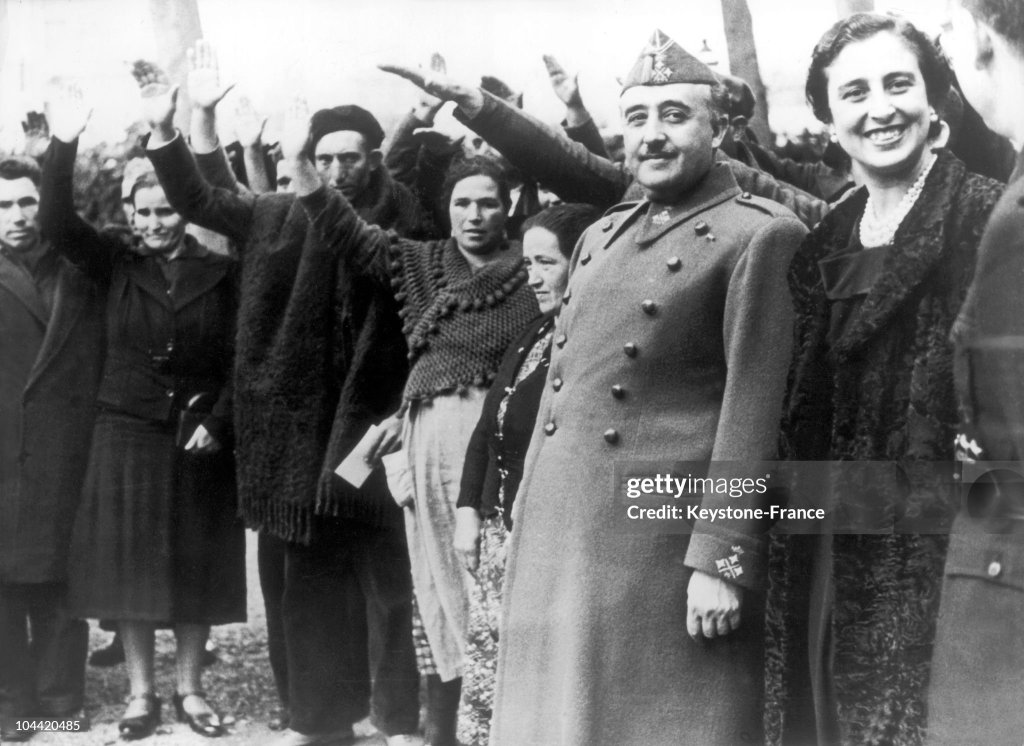
The Burgos correspondent of the Popolo di Roma reported today that a mission from the Madrid National Defense Council had arrived at the Spanish Nationalist capital to offer the city’s unconditional surrender. The correspondent said that the mission had flown to Burgos in a plane bearing the insignia of the Spanish Republicans and that its arrival apparently had been expected, since extraordinary police measures were taken to keep it secret. The newspaper’s dispatch said that the delegates included Wenceslao Carillo, Minister of the Interior in the Madrid defense junta, and General Antonio Ortega, formerly commander of the Republican forces on the Basque front. They were said to have been accompanied by two members of the Nationalist secret service.
Radio messages from Madrid relayed by Burgos, Spain, this morning, stated that the National Defense Council had admitted its surrender was only a matter of hours. All day passed in expectation of the event, but it has not occurred. Why it has not come is explained by other messages. Generalissimo Francisco Franco’s army of 700,000 men, complete with tanks, guns, cavalry and airplanes, does not want to be done out of its paradelike capture of the Republican capital. It is necessary for two reasons, at least: First, so that the Spanish people may be impressed by this display of the victor’s strength, which all independent reports confirm is likely to be really impressive; and, secondly, so that foreign peoples shall get an equally strong impression that Spain has emerged from this civil war to high rank among nations.
It is expected in Burgos that a few figurative shots may be fired at Madrid tomorrow, or whenever the official surrender is to be staged. General Franco’s army will then march in with banners flying. In Estremadura, in Southwestern Spain, there may be a little more fighting, but there, too, surrender is expected within a few hours after General Franco’s last formidable “attack” is launched. It is reported that last week a whole boatload of German camera men and newspaper correspondents was shipped to Spain to record General Franco’s triumph. Those French correspondents still at Burgos also are being well treated.
In Madrid today it was announced that ten Communists had been tried and executed for the leading part they played in the revolt against the National Defense Council when the then Premier Juan Negrin and other members of his government abandoned the struggle. It is said-but this cannot be confirmed-that during the past two weeks the Madrid military junta has done a very effective job in rounding up Communists and all others who might have been expected to trouble the success of General Franco’s entry. These prisoners, it is stated, will be found in jail when General Franco enters.
Almost the only military activity still going on is the bombing by Italian airplanes from Majorca of Valencia and such other easily vulnerable and now almost defenseless places. Today five planes flew over from Majorca and dropped bombs on one residential suburb of Valencia, killing some and wounding others. Of what is happening in the rest of Spain outside Burgos and Catalonia it is not possible to get information, as outside communication has been cut off and between Madrid and the coast only military messages are being transmitted. All airplanes in Madrid have been commandeered by the Defense Council to prevent anyone from escaping. They will be handed over to General Franco.
Four IRA bombs exploded in Coventry.
First performance of Béla Bartók’s 2nd Violin Concerto at the Concertgebow, Amsterdam with Zoltán Székely on violin and Willem Mengelberg conducting the Concertgebouw Orchestra.
In Washington, Marriner Eccles, Federal Reserve System Chairman, an advocate of President Roosevelt’s spending policies, challenges Congress to slash the budget as a test. The public seems economy minded, he says, and this should be a guide. Agitation over recovery methods reached a new high pitch of heat and confusion at the Capitol today when Marriner S. Eccles, chairman of the Federal Reserve System and advocate of President Roosevelt’s spending-lending policies, openly challenged Congress to vote for the budget-balancing economies which it seemed to want and which “a great majority of the people appear to believe” would restore business confidence.
In a statement made before the Special Senate Silver Committee, which is studying the question of further monetization of silver, Mr. Eccles registered his conviction that a policy of retrenchment under present conditions would have “disastrous results.” But he recognized, he said, that we live under a democracy, and that the views of the majority “should promptly be made effective.” Mr. Eccles drew from the overwhelming preponderance of available indices the opinion that the majority will in the country-in the business community, in Congress and among the people themselves was for the economy route to prosperity. Under those circumstances, he insisted, the responsibility was upon Congress to act without delay.
“The country is entitled to a clearcut and prompt determination of policy on this vital issue,” he told the committee. “Uncertainty and hesitation do not contribute to recovery. It is Congress that determines the rate and nature of our taxes; it is Congress also that determines the amount of government money to be used for different purposes. If balancing the budget will bring recovery, then Congress can instantly do so by reducing expenditures to the level of receipts. If, in addition, taxes were to be revised and cut as a further inducement for private enterprise, government expenses could be reduced still further to make up for the decline in tax receipts.”
Within an hour after Mr. Eccles’s statement had been disclosed Senator Harrison, a leader of the Senate economy group, accepted the challenge to Congress to reduce Federal spending, but he asserted that the responsibility for cooperation rested upon the executive branch of the government. “No one believes that the Federal budget can be completely balanced at this time,” Senator Harrison said. “The expenditures are too large and the continuing deficits too great. But the American people do believe that some approach should be started immediately by the Congress, acting in cooperation with the Executive, to balance the budget.”
President Roosevelt by proclamation today terminated as of April 22 the tariff rates he had previously proclaimed under the reciprocal trade agreement of March 7, 1938, with Czecho-Slovakia. Technically the agreement remains in effect, but its operation has been suspended as a result of the German occupation of Bohemia, Moravia and Slovakia and of the Hungarian occupation of Carpatho-Ukraine (Ruthenia). It could be restored in full force by another proclamation.
Contrary to what had first been contemplated, the lower rates carried in the agreement will no longer be generalized to other countries. That had been desired here, but it was found impossible to maintain them for application to others while eliminating them for Czecho-Slovakia. Previously the Treasury had directed that Czecho-Slovakia should be considered German territory for customs purposes, so that goods from that region would be required to pay the full United States tariff rates plus the 25 percent countervailing duties announced last Saturday.
Reports of a proposed trade whereby $265,000,000 in parity and conservation payments to farmers would be retained in the billion-dollar Agriculture Department Supply Bill for 1940 in return for the full $150,000,000 requested as a deficiency item for relief came today as the House began consideration of the bill. The rumors came after the Appropriations Committee reported the bill at a total of $1,067,274,427, or $244,593,376 above Budget Bureau estimates, bringing from Representative Cannon, a member of the subcommittee handling the bill, the statement that it was “the largest agricultural appropriation bill ever reported in the history of the United States.” Economy-minded members opened Immediate attacks on the measure, the benefits of which total $750,000,000 for the purposes of agricultural recovery.
Tammany leader James Hines receives a sentence of four to eight years for conspiracy. He begins discussing an appeal process with lawyers while in Tombs Prison. Sentenced to serve four to eight years in jail for his part in the Arthur (Dutch Schultz) Flegenheimer policy racket, James J. Hines, Tammany district leader, began serving the term yesterday in the Tombs Prison, leaving his cell only to confer with lawyers on an immediate appeal. Hines was permitted to remain in the Tombs on a stay of removal to a state prison, granted to permit his lawyers to take the first step in a fight to annul his conviction of conspiracy with the Schultz racket gang. He was introduced to the routine of the prison with a warning that he would receive the same treatment as other prisoners.
A DAR official insists that she did not receive the resignation of Eleanor Roosevelt.
Albert Einstein baffles an airport public relations officer with complicated math formulas as a joke.
The War Department awarded today a $185,750 contract for a gas mask assembly plant and the production of an undisclosed number of masks to the Goodyear Tire and Rubber Company, Akron, Ohio. Congress was told the army had insufficient masks to equip even the regulars, disregarding the National Guard. The $552,000,000 defense program of the Administration includes funds to increase the equipment. War Department contracts totaling $763,632 included, for gauze bandage and absorbent cotton, Acme Cotton Products Company, New York, $19,906.
Top dancer Bill Robinson opens in the Broadway show “The Hot Mikado,” an African-American version of the operetta “The Mikado.”
Joe DiMaggio delivers two home runs in an exhibition game against the minor league Newark Bears.
The International Congress of American Democracies sets up Latin American anti-fascist fronts and creates national units for the cause.
At dawn, the largest bombardment of the Second Sino-Japanese War was commenced on Chinese positions at Wucheng near the Xiushui River in Jiangxi Province, China where Japanese troops were held down by Chinese defenses since 18 March 1939; this bombardment would continue until 26 March 1939. Nearby, Japanese troops captured Fengxin County and Anyi County.
Japanese forces battling toward Nanchang, unconquered capital of Kiangsi Province south of Hankow, reported today that they had killed 1,100 Chinese and captured 6,501. The Japanese said that their losses. were eighty dead and wounded. The advance was protected by 100 planes and a tank corps. Wuning remained in Chinese hands, but the Japanese pushed within twenty-five miles of Nanchang. A heavy engagement on the north shore of Hangchow Bay, about sixty miles south of Shanghai, was reported when Japanese encountered 400 Chinese regulars. One hundred Chinese were said to have been killed.
The resurgent Chinese air force was reported today to have struck at the Japanese in two widely separated sectors. Generalissimo Chiang Kai-shek’s airmen were said to have raided a Japanese airdrome at Wuchang, causing a considerable amount of damage despite Japanese anti-aircraft batteries, and to have machine-gunned Japanese barracks outside Hankow. Wuchang and Hankow are separated only by the Yangtze River. Another squadron was reported to have bombed Japanese barracks and a supply depot on Samstow Island in the mouth of the West River, near Canton.
Japan and China deem a final accord far away, though both are weary of fighting.
Born:
Bert Berdis, American comedian (“Tim Conway Show”), born in Pittsburgh, Pennsylvania.
Rosie Reyes, Mexican tennis player (French Championships women’s doubles 1958 [with Yola Ramírez]), born in Mexico City, Mexico (d. 2024).
Dow Jones Industrial Average: 140.33 (+0.82).
 History Diaries