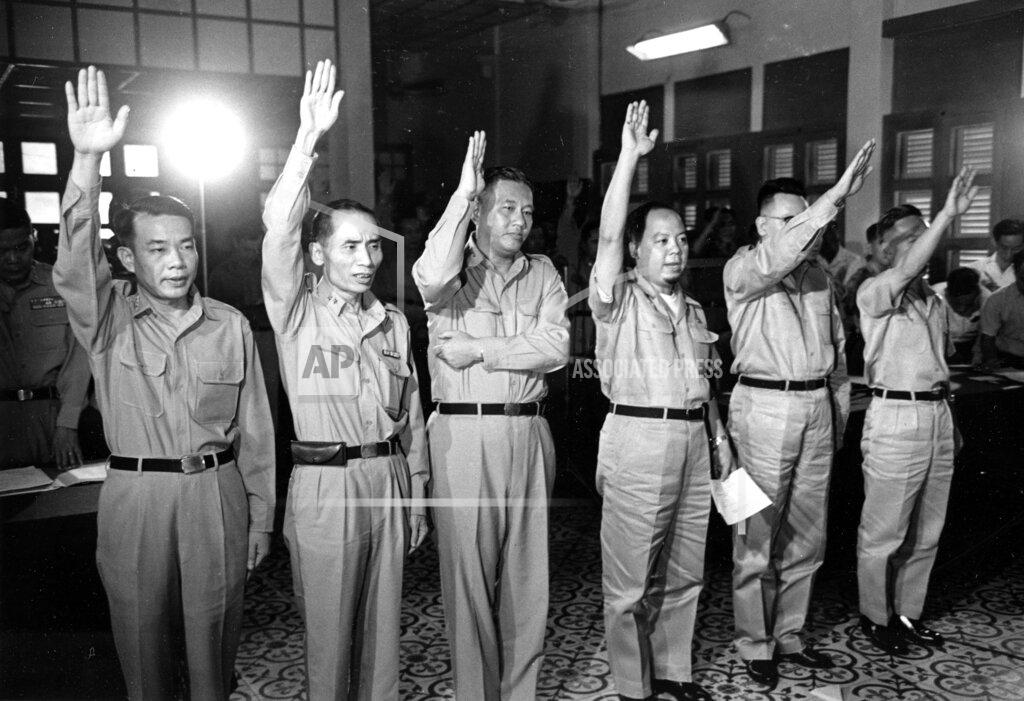
South Vietnam’s Military Revolutionary Council gave Premier Nguyễn Khánh a unanimous vote of confidence today. The council is South Vietnam’s highest body. In a surprise three‐hour meeting — its first since General Khánh seized power January 30 — the military leaders re‐elected him chairman by a vote of 53 to 0. General Khánh cast a blank ballot. After the meeting, Premier Khánh announced a council shake‐up and establishment of a new. executive steering committee to be headed by himself. It will assure that every combat unit in the field is represented, he said. Now, Premier Khánh implied, the council over‐represents the military officials in the city of Saigon.
Premier Khánh said the Self-Defense Corps and the Civil Guard would be represented on the council. He indicated the moves would broaden the council’s base to obtain more popular and legal footing. Although the council theoretically has the power to override General Khánh on any issue, it will continue to act mainly in an advisory capacity. The general denied speculation that the purpose of the meeting today had been to deal with dissension in the armed forces and other pressures against the regime.
“There were no specific circumstances,” he replied when asked if there had been any one reason for the meeting. It appeared that its main purpose was to realign the council, which has been somewhat disarrayed since the January coup. “I am glad to announce that on the vote I got 53 votes out of 54,” General Khánh said, adding that he had cast a blank ballot. “This again shows the unity of the armed forces,” he went on, “not only in Saigon but the whole force, especially representatives of combat units in the field. “I am very, very happy. I will do my test to deserve their confidence.” The meeting was held at joint military headquarters.
Negotiations for an accord between Cambodia and South Vietnam were in uneasy suspension tonight. The hopes of yesterday fell before new expressions of Cambodian anger over a border attack by Vietnamese on Thursday. The negotiators for Cambodia praised the Vietnamese for having accepted, full responsibility after the incident. But the chief of state, Prince Norodom Sihanouk, maintained a harsh line in his first official statement after Saigon’s swift moves to make amends. In a radio speech at Chantrea, the scene of the border attack, he said mere apologies were not enough to save the talks.
Prince Sihanouk told the Vietnamese delegation to go home to Saigon, Reuters reported. However, observers thought the official text of the prince’s remarks might differ from the speech as broadcast. The prince used the apparent fact of American participation in the Chantrea incident to make new accusations against the United States as the principal violator of Cambodian neutrality. He renewed his threat to turn to Communist China for support against alleged American attacks. During the night a strongly worded note of protest was handed in at the United States Embassy demanding official and unconditional apologies and payment of adequate reparations for damages.
The new anti‐American statements came amid general uneasiness of United States citizens here following attacks on the United States and British Embassies in Phnom Penh 11 days ago. Prince Sihanouk’s official text, which often differs from his speeches as delivered, will not be available until tomorrow. The latest developments left both Vietnamese and Cambodian officials, as well as diplomatic observers, unclear about the actual state of negotiations. These are aimed at resolving border issues between Cambodia and South Vietnam.
Secretary of State Dean Rusk announced today that the Soviet Union would release the two remaining crewmen of the United States reconnaissance bomber shot down over East Germany on March 10. He indicated that under the circumstances the United States considered the incident closed. He suggested that the way was again open toward new agreements with the Soviet Union, notably on the establishment of consulates in the two countries. Mr. Rusk was informed of the Soviet decision just before he went to a Washington television studio about noon. Announcing the decision on a nationwide program, he said the two officers would be set free “in the very nearest future.”
The State Department still lacked details on when and where Captain David I. Holland of Holland, Minn., the pilot, and Captain Melvin J. Kessler of Philadelphia, instructor‐navigator, would be freed. But the belief in Washington was that it would be in the next few days. Yesterday Soviet authorities in East Germany released First Lieutenant Harold W. Welch of Detroit, the aircraft’s navigator, but until late this morning the Government had no idea what plans the Russians had for Captain Holland and Captain Kessler. The three crewmen parachuted from their crippled RB-66 aircraft, a twin‐engine jet bomber equipped for reconnaissance work, after it was attacked by Soviet jet fighters inside East German airspace. Lieutenant Welch was injured during his parachute landing and a United States Air Force flight physician was allowed to visit him twice at a Soviet military hospital at Magdeburg.
Secretary Of State Dean Rusk said today that he had “great hopes” that a settlement of the Panama dispute could be reached in the near future. This new optimism over the controversy, now in its third month was shared to a considerable degree by most Latin-American diplomats here who had participated in the continuing mediation efforts. The repeated experience of standing on the verge of an agreement then seeing it collapse in last‐minute problems, discouraged the diplomats from engaging tonight in outright predictions of success. On the whole, the letter sent yesterday by President Johnson to Ambassador Juan Bautista de Lavalle of Peru, chairman of the Council of the Organization of American States, and Mr. Rusk’s remarks on a television program today, suggested that the United States have moved the Panamanian crisis off dead center, where it appeared stalled last Monday.
Stringent security measures by the Indian Army and hundreds of arrests of Hindu “troublemakers” had apparently halted religious killings today in eastern India. Anti‐Muslim violence there has taken at least 143 lives in the last week. One person was killed and three were wounded when troops opened fire tonight on a crowd of 500 in the steel town of Rourkela, in the state of Orissa. The crowd, described officially as “riotous,” had refused to disperse. It had assembled in defiance of a curfew. While no other new killings were reported, the official death toll in Rourkela rose to 63. The increase was caused by deaths of those wounded in Friday’s violence and by the discovery of more bodies.
More than 1,000 Indian soldiers occupied Rourkela yesterday to halt the killings. Earlier today troops were reported to have fired twice to frighten troublemakers, but no casualties were announced then. About 250 people were under arrest in Rourkela, and there were reports of sporadic arson and looting in the Sundargarh district of Orissa, north of Rourkela. Forty‐two United States citizens and three Britons were evacuated to Calcutta. No casualties were reported in the foreign community in Rourkela.
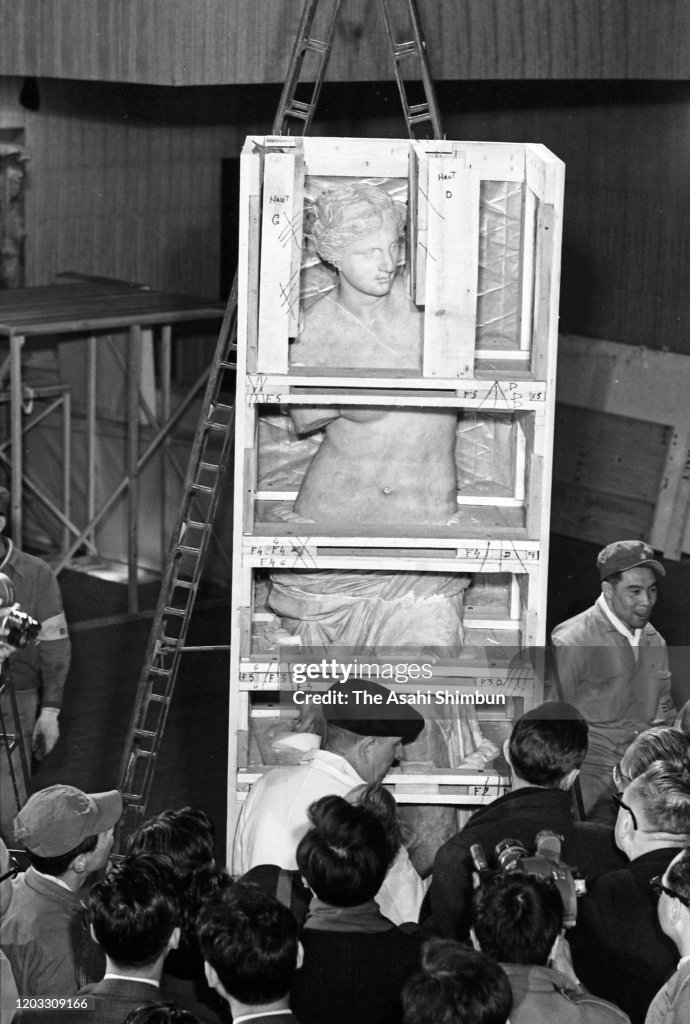
Venus de Milo, the famed 2,000-year-old Greek statue was found to be slightly damaged as it arrived in Yokohama for transfer to the National Museum of Western Art in Tokyo on loan from the Louvre Museum in Paris. Already missing both of its arms, the statue was found to have sustained four chips “from the folds of her robe below the hip on the left side”. Venus de Milo had been shipped from Marseilles on February 18 on board the French ocean liner Vietnam.
PIDE, the security police for the dictatorship in Portugal, announced in a press release that it had arrested several extremists who were plotting to overthrow Portuguese Prime Minister António de Oliveira Salazar and President Francisco Franco of Spain. According to the police, the plotters were going to unite the two neighboring republics into a single Union of Iberia, to be ruled by a former Portuguese presidential candidate, General Umberto Delgado.
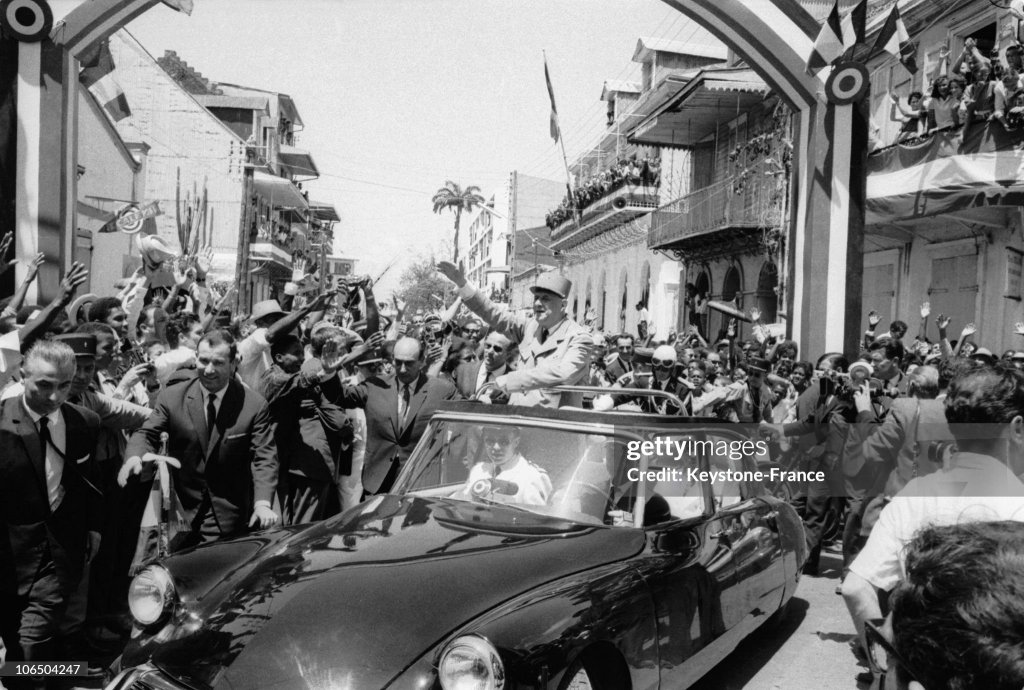
President de Gaulle declared today that France, in solidarity with her allies, was on guard against potential foes. But he said this solidarity did not diminish her independence. The French leader was addressing a wildly cheering crowd in the Place de Savanne. His welcome here was the most tumultuous and unruly of his visit to the French departments in the Caribbean and South America. After his speech security men had to fight a way through the crowd so that the general could reach his car. For a moment General de Gaulle’s tall figure was engulfed in a sea of heads and of hands reaching out to touch him. When the car started, dozens rushed after it while the deep‐throated chant “Vive de Gaulle!” echoed over the old city. More than 25,000 people jammed the square, clambering on trees and railings to see the President.
A Communist proposal to open the United Nations World Trade Conference to all countries is expected soon after the conference opens. The conference, which begins in Geneva tomorrow, has been designed as an intensive and massive examination of the economic problems of underdeveloped countries and how to solve them, with the emphasis on better trading terms and more aid from the developed countries. Premier Khrushchev, in a message to the delegates, called for the elimination of “all artificial obstacles” to international trade and said the principal aims of the conference should be to ensure “all countries of a worthy place in international division of labor.”
Senate leaders hope to reach the first milestone this week in the long march toward passage of civil rights legislation. Southerners who have held the floor for 12 days indicated that they might ease up on the talk and permit a preliminary vote. This would be on a formal motion to make the House-passed rights bill the pending business before the Senate. Technically speaking, all the talk so far has been on that motion, made March 9 by the majority leader, Senator Mike Mansfield of Montana. Actually, the Southerners have been excoriating the substance of the bill itself.
Among other things the bill would bar segregation in hotels and restaurants, prohibit job discrimination and call for an end to Federal aid to discriminatory state projects. These are the provisions that have drawn the heaviest Southern fire. The Senate is due to take off this Thursday for a brief Easter recess. The question is how much, if anything, it can accomplish on civil rights before leaving. If the Southerners permit a vote on the Mansfield motion, there is no doubt about its approval. The next obstacle will be a motion by Senator Wayne Morse, Democrat of Oregon, to refer the bill to the Senate Judiciary Committee for 10 days.
The Judiciary Committee, headed by Senator James O. Eastland, Mississippi Democrat, never voluntarily reports out civil rights bills. It has done so under instructions from the Senate and would have to do so after the fixed period specified by Senator Morse. The strongest supporters of civil rights legislation are mostly lined up against the Morse motion, on the ground that it would mean another useless delay. Senator Morse, who supports the bill, insists that acceptance of his motion would weaken one Southern argument, that regular procedures have not been followed. Both sides forecast an extremely close vote. It could come this week or after the debate resumes next Monday.
The Administration will open its case tomorrow for $3.4 billion in foreign aid spending during the next fiscal year. That figure was set by President Johnson in his special foreign aid message last week. Secretary Rusk will open hearings tomorrow before the House Foreign Affairs Committee. He will be followed by the International Development Administrator, David E. Bell, and Secretary of Defense Robert S. McNamara. Congressional critics regarded the President’s aid message as an invitation to substantial cuts. No one doubts that it will take a major effort by the President and his aides to hold this year’s fund anywhere near the asking figure. Representative Otto E. Passman, Louisiana Democrat, who handles aid appropriations, is talking about cutting the $3.4 billion to $2.5 billion. On the basis of past performance, this could mean a final figure of $2.8 billion.
The Knights of the Ku Klux Klan are planning to move — hood, klavern and kleagle — into private Caucasian communities to escape racial integration. Klansmen, according to the plan, will live with their families in Klan‐built houses and have their own schools, churches and parks while continuing to earn their living in the outside world. This plan is one of several innovations intended by the leaders of the United Klans of America, Inc., the largest of the Klan groups. scattered across the South, to give the racist fraternity unity, money and respectability. The Klan, which has all but died at several periods, recently has had a new spurt of growth, particularly in such areas as North Carolina and Mississippi, where it was almost nonexistent several years ago.
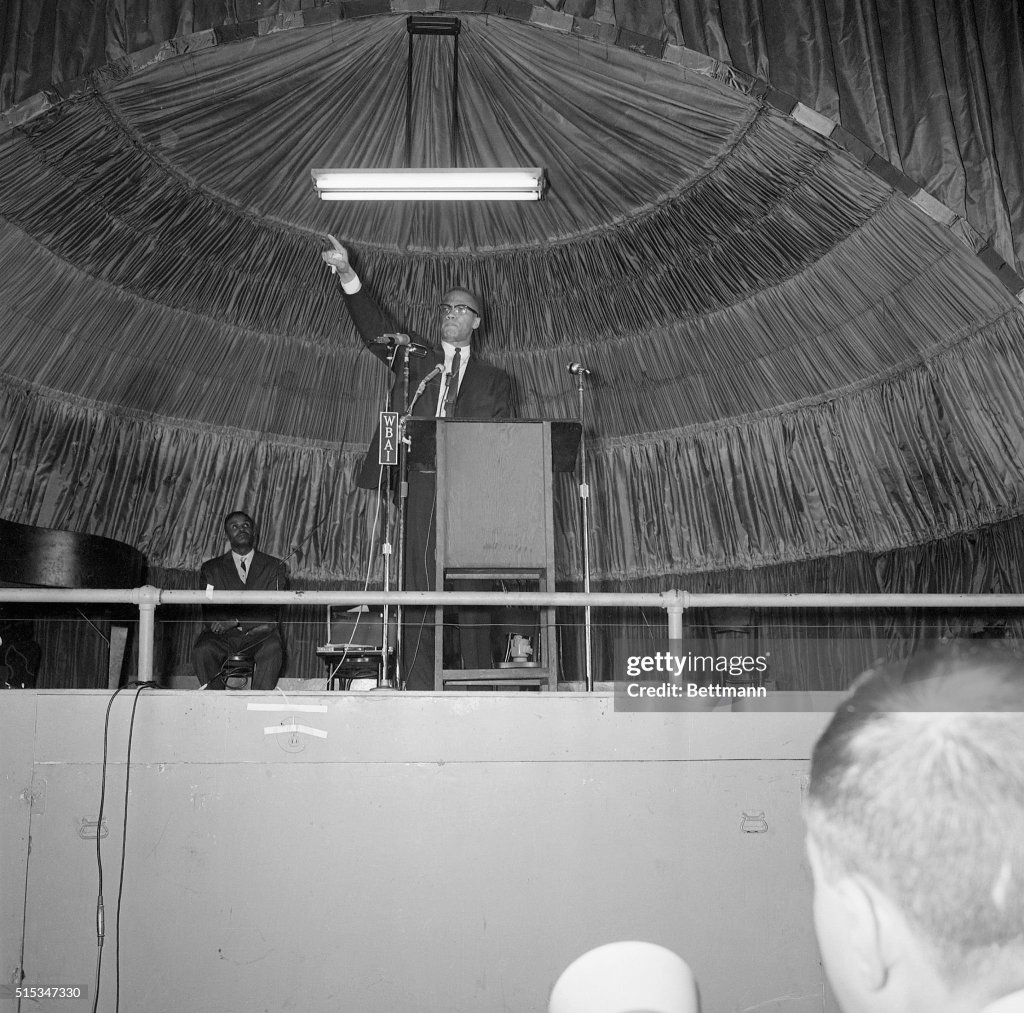
A thousand enthusiastic Blacks cheered Malcolm X last night when he exhorted them by declaring “it’s time for you and me to let the government know it’s ballots — or bullets.” It was the 38‐year‐old Black Muslim’s first public rally since he broke off March 8 from Elijah Muhammad’s Nation of Islam to organize Black Nationalists of any religion or creed. The meeting took place in the Rockland Palace, West 155th Street and Eighth Avenue. His first effort, Malcolm X announced, would be a voter registration drive. Black votes, he said, had “power to determine who will sit in the White House and who will sit in the doghouse.” But down South, he asserted, “in order to start casting ballots, you have to have some bullets.”
To win control politically and economically of their own communities, Malcolm X urged “22 million so‐called Negroes” to join any Black Nationalist organization or any organization practicing that philosophy. By May or June, he said, the movement could hold a national convention here — “if they won’t let us have Madison Square Garden, maybe we can have it in Times Square.” Then, he went on, amid applause, “if it’s necessary to form a Black Nationalist party — or a Black Nationalist army — we’ll form it.” Another tactic he proposed was to “internationalize” the civil rights problem here to a human rights issue, which would allow it to be taken to the United Nations. In the world organization, he said, American Blacks would have friends in African nations and “800 million Chinese.”
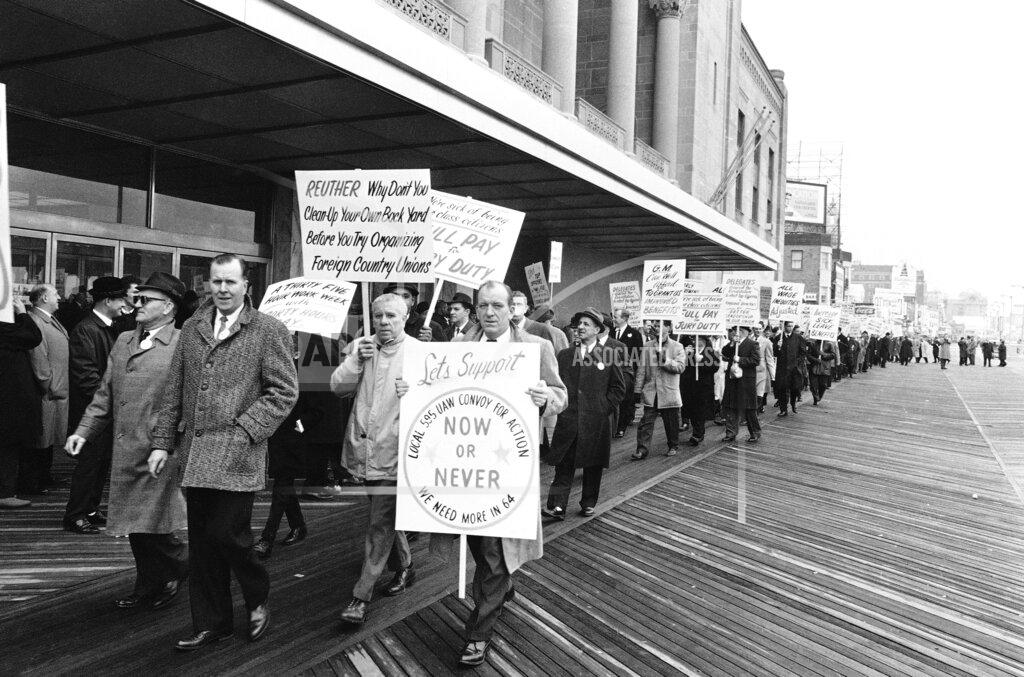
President Johnson will turn his attention this week to cementing his relationships with organized labor. He will make two speeches at major union meetings. The first will be tomorrow to the United Automobile Workers convention at Atlantic City. The second will be here Tuesday at the legislative conference of the Building and Construction Trades Department of the American Federation of Labor and Congress of Industrial Organizations. Some 3,000 leaders of local building trades unions are expected to attend the conference. These will be Mr. Johnson’s first appearances before large groups of local union officials since he became President. The President is on good terms with the top leadership of American labor. He has met with high union officials on a number of occasions and has often talked on the telephone with them.
Every American should be guaranteed an adequate income as a matter of right whether he works or not, a 32-member group calling itself the Ad-Hoc Committee on the Triple Revolution urged today. The group, composed of economists, educators, writers and others, said that three revolutions now occurring required radical, changes in national attitudes and policy. The three revolutions listed in their statement, which they sent to. President Johnson, were “the cybernation revolution,” “the weaponry revolution,” and “the human rights revolution.” The recommendation for a guaranteed income was one of a a number of suggestions put forward by the committee to deal with an economy in which, it declared, “the traditional link between jobs and incomes is being broken.” The cause of this break, the committee said, is the cybernation revolution — the combination of the electronic computer with the automated, self-regulating machine.
Walter P. Reuther, president of the United Automobile Workers, today brushed aside as unwise a proposal that the union endorse Attorney General Robert F. Kennedy for Vice President. The proposal was made at the union’s convention by John M. McCarrell, president of Fisher Body Local 544 in Pittsburgh. Mr. Reuther declared: “I think that we could do nothing more damaging to Bobby Kennedy than to get him involved in running for the Vice Presidency under these circumstances. “Sometimes your friends are your worst enemies on these kinds of things.”
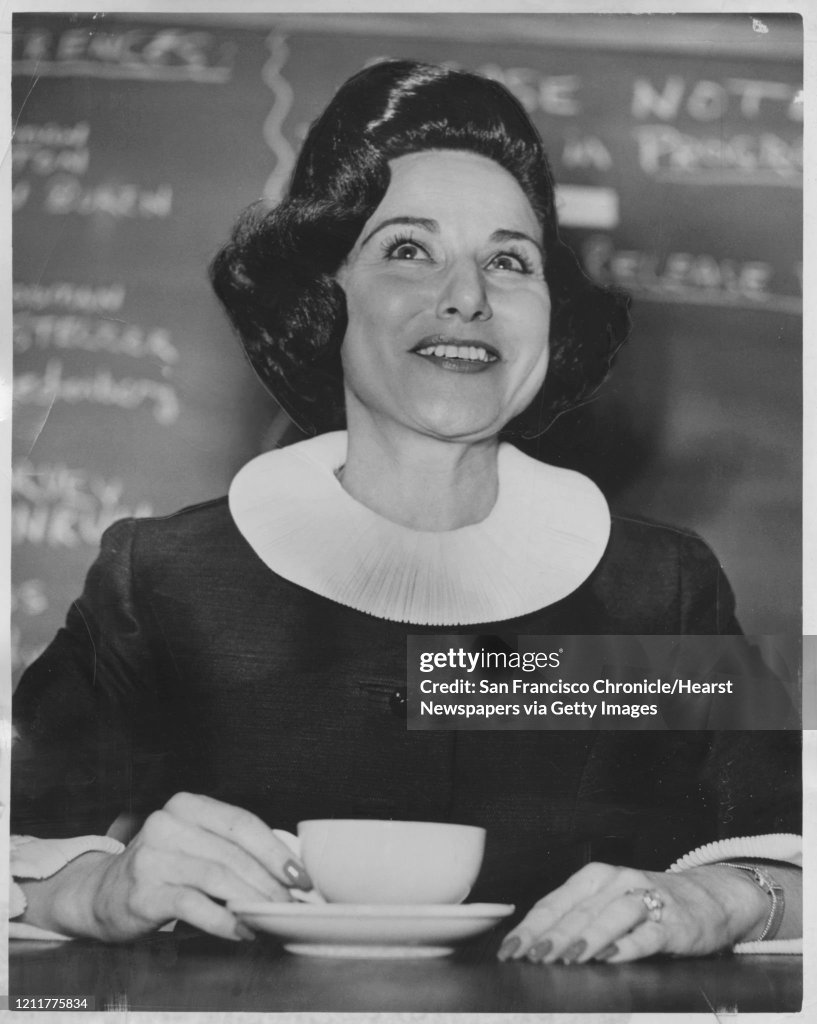
Attorneys for Pierre Salinger will go before the California Supreme Court here tomorrow to try to clear up questions about the legality of the Senate candidacy of the former Presidential press secretary. The court will be asked to order the registrar of voters for San Francisco, Charles A. Rogers, to certify without reservation that Mr. Salinger has filed a legal declaration of candidacy for the Democratic nomination. Mr. Rogers said this afternoon that he intended to forward the declaration to state officials in Sacramento Monday morning after he had received legal advice on the wording he should use in the “qualifications” he believes he must attach to it.
The situation is difficult for Mr. Rogers, because Mr. Salinger has not been a registered voter in San Francisco for several years. Yet the law requires Mr. Rogers to certify that Mr. Salinger has been a Democrat for at least three months and has not been affiliated with any other party within the last five years. “I have no records of his party affiliation to work from,” Mr. Rogers said. “In other cases, we look at the party registration on file in our records and then certify the answers required of us. But in this case, we have no records.”
Barbra Streisand appears on the cover of the New York Times Magazine section.
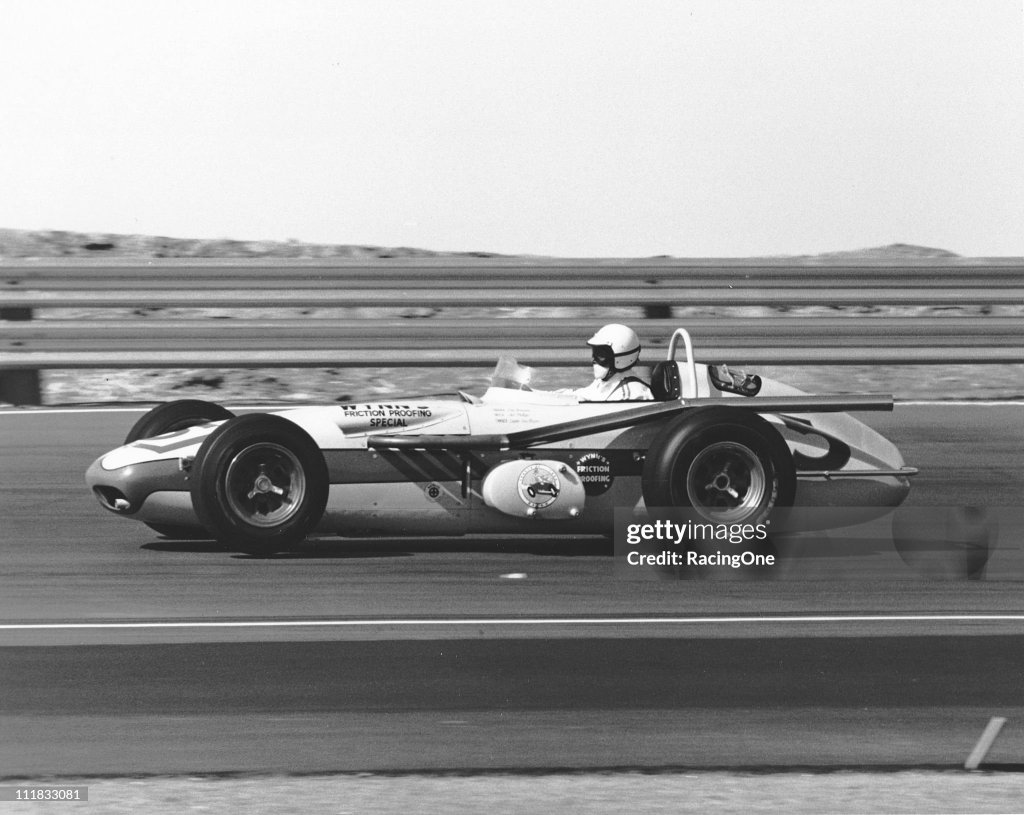
The 1964 USAC Championship Car season began at Avondale, Arizona, with the Phoenix 100, won by A. J. Foyt.
The 1964 Women’s Western Open golf tournament in Florida, was won by Carol Mann. Mann won her first of two major titles by 2 shots from Ruth Jessen and Judy Kimball.
Born:
Nicholas Patrick, British-born American astronaut (NASA Group 17, 1998; STS-116, Discovery, 2006; STS-130, Endeavour, 2010); in Saltburn-by-the-Sea, North Yorkshire, England, United Kingdom.
Kevin Henderson, NBA shooting guard and point guard (Golden State Warriors, Cleveland Cavaliers), in Baltimore, Maryland.
Died:
Addison Richards, 61, American actor (“Pentagon”, “Fighting Seabees”).
 History Diaries