
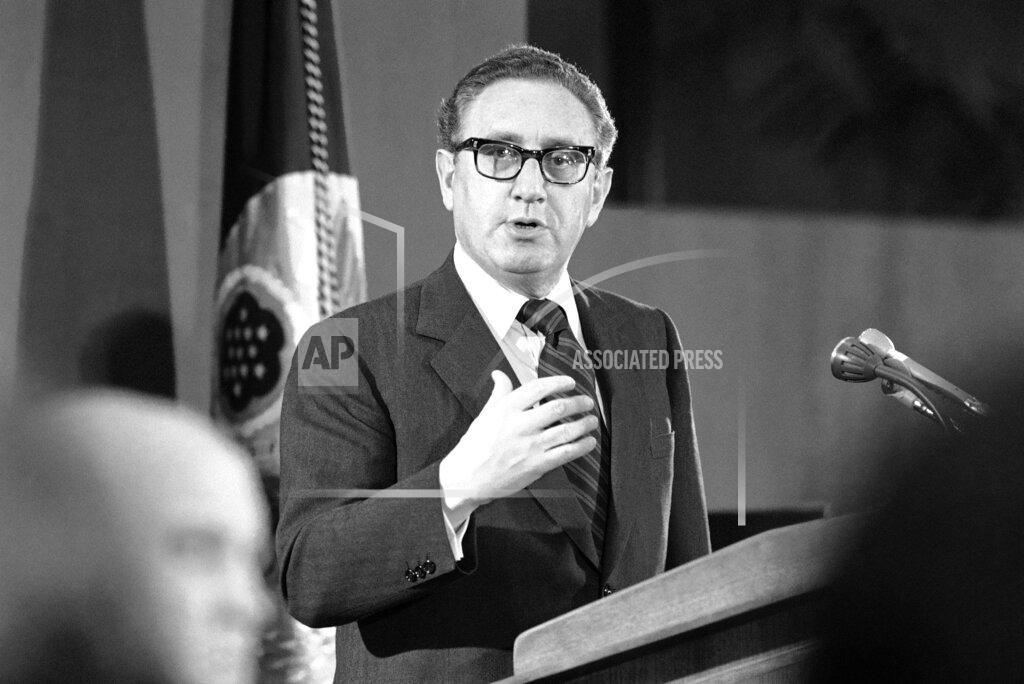
Secretary of State Kissinger said that relations between the Soviet Union and the United States had entered “a more difficult period,” but that he would strive during his visit to Moscow to sustain the policy of relaxing tensions between the two countries. Mr. Kissinger, who leaves for Moscow tomorrow, held a news conference and acknowledged publicly for the first time that American officials were concerned about the reception he will receive in Moscow. At a news conference in advance of his departure on Saturday night for Moscow, Mr. Kissinger publicly acknowledged for the first time the concern of American officials over recent developments in relations between the two countries and the uncertainty about the reception Mr. Kissinger would receive from Soviet leaders.
Mr. Kissinger was asked whether he agreed that the atmosphere was much “chillier” than on his previous visits to Moscow. He replied at length, citing the need for maintaining good relations, but acknowledging, “We are going there at a more difficult period than at some previous visits.” As examples of the difficulties that had emerged he cited “frictions” with the Soviet Union in the Middle East, Soviet resentment over the absence of promised improvement in trade status in this country, and problems in the talks on strategic‐arms limitation.
Communist-led insurgents cut off Cambodian Government forces seeking to retake the provincial capital of Phsar Oudong, 23 miles north of Phnom Penh, military and diplomatic sources said. The government forces have been isolated into four pockets, including one containing a training center with 800 recruits. The insurgents reportedly were destroying temples in Phsar Oudong, a town important for religious reasons. The government sent more soldiers north westward today to join troop trying to retake the fallen provincial capital of Phsar Oudong but military sources reporter that all efforts were stalled by heavy insurgent resistance.
One group of Cambodian Government soldiers trying to move toward Phsar Oudong from the east, was reported halted by heavy fire one mile from its objective. A second group trying to attack from the north made no headway, the reports said. A third group, equipped with armored cars, attempted to push toward the city from the southeast, but it too was reported stalled. Officers in the field said that the insurgents had brought up large stocks of arms and ammunition and had dug extensive bunkers to defend Phsar Oudong.
Fighting between Syria and Israel today spread over the broadest front since the current round of daily exchanges of artillery and tank fire started, according to a report from the Israeli front. General headquarters here said that the exchanges today, which were intermittent, continued for five hours. There were no Israeli casualties, it added. The military reporter of the state radio said today’s fighting opened at 10:30 AM with a Syrian attack against the southern flank of the salient captured by the Israelis in the war last October.
Spokesmen in Damascus asserted that Syrian and Israeli forces exchanged artillery fire along the Golan Heights today for the 10th day and Syria said she had inflicted a number of casualties. A military spokesman said that Israelis began the firing and that they shelled Syrian civilians.
President Hafez al‐Assad of Syria is reported planning to go to Moscow Sunday for talks with Soviet leaders before Secretary of State Kissinger arrives there later in the week. This report in the Beirut newspaper Al Yom, which has good Syrian connections, was taken as another sign of increased Soviet involvement in Middle East peace moves. The newspaper said President Assad was expected to confer with Soviet leaders on the issue of Syrian‐Israeli military disengagement on the Golan Heights and on Syrian demands for Israeli withdrawal as well from territory seized in 1967. Mr. Kissinger succeeded, during a recent visit to the Middle East, in obtaining Syrian and Israeli agreement to contacts in Washington on disengagement. Al Yom said that the Syrians would insist that military disengagement be coupled with a first step by Israel toward withdrawal from the Golan Heights area occupied since 1967. Such a first step, in the Syrian view, should be the yielding of the town of El Quneitra, the Syrian administrative center of the Golan region.
The Nixon Administration asked the Senate to revive a bill to authorize continued U.S. participation in a lending fund for the poorest nations of the world. The appeal to the Senate Foreign Relations Committee was made by Secretary of the Treasury George P. Shultz. The House on January 23 defeated a bill to authorize a $1.5 billion contribution to the lending funds of the International Development Association.
The establishment of a $3 billion emergency aid fund for the countries worst hit by soaring oil and wheat prices was urged on Europe, the United States and Arab oil producers by the Common Market’s executive commission. The author of the plan, Development Commissioner Claude Cheysson, said the plan would be aimed at offsetting disastrous payments deficits mostly in Asia and Central America.
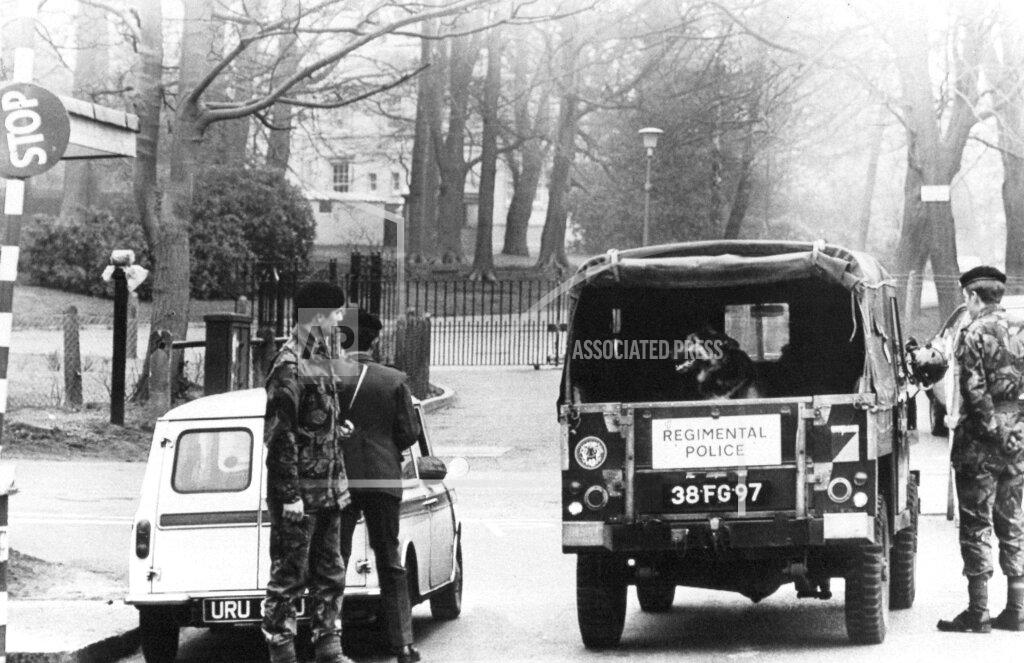
A 26‐year‐old Londoner was charged and held without bail today in the attempted kidnapping of Princess Anne and her husband, Capt. Mark Phillips. The accused, identified as Ian Ball, was seized last night after several shots were fired into the limousine carrying the couple along the Mall, the broad avenue leading to Buckingham Palace. Four persons, including the Princess’s bodyguard, were wounded but were reported in satisfactory condition today. Mr. Ball, who told the police he was unemployed and had no permanent address, made a two‐minute appearance in Bow Street Magistrates Court. He stood erect, neatly dressed in a gray pinstripe suit, and said only that he wanted legal aid. The specific charge was that he had tried to murder the Princess’s bodyguard, Inspector James Wallace Beaton, who, though wounded, fired back. Other charges, including that of attempted kidnapping, could be filed later.
The police said later that they were convinced that the attack was a “one‐man” operation and not politically motivated. They also said that long letter found in the defendant’s rented car was addressed to Queen Elizabeth and demanded £2‐million (about $4.8‐million) for the safe return of her daughter. The letter was described by government sources as neatly typed but confused in content. Others reported that it contained references to injustices created by the existence of a royal family.
Raiders in a car shot down six workers with a burst of machine-gun fire in the Belfast docks area. Police said one man was killed and five wounded. The workers were standing outside a timber yard in the predominantly Catholic area when they were fired upon.
Sweden and the United States formally announced the resumption of diplomatic relations and confirmed the nomination of ambassadors. President Nixon named Robert Strausz-Hupe, a native of Vienna and now ambassador to Belgium. Wilhelm Wachtmeister, head of the Foreign Ministry’s political department, was named as Sweden’s envoy and said he would leave for the United States the first week in May.
West Germany’s lower house passed a measure making legal abortions free under national health insurance. The measure is seen as a first step to a general relaxation of the present law which makes abortion a criminal offense unless the woman’s life is at stake. Before the new law can come into force, however, it must be passed by the upper house where the Christian Democratic Party, which opposes the measure, has a majority.
Italian Premier Mariano Rumor asked parliament for a confidence vote in his new center-left coalition government, almost identical to the one that resigned over economic differences 19 days ago. Rumor, a Christian Democrat, said all Italians must make sacrifices to pull the country out of its economic difficulties. He predicted higher prices for meat, gasoline and public utilities.
Pope Paul VI has called for increased devotion by Roman Catholics to the Virgin Mary, declaring that such action is fully in keeping with the modern women’s rights movement and the search for Christian unity. In a new exposition of the Virgin’s role, the Pope said: “The modern woman will note with pleasant surprise that Mary of Nazareth, while completely devoted to the will of God, was Far from being timidly submissive woman or one whose piety was repellent to others.”
Violence abated in poverty-ridden Bihar state in India but five days of death, looting and arson still threatened to topple the state government, supported by Prime Minister Indira Gandhi’s Congress Party. At least 22 persons have been killed by police, 101 wounded and 601 arrested. In New Delhi opposition members of Parliament demanded the Bihar legislature be dissolved and new elections ordered.
In Canada, a group of union workers from the Quebec Federation of Labour (FLQ) caused $35,000,000 in damage to the LG-2 (La Grande River) site of the James Bay Project for hydroelectric power. The destruction included using bulldozers to destroy the site and setting buildings on fire. The act came at the direction of FLQ vice president André Desjardins, after a subcontractor had refused to fire two workers belonging to a rival union, the Confédération des syndicats nationaux (CSN).
The United States Court of Appeals refused to prevent a secret grand jury report on President Nixon’s possible role in a Watergate cover-up from going to the House Judiciary Committee. In rejecting an appeal by lawyers for several Watergate defendants that the action might jeopardize their rights, the court gave the lawyers until 5 P.M. Monday to appeal to the Supreme Court.
Leon Jaworski, the special Watergate prosecutor, disclosed that he had subpoenaed additional White House documents, but neither he nor White House spokesmen would say what items were covered by the writ, which was served last Friday. The President’s lawyer would say only that a response was “under consideration,” but there was no indication of what that response might be. If the President decides to fight the subpoena, it could provoke another constitutional confrontation.
The chairman of the House Judiciary Committee said that granting the White House demand for an adversary role in the impeachment inquiry could turn the House proceeding into a full-scale trial and thus usurp the Senate’s constitutional role as the sole judge of a president’s conduct in office. Representative Peter Rodino made the argument as Republican members continued to support the White House bid to cross-examine witnesses and introduce evidence to the inquiry.
Acting on orders from the judge in the Mitchell-Stans trial, the government has given defense attorneys a transcript of part of a tape-recorded conversation between President Nixon and John Dean. The transcript, which is believed to contain evidence favorable to Maurice Stans, was handed over Wednesday night. The disclosure came as the day’s proceedings were postponed until Monday because of the illness of a juror.
A sick juror forced the postponement of the federal trial in New York City of former Cabinet members John N. Mitchell and Maurice H. Stans. Judge Lee P. Gagliardi recessed the trial until Monday while doctors determined the condition of Mrs. Violet M. Humbert. At the time, the courtroom was packed to the bursting point, waiting for the appearance of former White House counsel John W. Dean III, who was scheduled to testify. Former Attorney General Mitchell and former Commerce Secretary Stans are charged with attempting to influence a Securities and Exchange Commission investigation of fugitive financier Robert L. Vesco.
Led by surging food costs, consumer prices rose 1.3 percent last month, according to the government, which tempered the grim report with some brighter economic news — evidence that the slowdown in production and employment may be milder than had been feared.
A Senate-House conference committee agreed to increase the minimum hourly wage from $1.60 to $2 as of May 1, but adjourned without approving a final bill because of a dispute over some details.
It has been 45 days since Patricia Hearst was abducted from her Berkeley, California apartment, but there is still no indication when she might be released.
Two persons were killed and eight injured in a fire that destroyed a three-story hotel in downtown Duluth, authorities said. Two of the injured were listed in critical condition. One of them was a man who suffered a skull fracture after a leap from the top floor. Donald Parkkonen, clerk at the Crossroads Inn, said when he smelled smoke and found it coming out of a room, “I opened the door and there was this guy on fire, and flames everywhere.” Cause of the blaze was still under investigation.
Billy Epperson, wearing a Buster Brown haircut to hide a birth defect, pulled on his favorite cowboy boots and blue jeans and returned to the Houston kindergarten class from which he was expelled for violating the school’s district rooming code. The school kicked Billy, 5, out of class on February 22, saying his long hair did not meet standards. Billy’s parents, Mr. and Mrs. William F. Epperson, have let their adopted son’s hair grow over his ears to hide a misshapen head, which they fear might subject him to ridicule. They had to appeal all the way up from the principal to a federal court before a judge ordered Billy reinstated.
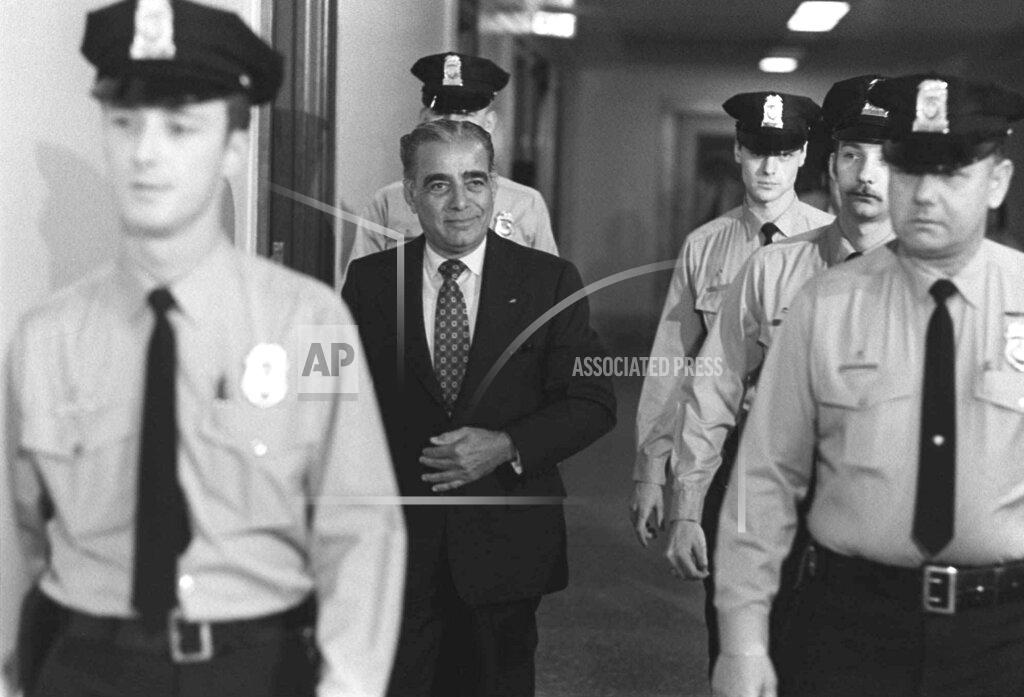
George P. Monaghan, a New York City police commissioner and fire commissioner in the early 1950s, was arrested on charges of perjury before a grand jury investigating loan sharking. Monaghan, of the Bronx, pleaded innocent. A hearing was set for April 23. The indictment cited Monaghan for answers he gave the grand jury in several appearances in January when the jury sought to determine whether Monaghan had been threatening a man who allegedly owed a debt and usurious interest of $90,000.
Federal officials ordered yesterday an analysis of whether major design changes are needed on DC‐10 jumbo jetliners. The recent Paris crash that killed 346 persons has prompted Federal authorities to order an urgent Government analysis of whether major design changes are needed on DC‐10 jumbo jet airliners. In disclosing the order last night, the Federal Aviation Administration said it would issue a directive today making mandatory several immediate improvements in the locking system of the DC‐10’s rear cargo door. The manufacturer, the McDonnell‐Douglas Corporation, already has begun voluntarily to make one of the more important of these changes on all 130 DC‐10’s operated by 23 airlines around the world. F.A.A. decrees are binding only on United States airlines. The consensus among aviation experts is that the Paris tragedy on March 3 was probably caused by failure of the aft cargo door, which was found six or seven miles from the main impact site with the bodies of six victims.
Fast-moving tornadoes and high winds swept across the Southeast, leaving six persons dead, scores injured and widespread damage. Winds reached up to 100 m.p.h. at Columbus, Georgia. The storm system developed over Texas and then moved rapidly to the northeast, carrying a mass of cold air that clashed with warm, moist air over the Southeast. At one point it extended 1,000 miles from Virginia south to Georgia and then west to Louisiana. Two men were killed in Louisiana and four in Georgia. At least 20 persons were injured in Alabama.
Dow Jones Industrial Average: 875.47 (+3.13, +0.36%).
Born:
Nikolay Tsekhomsky, Russian financier, chairman of the board of Barclays Bank Russia; in Leningrad (now Saint Petersburg), Russian SFSR, Soviet Union.
Laura Allen, American actress (“The 4400”), in Portland, Oregon.
Died:
Candy Darling [born James Slattery], 29, American transgender actress, died of lymphoma.



 History Diaries