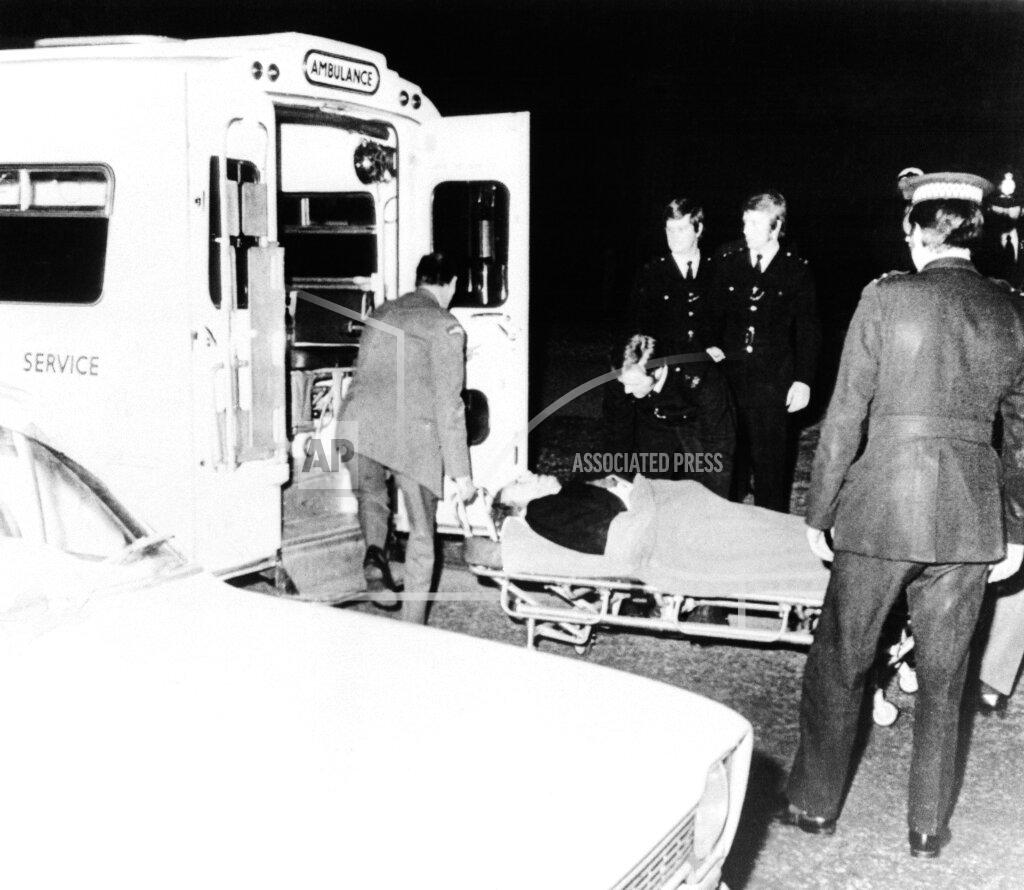
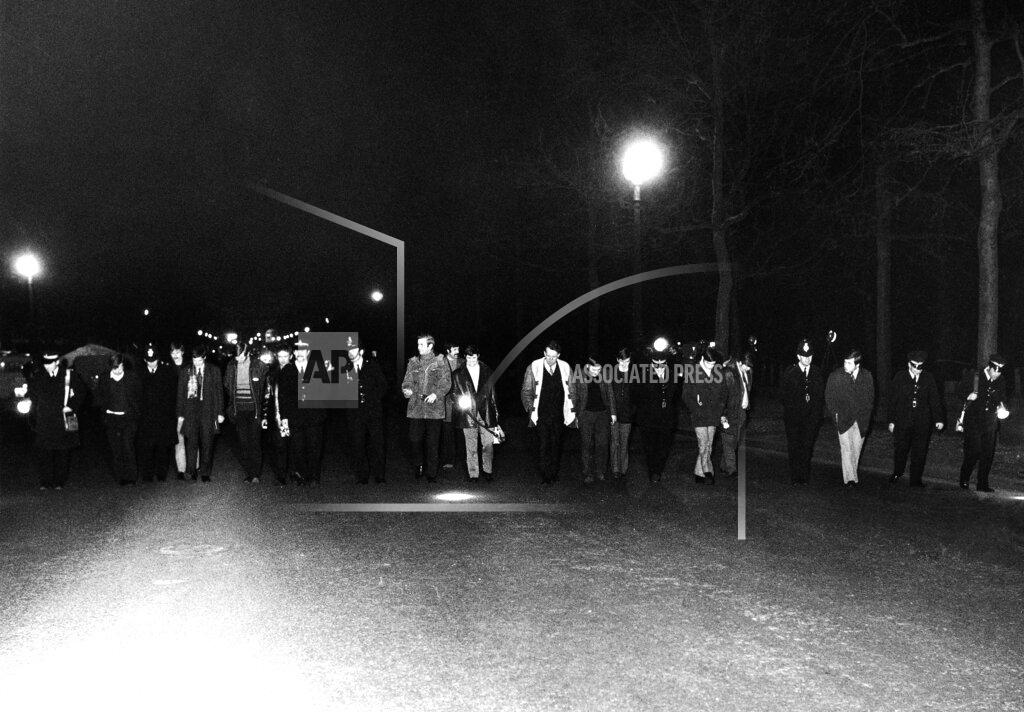
In London, an attempt was made to kidnap Princess Anne, daughter of Queen Elizabeth II. Ian Ball, later found by a court to be insane, drove his Ford Escort into the path of an automobile bringing Anne and her husband Mark Phillips back to Buckingham Palace after a charity event. Ball began firing a pistol and shot Anne’s bodyguard Jim Beaton; chauffeur Alex Callender; and tabloid reporter Brian McConnell and police constable Michael Hills. A passing pedestrian, former boxer Ron Russell, punched Ball and led Anne to safety. The story would later be dramatized in a 2006 Granada Television film, “To Kidnap a Princess.”
Ball famously intended to hold the Princess Royal for ransom – but even after he shot the men in her escort, Anne had no intention of going with her would-be kidnapper. After Ball opened the door of the Rolls Royce, wrestled her to the ground, and commanded her to get out, her three-word response shut down further conversation on the matter: “Not bloody likely!” In a 1980 interview with television personality Michael Parkinson, Anne recalled being “scrupulously polite” to her assailant at first because she “thought it was silly to be too rude at that stage”, before explaining that she finally “lost her rag” when he split the back of her dress.
Ultimately, passing heavyweight boxer Ronnie Russell came to Anne’s rescue – rushing up to the car and punching Ball twice in the head, knocking him to the ground. “I hit him as hard as I could – if he had been a tree he would have fallen over,” he later said. As for Anne’s parting words to her assailant? “Just go away and don’t be such a silly man.”
[Ed: Now I like Princess Anne even more.]
Two British soldiers in civilian clothes were killed in separate gun battles with Northern Ireland police who apparently mistook them for guerrilla gunmen. One source said an army van returning soldiers from leave in West Germany broke down shortly after midnight and a passing police patrol apparently was startled into action after glimpsing weapons.
West Germany has made a compromise proposal to answer American complaints that the European Common Market nations do not consult adequately with Washington before making important decisions. Under the terms of the German proposal, the Common Market’s Political Consultation Group, which prepares decision papers for the Common Market ministers, would invite American comment before recommendations on important questions are referred to the ministers for final decision.
West German Foreign Minister Walter Scheel said his government would not accept any European plan to reduce America’s role in European affairs. But he rejected President Nixon’s thesis that security, economic and other aspects of the alliance should be tied together.
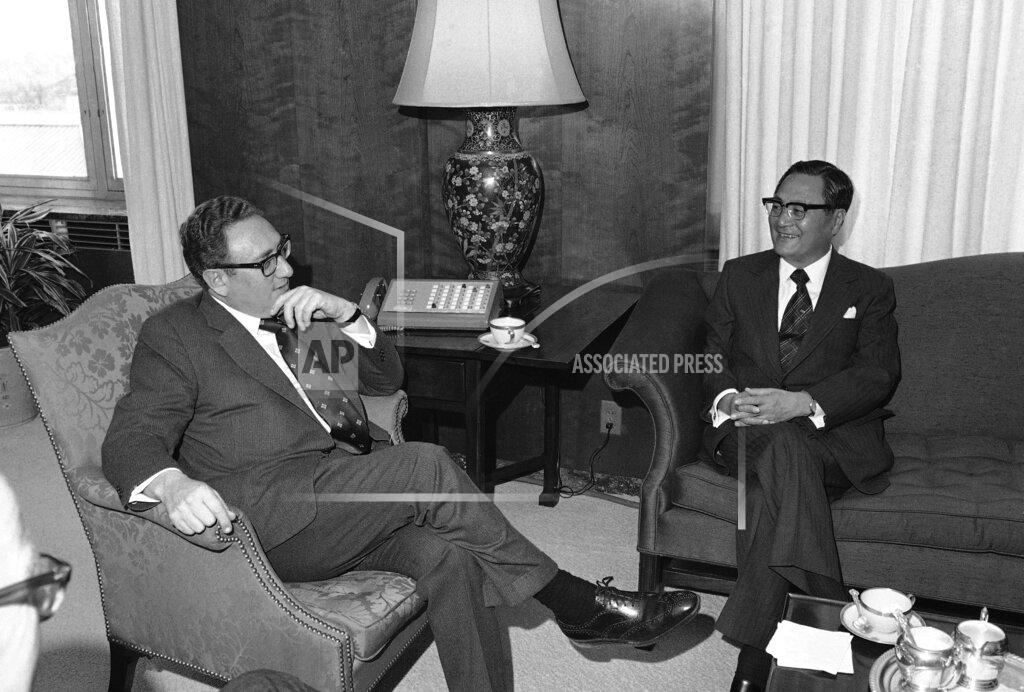
Normal diplomatic relations between the United States and Sweden will be resumed within the next couple of days after a freeze lasting more than 15 months, official Swedish sources said in Stockholm. Robert Strausz Hupe would be named U.S. ambassador to Sweden, and Count Wilhelm Wachtmeister would be Sweden’s ambassador in Washington, the sources said. Relations between the two countries have been cool because of Sweden’s harboring-of-American military deserters and its strong criticism of the U.S. role in Vietnam,
A resolution in the Soviet Union for the destruction of designated “unpromising villages” (neperspektivnyye derevni), and the relocation of their residents from rural locations to urban buildings, was approved by the Council of Ministers of the Soviet Union and the Party’s Central Committee. Under the terms of the resolution, 143,000 settlements in the U.S.S.R. were identified as being on land that could not be farmed, and 114,000 of those were to be liquidated. The 170,000 families in the “unpromising” locations were to be relocated to comfortable settlements on collective farms with apartment buildings for residents.
Retreating Cambodian government forces waged a fierce battle with Communist-led insurgents near the overrun capital of Phsar Oudong while government reinforcements moved toward the town from two directions in hopes of recapturing it. Cambodian Government forces shipped 20 armored personnel carriers arid 1,000 men up the Tonle Sap in the drive to retake the provincial capital of Phsar Oudong, the military command reported today. It was the Government’s first use of armor outside the Phnom Penh defense zone, 24 miles to the southeast of Phsar Oudong, in the war with Communist‐led insurgents. Landing craft reportedly put the troops and personnel carriers ashore yesterday at Kompong Luong, three miles east of Phsar Oudong. The command said that the force immediately clashed with insurgent forces along the river bank.
In South Vietnam scattered fighting was reported which took the lives of 117 Communists and 63 government soldiers.
The Golan Heights front exploded into its ninth day of shooting. Syria said a 2½-hour battle raged while Israel reported only sporadic Syrian shellings and said its forces did not fire back. No casualties were reported.
Apparently fearing that increased oil supplies would lead to lower prices, some Arab nations are still not relaxing production cutbacks imposed last October despite the lifting of the embargo on shipments to the United States. Though Saudi Arabia announced an immediate production increase and is expected to produce more than her pre-October levels, both Kuwait and Libya indicated that their cutbacks would be maintained. The result may be only a slow decline of international oil prices.
Despite the lifting of the oil ban against the United States, Arab oil production will remain at current reduced levels until oil ministers make another decision at a future meeting, according to Kuwait Oil Minister Abdel Rahman Atiki. The next meeting is expected in Cairo June 1 to review action taken Monday in Vienna lifting the embargo. Just back home from Vienna, Atiki made the comment in direct contrast to Saudi Arabian statements that production would increase.
Arab oil has been quietly flowing to U.S. military forces overseas for the past several weeks in what has been an informal easing of the embargo that was not officially lifted until this week, informants said. The oil-roughly 100,000 barrels a day or about half what U.S. forces were buying prior to the October war-was being purchased through refineries in “third countries” rather than directly from Arab producers.
Eight Black September terrorists who killed three diplomats — two of them American — in Sudan last March have been indicted on five counts, including murder, and will be tried in Sudan’s capital of Khartoum. The trial will be held by a special three-man superior court but there is no word when it will begin, U.S. officials reported.
At least five more persons died as anti-government demonstrations continued in the east India state of Bihar, the Press Trust of India news agency reported. The death toll since the demonstration erupted four days ago. rose to 28, most of them victims of police gunfire.
Ugandan dictator Idi Amin ended the hijacking of an East African Airways airliner by talking to a gunman and his wife, and persuading them to surrender, while passengers watched. The Fokker Friendship plane had been carrying 33 other people in Kenya on a flight from Nairobi to Mombasa when the Ethiopian couple forced the pilot to fly to Kampala. A Dutch businessman aboard told reporters, “The president strode up to the cockpit of the plane and began talking with the Ethiopian at pistol point about an hour after we landed at Entebbe Airport. The gunman then threw his pistol from the plane onto the tarmac and he and his wife surrendered to the president,” and added “Amin treated the hijackers like kings and seemed to be enjoying it.”
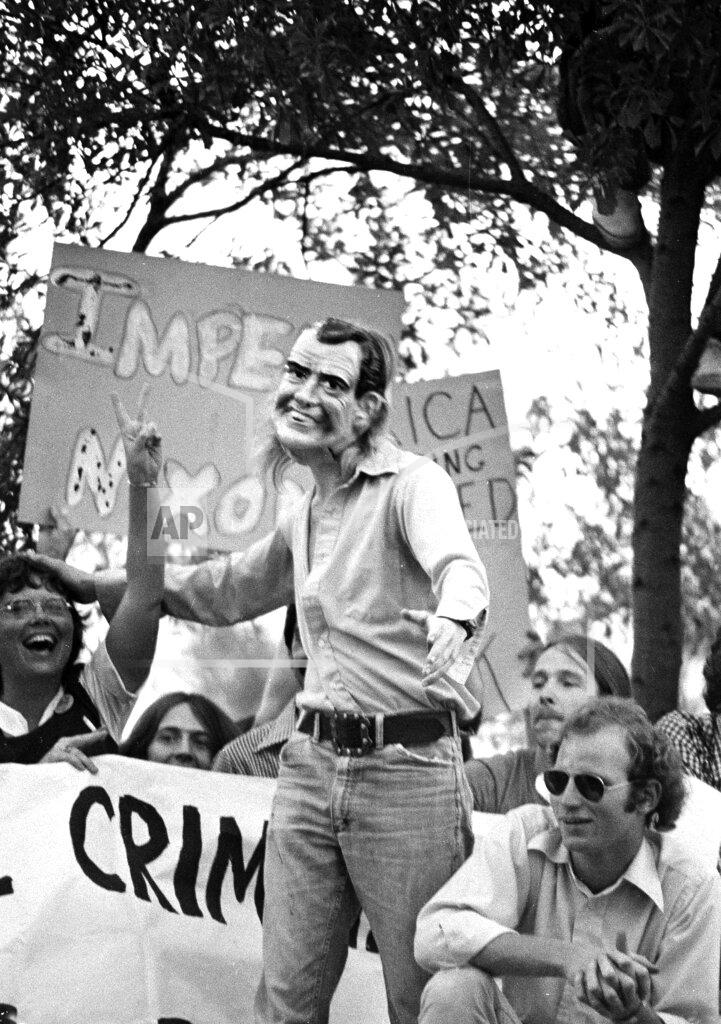
The House Judiciary Committee headed into its first serious party-line dispute over a demand by the President’s attorney that he play an active role in the impeachment inquiry. In two letters to the committee, James St. Clair said it was “imperative” that he be allowed “to cross-examine witnesses, suggest witnesses to be called and to introduce relevant and material evidence.” At separate caucuses the committee’s Democratic majority decided to oppose the request and the Republicans supported it.
Federal Judge John Sirica refused to grant a delay of more than 24 hours in sending a secret grand jury report to the House Judiciary Committee, and the matter was taken to the Court of Appeals.
Senator James Buckley’s call for President Nixon’s resignation gained no visible converts among conservative Republicans, drew a stack of angry telegrams and evoked glee in some Democratic circles. An Associated Press poll showed that Mr. Buckley and Edward Brooke of Massachusetts were the only two Republican Senators in favor of Mr. Nixon’s resignation, while 15 Democratic Senators said they believed the President should resign.
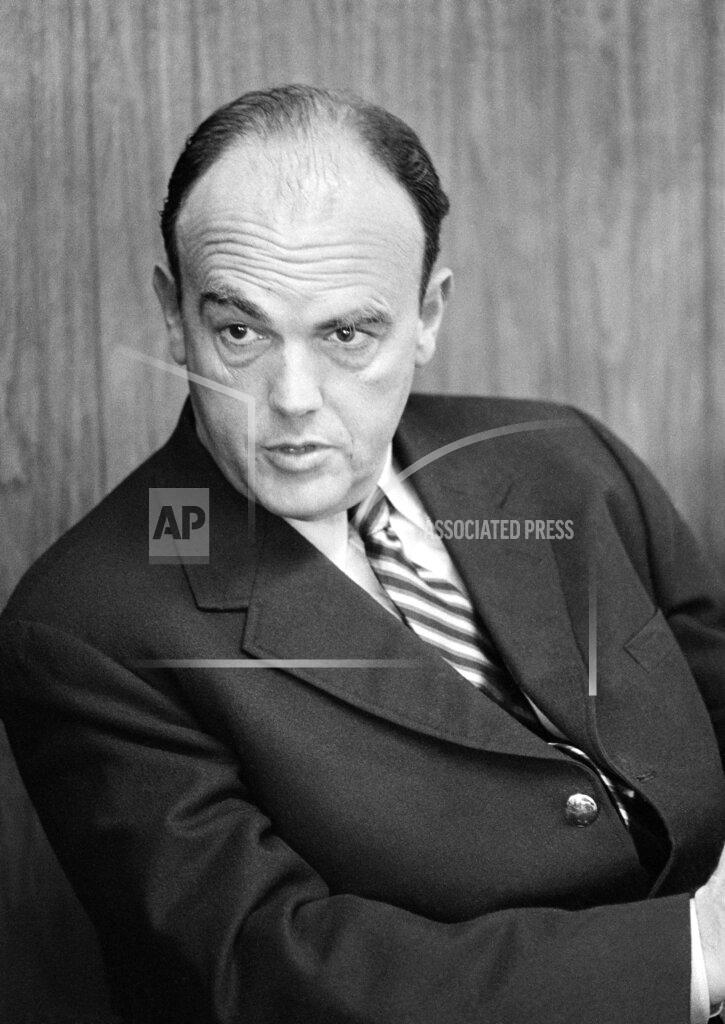
A former chairman of the Securities and Exchange Commission testified at the Mitchell-Stans trial that John Dean had made at least four telephone calls — one at the behest of John Mitchell — concerning Robert Vesco’s problems with the S.E.C. William Casey said that in one call, Mr. Dean, then the President’s counsel, asked the S.E.C. to delay its investigation a week, until after the 1972 election, out of fear of “some kind of last-minute smear.”
Advisers to the Senate Watergate committee recommended that Congress strip the Justice Department of its political clout and retain a special prosecutor during the transition. A study prepared by the National Academy of Public Administration also called on Congress to make clear to the public that any President can be impeached “without first being beheaded, jailed, fined, indicted or even indictable.” the panel’s 169-page report, one of a series, also recommended that the U.S. attorney general be barred by law “from advising the President in the latter’s political or personal capacity.”
The Senate Labor and Public Welfare Committee unanimously approved a $22.5 billion bill extending for four years major federal aid to education programs for grade and high school children. The panel rejected changes sought by President Nixon, who has said that the bill faces a veto unless it is substantially revised. The bill includes provisions that its sponsors say would try to make sure that the aid reaches the targets intended by Congress. Mr. Nixon said these would create “a bureaucratic nightmare.” He said the government should adopt a revenue-sharing, bloc grant approach that would leave it largely up to the school districts how to spend the money.
President Nixon’s job rating by the public is at its low point to date, according to the latest Gallup Poll, which shows 25% approve of the way he is handling his duties, while 64% disapprove and 11% are undecided. Mr. Nixon’s standing is two percentage points higher than the lowest rating given any President since the measurements were initiated in Franklin D. Roosevelt’s second term. President Harry S. Truman received approval of 23% in November, 1951, shortly after truce talks during the Korean conflict broke down. In the latest poll, Republicans gave Mr. Nixon 55% approval. The survey periods were February 22-25 and March 1-4 and covered 1,563 adults.
American oil companies, which might make $8 billion in profits on U.S. sales this year, could fully escape paying a new windfall tax under a plan tentatively approved by the House Ways and Means Committee. And in a step that could take a relatively tiny new tax bite for the immediate future, the committee also gave temporary approval to a partial phaseout of the industry’s controversial 22% depletion allowance in the United States plus a retroactive immediate end to its use overseas. The allowance saves U.S. oilmen about $2 billion a year in federal taxes.
The Agriculture Department wants to put more fatty parts of animals, including hog jowls and cattle briskets, into the consumer food chain by letting processors use more such items in hamburger and hot dogs. A proposal just announced would let manufacturers use more of the fatty trimmings as long as they included “visible lean” streaks or bits of red meat. Officials said, however, a federal rule that limits total fat to 30% in such products as hamburger, hot dogs, and other sausages would still be in effect.
More teachers joined a three-day strike in Kansas City, Missouri, and half of the 63,000 students stayed home. Many schools closed, officials said, and Teamsters said they would not deliver milk to school cafeterias. Hopes for renewed talks between the teachers and school officials clouded as the ranks of pickets increased. No new talks on a contract for the 1974-75 school year were scheduled after the teachers rejected a 5.5% wage increase offered by the administration.
Citing increased car sales, the General Motors Corporation canceled scheduled layoffs for 27,000 workers at seven plants over the next two weeks. A spokesman said that the decision had been influenced by a better outlook for the spring selling season as a result of the easing of the Arab oil embargo. Among those affected by the decision are 3,400 workers at G.M.’s Tarrytown, New York, plant who had been scheduled for a layoff in two weeks.
Six days before the crash of a DC-10 that killed 346 people in the worst airline disaster, the plane’s manufacturer balked at a federal request for a review of safety measures to prevent the type of explosive decompression most experts believe caused the tragedy.
The F‐14 Tomcat, the Navy’s newest and most versatile fighter, made its first operational flights Monday from the deck of the nuclear‐powered aircraft carrier Enterprise. These flights were the first step in mating the $14.8‐million aircraft to the world’s largest man‐of‐war. Senior naval officers regard the Tomcat as the first United States aircraft capable of besting the most advanced Soviet fighters in aerial combat and of countering Russian ship‐to‐ship cruise missiles. The landings and takeoffs by the F‐14 over the Pacific off San Diego on Monday and yesterday began the long, arduous process of integrating the two Tomcat squadrons, each of 12 aircraft, into the Enterprise’s air wing, which also includes two squadrons of A‐7E Corsairs, one squadron of A‐6 Intruders and one squadron of EA‐6 Prowlers.
Two more F‐14 squadrons will be assigned to a carrier deployed in the Mediterranean or the Atlantic later this year.
Chet Huntley, the former television newscaster, died in Montana. He was 62 years old and had undergone surgery for abdominal cancer two months ago.
“The Super Cops” directed by Gordon Parks premieres in New York, New York.
Dow Jones Industrial Average: 872.34 (+4.77, +0.55%).
Born:
Carsten Ramelow, German footballer with 46 caps for the Germany national team; in West Berlin, West Germany.
Died:
Chet Huntley, 62, American journalist and anchor of NBC’s Huntley–Brinkley Report from 1956 to 1970, died of lung cancer.
[Lavinia] Marian Fleming Poe, 83, African American advocate in Virginia.


 History Diaries