Rumania signs a commercial agreement with Germany but says no ultimatum was issued by the Reich. The Reich wants Rumania to serve as a farm country supplied by German industry. The Bucharest army is kept in readiness. It was learned late tonight that Rumania had decided to sign a commercial agreement with Germany, but it was stressed that the accord would not follow the proposals originally laid down by the Germans. The agreement was the result of negotiations carried on here between Dr. Helmuth Wohlthat, on behalf of Germany, and Rumanian trade officials. It was pointed out that the original German plans in no sense constituted an “ultimatum.” While the original German proposals were used as the basis for negotiations, it was said that the determining factor in Rumania’s acceptance was that she could obtain better prices for her agricultural products from Germany than from other countries.
While some circles attribute to Italian influence official Germany’s seeming disinterestedness regarding the Hungarian occupation of Carpatho-Ukraine, others fear some Hungarian move directed against Rumania with German support. Official quarters apparently do not share this fear; nevertheless, it is stressed that all precautionary measures of a military character have been taken. The press and public opinion continue to be somewhat perturbed by certain foreign interpretations of Dr. Wohlthat’s offer as an “ultimatum.” Reflecting general opinion, the newspaper Curentul states: “Germany desires economic collaboration and friendly relations with Rumania. We do not see obstacles, but naturally friendship must not mean either vassalage or a protectorate, even in the economic field, but must mean reciprocal confidence. To such relations the whole country will consent at any time, but mutual respect is the first condition of friendship.”
At least 500,000 men, called from a dozen classes of the Rumanian Army, tonight guarded the frontiers of Rumania, rich in oil and wheat. There was no general mobilization nor were any of the yearly classes called in full. The standing army of 200,000 men provided the backbone of defense, but informed quarters said it had been reinforced by the call of an even larger number to the colors from the reserves. Reserve engineers and artillerymen were called from all classes, and authorities said enough soldiers were at their posts to prevent a surprise from any quarter.
The population was calm, however, and there was general belief that there would be no attack. Heavy strength, nevertheless, was mobilized along the southern border of Carpatho-Ukraine, former autonomous province of Czecho-Slovakia which has been annexed by Hungary. Rumanians called it their “new frontier,” involving new defense problems. Before Czecho-Slovakia was dissolved Rumania had an ally on that border and because of mutual non-aggression treaties defenses there were not developed. Now Rumania must reckon with Hungary, which has extensive territorial claims against Bucharest. King Carol’s Grand Council took a clear stand that appeared to reassure the public. In effect, it declared, “Rumania wants nothing, but is determined to give nothing away.”
Hitler keeps Italian Premier Benito Mussolini informed of Reich moves by telephone and courier. The fascist press tells the public that Italy’s concerns will not be neglected.
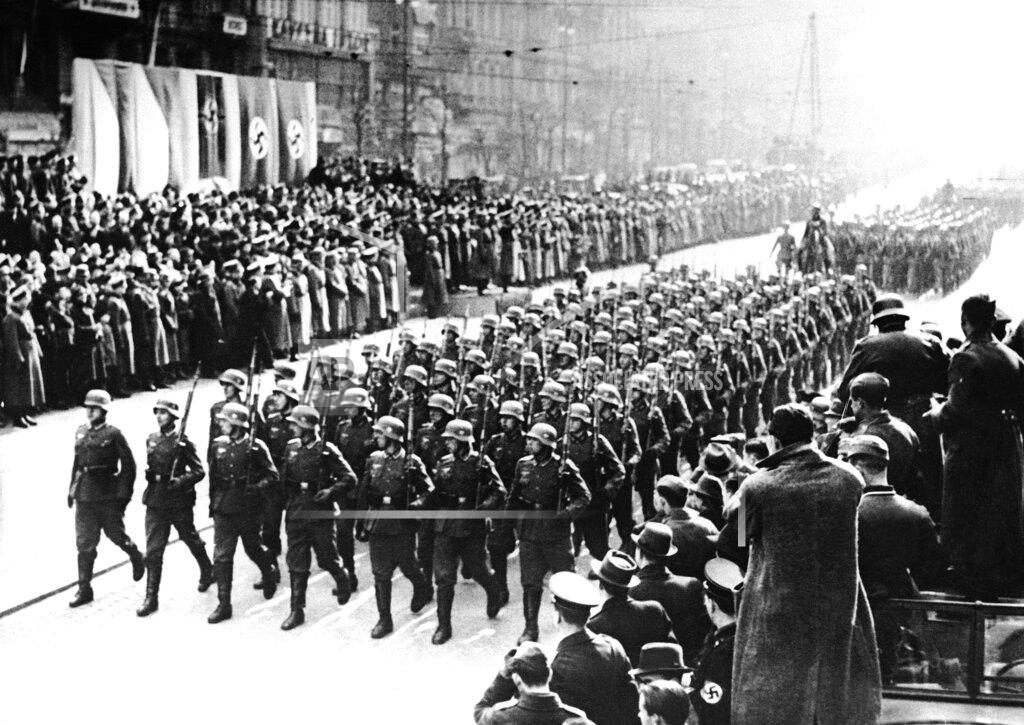
The Reich parades through silent Prague; Czechs maintain grim self-control. The German Army celebrated its bloodless victory over Czecho-Slovakia with a triumphal march today through the heart of Prague. Detachments of the Heer clattered and rumbled down mile-long St. Wenceslaus Square in stained field uniforms, tanks and field guns. still streaked with the dust of their invasion, in grim reminder to the watching Czechs of what they would have faced had they resisted. It was a parallel to the victory parade just a year ago in Vienna on completion of the union of Austria, but with one striking difference. Last year, when the German troops paraded before Adolf Hitler, they were tumultuously cheered by a Viennese crowd. Today’s parade passed between lines of silent men and women.
Not a cheer, not a single “Heil Hitler” came from the spectators, who were overwhelmingly Czech in nationality and sympathies. Nor did anyone boo or hiss. The Germans and their Czech Nazi sympathizers, for their part, refrained from any sign except the upraised right-hand salute. The only music was the marches for the troops. No national anthem was played, either German or Czech. The expressive silence was another display of the extraordinary effort both Germans and Czechs are making to avoid anything which might incite disorder.
Former Czech officials bid the country to cooperate with the Reich. Waves of suicides are seen in the takeover.
Germany remains defiant of foreign critics, asserting a sweet revenge for the Czech leader’s anti-German stance.
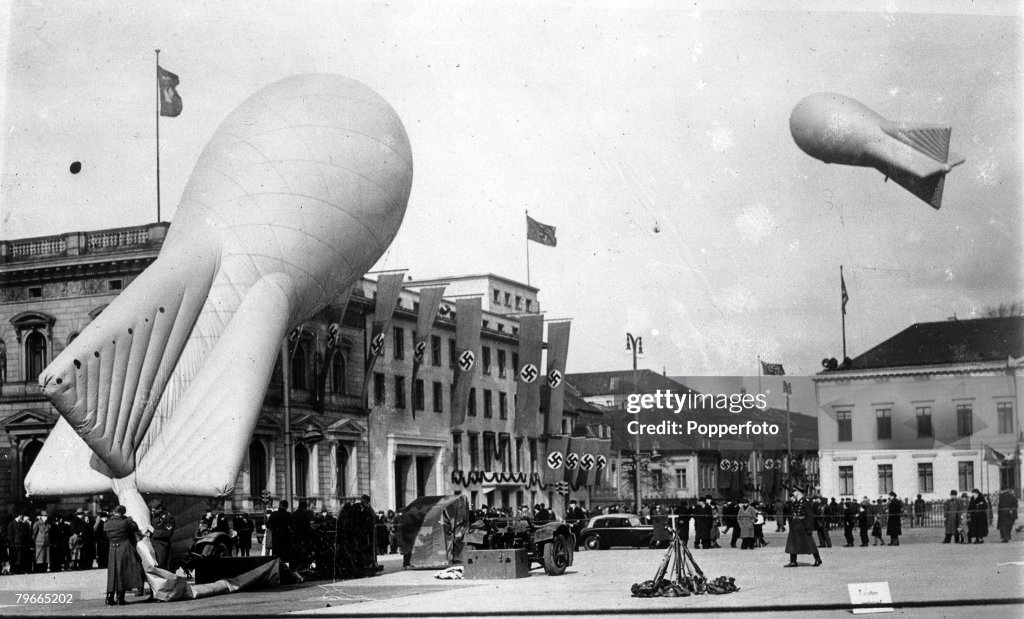
The German press calls Hitler the “Aggrandizer of the Reich,” a title given to medieval rulers who expanded empires. Hailed as “Aggrandizer of the Reich” who more than any medieval emperor who ever bore that title has brought Germany “security, peace, glory and greatness,” Chancellor Hitler tonight staged a triumphant entry into his capital on his return. from the bloodless war that wiped. Czecho-Slovakia from the map and added to the new Great German Empire two protectorates with another 10,000,000 people.
In elaborateness and showmanship this entry exceeded any triumph staged for any Roman Caesar, for Dr. Joseph Goebbels, who as Propaganda Minister and Gauleiter (district leader) for Berlin had charge of the preparations, made full use of his command of the masses as well as all modern. technical devices and pyrotechnics. Despite rain, snow and sleet approximately 1,000,000 lined the two-mile, flag-draped, garlanded route and cheered themselves hoarse as Herr Hitler, standing up straight in the front seat of his automobile, saluted as he drove slowly past, while bands blared, searchlights played and exploding fireworks showered the scene with cascades of many-colored sparks.
The French senate strongly upholds Premier Édouard Daladier, granting him emergency authority. Putting his dictatorial powers for national defense into immediate operation, Premier Edouard Daladier has decreed absolute silence on himself and his Ministers with respect to all decisions taken. Quickly after the Senate’s ratification today of his request for special powers, by the massive vote of 286 to 17, the Premier called his Ministers and several experts from the Finance and War Ministries into council in a meeting that lasted two hours. He laid before his Cabinet, a communiqué said, the first measures that he proposed to take by virtue of the special powers he has received. These will be submitted again at 5 PM tomorrow at a full Cabinet meeting presided over by President Albert Lebrun and will be “put into operation immediately.” What these measures will be the Premier and his Ministers refused to tell. “I can tell you nothing beyond what is in the communiqué,” M. Daladier told assembled newspapermen when he left the Ministry of War shortly after 9 o’clock tonight.
The British trade delegation headed by Robert S. Hudson, Secretary for Overseas Trade, arrived in Warsaw, Poland this afternoon without having stopped in Berlin en route. Mr. Hudson and his aides will spend three days here in the interests of the expansion of Anglo-Polish trade. They will see leading businessmen in addition to officials. The Poles now more than ever want to increase trade with the British, since, with the annexation of Czecho-Slovakia, Germany’s share of Poland’s foreign trade has risen to the menacing figure of 30 percent.
Switzerland plans to fight to maintain its independence, the federal councilor says. Hitler pilgrimages are banned.
Insistence by Ramon Serrano Suner, Nationalist Minister of the Interior and Propaganda, on “victorious peace” was regarded here today as rejection of a Republican offer to negotiate an end to the Spanish civil war. The Republican National Defense Council made clear overtures last night by addressing a peace offer directly to the Nationalist government in a radio broadcast from Madrid.
Señor Serrano Suner broadcast a communiqué today from Saragossa in which he said: “We can answer in no other way than this: We desire victorious peace. After peace, victorious, we will show our generosity, which we are proving in good works.” Authoritative sources interpreted the Propaganda Minister’s response that Generalissimo as evidence Francisco Franco regards “victorious peace” as a complete victory for his Nationalist armies, or unconditional Republican surrender.
Meanwhile, General Franco’s preparations for an offensive against the Republican-held zone were continuing rapidly, with no indication that he had deviated in any way from his repeatedly announced insistence on complete surrender. The Madrid Council’s action was regarded in some quarters here merely as an attempt to gain time for flight from Republican areas by those leaders whom the Nationalists regard as responsible for prolonging the conflict.
The Nationalists, therefore, considered that the next step was up to Madrid, holding that the Republicans must define what they mean by “honorable peace.” Señor Serrano Suner made clear to Madrid that the alternative to peace at General Franco’s dictate was an early start of a campaign to wipe out the last trace of Republican resistance on the Mediterranean coast and in South and Central Spain. No indication was given of when the offensive might start. It was believed, however, that the Republicans would have ample time to make specific proposals.
General José Miaja, head of the Republican National Defense Council, said tonight that he had received no reply from the Nationalists on last night’s radio appeal for immediate peace negotiations. Lieutenant José Miaja Jr., son of the Council head, who was released March 10 by Nationalists, arrived in Madrid today in time to celebrate his saint’s day with his father. The younger Miaja was taken prisoner by the Nationalists early in the war and was released in exchange for Miguel Primo de Rivera, son of the late dictator of monarchial Spain.
“If Franco would give us half a chance there could be peace in Spain this week.” That is the reaction of the Spaniards in Valencia to the appeal to General Francisco Franco broadcast by Julian Besteiro, Republican Foreign Minister, last night from Madrid. The appeal, in which the National Council of Defense formally notified the “Nationalist Government” that it was disposed to talk about an honorable peace and awaited the Nationalist answer, was epoch-making in that it was the first time that this side had referred to the Franco regime as the “Nationalist Government” rather than the “Rebels,” and also it is thought to have been the first time that radio was used to convey a message of this importance. Here it is fervently hoped that this bold step will break the ice and lead to a satisfactory peace.
Turks express shock that Czechs did not fight to keep their homeland and express concern over the Reich.
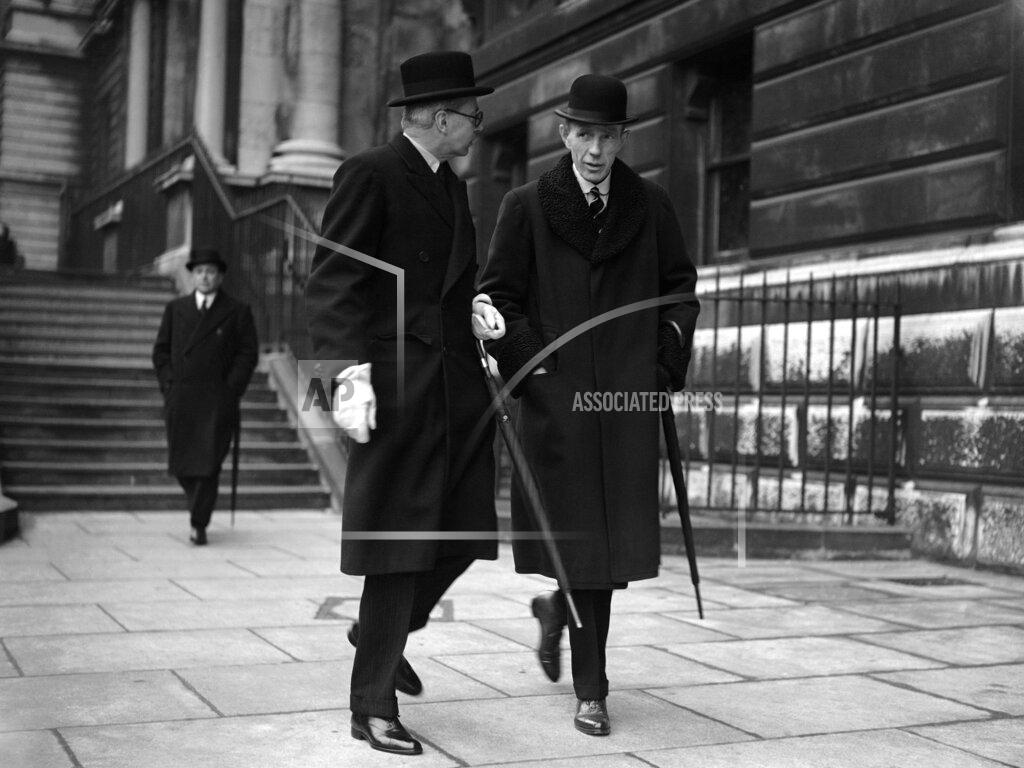
British Secretary of State for Foreign Affairs Lord Halifax explained to the Soviet ambassador in the United Kingdom that the reason for the rejection for Joseph Stalin’s call for a multi-power conference to contain Germany was due to the lack of available personnel to embark on these negotiations.
The Soviet Union will not recognize the German seizure of Czecho-Slovakia. Foreign Commissar Maxim Litvinov sent a note to that effect yesterday to Count Friedrich von der Schulenberg, the German Ambassador here. The note was in stronger worded terms than are usual in diplomatic exchanges. Mr. Litvinov said that no head of a State had the right to dispose of his country unless the latter’s population had had a full and free opportunity to approve or disapprove such action. The foregoing was the subject of a communiqué from the Soviet Foreign Office today. It is considered here as an important political step because it puts the Union of Soviet Socialist Republics on record as condemning an act of aggression. But Soviet officials slightly shrug their shoulders over the report that France and Britain are now seeking Russian aid about a German ultimatum to Rumania.
Britain suggests a bloc to resist the Reich. Soviets respond cautiously. The Soviet Government gave only a qualified and tentative answer today to an inquiry from Viscount Halifax, British Foreign Secretary, as to what its attitude would be in the event of a German attack upon Rumania. The Russians did not rule out help for Rumania, but before committing themselves they showed a wholly natural desire to know what Britain and France would do. It is expected that the soundings between London and Moscow will continue, and they may become slightly less cautious after another emergency meeting of the British Cabinet tomorrow morning.
In Russia, the “Industry of Socialism” Exhibition finally opened, sixteen months behind schedule, having finally satisfied the censors that the pictures displayed proved that life had got better in Russia since the removal of the Tsars.
Professor Pierre Montet of Strasbourg University reveals the discovery of a gold sarcophagus in an Egyptian tomb near ancient Tanis. A silver sarcophagus is found inside the gold, the first known appearance of silver in Egypt.
Discussions on Palestine end in discord. Britain plans to impose a proposal.
French troops and Syrian police fought demonstrators in the streets of Damascus and Homs today, while outbreaks occurred in a dozen scattered sectors in Syria. By midday several persons were reported to have been killed and hundreds wounded in street battles. Homs is about 100 miles north of Damascus.
The Neutrality Act debate nears in Congress as some urge easing the law. Congress will consider this week the important domestic questions of relief, government reorganization, housing, national defense and various appropriations measures, but will keep a weather eye on Europe and the White House to watch every move on the checkerboard of international affairs.
The week may witness the start of an Administration drive to lower at least one of the barriers which it considers an obstacle to full freedom of action in the conduct of foreign relations. Senator Pittman has announced that he will introduce tomorrow a bill to revise the Neutrality Act along lines which some contend would make it easier for the United States Government to aid those nations with whose policies it is most in sympathy with, and deny aid to those whose ideas and actions it finds objectionable.
President Roosevelt has stated that he believed the existing neutrality laws should be revised, but that he had no plans for suggesting specific revisions to Congress. Senator Pittman maintains that the bill he will offer was not White House inspired, but the fact some of its provisions coincide with ideas previously expressed in Administration circles led some observers to predict that Administration support might be thrown behind it. The possibility that the President might indicate his endorsement of the bill through some public utterance, or in a special message to Congress, was foreseen in some quarters.
The restrictions of the neutrality laws and the provisions of the Johnson Act which prohibit the extension of credit to countries in default on their war debts to this country are the two chief statutory obstacles to freedom of action by the administration in the conduct of foreign affairs. Modification of the neutrality statute along the lines of the Pittman bill or otherwise would make one obstacle less formidable from an administration standpoint. There has been no suggestion from any quarter that the Johnson Act should be repealed or revised.
The United States is interested in seeing that “a substantial balance of power” is maintained in Europe so that it will not be forced to defend the Monroe Doctrine in Latin America, Senator Key Pittman, chairman of the Foreign Relations Committee, asserted in an address tonight over the Columbia Broadcasting System. The Senator discussed the changes he proposed to the existing Neutrality Act. He has announced that he will introduce a bill tomorrow which will permit the export of arms and munitions to all belligerents in time of war on a “cash-and-carry” basis.
“The great emergency that is facing the world and, inevitably, our own country if the march of the totalitarian powers continues and I now see nothing to stop such march unless it be stopped by the immediate and united action of the liberty-loving people of Europe demands our action,” Senator Pittman said. “The emergency demands of our government an expeditious and enormous increase of the capacity in this country for the production of materials and instruments of defense. It is totally impracticable, if not impossible, for our government to sufficiently increase the capacity of government works to meet any such emergency. Our government must rely upon the expansion of the capacity of private industry. Private industry will not expand if it is denied the right and power to export its products.”
The present Neutrality Act, according to Senator Pittman, “prevents our citizens and our ships from enjoying their right on the high seas under international law during war.” Asserting that it was the determination to “fight for our rights as neutrals on the high seas that forced us into the World War,” he added: “The existing Neutrality Law constituted a surrender of those legal rights that we fought for in the World War. We have discovered that the existing law in some particulars is unjust if not unneutral.” He then cited the situation in the Orient. Asserting that if the Embargo Act had been applied to both countries, “China would have suffered more than Japan.”
Establishment of a Railroad Reorganization Court to assume jurisdiction over rehabilitation of insolvent railroads and thus prevent “recurring cycles of insolvency, reorganization, further insolvency and further reorganization” will be proposed in a bill to be introduced in the Senate tomorrow by Senator Burton K. Wheeler of Montana and Senator Harry S. Truman of Missouri, chairman and member of the Committee on Interstate Commerce.
As set forth in a synopsis of the measure prepared by its sponsors, the chief objects of the legislation are: To assure a sound financial structure as a result of the reorganization process, to expedite and facilitate the reorganization procedure and to eliminate unwholesome practices in reorganization procedure. The proposal, the Senators point out, is in line with a suggestion to the President by a committee of the Interstate Commerce Commission in a report of March 24, 1938, that, in addition to opportunities for improvement of reorganization, Congress might give its attention to the “establishment of one court to have charge of railroad reorganization.”
The former Czechoslovakian leader, Edvard Beneš, compares the Nazi roust to being guillotined. He warns the United States it has major role to play in world events.
Midwives still reportedly deliver 10 percent of babies, according to the U.S. Census Bureau.
Fleet Exercise No. 5 in the Caribbean Sea, participated by U.S. Navy and U.S. Marine Corps personnel, drew to a close.
Chile doubts the danger of an epidemic as nearly 300,000 earthquake victims have been inoculated against typhoid and other diseases since the January 24 earthquake.
A group of Japanese troops boarded barges at Xingzi, Jiujiang, Jiangxi Province, China, sailed south 10 kilometers on the Yangtze River, and disembarked to attack Chinese positions at Wucheng.
Japanese naval commanders reported that their planes had smashed a Chinese counter-offensive today along the Han River in north central Hupeh Province. After wiping up the Chinese along a sparsely settled stretch of the river, the commanders said, the planes continued on to the river ports of Siangyang and Fancheng, bombing those major Chinese military bases.
Japanese dispatches from the front said that heavy Chinese troop concentrations, barracks and warehouses in the two towns were bombed by dozens of planes sent over by the invaders. “Great loss of life” was reported in an air raid on 500 junks carrying Chinese troops across the Han at Siangyang.
A British mission report from Changsha today said that the Rev. A. G. Leigh, 35, a Briton, was killed last Wednesday in a Japanese air raid on Pingkiang, Hunan Province. A bomb was said to have made a direct hit on a dugout in which the minister, a member of the English Methodist Missionary Society, had taken refuge with twelve Chinese. He was from London, where his wife now is on a visit.
Born:
Jim Boylan, NFL wide receiver (Minnesota Vikings), in Washington, District of Columbia.
 History Diaries