Fighting broke out early today at the small Turkish Cypriote village of Ghaziveran, 40 miles west of Nicosia, a British military spokesman reported. Mortars were being used in the fighting, the spokesman said. Yesterday, Fazil Kutchuk, the Turkish Cypriote Vice President of the republic, protested to the British command that his community’s people “are still under siege almost everywhere.” After 10 days of relative calm on Cyprus, Greek Cypriotes attacked the Turkish Cypriote enclave today. By nightfall at least three Turkish Cypriotes were dead and four were wounded. Five Greek Cypriote attackers were wounded and one died in the hospital.
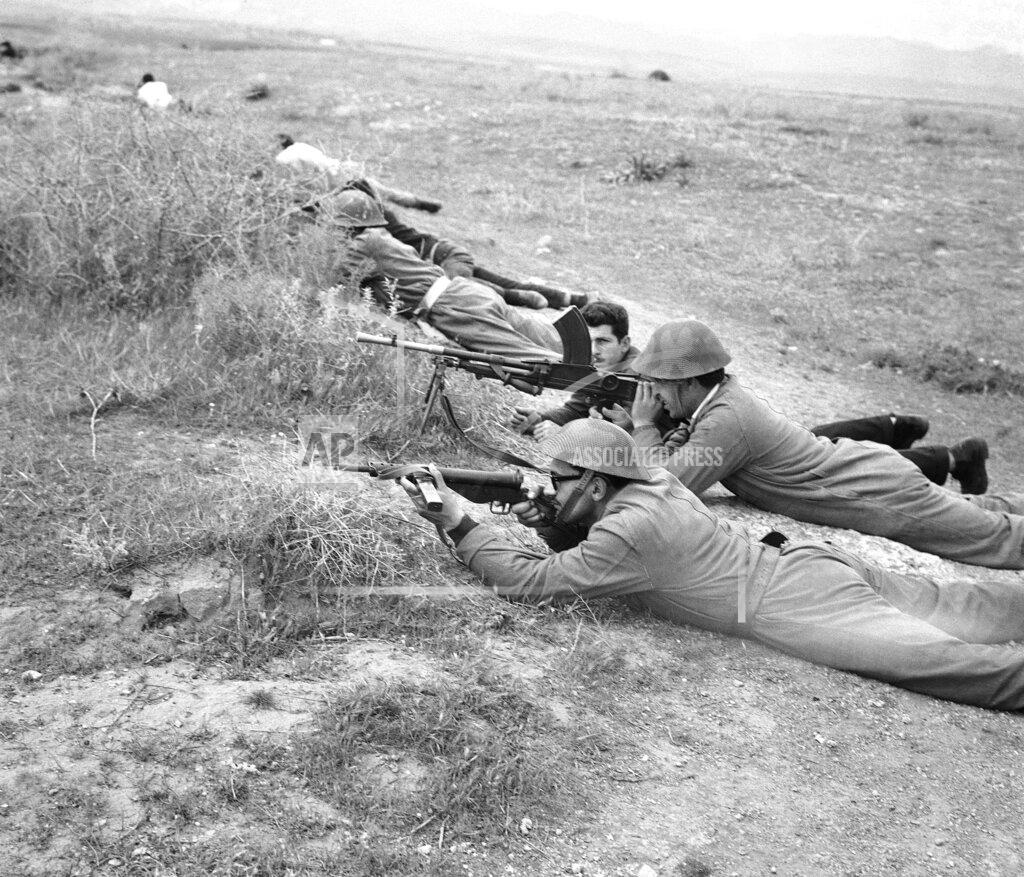
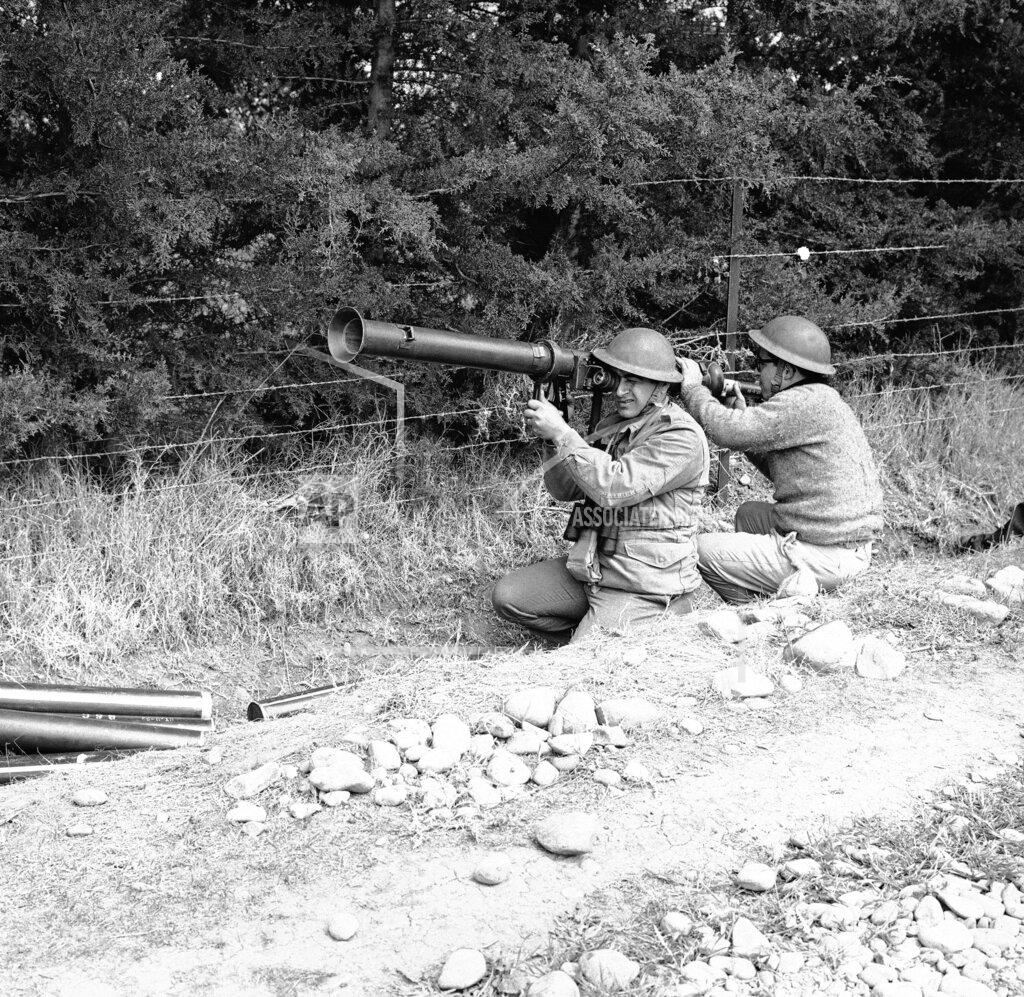
The siege of Ghaziveran, on Morphou Bay, has been uneven. Two cease‐fires during the day broke down. British troops intervened but with the approach of darkness, they were pulled out of the village. As they left, rifle and machine‐gun fire was exchanged again. About 200 women and children and a few old men huddled in a small schoolhouse in the center of the village. Bullets tore through the leaves in orange groves around the village, chipped the stucco walls of the school or lodged in the walls of other buildings. Turkish Cypriotes appeared to be dug in at 15 positions in the groves and fields. They had one Bren gun and two or three rifles. The other weapons were shotguns. Major John Gillespie, the British paratroop commander on the scene, thought there were 500 Greek Cypriotes surrounding the village. Earlier in the day they were lobbing mortar shells into Ghaziveran and firing bazookas to penetrate the walls.
Briefly the Greek Cypriotes used one of their armored bulldozers and an old armored car, stolen, according to one account, from the British target range on the island. With only 15 men, Major Gillespie was in no position, to enforce a cease‐fire. He arranged a temporary one at 10:45 AM, five hours after the fighting started. A United Nations representative was present but the hard work of keeping the peace still belongs to the British. Eighty-two more Canadian soldiers of the United Nations force arrived tonight, bringing the total to 651. They still have no directive from New York and are not taking an active role in keeping the peace.
The United Nations force is the latest effort to end communal warfare on Cyprus. Turkish Cypriotes resent Greek Cypriote attempts to amend the constitution to remove safeguards accorded to the Turks. Fighting broke out at Christmas. Even while Ghaziveran was under fire, sporadic shooting started in Kalokhorio southwest of here. Deserted houses owned by Turkish Cypriotes in Kato Koutrapha were set afire and at Temblos, the last Turkish community on the north coast to hold out against the Greek Cypriotes, a few more shots than usual were fired into the village.
The shooting here started in the welter of confusion and hate that is normal here these days. Greek Cypriotes arrived at the village last night. According to their version, they used loud‐speakers to tell the Turkish Cypriotes to pull down their roadblock. The Turkish version is that they were told to hand over their weapons. The village chief said he told the Greeks at 5 AM he would talk it over and be back in half an hour. At 5:45 he was still talking and the shooting started. At 9:20, an ultimatum was issued from the Turks at Lefka that unless the attack on the village were stopped, they would launch their own attack on the Greeks. Whatever the cause, the shooting stopped at 10:45 AM.
It broke down and Glafkos Clerides, the Greek Cypriote President of the House of Representatives, went to the scene and helped arrange another at 1:15 PM. By this time, several houses were afire. The cease‐fire was to last until 4 PM, with the limited, objective of getting the women and children into the school. At 3:15 the village was raked with small‐arms fire and women and children ran through streets screaming. Through Major Gillespie’s efforts, the Turks agreed not to put any armed men in the school and the Greeks agreed to spare the building. As darkness came, Major Gillespie pulled the British troops to the edge of the village.
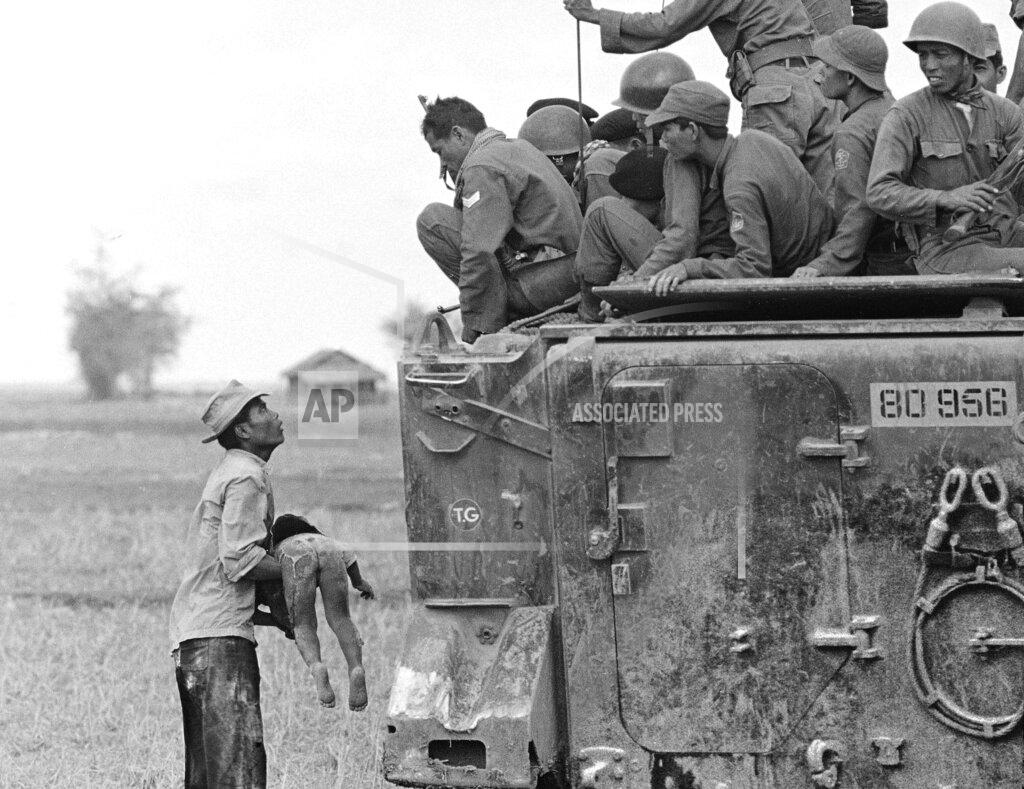
Troops from South Vietnam, accompanied by U.S. Army advisers, mistakenly crossed the border into Cambodia and attacked the village of Chanthrea, killing 17 civilians. Cambodia charged South Vietnamese forces attacked Cambodian border villages today, thus providing a fresh complaint to be presented to a mission that has just arrived from South Vietnam. The charge was made even before Brigadier General Huỳnh Văn Cao and his negotiating delegation from South Vietnam had a chance to talk with the Cambodians about their border dispute.
Border violations were partly responsible for the decision of Prince Norodom Sihanouk, the Cambodian chief of state, to break diplomatic relations with South Vietnam last year. South Vietnam has admitted that its troops crossed the ill-defined frontier in the past to chase Communist guerrillas. Dispatches from Saigon indicated that a similar chase may have been involved this time. One dispatch said a Vietnamese armored unit drove into a village at or near the frontier west of Saigon, then withdrew when it realized it had strayed into Cambodia.
Secretary of State Dean Rusk warned the Soviet Government today not to make a major incident of the capture of the crew of a United States reconnaissance plane East Germany last week. The Secretary called in Ambassador Anatoly F. Dobrynin to demand again that the three fliers be released promptly. Other issues in Soviet‐American relations are at stake, Mr. Rusk said. He did not elaborate. Mr. Rusk conceded the difficulty of his contention that navigation errors had twice led American planes to stray into East Germany in the last two months.
Although Moscow may find it hard to believe in two such mistakes, he added, it would be an even greater mistake for the Soviet Union to ignore the facts and to manufacture evidence of aerial espionage. Mr. Rusk is said to have reviewed some of the evidence supporting his contention of accident. Mr. Dobrynin said he had no instructions to comment on the incident. He promised to report the conversation to Moscow.
Thus far, Soviet authorities have officially conceded the capture of only one of the three fliers who parachuted from their RB‐66 when it was shot down by Soviet fighter planes March 10. The twin‐engine jet reconnaissance craft crashed near the town of Gardelegen, 16 miles inside East Germany. Subsequently, the Soviet authorities in East Germany acknowledged briefly that all three airmen were being held. The United States said the unarmed plane had wandered off course during a routine training flight. The Soviet Union charged it had deliberately flown into East Germany and said, reconnaissance equipment had been found in the wreckage.
Secretary of State Dean Rusk said tonight that, in the basic East‐West contest, “the world struggle is going well from our viewpoint.” Mr. Rusk outlined some United States foreign policy aims in a speech before a joint meeting of the Western Political Science Association and the International Studies Association. In reporting on the fight against “Communist imperialism,” Mr. Rusk concluded that, “in the main, the world struggle is going well from our viewpoint.” Amplifying, he said that West Berlin, Western Europe and Japan remained free and prosperous; many of the less‐developed nations had “moved ahead impressively,” and almost all countries, old and new alike, “are stubbornly defending their independence.”
The United States offered today to destroy 480 of its B‐47 bombers if the Soviet Union would destroy the same number of its TU‐16 bombers, which have equivalent range and speed. In presenting the offer at the 17‐nation disarmament conference, Adrian S. Fisher, the United States delegate, stressed that the jets to be scrapped would be drawn from the “operational inventory” of each air force. Mr. Fisher said that in addition to being willing to destroy these bombers at the rate of 20 a month over two years, Washington was prepared to destroy an agreed number of the same type of aircraft now “stored and preserved for emergency mobilization.” Mr. Fisher said that a “bomber bonfire” would give a “graphic example of armament reduction to the entire world.”
Semyon K. Tsarapkin of the Soviet Union immediately disputed this view by denying that the measure represented real disarmament. The United States Defense Department, he asserted, merely wants to replace its obsolete B‐47’s with multipurpose aircraft now being tested or on order.
The Organization of American States, heartened by new assurances of cooperation, again attempted today to arrange a settlement of the controversy between Panama and the United States over the Panama Canal treaty. A 17‐nation General Commission of the organization’s Council was reported to have decided to ask the United States to clarify its position on the accord nearly reached with Panama last week. The new effort was spurred by the Panamanian Government’s assurances that it would abide by the agreement if the United States did.
The Foreign Ministry of Luxembourg announced that its head of state, the Grand Duchess Charlotte, would abdicate soon after a reign of 45 years, and turn the monarchy over to her 43-year-old son, Jean.
The British government announced plans to build three new towns in South East England to provide housing near overpopulated London. One of these was centered on the village of Milton Keynes in north Buckinghamshire.
In the United Kingdom, power dispute talks broke down and it was feared that supply disruptions would follow industrial action.
Sir Edward Boyle, the British Minister of Education, announced that his Ministry had officially approved the 43 symbol Initial Teaching Alphabet for schoolchildren persons just beginning to read. The I.T.A. had been devised by another member of parliament, James Pitman, who said that as many as 10,000 British children (and 2,000 American children) had learned to read using the alternative alphabet since its introduction as an experiment by the University of London in September 1961.
President Johnson asked Congress today to provide $3.4 billion for foreign aid in the fiscal year beginning next July 1. “We cannot ask for a reprieve from responsibility while freedom is in danger,” he warned. The figure was $1.5 billion less than that requested by President Kennedy a year ago, and the smallest asked by any Administration since the Marshall Plan began 16 years ago. However, President Johnson acknowledged in his special message that he was asking for “a good deal of money.” He expected even his modest, reduced estimate to face difficulty in both houses of Congress. He stressed that he was trying to bring down the cost of foreign assistance by cutting personnel and limiting economic aid to those countries that had done most to help themselves.
The Congressional Joint Economic Committee blamed foreign countries today for most of the troubles of the United States with its international payments. In a strongly worded, unanimous report, the committee said the countries with a surplus in international payments were not taking the actions needed to bring about an “adjustment” in such payments. They were blamed for restrictive trade policies, restrictions on capital movements and tourism, and failure to pull their weight in the burden of defense and foreign aid, particularly defense. This nation’s partners in the North Atlantic Treaty Organization, the report said, “are enjoying more or less a free ride.” It was clear from the wording of the report that the criticism was directed almost exclusively at the nations of Western Europe. However, the report made no mention of the fact that there are now few European countries with large balance‐of payments, surpluses, in contrast with a few years ago.
Southern opponents of the civil rights bill indicated today that they would be ready by the middle of next week to permit the Senate to vote on taking up the measure. Today was the 10th day of debate on a motion to make the House‐passed bill the pending business of the Senate. As the session opened, Senator Richard B. Russell, Democrat of Georgia, leader of the Southern bloc, refused to agree to a request for a vote on taking up the bill an hour after the Senate convenes next Monday. The request was made by Senator Mike Mansfield of Montana, the Democratic leader. However, Mr. Russell said that the 18 Southerners did not intend to make their main fight on the motion to call up the bill. He said that they expected a vote on the motion in the “next several Gregorian days.” Privately, southerners said they would be ready to vote on motion next Tuesday or Wednesday. They said that they also expected to dispose of another motion, to send the bill to the Judiciary Committee for the Easter weekend.
The motion for referral to committee will be made by Senator Wayne Morse, Democrat of Oregon. Although he is a supporter of the bill, he strongly objected to bypassing the Judiciary Committee, arguing that hearings and a committee report were necessary to create a legislative record. The courts may need such a record later as a guide to the intent of Congress, he contends. The committee, which is headed by Senator James O. Eastland, Democrat of Mississippi, has reported out only one of 121 civil rights bills referred to it since 1953. That one was reported at the direction of the Senate. Despite this record, Mr. Morse argued today that no danger was involved in sending the present bill to the committee because a motion would stipulate that the bill be returned in 10 days. Furthermore, he pointed out that the committee had a majority of nine members favorable to civil rights who could be expected to produce a favorable report regardless of the opposition of the four ranking Southern members.
Blacks broke a months‐long peace today and resumed street demonstrations in this city, where similar protests were held for weeks last spring. Twelve persons were arrested, eight of them children. Black leaders announced the protests in advance. They said the demonstrations were being resumed because the city had reneged on its previous integration pledges.
The demonstrators, singing “We Shall Overcome,” marched into the downtown area in a thunderstorm, carrying signs that read “City Hall: unlock the Toilet Doors” and “Do Not Buy Where You Can’t Be Hired.” The demonstration today was the first in Birmingham since last September. There were strong threats of protests last October, but they failed to take place. Shortly after the arrests were made, two members of the pro-segregationist National States’ Rights party started counterpicketing in the business district.
In other cities, there were these racial developments:
More than 100 Blacks, most of them of school age, staged a noisy demonstration outside a courtroom in Jacksonville, Florida, where 15 civil rights demonstrators were scheduled to go on trial. They ended the protest when they were threatened with contempt‐of‐court proceedings.
In Mobile, Alabama, a federal district judge ruled that local grand juries had the power to compel federal attorneys to testify about matters the juries were investigating. This ruling could have a far‐reaching effect on racial cases.
Some of the demonstrators who took part in the Birmingham protest today appeared to be no older than 10 years.
Three major civil rights organizations with biracial membership reported yesterday that their revenue from fundraising had increased since the beginning of 1964. Recent school boycotts, demonstrations, and other incidents apparently have caused no loss of support. The New York and Chicago school boycotts and the lie‐down on the Triborough Bridge in New York brought criticism and resentment from many white persons, and the plan to accelerate integration in the schools in New York by involuntary transportation of pupils touched off a protest demonstration by some 15,000 persons, almost all of them white. However, the fundraising reports of the civil rights organizations since January show no evidence that the organizations have been adversely affected.
The National Association for the Advancement of Colored People, the biggest and most prestigious of the civil rights organizations, reported an increase in membership since the beginning of this year, compared with the corresponding period in 1963. The bulk of the group’s income is derived from membership fees. William R. Sinis, director of the National Urban League Fund, said his organization’s fundraising had started slowly this year, but that the league had not had to call upon foundations for support as it had in the early part of 1963.
Pierre Salinger resigned tonight as White House press secretary. It is expected that he will seek the Democratic nomination for the Senate seat held by Clair Engle, Democrat of California. President Johnson named George E. Reedy, who has been on the Johnson staff since 1951, as Mr. Salinger’s successor. Mr. Salinger’s resignation was effective immediately. He plans to return to his native state of California with Andrew T. Hatcher, the associate press secretary, who also resigned tonight. Senator Engle, who is recovering from an operation for removal of a brain tumor, is seeking re‐election. The deadline for filing in the California primary is 5 PM tomorrow.
Jerrie Mock, a 38-year-old housewife in Columbus, Ohio, departed from that city’s airport on her quest to become the first woman to fly solo around the world, two days after Joan Merriam Smith had departed on the same venture. For the next 29 days, readers of newspapers worldwide would follow the progress of Mrs. Mock and Mrs. Smith to see who would complete the task first. Mrs. Smith’s two-day start was offset by engine trouble that delayed her in Dutch Guiana for a week. Ultimately, Jerrie Mock would complete the circumnavigation of the world first, landing her “Spirit of Columbus” on April 17 at 9:36 in the evening in Columbus, after a journey of 22,858.8 miles and 21 stops. Mrs. Smith had gotten as far as Australia, landing at Darwin on April 17. Mrs. Smith, who had repeatedly encountered engine trouble, would become the second woman to fly solo around the world, landing back at Oakland on May 12.
The American communications satellite Relay II made the first transmission of a live television broadcast from Japan to the United States.
This was Sean Connery’s first day of shooting on James Bond film, “Goldfinger.”
Dow Jones Industrial Average: 819.36 (-0.89).
Born:
Jeff Hamilton, MLB third baseman (Los Angeles Dodgers), in Flint, Michigan.
Barbara Lynch, American restaurateur (The Barbara Lynch Gruppo), in Boston, Massachusetts.





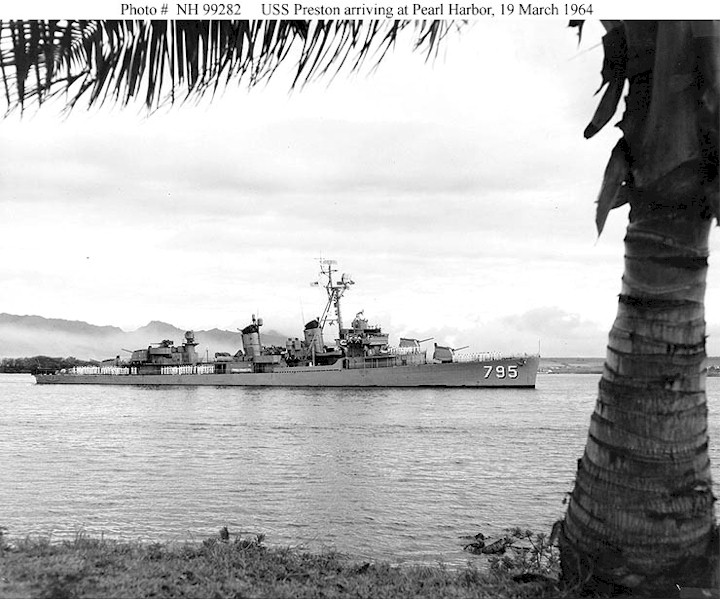
[This is one of the destroyers which will be involved in the Tonkin Gulf Incident in August of this year, which will provoke/excuse greater U.S. involvement in Vietnam.]
 History Diaries