Neville Chamberlain publicly accuses Hitler of breaking his promises made at the Munich Conference. Chamberlain awakens to Parliament’s and the presses’ violent reaction to Germany’s Czechoslovakia coup. Chamberlain finally realizes his own political future is at risk. He apologizes to Britain for “the very restrained and cautious” stance so far. In words of bitterness such as no British Prime Minister has ever used toward Nazi Germany, Neville Chamberlain tonight served notice that the British Government would never believe any assurance from Chancellor Adolf Hitler again. It was the death knell of the policy of “appeasement” based upon trust of the dictator’s words, and it was cheered by an audience of 2,500 in the town hall of Mr. Chamberlain’s native city, Birmingham.
If Britain continues to work for peace, Mr. Chamberlain suggested, it will be on the basis of her armed strength and her solidarity with other peace-loving nations, “perhaps even beyond the confines of Europe.” Mr. Chamberlain charged Herr Hitler had broken solemn pledges and without shadow of justification had extinguished the liberties of “a proud, brave people.”
“If it is so easy to discover good reasons for ignoring assurances so solemnly and repeatedly given,” he cried in a voice vibrant with anger, “what reliance can we place upon any other assurances that come from the same source?” All of Mr. Chamberlain’s restraint of the past few days had disappeared. He admitted his hopes had been shattered but he did not let himself he discouraged. Replying to a vote of thanks from the audience after his speech he said: “We need not be downhearted. This is a great and powerful nation — far more powerful than we were even six months ago — and acts of violence and injustice bring with them, sooner or later, their own reward. Every one of these incursions raises up fresh dangers for Germany in the future and I venture the prophecy that in the end she will bitterly regret what her government has done.”
While Mr. Chamberlain was speaking the British Ambassador to Berlin, Sir Nevile Henderson, was preparing to return to London tomorrow, ostensibly “to report” but in reality for an indefinite leave of absence. His recall was finally ordered today as a sign of the British Government’s indignation at the events of the past few days.
British Field Marshal Lord Gort told Secretary of State Hore-Belisha that “It would be murder to send our Field Force overseas to fight against a First-class power.”
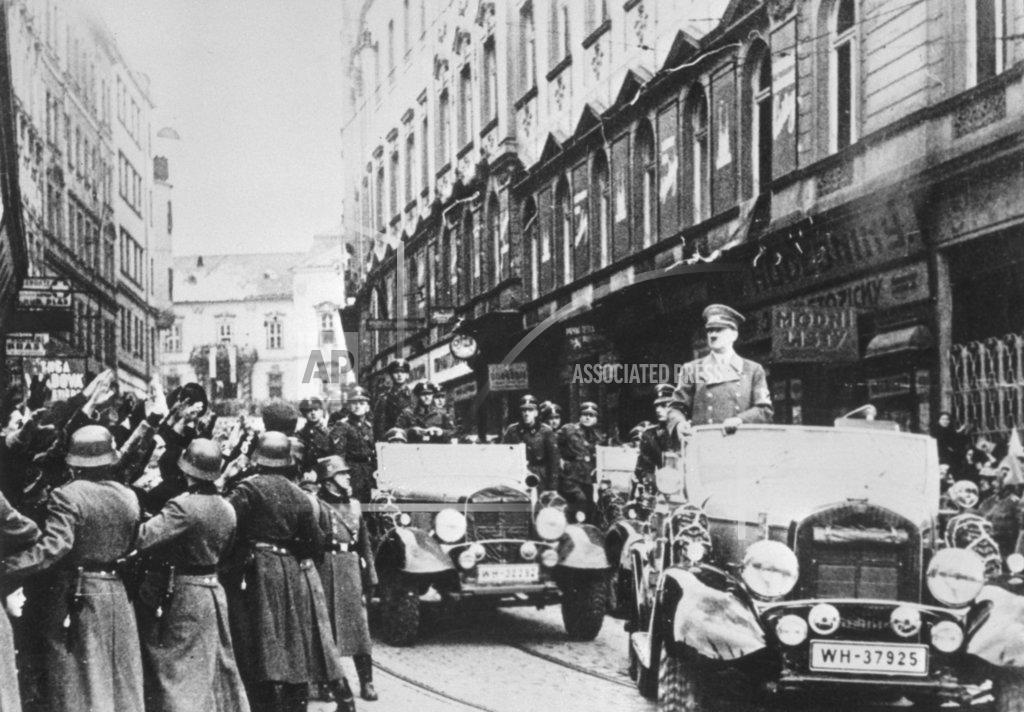
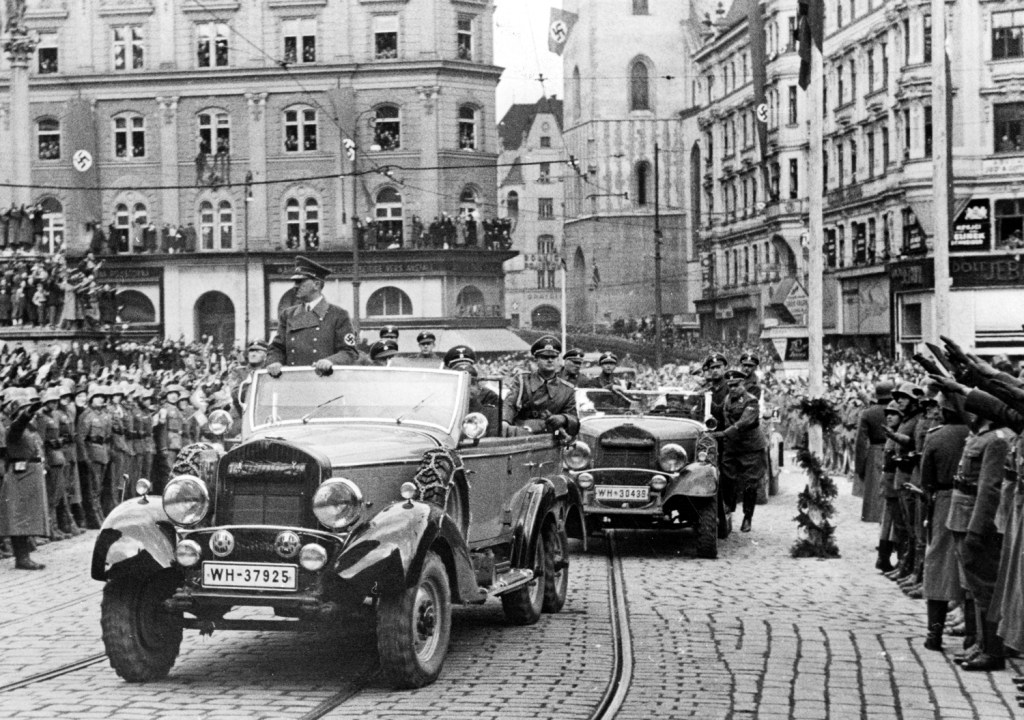
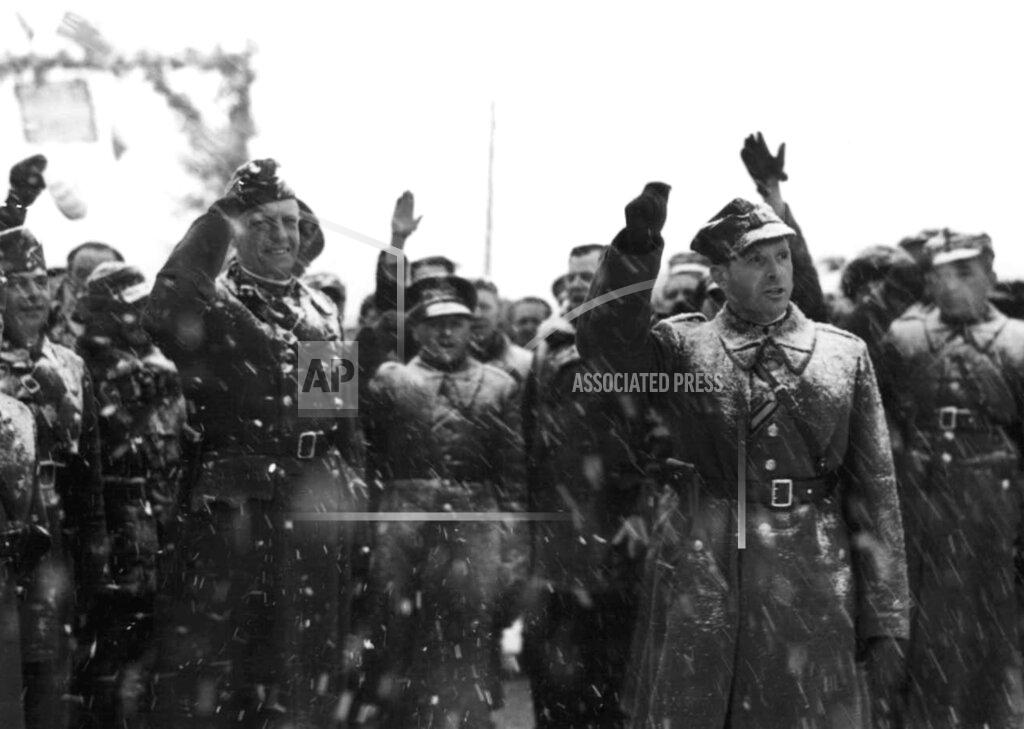
Hitler visits the occupied territory of Brünn (today Brno), in Czechoslovakia, and then travels to Vienna. Hitler, touring through his new protectorate of Bohemia and Moravia, left Brünn this afternoon after a visit of several hours in the Moravian capital. In his short visit after his arrival from Prague, Herr Hitler received the acclaim of the German element of Brünn’s population and reviewed a parade of the Second Panzer (Armored) Division that had preceded him into Germany’s new domain. He arrived at 11:30 AM and half an hour later watched while tanks and armored cars paraded. German bombing squadrons roared overhead. The city was decorated with swastika banners and garlands hung from the façades of buildings. Municipal officials then greeted him at the City Hall.
Adolf Hitler rode into swastika-bedecked Vienna from his new protectorate of Bohemia and Moravia today to the thunderous acclaim of Viennese throngs. Herr Hitler came here from Brünn, Moravia, aboard a special train after a two-day swing through his newly acquired territory. From the railway station he rode to the Hotel Imperial through streets dense with crowds giving the stiff-armed Nazi salute and shouting “Sieg Heil” — ‘hail to victory’.
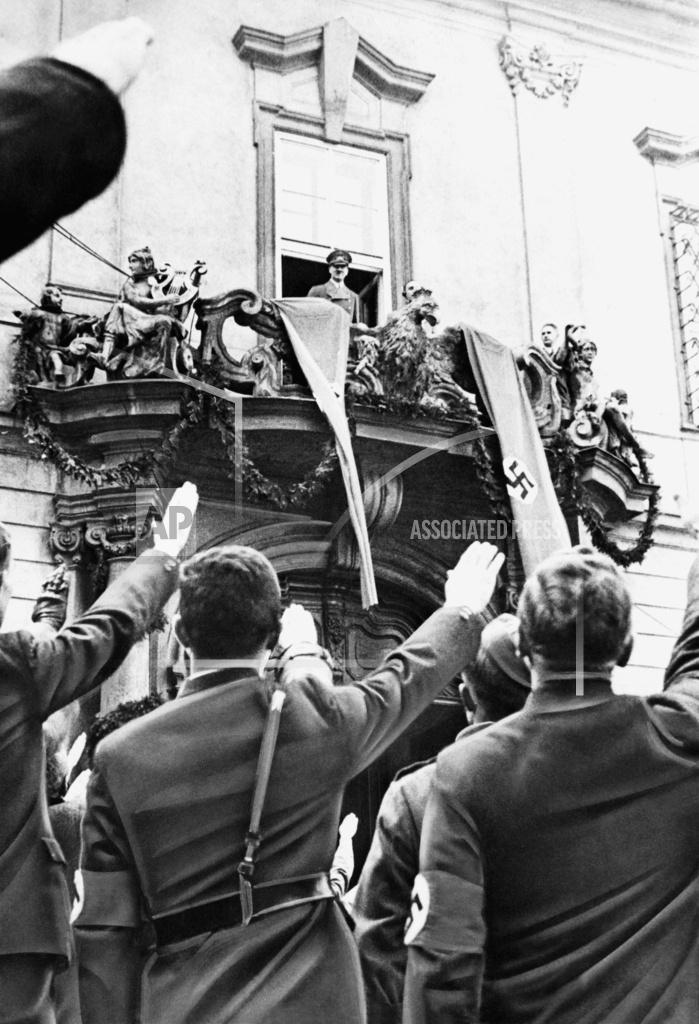
After taking the salute of a guard of honor drawn up in front of the hotel, Herr Hitler went immediately to his first floor suite. A few minutes later he appeared on the hotel balcony and gave the Nazi salute in response to an unending chant of “We want to see our Führer!” from the crowd below. All Vienna was decorated with red, white and black swastika banners. They had been displayed for two weeks in celebration of the first anniversary of the Austrian annexation by Germany, which occurred a year ago last Monday.
While in Vienna in German-occupied Austria, Adolf Hitler approved the formation of a German protectorate in Slovakia. Elsewhere, France, United Kingdom, and Soviet Union lodged official protests regarding the German occupation of Czechoslovakia.
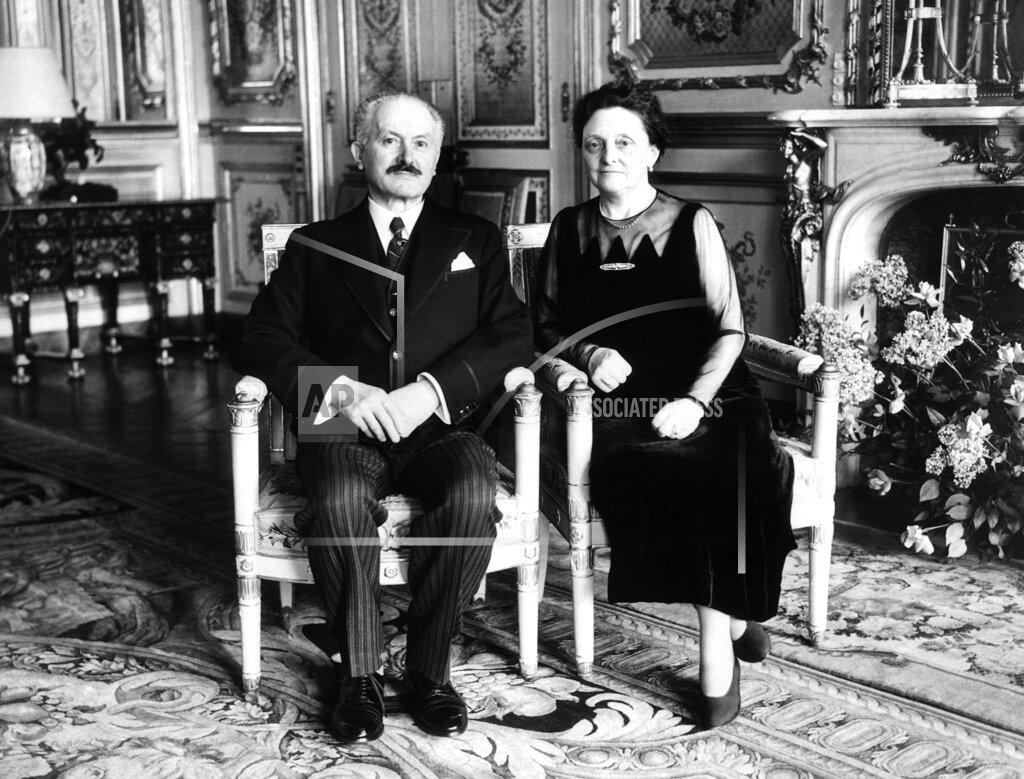
The sense of political realism so strongly developed in Czechs was strikingly demonstrated today in an official announcement by former President Emil Hácha and former Premier, Rudolf Beran. Dr. Hácha broadcast a description of his historic interview in Berlin. His speech was melancholy in tone but he asked. the Czechs to cooperate with the Reich and he warned against opposition to the new regime.
M. Beran, replying to a speech by General Johannes Blaskowitz, Commander in Chief of Bohemia, said that the Czech people were united in their determination to maintain the best relations with the German Army. He assured the general that his (M. Beran’s) government would work loyally for the cooperation of Germans and Czechs.
This passage indicated that the “protectorate” government remained in the hands of the Beran Cabinet — only nominally, it is true. Dr. Hacha succeeded in amalgamating the two political parties created after the September events. The Workers party decided on self-dissolution today and joined the National Union movement. Addressing the leaders of that organization today, Dr. Hácha condemned the tactics of General Radola Gajda’s Fascists who attempted separate political negotiations with the Germans. He declared that any agreement reached between General Gajda and General Eccard Freiherr von Gablenz, military commander of Prague, was invalid.
The man in the street, however, was somewhat taken aback by such realism. In his newspaper he read how Mlle. Hácha accompanied her father on his sad mission to Berlin, how she received a bouquet of beautiful yellow roses tied with a red bow bearing the swastika emblem while State Secretary Otto Meissner was polite enough to send her a box of candy as a farewell gift. He read also the interview between Chancellor Hitler and General Jan Syrový, hero of the Czech Legionnaires whom the German press only six months ago termed Bolshevist and Hussite.
Dr. Eduard Benes, the former Czech president, sends a protest to the United States, France, Britain, and Russia, asking them to combat Hitler’s crime, saying the Czech people are powerless.
The British Government received tonight from its own sources in Bucharest, Rumania, word that a virtual ultimatum had been issued to the Rumanian Government by Dr. Helmuth Wohlthat, head of the German economic mission there. Dr. Wohlthat’s “proposals” were said to be as follows:
First, that Rumania should by degrees cease all her efforts to build up her national industry, close down gradually all her existing factories and limit herself to being an agricultural country.
Second, that her entire exports of grain, oil, lumber, cattle and foodstuffs should go exclusively to Germany.
Third, that if Rumania agreed to these terms Germany would be ready to guarantee Rumania’s territorial integrity and the independence of the Rumanian people.
The Rumanian Government completely rejected the German proposals. In view of this German threat, all political leaders, including Dr. Juliu Maniu, leader of the powerful Peasant party and a former Premier, have joined together in a sacred patriotic union.
The Crown Council met this evening for three hours under the presidency of King Carol and in the presence of a number of army commanders. It is understood that the precautionary measures already taken were approved. No further troop movements have been ordered for the present, but a general state of readiness for any eventuality will be maintained. Indignant denials were made today in regard to reports circulated abroad that Rumanian troops have made a demonstrative march from Sighet, Rumania, to Huszt, former Carpatho-Ukrainian capital.
It was announced in Sofia today that Bulgaria would soon take measures similar to Rumania’s in preparation for any eventuality. Parliament has passed several bills relating to national defense and granting the government special powers in case the country is threatened. About 1,500 university students demonstrated before the Czecho-Slovak Legation this morning. The Czech Minister, Prokope Maxa, appeared at the window and waved to the cheering crowd. Extra police were summoned to disperse the demonstrators. The police fired a volley in the air and arrested 150 of the students. Thereupon the students decided upon a strike in protest against Germany’s overrunning of Czecho-Slovakia, but the authorities have prevented this news from appearing in the press. Anti-German feeling is running high here.
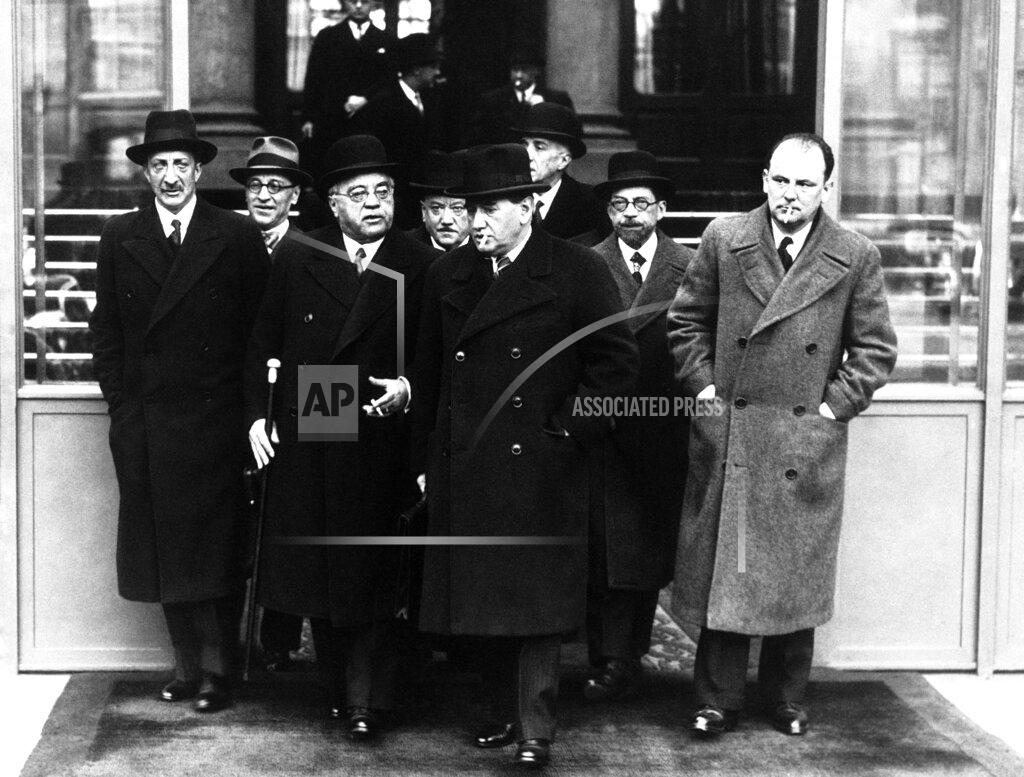
Daladier announces that France is to increase defense spending. With the avowed object of turning France into a vast workshop for national defense, Premier Édouard Daladier, in agreement with his Cabinet, today asked Parliament to approve within the next two days a five-line bill giving the government full power to rule by decree in all matters affecting national defense. This has been the only reply thus far, beyond words of lament, to Chancellor Adolf Hitler’s absorption of Czecho-Slovakia into the German Reich.
Former Premier Leon Blum and his colleagues of the Left do not consider it either wise or sufficient. “Do you think,” M. Blum asked, “that you are a man who can now appear before the world as representative of the double will of France to preserve her security and safeguard peace? Do you think these full powers you are demanding are an indication of wisdom and real energy?” He then hinted that the workers might object to this way of acting.
M. Daladier offered to resign if, as Deputy Louis-Oscar Frossard had suggested in an earlier speech, it should be found possible to make a government of national union. But he did not believe it possible. “At least,” he said, “I am putting forward a plan of action that I know to be necessary, that I believe to be effective. If you don’t approve, turn me out.”
According to tonight’s army communiqué the Hungarian occupation troops made remarkable progress in Carpatho-Ukraine [Ruthenia] today. At Korosmezo they reached the Polish frontier where ceremonies similar to yesterday’s occurred. Special mention was made of the extraordinary performance of a bicycle battalion which, notwithstanding resistance by Ukrainian irregulars, inclement weather and the difficult nature of the country, covered 170 miles in two days. Admiral Nicholas Horthy, the Regent, left Budapest tonight to join the troops in Carpatho-Ukraine. By episcopal order all Budapest church bells rang today in the celebration of the re-annexation of Carpatho-Ukraine. National flags were displayed by order of the mayor.
A torchlight parade, organized by students tonight, included former soldiers from all classes of the population. The demonstrators marched to the Polish Legation where they were welcomed by the Polish Minister. Then they went to the German Legation where they cheered Chancellor Hitler and shouted for the return of Bratislava to Hungary. There also were demonstrations before the Italian Legation.
The Hungarian Army, skirmishing its way through Carpatho-Ukraine [Ruthenia] against Czech and Ukrainian defenders, brought up heavy artillery and tanks tonight. The resistance was scattered. Only a few Czech soldiers continued fighting, and Ukrainian irregulars were retreating into the hills before the Hungarian advance. Railways leading into the newly annexed region were crowded with troop trains. Cavalry units are being assembled here.
Retreating Ukrainian guardsmen took Hungarian hostages with them, the Hungarian military command announced. The reports caused the pursuit of a Ukrainian band which the Hungarian occupation army drove from Huszt last night. Reports to the Hungarian command said that several dozen Hungarian residents of the Husat region were forced to dig trenches defending the capital, and that they then were taken along when the guardsmen retired.
Poland worries about the increased influence of Hitler, and expects the Nazis to vote to return the Lithuania area of Memel to Germany.
Two Spanish lieutenant colonels of the Republican Army were sentenced to death today after their conviction by a court martial for participating in last week’s unsuccessful Communist revolt against the National Defense Council. The supreme military court immediately confirmed the sentence imposed on Lieutenant Colonel Luis Barcelo. former commander of the First Army Corps, who was ordered executed by a firing squad at dawn tomorrow. The case of Lieutenant Colonel Emilio Bueno, former commander of the Second Army Corps, was referred to General José Miaja’s National Defense Cabinet. There were indications that his sentence might be commuted to life imprisonment. The officers were accused of being ringleaders in the Communist uprising that began March 7, two days after the National Defense Council itself overthrew the regime of Premier Juan Negrín.
Portugal and Spain signed a treaty of friendship and non-aggression.
Russians are happy as the head of the secret police, Yezhov, is removed. They also expect Germany to ask for Soviet business.
In London the Palestine Conference concludes without achieving a settlement. Although non-Palestinian Arabs have tried to work out a compromise, neither the Jews nor the Arabs of Palestine could come to agreement. After six weeks, the Palestine Conference ended today in failure as far as producing any agreement between the Arabs and Jews is concerned. Final formal statements rejecting the British proposals were submitted to Colonial Secretary Malcolm MacDonald this afternoon. Almost immediately thereafter the exodus from London of all delegates started. The British delegates accepted the failure of their titanic efforts philosophically. Indeed, it was acknowledged today that they had never expected their efforts to succeed. They retired to the country to prepare the policy they will now impose on Palestine, whether it is liked or not.
Germany’s seizure of Czecho-Slovakia was condemned in strong terms today by the United States through a statement issued by Sumner Welles, Acting Secretary of State, with the approval of President Roosevelt. It was one of the sternest denunciations of another government by the United States in many years, and it received approval in Congress. This government even refused to regard the partitioning of Czecho-Slovakia as final, much less to recognize it diplomatically. On the contrary, the statement referred to the acts of the past three days as having led only to “the temporary extinguishment of the liberties of a free and independent people.” With those people, the statement added, the American people have maintained “specially close and friendly relations” since the “republic of Czecho-Slovakia attained its independence.”
Several hours after the statement had been issued the State Department, in response to repeated Inquiries, explained the use of the word “temporary.” It indicated, the department said, that this government was neither directly nor indirectly recognizing the legitimacy of the acquisition of Czecho-Slovakia.
This explanation was considered as signifying that there was no intention of recognizing the consolidation of the republic with the Reich. The statement declared that the United States had every right to speak out. This country, it said, stands for law and order in international relations; it is dedicated to the principles of human liberty and democracy: it has repeatedly contended for observance of treaties and the pledged word; it believes in non-aggression; and it is opposed to military aggression.
“It is manifest,” the statement said, “that acts of wanton lawlessness and of arbitrary force are threatening world peace and the very structure of modern civilization.” Of all these things the United States by clear and direct implication accused Chancellor Adolf Hitler. Nor was it any surprise, because from the time that the attack on Czecho-Slovakia was begun it had been evident that all that it represented was condemned here. Furthermore, behind it all stand the broken promises of Chancellor Hitler as given at Munich and on other occasions.
There was no indication that officials were optimistic about the immediate effects of the statement on Chancellor Hitler, but it was manifest that they felt it should be made and the position of the United States defined, so that Germany and other nations that might be considering strong-arm tactics to attain territorial ends would know the position and attitude of America. They felt also that the statement could have a long-range effect.
Some U.S. Congress members agree to condemn Hitler; others wish to remain out of war concerns. Today’s statement by Undersecretary of State Sumner Welles condemning the German movements in Central Europe stirred a considerable amount of comment among members of Congress. Their opinions varied from complete agreement to the usual expressions that this country ought to keep out of other people’s quarrels.
Senator Key Pittman of Nevada, chairman of the Senate Foreign Relations Committee, issued this statement: “The statement given out today by the Under-Secretary of State. Mr. Sumner Welles, with regard to the military invasion of what was left of the territory of Czecho-Slovakia and the temporary extinguishment of the liberties of the citizens of Czecho-Slovakia is a re-pronouncement of the policy and attitude of the President, our government and every informed patriotic citizen of the United States.
“Führer Hitler, by this last act, has confirmed his deception of Mr. Chamberlain (the British Prime Minister), has made clear his fanatical ambition and intention to dominate everywhere that conspiracy and military force can accomplish such purpose. “Predictions as to Führer Hitler’s ambitions and purpose by public men in the United States have been criticized even here as groundless and provocative. It is evident that the three totalitarian powers are acting under a perfect understanding. Suggestions with regard to the danger to Latin-American republics may not now be derided. “It is evident to me that, in acting for our own defense in the most serious situation that ever faced us, we must not delay in preparations for potential political and physical action.”
Senator William H. King of Utah, who has introduced a resolution to repeal the Neutrality Act in its entirety, predicted on the floor of the Senate that Chancellor Adolf Hitler would next annex Memel and that then perhaps Poland and Hungary “will feel the grip of this great Frankenstein that is so ruthlessly walking through Europe.” He advocated severance of diplomatic relations with Germany and concerted action by the United States, France and Great Britain to stop “the further march of the dictatorships.”
Senator William E. Borah of Idaho, on the other hand, held that the disappearance of Czecho-Slovakia was inevitable after the Munich pact.” He said that the events of the past few days were as much the fault of Great Britain as of Chancellor Hitler. Senator Hiram W. Johnson of California merely commented that “I don’t want to meddle in their affairs, and I don’t want them to meddle in ours.” Senator Ellison D. Smith of South Carolina held that the situation in Central Europe” is Europe’s baby, not ours.”
Senator Alben W. Barkley of Kentucky, majority floor leader, approved Mr. Welles’s statement. “Certainly no part of the world can be unconcerned over the happenings in Europe in the past week,” he said. “If any nation was unconcerned, it would be equal to showing a lack of interest in regard to international law, comity and international obligations. All of this emphasizes the necessity for resumption of moral equalization in dealings between nation and nation.”
Vladimír Svetozár Hurban, the Minister of Czecho-Slovakia who refused to yield his legation to the German Embassy in Washington yesterday on the grounds that he had no instructions from his President, announced today that he had informed his government that he did “not recognize President Hácha’s capitulation to Chancellor Hitler as valid, inasmuch as it is unconstitutional.” Therefore, he is adhering to his refusal to abandon the legation. The indications today that the United States would not recognize the acquisition of Czecho-Slovakia by Germany might mean that the State Department would continue to recognize him as Minister.
The Czecho-Slovak Constitution, the Minister said, provides that territorial changes must be approved by a three-fifths vote of the National Assembly. “The President or the government,” he added, “is not empowered by the Constitution to cede any part of Czecho-Slovakia. The agreement signed in Berlin on March 15, therefore, is not valid. I took the oath to obey the laws of the Czecho-Slovak Government. No one has power to force me to act against the law.” M. Hurban said he was disregarding a radio message from Prague in which Dr. František Chvalkovský, the former Minister of Foreign Affairs of Czecho-Slovakia, said he was ordered to surrender the legation and consulates in the United States to Germany.
A representative accuses President Franklin Roosevelt of using “urgency” as a way of keeping power. He lists 39 emergencies discussed by Roosevelt in his speeches.
The United States suspends mail going to Czechoslovakia. Letters are held in transit and subject to recall.
President Franklin Roosevelt wears a green suit, shamrock, and green carnation on St. Patrick’s Day.
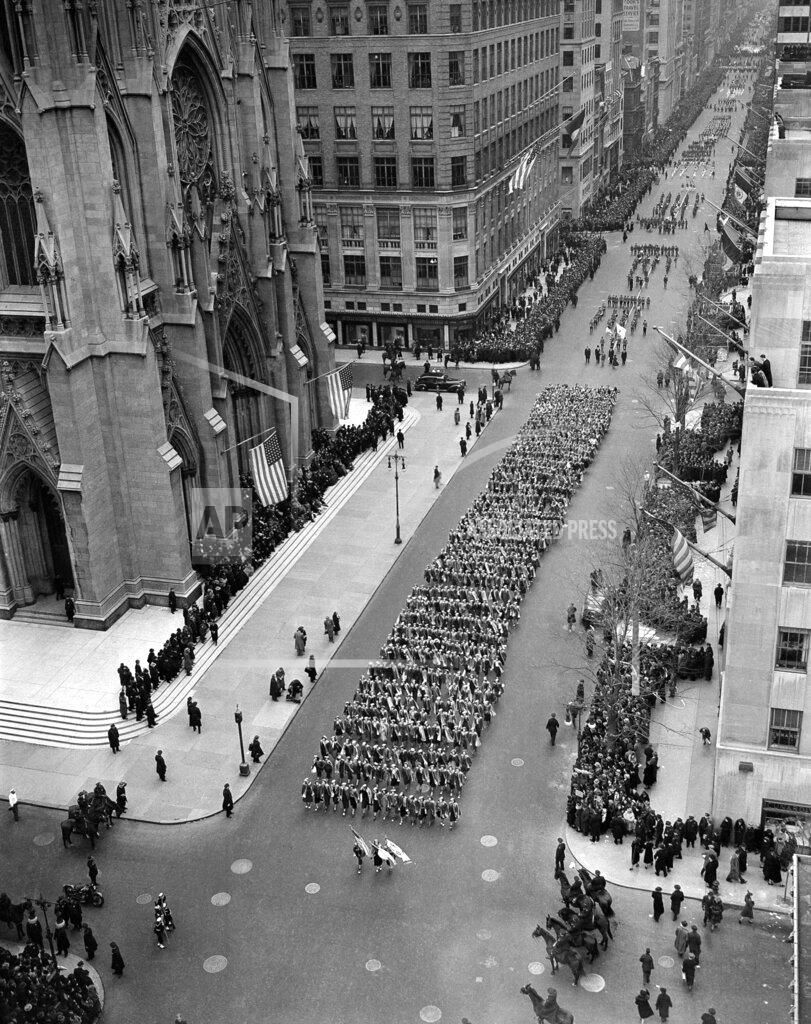
Sixty thousand Irish march on Green Fifth Avenue, braving biting winds.
The radio series “Beau Geste” is broadcast for the first time today from Hollywood. It stars Laurence Olivier and Orson Welles in the tale of three brothers who join the French Foreign Legion.
The Mexican oil talks end in a deadlock.
The Battle of Nanchang between the Kuomintang and the Japanese breaks out. Back in July 1938, Japanese troops had attempted to approach Nanchang during their assault on Wuhan, but their advance were stopped by the Chinese defenders at the Xiushui River. The Chinese positions were well entrenched, blocking the path to Nanchang for the Japanese troops. For the rest of the year, the stalemate continued as both sides remained standstill on each side of the river. In the spring of 1939, the Japanese troops with their new reinforcements began their new offensive toward Nanchang. The Japanese now prepared to conduct a very heavy artillery bombardment in support of their advance. In addition to conventional artillery fire, the Japanese bombardment also utilized toxic gas produced by Unit 731, which had been deployed occasionally in the China field of operations
Dow Jones Industrial Average: 143.89 (-3.65).
Born:
Robin Knox-Johnston, British yachtsman who completed the 1st single non-stop circumnavigation of the globe in 1969, in London, England, United Kingdom.
Jim Gary, American sculptor known for whimsical monumental art and sculptors of large, colorful dinosaurs made from discarded automobile parts, in Sebastian, Florida (d. 2006).
Cliff Schmautz, Canadian NHL right wing (Buffalo Sabres, Philadelphia Flyers), in Saskatoon, Saskatchewan, Canada (d. 2002).
 History Diaries