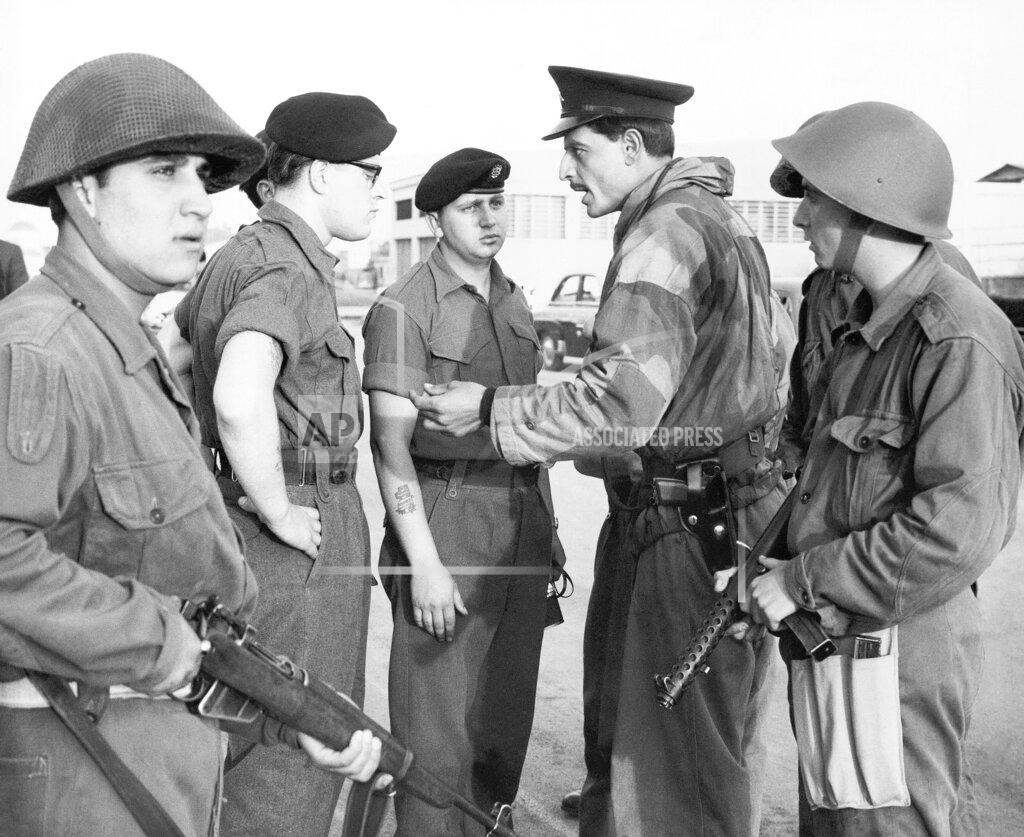
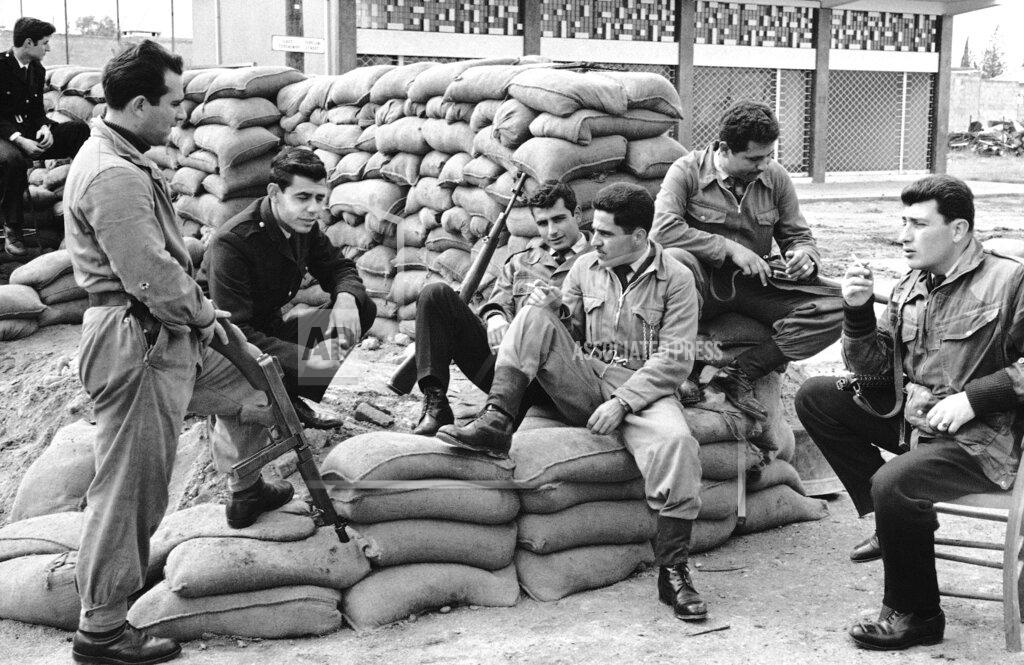
In London, Duncan Sandys, Commonwealth Relations Secretary, indicated today that new difficulties had arisen in organizing the United Nations peace‐keeping force for Cyprus. The force “cannot come into being and cannot begin to operate until its terms of reference are settled,” Mr. Sandys said in the House of Commons. This was “under very active discussion” between U Thant, United Nations Secretary General, and the countries concerned, he said. These countries are Britain, whose forces have maintained a solitary peace‐keeping role between the islandʼs ethnic Greek and Turkish communities since Christmas week, and Canada, Ireland, Sweden and Finland. All have promised troops for the force.
Expressing hope that the force would begin operating in Cyprus quickly, Mr. Sandys added, “We fear at the moment that there is going to be certain delay among these countries.” Canada, which already has an advance party in Cyprus, was prepared to send about 1,000 troops “as soon as other countries are ready to do the same,” Mr. Sandys said. The Secretary refrained from specifying the difficulties, but the belief in official quarters is that the Security Councilʼs resolution creating the force is ambiguous. The Council recommended that the force should, as necessary, “contribute to the maintenance and restoration of law and order and a return to normal conditions” in Cyprus.
Officials in London believe that it will be difficult to know what restoring law and order means under the prevailing conditions in Cyprus unless the terms of reference are specific. The British troops ran into trouble when Greek Cypriote irregulars were armed and formally enlisted as part of the islandʼs security troops by Archbishop Makarios, the Greek Cypriote President of Cyprus. Britain is apparently asking whether the Security Council resolution means helping the Greek police or trying to halt fighting no matter who is involved. British troops found themselves recently having to take orders from Greek Cypriote irregulars because the troops were under orders not to fight.
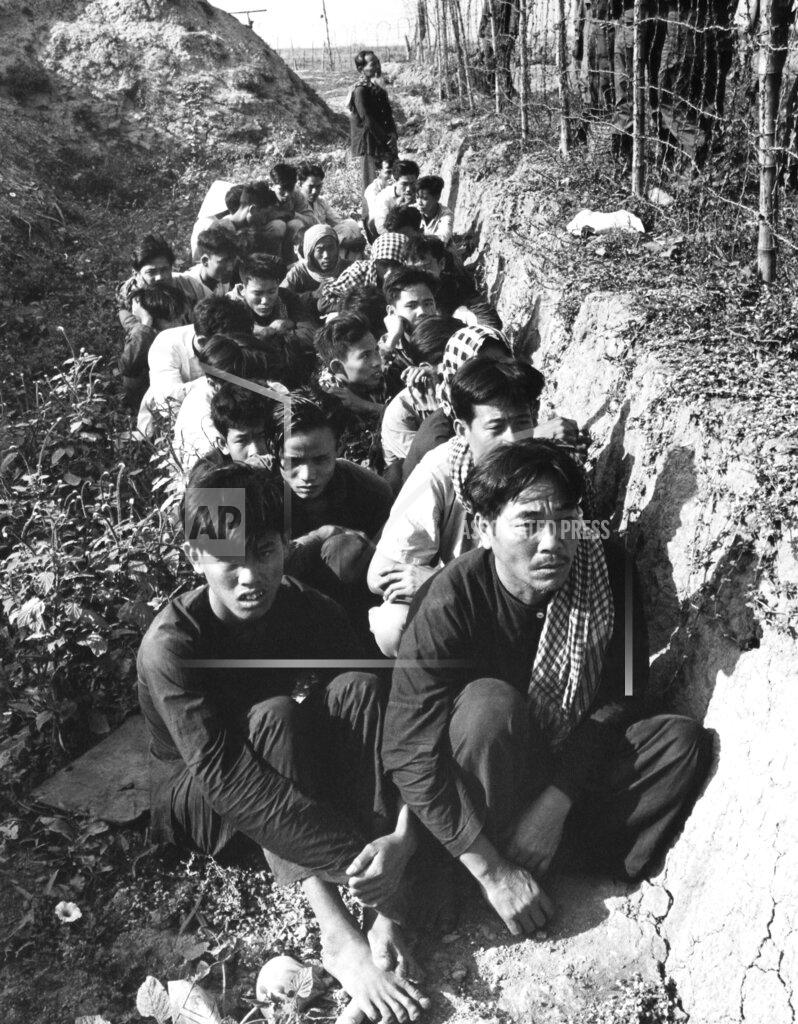
Prince Norodom Sihanouk voiced dissatisfaction today with Communist North Vietnam and said he was renewing contacts with South Vietnam. Earlier in the day the Prince, Cambodia’s chief of state, told the National Assembly that he would establish diplomatic relations with North Vietnam and draft a frontier agreement with that country. Since Cambodia and North Vietnam have no common frontier, Prince Sihanouk apparently meant he would deal with Hanoi, the North Vietnamese capital, as the representative of all Vietnam, South as well as North.
Prince Sihanouk said to newsmen, however, that North Vietnam had not replied clearly to Cambodia’s demand for recognition of her present borders. Consequently, he said, at the request of the Japanese and Philippine Ambassadors, he had agreed to a renewed contact with the South Vietnamese regime. Delegates from South Vietnam are scheduled to arrive here in a day or two, Prince Sihanouk said, presumably to discuss the frontier question. The prince said Cambodia would extend her hands to whichever of the two Vietnams “is less demanding with respect to our country.”
He complained that North Vietnam’s attitude on the frontier issue had been “as vague as the Anglo‐Saxons,” an apparent reference to the United States and Britain. Washington and London objected to the prince’s proposal to call a conference in Geneva to guarantee Cambodia’s frontiers and neutrality. Before his abrupt turnabout, Prince Sihanouk told the Assembly that if Cambodia recognized North Vietnam “this will not mean in any way that we will become allies of the Socialist [Communist] camp.”
Representatives of the factions in Laos’s coalition Government agreed today to cease “all military activities” around the Plaine des Jarres, and to send officers to the spot to report on the possibility of extending the area. The next meeting is scheduled for next Saturday. Last Saturday the three parties agreed that their forces should police the meeting area with the cooperation of the International Control Commission and the Ambassadors of Britain and the Soviet Union. The two countries were co‐chairmen of the 1962 Geneva conference on Laos. The commission is made up of delegates of India, Canada and Poland. It was decided last January 20 that to try to solve the tension between the three Laotian parties, which is now entering its twelfth month, there should be a meeting of the parties’ leaders.
A United States military spokesman acknowledged today that U-2 reconnaissance planes were flying missions in South Vietnam. “U‐2 aircraft are in South Vietnam for the purpose of in‐country mapping,” the spokesman said in response to a question. He declined to give more information. The planes are believed to be operating from Biên Hòa airbase near Saigon. The base has been closed to newsmen since the American military build‐up here nearly two and a half years ago. Extensive aerial reconnaissance has already been carried out over South Vietnam by more conventional jet aircraft, such as the RF-101 and the RB-57.
Dundee’s “Royal Arch”, originally erected in the 1850s to commemorate a visit to the city by Queen Victoria and her husband, Prince Albert, was demolished to make way for the construction of the Tay Road Bridge.
President de Gaulle received a tumultuous reception today on the first of his goodwill visits to Latin America. Both the French President and his host, President Adolfo López Mateos of Mexico, hailed the visit as an important step toward the rapprochement of France and‚ Mexico and, in fact, all of Latin America. At the same time, however, both said that the effort at understanding did not seek to harm any other people or any other nation.
The French President appeared to sound the keynote of his visit in brief remarks from the National Palace balcony. He said: “No doctrine, no quarrel, no divergent interests separate us. Quite to the contrary, we have many reasons that urge us to draw closer to each other.” General de Gaulle, in uniform, rode standing in an open car beside President López Mateos through thousands of cheering spectators. He was the first uniformed French general on parade here, as far as anyone can recall, since French occupation forces left in 1867.
General de Gaulle, whose public appeal has been growing greatly here, evoked a storm of applause shortly after his arrival. He made an emotional speech in Spanish to 225,000 spectators from the National Palace balcony. The balcony faces the huge plaza known as the Zócalo, which was the religious and political hub of the Aztec Empire before its temples were razed by the Spanish. The general said, “France salutes Mexico with respect. We are aware of the impressive American origins that your nation harks back to” He continued, “We are aware with what courage you fought and maintained your independence and you Mexicans, you know to what extent the French during the whole course of their, long and hard struggle as a people fought for the liberty and dignity of man.” The world is undergoing a transformation, the French leader said, and it “is threatened by frightful trials.”
The Russians have refused to release an American airman who was badly injured when a United States reconnaissance‐bomber was shot down over East Germany last week, the United States Air Force announced today. It said the injured flier is First Lieutenant Harold W. Welch of Detroit. He is in a Soviet military hospital at Magdeburg, where he was taken after having parachuted with two other United States officers from the RB-66 reconnaissance plane when it was shot down. The Russians allowed an American flight surgeon, Captain John I. Monroe, to visit Lieutenant Welch last night. The Russians announced yesterday that one of the three Americans was injured and the Air Force could send a physician to visit him. However, they refused to give any information on the other airman, Captain David I. Holland of Holland, Minnesota, the plane’s pilot, and Captain Melvin J. Kessler of Philadelphia.
The United States is presenting a vigorous legal argument to non‐Communist nations to persuade them that the Soviet Union will have no vote in the next General Assembly unless it pays some of its debt to the United Nations. The issue, viewed here as a grave constitutional crisis for the world organization, will arise the moment the Assembly convenes, in emergency session or in the scheduled fall session. Some nations, with Washingtonʼs support, are moving to delay the regular session until after the United States Presidential election November 3. The purpose is to avoid confusing debates in the Assembly with domestic debates in the election campaign. At an early stage, the Assembly will have to deal not only with the voting rights of the Soviet Union and other debtor nations but also with the controversial proposal to admit delegates of Communist China in place of those from the Government of Nationalist China on Taiwan.
President Johnson reaffirmed today the commitment of the United States to the Alliance for Progress. In his first major speech on Latin‐American affairs, Mr. Johnson told a diplomatic audience at the headquarters of the Organization of American States that “our alliance will prosper” because its participants have the needed “national faith.”
“It is not idle hope,” he said, “but the same faith that enabled us to nourish a new civilization in these spacious continents, and in that New World we will carry forward our Alliance for Progress in such a way that men in all lands will marvel at the power of freedom to achieve the betterment of man.”
Following up on his promise in the 1964 State of the Union address to raise living standards in America, U.S. President Lyndon Johnson sent a detailed message to the U.S. Congress, declaring “I have called for a national war on poverty. Our objective: total victory.” Johnson, who opened by writing “We are citizens of the richest and most fortunate nation in the history of the world,” asked for a $962,000,000 program to help ” millions of Americans — one fifth of our people — who have not shared in the abundance which has been granted to most of us, and on whom the gates of opportunity have been closed.”
His long-delayed program embracing both new proposals and some similar to ones pending in Congress, would focus primarily on two areas:
- Helping 380,000 underprivileged young people — in the first year alone — to break the cycle of poverty through job training and education in camps, centers, communities and campuses. This would cost $412.5 million.
- Stimulating local communities throughout the nation into waging antipoverty wars of their own with Federal assistance. This would cost $315 million.
U.S. Senator Richard B. Russell proposed today a voluntary “racial relocation” program to adjust the imbalance of the Black population between the 11 states of the old Confederacy and the rest of the Union. The Georgia Democrat, who is leading the Southern opposition in the Senate to the civil rights bill, said he would offer his proposal as an amendment to the bill when it formally becomes the pending business of the chamber. Mr. Russell, who pointed out that he had made a similar relocation proposal in 1949 but that it had been rejected, advanced the proposal today as the Senate continued to debate a motion to make the civil rights bill the pending business. The measure seeks to combat discrimination in voting, education and employment and in public accommodations.
Mr. Russell said the ultimate objective of what he called his “thoroughly democratic” and “humanitarian” program would be the achievement of a Black population in each state “as near to the national average as practicable and feasible.” At present, Blacks are 10.5 percent of the total population of the United States. Senator Russell described the House‐passed civil rights measure as “a force bill” designed to break up “the separate but equal system” that the South has devised in the “hope of solving the problem of two races living side by side without eventual amalgamation and mongrelization of both.”
A partisan fight marked by shouting and sarcasm broke out on the Senate floor today over whether the Rules Committee should continue its investigation of Robert G. Baker. Senator Hugh Scott, Pennsylvania Republican, accused members of the Democratic majority on the committee of wanting to “cut and run” to avoid further embarrassing disclosures from the inquiry. The Democratic defense was handled solely by Senator Joseph S. Clark, also of Pennsylvania. He frequently was outnumbered and outshouted in the unequal contest.
Senator Scott had ample backing from Senator Carl T. Curtis of Nebraska, ranking Republican on the committee, and other Republicans who wandered in and out of the chamber while the three‐hour fray was in progress. Mr. Scott and Mr. Clark are members of the committee, but the latter has taken a less active role in the investigation than his Republican colleague. Mr. Clark seemed unprepared for a point‐by‐point defense. His sharpest counterattack was that Mr. Scott had picked a day for his assault when every other Democrat on the committee was out of town. The eruption on the floor culminated a quarrel that has been simmering within the committee for weeks.
Senator Barry Goldwater called Robert G. Baker “Lyndon Johnson’s man” today. He demanded a complete disclosure of “White House participation in the Baker case.” Since Mr. Johnson became President, the Arizona Republican charged, “the general atmosphere in Washington is back to the Deepfreeze days.” That atmosphere, he said, was “created by the doubts that hang around the Bobby Baker case.” The Deepfreeze reference was to charges in the last years of the Truman Administration that government officials had accepted home appliances and other gifts for their influence in behalf of private parties.
Campaigning in northern California, Senator Goldwater also raised questions about the President’s involvement in the Billie Sol Estes case. Influence-peddling was a major charge in the investigations of both the Texas financier and the former secretary to the Senate Democratic majority. That the Johnson family radio and television station is the only one in a city the size of Austin is “a very peculiar situation,” Mr. Goldwater observed. “It’s not peculiar ha ha, it’s peculiar unfunny,” he added.
The president of the American College of Trial Lawyers, Whitney North Seymour of New York, strongly criticized today the conduct of Melvin M. Belli, chief defense counsel in the murder trial of Jack L. Ruby in Dallas. Ruby was convicted of murder in the killing of Lee Harvey Oswald, accused assassin of President Kennedy. Mr. Seymour, presiding over the opening session of the college’s annual convention, also suggested that the appropriate bar associations examine Mr. Belli’s conduct during the trial for possible action. Mr. Seymour’s remarks were met with prolonged applause. The college is a professional organization with limited membership.
The threat of a national railroad strike faded today, at least temporarily. The five operating rail unions, in a quick shift of strategy, were understood to have decided not to call strikes on Wednesday against the Louisville & Nashville Railroad and the Southern Pacific Company. The nation’s railroads first announced here today that they would seek injunctions today or tomorrow in United States District Court barring strikes against the two carriers. But tonight, on the basis of information that the unions would not strike, they changed their minds and announced that they would not seek injunctions “unless there is a threat of strike.” If the unions finally strike and the railroads are turned down on their requests for injunctions, they said today that they would act immediately to precipitate a national walkout by making changes in work rules over objections of the unions.
Dr. Hugh L. Dryden, deputy administrator of the National Aeronautics and Space Administration, was announced today as the winner of the Robert H. Goddard Memorial Trophy for 1964. The trophy, endowed by the widow of Mr. Goddard, the rocket pioneer, is presented annually to the person judged to have made the greatest contribution during the preceding year to advance United States leadership in astronautics. Lieutenant Colonel John H. Glenn Jr., the first American to orbit the earth, won the trophy last year.
A leading Government physician said today that advertising is one of the influences that caused people to start smoking. Dr. James M. Hundley, the assistant United States surgeon general, made this statement today as the Federal Trade Commission, opened public hearings on proposed rules to restrict cigarette advertising. Advertising was one factor the Surgeon General’s Committee on Smoking and Health had in mind, Dr. Hundley said, when it concluded that psychological and social factors largely determined smoking habits. He told the commission that the Surgeon General’s committee had found that there was no cigarette on the market today that could be called “nonhazardous” to health.
Paul Hornung and Alex Karras are reinstated in the NFL after a 1-year suspension. “Hornung will not be traded,” said Lombardi in Green Bay, without being asked, and Wilson said there was no thought of trading Karras. “He’s the best defensive tackle in the league,” said Wilson, “the best pass rusher in a long time.” The athletes violated their player contracts by betting. Hornung wagered sums of $100 to $500 on dozens of contests between 1956 and 1961 (most often backing the Packers), and Karras $50 to $100 at least six times between 1958 and 1962. Although football ranks behind only horse racing and basketball as a medium of betting, N.F.L. players are forbidden to wager on it.
Dow Jones Industrial Average: 816.48 (+0.26).
Born:
Gore Verbinski, American movie director (“Pirates of the Caribbean” films; “Rango”), in Oak Ridge, Tennessee.
Patty Griffin, American singer and songwriter (“Downtown Church”), in Old Town, Maine.
Rich Borresen, NFL tight end (Dallas Cowboys), in Queens, New York, New York.
Died:
Nicholas Joy, 80, French actor (“Gentleman’s Agreement”; “Desk Set”; “Boss Lady”).
Lino Enea Spilimbergo, 67, Argentinian artist.
Abdul-Wahab Mirjan, 54, former Prime Minister of Iraq who resigned two months before the assassination of both the King of Iraq and his successor as premier.
 History Diaries