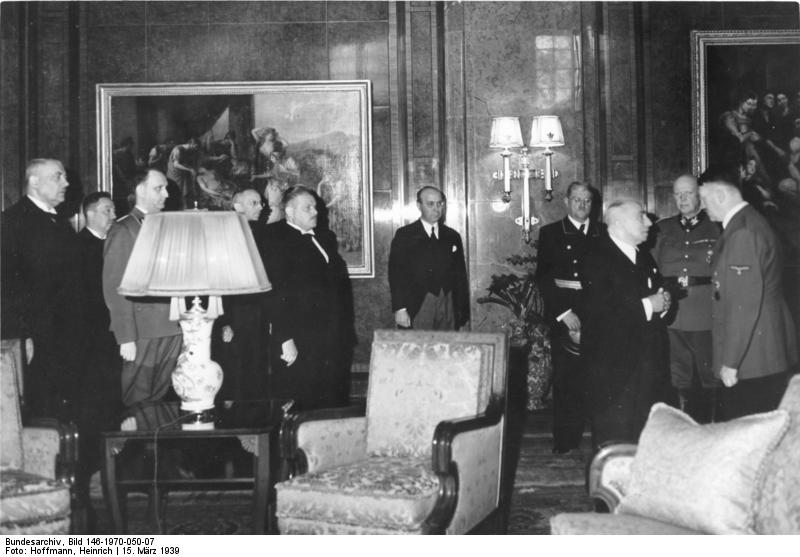
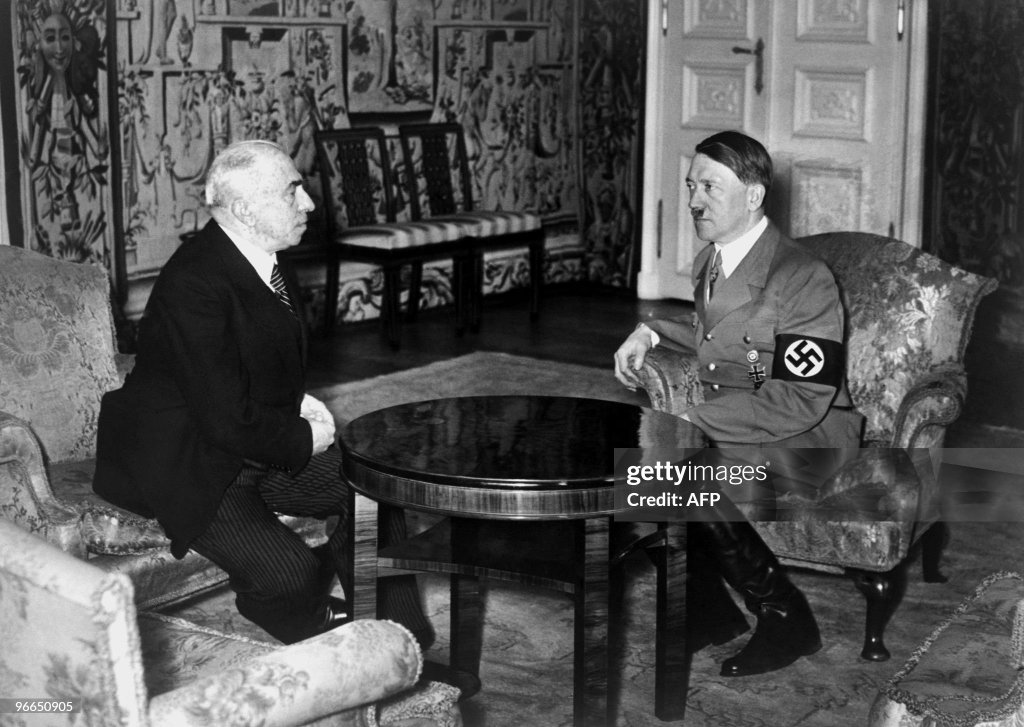
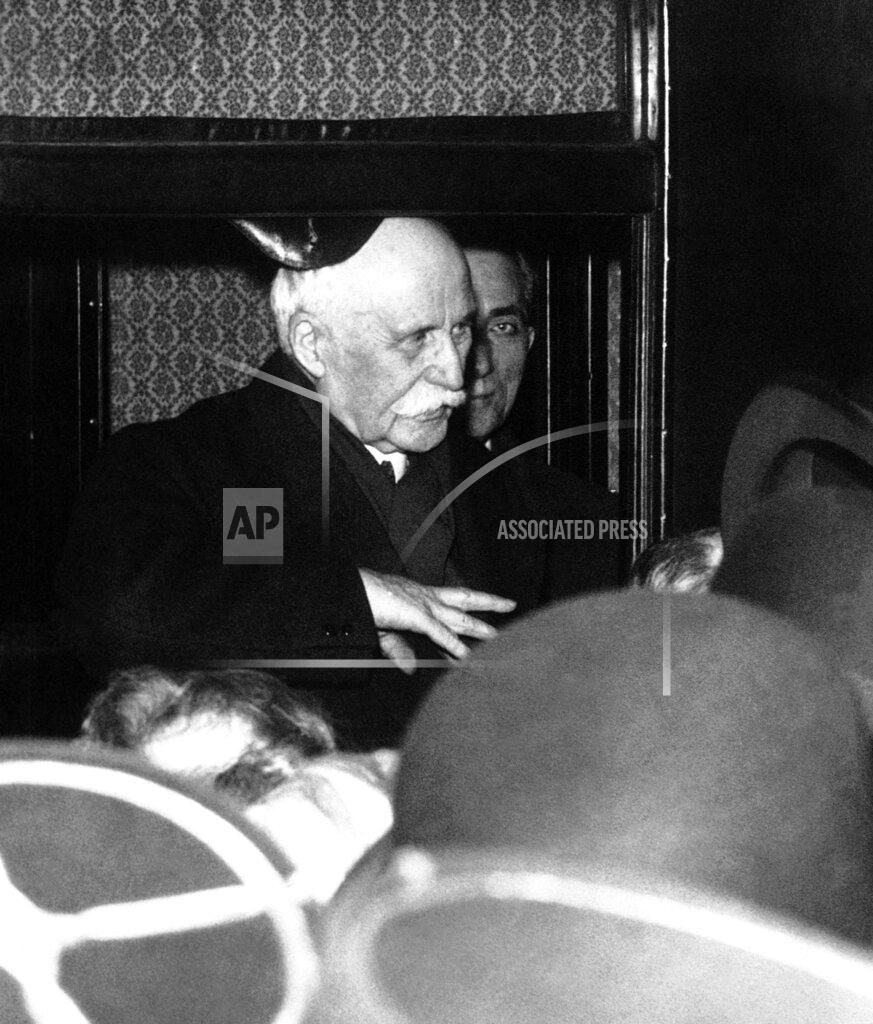
Czech statesmen agree to a loss of freedom in a three-hour meeting. Autonomy is promised. At 0115 hours, Czechoslovakian President Emil Hácha met with Adolf Hitler, who was accompanied by Wilhelm Keitel, Hermann Göring, Joachim von Ribbentrop, and Theodor Morell, in Berlin, Germany. Hitler threatened Hácha that German forces were poised to invade Czechoslovakia at 0600 hours, so it was up to Hácha to either agree to a peaceful occupation or face a destructive invasion.
At 0215 hours, Hitler left the conference room, and Göring and Ribbentrop continued to threaten Hácha with, among other things, the bombing of Prague. Hácha fainted twice during the negotiations, and both times were revived by injections by Dr. Morell.
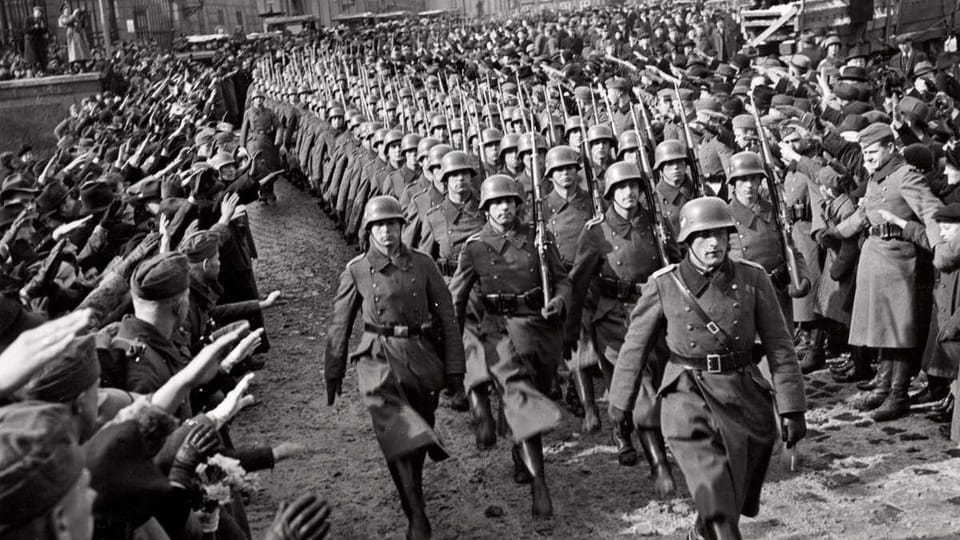
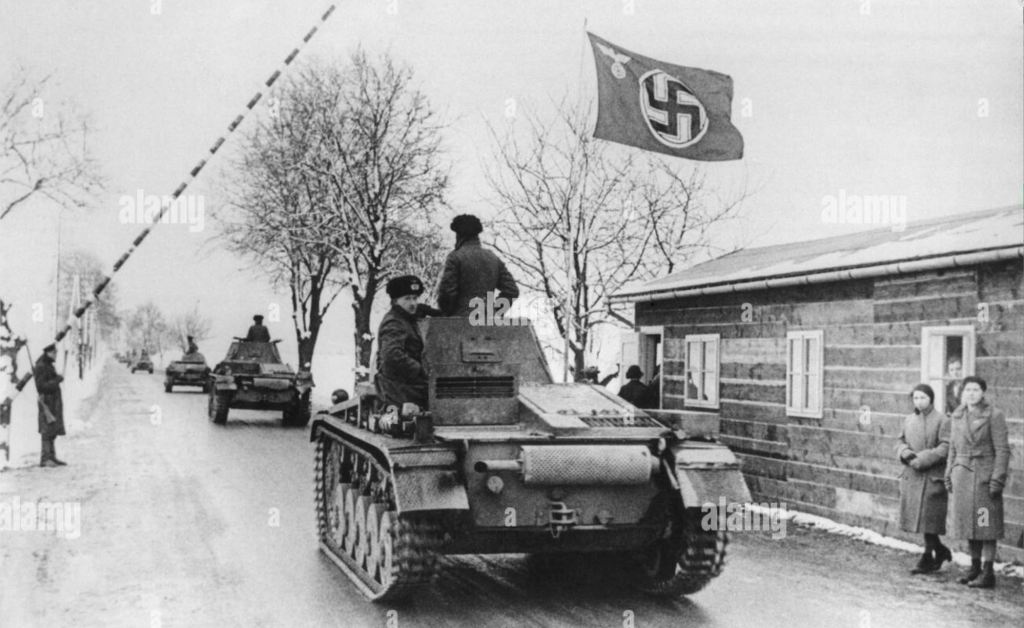
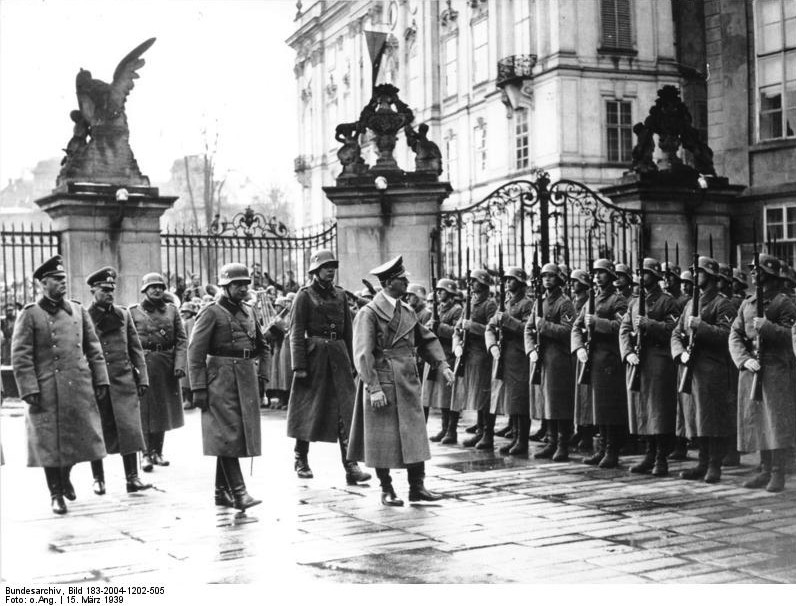
Hácha gave in at 0355 hours, and German troops marched across the borders at 0600 hours unopposed. The Reich invades Czechoslovakian provinces without opposition. Germany occupies and annexes Czechoslovakia reneging on the Munich Agreement. In the evening, Adolf Hitler entered Prague in a grand parade. During the day in eastern Czechoslovakia, Hungarian forces marched into Ruthenia, ending the one-day-old nation of Carpatho-Ukraine.
Czechoslovakia, Bohemia, and Moravia are absorbed into the Reich as “protectorates.”
Chancellor Adolf Hitler arrives in Prague after inspecting his troops. Citizens were told of their country’s takeover by the Reich in a radio broadcast.
Erwin Rommel was made the commanding officer of Hitler’s headquarters during Hitler’s visit of the recently annexed Czechoslovakia.
An exultant Führer was received with cheers, tears and boos as he rode into Prague this afternoon to fulfill what he had proclaimed to be Germany’s historic destiny. Czechoslovakia, the first democratic state to arise in central Europe, lies in ruins, Himmler’s Gestapo is taking over and Field Marshal Göring is raiding the Czechoslovak National Bank of millions of gold crowns to bail out the near bankrupt Reichsbank.
Some 12 hours earlier, at five minutes to four in the morning, the broken Czechoslovak president, Dr Emil Hacha, had signed away his country’s independence after a night of bullying by Hitler, Göring and von Ribbentrop. At one point, when they were chasing him round the room in the Berlin chancellery waving papers for him to sign, Hácha fell unconscious to the floor and Hitler’s quack physician, Theodor Morrell, was called to administer injections, which sufficiently revived the president to enable him to put pen to paper and telephone Prague with orders to surrender. Hácha is considered weak and possibly even senile. Hitler has threatened a bombing raid against Prague unless he obtained from Hácha free passage for German troops across Czech borders.
Hitler raced through the chancellery shouting: “This is the greatest day of my life! I shall go down in history as the greatest German!” He claimed that his annexation of the Czech lands, Bohemia and Moravia, and, in effect, Slovakia was perfectly legal, since Germany had been invited to place them under its protection. In fact, Hitler had been planning the takeover even as he was signing the Munich agreement with Chamberlain and Daladier in September last year.
He had said then that he only wanted those parts of Czechoslovakia occupied by Sudeten Germans, and promised to respect the independence of what remained of the country. But secretly he was giving orders to his armed forces to prepare for invasion. He brushed aside the possibility of Anglo-French action, referring to Chamberlain and his ministers as “little worms”. Last September Chamberlain told the British people that it was “horrible and fantastic” to think of going to war over a “a quarrel in a faraway country between people of whom we know nothing.” Now, less than six months later, the country seems not so far away after all – thanks to the German dictator who is tonight sleeping in Hradzin Castle, the ancient palace of the Bohemian kings.
Another Czech province, Carpatho-Ukraine, also declares its independence.
German troops enter Prague, and Bohemia becomes a German Protectorate. Konstantin von Neurath is soon appointed “Reich Protector of Bohemia and Moravia.” Some 56,000 Jews are trapped, many of them refugees from Germany and Austria who had fled to Bohemia and Moravia only the year before. Adolf Eichmann soon sets up a Jewish emigration office in Prague.
The New York Times reports:
Chancellor Adolf Hitler's standard was hoisted at 8 o'clock tonight on the tower of Prague's historic Hradschin Castle. The gold-bordered swastika flag waving over the palace of the old kings of Bohemia, which for the last twenty years has been the residence of the Presidents of the Czecho-Slovak republic, marked a turning point in the history not only of Bohemia but of the whole of Central Europe.

Herr Hitler arrived in Prague late this afternoon after having inspected various German troop columns marching on Bruenn and Olmuetz. He drove straight to the Hradschin, where he was met by the German Minister accredited to what was formerly Czecho-Slovakia.

The citizens of Prague were greatly impressed by the promptness with which Herr Hitler arrived only eight hours after the vanguard of the German Army had crossed the capital's limits.

Prague had spent last night filled with anxiety. The news had reached the capital that while President Emil Hacha and Foreign Minister Frantisek Chvalkovsky were on their way to Berlin to hear the final decision on their country's fate German troops-among them Herr Hitler's own guards-had occupied yesterday afternoon the industrial district of Moravska Ostrava.

Radio Announces the End

This morning citizens turning on their radios heard with consternation a German broadcast announcing "Finis Czecho-Slovakia" and an announcement that German troops would today occupy the whole of Bohemia and Moravia "in order to secure peace and order there and protect the German inhabitants of these provinces, whose lives are threatened by the Czechs."

The German populace of Prague turned out early. They had received orders from their leaders to hoist the swastika flags that had been distributed to them last Sunday for the memorial celebration honoring the German war dead.

Groups of German school children lined the route that the occupying troops were to take on their march through the city, while German women were summoned to assemble in a square. German university students marched in their Nazi uniforms toward the outskirts of the capital to welcome the German troops.

Many shops remained closed. The weather was unusually wintry and large snowflakes were driven by a fierce east wind.

The Czechs thronged the streets, outwardly calm but filled with anxiety and bitterness. They evidently could not believe that their beloved capital — the "golden Prague" of their 1,000-year history — could fall in a bloodless war.

Guns Pointed at City

The German vanguard reached the square in front of the Hradschin at 9:15. Armored cars took up positions with guns pointing at the city, which, with its hundred towers, spreads out at the foot of the castle. At the same time army trucks drove to police headquarters and German police officers and men began to take over the security service.

Immediately afterward German motorized forces drove over the Prikopje, one of Prague's main streets. Thereafter infantry, artillery, armored cars and Hitler Elite Guard formations arrived continuously.

The German populace shouted itself hoarse with "Heil Hitler!", waving paper swastikas. And so Prague had to bow its head in humiliation.

The Czech attitude varied between despair and defiance. Both men and women wept openly and unashamed. They gathered in the side-streets too proud to show their grief to the invader.

Those of a more defiant nature stood along the troops' route and shook their fists and spat on the ground as they passed. It is to the Germans' credit that they took no notice of any of these demonstrations.

[Other dispatches reported that Czechs jeered and whistled at the German troops, that a few volleys of snowballs were flung at tanks and armored cars and that the invaders were greeted by a crowd singing the national anthem.]

At noon German police began to appear in the streets directing traffic together with Czech policemen. All public buildings were occupied by Germans driving up in large trucks. The National Bank was one of the first, being occupied by German bank clerks. Everything had been prepared with characteristic German thoroughness according to plans certainly framed much in advance.

Immediately after the troops' arrival the Gestapo [German secret police] began its work with lists also prepared in advance.
The incorporation of Bohemia and Moravia marked the end of Czechoslovakia’s membership in the League of Nations.
Erwin Rommel was made the commanding officer of Hitler’s headquarters during Hitler’s visit of the recently annexed Czechoslovakia.
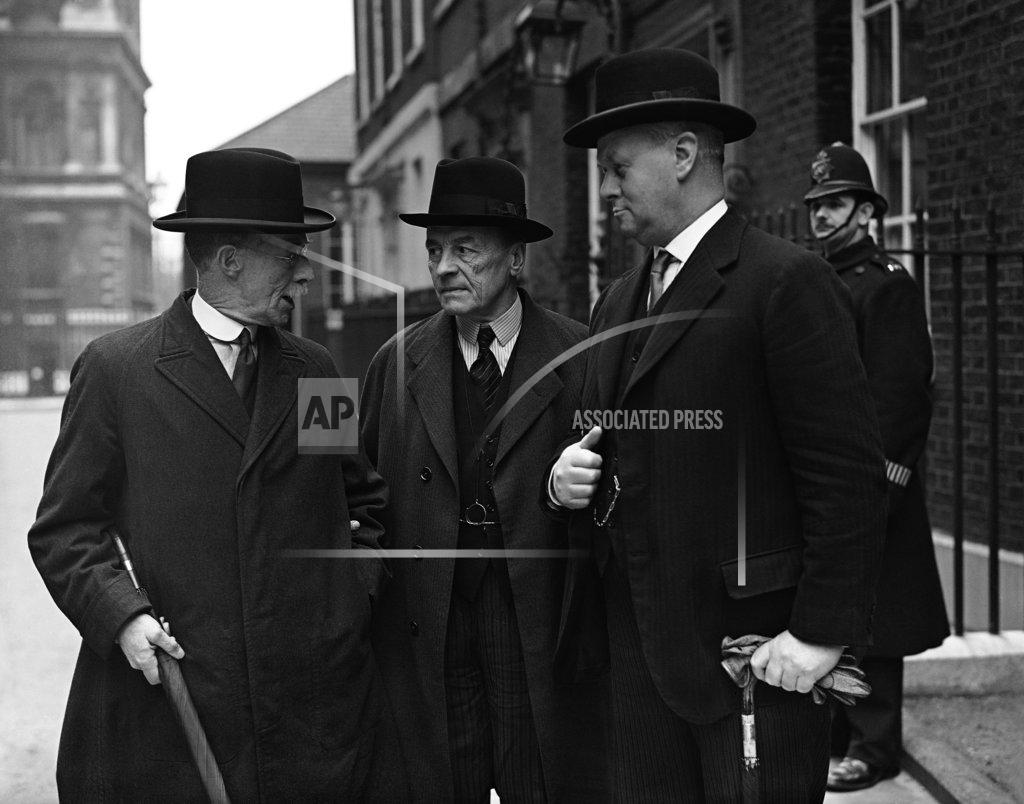
Prime Minister Chamberlain cancels trade talks between Britain and Germany. Slowly and reluctantly the British public started to awaken today to the implications of Germany’s latest conquest. And the government showed its first signs of displeasure at the event which Prime Minister Neville Chamberlain described in the House of Commons as “a cause of disturbance,” “a shock to confidence,” and a violation of the Munich agreement. To a subdued and uneasy House of Commons Mr. Chamberlain announced the definite postponement of the visit to Berlin by Oliver Stanley, President of the Board of Trade, and Robert Hudson, secretary of the Department for Overseas Trade. They were to have left at the end of this week for a series of trade talks intended to lead to an Anglo-German understanding in wider fields, but, according to Mr. Chamberlain, “the British Government feels the present moment would be inappropriate for the proposed visit.”
The Soviet army has doubled over the past five years, now reaching 3 million.
Arab and Jewish delegates both refuse Britain’s new proposal for Palestine. Both Arab and Jewish delegates to the Palestine Conference were determined tonight to reject the latest British proposals, and the conference is now expected to end this week. Neither side has formally rejected the proposals, which were not put in writing. The Arabs asked for time and will meet the British Friday. The Jewish delegates found the latest plan little different from the “suggestions” issued two weeks ago, which they held did not even provide a basis for discussion. The Jews will meet tomorrow to discuss whether it is worthwhile to meet the British again.
But in both camps, it was being freely said tonight that the proposals — which can be modified in detail but not in principle — were not acceptable. Therefore, it seems most likely that the British will give the conference until the end of this week, and then next week will announce their own plan for imposition on both sides. While this policy is expected to bear a general resemblance to proposals that Colonial Secretary Malcolm MacDonald submitted today, it was stressed tonight that it might differ in important aspects.
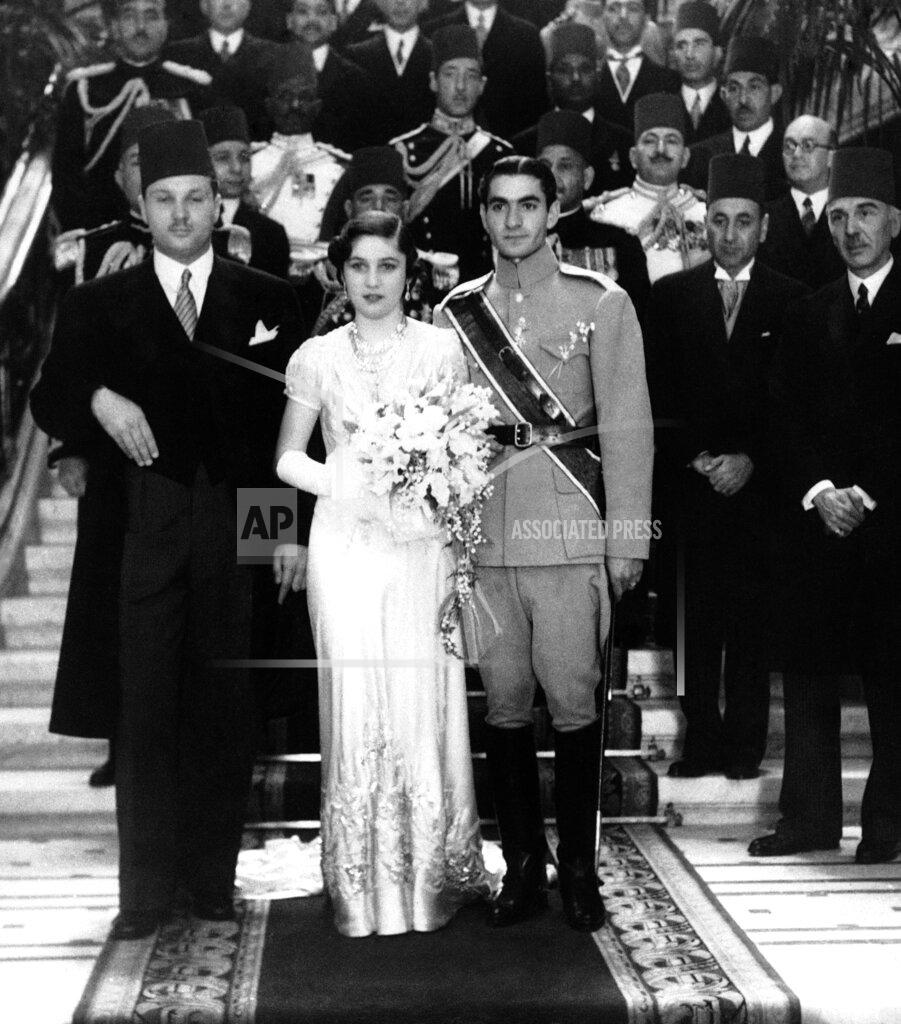
The Egyptian Princess Fawzia (17) weds Iranian heir, Crown Prince Reza Pahlevi (19), uniting two leading Muslim sects. The newlyweds are both teenagers. The marriage will not be a happy one, and ends in divorce in 1948.
Washington leaders hesitate to make a final decision about the Neutrality Act with so much flux in Europe. While President Roosevelt’s defense program is being speeded through Congress by the developments abroad, the changing European situation is causing more hesitancy about the Neutrality Act. Secretary Hull and other State Department officials interested directly in the act, part of which expires by limitations May 1, are still dubious that a Presidential request for its revision would meet a favorable reception at the Capitol. Possibility of putting the munitions traffic on a cash-and-carry basis in time of foreign war is being considered. As the law now stands, an automatic embargo covers all exports of arms, ammunition and implements of war to all belligerents as soon as the President declares that a state of war exists.
Senator Pittman announced last week, after President Roosevelt and Senator Barkley, Democratic floor leader, had both said the same day that the Neutrality Act had proved unsatisfactory as a contribution toward world peace, that the Foreign Relations Committee, of which he is chairman, would start consideration of four proposals bearing on the act. At its regular meeting today, however, the committee became involved in discussion of Mr. Pittman’s resolution which would authorize navy yards in this country to construct warships for Latin-American republics on a cash basis. The Neutrality Act was not considered.
An informal organization to take over the sponsorship of business-recovery tax revision unless President Roosevelt himself assumes leadership of the movement soon after today’s tax returns are in was taking shape today on Capitol Hill. Agitation for this course was coming largely from members of the Senate Finance Committee, whose chairman, Senator Harrison of Mississippi, conferred with the President again today. The Senator came away suggesting that “progress was made” toward the double purpose of cutting down Federal expenditures and altering the Revenue Law to a degree deemed necessary for industrial revival.
Attending the President’s conference was Secretary Morgenthau and Under Secretary Hanes, who first advanced the general proposition of revising taxes that are a deterrent to business. Representative Cooper of Tennessee, spokesman for the Ways and Means Committee, also was present. “All we can say is that we had a pleasant conference,” said Senator Harrison. “No conclusions were reached — but progress was made.”
The Senator is known to be considering the possibility of moving independently, with his committee, on tax revision if the White House does not take a more positive stand, but so far, he has held back: first, because of the belief that the new revenue returns must be filed before an approach may be made to the tax problem, and, second, because of the feeling that the President himself should have every opportunity to take the lead. Mr. Harrison’s committee colleagues have not been encouraged, however, over the prospect that the President would assume command, and some of them proposed today that they set on their own responsibility if more definite signs did not come from the White House soon.
Senator Harrison reiterated that a tax bill would have to be considered at this session to re-enact the $750,000,000 in “nuisance” taxes which expire on June 30, and to provide some substitute for the various taxes applying to corporations which automatically expire on December 31. He indicated that he had discussed again with the President the Treasury proposal, to which the Senator adheres in general, of repealing the undistributed profits tax, as well as the capital stock and excess profits levies, and substituting one corporation income impost at a rate high enough to make up the revenue that might be lost by these repeals.
Also today in Washington, President Roosevelt discussed railroad legislation with Senator Wheeler. He signed the $20,265,041 First Deficiency Appropriation Bill.
The Senate was in recess. Its Foreign Relations Committee heard spokesmen of the War and Navy Departments approve the Pittman bill for the sale of munitions to South American republics and reported favorably the nominations of Laurence A. Steinhardt as Ambassador to Russia and William Dawson as Minister to Panama.
The Joint Monopoly Study Committee continued hearings on the liquor industry and conferees completed action on the bill to expand the Army Air Corps.
The House debated the Interior Department Appropriation Bill; sent the Treasury-Post Office and Legislative Appropriation Bills to conference, received the Maritime Commission’s report on coastwise and intercoastal shipping, received the Healey Resolution for an investigation of relief conditions in cities of 5,000 or more and adjourned at 4:53 PM until noon tomorrow.
A Deficiency Appropriations subcommittee approved $116,539,287 of President Roosevelt’s request for supplemental national defense funds, but postponed action on the request for funds to train student pilots. The Labor Committee questioned Elmer F. Andrews, Administrator, and Calvin Magruder, counsel, of the Wages-Hours Division, on proposed amendments to the Wages and Hours Law.
Appointments in the naval high command were announced tonight by Charles Edison, Acting Secretary of the Navy. Virtually every flag command in the service with the exception of Commander in Chief of the Fleet and Commander of the Fleet Scouting Force are involved. High commands to be changed include those of Naval Operations which is the supreme active post of the Navy; the Asiatic Fleet, the Battle Force of the Fleet, and the Naval Bureau of Aeronautics. Most of the assignments will be effective in June.
Admiral Claude C. Bloch continues as Commander in Chief of the fleet. Vice Admiral Adolphus Andrews retains command of the Scouting Force. The Asiatic Fleet command goes to Rear Admiral Thomas C. Hart, now president of the General Board. As chief of the forces in Asiatic waters Rear Admiral Hart’s rank will be that of admiral, which also will be the rank of Rear Admiral Harold R. Stark, who will succeed Admiral William D. Leahy as chief of naval operations.
Captain John Henry Towers, now assistant chief of the Naval Bureau of Aeronautics, is promoted to rear admiral and is to be the new chief of naval aviation. The new commander of the Battle Force is to be Rear Admiral James O. Richardson, now Chief of the Bureau of Navigation. He will take the rank of admiral. His successor as chief of navigation is Rear Admiral Chester W. Nimitz, now in command of the First Battleship Division of the Battle Force. The appointments, not including Admiral Leahy who will retire in accord with the age limit this Summer, involve fourteen officers.
Child star Jackie Coogan wins a $150,000 settlement against his mother and stepfather.
The National Association of Master Plumbers announces that 95 percent of all bathrooms are in the United States.
The former boxing champion Abe Attell remarries.
The Japanese Foreign Office issued tonight a statement which, while not closing the door to further negotiations, lays upon the Soviet Government all responsibility for any consequences of the fisheries dispute between the two countries. The statement declares Japan will not accept the results of the Soviet fisheries auctions this afternoon at Vladivostok. Although the results of the auctions were not known here officially, it did not appear from the statement that these needed to be regarded as final, since the Soviet Government, while rejecting Japan’s demand that the auctions be postponed, had announced that these sales might be repeated.
The Japanese statement pointed out that the auctions included stabilized lots — that is, those regarded as permanently allocated to Japan. It added that, postponement having been refused — though re-auction was conditionally promised to Shigenori Togo, Japanese Ambassador, by Foreign Commissar Maxim Litvinov in Moscow — Japan would not abide by today’s results, and the statement said Japan might be constrained to act in self-defense if the Soviet Union resorted to unilateral action.
Japan today gave fresh indications that her long dispute with Soviet Russia over Siberian fisheries might cause trouble. The Japanese Navy prepared to give 20,000 Japanese fishermen the protection of warships when they make their annual voyage to the Kamchatka fishing grounds next month. It was reported that some naval vessels had moved to Korean bases in anticipation of possible Russian efforts to block the fishing fleet.
A Japanese Navy spokesman said warships had been stationed at Chinkai, Southern Korea, for “regular training exercises.” He denied rumors of a naval concentration at Rashin, within 160 miles of the Soviet naval base, Vladivostok. He said the Chinkai maneuvers may have started the rumors. Although expressing hopes for an amicable settlement, the spokesman said the Soviet Commissar of Foreign Affairs. Maxim Litvinov, was assuming “a very strong attitude” and that the Japanese Navy was watching the situation “with very grave concern.”
The warfare in China is expected to take on a new character soon. It was reliably learned that Generalissimo Chiang Kai-shek has decided, besides launching two offensives next month, to order one-third of the government’s forces to filter in through wide gaps in the Japanese lines and adopt mobile tactics, harassing the Japanese rear.
Such tactics in the Yangtze Valley, in South China and in Shantung, Honan and Shansi Provinces will have serious effects on the present Japanese positions which, have been weakened by the sending of hundreds of thousands of men to Manchukuo, Chahar, and Suiyuan for possible use against Russia. The forces that will fight behind the Japanese lines are greatly superior in training, officering and equipment to the guerrillas who now are harassing the invaders. The Chinese Government is convinced that measures are necessary to frustrate the Japanese plans to begin to make a profit in occupied territories.
The guerrillas have been successful in blocking many economic plans but Chinese leaders feel these efforts must be intensified. Last year, for instance, Japan counted upon 1,800,000 pounds of cotton from North China but because of guerrilla activities, which disrupted all lines of communications repeatedly, she received only 800,000 pounds. Japan was forced to buy 1,000,000 pounds in world markets, depleting her foreign exchange. This year Chinese efforts are designed to create an almost complete industrial transportation paralysis. Chungking also is sending troops behind the Japanese lines because of worry over the rapid progress of Communist organizers within what is technically a Japanese-controlled territory. This territory includes about 880 haien [counties] but Chinese administrations are in control in about 640 of these haien, within which agents of the Eighth Route Army are spreading communism and rapidly changing the forms of administration and popular thought against the Kuomintang (Nationalist party). It is hoped the presence of strong government forces in these haien will check this tendency.
Japan’s military invasion, coupled with the fact that she lacks sufficient men effectively to garrison the overrun areas, is largely instrumental in the spreading of communism, which danger is one of Japan’s excuses for the invasion.
The Episcopal American Church Mission school at Ichang, Yangtze River city midway between Hankow and Chungking, was reported today to have been destroyed during raids. by Japanese bombers on Monday. Projectiles were said to have been showered on the property despite a United States protest to Japanese Authorities over the bombing of the mission last Wednesday. Messages through foreign channels contained no details on the damage or casualties. Japanese were said to have told United States consular officials at Hankow, in explaining that an investigation of the previous raid had been started, that the United States flag and markings on the school property were too small to be distinguished from the air. The Japanese acknowledged, however, that they had been told of the location of the property.
Dow Jones Industrial Average: 147.66 (-3.44).
Born:
Robert Nye, British novelist and poet (“Facts of Life & other fiction”), in London, England, United Kingdom (d. 2016).
Naval Construction:
The Royal Navy Tribal-class destroyer HMS Bedouin (F 67, later G 67) is commissioned. Her first commanding officer is Commander James Abernethy McCoy, RN.
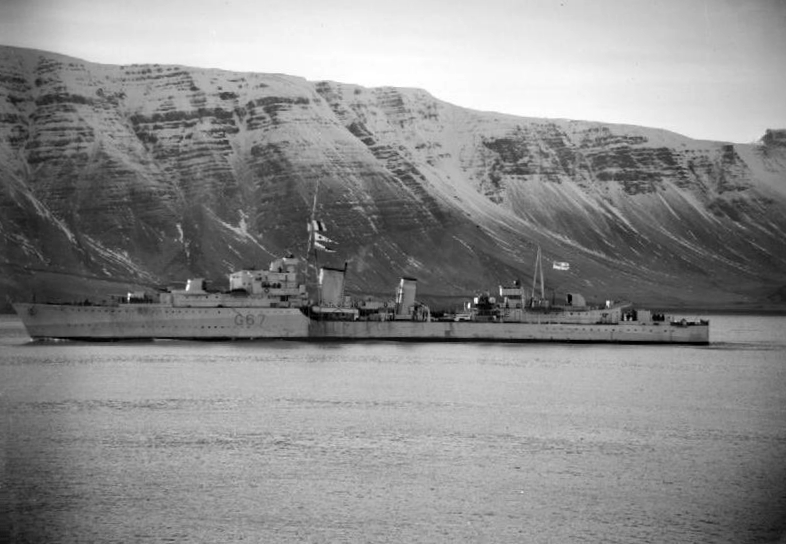
She served in the Second Battle of Narvik, where she was slightly damaged, and in the 1941 commando raid on the Lofoten islands.
Lost 15 June 1942. During Operation Harpoon, a large allied convoy to resupply Malta, she was sunk by the combined action of Italian cruisers Raimondo Montecuccoli and Eugenio di Savoia and an SM.79 torpedo bomber. HMS Bedouin (Cdr. Bryan Gouthwaite Scurfield, OBE, RN) was one of the Home Fleet destroyers detached to the Mediterranean for the purpose of Operation ‘Harpoon / Vigorous’, a double supply convoy to Malta in June 1942. South of Pantellaria, an Italian cruiser and destroyer force led by the cruisers Eugenio di Savoia and Montecuccoli intercepted the convoy, but were driven off by HMS Bedouin, HMS Marne, HMS Matchless, HMS Ithuriel and HMS Partridge, although both HMS Bedouin and HMS Partridge were damaged. HMS Bedouin was completely disabled, but HMS Partridge managed to get under way once more, towing HMS Bedouin.
When the Italian squadron later reappeared, the tow was cast off as HMS Partridge endeavored to defend herself. Eventually it was an Italian aircraft which finished off HMS Bedouin with a torpedo in position 36°12’N, 11°38’E while HMS Partridge escaped. A gunner manning a .5-inch (12.7 mm) quad machine gun mounting shot down the torpedo bomber which delivered the coup de grâce. Twenty-eight men from her complement were killed in action and 213 were taken as prisoners of war by the Italian Navy.
Battle Honors: NARVIK 1940 – NORWAY 1940-41 – ATLANTIC 1940-41 – ARCTIC 1941-42 – MALTA CONVOYS 1942
 History Diaries