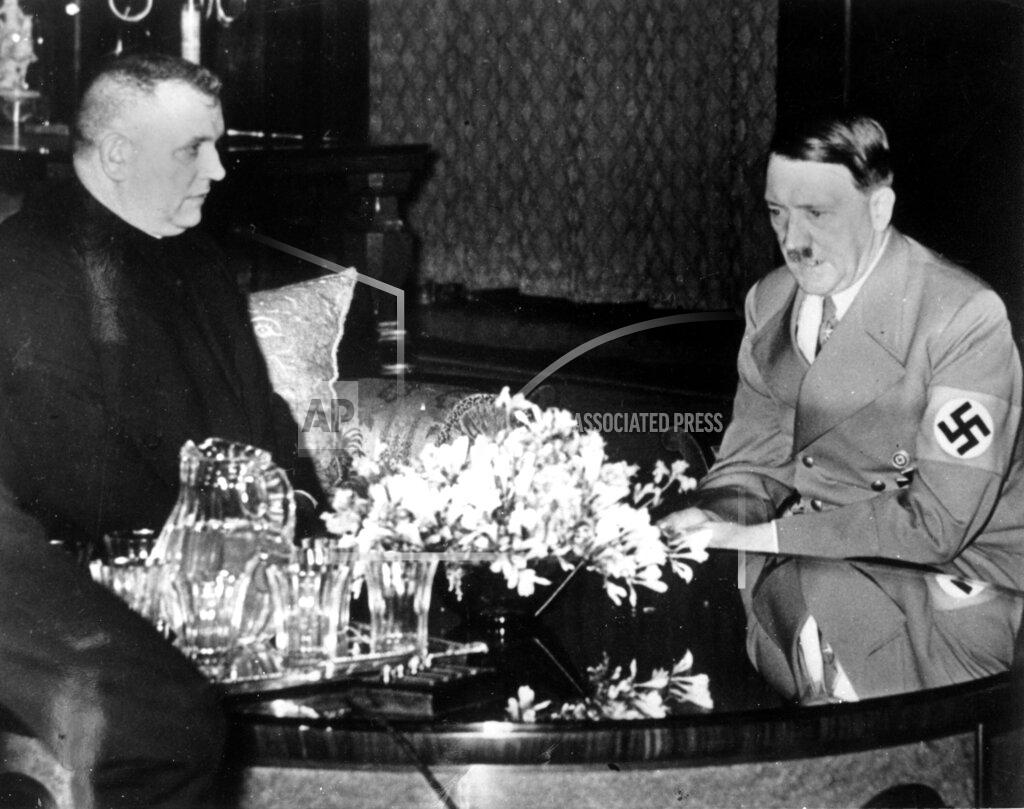
Slovakia and Ruthenia declared independence from Czechoslovakia; as Czechoslovakia had fallen into pieces, the United Kingdom and France considered it to be the evidence that Czechoslovakia no longer existed as a nation, thus they no longer had any alliance obligations to the now defunct nation. Monsignor Josef Tiso proclaims the independence of Slovakia and establishes an independent Axis state under the Fascist Hlinka Party. Slovak Nazis launch a wave of terror against Slovakian Jews. After the war, Tiso will be arrested, imprisoned and executed by the Communist government in Prague.
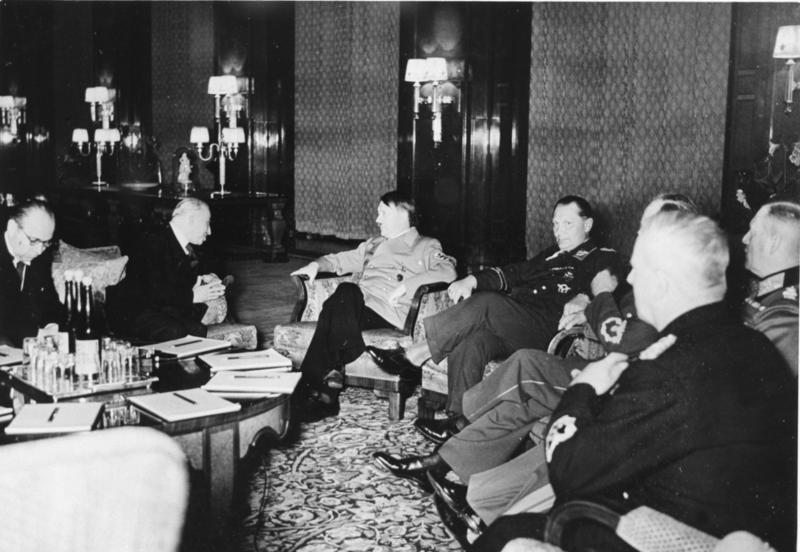
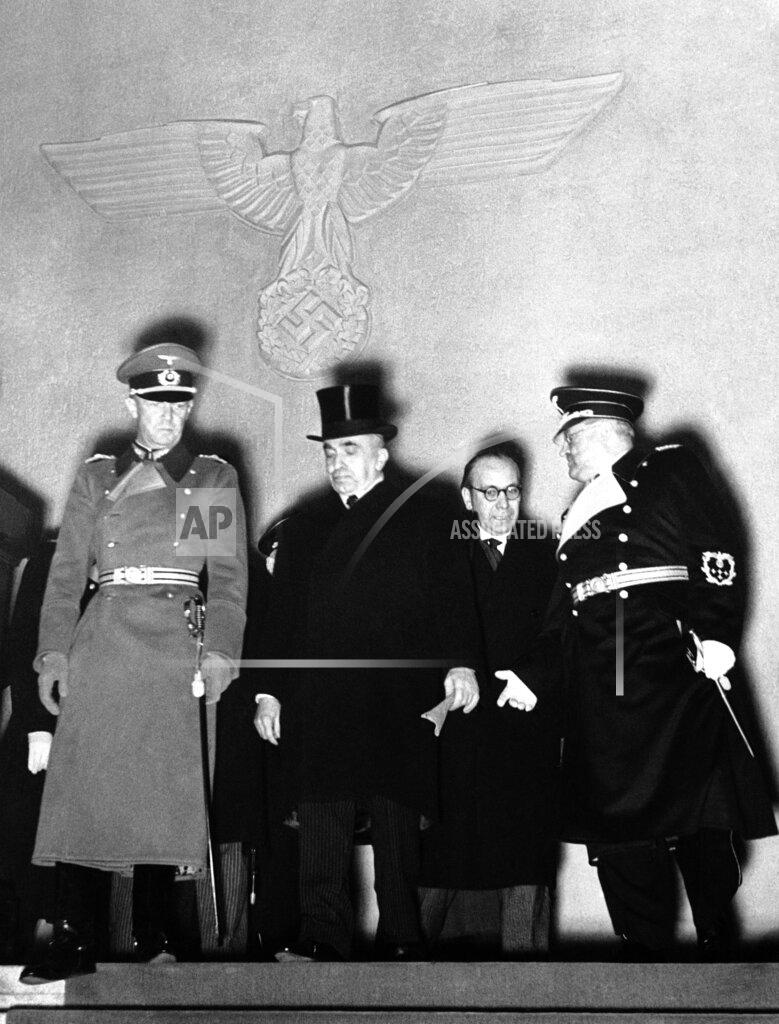
During the day, Czechoslovakian President Emil Hácha traveled by train to Berlin, Germany to conduct last-minute negotiations with Adolf Hitler to save his country. After the secession of Slovakia and Ruthenia, British Ambassador to Czechoslovakia Basil Newton advised President Hácha to meet with Hitler. When Hácha first arrived in Berlin, he first met with the German Foreign Minister, Joachim von Ribbentrop prior to meeting with Hitler. Von Ribbentrop testified at the Nuremberg trials that during this meeting Hácha had told him that “he wanted to place the fate of the Czech State in the Führer’s hands.”
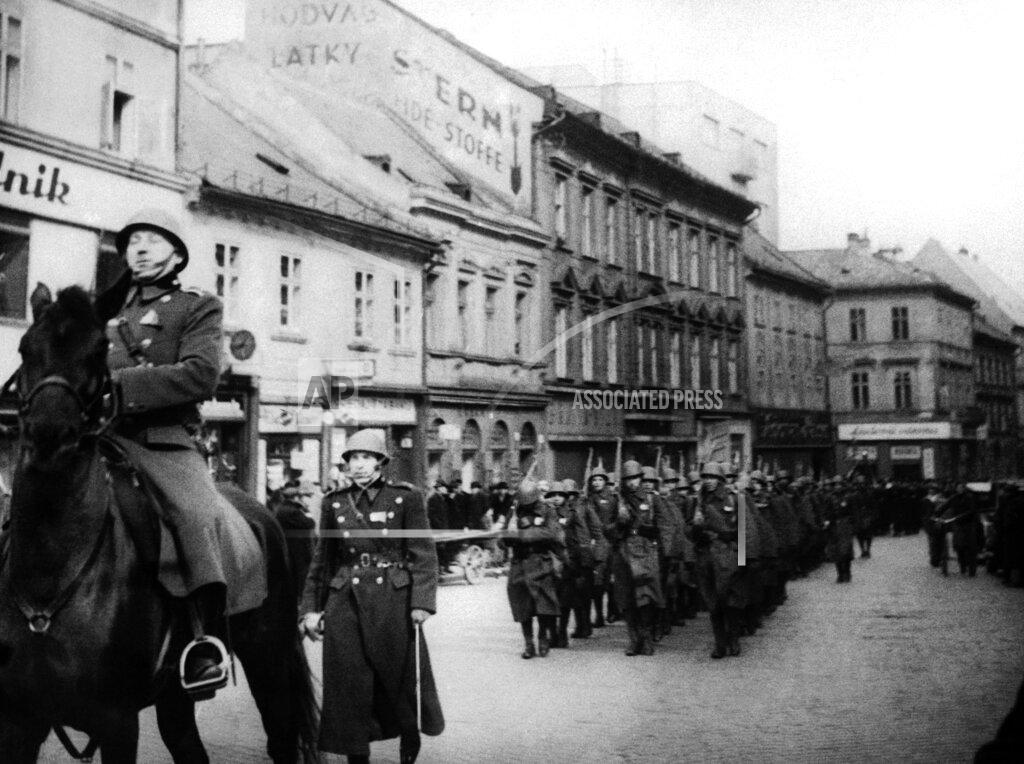
In the evening of 14 March 1939, Hitler summoned President Hácha to the Reich Chancellery in Berlin. Hitler deliberately kept him waiting for hours, while Hitler watched a film. Wilhelm Keitel in his memoirs recalled that when Hácha arrived Hitler said that “he was going to let the old gentleman rest and recover for two hours,” which was incomprehensible to Keitel. Finally, at 1:30 a.m., on 15 March 1939, Hitler saw the President. He told Hácha that as they were speaking, the German army was about to invade Czechoslovakia.
Warned by the German Abwehr’s Paul Thummel that Prague would be occupied the next day, Colonel Franyišek Moravek, Chief of the Czechoslovak intelligence service, and ten members of his staff embark on a Dutch civilian aircraft hired by the British MI6. Later, in London, the group would offer their valuable services to Prime Minister Edvard Beneš’ Czech government in exile.
The destruction of Czecho-Slovakia tonight was not enough to shake Britain from her recent apathy toward events in Central Europe, although it must have destroyed some of the favorite assumptions on which the British policy has been based in the last twelve months. All along it has been the public contention of Prime Minister Neville Chamberlain and those who think as he does that Germany’s chief aim in Europe was the “unification of the German-speaking peoples.” Tonight, Hitler had crossed his Rubicon; for the first time he had subjugated millions of non-Germans who are considered within the Reich to be the racial inferiors of the Germans.
Yet there was no sign that the implications of this immense event had been appreciated at 10 Downing Street or in the House of Commons, where the general attitude was a helpless shrug of the shoulders, or among the general public, which seemed to care far more about a cricket match in far off South Africa than about the transformation of the map of Europe. Most of the newspaper placards in the streets today proclaimed in eight-inch letters, “Another Great Stand” — but by the British cricket team. By the British Government there was no suggestion of any “stand” whatsoever.
Hungarians drive across Ruthenia (Carpatho-Ukraine), aiming for the common border with Poland. Hungarian troops pierced the frontiers of Carpatho-Ukraine (Ruthenia), part of the dissolved State of Czecho-Slovakia, and by midnight had penetrated thirty miles into Carpatho-Ukrainian territory, or probably more than halfway across toward the Polish border. Carpatho-Ukraine is about sixty miles wide at its widest point. Hungary acted after the Carpatho-Ukraine Government had refused to issue arms to the Hungarian minority in accordance with an ultimatum handed at 3 PM yesterday to Milos Kobr, the Czech Minister here, by Assistant Foreign Minister Jon Forernle of Hungary. First reports said that the Hungarian troops were advancing rapidly through Carpatho-Ukraine but were having repeated skirmishes with retreating Czech forces. Hungary decided to occupy the whole of Carpatho-Ukraine and thus obtain a common frontier with Poland in compensation for Germany’s effecting the partition of Slovakia through the latter’s proclamation of independence.
The ultimatum handed to the Czech Minister yesterday contained the following demands:
First, all Hungarians interned in Czecho-Slovakia must be released immediately.
Second, arms must be issued to the Hungarian minority.
Third, all “persecution” of members of the Hungarian minority must cease and they must receive full rights to form whatever associations they wish.
Fourth, Carpatho-Ukraine must be evacuated within twenty-four hours.
Fifth, the property of Hungarian subjects and the Magyar minority must be fully respected.
Sixth, an answer must be given to these demands within twelve hours of the delivery of the note.
Rumanian troops occupy about 20 villages in Carpatho-Ukraine. A Reuters news agency dispatch from Prague early today said Rumanian troops had occupied more than twenty villages in the eastern part of Carpatho-Ukraine. The information was sent from Bratislava, the capital of Slovakia. The dispatch said Premier AugusItin Volosin who yesterday declared the independence of Carpatho-Ukraine, the easternmost province of Czecho-Slovakia, had fled to Rumania.
According to information from Huszt, the capital of Carpatho-Ukraine, received in Prague by the semi-official news agency, Premier Volosin was wounded in a clash last night between the population and his escort. His Cabinet was said to have fled to Rumania with him. The eastern part of the province is largely inhabited by Rumanians.
Polish Foreign Minister Josef Beck received the Rumanian Ambassador and the Hungarian Minister tonight as rumors spread in Warsaw that the eastern part of Carpatho-Ukraine would be occupied by Rumania. There are about 40,000 Rumanians in the eastern part of Carpatho-Ukraine, once an autonomous province of the Czecho-Slovak Republic, which broke away today under German and Hungarian pressure.
Colonel Beck met with the Hungarian and Rumanian envoys after the government had announced that it had increased its forces along the Carpatho-Ukraine border “for the protection” of the border. The number of troops was not disclosed.
Marshal Edward Smigly-Rydz today ordered that the Polish garrisons on the Carpatho-Ukrainian frontier be greatly strengthened. Several additional divisions are proceeding to new positions. The order followed a conference between Foreign Minister Josef Beck and Marshal Smigly-Rydz this afternoon. The troops have not been ordered to advance into Carpatho-Ukraine and are guarding against attempts of Carpatho-Ukrainians to enter Poland.
Madrid is calm again as the fighting between Loyalist factions ends. Communist rebels either had been captured by General Miaja’s forces or had been forced to flee to the Guadarrama Hills. Madrid newspapers resumed publication.
A raid in Valencia, Spain, kills 12 civilians. There is no military target near where the bombs fell.
The National Defense Council in Madrid announced tonight that it was concentrating on establishing “a permanent peace.”
The Nationalist destroyer Velasco, accompanied by the merchantman Mar Negro, captured 210 men composing the crews of ten fishing boats who were at work off the Valencia coast. The men were put aboard the Mar Negro. The news was carried to Valencia by an eleventh fishing boat, which escaped.
Pope Pius XII blesses Irish groups in anticipation of St. Patrick’s Day events.
The “Timeless” Test between South Africa and England in Durban ends – it started on March 3.
The British draft a plan for Palestinian rule. The proposal will be presented to the cabinet tomorrow. Britain is rumored to propose a five-year delay in the formation of a Palestinian state. Jewish immigration will be restricted but not stopped. Neither the Jews nor the Arabs are expected to find the plan acceptable.
The end of the Czech state stirs emotion in Washington, D.C. The United States helped form the nation after World War I. The U.S. government refused to recognize Germany’s annexation of Czechoslovakia and imposed countervailing duties on imports from Germany.
Declaring that the cause of national prosperity could not hope to gain from a wholesale discharge of federal relief workers, President Roosevelt urged upon Congress today the need for a supplemental appropriation of $150,000,000 to continue the Works Progress Administration into the next fiscal year. In his message the President contended that insufficiency of present funds would compel the WPA Administrator to begin, “within the week,” the progressive discharge of workers to a total of nearly 1,250,000 by June 30. With dependents, the number of those affected, he estimated, would be 4,000,000 “within the next few weeks and nearly 1,000,000 more later on.”
“I cannot bring myself to believe that these discharged men and women will contribute to the prosperity of the United States,” the President said, “nor do I believe that the merchants and landlords they are now dealing with will become more prosperous when their trade ceases.” With that statement he placed full responsibility for the final decision upon Congress.
The message was followed by quick steps on the part of the Administration leadership in Congress to shove the new appropriation through the House within the next few days. On a rebound, however, these moves brought threats of delay and the possibility that even this new request might be pared by Congress. Acting in line with President Roosevelt’s message, Chairman Taylor of the House Appropriations Committee introduced a bill calling for the additional $150,000,000. He immediately designated the deficiency subcommittee to consider it, but announced that he would head the committee himself this time and not leave the acting chairmanship to Representative Woodrum of Virginia, as he had done for several sessions.
The Reorganization Bill giving to the President limited power to reshuffle government bureaus and agencies, already passed by the House, moved to the head of the Senate’s order of business late today. It will be taken up on Thursday, the Senate having given itself a holiday tomorrow. The bill was put in the leading position after a special committee on reorganization, headed by Senator Byrnes, after deciding at a morning session not to hold public hearings on it, voted at an afternoon meeting to report it out and also arranged with Senator Barkley, majority leader, to force the issue at the earliest moment.
The Barkley amendment, forbidding the award of national defense contracts to industrialists held to be violators of the National Labor Relations Act, was deleted from the Air Corps Expansion Bill in conference today. The Senate conferees yielded before the firm opposition of the House members. Under the amendment the Secretary of War would have ruled on the eligibility of bidders. This stipulation, which was added to the measure by the Senate, was regarded as definitely dead, since the parliamentary situation is now such that the whole bill would have to be defeated on the floor of the Senate before it would be possible to start work on passing another measure including such an item. Senator Barkley, the majority leader, declined to say what he intended to do, but it was gathered from other sources that Administration forces would accept the conference report in both houses.
Hopes of Administration and Congressional groups of winning White House support for revision of the business tax structure as a recovery stimulant went unsatisfied today when President Roosevelt said in a press conference that he had yet to be shown how the changes could be made without reducing governmental income, to which he is flatly opposed. Having conferred a few hours before with Secretary Morgenthau and Under Secretary Hanes of the Treasury on implementing the Administration’s recovery program, Mr. Roosevelt laid down the general proposition, in reply to questions, that it was up to Congress to decide what readjustments could be made in business taxes, if that could be done without curtailing federal revenues or imposing heavier burdens on small business.
Thus, if the business tax revisionists found encouragement for their hope that something might be done during the present session, it was because the President had been generally expected to slam the door tightly shut against any such prospect. Actually, he left it just about where it had been. That position was open just enough to let in a draft. Between the time the President conferred with Morgenthau and Hanes and his press conference, Speaker Bankhead had sounded what was thought to be the death knell of business tax revision as an issue at the present session.
The Speaker joined Senator Barkley, majority leader, in the assertion that complaints against “tax deterrents” were only a “pretext” for something else. Emphasizing that he expressed his own views, rather than those of the White House or the Ways and Means Committee of the House, Mr. Bankhead said any increase in the percentage corporate income tax as a necessary part of any general business tax revision would fall most heavily on the small businessman. He added that in his opinion there would be no “serious effort made for general revision of the tax laws at this session of Congress.”
Speaker Bankhead came out today for some sort of retirement pay or direct pension for members of Congress. He said he had long thought that members of Congress were entitled to the same consideration as judges or federal civil employees. He added, however, that he had found no definite plan that he approved.
“The proposal to provide some system for retirement pay for ex-members of Congress,” he declared, represents the views of a number of members of the House who have voluntarily approached me on this subject. It has been their unanimous opinion that the matter of undertaking to formulate some equitable and just retirement system for members of Congress is a matter worthy of serious consideration.
“I did not initiate this movement, although I must say in all candor that I approve of this discussion. Practically all men in the federal service, including the judiciary, the army and navy and those in civil branches of the government, have been provided with some form of security after a certain number of years of service with the government.”
A New York Supreme Court justice upholds the Board of Education’s right to ban teachers from holding a second job.
The Ford Motor Company, filing 273 exceptions to a proposed National Labor Relations Board decision against it, accused the board today of having “a fixed bias and a fixed prejudice against employers in general.” The company particularly took exception to “the failure of the board to take into consideration the sit-down strikes which were prevailing at the time (1937) of the event dealt with in the decision,” asserting these events were essential to an understanding of the evidence.
The Martin Maryland medium bomber took its first flight. Built to a USAAC specification, the Maryland was only ever employed by France and Britain. It would be the first U.S.-supplied bomber to be used by the RAF in North Africa.
Costa Rica preserves the only true democracy in Central America, a touring correspondent says.
Argentina finalizes barter deals with Germany and Italy, trading wheat for trucks and equipment.
India lacks unity for independence from Britain. The congress is unable to speak for Muslims, Sikhs, and other minorities.
The Soviet-Japanese dispute over an auction of fishery lots off the Siberian coast moved closer to a showdown today when Foreign Commissar Maxim M. Litvinoff and Japanese Ambassador Shigenori Togo met but failed to agree.
Under a Japanese-Russian treaty repeatedly extended until last year, a number of the fishing lots — an important Japanese source of food and industry — went to Japan without auction. The Japanese protest that Russia has withdrawn a number of these lots from the exclusive Japanese auction.
On February 22 Mr. Litvinoff was said to have warned that any Japanese attempt to help Japanese fishermen take what they wanted in the Siberian waters — as hinted in Japanese newspapers — would “not be localized.” Mr. Togo was said to have replied then that the Japanese Government “will take all necessary measures to protect Japanese interests.”
Some observers believed there might still be a chance of compromise but that the situation might become critical if the Japanese disregarded the auctions and carried out a threat to protect Japanese fishing boats with warships. Recent reports from the Far East indicated that the Japanese had been moving more troops into Manchukuo, toward the Siberian frontier, where repeated Soviet Japanese conflicts have occurred.
War brings riches to Chinese banks.
Japan moves toward monopoly in China, as foreign traders are barred from the interior.
Dow Jones Industrial Average: 151.10 (+0.31).
Born:
William Benjamin Lenoir, American astronaut (NASA Group 6 , 1967; STS-5), in Miami, Florida (d. 2010, from head injuries after a bicycle accident).
Chuck Lamson, NFL strong safety (Minnesota Vikings, Los Angeles Rams), in Webster City, Iowa. (d. 2015).
Raymond J. Barry, American actor (“Steel City”), in Hempstead, New York.
Bertrand Blier, French novelist and director (“Going Places”), in Paris, France.
Stavros Xarhakos, Greek composer and conductor, in Athens, Greece.
Naval Construction:
The Royal Navy Net-class boom defense vessel HMS Burgonet (Z 33) is launched by the Blyth Shipbuilding & Drydock Co. Ltd. (Blyth, U.K.).
The Regia Marina (Royal Italian Navy) Marcello-class submarine Comandante Cappellini is launched by Odero-Terni-Orlando (OTO), Italy. This will later serve in the German Kriegsmarine as UIT-24 after the Italian capitulation, and finally in the Japanese Navy as I-503 after the German surrender. Her final crew was a mixture of Italians, Germans, and Japanese.

 History Diaries