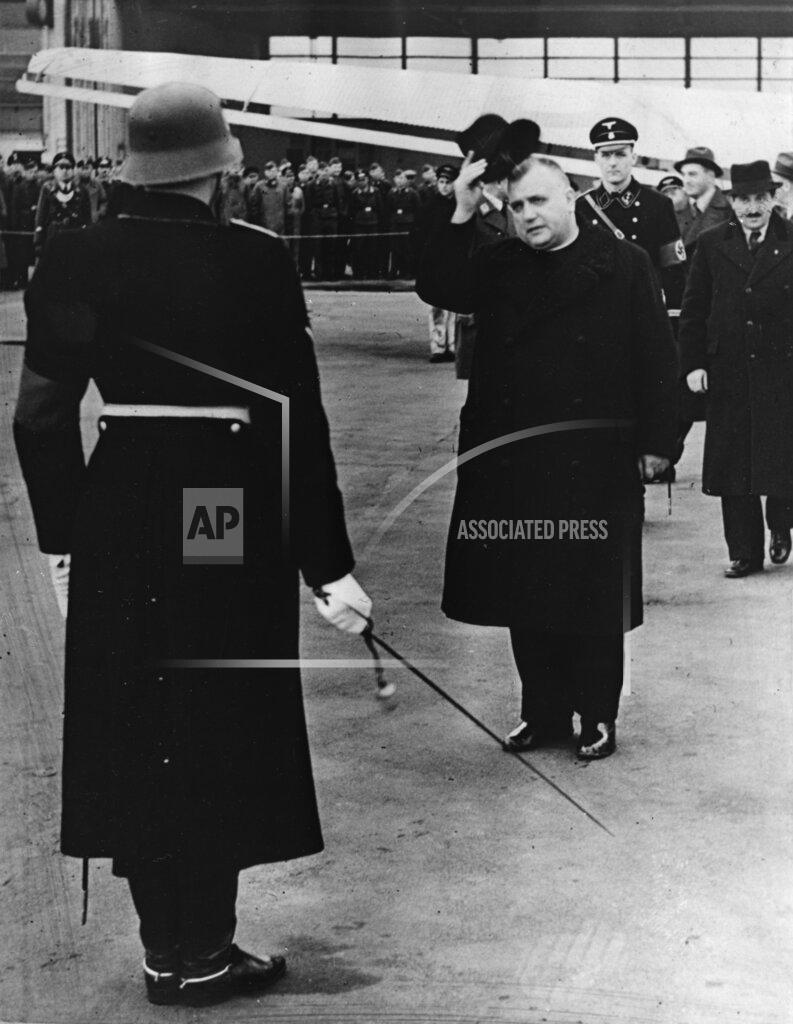
In a hastily arranged meeting in Berlin with recently deposed Premier Monsignor Tiso and Ferdinand Ďurčanský of Czecho-Slovakia, Chancellor Adolf Hitler claims that, “Czecho-Slovakia owed it only to Germany that she had not been mutilated further.” The point is that if Hitler can show that Slovakia wants to be independent, then he has just cause for applying pressure on the Czecho-Slovakian government to give in. At 1900 hours, Adolf Hitler once again demanded Jozef Tiso to declare Slovakian independence from Czecho-Slovakia; meanwhile, German Foreign Minister Joachim von Ribbentrop presented him reports of Hungarian troop movements on its border, hinting that Hungary, friendly to Germany, was ready to strike should the negotiations in Berlin, Germany fail.
Bombs explode in the Czech capital of Bratislava after a demonstration. Deadly bomb explosions tonight punctuated the separatist demands of Slovaks who staged violent anti-Czech demonstrations in the Slovakian capital of Bratislava and heard their leaders virtually declare their independence of the Prague central government. The explosions, in which six persons were reported killed and fifty injured, came in succession during a defiant demonstration at which Alexander Mach, Propaganda Minister in the ousted Cabinet of Premier Joseph Tiso, declared that “Slovakia is now governed by Slovaks — the Czechs have no more to say.” The demonstration was in celebration of the release of M. Mach, who had been held by the Czechs. Explosions continued in Bratislava through the night, according to a dispatch from Prague. The object was believed to be to give Germany an excuse to send in troops “to restore order.”
“The fate of Slovakia is being decided in these moments,” M. Mach shouted to the echo of “Sieg Heil!” and “Heil Hitler!” from Germans and Slovaks, whose solidarity seemed to be complete. “Perhaps within half an hour we shall hear news of great importance from the Berlin radio.” His forecast was followed within a few minutes by the announcement of a demand by Chancellor Adolf Hitler for a meeting of the Slovak Parliament tomorrow.
Throughout Germany, the Gestapo raided the offices of the patriotic Pan-German League. A number of its leaders were arrested, their offices sealed and the League compelled to close.
Otto Rahn dies of overexposure while hiking in the mountains near Kufstein. Rumors persist that he was murdered by the SS.
The British Government and people resolutely looked the other way tonight while the apparent disruption of the Czecho-Slovak State proceeded a stage further under pressure from the Slovaks and their friends in Berlin. There is complete confidence in London that in the end the Czech Government will do whatever the Germans may command; it has no choice in the matter. Moreover, Prime Minister Neville Chamberlain has made up his mind that there is going to be no crisis in Europe at the present time and really believes that general conditions in Europe justify optimism.
The impression in London tonight is that Mr. Chamberlain’s confidence has not been shaken and that the sudden developments in Slovakia are regarded as an annoyance rather than as a source of worry. In the British view there is no need for events in Central Europe to impair any one’s confidence, except perhaps in the intentions of the German Government toward non-German peoples beyond the Reich’s frontiers.
Naturally it is hoped in Britain that the status of Slovakia may be settled without open military intervention by Germany. Any “unpleasantness” in the form of a German march across the Slovak border might be embarrassing to Mr. Chamberlain and all those who believe with him that it is time for confidence to return to Europe.
But Great Britain will do nothing, even if “unpleasantness” occurs. British apathy over Czecho-Slovakia’s future is overpowering; the public is bored with the whole question, and even Mr. Chamberlain’s critics on the Left are averting their eyes from the spectacle of what Germany does with its Central European “colony,” as Czecho-Slovakia is sometimes called here.
The Hungarian Ambassador to Poland, Andrew de Hory, conferred at length today with the Polish Foreign Minister, Josef Beck, regarding the new conditions created by the possibility of a declaration of Slovak independence. The situation is regarded in Warsaw as very serious and it is believed that both Budapest and Warsaw are discussing the possibility of a German move, which is greatly feared. The Opposition newspapers place upon Germany the responsibility for the crisis. It is explained officially that although Poland is directly interested in developments she will continue, for the time being, her “wait and see” policy.
Authoritative political circles nevertheless admitted that the secession of the Slovaks from Prague would present a new opportunity for the much-desired common frontier with Hungary. That appears the only possible solution if Carpatho-Ukraine should find herself isolated geographically by the proclamation of Slovak independence. Manifestly, Carpatho-Ukraine could not exist economically in such a position. It is recalled in this connection that Colonel Beck declared recently that Rumania was now no longer opposed to the common frontier. It is understood that Mr. de Hory reported to Budapest immediately after his conversation with Colonel Beck, and this evening he again got in touch with the Foreign Office here.
Premier Paul Teleki made a statement today to the official Hungarian news agency concerning recent events in Slovakia. He said that Hungary’s frontiers with Slovakia were already definitely fixed and would be occupied tomorrow on both sides. “Whatever happens within Slovakia,” he declared, “is an internal affair of that country. Hungary is watching the course of events very closely.”
Madrid has regained the appearance of as much normality as is compatible with war conditions, following final suppression of the Communist rebellion exactly a week after it started. Theaters and cinemas have reopened and children are playing on the barricades. Now that the uprising against the National Defense Council has been quelled it can be revealed that it acquired much greater proportions than at first were generally imagined. Colonel Segismundo Casado forestalled the then Premier Juan Negrin’s coup d’état in the nick of time.
The Communists were disposed roughly over the First and Second and part of the Third Army Corps. Colonel Casado had the rest of the third and the whole of the Fourth and Fifth Army Corps, mobile units, and the greater part of the carabineers and metropolitan and shock police. Confusion among the soldiers themselves was great, however, and it needed only the putting on or taking off of a white armlet to swell the ranks of one or the other of the opposing forces and to turn the tide of the conflict.
Most of the soldiers fighting for the Communists were not members of the party but men who had been tricked into believing that to oppose Colonel Casado was the same as opposing Generalissimo Francisco Franco. The Communists argued that Colonel Casado had agreed to a treacherous surrender of Republican territory. It is expected that such few of the Communist rebels as may still be holding out in isolated groups outside this capital will soon be subdued, as regular open warfare can be waged against them, unhampered by the humanitarian restrictions that made repression of the rising within the city so laborious.
Colonel Segismundo Casado, Republican Defense Minister, said in an interview tonight that the National Defense Council was doing its utmost to evacuate Spanish Republicans wanted by Nationalist Generalissimo Francisco Franco before attempting to obtain an “honorable peace.” He said four special foreign correspondents. including Henry Shields, who represents The Daily Worker of New York, who is under arrest here, would be expelled from the Central Zone. He asserted the Communist uprising of last week had been completely crushed and denied a fresh revolt had broken out at Cartagena. He estimated that 2,500 Communists were killed in last week’s revolt. He said the Cabinet at a meeting late today “decided to demobilize not only men 44 and 45 years old, but also all men belonging to all classes who as a result of being physically unfit for the front are doing auxiliary service behind the lines.”
General José Miaja was reported ready today to make immediate peace with Generalissimo Francisco Franco to forestall a threatened Nationalist offensive to take the rest of Spain by force. After a five-hour session in Madrid last night, the National Defense Council announced that, with the six-day Communist uprising suppressed, the government would go ahead with “the plan drawn up before the rebellion.” That plan, border observers believed, would mean the end of the civil war by virtually unconditional surrender. Those observers, however, were skeptical of the Defense Council’s announcement that the Communist revolt against the peace plan finally had been suppressed. They pointed out that the same announcement had been made twice before and that after each bitter fighting continued in Madrid. Dispatches from Madrid this morning said some 30,000 Communist soldiers from the Madrid area alone had been involved in the revolt. They formed units of two army corps defending Madrid. Their corps commanders were said to have ordered them into action against the Defense Council.
A spokesman for the Casa Cordon, the Spanish Nationalist State Department, revealed to the press today that identical notes with regard to its statement to the press and radio last Wednesday concerning shipping entering Spanish Republican ports had been handed to all diplomats of nations represented at Burgos. The British Foreign Office, through its embassy here, he added, submitted yesterday a reply summarizing Foreign Minister Viscount Halifax’s declaration to the House of Lords Thursday and asked for clarification on certain points. The Burgos spokesman significantly referred to “repressive measures” against the Republican coast, which expression he said was used in the identical notes to the nations, while the word “blockade” was not used. The British note, it is understood, asks for clarification with regard to naval ships entering the Republican zone.
The Casa Cordon does not look for any incidents with the British over enforcement of these measures. Consequently, the tendency of the Nationalist press to overstress the Nationalist and British statements should not be taken too literally. The Nationalist Government’s attitude continues to be that anything affecting Spanish territoriality is purely a Spanish affair. Moreover, any decision affecting Mediterranean policy is regarded as invalid unless Spain is fully consulted in advance as “an equal partner in that sea.”
A fascist editor claims that Italy is arming African natives. The editor is considered Mussolini’s mouthpiece.
HMS Acasta completed ASDIC testing work with Vickers-Armstrong.
A British Cabinet subcommittee today started drafting British proposals for a solution to the problem of the Holy Land. It is expected these will be submitted to the full Cabinet Wednesday and to the Jewish and Arab delegates to the Palestine Conference immediately thereafter. If, as expected, neither side agrees to the proposals, the British Government will then decide to impose its own policy, which is expected to follow the general outlines of the plan being prepared today. However, it is possible that any imposed solution may be only temporary, pending revival of the present attempt to obtain an agreement.
Prime Minister Neville Chamberlain today received a large delegation of members of the House of Commons of all parties who urged that the Jewish national home be maintained in Palestine. The executive of the Zionist. Agency met today, but came to no conclusion pending submission of the British proposals. Colonial Secretary Malcolm MacDonald saw several heads of delegations from independent Arab States. The Palestine Conference was virtually suspended until Wednesday.
Police dogs, following the trail of terrorists who planted a land mine near the Gilbea Hills, led searchers tonight to the non-Jewish German settlement, Waldheim, in the Nazareth Hills, twenty miles from Haifa. Two Jews were killed and two others gravely wounded when the mine exploded today as they were walking along a trail near the Gilbea Hills.
President Franklin Roosevelt asked Congress for relief funding of $150 million to last through June. The Roosevelt Administration moved today to dissolve one cause of friction between itself and Congress by abandoning the proposal for an immediate increase in the statutory national debt limit, but prepared to insist tomorrow upon restoration of the $150,000,000 reduction in the supplemental appropriation for unemployment relief.
Meanwhile a discouraging note was sounded by Senator Barkley, the majority leader, to those who had hoped for tax revision at this session to encourage business. A few hours after coming from a White House conference with President Roosevelt, the Senator expressed doubt of the advisability of attempting tax revision at this session and intimated that the President would make known his views on the subject within a few days.
These developments added up to a day of confusion concerning efforts to heal the breach between. the two branches of the government and, more especially, to bring a better understanding between the Administration and business. Secretary Morgenthau conferred this afternoon with Federal Reserve Board officials, but would not discuss the nature of the conference other than to state that it was arranged last week and pertained to “joint problems” of a fiscal and monetary nature. The Secretary did say at his press conference, which followed his meeting with the Federal Reserve officials, that policy with respect to changing the public debt limit was discussed, “among other things.”
The Secretary announced, “after having lunch with the President,” that the Administration would not ask for an increase in the public. debt limit at this session of Congress, but that he would ask for removal of the “partition” limiting the proportion of the public debt in outstanding bonds to $30,000,000,000. Those at the Federal Reserve conference included Marriner S. Eccles, chairman of the Board of Governors; George Harrison, president of the New York Federal Reserve Bank; Allan Sproul of the same bank; Daniel W. Bell, assistant secretary of the treasury and until recently acting director of the budget, and E. A. Goldenweiser, Federal Reserve economist.
The defense program and the parallel question of foreign policy entered a new phase in Congress today when Senator Pittman introduced a resolution which would permit the President, at his discretion, to sell all units of naval vessels and arms, and anti-aircraft artillery and munitions to other American republics. The resolution also would authorize the Executive to give to them secrets concerning manufacture and operation of the armaments.
Representative Bloom of New York introduced a resolution with similar authorizations in the House, following Senator Pittman’s action. Thus, the Congress received from the respective chairmen of its committees dealing with foreign relations a measure reported to have the approval of the State Department, as a means of implementing the Monroe Doctrine. The authorization, Mr. Bloom said, would enable the Latin-American countries, which the United States is pledged to defend against foreign aggression, to be “better prepared to resist any possible attack on their territories by the armed forces of non-American powers.”
Senator Pittman intimated late last week that he proposed to take this course in regard to naval vessels, but even his close associates were surprised at the broad terms in the eventual resolution. There had been no suggestion heretofore that materials involving secret manufacture or processes would be supplied to foreign governments.
The resolution also left open the question of payment for these supplies which might be sold, for while the Pittman resolution specified “that no transaction herein shall result in expense to the United States,” it would authorize appropriations to manufacture war materials with the understanding that at an unspecified future date the purchasers would reimburse the United States.
Several Congressional leaders are studying plans for retirement pay for members of Congress with the idea of offering a bill at this session if an acceptable formula can be found. Two plans are under consideration. One is for the extension of a retirement system equivalent to that which is maintained for civil service employees. By this method members would be required to contribute a percentage of their pay to the fund. The other suggestion is to extend the system enjoyed by Federal judges to members of Congress. Such a plan, some members believe, I would not meet with the approval of the voters. Therefore, some combination of the two systems is proposed.
New York Supreme Court judge Salvatore Cotillo rules that “closed shops” can exist only when a union has a majority of employees. The ruling stems from an eight-month long strike at Busch Jewelry Co.
Professor Albert Einstein plans a quiet day for his 60th birthday. He should become a U.S. citizen in another year. Einstein believes he is close to uncovering the master key to the universe, a grand unification theory linking relativity and quantum mechanics.
[85 years later, physicists are still trying to accomplish this. No luck yet.]
Japanese columns swerving southward along the Han River, 100 miles west of Hankow, reported the capture of two Hupeh Province towns today and the sinking of most of a small fleet of junks in which Chinese troops were attempting to flee westward across the river. The towns reported captured were Lohanssu, on the east bank of the river opposite Shayang, and Likiawan, also on the east bank, fifteen miles north of Lohanssu. Shayang is near the point where the Han, after flowing southward, turns east to join the Yangtze 100 miles farther on at Hankow. Shayang is thirty-five miles northwest of Shasi, Yangtze port, which is one of two main Japanese objectives in this region. The other is Ichang, seventy-five miles farther up the river.
The Japanese said that as a result of today’s operations they now had wiped out all Chinese forces on the east bank of the Han and were in a position to advance toward Shasi and Ichang. It was announced in Shanghai that a Japanese-backed daily airplane service linking Shanghai, Nanking and Peiping would be started tomorrow, replacing the service formerly run by the Chinese Government.
A Japanese military spokesman announced widespread bombing activity designed to harass Chinese shipping south of Shanghai, carried out coincidentally with a vigorous “mopping up” expedition against Chinese guerrilla fighters in the region. During February Japanese units fought sixty-one engagements against guerrillas in the vicinity of Soochow, fifty miles east of Shanghai, in which they said they killed 1,004 and took eighty-four prisoners. The Japanese reported that in these clashes their casualties were only eleven killed and nineteen wounded.
Fighting was reported under way near Nanking with a new Chinese Fourth Route Army, which already had lost 350 killed. The Japanese reported four other battles had been fought between Shanghai and Nanking with bands of guerrillas, totaling 3,500 men. The Japanese also asserted one of their columns had attacked and captured Tsiyuan, on the north bank of the Yellow River near the Honan-Shansi border, the Chinese defenders retreating to the northwest and leaving 200 dead.
Dow Jones Industrial Average: 150.79 (-0.98).
Born:
Neil Sedaka, American singer and songwriter (“Breaking Up is Hard to Do”; “Love Will Keep Us Together”), in Brooklyn, New York, New York.
Al Luplow, MLB outfielder and pinch hitter (Cleveland Indians, New York Mets, Pittsburgh Pirates), in Saginaw, Michigan (d. 2017).
Wilbert Scott, NFL linebacker (Pittsburgh Steelers), in Connellsville, Pennsylvania.
Died:
Lucien Lévy-Bruhl, 81, French scholar and philosopher.
Naval Construction:
The U.S. type T3-S2-A1 civilian tanker Esso Trenton [later U.S. Navy tanker USS Sangamon (AO-28), then escort carrier USS Sangamon (CVE-26)] is laid down by the Federal Shipbuilding & Drydock Co. (Kearny, New Jersey, U.S.A.).
The Royal Navy British Power Boat 60 feet-type motor torpedo boat HMS MTB 17 is commissioned.
 History Diaries