German leaders demanded Slovakian leader Jozef Tiso to visit Berlin, Germany, where he was told to declare Slovakian independence immediately otherwise Germany would withdraw its support for such a movement.
Events today brought no clarification of the situation with regard to Slovakia. Incitements directed against the State’s unity were continued by the Vienna broadcasting station, and it is no longer possible to attribute these to local action by Dr. Arthur Seyss-Inquart, Governor of Austria. Tomorrow is likely to be a critical day. The new Premier, Dr. Karol Sidor, is a Slovak nationalist but not a separatist — at present. The Czech effort to consolidate the new State and ensure Slovakia’s loyalty has failed against German intervention. If the Sidor government remains, it will do so at the cost of concessions by Prague, which will make the State’s future existence even less secure than the Munich settlement left it.
Most of the news broadcast from Berlin on the situation can be dismissed as baseless propaganda. The talk of troop concentrations in Slovakia is antiquated. So are the stories of “increasing excitement and clashes.” The concentrations date from Thursday; the “increasing clashes” from Friday. The clashes have since decreased, and the troop concentrations have become almost meaningless by the confinement of Czecho-Slovak units to their barracks in Slovakia, and, equally, the threats to proclaim Slovak independence by the fugitive Minister of Communications, Dr. Ferdinand Durciansky, have lost their force.
“The historic announcement” from Vienna for which the Slovaks waited until 2:30 o’clock this morning failed to eventuate. Czecho-Slovakia intervened in Berlin yesterday to ask what was the meaning of this threat of a summons to revolt issued over the wireless of — formerly — a friendly neighbor. At the same time Prague hurriedly agreed to the formation of Dr. Sidor’s Slovak nationalist government.
The Foreign Policy Association suggests that the Reich is economically weak in key areas, including trade balance issues.
The National Defense Council in Republican Spain announced at 10 o’clock tonight that the Communist uprising had been totally crushed and that all rebel strongholds had surrendered without conditions. “The situation in Madrid is excellent,” said a statement issued after a meeting of the council. “Now that the events that paralyzed its political life are finished, the council will be free to devote itself without loss of time to the accomplishment of its patriotic aims.”
The two main Communist strongholds — the new Ministry buildings, on the site of the old race track, and the village of Chamartin, on the northern edge of Madrid — surrendered in the morning following an extensive massing of troops during the night by General José Miaja, head of the council. Some of the Communists have fled outside the capital to the neighborhood of the Guadarrama Mountains. It is expected that General Miaja’s troops will be able to suppress them easily, for open warfare can be waged without the restrictions imposed by fighting in the heart of a city.
Communists are being ejected from public office in Madrid and throughout the rest of the Republican territory. Communist provincial officials and municipal councilors of Madrid have been dismissed because they deserted their posts and have been proved guilty of complicity in the revolt. The United Socialist Youth Organization, which was formerly under Communist influence, has been taken over exclusively by Socialist leaders.
General Miaja’s troops released 500 prisoners, including José Gomez Osorio, Civil Governor of Madrid, when they captured the former royal palace at El Pardo, ten miles northwest of Madrid, from the Communists today. So far 3,000 prisoners held by the Communists have been released. For the first time since last Tuesday, when the revolt against the new council began, the people of Madrid were able today to go outdoors safely and enjoy the sunshine. The streets were crowded with people inspecting the scenes of the fighting.
Prime Minister Chamberlain makes a public pledge of support for Polish sovereignty in Parliament. This speech has been called one of the most important expressions of England’s support for Polish independence.
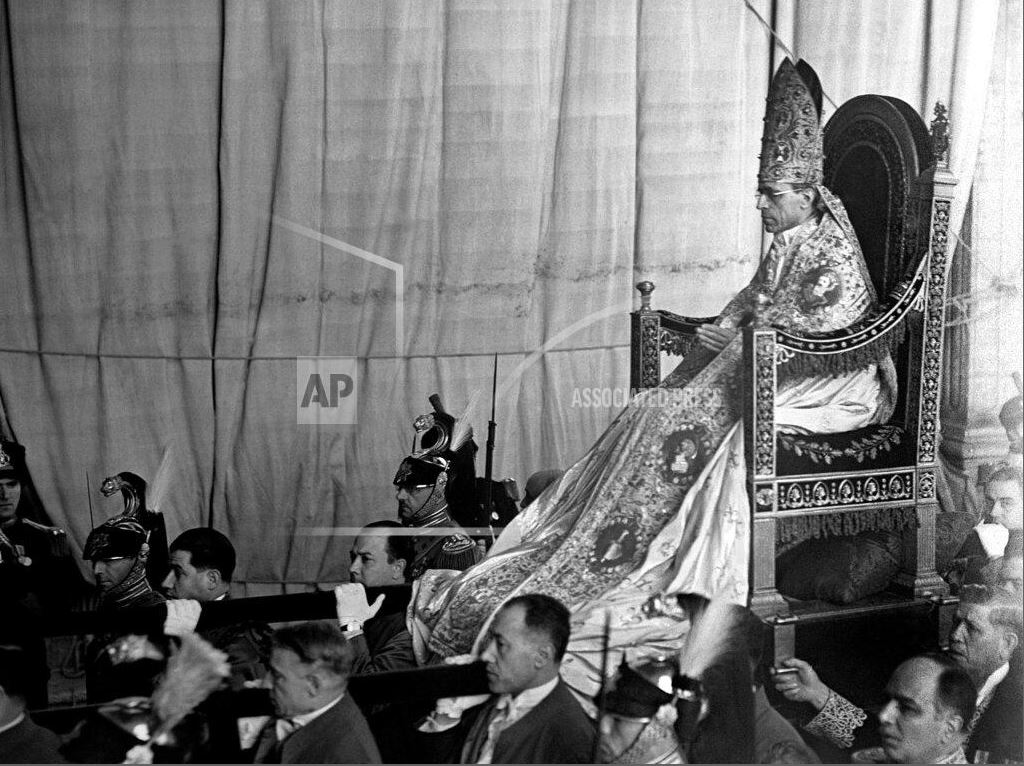
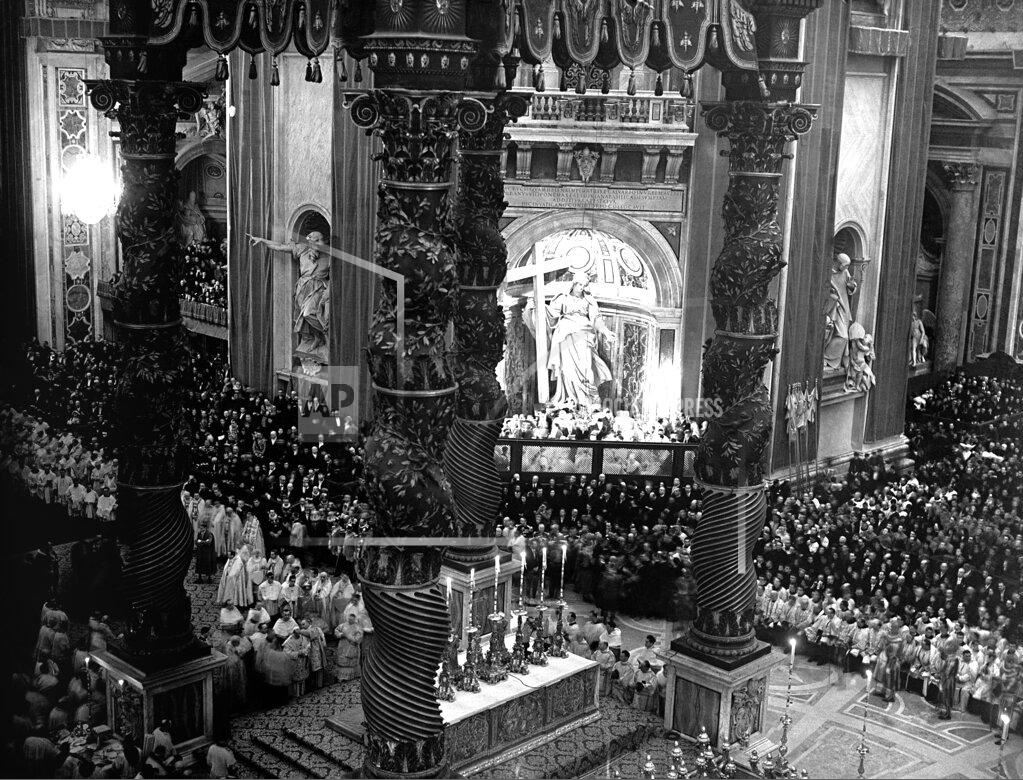
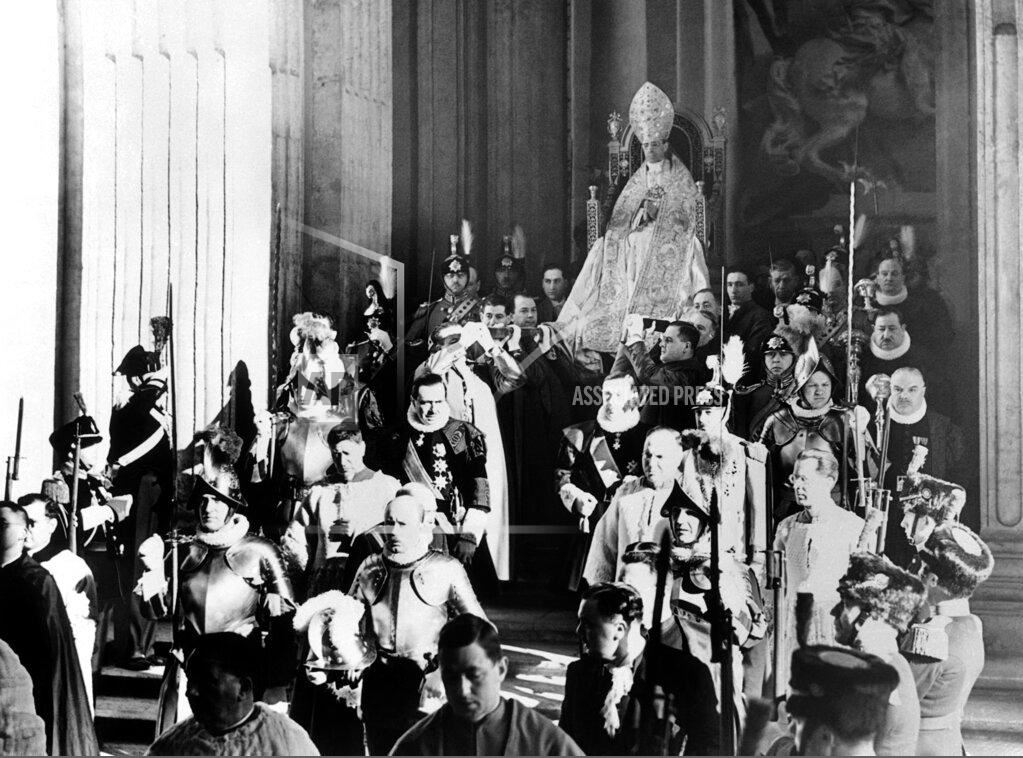
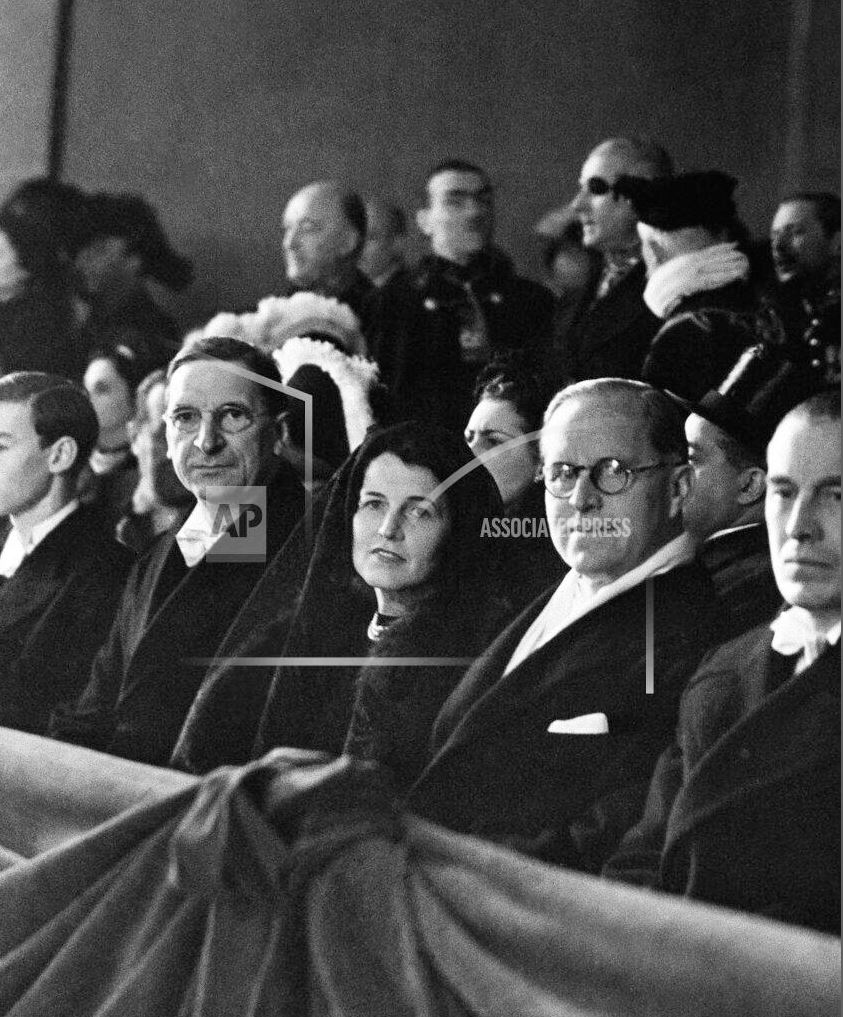
Pope Pius XII (Eugenio Maria Giuseppe Giovanni Pacelli) was crowned 260th Supreme Pontiff in a ceremony at the Vatican. His coronation took place on this day in 1939. Upon being elected pope he was also formally the Grand Master of the Equestrian Order of the Holy Sepulchre of Jerusalem, prefect of the Supreme Sacred Congregation of the Holy Office, prefect of the Sacred Congregation for the Oriental Churches and prefect of the Sacred Consistorial Congregation. There was however a Cardinal-Secretary to run these bodies on a day-to-day basis. Pacelli took the same papal name as his predecessor, a title used exclusively by Italian Popes. He was quoted as saying “I call myself Pius; my whole life was under Popes with this name, but especially as a sign of gratitude towards Pius XI.”
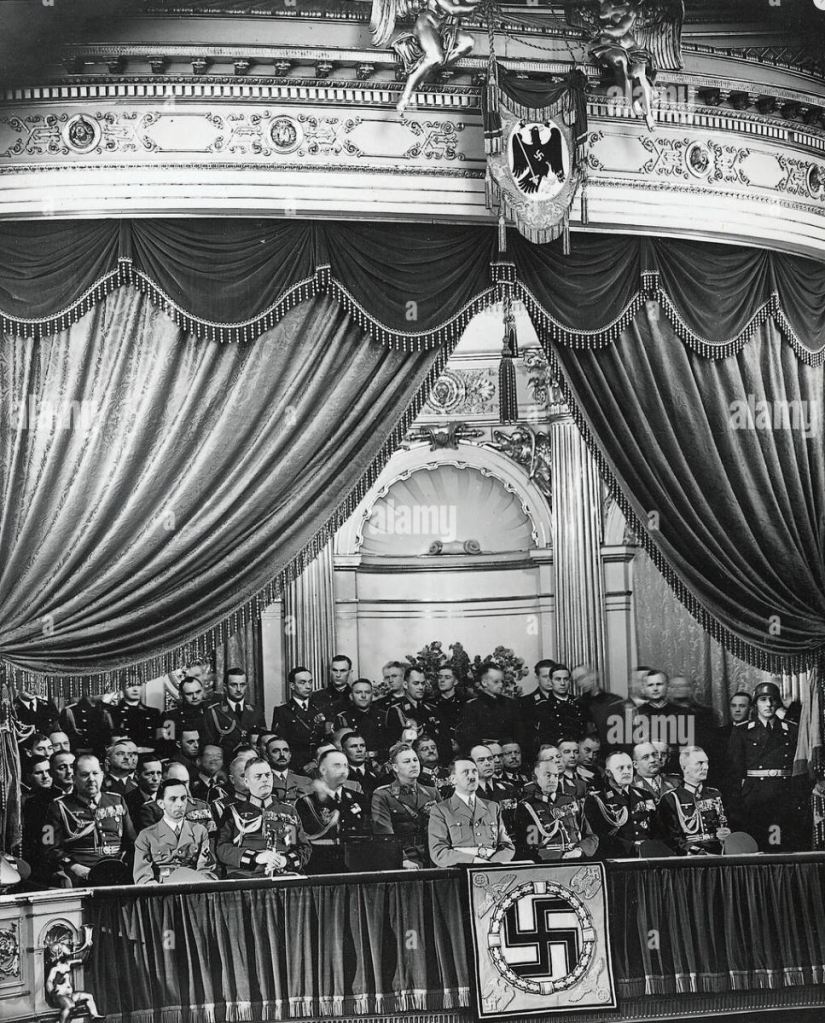
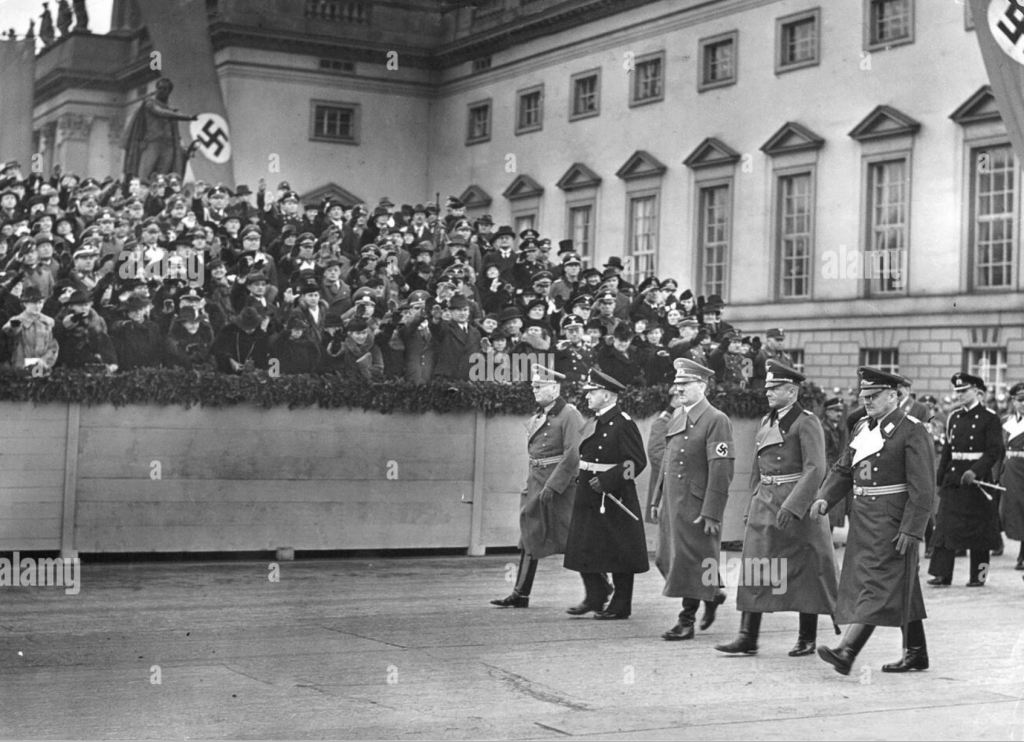
For the first time Hero Commemoration Day in Berlin is combined with the celebration of the freedom to rearm.
The commemoration of the 20th anniversary of the American Legion will include an unveiling of a tablet in Paris.
Rumors had reached the Lithuanian government to the effect that Germany had specific plans to take over Klaipėda. On 12 March 1939, Foreign Minister Juozas Urbšys represented Lithuania at the coronation of Pope Pius XII in Rome. On Urbšys’s return to Lithuania, he stopped in Berlin with the hope of clarifying the growing rumors. On 20 March, just five days after the German occupation of Prague, German Foreign Minister Joachim von Ribbentrop agreed to meet Urbšys but not the Lithuanian Ambassador to Berlin, Kazys Škirpa, who was asked to wait in another room. The conversation lasted for about 40 minutes.
Ribbentrop demanded the return of Klaipėda to Germany and threatened military action. Urbšys relayed the verbal ultimatum to the Lithuanian government. Because the ultimatum was never set down in writing and did not include a formal deadline, some historians downplay its importance and describe it as a “set of demands”, rather than as an ultimatum. However, it was made clear that force would be used should Lithuania resist, and Lithuania was warned not to seek help from other nations. A clear deadline was not given, but Lithuania was told to make a speedy decision and that any clashes or German casualties would inevitably provoke a response from the German military.
Jewish delegates to the Palestine conference made a new and unsuccessful attempt tonight to induce the British Government to modify the restrictions upon immigration contained in its proposed plan of settlement.
The first British “suggestions” two weeks ago did not mention immigration, but the plan that the British will submit to the Jews and the Arabs at the conference this week is understood to restrict immigration to a definite figure. According to some sources, the quota will be 10,000 annually for the next five years. The Jewish delegates urged tonight that such a restriction would “freeze” the number of Jewish. settlers at the present level and destroy the meaning of a national home. But Colonial Secretary Malcolm MacDonald refused to make any changes.
A large-scale battle raged today between British forces and an Arab band near Zemal, in neighboring Trans-Jordan. Forty-five casualties were counted late today among the Arabs, who were reported to have entered Trans-Jordan several days ago from Syria. In Jerusalem fifty-eight terrorists were arrested in a round-up near the Jerusalem-Jaffa Railway.
The transmission to Congress by President Roosevelt of a request for an additional $150,000,000 for relief during the current fiscal year is expected to precipitate a new economy fight which may develop into the sharpest of the present session. It is expected that Mr. Roosevelt’s request will be sent to Capitol Hill tomorrow or by midweek at the latest.
There have been sporadic economy battles over specific items in appropriation bills already enacted or pending, but since Congressional action on the Relief Act of 1939 was completed on February 2, the broad issue of economy as a basic policy has been dormant. It flared up momentarily on February 7 when President Roosevelt, in signing the act, somewhat curtly demanded immediate consideration of the restoration of the $150,000,000 which Congress had cut from his original estimate of $875,000,000, but there was no legislative action on this demand and little public discussion of it ensued.
Behind the scenes, however, the proponents and opponents of greater spending for relief during the present fiscal year have been active. This, it is understood, has been particularly true of the supporters of the Administration’s policies. Members of Congress report that they have been receiving large numbers of letters from constituents urging them to support the larger relief appropriation. In many instances, it was said, activities of the Congress of Industrial Organizations, the Workers Alliance and similar organizations have inspired the communications.
As a result, it was generally conceded that Mr. Roosevelt has a better chance this time to get the $150,000,000 he is expected to ask than he had earlier in the session when the economy forces in the Senate and House succeeded in cutting that amount from the sum he asked on the grounds that “emergency” conditions required it. The success of the new request, it is believed, will depend largely upon whether Mr. Roosevelt can convince Congress that an emergency exists now.
Spurred on by President Roosevelt’s “big stick” and the indication that an additional 1,500,000 members of AFL and CIO unions want peace, the joint committee of the two groups will meet. again at 10 AM today to resume deliberations. Hovering over the peace conferees are the unqualified statements made to them last Tuesday by President Roosevelt. It became known yesterday that the President’s textual statement, as made public at the White House, was a mild version of what he really said.
At the conference, it was reported, the President emulated his White House predecessor and used a “big stick” in the form of a distinct threat that peace must be made if the labor movement is to escape from something worse than war. What that something was he did not indicate. Some of those at the meeting gained the distinct impression that Mr. Roosevelt would give the conferees as much time and as much leeway as possible and that he was prepared to place every bit of machinery in any Federal service at their disposal. If, however, it appears at the end that the conferences are doomed to collapse he will probably step in with a proposal of his own.
The papal rites are heard on the radio by U.S. listeners.
Senator Key Pittman of Nevada introduces a bill that would allow the President to sell naval vessels and arms to any American republic.
An opinion poll shows U.S. citizens willing to provide food and military supplies to France and Britain, but 83 percent draw the line at sending troops.
With children from kindergarten to high school age in storm troop and Hitler youth uniforms and the older ones marching and heiling with mechanical precision to the delight of the 1.000 parents and friends who looked on, the Jugenudschaft des Amerikanischdeutchischen Volksbundes, youth division of the German-American Bund, held its annual festival last night at Prospect Hall in Brooklyn, New York. The boys, resplendent in shiny black Sam Browne belts, and the girls, looking like so many Bruennhildes, all with their hair parted in the middle and the two braids done up in knots on the backs of their heads, went through their program under police protection.
Scientists note that excessive cigarette smoking causes nausea.
Crime soars in Shanghai. Much of it is protected by the Japanese and their puppet Chinese authorities, to whom the criminal operators of gambling establishments, opium dens, and house of prostitution pay tribute.
Japanese troops began advancing from Hupeh (Hubei) Province, China toward Nanchang, Jiangxi Province, China. The Japanese advance their offensive in Hupeh and report 3,500 Chinese dead in two weeks of fighting.
Born:
Johnny Callison, MLB outfielder (All-Star, 1962, 1964, 1965; Philadelphia Phillies, Chicago Cubs, New York Yankees), in Qualls, Oklahoma (d. 2006).
John Paul Sr, Dutch-American auto racer (24 Hours of Le Mans 1978; 24 Hours of Daytona 1982; 12 Hours of Sebring 1982), in Netherlands (disappeared 2001).
 History Diaries