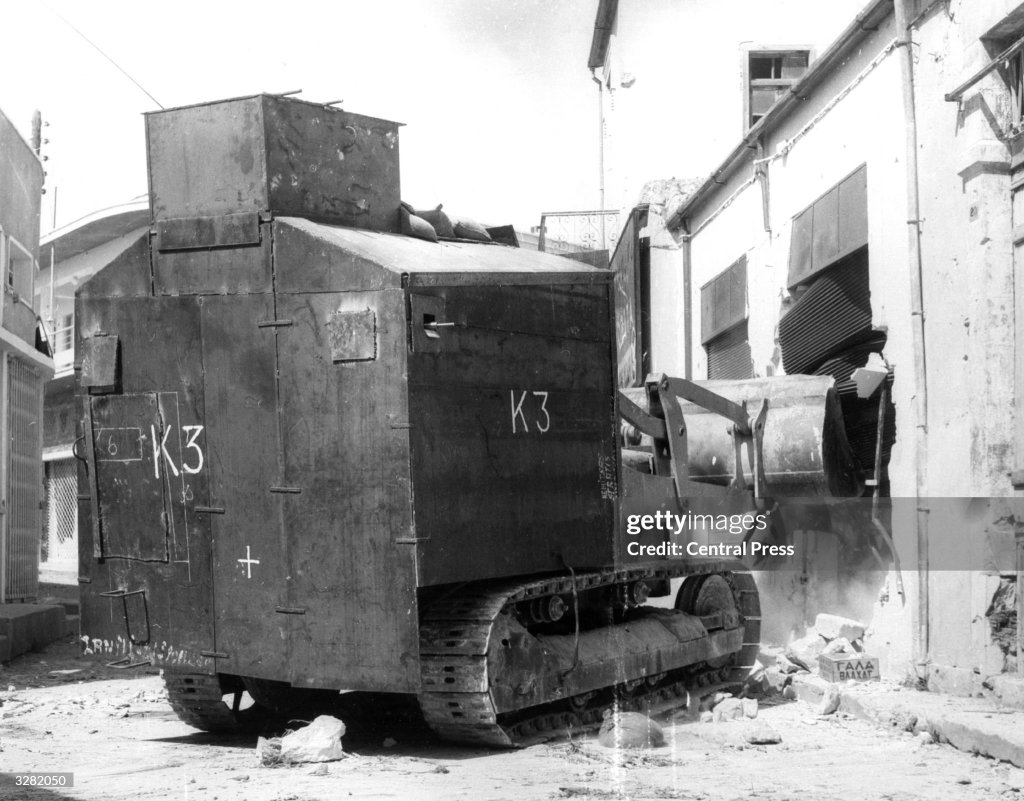
Indications were in evidence tonight that major violence involving British, Turkish and Greek and Turkish Cypriote forces could erupt shortly. The Greek Cypriotes told the British yesterday that they no longer recognized the “greenline” agreement. That refers to the twisting truce line that wanders through the northern suburbs of Nicosia and bisects the old city. It was established to separate the Greek and Turkish communities after violence between the two broke out last December. Along the line, and for 100 yards on each side of it, the British truce forces are empowered to fire in self‐defense and against any organized armed incursions or infiltration. They are said to have warned that they will do so.
The Turkish Government warned that it would intervene and protect Turkish Cypriotes unless the United Nations sent a peace‐keeping force to the island soon.
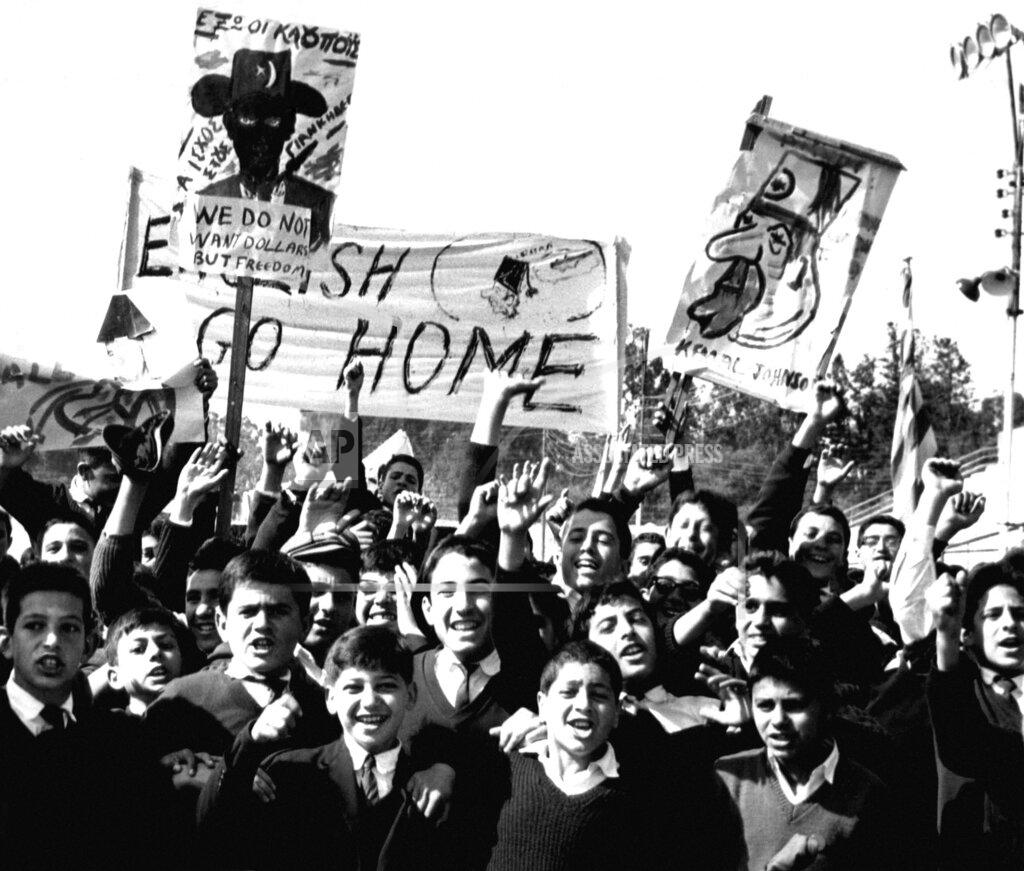
Several thousand Greek Cypriote secondary school students demonstrated today against Britain and the United States and in favor of President Makarios of Cyprus and General George Grivas. General Grivas was the leader of the Greek Cypriote guerrillas who fought British colonial rule. The car of Sir Arthur Clark, British High Commissioner, was surrounded by 200 students who shouted insults at him as he was on his way to see Archbishop Makarios to discuss the critical situation. Makarios apologized for the incident. As the crisis seemed to worsen hour by hour, Vice President Fazil Kutchuk, leader of the Turkish community, sent another appeal for help to the United Nations Secretary General, U Thant, and to the foreign ministers of Greece, Turkey and Britain. The conflict between the two communities stems from Greek Cypriote efforts to change the island republic’s Constitution. The Turkish Cypriotes, outnumbered four to one, are fearful that the change would undermine their rights and safeguards.
In the treaty of 1960 that gave Cyprus independence from Britain, the Governments of Britain, Turkey and Greece were given the right to intervene to maintain the status quo on the island. Turkey has threatened to use that right to protect the Turkish Cypriotes. The green‐line agreement was signed by the British, the representatives of Greece and Turkey and the leaders of the Turkish and Greek Cypriote communities. Its denunciation by the Greek Cypriotes has precipitated frantic military preparations on all sides in the last 24 hours. It is understood that the British have told the Greek Cypriote authorities that British forces have orders to shoot to kill if Greek Cypriotes advance into the green‐line area. The Turkish Army contingent, nominally a part of the tripartite truce force, is prepared to use force to preserve the green‐line agreement, which applies only to the greater Nicosia area. Units of the 900-man contingent, based north of Nicosia on the road to Kyrenia, have moved close to the capital.
Informed circles believe that the Greek Cypriotes are planning military action to cut the Kyrenia road, now held by the Turks and Turkish Cypriotes. The Greek Cypriotes are in Trachonas, just north of the city. The green line there separates Trachonas from the Kyrenia road. In Trachonas, along the edge of the green line area, the normal security complement of 40 Greek Cypriotes has been increased by at least six times, according to reliable sources. The southern edge of Trachonas meets the northern edge of an area held by Turkish Cypriotes. British paratroopers there have installed three antitank guns loaded with antipersonnel shells. The guns all point toward the Greek Cypriote positions in Trachonas. Another indication of the situation’s gravity was an order placing the old walled city out of bounds to Royal Air Force personnel from the British base outside Nicosia. Service families outside the base are confined to their homes after duty hours. Families inside the base area are not permitted to leave it.
British forces in the Turkish quarter in Kazaphani village, near Kyrenia, were given a Greek Cypriote ultimatum today that was later withdrawn. The British troops are in Kazaphani to guard the Turkish Cypriotes who surrendered yesterday to Greek Cypriotes. According to the Britons, the ultimatum said they were to get out of Kazaphani by 3 PM today or face the consequences. Greek Cypriote officials said the British were told that they could stay in the village but could not patrol in it. In any case, the British were at battle stations with automatic weapons and bazookas. The matter is now up for discussion, according to the Greek Cypriotes.
The United States and Britain decided today to contribute half the money required to maintain the proposed United Nations peacekeeping force in Cyprus for three months. Previously the United States offered to supply an airlift but refused to make a monetary contribution. According to reliable sources, the United States has now agreed to pay $2 million toward the $6 million it will cost to maintain, the 7,000‐man force. Britain, these sources said, has offered to pay $1 million plus the expenses of the 3,000 to 3,500 British soldiers now stationed in Cyprus who are to be incorporated in the force.
President de Gaulle intervened in the Cyprus crisis today by suggesting a change in the island’s constitutional arrangements. France’s leader said he did not believe that Turkish and Greek Cypriotes could form a single nation. This statement was interpreted by some diplomats as an indication that the general was thinking of repatriation of the Turkish minority as a solution. The President, according to Alain Peyrefitte, Minister of Information, believes that the present “statute,” meaning the Zurich agreement of 1959 and the present constitution, are “the origin of the troubles there and that consequently the solution is to change the statute.”
Mr. Peyrefitte, outlining the general’s views, said, “The island should not be locked up within a statute which creates a hybrid situation and which consists in establishing a country of both Greeks and Turks who do not seem to be made to constitute one nation together.” The statement, made after a Cabinet meeting, offended diplomats of those Western countries most involved in finding a solution of the island’s problem. They found the French suggestion “unhelpful” and “a disservice” to the United Nations effort toward peace on Cyprus, where there have been new outbreaks of fighting between Greek and Turkish Cypriotes. “If the French have anything constructive to offer,” one source said, “let them produce it. Otherwise, it would be best for them to keep quiet.”
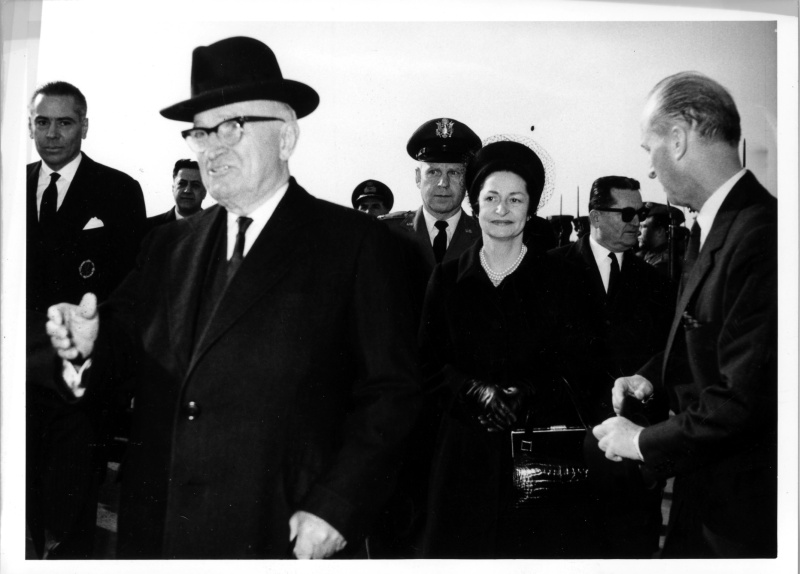
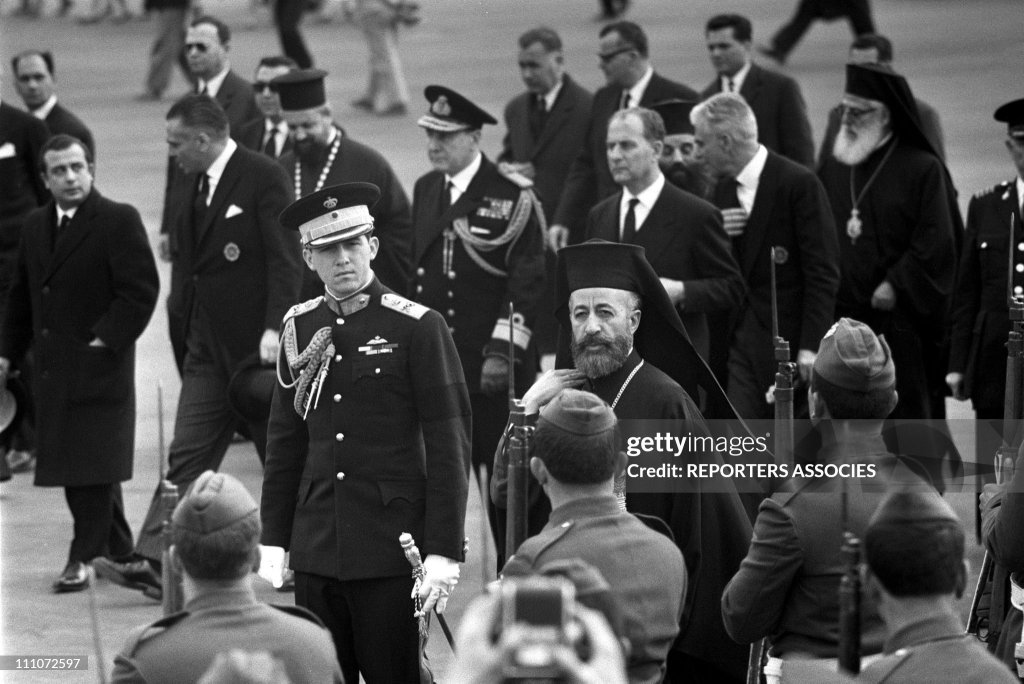
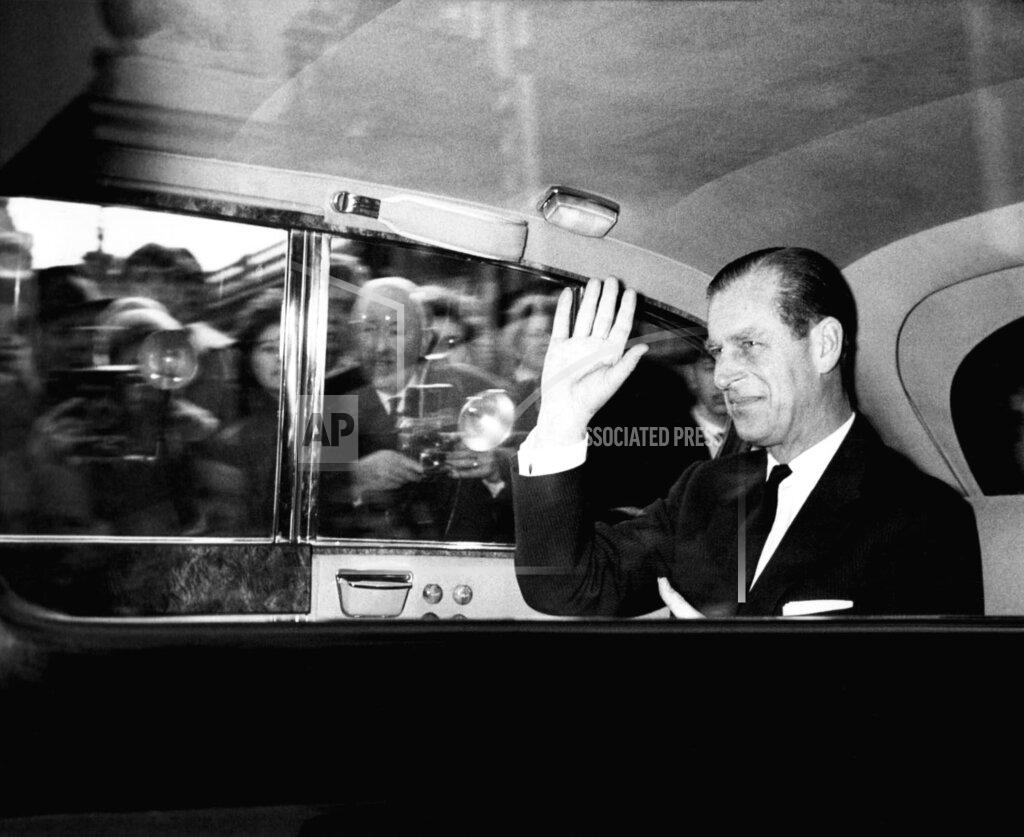
Monarchs, presidents and premiers from many nations gathered in Athens tonight to do honor to King Paul of the Hellenes, who died last Friday. Among the first arrivals from abroad were the members of the United States delegation led by Mrs. Lyndon B. Johnson and former President Harry S. Truman. Thousands of Athenians gathered before major hotels and watched the coming of the notable men and women who will attend the funeral tomorrow. Other thousands filed by the bier in Athens Cathedral, where the body lay in state. The service will be at 10 AM, in the presence of King Constantine, son and successor of Paul, and his mother, Queen Frederika.
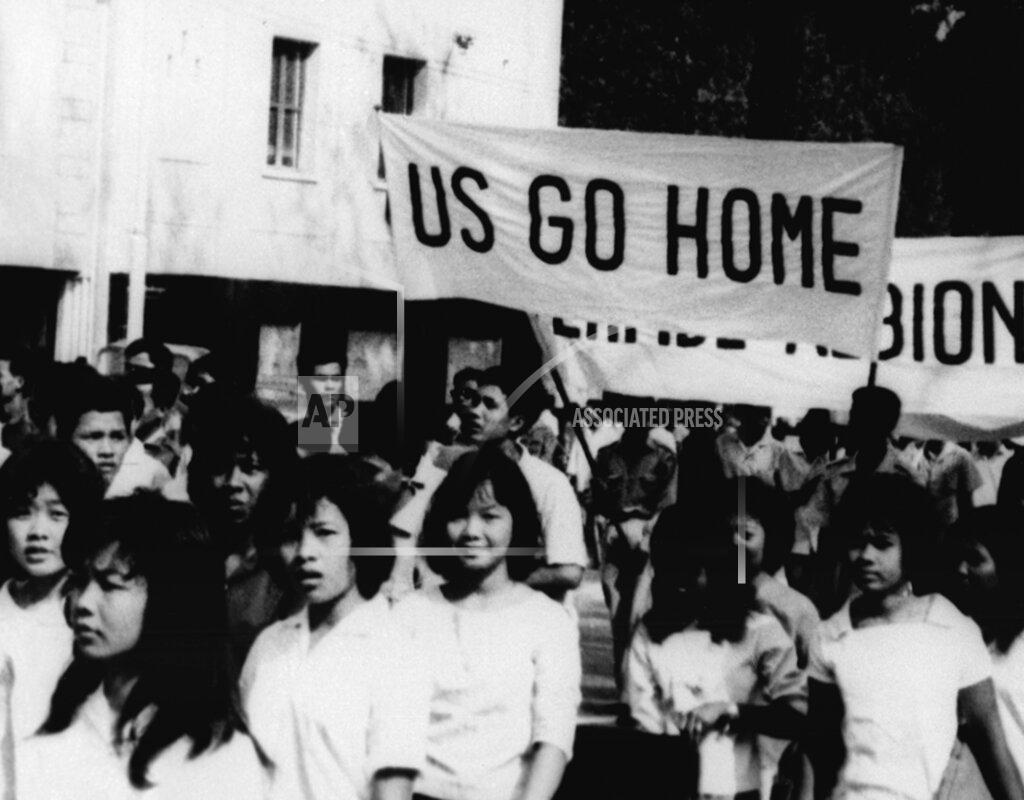
Prince Norodom Sihanouk Cambodia’s chief of state, expressed regrets today for the sacking of the United States and British Embassies and their information offices today in a three-hour riot. In Washington the United States protested the attacks both orally and in writing. While expressing regret, the Cambodian leader kept up his feud with the United States, saying he understood why the people “might be angry at the imperialists.” He announced that he was abandoning a plan for a four-power conference to guarantee Cambodia’s frontier. The prince proposed such a conference last month in what he called an effort to compromise Cambodia’s differences with Washington.
Thousands of Cambodians took part in the attacks on the United States and British offices in Phnom Penh early in the day. Breaking through police lines, the demonstrators hauled down and burned the flag over the United States Embassy and scattered embassy papers in the streets. British Embassy cars were burned and some United States Embassy cars were overturned. But personnel of both embassies escaped unhurt. Rioters also wrecked the building of the British Council, a private group promoting cultural interests abroad. The United States chargé d’affaires, Herbert D. Spivack, and the British Ambassador, Peter Murray, protested immediately.
The crowds marched to embassy row shouting “U.S. go home!” “Down with imperialists!” “Down with the free world!” and “Perfidious Albion!” (England). They appeared well organized as they overflowed Boulevard Norodom. The crowds hurled rocks at the United States Embassy, in the heart of Phnom Penh near the Central Market. Then, as police barriers gave way, the crowds surged into the ground floor of the Embassy, wrecking it and scattering official papers. Outside, demonstrators put a ladder against the building, climbed up and took down the United States flag. The flag was burned and the flag of Cambodia was raised in its place.
The Soviet Government charged today that a United States Air Force reconnaissance plane shot down over East Germany Tuesday had been “carrying out military reconnaissance.” A Foreign Ministry note protested the flight as a “premeditated provocation.” It said the plane, a Douglas R.B‐66 twin-engine jet, had crashed near the town of Gardelegen, 16 miles inside East Germany, “after the Soviet armed forces took the necessary measures for the safeguarding of the airspace.” Witnesses in East Germany stated that the three crewmen of the RB‐66 had parachuted safely, Reuters said. In Washington, Government sources denied that the plane had been on a reconnaissance mission.
Raúl Leoni was inaugurated as President of Venezuela, becoming “the first democratically elected president of Venezuela to succeed another so elected.” Delegates from 50 nations were on hand in Caracas to watch outgoing president Rómulo Betancourt hand over the presidential sash to Leoni at the end of Betancourt’s five-year term.
President of Finland Urho Kekkonen left Poland and began a state visit to the Estonian SSR in the Soviet Union as the guest of General Secretary Leonid Brezhnev. It marked the reopening of relations between Finland and the USSR.
The Trident jet airliner made its first commercial flight, flying from London to Copenhagen for British European Airways (BEA). Regular service would begin on April 1.
Senator Allen J. Ellender acknowledged today that registrars in some parts of the South kept Blacks off the voting rolls by the discriminatory use of literacy tests and application forms. This practice is what Title I of the civil rights bill is designed to prevent. On the third day of the Senate debate on the House‐passed bill, Mr. Ellender, Democrat of Louisiana, said that in some counties where Blacks outnumbered whites “there is little or no registration” of Blacks because the whites feared they would be “outvoted.” This acknowledgment of discrimination came during an exchange with Senator Hubert H. Humphrey of Minnesota, the assistant Democratic leader, who is the floor manager for the bill.
It marked the first success for the strategy decided upon by the leaders of the bipartisan civil rights coalition. This strategy calls for refusing to allow the Southerners to talk hours on end without challenge. It is customary for Senators holding the floor to yield for questions. In midafternoon Mr. Ellender was reading a long speech in an almost inaudible voice before a virtually empty chamber. He declared the voting rights section would have the effect of reactivating the voting laws that he said Congress fastened upon a prostrate South in Reconstruction and then repealed in 1893.
Title I would require that literacy and other voter tests be given to both whites and Blacks in the same way and judged by the same standards. It would require that literacy tests be in writing except where the applicant requests, and the state law permits, an oral test. Copies of the questions and answers, whether oral or written, would have to be made available to the applicant on request. The section would also prohibit the disqualification of Blacks for immaterial errors and omissions on application forms.
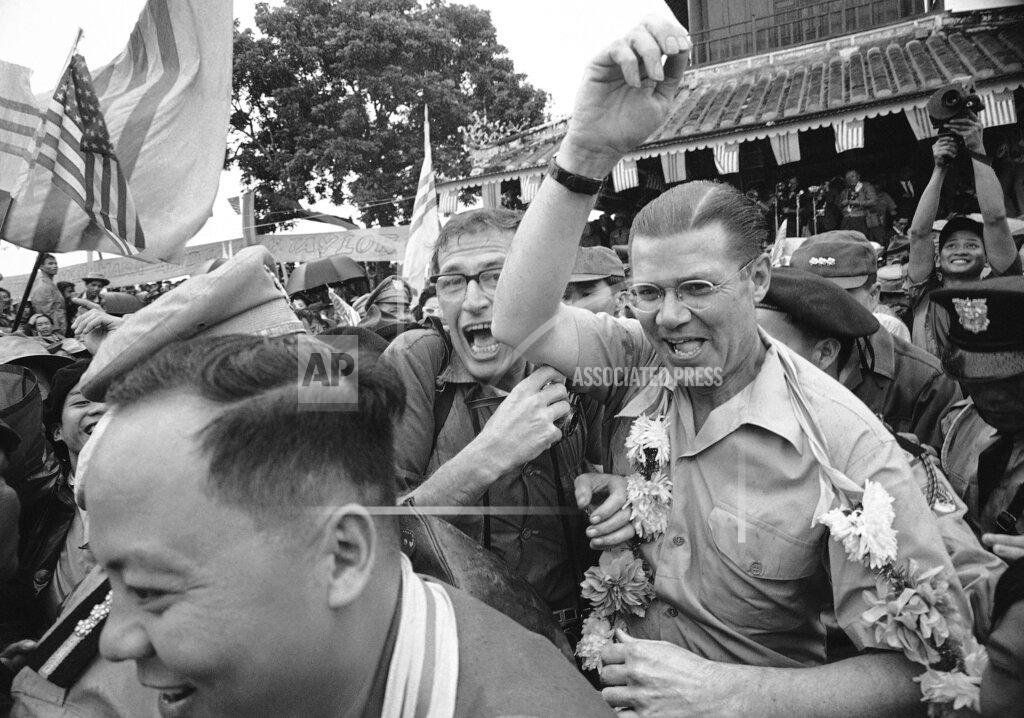
U.S. Ambassador to South Vietnam Henry Cabot Lodge, obviously delighted by his victory in the New Hampshire Republican Presidential primary, said today that he had been accorded a great honor. Mr. Lodge said his position as envoy to South Vietnam forbade his talking politics but that a statement would be made on his behalf in New England. Grinning broadly and waving to newsmen, Ambassador Lodge looked like a candidate although he stated that he was not resigning or leaving South Vietnam.
Mr. Lodge received the news that he had triumphed over Senator Barry Goldwater and Governor Rockefeller upon his return from a political barnstorming trip to Huế, the former imperial capital in north central Vietnam. Mr. Lodge was not garnering votes for his party. He was out with another Republican, Secretary of Defense Robert S. McNamara, both working for a Democratic Administration, rallying Vietnamese for the fight against Communist Việt Cộng insurgents. Mr. McNamara, in a speech before some 15,000 Vietnamese at the Phu Văn Lâu Palace in Huế, appealed for support for Major General Nguyễn Khánh, Premier of the Saigon Government.
The political pros are now betting on Governor William W. Scranton of Pennsylvania, former Vice President Richard M. Nixon or Ambassador Henry Cabot Lodge of Massachusetts for the 1964 Republican Presidential nomination. They seem to agree that Ambassador Lodge’s spectacular write‐in victory in the New Hampshire primary election yesterday virtually eliminated both Senator Barry Goldwater of Arizona and Governor Rockefeller of New York. At the same time, they expect Senator Goldwater to retain sufficient strength in a deadlocked convention to transfer about 250 delegate votes, most of them from the South, to the man of his choice and thus decide the issue — probably in favor not of Ambassador Lodge but of Mr. Nixon or Governor Scranton.
Senator Barry Goldwater looked today to the California primary June 2 as a major test of his Presidential chances and to the Oregon primary May 15 as the test of Henry Cabot Lodge’s national appeal. Mr. Goldwater and his major advisers do not regard Mr. Lodge as their most dangerous foe despite his victory in New Hampshire yesterday. They continue to believe that former Vice President Richard M. Nixon will be the man “to contend with” at the Republican National Convention July 13. However, this assertion will be tested in Oregon’s primary, in which Mr. Lodge’s name is entered. Mr. Goldwater said today of the New Hampshire result that “apparently” a lot of voters “felt they could not vote for Rockefeller or me, so they voted for Lodge.” He added that “the Lodge name is a difficult one to cope with in New Hampshire.”
The Senate Rules Committee ended its investigation of Robert G. “Bobby” Baker today. However, Republican members of the group have protested. They have submitted a list of about 12 additional witnesses who, they said, should be questioned. Lennox P. McLendon, chief counsel for the committee, said any additional testimony would be repetitious. He apparently spoke for the chairman, Senator B. Everett Jordan, Democrat of North Carolina.
But Senator Hugh Scott, Republican of Pennsylvania, warned: “If the majority on the committee, in defiance of the rights of the minority, seeks to impose a gag upon us, I will, speaking personally, be forced to carry the fight to the Senate and to the court of public opinion.” Senator Carl T. Curtis of Nebraska, ranking Republican on the committee, submitted the list of additional witnesses. Their names could not be learned except that of Walter Jenkins. Mr. Jenkins is on President Johnson’s staff.
The House opened a fight today over $544 million in pay raises for 1.7 million Federal employes, including members of Congress. Opponents of the $10,000 Congressional pay increase challenged their colleagues to make their decisions by answering a roll call, rather than with a shouted voice vote. For a while appeared that this would be the main vote, but many other proposals were before the House. The increases are backed by the Administration. Speaker of the House John W. McCormack, Democrat of Massachusetts, gave his support openly. Representative Carl Albert of Oklahoma, the Democratic floor leader, made the opening speech in support of the raises. He gave emphasis to Congressional pay.
The House Committee on Science and Astronautics approved virtually intact today the major portions of the $5.3 billion civilian space budget requested by the Administration. A cut of only $41.6 million was made in the $3.4 billion asked for the manned space flight program. The proposed $878 million budget for the space sciences program was reduced $34.6 million by the committee. Still to be acted upon by the committee is a $900 million item in the space agency budget for advanced research and technology. The committee is expected to approve this item later in the week with only minor reductions. The reductions were far less than those imposed by the committee last year, when it lopped some $500 million from the budget of the National Aeronautics and Space Administration.
The U.S. Coast Guard’s extensive fleet modernization program was given impetus last week when the Senate approved authorization of $93,299,000 in vessel procurement and construction for the fiscal year that begins July 1. The measure now goes to President Johnson. The service announced earlier this year a 10‐year program, the first phase to include 38 major ships to replace vessels built in the late 1920’s and the early 1930’s. Among the new vessels will be a 350‐foot cutter — the longest ever constructed for the 174‐year‐old arm of the Treasury Department.
Gene Roddenberry wrote a 16-page proposal for a science fiction television show that he tentatively titled “Star Trek”.
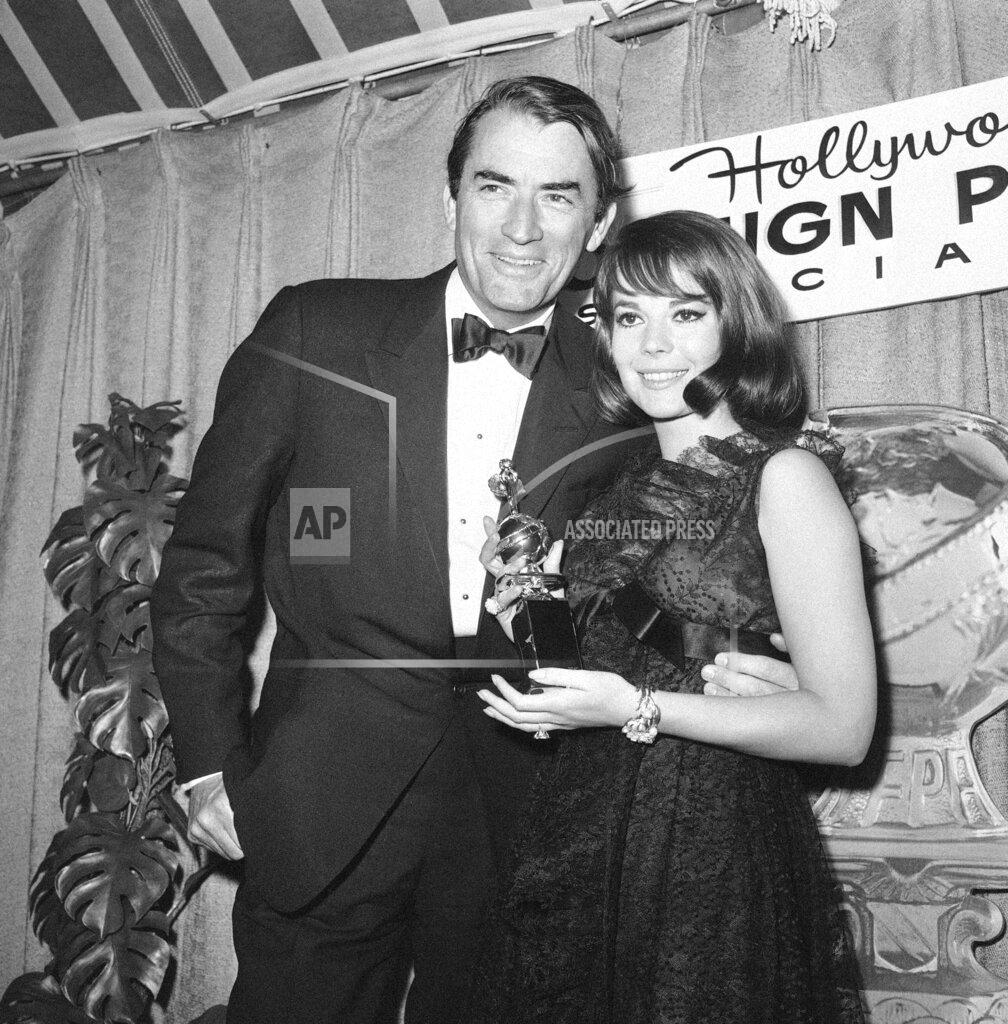
At the 21st Golden Globe Awards, award-winners included “The Cardinal,” Sidney Poitier, Leslie Caron and Elia Kazan.
Dow Jones Industrial Average: 813.87 (+4.48).
Born:
Raimo Helminen, National Team and NHL forward (Olympics, Team Finland, silver medal, 1988; bronze medals, 1994, 1998; New York Rangers, Minnesota North Stars, New York Islanders), in Tampere, Finland. Helminen’s appearance at the 2002 Olympics made him the first ice hockey player to compete at six Olympics.
Thad Jefferson, NFL linebacker (Houston Oilers), in Ontario, California.
Vincent Alexander, NFL running back (New Orleans Saints), in St. Tammany, Louisiana.
Paul Migliazzo, NFL linebacker (Chicago Bears), in Kansas City, Missouri.
Emma Chambers, British actress (“The Vicar of Dibley”, “Notting Hill”), in Doncaster, England, United Kingdom (d. 2018)
Shane Richie, British actor (“EastEnders”, “Flushed Away”), in Harlesden, London, United Kingdom.
Vinnie Paul, American drummer (Pantera), in Abilene, Texas (d. 2018).
Leena Lehtolainen, Finnish crime novelist, in Vesanto, Finland.
Died:
Cleo Madison, 80, American silent film actress.
 History Diaries