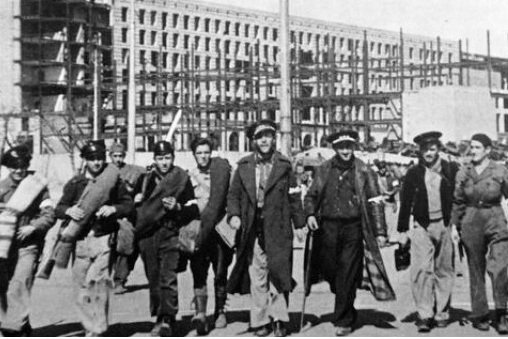
A Communist revolt in Madrid ends with surrender by the communists. Madrid Communists picked as their stronghold of resistance today an unfinished massive red brick building at the top of Paseo de la Castellana, where the government had been raising a huge office building on the site of the old Hippodrome (race track). Bombs from General José Miaja’s planes left gaping holes in the walls, just as Nationalist bombs have blasted the magnificent unfinished buildings in University City on the western outskirts since the siege of Madrid started in November, 1936. General Miaja’s Cabinet met in continuous session. Republican radio reports said Communists were surrendering in increasing numbers at Barrajas and Canillejas.
Madrid residents were kept indoors all day, unable to replenish their larders, while rival bands of Communists and troops loyal to the Republican cause swept the streets with rifle and machine-gun fire. General José Miaja, head of the Defense Council, and Colonel Casado brought more loyal battalions from the front-line trenches in the morning, when firing in the northeastern quarter of the capital heralded the new Communist uprising. Tanks, armored cars, and airplanes again went into action, while Generalissimo Francisco Franco’s forces looked on from their trenches. Imprisoned in their houses, Madrid’s civilians were entirely dependent for news on the radio, which remained in General Miaja’s control. Early in the afternoon they learned the Communists’ headquarters had been located near Canillejas on the main road to Guadalajara. The voice over the radio added: “Troops loyal to the Defense Council, with abundant war material, are marching on Canillejas.” Apparently there was a brief engagement on Barrajas Airfield.
At 9:30 tonight the National Defense Council’s radio announced that Communist headquarters at Canillejas, about three miles northeast of Madrid, had surrendered and 1,400 prisoners had been taken after the third Communist uprising in three days. Earlier, over the radio, Defense Minister Segismundo Casado had given a grave warning to the Communists, who in the morning made another attack in Madrid. He declared the council had finished with indulgent measures. “The troublemakers,” he said, “are representatives of folly. They are irresponsible persons and must be treated as such. We intend to impose discipline with all necessary rigor. “We would like to have treated these troublemakers as brothers. and fighting comrades and as Spaniards, but they no longer deserve the name.”
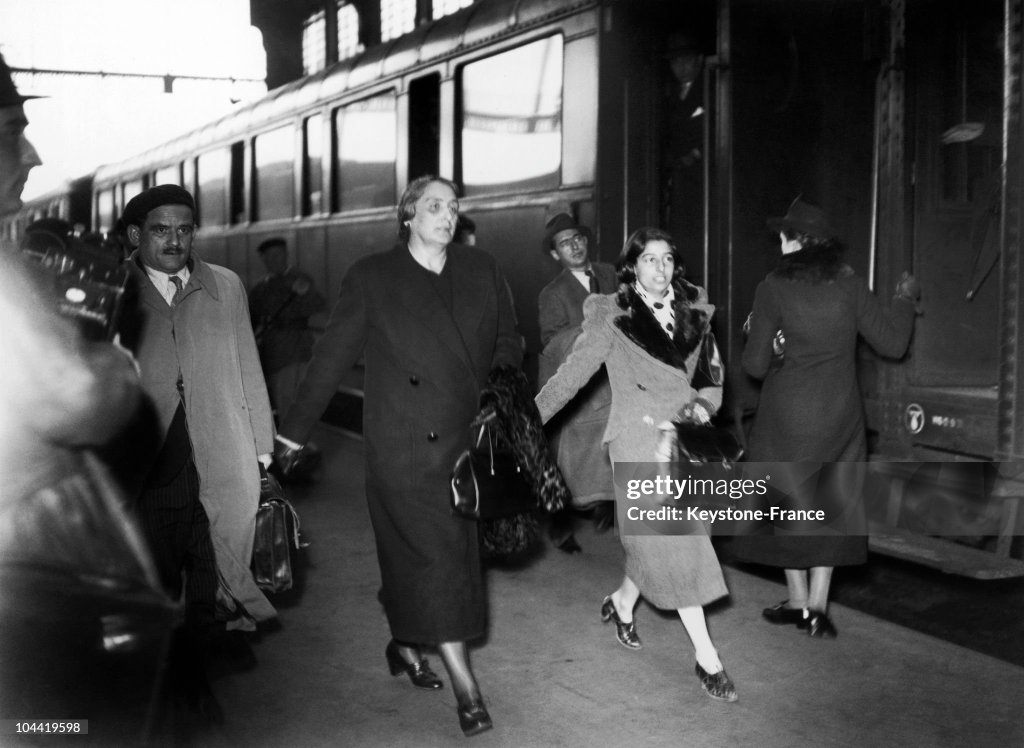
Paris asks the Spanish Communist leader La Pasionaria to leave the area.
Franco blocks all Republican ports, and orders warships to sink all entering craft, regardless of how they are registered.
Britain warns that ships will resist attempts to sink them at blockades around Spain. Viscount Halifax served peremptory notice on the newly recognized Franco regime today that British warships would see to it that there was no interference of any kind with British ships on the high seas whatever the terms of its “sink at sight” blockade of Republican Spain.
“I wish to make it plain that if action outside territorial waters were taken His Majesty’s government would be obliged to resist such action in the same way as it has done in the past,” the Foreign Secretary told the House of Lords. “I must also make it quite plain that His Majesty’s government would regard as a very serious matter the sinking of a British merchant vessel even within territorial waters, especially if due warning was not given and adequate steps taken for the safety of the crew.”
Czecho-Slovakian President Emil Hácha suspended Jozef Tiso’s Slovakian government and placed Slovakia under martial law. President Hácha of Czecho-Slovakia this morning dismissed Dr. Tiso as Premier of autonomous Slovakia, following reports that radicals within the Slovak Cabinet wanted a government under German protection. Dismissed with Dr. Tiso were Economics Minister Jan Pruzsinski and Labor Minister Ferdinand Durciansky. Dr. Hacha named Josef Sivak to succeed to the Premiership. Hácha ordered the arrest of Slovakian political leader Jozef Tiso. Premier Tiso appealed to the Germans for assistance and traveled to Berlin to confer with Chancellor Adolf Hitler.
An official statement early this morning declared that during the last few days the chief of the Slovak Propaganda Office, Sano Mach, with the aid of unruly elements had taken advantage of weakness of the Tiso government to start a propaganda campaign directed against the unity of the Czecho-Slovak Republic, with the idea of an independent Slovakia. Slovakia, since the Munich agreement last September, has had an autonomous administration in local matters, but the Czecho-Slovak national regime at Prague controlled the administration of international dealings.
[Ed: So begins the final crisis of pre-war Czecho-Slovakia, encouraged and planned by Hitler, in furtherance of his own plans for the destruction of that nation and annexation into the Reich. And so also, soon begins the end of Chamberlain’s foolish dreams of appeasement. The countdown to war has begun.]
It became known today that such optimistic reports of the general international situation had been received in British Government quarters that the possibilities of disarmament talks before the Summer is out were being discussed. This was disclosed barely after the dying down of the applause that had greeted an announcement in the House of Commons by Sir Kingsley Wood, the Secretary for Air, that Britain’s vast air rearmament machine was running ahead of schedule at a cost of something like £250,000 daily.
The government spokesman who circulated the information on disarmament privately qualified his forecast of the nearness of a conference with the remark “If all goes well,” by which he was understood to mean that by the Summer there must have been a satisfactory end to the Spanish civil war and termination of the continual “bickering” between Italy and France. Consciousness of the swift growth of Britain’s armed strength is not the only cause of the optimistic feeling that in some quarters is said to have spurred Prime Minister Neville Chamberlain to call a disarmament conference at the first opportunity.
[Ed: One can hardly choose between laughter and tears. The timing of this is so appalling bad. Within a week, any hopes of peace are merely ashes. Czecho-Slovakia will finally open Chamberlain’s eyes to the futility of trying to stop Hitler with words and paper.]
Since Mr. Chamberlain and Viscount Halifax, the Foreign Secretary, visited Rome, there has been increasing hope that Italy’s “unofficial” claims on France may not be as formidable as at first thought. No importance is now attached here to Italy’s “unofficial” claims to Nice and Corsica, and if discussions between Rome and Paris begin, Italy’s “natural aspirations” may prove to relate mainly to the position of Djibouti and the Addis Ababa-Djibouti Railway and to the status of the Italians in Tunisia. Generally, it is assumed that the governments of the principal European powers are now on closer terms of friendship than readers of the German press, for instance, would surmise from Propaganda Minister Joseph Goebbels’s recent writings in the newspaper Angriff that angered British parliamentarians.
Still in presenting his air estimates of £205,000,000 in the Commons today, Sir Kingsley Wood made no reference to the charges that Britain’s rearmament has now reached the scale of “offense, rather than defense,” and he confidently contended that Britain’s new aircraft were as formidable as any in the world, and that “in the new bomber and fighter types now being issued we possess what I believe are the best in the world.” Sir Kingsley, when mentioning aircraft production, spoke of it in multiples of an unnamed figure “in the public interest.” In addition, there was no mention of reserves when he said that the number of Britain’s first line aircraft would be 1,750 by April, with an additional 500 overseas. The metropolitan — home defense — air force, he added, would have 2,370 aircraft by April, 1940.
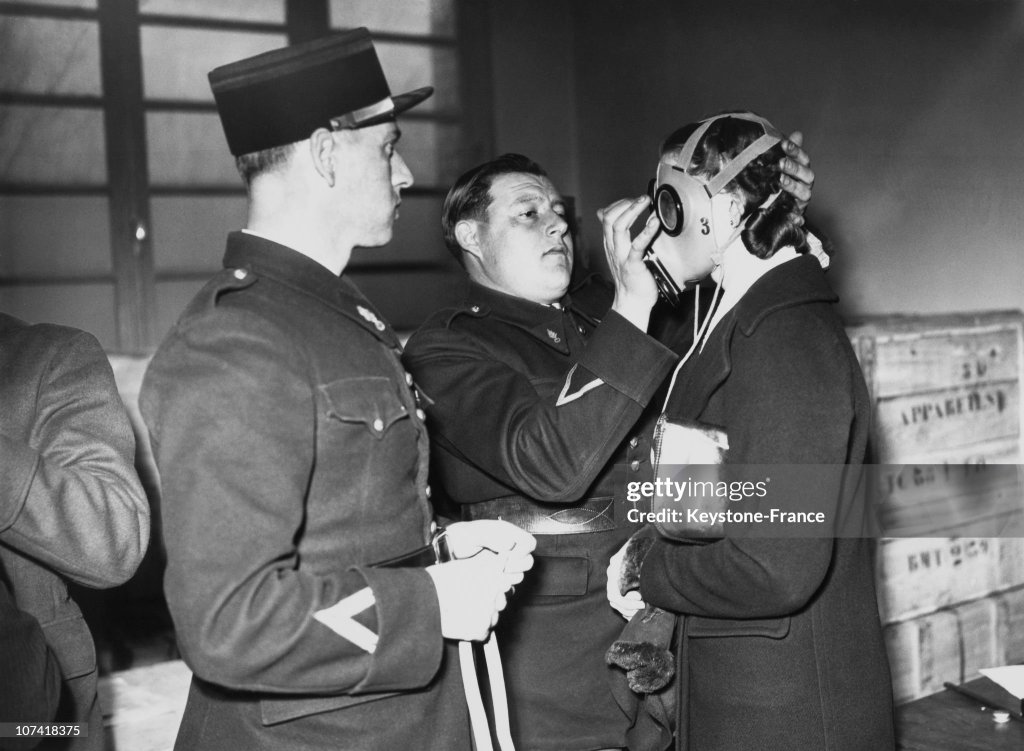
Apartment house and office notices summoned Parisians today to apply for gas masks. The first 200,000 masks were ready. Frenchmen failing to apply are subject to fines of 16 to 100 francs. Foreign residents are excluded from the distribution.
A project designed to increase the classes doing military service in France to total 621,000 men by 1941 by maintaining two-year service has been passed by the French Senate. Senator Jean Fabry, in submitting the measure, already adopted by the Chamber of Deputies, said it would permit the nation to call out 550,000 men next year, since the government needed at least 100,000 more men to counterbalance the large forces under arms in Germany.
The Nazis deny any threat to the Dutch and Swiss.
The Vatican rushes coronation plans for Pope Pius XII. A light miter is needed as the pope suffers from severe neuralgia.
Soviet Communists are to meet tomorrow in Moscow for the first party Congress since 1934. Stalin is expected to speak.
Italy reassures Britain that it has no intention to increase troops in Libya.
Iraq seizes 50 officers on charges of conspiracy to overthrow the government.
In Washington today, President Franklin Roosevelt discussed tax legislation with Secretary Morgenthau, Undersecretary Hanes, Senator Harrison and Representative Cooper. President Roosevelt sifts through ideas for tax cuts, and supports less spending, if possible. He received from George Rublee, director of the Intergovernmental Committee on Political Refugees, a report on progress made in arranging for emigration of Jews from Germany.
The only major controversy raised at today’s first meeting in Washington of the conferees seeking to compromise the differing versions of the Air Corps expansion bill passed by the Senate and the House concerned the Barkley amendment added by the Senate and intended to deny contracts. for national defense supplies to employers violating the National Labor Relations Act. The conferees came to tentative agreements on all of the differing items, except the following:
- The Barkley amendment.
- The top limit of 6,000 planes, substituted by the Senate for the 5,500 figure adopted by the House.
- The Tobey amendment adopted by the Senate which would permit the Treasury to recapture contractors’ profits exceeding 10 percent.
The discussion got no further than the Barkley amendment. Representative Andrews of New York read a memorandum criticizing the Senate proviso on several grounds. He said that he had received complaints from all over the country that the effects of the Senate change would be unfair and would hamper the prosecution of the national defense program.
He objected especially to what he considered the unlimited power vested in the heads of any government department connected with the national defense program to judge whether any prospective contractor was violating the Wagner Act by interfering with, restraining or coercing his employees in the exercise of their right to organize for collective bargaining. He took the position that the departmental head either would have to set up his own machinery for investigation, or accept blindly the findings of the National Labor Relations Board, and that, in any event, a manufacturer might be denied a contract without hearing and without opportunity for review.
Mr. Andrews told the conferees that the Barkley amendment was a “circuitous method” of amending the Wagner Act and that it should be considered by the labor committees of Congress along with other proposed changes in that law. He held that it tries to accomplish the same changes in the Walsh-Healy Act as were adopted by the Senate last year and died in the House Judiciary Committee because of opposition by the American Federation of Labor, after the Committee for Industrial Organization, now the Congress of Industrial Organizations, had endorsed them.
As result of the hotel strike of the city’s leading hostelries, the Washington Correspondents Association today canceled its annual banquet, at which President Roosevelt, his Cabinet, and high Administration officials were to have been guests of several hundred newsmen Saturday night. The association, composed of the active Washington newspaper men, called off the celebration, which was to have been its twenty-fifth, rather than force the President and Cabinet members to choose between crossing a picket line or rejecting invitations which they already had accepted, it was said. Labor Department conciliators said that they would try, at a meeting tomorrow, a new approach to a settlement of the strike. In view of the uncertain outlook, however, the association acted to avoid any possibility of embarrassment to the invited officials or any inconvenience to guests who were coming from distant cities.
Meanwhile, New Dealers in the executive and legislative branches with known pro-labor leanings were hard put to it for a decision whether to move out of their hotels to less conveniently situated apartments to risk criticism for remaining. A report that Senator Wagner, labor’s spokesman in the upper chamber, had avoided a picket line thrown around his hotel by entering a side door yesterday, went unconfirmed. At the Senator’s office it was announced that he had returned to New York “on urgent business.” On the House floor, Representative Clare E. Hoffman, Republican of Michigan, accused his New Deal colleagues of “sneaking” into their hotels to avoid being seen going through the picket lines of striking hotel workers. The downtown hotels’ clerical and other workers were pressed into emergency service. Bellboys hustled dishes away from luncheon tables. Stenographers and secretaries of hotel officials donned aprons to wait on tables. Short-order cooks were rounded up somehow. But the city’s cafeterias were doing a land-office business.
Representative Martin Dies, chairman of the Special House Committee to Investigate Un-American Activities, introduced in the House today three bills designed to curb the activities of organizations and individuals whose doctrines and practices were held to be inimical to the government of the United States.
One bill would require the registration with the Secretary of State of Communists, Fascists, and anti-racial and anti-religious groups, and the filing with the Secretary at stated intervals of information concerning officers, membership, finances and other activities of such organizations. Failure to register and file necessary statements would be made a penal offense.
A second bill would make Communists and Fascists ineligible for employment by the Government of the United States. Communists or Fascists seeking such employment would be required to file a statement with the Secretary of State disclosing their beliefs, and the penalty for failure to file such a statement would be imprisonment for not more than two years or a fine of not more than $1,000, or both.
The third bill would provide for the deportation of Communist and Fascist aliens.
An analysis of Bureau of Census figures shows that one of every nine employed persons in the nation is on a government payroll and that the annual earnings of this group total $5,400,000,000, or about one-eighth of all salaries and wages in the United States.
The figures were made public yesterday by the National Municipal League and are contained in a report to the league by Edward R. Gray and William R. Divine of the Census Bureau on “Income in the United States, 1929-37.” The figures do not include persons working on relief projects. Of the 3,800,000 public employees covered in the report, one-third are on federal payrolls, one-third employed in schools and educational systems and the rest holding miscellaneous Federal, State and municipal jobs. Between 1929 and 1937 the number of public employees increased 17.5 percent, while those in private employment declined 9.1 percent.
The House Judiciary Committee decided today to hear additional witnesses in connection with its consideration of the Thomas resolution looking into the impeachment of Secretary Perkins and two officials of her department. Acting upon the recommendation of a subcommittee headed by Representative Hobbs of Alabama, the committee summoned R. P. Bonham, district director of immigration at Seattle, and R. J. Norene, divisional director, to appear next week. It was said that Representative Dies, chairman of the House Committee Investigating Un-American Activities, also would be asked to appear. All are to be questioned in connection with the case of Harry Bridges, West Coast CIO leader, against whom a deportation action was begun by the Immigration Bureau, but was held in abeyance, pending decision of the United States Supreme Court in another deportation case.
The AFL agrees to discuss forming a Congress of American Labor with the CIO. The peace negotiations between committees representing the American Federation of Labor and the Congress of Industrial Organizations, started by President Roosevelt, will be resumed this evening when the two committees meet at the Hotel Biltmore to discuss a basis of agreement.
Al Capone aids the United States in the tax evasion case against John Torrio.
New York Mayor Fiorello La Guardia warns new policewomen recruits not to gain weight, and gives the same advice to men.
Early radio star Ernest Hare dies. His claims to fame include being part of the first on-air comedian team and the first to sing into a tomato soup can as a microphone at an experimental radio station.
The Reich attacks the idea of a Pan-American coalition, instead proposing Spanish-U.S. control of South American countries.
The Roosevelt administration and the Brazilian government concluded a series of agreements, through which the Brazilians received financial aid and general economic development assistance.
Japanese planes and cruisers bombed and shelled coastal points of Southern Fukien Province today in what may be the prelude to extension of the Japanese invasion to a new quarter of the South China coast. There were no reports of an attempted landing, but dispatches from Amoy told of severe punishment from sea and air of mainland points opposite Kulangsu, international settlement island. Flights of bombers flew over Kulangsu several times.
Four planes from a carrier outside the Amoy harbor continued the bombing attacks today in conjunction with cruiser operations. The Japanese-sponsored press at Amoy reported that 100 persons had been killed in the attacks since Monday but offered no explanation of the operations. According to information available at Amoy there were no Chinese troops in that coastal section, about 250 miles northeast of Canton.
Dow Jones Industrial Average: 151.33 (-0.09).
Born:
John Howard Davies, British child actor (“Oliver Twist”), and television comedy producer and director (“Monty Python’s Flying Circus”; “Fawlty Towers”; “The Good Life”), in Paddington, England, United Kingdom (d. 2011).
Ben Wilson, NFL fullback (Los Angeles Rams, Green Bay Packers), in Houston, Texas (d. 2023).
Jerry Robinson, AFL flanker and wide receiver (San Diego Chargers, New York Jets), in Jonesboro, Louisiana (d. 2013).
Naval Construction:
The Royal Navy Net-class boom defense vessel HMS Planet (Z 50) is commissioned.
The Вое́нно-морско́й флот СССР (ВМФ) (Soviet Navy) Project 7-class (Gnevny-class) destroyer Boyky (Бойкий, “Active”) is completed.
 History Diaries