In South Vietnam, a mortar shell fired by the Việt Cộng, killed 23 young students, ranging from 8 to 12 years old, at an elementary school playground at Cai Lậy. The Việt Cộng had apparently been aiming at a nearby military compound and had missed. Another nine children died of their injuries after being hospitalized. Police and military jeeps rushed to the scene at Cai Lậy, 45 miles southwest of Saigon, to take the small victims to hospitals. Scores of parents rushed to the school.
Earlier today, South Vietnamese Government forces halted a Communist attack on the southern edge of the Plain of Reeds in the delta 50 miles southwest of Saigon, the military command said. The command reported that 36 North Vietnamese and Việt Cộng soldiers had been killed while government casualties were three wounded. Government troops have been fighting North Vietnamese and Việt Cộng forces in the delta for weeks in an effort to control the rice harvest. The command also said that 60 Communist soldiers had been killed in three battles near Route 4, about 50 miles southwest of Saigon. Government casualties in the battles were four killed and 34 wounded, the command said.
North of Saigon, a battalion-size North Vietnamese force, moving behind mortar barrages, was reported to have attacked a government battalion in an area 40 miles from the capital. Initial reports said the government forces had killed 21 North Vietnamese and suffered two killed and two wounded. In the Central Highlands, the command said North Vietnamese and Việt Cộng troops attacked a government military convoy with mortar and small arms fire, wounding one soldier.
The South Vietnamese Army today reported 218 Communist soldiers killed and 154 of its own troops, killed, wounded or missing in 30 hours of intensified fighting, mainly in the Mekong Delta and in areas north of Saigon. Headquarters officers said more troops apparently were being committed in areas of contested Việt Cộng and government control, leading to gradually heavier casualty figures.
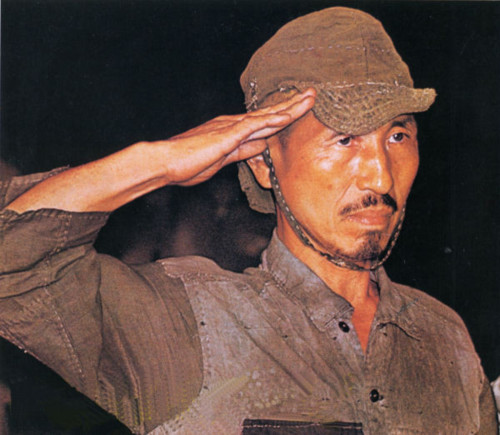
A Japanese soldier named Hiroo Onoda emerged from the Philippine jungle, unaware that World War 2 had been over for nearly 30 years. Onoda had been on the island of Lubang since 1944, a few months before the Americans invaded and retook the Philippines. The last instructions he had received from his immediate superior ordered him to retreat to the interior of the island – which was small and in truth of minimal importance – and harass the Allied occupying forces until the IJA eventually returned. “You are absolutely forbidden to die by your own hand,” he was told. “It may take three years, it may take five, but whatever happens, we’ll come back for you. Until then, so long as you have one soldier, you are to continue to lead him.”
Onoda complied with such determination that he ignored repeated efforts to persuade him to surrender – by leaflet drop, by loudspeaker and by patrols on the ground – and continued to take the war to the local people. Over the course of three decades, he and a dwindling band of companions killed 30 Lubang islanders and wounded 100 more in a sporadic guerrilla campaign that saw the once-mighty Imperial Army reduced to the assassination of some cows and the occasional immolation of piles of harvested rice farmed close to the jungle’s edge. After the loss of the last of his four men in a firefight with the local police, Onoda soldiered on alone. One of Onoda’s companions surrendered to Philippine forces in 1950, and by 1972 police had killed the other two. But despite being left alone, Onoda refused to surrender and went on to evade dozens of Philippine army and police patrols. The Japanese government attempted to track him down with search parties and even dropped leaflets over the jungle telling him the war was over, but Onoda dismissed these attempts as trickery.
On 20 February 1974, Onoda met Norio Suzuki, a Japanese man who was traveling around the world looking for “Lieutenant Onoda, a panda, and the Abominable Snowman, in that order.” Suzuki found Onoda after four days of searching. Onoda described that moment in a 2010 interview: “This hippie boy Suzuki came to the island to listen to the feelings of a Japanese soldier. Suzuki asked me why I would not come out…” Onoda and Suzuki became friends, but Onoda still refused to surrender, saying that he was waiting for orders from a superior officer.
Suzuki returned to Japan with photographs of himself and Onoda as proof of their encounter, and the Japanese government located Onoda’s former commanding officer, Major Yoshimi Taniguchi, who had since become a bookseller. Taniguchi went to Lubang Island, and on 9 March 1974, he finally met with Onoda and fulfilled a promise he had made back in 1944: “Whatever happens, we’ll come back for you”. Taniguchi then issued Onoda the following orders:
1. In accordance with the Imperial command, the Fourteenth Area Army has ceased all combat activity.
2. In accordance with military Headquarters Command No. A-2003, the Special Squadron of Staff's Headquarters is relieved of all military duties.
3. Units and individuals under the command of Special Squadron are to cease military activities and operations immediately and place themselves under the command of the nearest superior officer. When no officer can be found, they are to communicate with the American or Philippine forces and follow their directives.
Onoda was thus properly relieved of duty, and he surrendered. He turned over his sword, a functioning Arisaka Type 99 rifle, 500 rounds of ammunition and several hand grenades, as well as the dagger his mother had given him in 1944 to kill himself with if he was captured. Onoda wept uncontrollably as he agreed to lay down his perfectly serviceable rifle. He was later pardoned for the killings by the then Philippine president, Ferdinand Marcos. In his formal surrender to Marcos two days later, Onoda wore his 30-year-old imperial army uniform, cap and sword, all of which were in good condition.
A major Arab split seems to have developed over Egypt’s insistence that the American effort to bring about military disengagement with Israel would be matched by a relaxation of Arab oil restrictions. Saudi Arabia, the world’s largest oil exporter, has announced that she will be represented at the meeting of Arab producers in Cairo today and has made an official statement supporting an end of the embargo against the United States. Egyptian officials said categorically that the oil ministers’ conference would be held in Cairo today. In Algiers, the Energy Minister said that the oil producers had been officially asked to meet in Libya on Wednesday.
Syrian artillery fired briefly across the Israeli-Syrian cease‐fire line today as Israeli troops and tanks reinforced the front against any Syrian offensive. Troop‐carriers accompanied by American‐built tanks swept civilian traffic aside on the Golan Heights on their way to front‐line positions as Israeli jet aircraft flew above. The cease‐fire line has been tense since Israel reported early this week that Syria was considering renewed fighting in an effort to recapture some of the 300 square miles of land lost to Israel In the war last October.
Israel’s military command said Syrian gunners had fired several rounds at positions near Jaba, an occupied Syrian village of squat stone houses. The Damascus radio, reporting the incident, said the shells had destroyed an Israeli bulldozer and another vehicle. The Israeli communiqué said no soldiers had been hit and it did not mention damage. Israeli artillery positions did not answer the fire, the military command said.
The Soviet Union accused Israel today of “playing with fire” in the latest exchanges of shelling on the Golan Heights. Pravda, the Communist party newspaper, asserted that the new tension on the Syrian Israeli cease‐fire lines had arisen because Israeli leaders “needed it strictly for internal purposes” in political maneuvering. In particular, Pravda charged that Defense Minister Moshe Dayan was using the tension as a pretext for joining the new Israeli Cabinet without losing face and as a means of improving his political stock at home. “This is dangerous playing with fire,” the newspaper asserted.
A magistrate in Khartoum, Sudan, referred eight Palestinian guerrillas, accused of assassinating three Western diplomats, to trial by a higher court. The guerrillas are accused of killing U.S. Ambassador Cleo Noel, U.S. Charge d’Affaires Curtis Moore and Belgian Charge d’Affaires Guy Eid during a seizure of the Saudi Arabian Embassy in March, 1973. Meanwhile, a military tribunal in Beirut sentenced a Lebanese guerrilla to death and another to life imprisonment for seizing the Bank of America in Beirut and killing an American businessman in October.
The Human Rights Commission of the United Nations is being attacked by outside critics and by some of its own members over the meager accomplishments of its recent five‐week session. The general complaint is the commission failed to come to grips with the most pressing threats to individual liberty. Specifically, it was criticized most frequently for failing to inquire into allegations of gross violations of individual rights in eight countries.
Britain returned to a full workweek, ending 22 months of an economically crippling three-day week, but new Prime Minister Harold Wilson warned that there were still serious economic problems ahead. Meanwhile, 269,000 mine workers completed voting on acceptance of a record $230 million pay deal and prepared to return to the pits Monday after a four-week walkout.
New British Foreign Secretary James Callaghan told Laborites in East Lewisham he will seek a fundamental renegotiation of Britain’s terms of entry into the Common Market, making his first concern the effect of market policies on English shops. The Labor Party made renegotiation one of its pledges in the recent election campaign.
The Roman Catholic Bishop of Bilbao, the Most Rev. Antonio Afioveros Ataún, received the full backing of the Catholic hierarchy in Spain in his battle with the Government over his call for more Basque freedoms. The permanent commission of the Spanish Episcopal Council resisted strong Government pressure including a threat to denounce the Concordat of 1953 — which has governed Spain’s close relations with the church — and proclaimed the right of any bishop “to the free and full exercise of his spiritual power and of his jurisdiction.” The secretary of the commission told newsmen he believed that the measures taken by the Government against Bishop Afioveros had been lifted.
Pope Paul VI, recovering from influenza that kept him in bed for most of the past week, is expected to give his usual Sunday blessing from his apartment window today, a Vatican spokesman said. The 76-year-old Pontiff’s temperature has returned to normal and he has partially resumed his activities in his private study on the third floor of the apostolic palace, the spokesman said.
Agricultural Minister Korkut Ozal said Turkey will start planting opium poppies in state farms this month. He said the cultivation was intended to assure a good supply of “high quality opium seeds, which deteriorate fast unless planted.” A decision will be announced later on whether cultivation will be allowed on private farms. Poppy cultivation was banned in 1972 under pressure from the United States, which said 90% of heroin reaching U.S. addicts originated in Turkish fields.
Belgium’s quietest election campaign since World War II winds up today with the seven major parties offering voters a choice of action on three main issues-more autonomy for the French-and Dutch-speaking citizens, energy supplies and abortion. The last coalition government fell in January with the collapse of a $200 million oil refinery project involving Belgium and Iran.
A young couple stopped a rightwing Perónist on a Buenos Aires street and shot him to death. The victim was Miguel Angel Castroffini, head of a university faction loyal to Perón. A left-wing newspaper, Noticias, was bombed and three people were injured. Bombs also damaged the fronts of Argentine branches of the Bank of America and the Bank of Boston.
Four South African constables were killed in a skirmish with guerrillas believed to have taken place near Kandahar Island on the Zambezi River in Rhodesia, Police Minister Stefanus L. Muller reported at Pretoria. A sergeant with the patrol, which according to a correspondent in the area probably walked into an ambush, was missing after the encounter. Nine South African policemen have been killed in Rhodesia during the past 15 months.
The Soviet Union’s Mars 7 lander was released behind schedule during the Mars 7 flyby when it initially failed to separate from the probe. Because of a retrorocket failure, the probe skipped off the atmosphere of Mars and flew past rather than landing, and came no closer than 810 miles (1,300 km) from the surface before hurtling back into space.
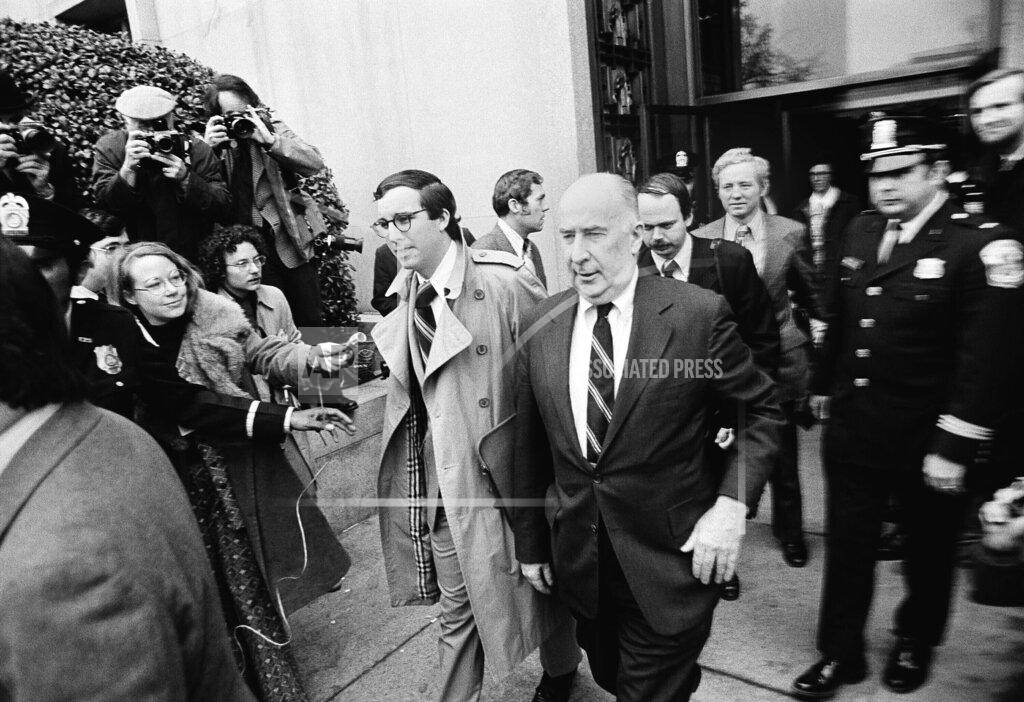
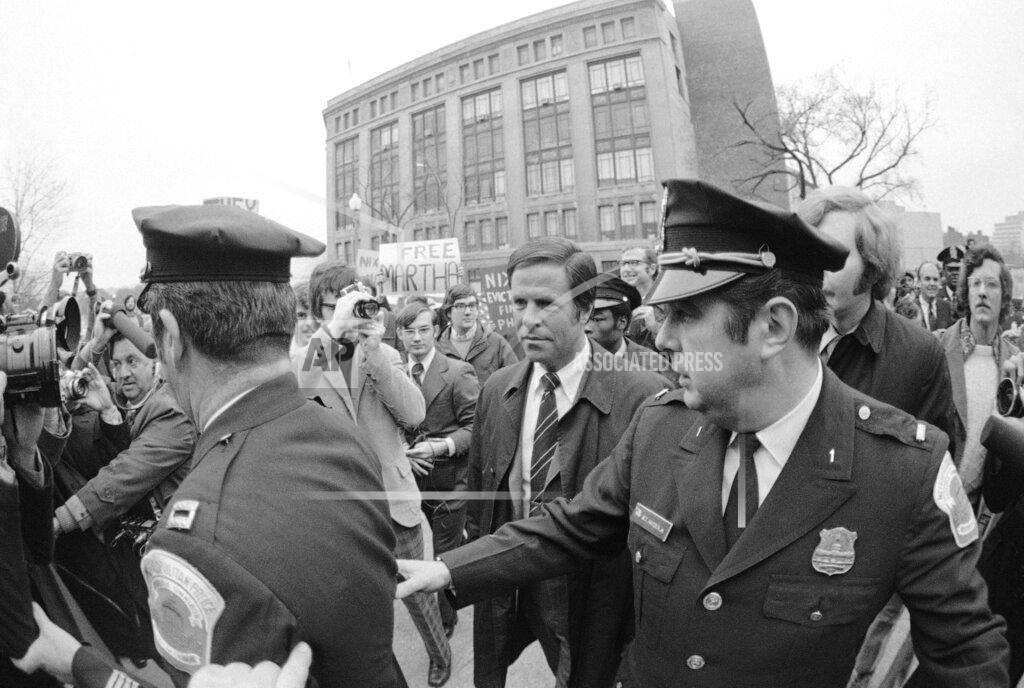
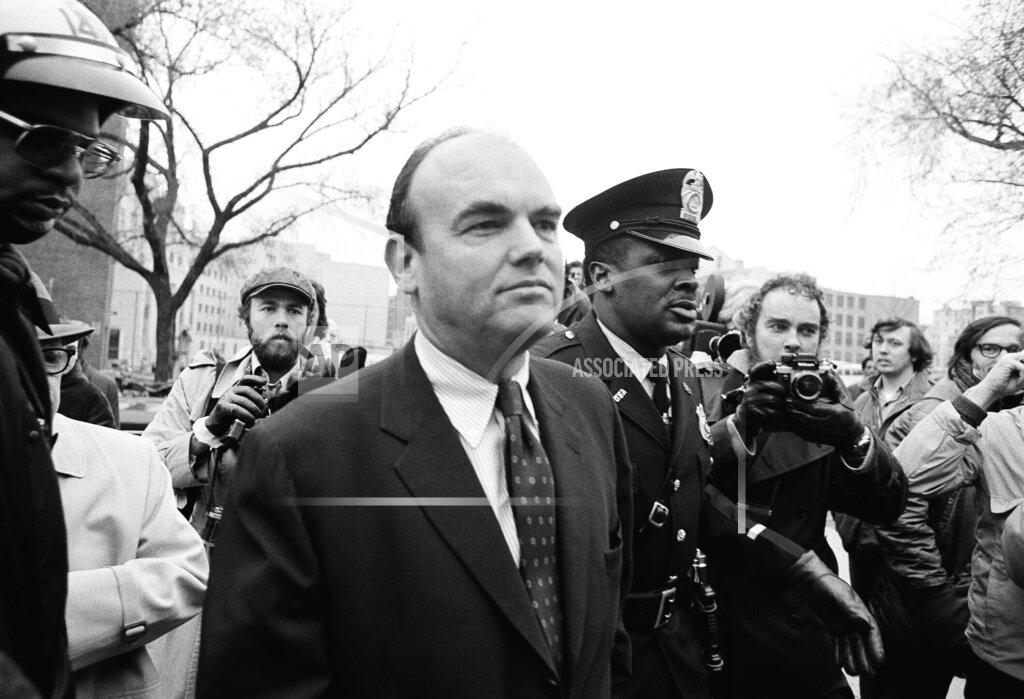
Seven of President Nixon’s former associates, charged with covering up the Watergate burglary, pleaded not guilty before Chief Judge John Sirica in Federal District Court in Washington. They entered the courtroom through a jeering crowd of about 250 persons that was held back by the police. Among the seven, John Ehrlichman and Charles Colson also pleaded not guilty to charges brought last Thursday arising from the Sept. 3, 1971, burglary of the office of Dr. Daniel Ellsberg’s former psychiatrist. The five others at the arraignment were John Mitchell, H.R. Haldeman, Kenneth Parkinson, Robert Mardian and Gordon Strachan.
A poll taken immediately after the voting in last Tuesday’s special congressional election in Ohio strongly suggests that Watergate has cost the Republicans the support of the independent voters. It also indicates that a substantial number of Democrats who broke away to vote for President Nixon In 1972, making possible his landslide victory, have returned to their traditional voting patterns. The poll was taken for the Democratic National Committee in the first district of Ohio, in which Thomas Luken, a Democrat, defeated Willis Gradison, a Republican.
With President Nixon’s popularity near its nadir and with former Nixon aides and other associates being indicted, tried or sentenced with growing frequency, it has become increasingly apparent in recent weeks that Vice President Ford has emerged as the one national Republican political leader around whom the party faithful are beginning to rally.
President Nixon scheduled a nationwide radio address for 10:07 a.m. today on the meaning of the American Revolution in 1776 and plans for observing its 200th anniversary in 1976.
President Nixon will hold more frequent press conferences, Press Secretary Ronald Ziegler predicted as he complained there was “still too much dwelling on Watergate” by Mr. Nixon’s questioners. Ziegler said, “As he holds them on a more frequent basis… the area of questioning will shift… to the things he’s doing in foreign and domestic policy.”
The White House delivered the first batch of Watergate tapes and documents to the House Judiciary’ Committee for inquiry into the possible impeachment of President Nixon. John M. Doar, the panel’s chief counsel, said some of the documents were from “federal departments,” but did not elaborate. Jack Anderson, a syndicated columnist, reported that some of the materials were from the Agriculture Department and Environmental Protection Agency, presumably dealing with 1972 campaign contributions from the milk industry and corporations accused of violating anti-pollution laws.
A taped message — the first in 16 days — from the reputed kidnappers of Patricia Hearst was received by a San Francisco radio station. The Symbionese Liberation Army broke its long silence tonight with a message to Randolph A. Hearst accusing him of being “deceitful” and dishonest in negotiations for the release of his 20-year-old kidnapped daughter. The message, delivered late this afternoon, did contain a statement from Miss Hearst, but her voice was barely audible. In the message, Miss Hearst said at one point “the F.B.I. and other Federal agencies want me to die.” At another point, Miss Hearst asked her father not to aid the Federal Bureau of Investigation in its inquiry. “If you had just done what the S.L.A. wanted,” she said, “the month would be over and I’d be out of here.”
Growing up in America for Michael and Robert Meeropol was not quite the same as for most young people because they carried a searing childhood memory. Michael is 31 years old today, his brother is 26. They are the sons of Julius and Ethel Rosenberg, who were executed in 1953 for conspiring to pass atomic secrets to the Soviet Union. The brothers believe that the time has come for them to emerge from obscurity to try to clear the names of their parents, who they believe were innocent.
[Ed: BULLSHIT. The Rosenbergs were GULTY as Hell. We know this not only from the trial, but from the VENONA decrypts of secret Soviet wartime cables, AND from the Mitrokhin archive brought West by a KGB defector after the end of the Cold War. GUILTY, END OF STORY.]
A family of four needs a minimum weekly income of $152 to make ends meet, an increase of 50% from estimates given by the American public in 1967, the Gallup Poll reported. Living costs were found to be considerably less in the South and Midwest than in the East or Far West, with the East ranking as the most expensive region. A key item in family budgets is the cost of food.
A rule to protect customers of mail order houses has been proposed by the Federal Trade Commission. The buyer would be entitled to a full refund if an item he ordered was not sent within 30 days. An earlier version had set the time period at three weeks. The proposal will not become final until after a period for public comment and review.
Bond for two suspects in the kidnapping of Atlanta Constitution editor John R. Murphy was reduced to $150,000 from $1 million for William A. H. Williams and to $20,000 from $100,000 for his wife, Betty. U.S. Dist. Judge Newell Edenfield exacted a promise from federal prosecutors that a statement obtained from Williams by the FBI when his attorney was not present would be destroyed and that Williams would be assured full telephone, mail and visitor privileges. The couple pleaded not guilty of extortion of $700,000 and other violations in the February 20 abduction.
Immediate pay boosts of up to 80 cents an hour are provided in a contract approved by Farah Manufacturing Co. clothing workers in El Paso and San Antonio, Texas, ending a long labor struggle. The three-year pact has a no-strike, no-lockout clause and allows the Amalgamated Clothing Workers of America to represent the workers. Farah said a strike and boycott since 1972 had cost it $20 million in sales losses. Previously, workers’ pay had ranged from $1.70 to $2.40 an hour.
America’s campuses, rocked by unrest in the 1960s, are being shaken again by a new crisis: A frenzied “slave market” in recruiting and paying college athletes. Many educators warn that the crisis is approaching a public scandal, and they attribute it to a national mania in the 1970s to “win at any cost.”
In a quarter-final match in England’s FA Cup competition, visiting Nottingham Forest led against host Newcastle United, 3 to 1, when the game had to be halted as hundreds of football hooligans invaded the pitch Newcastle. After play resumed, Newcastle United won, 4 to 3, but the result was declared void.
21st ACC Men’s Basketball Tournament: NC State beats Maryland, 103-100 (OT).
Born:
Armen Nazaryan, Armenian Greco-Roman wrestler, Olympic gold medalist 1996 and 2000, and three-time world champion in 2002, 2003 and 2005; in Masis, Armenia SSR, Soviet Union.
Tyrone Rogers, NFL defensive end (Cleveland Browns), in Montgomery, Alabama.
Wayne Franklin, MLB pitcher (Houston Astros, Milwaukee Brewers, San Francisco Giants, New York Yankees, Atlanta Braves), in Wilmington, Delaware.
Francisco Santos, Dominican pinch hitter, right fielder, and first baseman (San Francisco Giants), in Santo Domingo, Dominican Republic.
Yuriy Bilonoh, Ukrainian shot putter who won a gold medal in the 2004 Summer Olympics but had it withdrawn in 2012 because of his use of performance-enhancing drugs; in Bilopillia, Ukrainian SSR, Soviet Union.
Died:
Earl W. Sutherland, 58, American physiologist, Nobel Prize laureate (1971), died after undergoing surgery for internal bleeding.
Harry Womack, 28, American R&B musician for The Valentinos, was stabbed to death by his girlfriend, Patricia Wilson, after a misunderstanding.


 History Diaries