Britain will put 300,000 men in France in case of war. The British Government is now planning to send nineteen divisions, totaling about 300,000 men, to France in case of war, War Secretary Leslie Hore-Belisha told an astonished but approving House of Commons today in introducing army estimates of £161,000,000 for the coming financial year. His announcement marked the utter abandonment of the comfortable British idea of a “limited war” in which this country would supply sea power and air power but would leave the French Army to meet the brunt of a land attack along the Maginot Line.
Only a year ago, in introducing the previous army estimates, Mr. Hore-Belisha had suggested that it would not be necessary for Britain to send more than a small highly mechanized army into a Continental struggle. He talked then of the increased power of the defense in modern war and argued that Britain’s sacrifices of manpower in 1914 need not be repeated in the next war. “History sometimes repeats itself, but rarely in the same context,” were his reassuring words a year ago. “The assumptions of an unforgettable past are not always the surest guide to an unpredictable future.”
Today, however, Mr. Hore-Belisha reversed himself with a vengeance. The force that he is now planning to send to the Continent is four times as large as the immortal “contemptible little army” of 75,000 regulars that landed in France in the first fortnight of August, 1914, and that helped block the German drive on Paris. The new army would be sent in “echelons,” or installments, said Mr. Hore-Belisha, who was careful not to estimate how long it would take for all 300,000 with full equipment to be landed across the English Channel. But he told the House that the problem of transporting the army was being worked out to the smallest detail, and he left the impression that the reception of the new expeditionary force was already being discussed with the French military authorities.
Even this was not the whole story, for Mr. Hore-Belisha, as War Secretary, could not speak of the formidable force of scouting planes and other aircraft that would have to accompany an expeditionary force of such a size. And he suggested that by the time the complete expeditionary force had reached French soil new troops — possibly in equal numbers — would be recruited, trained and equipped in Britain.
France is pleased with Britain’s plan to contribute troops.
Adolf Hitler met with Wilhelm Keppler, the NSDAP’s economic expert, where he spoke about his wish to occupy Czecho-Slovakia for economic reasons, saying that Germany needed its raw materials and industries. Hitler totally ignored the agreements of the Munich Agreement and scheduled a German invasion of Bohemia and Moravia for the morning of 15 March. In the interim, he negotiated with the Slovak People’s Party and with Hungary to prepare the dismemberment of the republic before the invasion.
Economic negotiations begin in Prague tomorrow between representatives of the Slovak and Czech Governments. Pavel Teplansky, the Slovak Minister of Finance, has already arrived, and tomorrow Premier Joseph Tiso and the strongly Separatist Vice Premier, Karol Sidor, will join him. The negotiations are likely to end in consolidation of the central government’s position, but at the price of an unremunerative loan to Slovakia.
The Slovak extremists, however, have not finally shelved their schemes, as proved by the announcement that Sano Mach, the Slovak Propaganda Minister, will go to Huszt on the occasion of the opening of the Carpatho-Ukrainian Parliament as the guest of the Carpatho-Ukrainian propaganda chief, M. Komarinsky. The object of the meeting is to coordinate action against Prague on the lines planned by the Carpatho-Ukrainian Minister Julian Revay, who was dismissed from his office this week.
The German press continues to support all disintegrating tendencies in Slovakia and Carpatho-Ukraine. This is publicly claimed to be due less to any apparent desire to acquire further Czecho-Slovak territory than to a desire to be able to force the Prague Government to yield more rapidly to German demands concerning purely internal Czecho-Slovak affairs. At the moment, Prague shows timid signs of participating in the temporary Central European and Balkan rally against extreme German pressure.
Madrid smashes Communist forces within the city. After a night of bitter street fighting, General José Miaja has quelled a second Communist revolt within Madrid. His National Defense Council now seems free to present a united front, either for peace or for war, against Generalissimo Francisco Franco, who is now massing his forces outside this capital. “The war within a war,” as the Communist revolt against the “pacifist attitude” of the National Defense Council has been termed, came to an end at about midday, the time limit set by General Miaja’s radio for the surrender of those strongholds still being manned by recalcitrant Communists.
Several times during the morning the following message was broadcast: “Those few leaders who rebelled. against the National Defense Council have surrendered, some realizing their error, others repentant, and all convinced that normal conditions are indispensable if the council is to achieve the aims desired by all.
“The council allows three hours, from 9 A. M. to 12 M., for troops who have abandoned their posts to regain them. “The forces that have throughout remained loyal to the council must stand fast and suspend all fire unless attacked. “Now that normal conditions are restored throughout Republican territory, Spaniards may rejoice, for it is only when public order is absolute that we can achieve a dignified, honorable peace and liberty.”
This ultimatum apparently was effective, for the last shots were heard at 11:30 AM and no appeal for surrender has been made over the radio since. Late tonight Madrid was pitch dark and deathly still. Streets were deserted, except by frequent patrols and pickets, keeping the strictest watch. This correspondent tonight was able to telephone from Madrid to Valencia, which had been impossible earlier in the day. A fellow-correspondent in Valencia reported nothing was happening there and other coastal towns were quiet, as far as was known in Valencia. Sounds of fighting during the night must have caused considerable wonderment among General Franco’s troops listening a short distance away.
Generalissimo Francisco Franco declared a total blockade of all remaining Republican-held ports. All ships entering the three-mile limit were to be seized regardless of nationality, or torpedoed if sighted near Cartagena.
Pope Pius XII confers with the Reich envoy. The possibility of official negotiations between the Holy See and Germany, aiming at more tolerable conditions for the church, was advanced another step with a long audience. that Pope Plus granted to Dr. Karl-Ludwig Diego von Bergen, the German Ambassador to the Vatican. The audience occurred yesterday. but was kept secret by the Vatican and passed unnoticed until today because of the exclusion of newspaper men from the Vatican. The importance of the fact that the first reception to any diplomatic representative was given to the German Ambassador can scarcely be exaggerated, particularly when it followed so closely upon the conference of the Pope. with the German Cardinals. Undoubtedly the ground is being carefully explored for any possibility of an understanding, or at least a working arrangement. The secrecy with which everything is being done is also highly significant. It shows that the Holy See is not merely making a gesture to acquaint the world with its good intentions, thus embittering the fight with the Reich. On the contrary, it shows that the Holy See sincerely believes that an improvement of the situation may be attained by negotiation and wishes to open conversations with Berlin without delay.
Carpenters began building barricades in St. Peter’s Square today to control the enormous crowds expected Sunday to witness the coronation of Pope Pius XII on an outside balcony of the Basilica. More than 200,000 requests for tickets for the coronation mass inside St. Peter’s had to be rejected, and Vatican authorities predicted that Sunday would see one of the greatest popular assemblies in Rome’s history gathered outside. Detailed instructions regarding routes to St. Peter’s, both for those who will be admitted to the mass and those who must remain outside, were published in the Vatican newspaper, Osservatore Romano.
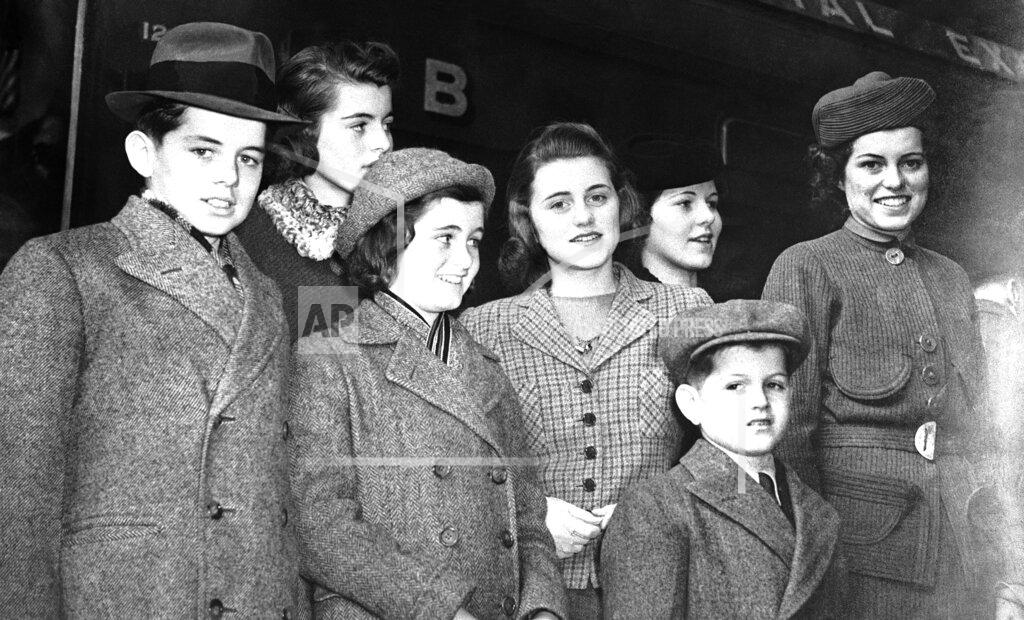
Occupying an entire sleeping car on the Golden Arrow Express, seven of Ambassador Joseph P. Kennedy’s nine children left London for Rome today to attend the coronation of Pope Pius XII on Sunday. The Ambassador, Joseph Jr. and John are to leave Saturday. Mrs. Kennedy already is in Rome.
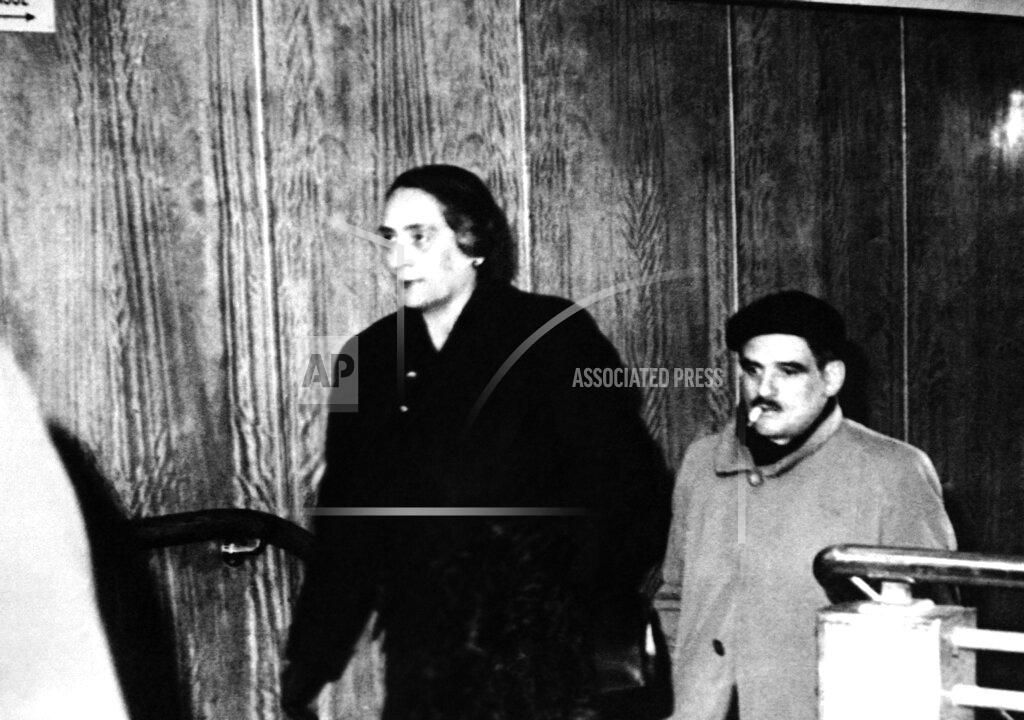
A Spanish Communist leader known as “La Pasionaria” refuses to discuss how she escaped from Spain and arrived in France. On her arrival at Marseille aboard the steamer Ville Doran tonight, Dolores Ibarruri Gomez, Spanish Communist, better known as La Pasionaria, refused to relate to the “bourgeois” press details about her escape from Loyalist Spain. On the advice of the French Communist Deputy, Jean Catelas, she remained locked in her third-class cabin and refused to land until reporters and photographers had withdrawn. A couple of hundred Communists waited at the wharf patiently to cheer her. After two and a half hours, under an escort of Mobile Guards and the police, she came ashore and took a taxicab to get a train for Paris.
“I only have to explain to my party,” she said in St. Charles Station. “When I reach Paris and am able to, I will talk, but not now.” She complained, however, about her treatment by French authorities at Oran, Algeria, who dealt with her as a prisoner and denied her all opportunity to communicate with anyone.
Britain suspends talks with Arab and Jewish delegates, and intends to draw up and impose its own plan on Palestine.
Following up President Roosevelt’s reference yesterday to the shortcomings of the Neutrality Act, the U.S. Senate Foreign Relations Committee probably will begin discussions of proposed revisions of the law within ten days, Senator Pittman, chairman, said today. Administration leaders on both sides of the Capitol regard the topic as political dynamite and will approach it with caution. The Administration will not bring forward any proposals of its own. That decision is confirmed in many quarters, particularly at the State Department. The most probable course seems to be that Mr. Pittman, after the hearings before his committee have developed outlines of the current state of public opinion, will introduce a bill of his own which will sail as close to the Administration’s desired course as is deemed politically feasible.
In the House, there is little sentiment for action at this point, even though the “cash and carry” section for commodity trade with belligerents, sponsored by the House in 1937, will expire on May 1. There is some advocacy of outright repeal on the Republican side, headed by Representative Wadsworth of New York, but he admits that he is able to stir up little interest among his Republican colleagues. Democratic leaders in the House have their hands so full, with a well-disciplined minority and a refractory segment of the majority facing them, that they want to pass the supply bills and other essential legislation and send the legislators home.
The possibility of a prolonged debate, cutting across party lines and affording opportunity for unlimited criticism of President Roosevelt and his conduct of foreign relations, strikes the Democratic leaders most unfavorably. However, they agree that public opinion probably would force them to take action on a Senate neutrality measure, if it were thrown in their laps. The State Department is maintaining an attitude of watchful waiting.
The House passed the Cochran-Warren Governmental Reorganization Bill early this evening after the Democrats, under the spur of leaders, had massed forces to bring the measure through its final test without radical change. The vote was 246 to 153, largely along party lines. The Democrats had a narrow escape on one amendment which struck at the vitals of the measure. This, offered from their own ranks by Representative Sumners, chairman of the Judiciary Committee, would have provided that either branch of Congress, by simple resolution, could disapprove an executive reorganization order. It was defeated on roll call, 209 to 193, after it had been adopted in committee of the whole by a teller vote of 176 to 156.
Since this was the only amendment attached to the bill in committee of the whole to which Democratic leadership objected, the bill was sent to the Senate substantially as it was offered last week to the House by its select Committee on Reorganization.
A promise of positive action to back the Administration’s overtures toward government-business cooperation was made by Secretary Hopkins today at the hour when President Roosevelt was discussing with Secretary Morgenthau and Undersecretary Hanes the Treasury’s ideas for Federal tax adjustments to the same end. “Life is too short to make speeches unless you are going to do something about it,” Mr. Hopkins said. at a press conference. By implication the same doctrine was subscribed to by Mr. Morgenthau and Mr. Hanes. The Treasury officials declined to discuss the business situation upon leaving the President’s office, indicating that the next move from their quarter was likely to be the recommendation of something concrete.
The tax discussion will be continued tomorrow at a conference with the President attended by Senator Harrison, chairman of the Finance Committee, and Representative Cooper of Tennessee, representing the Ways and Means Committee. Chairman Doughton of the Ways and Means Committee, who joined with Senator Harrison in a letter to Secretary Morgenthau asking for suggestions on tax revision to encourage business, is ill and will not be able to attend the White House meeting. The Treasury officials were asked. by the President to be on call tomorrow.
Congressmen walk through picket lines as hotel and restaurant workers go on strike in the nation’s capital. Cabinet members and other government officials and scores of Senators and Representatives walked through picket lines of striking employees of thirteen hotels today. Locals of the Hotel and Restaurant Workers International Alliance, A. F. of L., voted to strike at a meeting at 4 AM to enforce demands for a contract providing that new employees be required to join the union after a specified period. The hotels offered terms of preferential hiring for union members, which the union rejected.
Union officials said about 2,000 employees were out, including waiters, cooks, kitchen employees, bellboys, elevator operators, chambermaids and bartenders. Spokesmen for teamsters’ unions voted in the afternoon to stop delivery of milk, bread and beer to the struck hotels. The strike affected the Carlton, Continental, Harrington, Lafayette, Lee House, Mayflower, Willard, Wardman Park, Raleigh, Shoreham, New Colonial, Ambassador, and the Roger Smith Hotels. All announced that operations, curtailed when the strike started, would be resumed with substitute employees.
Officials weigh a food-scrip plan that would give the needy a paper that is redeemable for food in stores.
A doctor tells of a new surgery that cuts pre-frontal nerves and cures insanity.
The American Federation of Actors bans all WPA jokes.
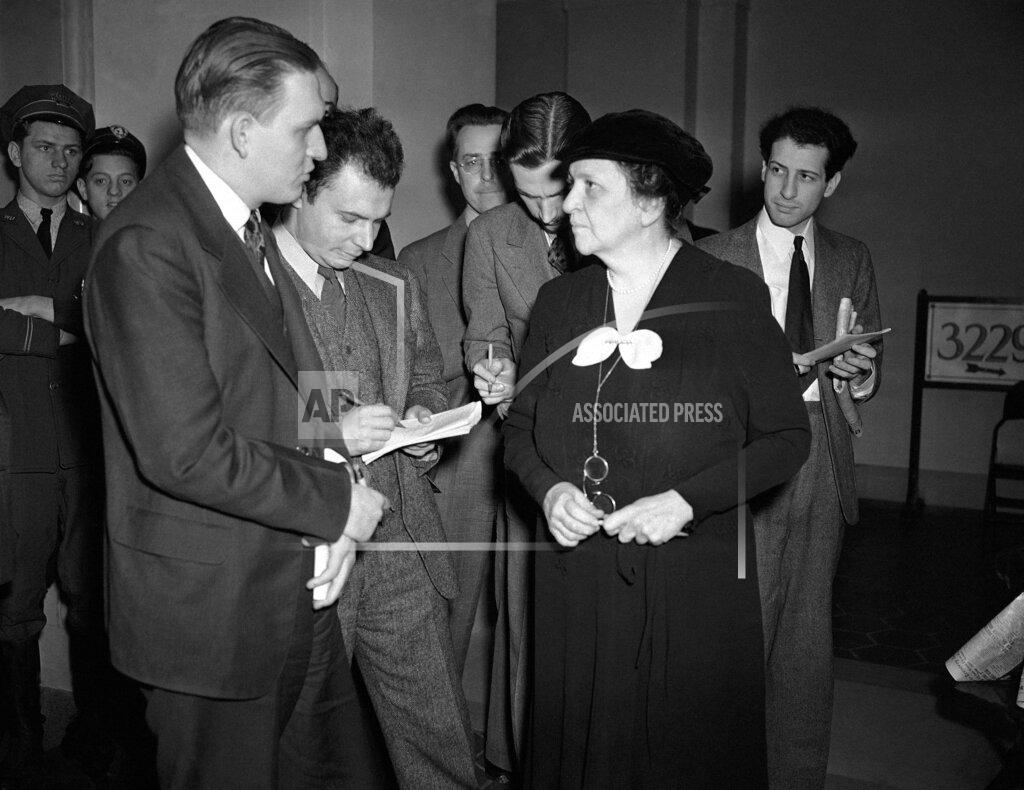
Author Pearl Buck chastises women with education and talent who do not exercise their talents, calling them “wasteful” and comparing them unfavorably to women in China.
The Women’s Prison Association urges psychiatric help for the wayward, saying that many women and girls can be made useful.
The daughter of Mme. Curie arrives to lecture on her mother’s radium discovery and the role of women in science.
During construction of the Bronx–Whitestone Bridge, 38-year-old construction worker Victor Weikko fell 105 feet (32 m) to his death.
Movie star Clark Gable divorces his wife Ria so that he can marry starlet Carole Lombard.
Actress Marlene Dietrich is set to become an American citizen.
Lenore Coffee & William Joyce Cowan’s “Family Portrait” premieres
Trainer Tom Smith says the racehorse Seabiscuit will not race until 1940.
Britain provides the Chinese government with a £5 million credit to bolster China’s monetary system. The British Government provided the Chinese Government with a £5,000,000 credit today to support the Chinese dollar. Although the money will be provided by two British banks, they will be indemnified by the British Treasury against loss. The credit ranks as Britain’s most spectacular move to checkmate Japanese aggression in China since the outbreak of the hostilities.
Announcing the decision in the House of Commons this afternoon, Sir John Simon, Chancellor of the Exchequer, explained the British credit would constitute half of a £10,000,000 Chinese stabilization fund, the other half being furnished by two Chinese Government banks. “His Majesty’s Government would welcome the establishment of this stabilization fund, the successful working of which would be of material assistance to British trade and enterprise in China,” Sir John said, adding that he hoped to introduce a bill in Commons early next week to give authorization for the British guarantee.
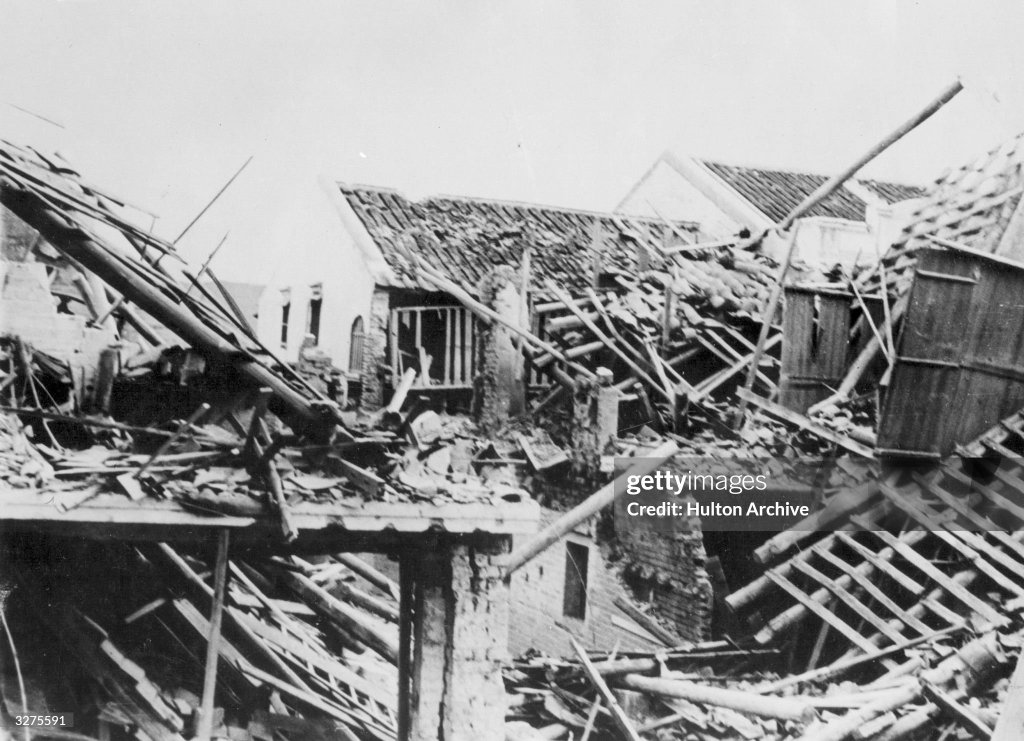
Japanese raiders strike at Ichang. Heavy Chinese losses are feared. The city of Ichang, Yangtze trading center halfway between Hankow and Chungking, was raided three times today by Japanese planes. Closely built up districts were reported to have been attacked and it was feared here that the destruction and casualties were heavy although details were not available. Eighteen planes bombed the city at 10 o’clock this morning and squadrons of nine and eighteen planes came over twice during the afternoon, Central News Agency dispatches say.
This agency also reports that Japanese planes yesterday bombed Ningsia, in the province of that name, and Pingliang, Yungchang and Wuwei in the province of Kansu. Casualties in the Ningsia bombing were said to be 300 killed or wounded. The Chinese military spokesman today said that the Japanese land offensive in Central Hupeh Province had been checked by Chinese reinforcements. Supporting this statement, the Central News Agency claims that the Chinese are now counter-attacking between Chungsiang and Tienmen and that several Japanese positions have been retaken, 30 Japanese killed and eight tanks captured.
This Chinese advance is said to make the recently won Japanese position at Chungsiang precarious. The military spokesman maintained that the Chinese were also counter-attacking in the northern outskirts of Chungsiang, declaring that the Japanese had only won the city itself after bitter street fighting that was very costly to them, through the use of asphyxiating gas. With only one division of troops along a fifty-mile front east of the Han River, the spokesman declared, the Japanese do not have sufficient strength either for a drive on Ichang or a northward movement against Siangyang.
Carrying out the most sensational air raid of this year, Japanese Army fliers today made a surprise swoop upon the walled city of Yungchang, lying within the shadow of the Great Wall, 1,600 airline miles northwest of Shanghai and 160 miles beyond Lanchow, Kansu’s capital. The towns of Yungteng and Kulang, also beyond Lanchow, were bombed. These points are important stopping places along the highway to Siberia, from which have come supplies and munitions for China from Russia. Another squadron of Japanese Army fliers simultaneously bombed Pingliang, 150 miles east of Lanchow and Sian, the capital of Shensi province.
Tokyo plans military self-sufficiency in three years.
The infant Japanese Princess is named Takako Suganomiya after an 8th-century poem. She will be called Princess Suga.
Dow Jones Industrial Average: 151.42 (+2.05).
Born:
Jim Bouton, MLB pitcher (World Series Champions-Yankees, 1962; All-Star, 1963; New York Yankees, Seattle Pilots, Houston Astros, Atlanta Braves) and author (“Ball Four”), in Newark, New Jersey (d. 2019).
Lidiya Skoblikova, speed skater (Olympics, 6 gold medals, 1960, 1964) and coach, in Zlatoust, Soviet Union.
Mike Lowry, American politician (Rep-D-Washington, 1979-89, Governor of Washington 1993-97), in St. John, Washington (d. 2017)
Lynn Seymour [Berta Lynn Springbett], Canadian-English ballerina (Royal Ballet, 1962-78), choreographer, and director, in Wainwright, Alberta, Canada (d. 2023).
Robert Tear, tenor singer (Welsh National Opera 1970), teacher and conductor, in Barry, Vale of Glamorgan, Wales, United Kingdom (d. 2011).
Naval Construction:
The Kriegsmarine (German Navy) Type VIIB U-boat U-48 is launched by F. Krupp Germaniawerft AG, Kiel (werk 583).



 History Diaries