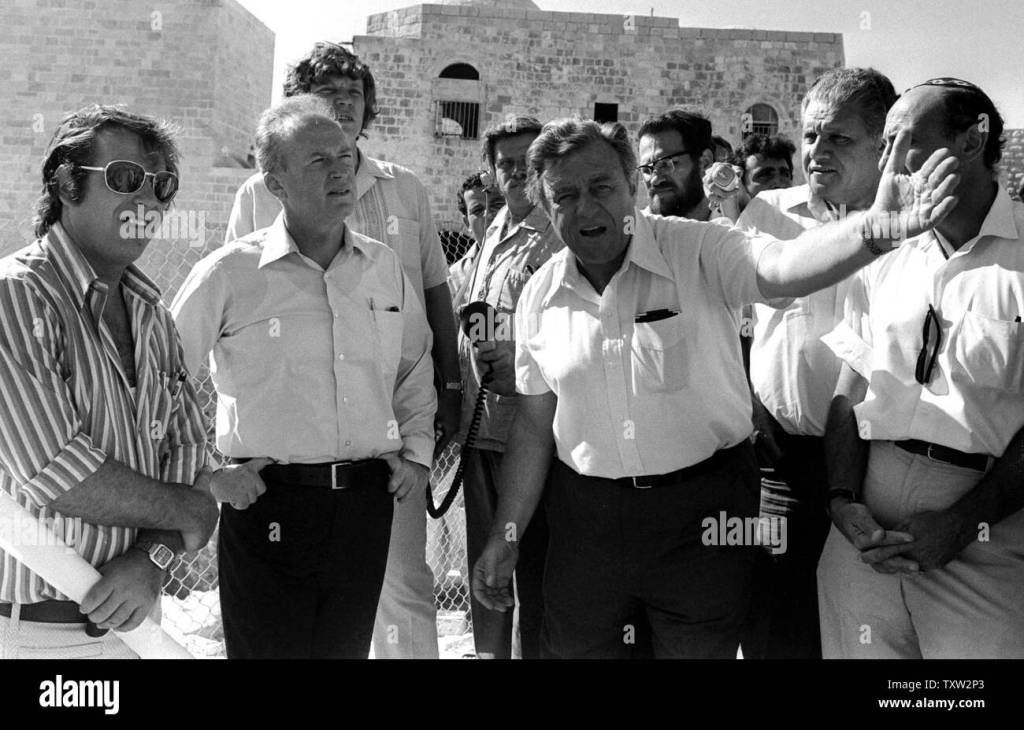
Premier Golda Meir of Israel charged that Syria had planned military action earlier this week to recapture the enclave of Syrian territory that Israel seized during the October war. Mrs. Meir said that Israel had immediately asked “foreign governments” to do what they could to avoid a new outbreak of fighting. This was assumed to be an allusion to the United States, which has been in direct contact with Syria, and the Soviet Union to work out ways to defuse the Syrian front.
Mrs. Meir’s remarks, made on television tonight, followed an army spokesman’s announcement of three shooting incidents during the day involving exchanges of tank fire and antitank rockets between Syrian and Israeli forces. The spokesman said there had been no Israeli casualties. Syria, also reporting no casualties, said she had knocked out two Israeli artillery batteries, an “engineering unit” and Israeli military vehicles. A State Department spokesman in Washington said he knew of no special request from Mrs. Meir for intervention.
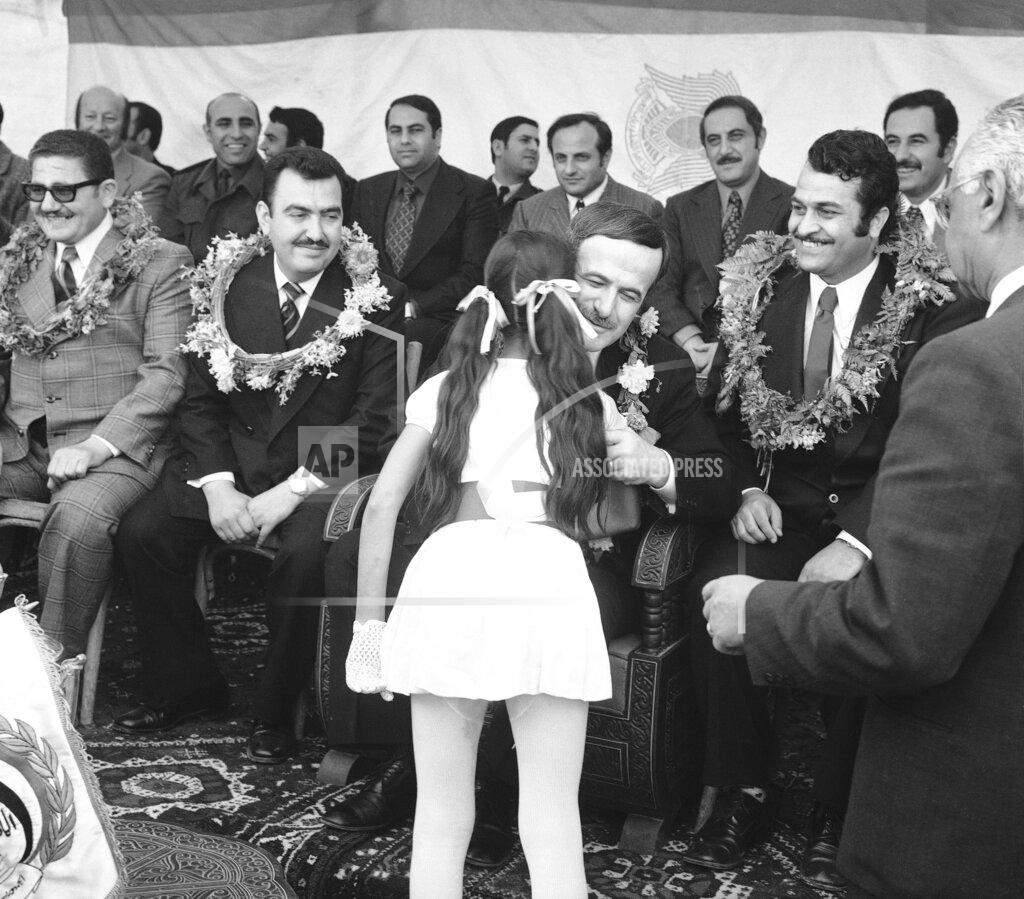
President Hafez al-Assad of Syria said that his country would remain at war with Israel until “all the Arab territory is liberated.” He spoke at a university rally. “If Israeli leaders think that we are tired of fighting or making sacrifices, then they have made another serious mistake,” he said at the rally at Damascus University, broadcast on the Damascus radio. Referring to Premier Golda Meir of Israel, who has said that the Golan Heights of Syria are an integral part of Israel, President Assad said that Palestine, including the present state of Israel, is “a basic part of southern Syria.”
President Assad, a former air force general who took power in a military coup in March, 1970, did not refer in his speech to talks under way between Syria and Secretary of State Kissinger on a separation of troops on the Golan Heights, occupied by Israel during the 1967 Middle East war and in fighting in October. The Syrian leader said, however, that “our stand in all talks” has been that United Nations resolutions calling for a political settlement in the Middle East and for a ceasefire in October required that Israel withdraw in full from the Golan Heights.
Resolution 242, on a political settlement, was adopted by the Security Council in 1967, calling for Israeli withdrawal, recognition by Arab countries of the state of Israel and the establishment of secure boundaries in the region free of acts or threats of violence. For the first time, President Assad said publicly that Syria accepted Resolution 242 as a basis for a political settlement as long as two conditions were satisfied: complete Israeli withdrawal from all occupied Arab lands and full recognition of the “rights” of the Palestinian Arabs, most of whom are now refugees from Israel.
Confusion surrounded the Arab countries’ proposed meeting to lift the oil embargo against the United States. The semiofficial Cairo newspaper Al Abram said tonight that Arab oh ministers would decide at a meeting here on Sunday to lift the embargo against the export of oil to the United States. This prediction came in a dispatch from the paper’s correspondent in the Saudi Arabian capital, Riyadh. He said the step would be taken in accordance with a secret resolution adopted at the meeting in Algiers last month of the heads of state of Egypt, Saudi Arabia, Algeria and Syria. The dispatch appeared in an edition of Al Ahram at the end of a day of developments that some diplomats said reflected a jockeying for power between such moderates in Arab oil policies as Egypt and Saudi Arabia and such hardliners as Algeria and Libya.
Al Ahram’s prediction of a lifting of the oil embargo against United States contrasted with a statement today in El Moudjahid, an Algiers newspaper that reflects the views of the Algerian Government. That newspaper said that the oil ministers might well consider a “tightening” of the Arab oil embargo against supporters of Israel rather than an easing of it. It was thought that the views of the moderates and hard‐liners would balance each other off at the oil ministers conference. In the end, however, it was considered likely that a moderate view would prevail.
Negotiators reached agreement today on formula to end a brief general strike that had severely affected transportation, food and tourist industries in Ethiopia. Tonight, the governing body of Ethiopian unions met for two hours without deciding whether to accept the compromise. The union leaders were to meet again tomorrow morning. About 100,000 workers could begin returning to work tomorrow if Premier Endalkachew Makonnen and the Confederation of Ethiopian Labor Unions general council approve the compromise. Ending the nationwide strike, which began yesterday, would be a victory for Mr. Endalkachew’s five‐day‐old government and could end a two‐week civil crisis that was set in motion by an army revolt.
One long chapter of the Vietnam war ended today with the release of the last prisoners who were officially listed as captured before the ceasefire of January, 1973. Culminating four weeks of exchanges, the South Vietnam ese Government announced that it had flown 121 prisoners to Lộc Ninh, a Việt Cộng administrative capital 75 miles north of Saigon. This brought to 31,961 the number of prisoners released by the. Government since the signing of the Paris agreement. Of these, 26,880 were soldiers and 5,081 were civilians. According to Government figures, 248 civilians chose to stay on the Saigon side.
The Việt Cộng released 5,942 prisoners. Of them, 5,336 were military men. This exhausted the official lists. But many more men and women remained in prison, for according to officials on both sides as many people have been captured since the cease‐fire as have been released. Some members of the International Commission of Control and Supervision are hopeful that the Việt Cộng and the Saigon Government will soon begin negotiations to free these additional prisoners, but there has been no sign of movement in that direction so far. To underscore their concern over the prisoner issue, the heads of the delegations to the control commission went to Lộc Ninh themselves Wednesday to observe the exchanges.
The Soviet press, offering Moscow’s first public assessment of the current turmoil inside China, has forecast a broad new purge “chiefly directed toward officials at all levels” of the Chinese Government. In an extensive commentary recently, Tass, the official press agency, contended that the “Aesopic style” of attacking the ancient philosopher Confucius and the discredited late Defense Minister and deputy chairman, Lin Piao, was being used “to hide the influential personalities in the Peking leadership that have been chosen as the next scapegoats.”
Unlike some Western commentaries, that in the Soviet has not named Premier Chou En‐lai as the specific target of what Tass described as a “factional struggle” inside China. But today Pravda and other Soviet newspapers offered roundup of foreign press comments on the subject that included Yugoslav speculation that the campaign was “very probably” directed against the Chinese Premier. The Soviet press frequently quotes foreign press reports that reflect Moscow’s thinking but don’t involve assuming responsibility for a particular position.
A week ago, the Government newspaper Izvestia, in first delving into the subject, reported that “many observers” here interpreted the campaign as “another round of the cultural revolution, a harbinger of new upheavals and changes in the higher echelons of the party and state bureaucracy.” The more recent Tass commentary revealed more about the Soviet position. “Judging by things,” it said, “the new movement was started and is being guided by the same people who led the cultural revolution and are backed by Mao Tse‐tung.”
A Pathet Lao Airlines Antonov An-24, carrying 15 Algerian journalists who were covering the southeast Asian tour by Algeria’s President Houari Boumedienne, along with the plane’s 3-man crew, crashed during its approach to a scheduled landing in Hanoi, killing everyone aboard. A cause for the accident was not determined. The Algerian government delegation arrived safely in North Vietnam on a separate aircraft.
The State Department today announced the postponement of a meeting that United States officials had tentatively scheduled for next Wednesday with representatives of the European Common Market. No new date was set. The topic was to have been the draft of a declaration of principles defining the relationship between the United States and the Common Market. The draft has been under negotiation since August. Diplomats representing three Western European embassies in Washington speculated that the postponement had been decided on by Secretary of State Kissinger to signal annoyance with the Common Market countries.
Britain’s new government made its first formal move against inflation today, announcing a national freeze on residential rents for the rest of the year. The action, fulfilling a campaign pledge made by Prime Minister Wilson, indicated that the new Labor Party Government would try to hold the line on prices through mandatory controls. Rising prices were a key issue in the national election, which led to the unseating of Edward Heath’s Conservative party last week.
Charles de Gaulle Airport opens in Paris, France.
President Nixon asked Congress to pass campaign reforms. Presidential counsel Bryce Harlow admitted that many of the reform ideas stemmed from the President’s own 1972 landslide election. The President also called for repeal of the equal time provision of the broadcasting law. President Nixon proposed in a message to Congress and in a national radio address to lead the cleanup of political campaigns. He recommended more detailed financial disclosures, some limits on what individual contributors could give, a severe curb on the use of cash in campaigns and some rules against “dirty tricks.” He seemed to imply, however, that he would veto public campaign financing or over‐all ceilings on campaign spending, two of the favored reforms in Congress.
The criminal conspiracy trial of John N. Mitchell and Maurice Stans continued in New York. Prosecution witness Harry Sears’ testimony established a direct link between the White House and fugitive financier Robert Vesco. The President’s brother Donald Nixon and John Dean were also mentioned. Just weeks before the 1972 Presidential election. Mitchell, who was then Attorney General, promised finally to talk to Dean, President Nixon’s former counsel, in an effort to avoid exposure before Election Day of a secret $200,000 campaign contribution, from Robert L. Vesco, a government witness, Harry L. Sears, testified in Federal District Court in New York.
Senate majority leader Mike Mansfield stated that he doesn’t think President Nixon will be impeached. Representative Wilbur D. Mills predicted that a Congressional report next month on President Nixon’s income tax payments would increase pressure for him to resign. For that and other reasons, he believes “very strongly” that Mr. Nixon will resign. The congressional investigation of the President’s income tax returns will bring pressure for his resignation. Mills warned that the President’s income taxes will be a greater concern than Watergate. When it is over, the investigation will reveal that President Nixon owes a substantial amount of back taxes.
Vice President Ford said today that he did not believe there would be further Watergate “bombshells.” “I know of no more bombshells,” he said. “I don’t think there will be any.” His comments came in response to questions at a news conference earlier today in Bal Harbour before he flew here tonight. Asked how extensively the President is keeping him briefed on the White House strategy on Watergate, he said: “I think the President has kept me very well informed. I had advance notices there would be more press conferences. I was informed there would be greater cooperation, I think good cooperation, as far as the House Committee on Judiciary is concerned.”
Watergate burglar James W. McCord Jr. accused President Nixon of deliberately concealing and repressing evidence. McCord, convicted Watergate conspirator, has accused President Nixon of having “fatally infected” Mr. McCord’s trial proceedings early last year by criminally suppressing and concealing evidence of the Watergate cover‐up. His assertion was based on what he termed Mr. Nixon’s “fantastic admission” during his Wednesday night news conference that John W. Dean 3d told him on March 21, 1973, that hush money payments had been made to the original Watergate defendants.
The Justice Department contended today that Congress would interfere with President Nixon’s powers if it granted amnesty for Vietnam war deserters and draft evaders. “Congress cannot abridge, impair or restrict the President’s pardoning power,” the Deputy Assistant Attorney General, Leon Ulman, testified at the first Inquiry on amnesty. But Representative Robert W. Kastenmeier, Democrat of Wisconsin, said “the precedents are murky” and that the House judiciary subcommittee that he heads would continue deliberation on amnesty bills.
President Nixon, voicing concern over the fresh wave of kidnappings, has ordered Attorney General William B. Saxbe to press for reinstitution of the death penalty in cases where a kidnapping victim is killed, a White House official said today. The White House chief of staff, General Alexander M. Haig Jr., said Mr. Nixon had ordered Mr. Saxbe to study “whatever additional measures the Federal Government might take to deal with this problem of kidnapping.” General Haig told newsmen aboard the President’s airplane on the way to Florida that Mr. Nixon talked to Mr. Saxbe last night and this morning about lobbying Congress on the matter.
Patricia Hearst, daughter of a San Francisco newspaper publisher, was kidnapped last month. Since then, an Atlanta editor was kidnapped and later freed after ransom was paid. There were kidnappings this week on Long Island and in Virginia. General Haig said Mr. Nixon had told Mr. Saxbe he wanted “increased emphasis on legislation that has been on the Hill for a year that provides for reinstitution of the death penalty.” The measure was sent to Congress by Mr. Nixon on March 21, 1973, and would apply the death penalty in hijacking and terrorism cases as well as in kidnappings in which the victim is killed. The measure would not be retroactive.
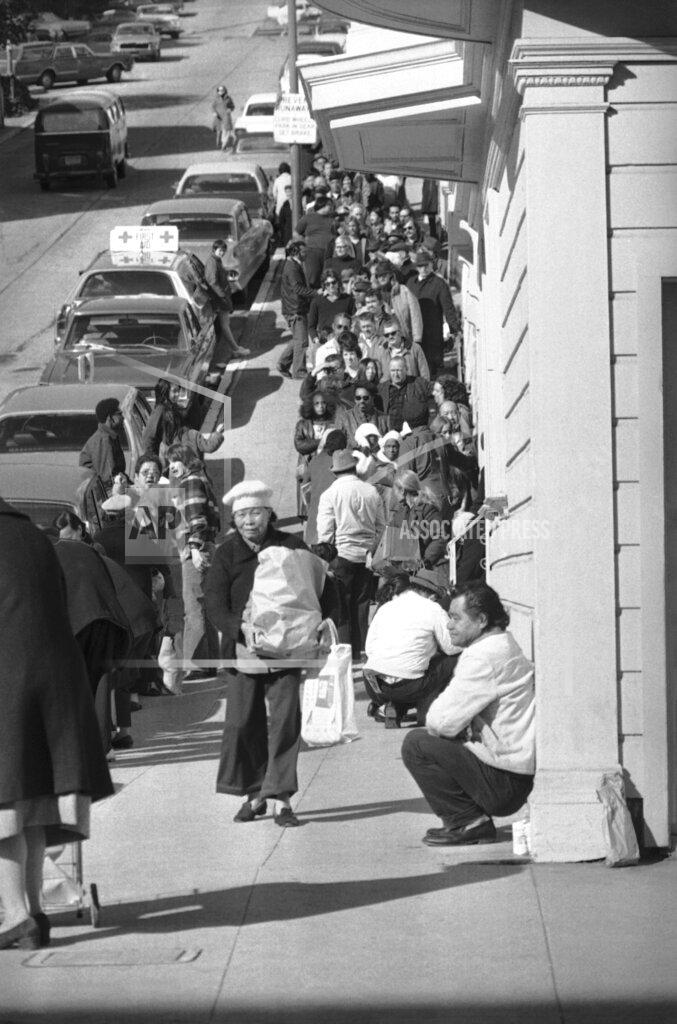
The value of the food ransom offered by Randolph A. Hearst for his daughter’s freedom passed $1‐million today without bringing a response from her kidnappers. Another 35,000 bags of free groceries worth $300,000 at supermarket prices were distributed in the fourth day of the “People in Need” program. It was set up by Mr. Hearst at the demand of the Symbionese Liberation Army, which said it kidnapped Patricia Hearst February 4. A “people in need” program volunteer, asked if he thought those who needed the food were getting it, replied: “Yes, nobody else would stand in line like this.”
A Federal judge today sharply reduced the bond of a man and his wife accused in the kidnapping of The Atlanta Constitution editorial‐page editor, Reginald Murphy and criticized the government’s treatment of one of them. A building contractor, William A. H. Williams, 33 years old, and his wife Betty, 26, pleaded innocent to extortion and other Federal violations in the February 20 abduction. United States District Judge Newell Edenfield’s criticism of government attorneys came after he was informed by Mr. Williams’s lawyer that the FBI had obtained a statement from Mr. Williams without his attorney present. Judge Edenfield reduced the bond for Mr. Williams from $1‐million to $15,000 and that of his wife from $100,000 to $20,000.
The nation’s unemployment rate held steady at 5.2 percent of the labor force in February after three months of increases, the Labor Department reported. In a special analysis, the department found that a maximum of 500,000 workers may have lost their jobs directly or indirectly through the energy shortage, mainly in the automobile industry.
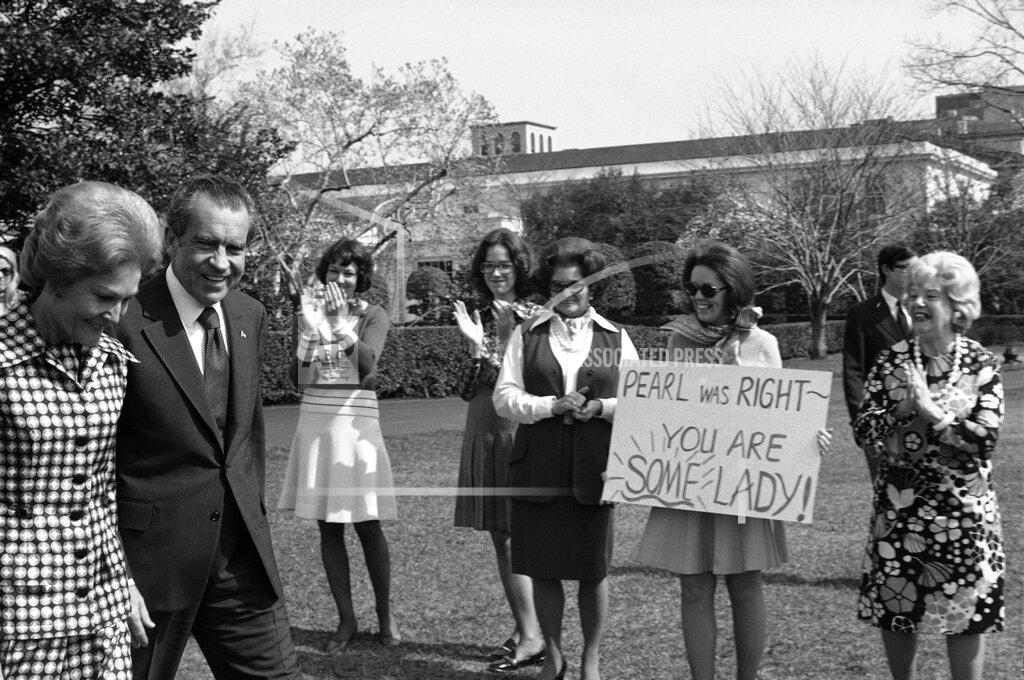
White House staff members staged a farewell for Mrs. Nixon today as she and President Nixon left for a Florida weekend. It was also the first leg of a Latin‐American trip for Mrs. Nixon as the President’s ambassador. About 50 staffers lined up outside the south entrance to the White House as the Nixons were boarding a helicopter for the flight to nearby Andrews Air Force Base. They held printed signs with such messages as “Adios Ambassador Nixon,” “We Love You,” and “Hurry Home. We’ll Miss You.” Mrs. Nixon said a smiling good‐by and the President came over, too, for picture‐taking with the send‐off group. Mrs. Nixon will be leaving from Florida on Monday for six‐day trip as Mr. Nixon’s personal representative to the inaugurations of the presidents of Venezuela and Brazil.
Cable television companies rushed to wire the cities when the Federal Communications Commission, on March 31, 1972, issued new rules that effectively lifted a long-standing “freeze” on the top 100 television markets, but what many had thought would bring a communications revolution by 1974 has instead turned into a retreat.
The U.S. television sitcom “The Brady Bunch” ended its five-season run after the broadcast of its 117th and final original episode before entering re-runs. Since the ABC network hadn’t yet announced its 1974-75 schedule, the season closer was a regular episode. ABC canceled the show on April 24.
Dow Jones Industrial Average: 878.05 (+8.99, +1.03%).
Born:
Steve Sarkisian, CFL quarterback (Saskatchewan Roughriders) and College football coach (Texas), in Torrance, California.
Toran James, NFL linebacker (San Diego Chargers), in Richmond, Virginia.
Mike Moriarty, MLB shortstop, second baseman, and third baseman (Baltimore Orioles), in Camden, New Jersey.
Died:
Martha Wentworth, 84, American actress.



 History Diaries