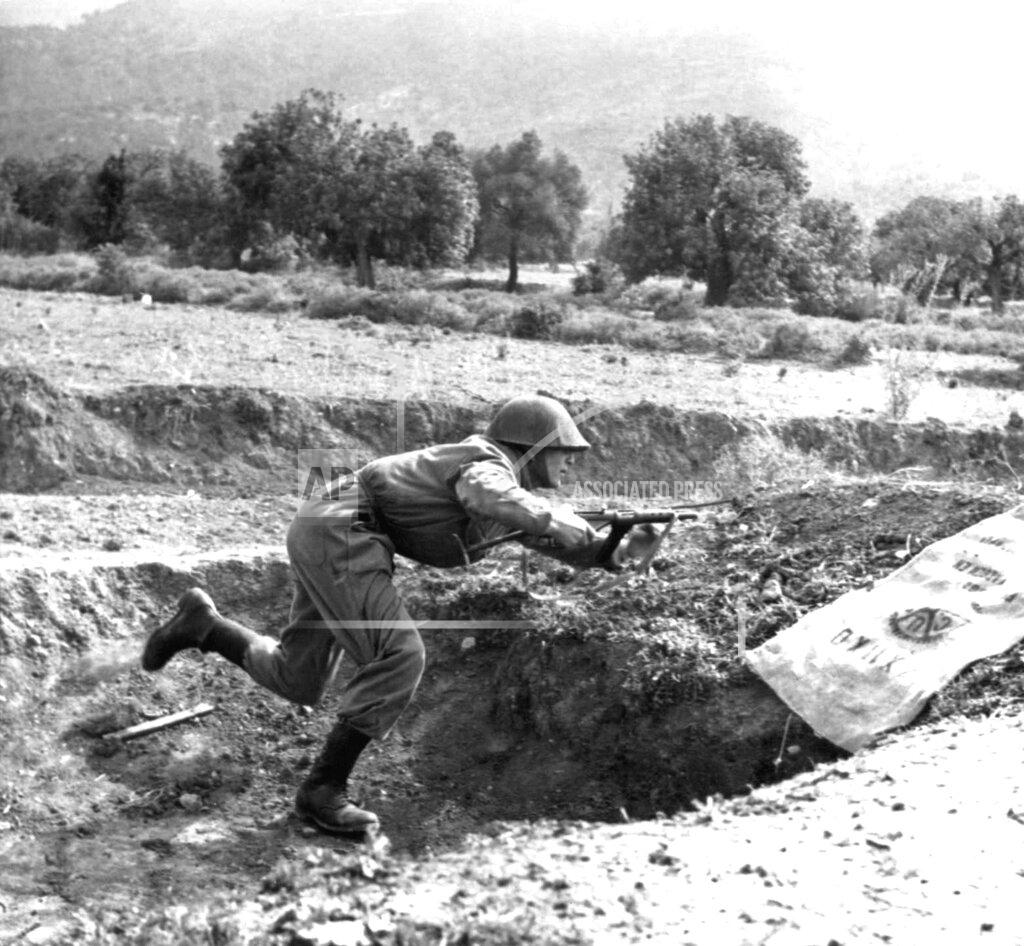
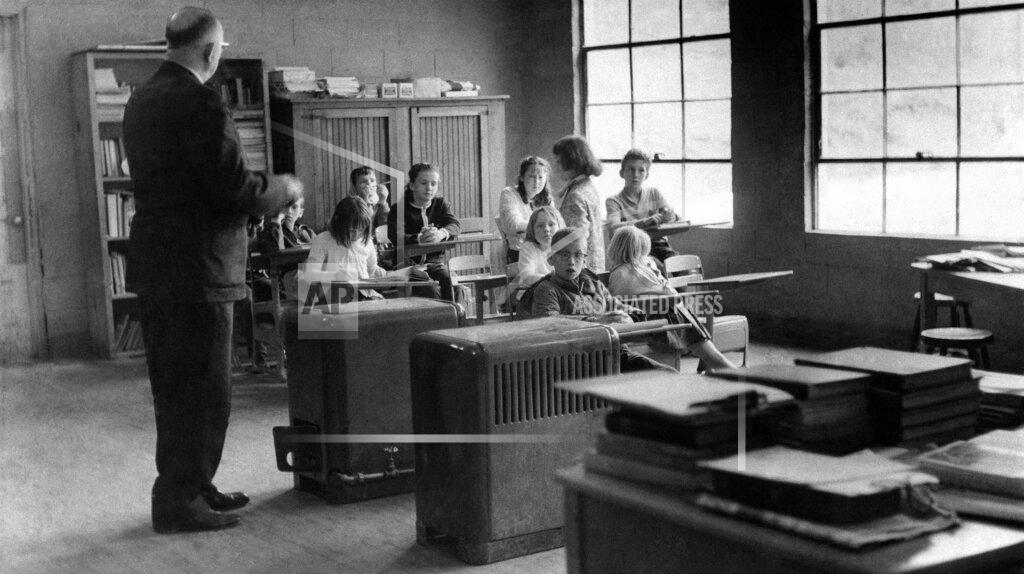
British Army troops engaged in combat in Cyprus for the first time, when two soldiers fired back at Turkish Cypriot combatants in the predominantly Turkish village of Karmi. The gunfire began after an army unit was sent to protect Greek Cypriot schoolchildren.
Heavy gunfire shattered today a tenuous cease‐fire along the northern slope of the Kyrenia range and a time bomb exploded in an arcade of the Turkish Cypriote Communal Chamber in Nicosia. One Cypriote, believed to be of Turkish descent, was killed in the fighting at Kazaphani, east of Kyrenia. Five Turkish Cypriotes were injured, two of them seriously, in the bomb explosion in Nicosia. It was the biggest flare‐up of violence since February 17, when the Cyprus issue was reopened before the United Nations Security Council. The bombing was the first since two bombs exploded February 4 at the United States Embassy here. British forces and a British-Greek‐Turkish truce team sought throughout the day to stop the shooting, which was centered in Ballapais and Kazaphani and in Karmi and Temblos, west of Kyrenia. Kyrenia, a port, was tense but calm. The firing had ceased by nightfall.
The bomb blast at the Communal Chamber, the legislative body of the island’s Turkish minority, occurred at 12:30 P.M. The chamber is in the Turkish sector of Nicosia, about 200 yards north of the dividing line between the Turkish and the Greek Cypriote sectors. The blast shattered the windows of 15 shops. The injured persons were sitting in a cafe near the end of the arcade. The bomb had been placed in a paper bag at the side of a stone stairway in the center of the arcade.
Fazil Kutchuk, Vice President of Cyprus and leader of the Turkish Cypriotes, rushed to the scene. He asserted that there was “no doubt” that the attack had been “an act of Greek Cypriote sabotage.”
PoIycarpos Georgadjis, Minister of Interior who is a Greek Cypriote, countered with an assertion that there was “no doubt” that the planting of the bomb had been “the work of Turkish Cypriotes.” The minister added that Dr. Kutchuk “knows better than anyone else that no Greek is allowed to enter the so‐called Turkish quarter of Nicosia.”
The fatality in Kazaphani, a mixed village, brought the two-day casualty figure in the Kyrenia area to four. The other three — two Turks and one Greek — were injured in shooting yesterday at Kazaphani and Tembios, a Turkish village. Greek Cypriotes living in Bellapais, a village on the slopes, exchanged fire with Turks in Kazaphani, situated at a lower level. Turkish Cypriotes exchanged fire with Greek security forces that had partly encircled Temblos.
As the gunfire echoed along the wooded slopes of the Kyrenia range, Turkish Cypriotes, who hold the pass on the road from Nicosia to Kyrenia, launched a diversionary attack. Their objective was the Greek village of Karmi, which is below St. Hilarion Castle, a Turkish stronghold on the crest of the range. The Turks apparently sought to relieve the Greek pressure on Temblos, situated below Karmi. A truce team and a British parachute unit with armored vehicles entered the village to evacuate children caught in the school near the Turkish positions. British soldiers fired about 20 shots in defense of the children.
Greece’s King Paul’s condition has worsened, a medical bulletin said tonight. There was gloom and consternation at the Tatoi summer palace, 16 miles from Athens, where the Greek royal family has gathered to pray again for the life of the 62-year‐old King. He is unconscious and his physicians have given up hope for his recovery. One said, “He is slowly fading away.”
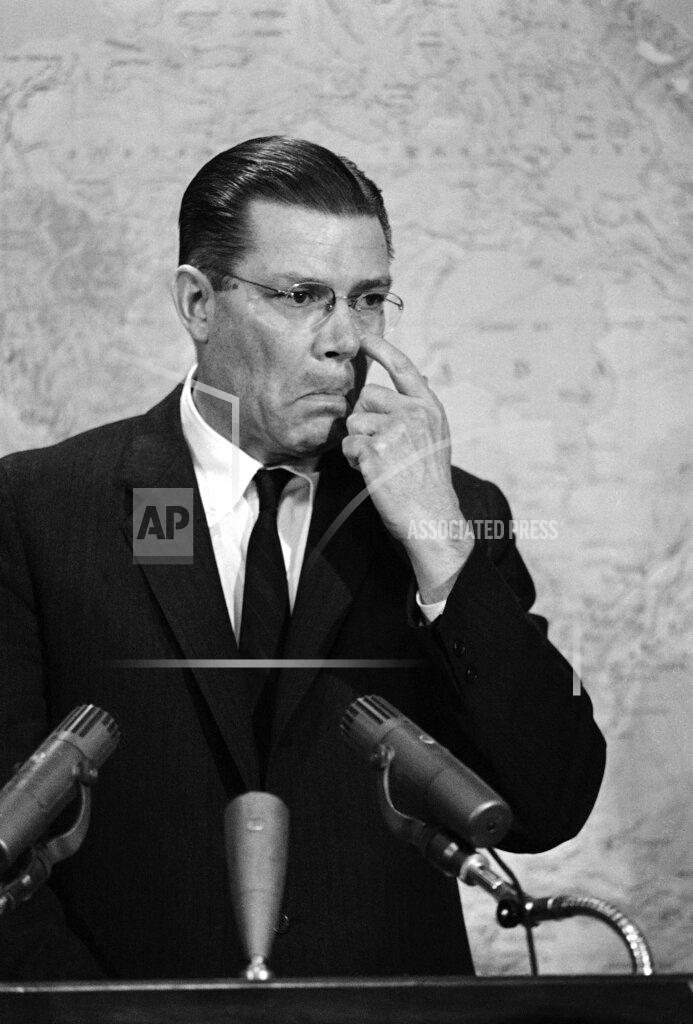
U.S. Secretary of Defense Robert S. McNamara said today there was evidence that North Vietnamese support of the Communist insurgents in South Vietnam was increasing. A growing number of improved and heavier weapons, manufactured in Communist China and supplied by the Communist regime in Hanoi, have been captured from the Việt Cộng guerrillas in South Vietnam during the last six months, the Secretary said. Mr. McNamara did not comment on whether the United States, in backing the South Vietnamese against the Communists, would join in or encourage military retaliation against North Vietnam. The Secretary of Defense discussed the situation in South Vietnam and his mission to that country at a news conference at the Pentagon before departing for major policy meetings with United States and South Vietnamese authorities in Saigon.
Mr. McNamara was to take off at 1:20 AM, Friday, for South Vietnam via Hawaii. President Johnson said last Saturday that he was sending the Secretary of Defense to South Vietnam to “appraise the situation,” which Mr. McNamara said today was “grave,” and to “make recommendations” for future action. Included in the Secretary’s group were General Maxwell D. Taylor, Chairman of the Joint Chiefs of Staff; David E. Bell, head of the Agency for International Development, which administers the assistance programs, and William P. Bundy, the new Assistant Secretary of State for the Far East. John A. McCone, Director of the Central Intelligence Agency, will join the group in Honolulu, after first briefing former President Dwight D. Eisenhower at Palm Springs, California. Late this afternoon, after President Johnson’s return from the funeral of Mrs. Robert F. Wagner in New York, a meeting of the National Security Council was held at the White House.
The South Vietnamese Government warned unspecified “foreign residents” today against participating in plots or espionage or giving assistance to “Communists and pro‐Communist neutralists.” The official warning was given in a communiqué from the Ministry of Information. It said “appropriate measures” would be taken against anyone endangering the “security of Vietnam.” The communique was the first official action on the topic since Premier Nguyễn Khánh accused French agents of plotting to assassinate him. Premier Khanh made the charge in conversations Sunday, but no one else in the government commented on the charge. “Documents, reports and information have given the evidence of such a plot,” the communique read, “which aims at destroying the effort put into the war by the whole people of Vietnam for their survival, a view to force them to accept a solution of neutrality advocated by foreigners and traitors.”
The Joint Chiefs of Staff order a U.S. Air Force air commando training advisory team to Thailand to train Lao pilots in counterinsurgency tactics; this had been proposed in December 1963 and the plan was approved by Thailand’s government in February 1964.
The Polish Government made public today details of its new proposal for a nuclear arms freeze in Central Europe. Pleading for a “serious and constructive approach to our proposal and serious and constructive negotiations,” Foreign Minister Adam Rapacki said the plan was “the result of consistent efforts of the Polish Government to stabilize the situation in Central Europe and to put developments in that area on a path that would lessen tensions and make disarmament possible.” Copies of a memorandum handed last Saturday to Warsaw‐based diplomatic representatives of interested countries were distributed at a news conference today in the Foreign Ministry building.
The memorandum called for the freezing at the present levels of all nuclear and thermonuclear arms “irrespective of the means of their employment and delivery” within an area comprising the territories of Poland, Czechoslovakia and East and West Germany, and including the “respective territorial waters and airspace.” This freeze area could be extended through “the accession of other European states,” the memorandum added. Nations maintaining armed forces in the area, which would include both the United States and the Soviet Union, “would undertake obligations not to produce, not to introduce or import, not to transfer to other parties in the area or to accept from other parties in the area the aforementioned nuclear and thermonuclear weapons,” it said.
Following an attempted coup in Gabon, some Gabonese mistakenly accused the United States as a co-conspirator in the recent coup attempt that had temporarily overthrown President Leon M’Ba, and bombed the U.S. Embassy in Libreville. The explosion, which occurred at a time when the building was closed and locked, “cracked two windows, partially demolished the embassy sign and splattered mud over the front of the building.”
Emergency crisis is proclaimed in Ceylon (now Sri Lanka) due to social unrest. The Government, which is facing strikes that are crippling the country, proclaimed a national emergency today. The immediate cause of the move was a strike by engineers of the national electric power supply system, which plunged the capital into darkness tonight. A strike by Government doctors and medical specialists has crippled public hospitals and Government health services. The doctors are seeking the right to practice privately on their own time. An organized slowdown by post office workers is paralyzing communications throughout Ceylon.
A last‐minute attempt to continue talks on the cease‐fire in Borneo failed today. Tun AbduI Razak, Malayan Deputy Prime Minister, and Salvador P. Lopez, the Philippine Foreign Minister, had canceled their departures this morning. Foreign Minister Subandrio of Indonesia and his party also postponed their departures. However, after several hours of separate talks with Thanat Khoman, the Thai Foreign Minister, who is the host for the meeting, the positions of Indonesia and Malaysia remained unchanged. Discussions were not resumed. Unless there is another shift, the cease‐fire will remain in effect in name only.
Again, the central point of the disagreement was over the bands of Indonesian‐based guerrillas who remained on Malaysian territory after the cease‐fire agreement was reached January 20. The Malaysians continued to insist that they could not discuss a political settlement of the dispute over their federation, which Indonesia opposes, so long as these guerrillas remained.
The Republic of Zanzibar prohibited the use of the pulled rickshaw on its streets, banning the human-pulled taxi as a symbol of feudal exploitation.
The U.S. House of Representatives passed by 238 to 142 today a bill imposing a tax on the purchase of foreign stocks and bonds by Americans. Enactment was urgently sought by the Johnson Administration. The voting was essentially along party lines, with only 13 Republicans voting for the bill and three Democrats against it. Easy passage was achieved because Representative Wilbur D. Mills, Democrat of Arkansas, chairman of the Ways and Means Committee, kept the whole of the Southern Democratic contingent in line for the bill. The bill, which now goes to the Senate, is a major element in the Administration’s program for reducing the deficit in the nation’s balance of international payments and cutting the loss of gold. The tax is retroactive to purchases since last July 19, and the very existence of the proposal has already had dramatic effects.
There have been almost no new issues of foreign securities in New York since the tax was proposed and the gold loss, partly for this reason, was reduced to $15 million in the fourth quarter of last year, one of the smallest losses in six years. The improvement has continued so far this year. Before President Kennedy proposed the tax in a special message on the balance of payments in July, foreign securities were being marketed in New York at the annual rate of $2 billion. Part of the reason for the complete drying up of new issues has been the uncertainty about the bill and what its final provisions would be. Secretary of the Treasury Douglas Dillon has said that he expects new foreign issues to resume once the bill is passed, but on a much reduced scale.
A witness unusually well qualified to testify on his subject pleaded with a Senate committee today to act without delay to give the nation a Vice President. A simple, direct method was proposed by the witness, Richard M. Nixon, a two‐term Vice President whose chief, President Dwight D. Eisenhower, suffered a heart attack, an inflammation of the ileum and a mild stroke. Mr. Nixon said, however, that he would support any method the committee proposed because the important point was prompt action while a sense of urgency prevailed.
Mr. Nixon would authorize the President, whenever a vacancy occurred, to select a Vice President, subject to approval of the Electoral College. He told the Judiciary Subcommittee on Constitutional Amendments that vacancies in the Electoral College could be filled under state laws. The committee chairman, Senator Birch Bayh, Democrat of Indiana, said the former Vice President was the most qualified living person to help the committee with this problem.
Richard M. Nixon underscored today his availability for a second nomination for President. He said he would not take himself off the Oregon primary ballot because to do so required him to sign an affidavit that he would not accept the nomination. The former Vice President has, however, asked the Florida Secretary of State to withdraw a slate of Nixon delegates. He did not authorize the delegate candidates to file in Florida and he understands that, under Florida law, he could have their names stricken. Mr. Nixon has said he believed that a person should not have his name on a state ballot unless he goes into that state and campaigns. Under Oregon law, however, the Secretary of State can decide by reading the newspapers whose name he will put on the preferential primary ballot. The owner of the name can have it withdrawn only by signing the sworn disclaimer. Mr. Nixon said that since he had already declared his willingness to take any Republican assignment he could not consistently sign the affidavit.
A growing write‐in campaign may produce more votes for Robert F. Kennedy for Vice President than Lyndon B. Johnson will get for President in the New Hampshire Democratic primary next Tuesday. Sponsors of the drive, including Governor John W. King, now are urging write‐in votes for the President, too. But The Concord Monitor, the state capital newspaper, commented in an editorial today that “the magic name of Kennedy” might produce an upset next Tuesday “as startling as Senator [Estes] Kefauver’s beating President Truman in a New Hampshire primary” in 1952. Neither Mr. Kennedy nor Mr. Johnson is officially on the ballot. Mr. Johnson is taken for granted here as the Democratic Presidential nominee. For that reason, many Democrats may not take the trouble to write his name on the ballot.
No one, of course, is urging that Mr. Kennedy’s name .be written in as a Presidential choice. But if the concentrated drive to endorse Mr. Kennedy for Vice President produces more write‐in votes for him than Mr. Johnson polls, the President would be damaged politically. Even if Mr. Johnson comes out ahead, a big vote for Mr. Kennedy would put strong and probably unwelcome pressure on the President, who has made it clear that he wants a free hand to choose his own running mate. Either outcome could strain relations between Mr. Johnson and Mr. Kennedy, who have never been close, either personally or politically.
President Johnson, Cardinal Spellman and 1,600 other persons attended the funeral service yesterday for Mrs. Robert F. Wagner, wife of the Mayor of New York. Persons prominent in city, state and national affairs filled the sanctuary and overflowed into a small side chapel and a downstairs hall in the Madison Avenue Presbyterian Church. At the Mayor’s request, the half‐hour service — composed of prayer, Scripture readings and choral anthems—was conducted according to the regular Presbyterian form. The Rev. Dr. David H. C. Read, the pastor, led the service from the Book of Common Worship.
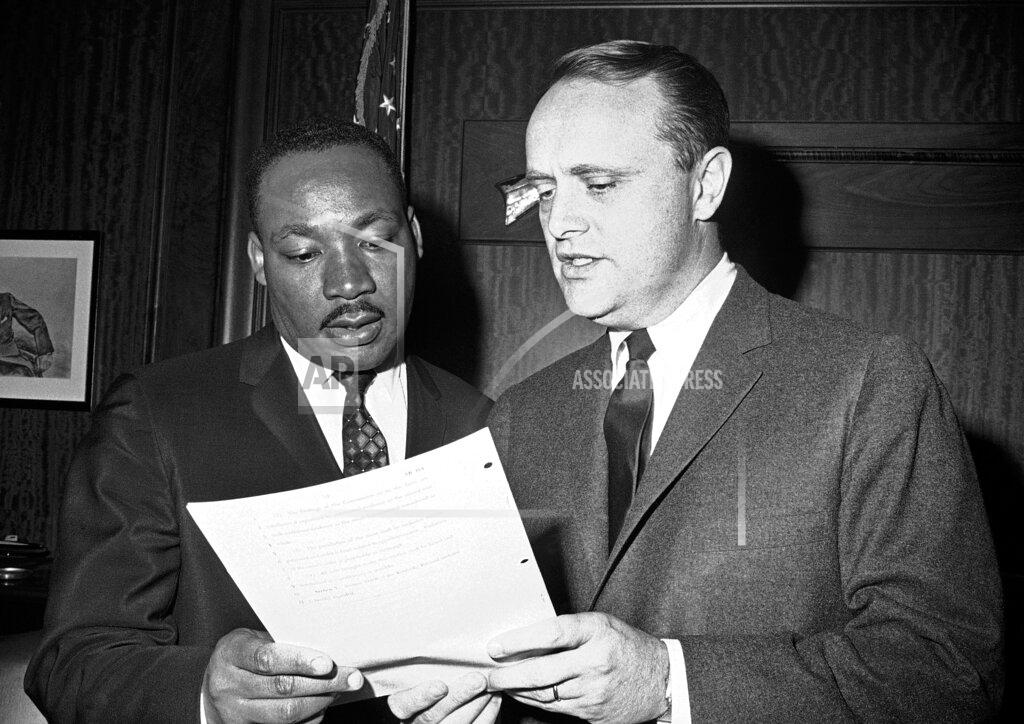
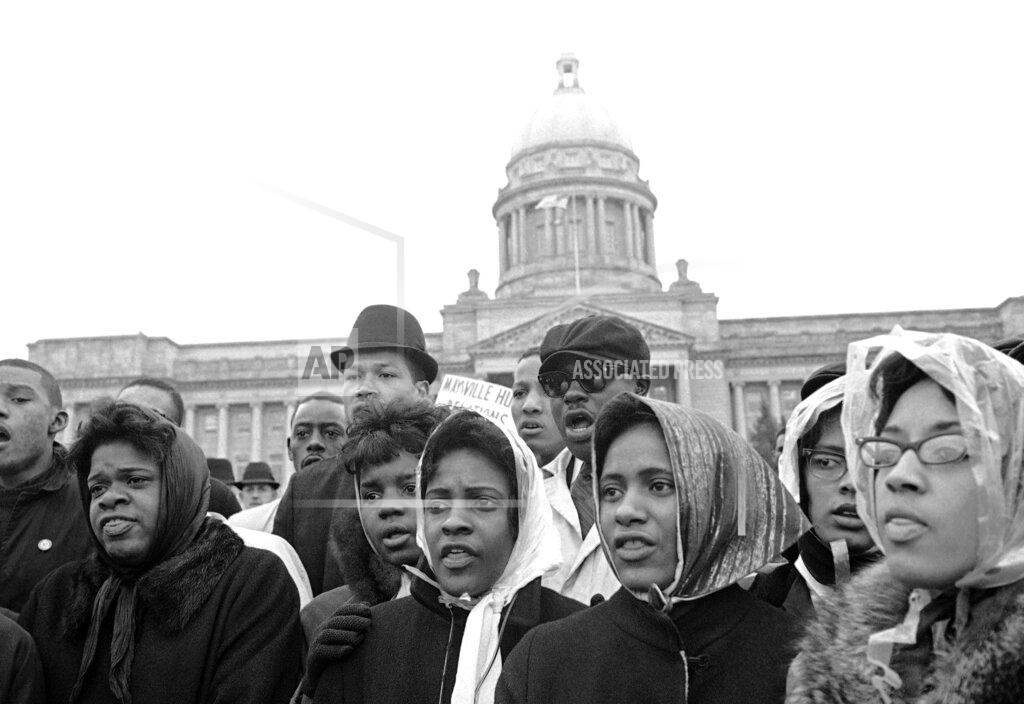
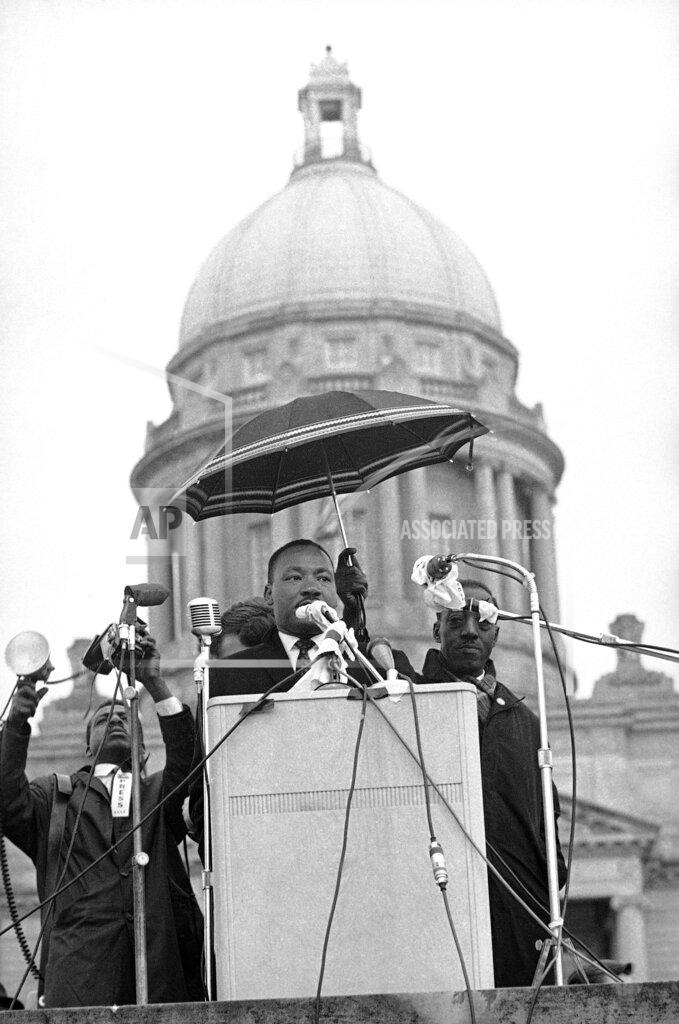
Close to 10,000 people from in and around Kentucky gathered at the state capitol for a peaceful civil rights demonstration which has become known as The March on Frankfort, one in a series of civil rights marches lead by the Rev. Dr. Martin Luther King, Jr. The Allied Organization for Civil Rights (AOCR) coordinated this effort. Among its members were Officers Frank Stanley, Jr., editor of The Louisville Defender; Dr. Olof Anderson, Synod Executive of the Presbyterian Church; and a young Georgia Davis Powers. Powers, who later became the first African American and the first woman to be elected to the Kentucky State Senate in 1967, states this was the beginning of her civil rights activism. Governor Breathitt fought hard for the public accommodations bill. And although it was unsuccessful in 1964, in 1966 the Kentucky General Assembly passed the Kentucky Civil Rights Act. Dr. King called it “the strongest and most comprehensive civil rights bill passed by a Southern state.”
Jack L. Ruby told the police after shooting down Lee H. Oswald that he had intended to put three bullets into the alleged assassin of President Kennedy, two Dallas detectives testified today. One of the detectives further stated that Ruby, when upbraided by a police captain for killing Oswald, replied: “Somebody had to do it. You guys couldn’t do it.” Ruby, on trial for murder with malice, was able, to fire only one shot into Oswald November 24 before policemen knocked him down and seized his revolver. The testimony of the two detectives struck heavily at the defense contention that the shooting was not premeditated and that Ruby was insane at the moment he shot Oswald.
Federal Judge Archie O. Dawson denied yesterday a motion by Roy M. Cohn to dismiss the perjury and conspiracy indictment against him because of a mail watch. Judge Dawson ruled that no law or constitutional right had been violated by the mail watch on Mr. Cohn and his lawyer, Thomas A. Bolan. The watch had been ordered by the office of United States Attorney Robert M. Morgenthau.
The judge, in his ruling, declared: “It is shocking to think that the Government, after an indictment is filed, may put a mail watch on the attorney for the defendant which might, in some cases, possibly lead to discovery of steps defense counsel was using in preparing for trial.” Judge Dawson said, however, that there was no indication that the watch brought such a result.
Atlanta Mayor Ivan Allen, Jr., says he has a verbal commitment from a Major League baseball club to move there if a stadium is ready by 1965. A $15 million stadium is approved the next day by the city Board of Aldermen.
Dow Jones Industrial Average: 803.77 (-0.93).
Born:
Reggie Williams, NBA small forward (Los Angeles Clippers, Cleveland Cavaliers, San Antonio Spurs, Denver Nuggets, Indiana Pacers, New Jersey Nets), in Baltimore, Maryland.
Scott Skiles, NBA point guard (Milwaukee Bucks, Indiana Pacers, Orlando Magic, Washington Bullets, Philadelphia 76ers), in LaPorte, Indiana.
Brett Petersmark, NFL center (Houston Oilers), in Royal Oak, Michigan.
Yoshua Bengio, Canadian computer scientist (Turing Award), in Paris, France.
 History Diaries