The United Nations Security Council unanimously adopted Resolution 186, providing for a multinational peacekeeping force for Cyprus. UNFICYP would become operational on March 27. The Security Council unanimously approved a resolution on Cyprus today that provides for an international peace‐keeping force and a mediator reporting to the Secretary General, U Thant. Mr. Thant in turn is to report periodically to the Security Council. This satisfies demands of some members for Security Council authority. Mr. Thant immediately began consultations on troop contingents for the force. A spokesman announced that the Secretary General had made formal requests to Brazil, Canada, Finland, Ireland and Sweden.
In accepting the assignment Mr. Thant told the Council that the problem of setting up the force was “delicate and difficult” because of limitations on choice, but that he believed he could organize it. He has said it would be limited to units of Commonwealth and nonaligned member countries and some of the British troops now there. Mr. Thant had meetings this afternoon and evening with the Cypriote Foreign Minister, Spyros Achilles Kyprianou, Turgut Menemencioglu of Turkey. Dmitri S. Bitsios of Greece and Sir Patrick Dean of Britain. The spokesman said there would be no information on the identity of the mediator or of the commander of the international force until Mr. Thant received replies to his request for troops, made immediately after passage of the resolution. Reliable sources have said the commander is to be Lieutenant General Prem Singh Gyani of India, who has been Mr. Thant’s personal observer in Cyprus. There has been widespread speculation on the identity of the mediator. The name most heard has been that of C. W. A. Schurmann of the Netherlands.
A Greek Cypriote trade delegation headed by Andreas Araouzos, Minister of Commerce and Industry, will leave Friday for the Soviet Union on the first official Aeroflot flight of the new commercial air link between Nicosia and Moscow. The mission is another of the recent manifestations of increasingly close relations between the Soviet Union and Cyprus.
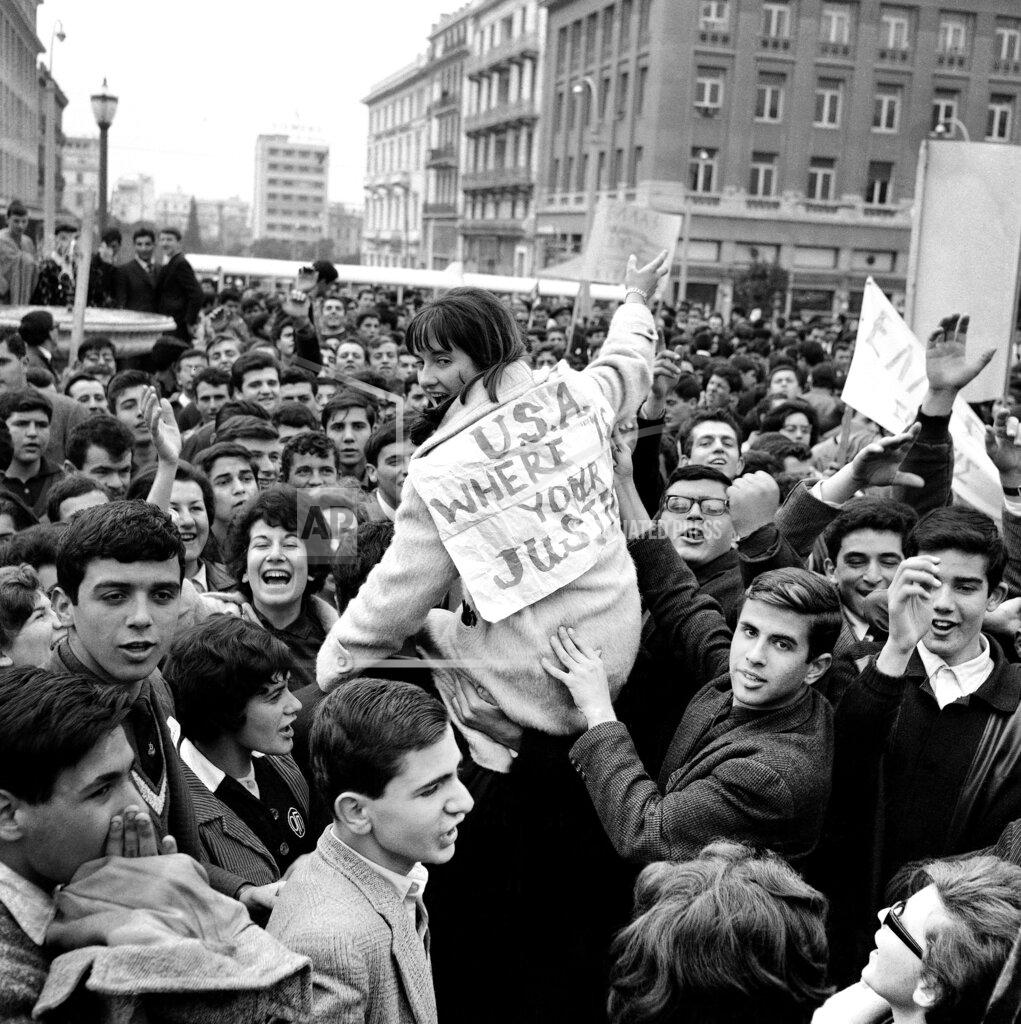
As demonstrations mounted in Athens and elsewhere, the United States Information Service announced tonight that the scheduled six‐day visit of 11 units of the United States Sixth Fleet, due to start tomorrow, had been “temporarily postponed at the suggestion of the Greek Government.” Only yesterday Foreign Minister Stavros Costopoulos assured Henry Labouisse, the United States Ambassador, that the warships would be welcome. The ships, including the aircraft carrier USS Shangri‐la, have just completed maneuvers with Turkish ships in the central Aegean. However, hostility toward the United States and Britain became more bitter and widespread today despite the United Nations Security Council’s adoption of a peace‐force plan for Cyprus.
The demonstrations, stirred by reports that the United States and Britain favored the Turkish minority in Cyprus over the Greek majority, have tended to grow because of the more liberal outlook the new Government adopts toward street demonstrations. The Communists have been quick to exploit this. Some of the slogans shouted by the demonstrators seem to have no bearing on the Cyprus issue. Demonstrators shouted and paraded outside the United States and British embassies. At one time a group of black-robed theological students stood outside the embassies chanting hymns for the salvation of Cyprus. A bronze statue of Harry S. Truman was daubed with whitewash and “Go home, Yankee” was scrawled on it. In Salonika, 30,000 Greeks rallied to hear civic leaders denounce America and Britain for “anti‐Greek bias” on Cyprus. Objections were also voiced about the visit of the Sixth Fleet.
Although the U.S. government is said to be advising South Vietnam not to sever ties with France over Khánh’s charge on 2 March that the French were plotting to assassinate him and impose a neutralist settlement, Americans in Vietnam report growing sentiment there for neutralism; to encourage the French, the Việt Cộng release four French citizens they have held prisoner. Many Americans here feel that General Khánh went too far with these charges, which he has yet to document publicly. They agree, however, that current French political influence is unhealthy for the anti-Communist struggle being pursued by the Saigon regime with American assistance. The increasingly anti‐French feeling of highly placed Americans here is a result of President de Gaulle’s continuing pronouncements for neutrality, which they feel are undercutting the United States effort to resist Communist advances in Southeast Asia.
United States authorities said today that Việt Cộng guerrillas wiped out a platoon of South Vietnamese militiamen yesterday in the mountains of Quảng Ngãi Province 320 miles northeast of Saigon. Outnumbered two to one, the Government force lost 5 killed, 15 wounded and 12 missing, the authorities said. Việt Cộng casualties were not determined. Reporting on a command change, usually reliable sources said that Premier Nguyễn Khánh had promoted Brigadier General Dương Văn Đức to major general and assigned him to command the Vietnamese army’s Fourth Corps. Almost all the Fourth Corps area, on the southern tip of Vietnam, is dominated by the Communists. General Đức replaces Brigadier General Nguyễn Hữu Có. There was no immediate information on a new assignment for General Có.
The Quảng Ngãi battle was the third significant action of the day. In the other two, previously reported, two American advisers were among the dead. They were Captain Morris R. McBride of Columbus, Georgia, killed 30 miles northwest of Saigon, and Captain Thomas W. McCarthy of Fayetteville, North Carolina, killed in an engagement near the Cambodian frontier.
The Chinese Communist party said today that United States reverses in South Vietnam had encouraged revolutionary action in other countries of Asia and in Africa and Latin America. Peking said that defeat of the tactics used by the United States advisers in South Vietnam proved that revolutionary forces could overcome the superior military strength of the United States. The call to other left‐wing movements to emulate the Việt Cộng was part of a long editorial in Jenmin Jih Pao, the Chinese Communist party organ. It commented on lessons to be learned from the war in South Vietnam. Analysts here said the editorial demonstrated that Peking viewed the struggle in South Vietnam as a pivotal one whose outcome would affect the East-West struggle.
In the U.S., Pennsylvania Governor William W. Scranton contended today the United States should go all‐out to save South Vietnam from a Communist victory. Mr. Scranton’s told his weekly news conference that on the basis of published reports, he thought the Vietnamese situation was obviously in bad shape. He said he believed Defense Secretary Robert S. McNamara’s report on his planned inspection trip to Southeast Asia would clear up some of the confusion.
Senator Wayne Morse, Democrat of Oregon, criticized United States policy in Asia in a Senate speech today and urged that the voters demand clarification of Administration plans in South Vietnam. Mr. Morse said he made the speech because of a briefing given yesterday by Secretary of State Dean Rusk to the Foreign Relations Committee, of which Morse is a member. Mr. Morse said it would be a mistake for the United States to send conventional forces to fight in North Vietnam. “I am opposed to it,” he said, “because American involvement in any Asian conflict is going to be a nuclear involvement. I am satisfied that there is no other way this country could meet the manpower and geographic advantages that a Chinese‐backed force would have over us.”
The 25th formula for settling the Panama crisis appeared to make no headway tonight. Diplomatic sources said that neither the United States nor Panama had found the new text acceptable in its present form despite some earlier optimism. Juan I. Plate of Paraguay, chairman of a mediation team of the Organization of American States, said the group would seek approval of the formula in new meetings tomorrow. The five‐nation committee was in constant touch all day with representatives of the State Department and Miguel J. Moreno Jr., Panama’s chief representative at the O.A.S. The group submitted yesterday a new draft based on recent conciliatory statements by Presidents Johnson and Roberto F. Chiara of Panama. It called for restoration of diplomatic relations and negotiations on outstanding issues.
A conference on the Malaysian crisis foundered in Bangkok, Thailand today and Prince Abdul Rahman announced that Malaysia would take the dispute with Indonesia to the United Nations. The talks between Indonesia, the Philippines and Malaysia bogged down over differences of opinion about the cease‐fire arranged in January by Attorney General Robert F. Kennedy. A statement issued by the Malaysians appeared to be a warning that they considered the cease‐fire to be void. The Malaysian Prime Minister called on his people to give their lives if necessary in defense of the country. He charged that the Indonesians had never carried out their side of the bargain. “To them a cease‐fire means that we cease but not they, with the result that many of our men were taken unaware and shot down in cold blood,” he said.
King Paul of Greece was critically ill tonight in his summer palace at Tatoi, his family’s private estate 16 miles north of Athens. Greece’s holiest icon lay at the bedside of the 62‐year‐old monarch. Queen Frederika, Price Constantine and the Princesses Irene and Sophia stood around the King. They prayed for a miracle from the jeweled gold Icon of the Holy Virgin of Tenos, the island shrine of the Greek Orthodox Church. A medical bulletin tonight gave the first indication of despair. It said that the King’s general condition was showing “serious deterioration.”
Teamsters union leader Jimmy Hoffa is convicted of jury tampering. Teamsters President Jimmy Hoffa was found guilty by a federal jury in Chattanooga, Tennessee on two counts of jury tampering that had happened in 1962. The conviction was the first after four previous trials on other federal charges had ended in an acquittal. Hoffa was released after posting a new bail bond for $75,000 pending the appeal of the verdict and his 8-year prison sentence. His appeals would finally be exhausted three years later, and he would begin his sentence on March 7, 1967.
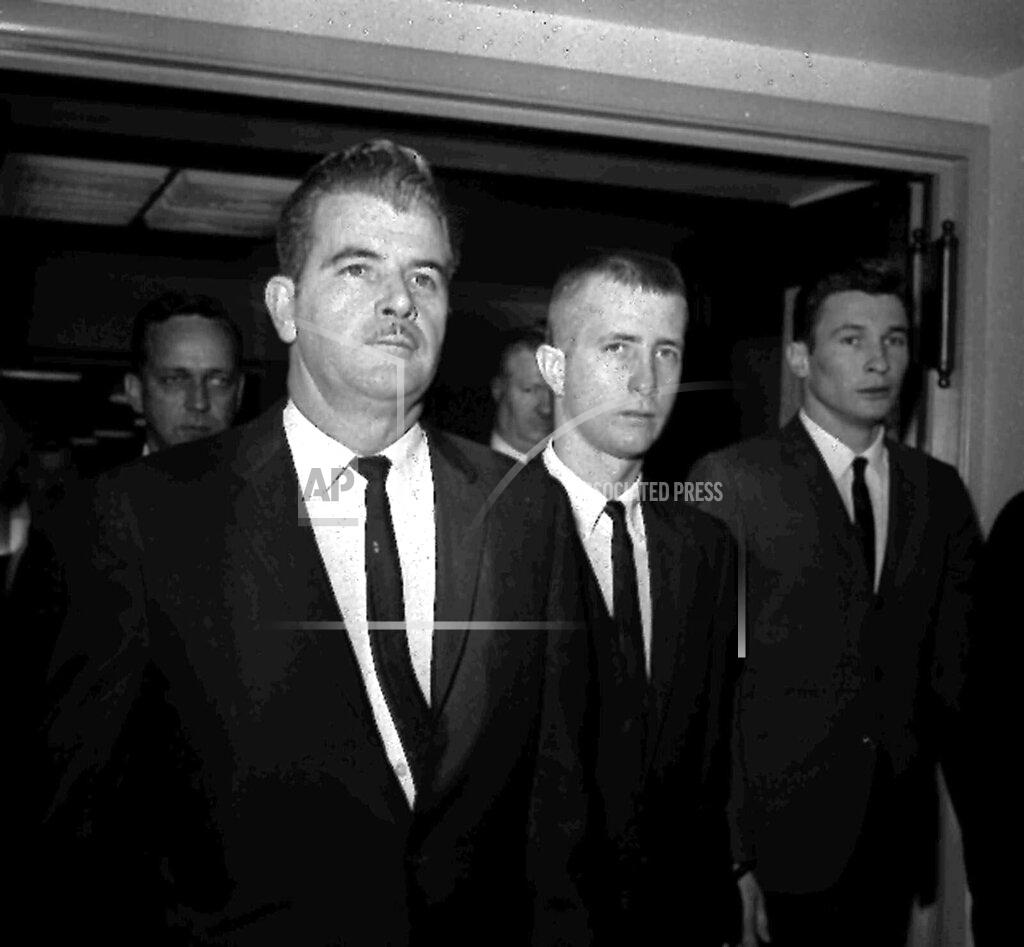
Convicted with Hoffa on one count each of jury‐tampering were Ewing King, 50, recently defeated as president of Teamsters Local 327 in Nashville; Larry Campbell, 39, a business agent with Hoffa’s home local in Detroit, and Thomas E. Parks, 50, Campbell’s uncle, a Nashville funeral home employee. Two defendants were acquitted. They were Allen Dorfman, 41, a Chicago insurance broker with close personal and business ties to Hoffa, and Nicholas J. Tweel, a Huntington, West Virginia, businessman who has done business with Mr. Dorfman.
Hoffa’s conviction was not expected to start a revolt against him within the union. AIthough there have been rumblings of discontent with his leadership, he has tight control of the union and no one was expected to come forward immediately to lead an attempt to unseat him unless he is put in prison.
Attorney General Robert F. Kennedy refrained from expressing any personal satisfaction today about the criminal verdict returned against James R. Hoffa. Senator John L. McClellan, Democrat of Arkansas, commented dispassionately on the verdict. With Mr. Kennedy, the Senator had questioned Hoffa long and often in Senate hearings. The American Federation of Labor and Congress of Industrial Organizations, which expelled Hoffa’s International Brotherhood of Teamsters, said pointedly that it would have “no comment.” Mr. Kennedy, whom Hoffa had accused of waging a vendetta, said, “It was in the hands of the jury, and the jury has given its decision.” He congratulated the Federal attorneys “for their handling of the prosecution.”
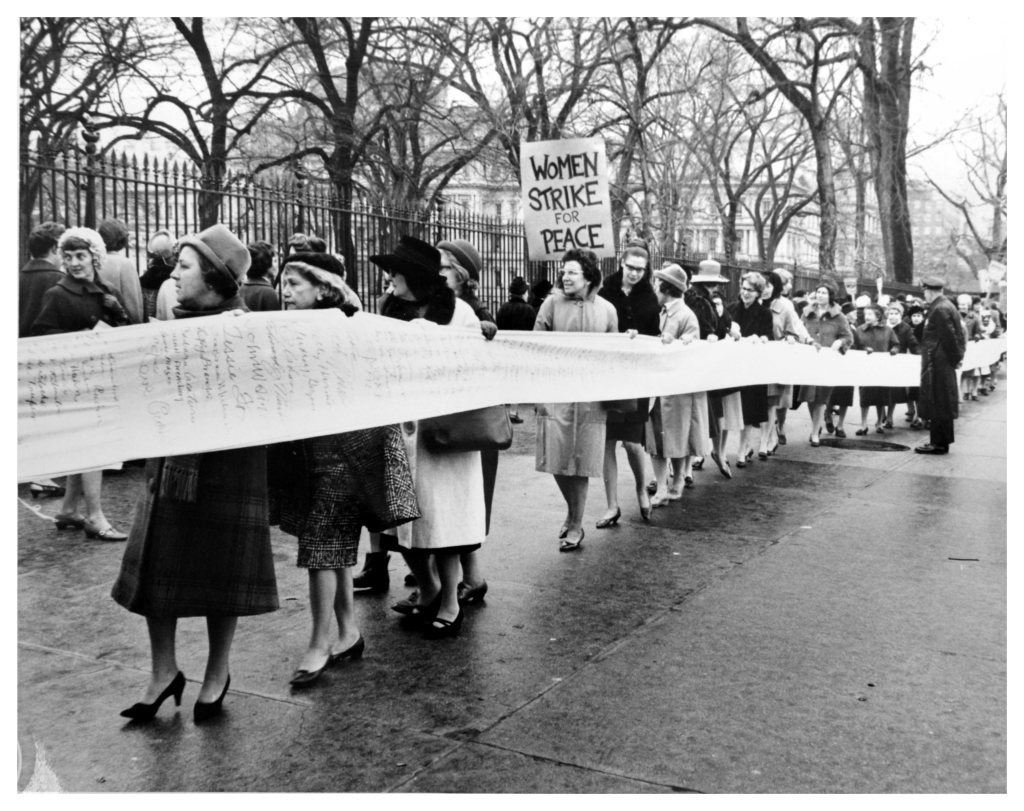
Nearly 400 women picketed the White House Wednesday afternoon in a demonstration urging President Johnson to “make 1964 the year the world turned away from war.” Members of Women’s Strike for Peace from New York, Connecticut, New Jersey, Pennsylvania, Maryland, Virginia and the District of Columbia were lobbying for a peace program that includes strong opposition to the proposed NATO multi-lateral force (MLF). As they marched along Pennsylvania Ave., led by WSP founder Dagmar Wilson of Washington, they unfurled a 250-yard-long banner of dish toweling bearing thousands of signatures.
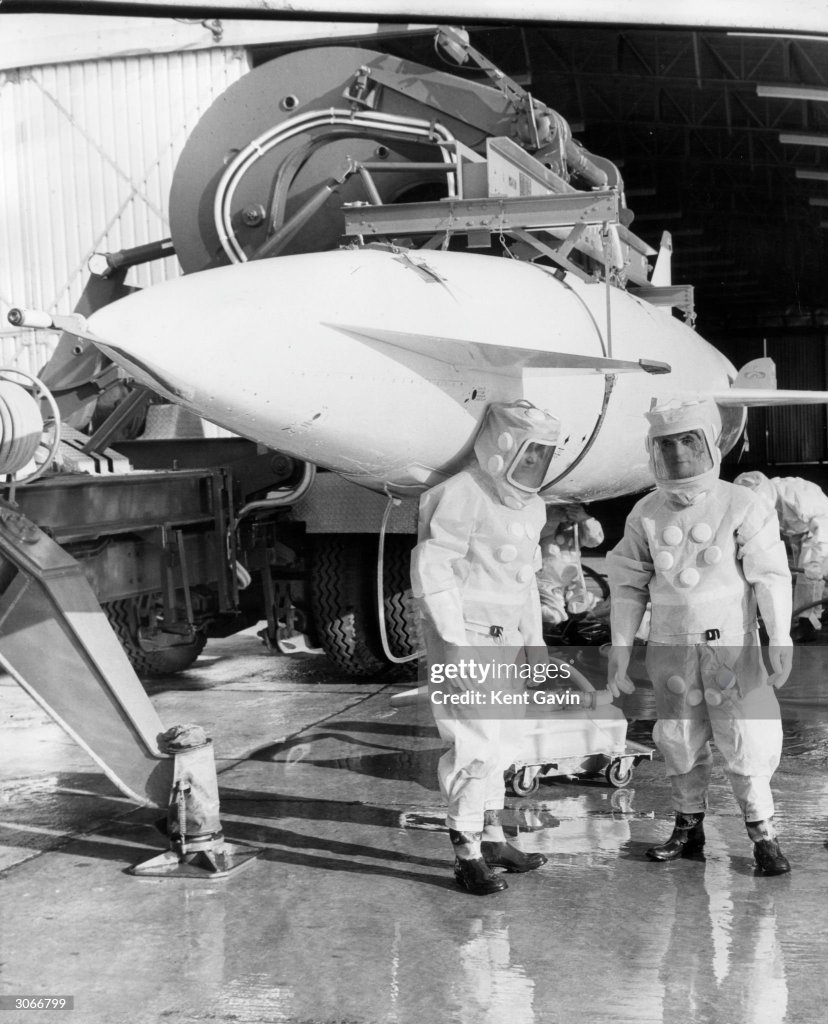
[The Multilateral Force (MLF) was an American proposal to produce a fleet of ballistic missile submarines and warships, each manned by international NATO crews, and armed with multiple nuclear-armed Polaris ballistic missiles. The proposal was floated by the Eisenhower, Kennedy, and Johnson administrations. The proposal sparked protests and withered when American and European differences over basing strategies and financing could not be reconciled and died when the 1968 Nuclear Non-Proliferation Treaty was signed.]
The Senate almost staged a full‐dress debate today on whether smoking caused cancer but cut it off by refusing to kill Federal price supports on tobacco. On a roll‐call vote of 63 to 26, the Senate rejected an amendment to the pending farm bill that would have wiped out tobacco subsidies on the ground that tobacco was an evil or that the Federal support program was too costly. Tobacco subsidies have been in effect 30 years. Tobacco‐state Senators argued that elimination of price supports on the rich crop would bring uncontrolled production of cheap tobacco rather than a curb on cigarette smoking, which has been cited as a health menace in a government report. The vote was in line with the Administration’s fight to keep the wheat‐cotton farm bill free of amendments. Democratic leaders regard this as necessary to assure approval by the House of Representatives and to avoid any threat of a Presidential veto.
The House Agriculture Committee reversed itself today and approved a permanent countrywide food stamp program for needy families. It had shelved the plan, a key project of President Johnson’s war on poverty, a month ago by a vote of 19 to 14. The panel’s vote of 18 to 16 today, however, provided that participating states pay half the costs, and reduced requested appropriations authorizations. Representative Leonor K. Sullivan, Democrat of Missouri, the author of the bill and sponsor of such a program for a decade, termed the amendment “crippling or worse.”
The House passed and sent to President Johnson today a bill continuing the airport development program for three years and authorizing $225 million to pay the costs. Final action on the bill came when it was passed by the House on a voice vote. The Senate passed it last week. The final bill, a compromise version, omitted a provision originally inserted by the House. This provision, aimed directly at White House executive orders against segregation, would have exempted airport projects from these orders unless specifically authorized by Congress.
Advocates of a $10,000‐a‐year pay increase for members of Congress invoked a doctrine of “comparability” today and won favorable action by the House Rules Committee. The committee cleared for House consideration next week a bill to increase the salaries of 1.7 million Federal employes; including Senators and Representatives. The vote was 8 to 3. The “comparability” principle was cited at a public hearing at which seven Representatives testified for the bill and one testified against it. The doctrine, as explained by Representatives Robert J. Corbett, Republican of Pennsylvania, and James H. Morrison, Democrat of Louisiana, holds that Federal pay scales should be comparable to those of private industry.
Mark Lane, an attorney from New York City, asked for and was granted the opportunity to appear before the Warren Commission for the stated purpose of representing the interests of the late Lee Harvey Oswald, who had been charged with the assassination of President John F. Kennedy. Lane, who would write the bestselling book Rush to Judgment and who would become the most well-known proponent of JFK conspiracy theories, showed the group news photographs from the assassination scene which he believed had been altered. Commission member and future U.S. President Gerald Ford told reporters later that Lane “was given a fair hearing. He put his ideas in the record, and all will be checked out.”
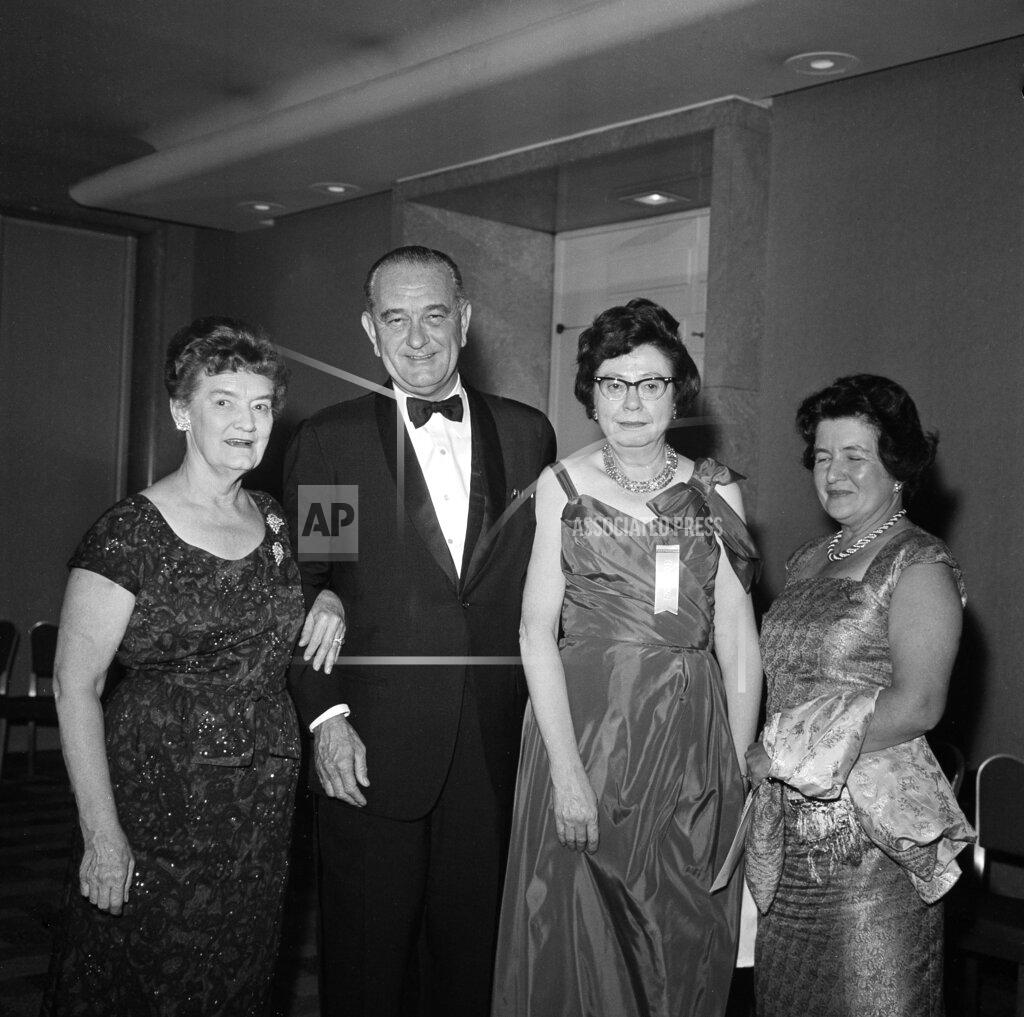
President Johnson appointed a woman as Ambassador and named nine other women to Government posts tonight as part of his pledge to end a “stag Government.” At a dinner at which the first Eleanor Roosevelt Memorial Award was presented to Mrs. Anna M. Kross, Commissioner of Corrections in New York City, the President said: “Our determination to enlist women in this Administration is no sporadic, election‐year objective. It will be a continuing aim not because it is politic but because it is sound.” He chose Mrs. Leon Keyserling of Washington, an economist, to be director of the Women’s Bureau in the Labor Department. She is the wife of President Truman’s economic adviser. She succeeds Mrs. Esther Peterson, who has become the President’s adviser on consumer affairs.
Former President Dwight D. Eisenhower suggested today that a President be empowered to name a successor immediately a vacancy occurs in the office of the Vice President. General Eisenhower also recommended a system of Cabinet, and possibly Congressional, review of any decision to name an “acting President” in the event disability struck the President. He made his views on Presidential succession and disability known publicly for the first time in a letter to Senator Birch Bayh. The Indiana Republican had sought General Eisenhower’s opinion. Former Vice President Richard M. Nixon, who confronted these issues when General Eisenhower became ill three times during his White House tenure, testifies tomorrow before Mr. Bayh’s Judiciary subcommittee on succession problems.
A key witness for the prosecution testified today that Jack L. Ruby said “I hope the son of a bitch dies” a minute after he shot Lee H. Oswald in the basement of the Dallas police station November 24. With this testimony by Detective J. R. Leavelle the prosecution sought to contradict the defense contention that Ruby was in a state of mental blackout when he shot the accused assassin of President Kennedy. Under cross‐examination by the chief defense counsel, Melvin M. Belli, Mr. Leavelle conceded that Ruby’s outburst might have been prompted by hearing someone shout, “Jack, you son of a bitch, you shot Oswald,” or that it might have been his reaction to the general outcry: “Oswald is shot, Oswald is shot.”
Dow Jones Industrial Average: 804.7 (-1.02).
Born:
Emilia Eberle [Gertrúd Emilia Eberle, now known as Trudi Kollar], Romanian gymnast (Olympic silver medals, Uneven bars and Team, 1980), in Arad, Romania.
Tom Lampkin, MLB catcher and pinch hitter (Cleveland Indians, San Diego Padres, Milwaukee Brewers, San Francisco Giants, St. Louis Cardinals, Seattle Mariners), in Cincinnati, Ohio.
Gord Kluzak, Canadian NHL defenseman (Boston Bruins), in Climax, Saskatchewan, Canada.
Jocelyn Gauvreau, Canadian NHL defenseman (Montreal Canadiens), in Masham, Quebec, Canada.
Pat Swoopes, NFL nose tackle (New Orleans Saints, Kansas City Chiefs, Miami Dolphins), in Florence, Alabama.
Stacey Driver, NFL running back (Cleveland Browns), in Griffin, Georgia.
Mitch Andrews, NFL tight end (Denver Broncos), in Houma, Louisiana.

 History Diaries