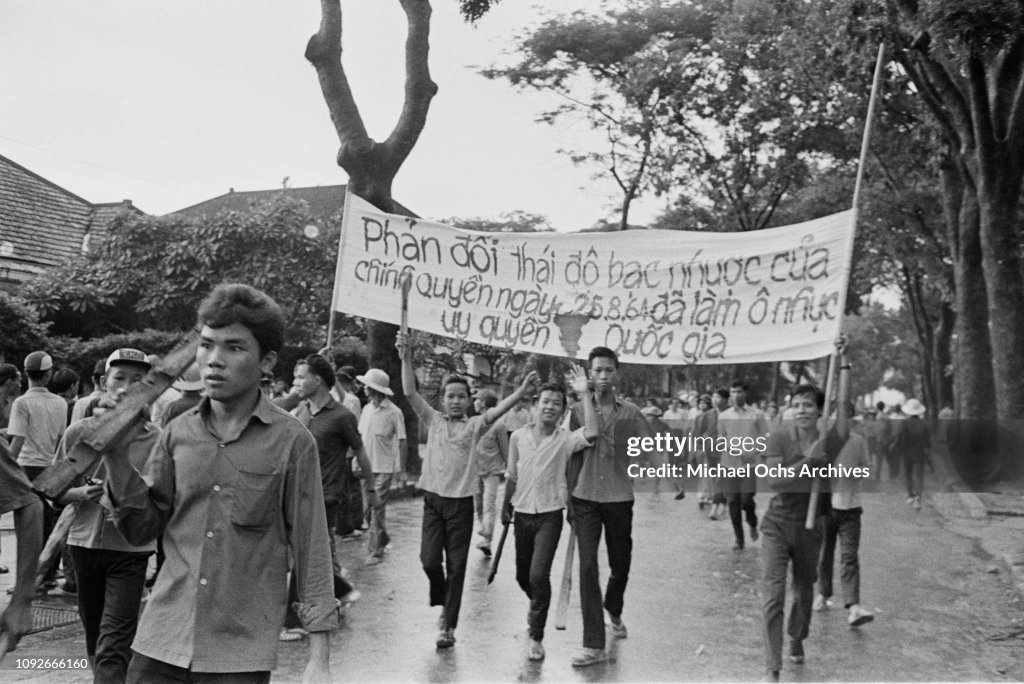
William Bundy, Deputy Secretary of Defense for International Security Affairs, sends President Johnson a series of recommendations for extending the war against North Vietnam including the blockading of Haiphong Harbor and the bombing of North Vietnamese railways. Beyond this, Bundy points out that such actions require some form of legislative endorsement short of a declaration of war, and he recommends that the President obtain a congressional resolution.
After a temporary delay because of bad weather, the destroyer USS Craig begins the DeSoto Mission this month called for by Oplan 34A to gather intelligence about North Vietnamese installations on the Gulf of Tonkin.
The South Vietnamese Premier, Major General Nguyễn Khánh, charged today that French agents were plotting to assassinate him, overthrow his government and join with the Communists to impose neutralism as a settlement in Vietnam. Answering questions, Premier Khánh said the same French agents were backing the Communist Việt Cộng insurgents in a terrorist campaign against Americans in Saigon. Khánh said Ambassador Henry Cabot Lodge knew about the plan. Premier Khánh’s statements today represented the first time he had publicly named France as an enemy of his month‐old regime. On seizing power January 30, he charged that French agents had been plotting with some deposed generals to bring about a neutral settlement of South Vietnam’s war against the Communist guerrillas. French officials in Saigon and Paris promptly denied the reports. Despite the insistence of Vietnamese officers outside his own junta, General Khánh has not yet published evidence for his accusations.
The progress the new Government has made in the war is meanwhile being assessed, a month after the coup. The outlook is made gloomy by an apparent inability to meet short term challenges.
Only Britain and Italy of the United States’ 14 allies in the North Atlantic Treaty Organization are prepared to support any action by the Johnson Administration that would mean an extension of South Vietnam’s war to North Vietnam. West Germany and the Netherlands want a military victory for South Vietnam in the guerrilla war now being waged against the Vietcong rebels. But they are fearful of any step that might involve Communist China and lead to global war. France, committed to negotiation, neutralization and unity for Vietnam, is the most outspoken of the NATO countries opposed to extension of the war. Belgium and Denmark are also opposed.
An informed Greek Cypriote Government source said tonight that the draft of a compromise resolution on Cyprus prepared for presentation to the United Nations Security Council tomorrow was “closer to our views but still in need of modifications.” The source declined to discuss the proposed resolution in detail or to say what modifications were being sought by the Government because, he said, the situation at the United Nations was still “fluid.” Nonetheless his remarks served to encourage the faint hopes that something positive might come out of tomorrow’s session of the Council. As one Western diplomat put it cryptically: “Something equally unsatisfactory to everybody may emerge, which will allow us to get off of dead center.”
The Greek Cypriote ministers met with Archbishop Makarios this afternoon. The resolution and the President’s reply to Premier George Papandreou of Greece were understood to have been the main topics. The Greek Premier sent a message to the archbishop last week seeking the Cypriote leader’s views and asking greater coordination between Athens and Nicosia. The archbishop’s reply, which was described as a “long exposition” of the Greek Cypriote position, was completed tonight. Two members of the Government will fly to Athens tomorrow with the response.
The island was calm today after a flare‐up yesterday. The seizure by Turkish Cypriotes of two Greek Cypriote hostages and the fatal shooting of a Greek Cypriote shepherd produced a tense situation that endured through the night. British truce forces and a truce team of British, Greek and Turkish officers spent much of the night, as one British officer said, “Working to keep the lid on.”
President Mohammad Ayub Khan, in an apparently significant switch of his public stand, acknowledged tonight the possibility of a Chinese invasion of India. He called on India to prepare to meet such a threat by settling her long‐standing dispute with Pakistan over the state of Kashmir. “Any student of history knows that this subcontinent has been invaded whenever there was internal strife or hostility,” President Ayub declared in a radio broadcast. His acknowledgment that a Chinese Communist attack was possible was considerably different from Pakistan’s previous official view of the critical confrontation between China and India along their frontiers high in the Himalayas.
The Chinese Communist party accused the Russians today of vilifying its leaders in six new books published in the Soviet Union. Peking rejected as slander a Soviet reiteration of the charge that Chinese Communist leaders had envisioned “creation of a ‘thousand times higher civilization’ on the corpses of hundreds of millions of people.” Jenmin Jih Pao, organ of the Chinese Communist party, asserted that Soviet leaders had revealed “once again what kind of hocus‐pocus is their outcry about ‘an end to public polemics.’” The Chinese Communist complaint was published this morning as a top‐level Rumanian Communist delegation left Bucharest by air for Peking to discuss the dissension in the world Communist movement caused by the Chinese‐Soviet ideological dispute.
Malaysian and British troops were reported today to be moving against “a large party” of Indonesian guerrillas in the Sarawak jungle. Indonesian-based terrorists were said by Malaysian officials to have crossed into Malaysian territory in the last 48 hours, despite the halt in guerrilla operations ordered in January by President Sukarno of Indonesia. The probability of new clashes in the jungle along the border between Indonesian Borneo and Sabah and Sarawak placed the cease‐fire, which was arranged in January by Attorney General Robert F. Kennedy, in further danger of collapse. The foreign ministers of Indonesia, the Philippines and Malaysia are to resume their talks in Bangkok Tuesday. Malaysian authorities say that Indonesia must order the guerrillas to return to their bases or the cease‐fire agreement will lapse.
Anti-government demonstrations began in Gabon, with protesters shouting “Léon M’ba, président des Français!” (“Léon M’ba, President of the French!”) and calling for the end of the “dictatorship”.
A special plane carried high Arab officials to Riyadh, Saudi Arabia, today for conciliation talks with King Saud and Crown Prince Faisal. The talks, in preparation since the Arab League conference here in January, aim at settlement by the United Arab Republic and Saudi Arabia of their dispute over Yemen. President Gamal Abdel Nasser is said to see the talks as a preliminary step to Saudi Arabian recognition of the revolutionary government in Sana. King Saud is believed to hope that the result will be a faster withdrawal of United Arab Republic troops in Yemen.
Berlin Mayor Willy Brandt will fly to Bonn Thursday for talks with Chancellor Ludwig Erhard to seek a way out of the controversies that have developed between them on Berlin policy. Siegfried Zoglmann, a Free Democratic leader, said his party agreed with the mayor that an all‐party commission should be established to seek a common West German concept for dealings with Communist East Germany.
The Liberian tanker Amphialos broke in two and sank 230 to 270 nautical miles (430 to 500 km) south east of Liverpool, Nova Scotia, Canada. HMCS Athabaskan of the Royal Canadian Navy rescued 34 of her 36 crew.
The leader of the Southern bloc in the Senate, Richard B. Russell of Georgia, said today that the public accommodations title of the civil rights bill was less objectionable than two other provisions. One of these, Title 6, would require a cut‐off in Federal aid to any segregated state program. The other, Title 7, would prohibit job discrimination by most employers and unions. Senator Russell’s comment, made on the Columbia Broadcasting System program “Face the Nation,” tended to support one widely held appraisal of civil rights prospects in the Senate. This is that the final bill will include a public accommodations title despite all the controversy about it.
The provision as it passed the House prohibits segregation at most restaurants, hotels and places of public amusement. “Severe as it is,” Senator Russell said of the title, it “is not the worst provision of the bill.” He said a fair employment commission provided in the bill would be a “bureaucrat’s dream,” and he attacked the fund cut‐off provision as an improper delegation of Congress’s duty to legislate. Senator Russell also disputed the idea that President Johnson would readily compromise on the civil rights legislation. The President’s very position as a Southerner would make that impossible, he suggested.
“I think President Johnson feels,” he said, “that if he loses any substantial part of it, that will cast all of his statements in support of it in doubt as to their sincerity. That really makes it a much more difficult position as to any possible compromise than there would have been had President Kennedy not met his tragic fate.” he said.
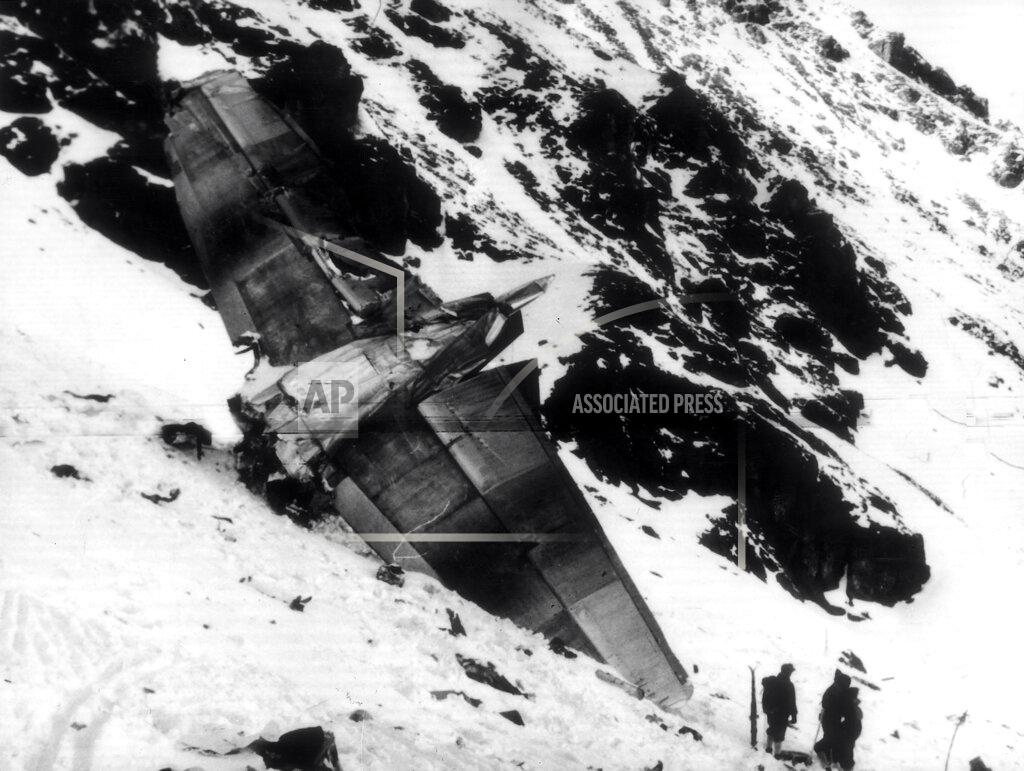
Eighty-five people were killed when Paradise Airlines Flight 901 crashed into a mountain in while on its way to Tahoe Valley, California, a ski resort town across the border from casinos in Nevada. Wreckage of the plane, a propeller-driven Lockheed Constellation, was located the next day on an 8,700-foot ridge in the Sierra Nevada mountains, where it had impacted after running into a sudden snowstorm while on its approach to Tahoe Valley. Twenty passengers had taken off with the plane from Salinas and another 61 boarded at San Jose. Fifteen other people in San Jose had wanted to board Flight 901 but were told that they would have to catch a later plane.
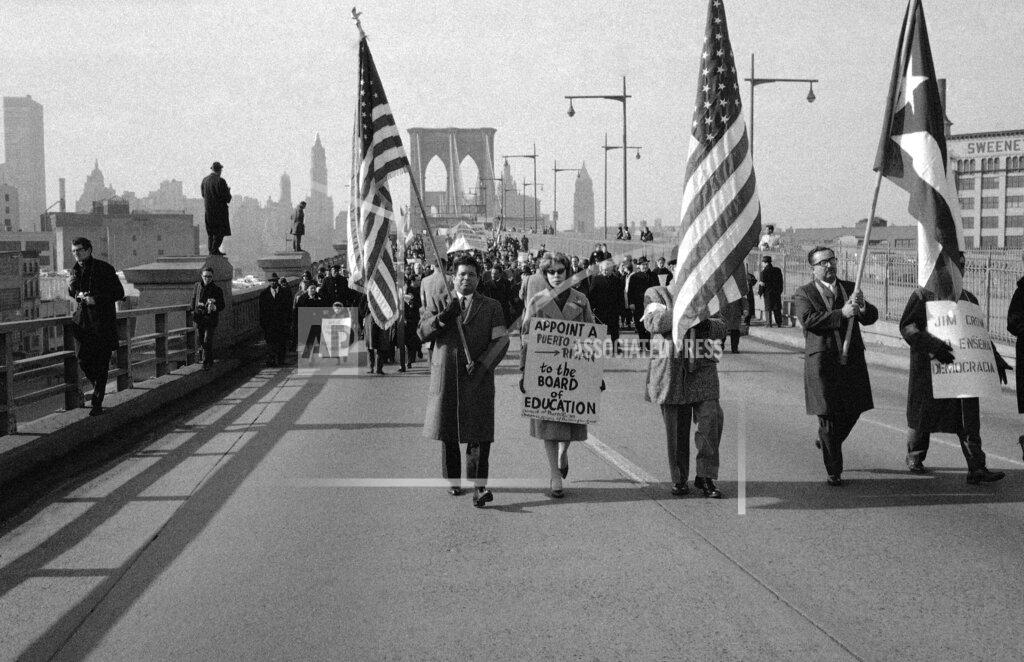
About 1,800 New Yorkers marched quietly from City Hall to Brooklyn across the Brooklyn Bridge yesterday to demand better educational facilities and more effective integration for the city’s Puerto Rican schoolchildren. The march, the first citywide civil rights demonstration sponsored by the Puerto Rican community, was described as a success by its leaders, although the turnout was far short of the 25,000 persons who had been expected. The three‐hour demonstration was without major incident. The marchers went from City Hall in lower Manhattan across the Brooklyn Bridge to the Board of Education office at 110 Livingston Street, Brooklyn, in relative silence. When they arrived in Brooklyn, Puerto Rican, Black, and labor leaders made short speeches, and the demonstration was disbanded. There were no Board of Education officials inside the building on Livingston Street to hear them. The only occupants of the building were uniformed and plainclothes policemen, part of a force of about 425 policemen at the demonstration.
Justice Department officials said today they were surprised and disturbed that an assistant federal prosecutor in New York had ordered a mail watch on Roy M. Cohn and on Mr. Cohn’s lawyer. The officials said they had known nothing about the order and had thought the only mail check was an unrelated one ordered by the Internal Revenue Service. They evidently were embarrassed by the episode. Mr. Cohn, who is under indictment on federal perjury and conspiracy charges, moved to dismiss the indictment two weeks ago on the ground that his mail was being checked. He produced a copy of a Post Office order for a mail watch. Justice Department officials said here at the time that this was an Internal Revenue matter entirely unconnected with their case against Mr. Cohn. They strongly denied that the Justice Department had any check on his mail.
Lawyers for Jack L. Ruby have decided to call him to the witness stand in his trial for the shooting of Lee H. Oswald. Defendants who plead insanity rarely take the witness stand, invoking the constitutional right of all defendants in criminal cases to remain mute. But Ruby’s lawyers say that his derangement is episodic, that between spells of mental blackout he is capable of normal thought and action. Appearing as a witness would expose Ruby to cross‐examination by District Attorney Henry L. Wade, but the defense believes that Ruby’s case would be strengthened if hectoring by the prosecution caused him to act abnormally in front of the jurors.
The United States has developed 11 or 12 of the phenomenal A‐11 jet fighters, and all have passed many difficult tests, Senator Richard B. Russell said today. The Georgia Democrat, chairman of the Senate Armed Services Committee, gave this additional information about the 2,000-mile-an-hour aircraft, which was a secret for five years. President Johnson ended the secrecy at his news conference yesterday. He said he had revealed the plane “to permit the orderly exploitation of this advanced technology in our military and commercial programs.” Senator Russell said that while tests of the experimental craft were continuing, the prototype was nearly ready for acceptance by the Air Force as a warplane. He spoke on the Columbia Broadcasting System’s radio and television program “Face the Nation.”
The 90,000‐pound Apollo spacecraft that will carry three astronauts to the moon is running into a worrisome but not unexpected weight problem. As it has passed from the drawing board to the production line, the spacecraft has put on pounds, until it threatened to become too heavy to be lifted into a lunar trajectory. As a result, the spacecraft several months ago was put on a strict design diet that saved several thousands of pounds. About a ton was saved, for example, by the seemingly simple expedient of having the astronauts stand up when they land on the moon, thus eliminating the need for seats. At this point, the weight problem seems to be under control. But inevitably the Apollo spacecraft will put on weight again, and as insurance the National Aeronautics and Space Administration has instituted a strict weight‐control program on all the Project Apollo contractors.
The weight of the lunar module was recently reduced by a suggestion of two design engineers at the Manned Spacecraft Center in Houston. George C. Franklin, head of the crew‐station arrangement section and Louie G. Richard, a flight‐systems engineer, suggested that instead of having the astronauts recline in contour couches or be seated on barstool-like chairs, they land on the moon standing up in their capsule. The result was a harness arrangement in which the astronauts, standing in the capsule, will be connected to the floor and ceiling by straps attached to the air pressure suits. The elimination of seats permitted a reduction in the overall volume of the module and in the size of the window through which the astronauts will look down at the lunar surface. Most importantly, it permitted about 2,000 pounds to be shaved off the weight of the capsule.
Richard Welsh, a professional skydiver who was celebrating his 29th birthday, was killed by an accident blamed on his habit of screaming while pretending to fall off of an airplane and on the fact that he had no pocket on his outfit. Lacking a pocket, Welsh had clinched the handle of his parachute’s ripcord between his teeth, but when he opened his mouth as he fell, the cord flew over his shoulder. As he fell 3,000 feet to his death, Welsh was seen “groping desperately all the way down” trying to grab the cord to open the chute; his body, along with his unopened parachute, was found in the backyard of a home in Delhi Township, Michigan.
This month’s issue of Playboy publishes an interview with Ayn Rand, who says, “I consider the Birch Society futile, because they are not for capitalism but merely against communism … I gather they believe that the disastrous state of today’s world is caused by a communist conspiracy. This is childishly naive and superficial. No country can be destroyed by a mere conspiracy, it can be destroyed only by ideas.”
The American première of Karlheinz Stockhausen’s Momente, performed by Martina Arroyo (soprano), the Crane Collegiate Singers of SUNY Potsdam (Brock McElheran, chorus master), and members of the Buffalo Philharmonic Orchestra (Lukas Foss, music director), conducted by the composer, took place in Kleinhans Music Hall in Buffalo, New York.
Born:
Clinton Gregory, American country and bluegrass singer-songwriter, guitarist, and fiddler (“Play, Ruby, Play”), in Martinsville, Virginia.
Florencio Randazzo, Argentine politician, in Chivilcoy, Argentina.

 History Diaries