Communist China adopted today a cautious attitude in its first comments on reports that the United States might support an extension of the anti-guerrilla war in South Vietnam to North Vietnam. The Peking press handled the reports in a manner that suggested to observers here that it wanted to discourage Hanoi from assuming that the Chinese would necessarily intervene. Hsinhua, the Chinese press agency, distributed a summary of an article published in Hoc Tap, journal of the North Vietnamese Communists, which had discussed the possibility of an extension of the war to North Vietnam.
The Chinese summary omitted all references in the article to possible attacks on North Vietnam. It also deleted a warning that Communist China would intervene. The original text of the article, as reported by the North Vietnamese press agency February 11, had included this statement: “Should the United States imperialists attack North Vietnam because they want to win in South Vietnam, they would have to cope not only with North Vietnam but also with China or eventually with the Socialist camp as a whole.” This statement was omitted from the Hsinhua summary, which was published today in Jenmin Jih Pao, organ of the Chinese Communist party.
In the first comment by the Chinese Communist press on the issue of a possible expansion of the war, Jenmmin Jih Pao said: “The United States clamor for expanding its war of aggression in South Vietnam has caused panic and drawn opposition among its West European allies.” The terse comment was made in an introduction to a roundup of French and British editorial comment warning against operations in North Vietnam and generally critical of United States policy. The Peking newspaper also published a roundup of United States press reports on the issue under the headline “U. S. Aggressors at Their Wits’ End.”
Chinese Premier Chou En‐lai said today that the United States could never win the war in South Vietnam, and that the harder it tried, the longer the conflict would last. The Chinese Communist leader is on a four‐day visit to Ceylon.
France has assured Britain that she will not seek to use a conference on Cambodia to promote President de Gaulle’s policy of neutralization for South Vietnam. Reliable sources who reported this today said the assurance had been given by France’s Foreign Minister, Maurice Couve de Murville, to British officials. Prince Norodom Sihanouk, Cambodia’s head of state, has asked that an international conference be called to guarantee his country’s neutrality.
Both the United States and South Vietnam fear that the conference could be turned into a forum for undermining the Governments of South Vietnam and Thailand, another of Cambodia’s neighbors. Both counties have frontier disputes with Cambodia. It was not known whether Mr. Couve de Murville had been asked for the assurances or whether he had volunteered them. Britain and the Soviet Union are co‐chairmen of the 1954 Geneva conference from which the successor states to French Indochina — Cambodia, Laos and North and South Vietnam — emerged.
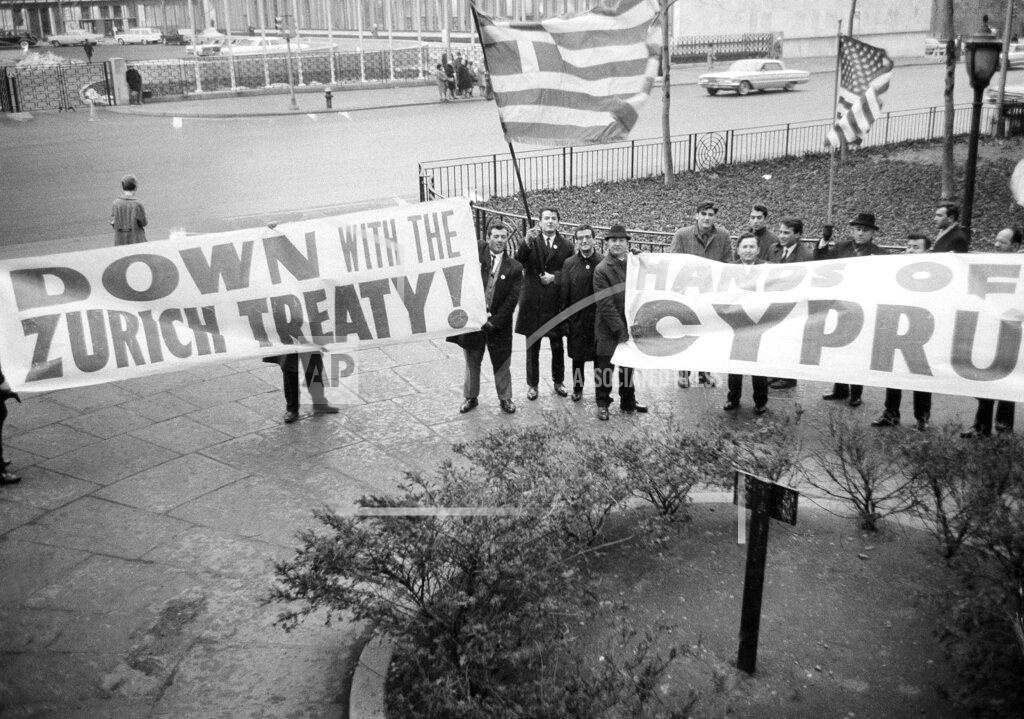
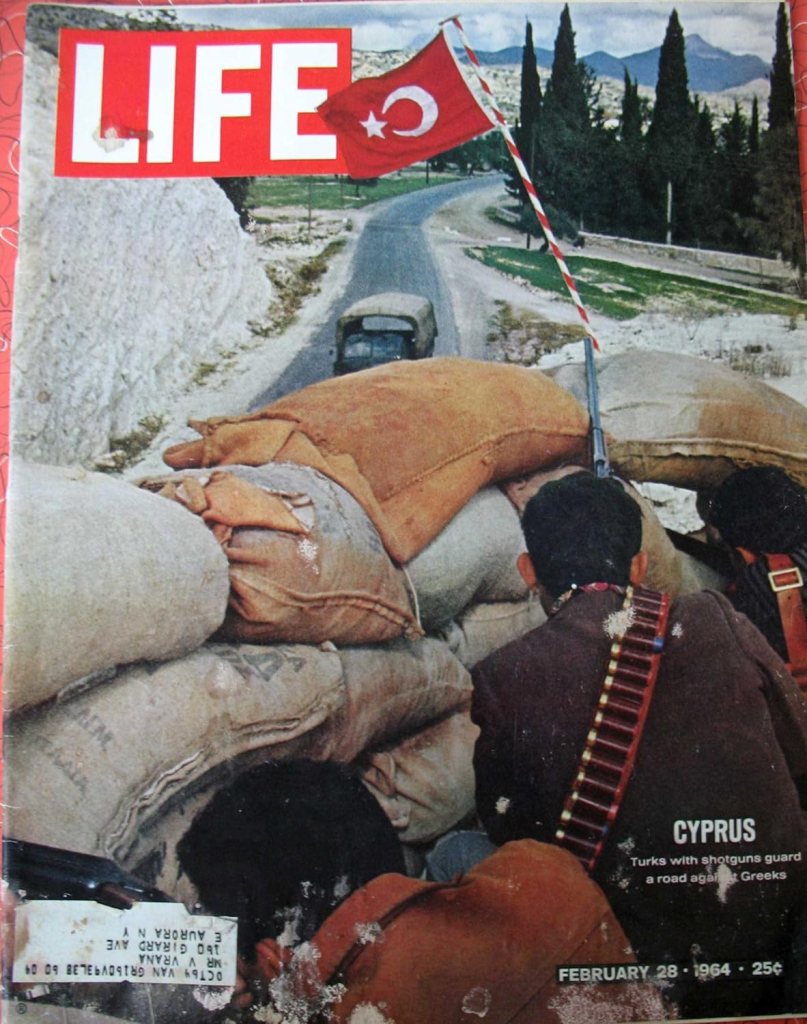
A representative of the Turkish community in Cyprus told the Security Council today that Britons had seen Greek Cypriotes shoot Turkish hostages. He said only 534 of 700 hostages had been released alive. Rauf R. Denktash, president of the Turkish communal chamber in the island republic’s Parliament, charged that the Greek Cypriote leaders had made no secret of their determination to dominate Cyprus. He said also that the bloodshed could have been ended quickly under the treaty of guarantee by the guarantor powers — Britain, Greece and Turkey — if the President of Cyprus, Archbishop Makarios, and other Greek leaders had not opposed intervention.
Meanwhile, five of the six elected members of the Council were drafting a resolution that would satisfy Turkey by acknowledging the treaty of guarantee, and satisfy Cyprus by guaranteeing her integrity. The sixth elected member, Czechoslovakia, took no part in the drafting. The resolution also would provide for appointment of a mediator by the Secretary General, U Thant, for a period of three months, and a peace‐keeping force to be paid for by the interested governments. The resolution was expected to be put before the Council at a meeting Monday afternoon.
Mr. Denktash was invited by the Council to present the Turkish Cypriotes’ views after it was charged that the official United Nations delegation of Cyprus represented only the Greek majority on the island. He told the 11‐member Council that the Turkish community had suffered more than 800 killed or wounded since fighting began December 21. “Every hour that has passed in debate has meant more persons dead or homeless,” he said.
The United States has served notice that it is prepared to wait “for several months” if waiting improves the prospects for a settlement of the Panamanian crisis, authoritative sources disclosed today. The Administration’s position was conveyed to a committee of the Organization of American States charged with finding a solution of the seven‐week‐old dispute between the United States and Panama. Washington’s position suggested that it was abandoning hope of a break in the dispute before Panama’s presidential elections, scheduled for May.
Another complication in the confused diplomatic negotiations occurred tonight when Costa Rica made it known that she was suspending her efforts to seek a compromise in the dispute. The Costa Rican action came shortly after officials disclosed that the United States had suggested modifications in the formula submitted by Costa Rica earlier this week. The Costa Rican text represented an attempt to break the deadlock over a formula proposed by Miguel J. Moreno Jr., Panama’s representative at the O.A.S. The Costa Rican effort stemmed from meetings February 21 between President Francisco J. Orlich Bomarcich of Costa Rica and President Roberto F. Chiari of Panama.
Diplomatic sources said the United States had objected to a reference in the Costa Rican formula to the treaties governing the Panama Canal. This was tantamount to a rejection of the Costa Rican plan. These developments were widely interpreted as reflecting a sudden stiffening of the Administration’s position. Only last Wednesday, State Department officials indicated that the formula sponsored by Cost a Rica was deemed acceptable “with minor modifications” The Costa Rican text called for a meeting of Panamanian and United States representatives to “discuss and reconsider” all aspects of their relations, “including the Canal treaties.”
Premier Khrushchev told a high‐level Communist party conference in the Kremlin today that incentive pay for farmers remained the most important problem in Soviet efforts to raise farm output. “We must boldly and resolutely advance along the road of material remuneration for quantity and quality of produce,” the Premier said. He was addressing a conference held by the party’s ruling Presidium to implement decisions taken earlier this month at the party’s Central Committee meeting. The Central Committee outlined a major program of intensification of farming designed to produce higher yields per acre through a greater application of fertilizer, irrigation and mechanization. Previous Soviet policy was to raise production by expanding acreage.
Malaysia said tonight that Premier Abdul Rahman, the Prime Minister, would not attend another meeting with President Sukarno of Indonesia and President Diosdado Macapagal of the Philippines until the question of the cease‐fire in Borneo had been settled. The Ministry of External Affairs issued a statement in reply to a request by Indonesia and the Philippines for a meeting as soon as possible. The statement said preliminary talks at a ministerial level, which are scheduled to resume Tuesday in Bangkok, would have to succeed before Malaysia would agree to another round of talks at the level of heads of Government. The primary element for success, Malaysia said, is a firm agreement on implementation of the cease‐fire. The cease‐fire was broken twice recently. Also at issue is Malaysia’s demand for the withdrawal of about 200 Indonesian‐based guerrillas.
Norway will acquire 64 supersonic fighter bombers from the United States, to be delivered in 1966 and 1967. This move, which is subject to the formal approval of Parliament, was announced today after heads of the Government met with King Olaf V. Approval is regarded as assured. The plane involved is the new twin‐jet F‐5 Freedom Fighter, developed by the Northrop Corporation of Beverly Hills, Calif., for use in the United States military assistance program. Other nations that will get the F‐5 are Greece, Turkey, Iran, and some members of the Southeast Asia Treaty Organization. The F‐5 is said by Northrop to be able to operate without runways from earth and grass fields, or from the frozen lakes that the Norwegians also expect to use.
President Johnson, who had succeeded to the American presidency three months earlier upon the death of John F. Kennedy, began his campaign to win the office in the 1964 election. Speaking to 3,000 Florida Democrats at a fundraising dinner in Miami Beach, Florida, Johnson emphasized his commitment to civil rights and remarked that “full participation in our society can no longer be reserved to men of one color”, adding that his administration would push for equal rights “until we have eliminated the last barrier of intolerance.”
The White House said today that a “security reason” had caused unusual precautions to be taken for the protection of President Johnson and his family on a trip to Florida yesterday. “The security measures taken yesterday were in addition to security measures usually taken and there was a security reason for that step,” Pierre Salinger, White House press secretary, said.
The Miami Herald reported that the Secret Service had received a tip that a Cuban suicide pilot might attempt to ram the President’s plane or a Cuban‐based ground‐to-air missile might be aimed at the plane, according to The Associated Press. No official sources would confirm the report.
Mr. Salinger spoke of the security precautions after announcing that the President would hold his first news conference before live television cameras at 11 A.M. tomorrow. The press secretary would not say that there had been a threat against Mr. Johnson or his family and seemed unwilling to discuss the matter further.
The Administration will begin a beef‐buying program soon to head off a Republican move to write a restriction on beef imports into the farm bill. The purchase program will also be aimed at trying to help cattlemen, who have contended that the rising tide of beef imports has been a major element in a 15‐month slump in live‐cattle prices. Senator Hubert H. Humphrey of Minnesota, assistant Democratic leader, told the Senate of the proposed buying program today as debate opened on the wheat and cotton bill. He sought to counter an amendment proposed by Senator Roman L. Hruska, Republican of Nebraska, to cut beef imports from all countries this year about 40 percent below the average of 1962–63.
Senator Barry Goldwater suggested today that United States intercontinental ballistic missiles had a “fire reliability” of only 38 percent. Mr. Goldwater said in an address to the National Press Club that the figure was “hypothetical.” However, he said later that it was based on a personal computation and that it might be too high. Mr. Goldwater said the computation was based on estimates and assumptions about the reliability of a missile at various stages — from surviving an enemy attack, to launching, to flight, to hitting a target.
The Arizona Senator, a candidate for the Republican Presidential nomination, who is a major general in the Air Force Reserve, said that manned bombers had “beyond any question of a doubt a dependability of about 98.5 percent.” He called Defense Secretary Robert S. McNamara’s statements that missiles were more reliable than bombers “erroneous.” The Senator urged that a strategic deterrent “mix” that made heavy use of bombers be maintained. Both houses of Congress have voted an unrequested sum of $57 million for the development of a new manned bomber over protests by Mr. McNamara. Mr. Goldwater voted for the appropriation and helped lead the debate.
The government’s jury tampering case against James R. Hoffa headed today toward the jury, after a mysterious “assassination plot” slipped into the court record. A cryptic reference to the plot came during an all‐day hearing on defense efforts to throw out the cornerstone of the government’s case on the ground that it was based on illegal wiretap evidence. The plot was not explained further, except for an assurance that it did not involve the late, President Kennedy. The jury was absent all day. Final arguments are scheduled Monday, the start of the trial’s seventh week, and the case will probably reach the jury Tuesday night. United States District Judge Frank Wilson denied the defense request to throw out the testimony of Edward G. Partin, a Baton Rouge, Louisiana, Teamsters Union official.
Jack L. Ruby’s jury was still incomplete tonight. Judge Joe B. Brown ordered a Saturday session in an attempt to find the 11th and 12th jurors. If the attempt succeeds, testimony may begin Monday. After a 10th juror was selected at the morning session, the court went through a dozen more prospects in a fruitless effort to fill the jury box. The chief defense counsel, Melvin M. Belli, used up his quota of 15 peremptory challenges and asked for more. Judge Brown gave him three. Before the day ended, Mr. Belli used one of them.
Mr. Belli said he would have to use all his arbitrary challenges. If he did not, he explained, he would be weakening his contention that a fair and impartial jury cannot be found in Dallas and that the trial should be moved to somewhere else in Texas. All 10 jurors selected so far are white Protestants. Mr. Belli complained that the jury panel did not represent a cross‐section of Dallas since “only one Jew, three Negroes, one Italian and two Catholics” had appeared in the witness box. Actually, four Blacks have been called. All were excused because they opposed capital punishment. Ruby is charged with murder in the slaying of Lee H. Oswald, the accused assassin of President Kennedy, last November 24.
The Senate unanimously approved today the nomination of Nicholas Johnson, a 29‐yearold Iowan, as administrator of the Federal Maritime Administration. The Senate acted after a quick hearing by the Senate Commerce Committee.
Eva and Pavel Roman of Czechoslovakia clinched their third ice‐dancing crown today at the world figure‐skating championships. Three American teams finished in the top eight places. The Czechoslovak brother and sister, aged 20 and 18, respectively, received six of the seven first‐place votes in the free skating phase of their program. They already had a substantial lead in the compulsory figures, which counted for 60 per cent of the final mark. In the compulsory figures, they totaled 249.2 points and eight ordinals. Paulette Doan and Kenneth Ormsby of Canada finished second and Janet Sawbridge and David Hickingbottom of Britain, third.
In the singles competition. Sjoukje Dijkstra of the Netherlands held a commanding lead after today’s compulsory figures were completed. Miss Dijkstra was a unanimous first‐place selection, with a perfect ordinal mark of nine and a total of 1,312.7 points. She appears certain to retain the title she has held for the last two years. The 22‐year‐old blonde was far in front of Regine Heitzer of Austria, who held second place with 1,239 points and 18 ordinals, and Petra Burka of Canada, third with 1,75 points and 32 ordinals. The top American in the standings was Christine Haigler of Colorado Springs, Colorado, whose 1,166.7 points and 36 ordinals left her in fourth place. Another United States entry, Peggy Fleming of Pasadena, California, was fifth with 1,130.7 points and 53 ordinals.
The Dow Jones Industrial Average passed the 800 mark for the first time, rising to 800.14 in the last hour of trading to close at 800.14 points.
Dow Jones Industrial Average: 800.14 (+3.10).
Born:
Djamolidine Abdoujaparov, Uzbekistani road cyclist (Tour de France points winner 1991, 1993-1994), in Tashkent, Uzbekistan.
Carl Hilton, NFL tight end (Minnesota Vikings), in Galveston, Texas.
Tony Sagnella, NFL defensive tackle (Washington Redskins), in New Haven, Connecticut.
Ron Pasquale, NFL guard (St. Louis Cardinals), in Youngstown, Ohio.
Died:
Gus Lesnevich, 49, American boxer and former world light heavyweight champion from 1941 to 1948, died of a heart attack in his doctor’s office.
Timmy Mayer, 26, American racing driver, was killed in a practice session at Longford, Tasmania, in Australia, when he lost control of his custom-built Cooper T70 at 120 mph, became airborne, and hit a tree next to the course. Mayer had been preparing for the eighth and final race in the inaugural Tasman Series.

 History Diaries