
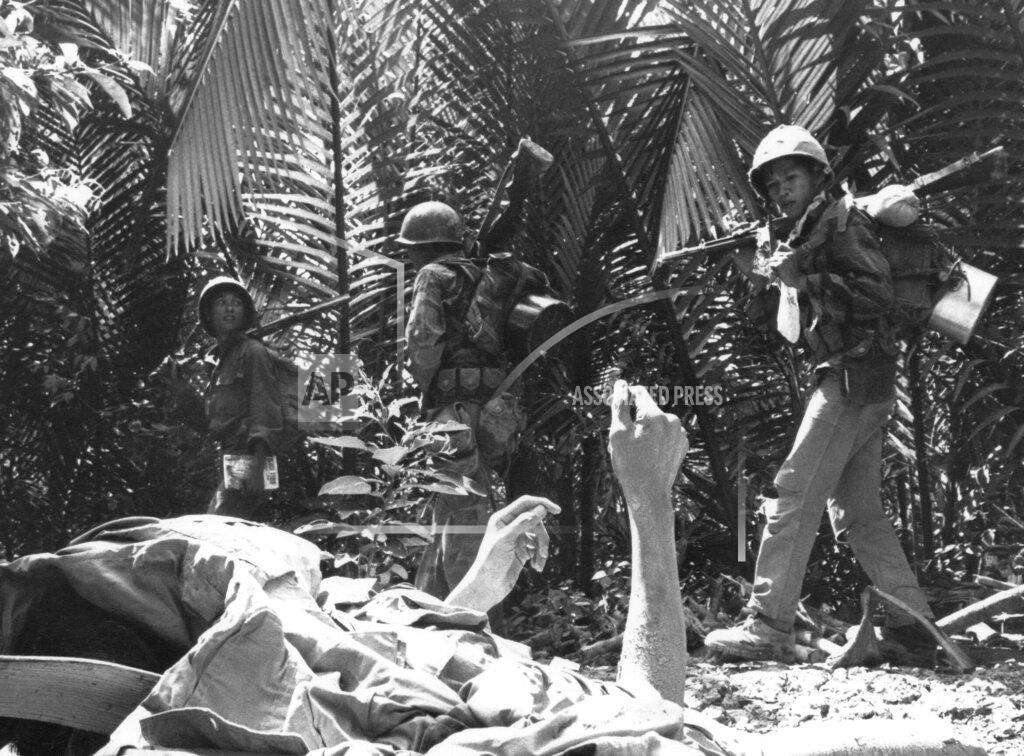
The 514th Battalion of the Communist Việt Cộng’s army fought its way through an encirclement last night, inflicting a dramatic defeat on South Vietnamese Government forces. The engagement showed how guerrillas could also be successful with classic infantry tactics. Early today the Vietnamese Premier, Major General Nguyễn Khánh, former field commander who seized power January 30, inspected the battlefield in the muggy Mekong Delta where an elite Việt Cộng force of 600 men held off, confused and finally outwitted a superior government force. The guerrillas escaped under cover of night. Complete casualty figures have not been made public a day after the eight‐hour battle. A Vietnamese Marine battalion, which suffered the brunt of the Communist fire, reported 16 dead and 41 wounded. An unconfirmed estimate of Việt Cộng deaths was in excess of 40, mainly from air strikes against the thick banana and coconut groves where the guerrillas were dug in. The engagement 40 miles southwest of Saigon broke a two‐week lull in military activity during which government forces encountered no significant Việt Cộng concentrations. The guerrillas’ normal practice in the event of encirclement is to disperse and slip away. On this occasion the Việt Cộng battalion smashed its way through two government lines, inflicting the bulk of the casualties on its way out.
Military analysts said battles such as this tended to weaken the characterization of the Vietnamese struggle as a guerrilla war. Though guerrilla tactics are still widely used, the Việt Cộng forces have shown in recent months that they also have units capable of fighting from fixed positions. Of these units the 514th has gained a reputation in the South Vietnamese Army and among United States advisers as one of the toughest and craftiest. Intelligence sources noted that most Việt Cộng battalions changed their numerical designations in periodic reorganizations but that the 514th had remained the same. It operates from Ding Tuong Province, in the Mekong Delta. A well‐led, disciplined unit, it is armed with heavy infantry weapons and antiaircraft guns and includes medical and signal teams. Military sources said it had killed more Vietnamese and Americans and shot down more helicopters than any other identified Việt Cộng unit. The military command in Saigon has said many times that it has wiped out the bat-talion but the 514th has always reappeared to inflict further defeats.
The Marine battalion came upon the Việt Cộng force yesterday almost by accident, though intelligence reports the day before indicated it was in the area. The guerrillas outlying units were well camouflaged into surrounding rice paddies. During five hours of heavy fire, the Marine battalion of 500 men could not move more than 300 yards against a Việt Cộng detachment estimated at about 50 men. The total government strength deployed before the engagement was over was 2,500 men. When air strikes halted at nightfall, the 514th broke out of the encirclement. Military sources said the Marine commander lost control of his units as the Việt Cộng pushed through. More than 100 government soldiers drifted back toward the command post a mile away, some of them shooting toward their own units in the confusion.
At a press conference, Secretary of State Dean Rusk says that recent U.S. warnings to North Vietnam are reminders that aggression is ‘serious business’ but that Americans should not regard extending the war as a ‘miracle’ way to end the fighting. Rusk rejects any political settlement that involves U.S. withdrawal, leaving South Vietnam exposed to a Communist takeover. The basic problem is in South Vietnam, the Secretary said. Washington’s purpose in recent days, he explained, has been to remind those in North Vietnam who direct and support the guerrillas that such aggression is a “serious business.” What the United States will do, he said, will be decided after Secretary of Defense Robert S. McNamara’s visit to Vietnam next week.
Mr. Rusk said the Administration was reluctant to talk about the guerrillas’ successes while a friendly Government in Saigon was trying to cope with the situation. The evidence of concern here should suffice to inform the American people that “there is a problem and it must be dealt with,” he added. Taken together, Mr. Rusk’s comments on Vietnam at a news conference were intended neither to commit the Administration to supporting an expansion of the war into North Vietnam nor to withdraw the well‐advertised hints that such a policy change was under consideration. “Whatever happens in the north, there is a large problem in South Vietnam to be dealt with,” he said. “The Vietnamese are determined to do it. The materiel, the forces are there that are capable of doing it, and no miracle in the north is going to suddenly transform or eliminate the problem in South Vietnam.”
Foreign Minister Maurice Couve de Murvile has told French senators that negotiation and neutralization are the only possible course in South Vietnam. This and other statements by the Foreign Minister at a closed session of the Senate Foreign Relations Committee yesterday indicated the French Government’s growing belief that, as far as the United States is concerned, the game is up in Saigon. Mr. Couve de Murville did not amplify his remarks on negotiation and neutralization. Diplomatic sources said they were an extension and development of a French policy enunciated by President de Gaulle last August. The French emphasis on negotiation leading to unification and neutralization of all Vietnam has developed rapidly in the last 48 hours. Informed sources said this was a result of the obvious deterioration of the military situation in South Vietnam.
This deterioration, allied sources pointed out, owes something to General de Gaulle’s call on January 31 for the neutralization of Vietnam, now divided, and of Laos and Cambodia. He stated then that this would have to take place with Communist China’s cooperation. Mr. Couve de Murville declared that France saw no possibility of a military conclusion in the guerrilla war raging between the Vietcong guerrillas, supported by Communist North Vietnam, and the South Vietnamese, armed, trained and financed by the United States. It is difficult to believe that the United States can win with 20,000 men where France failed with 200,000, Mr. Couve de Murville said. This was a reference to a series of defeats at the hands of the Communist rebels 10 years ago that led to France’s withdrawal from her colonies on the Indochinese Peninsula.
Key right‐wing military positions commanding the southeastern gateway to the strategic Plaine des Jarres in north-central Laos have fallen to the pro‐Communist Pathet Lao forces after a three‐day attack. Laotian military sources and foreign observers feared that the Pathet Lao attacks, coming after two weeks of relative calm, might be a prelude to major clashes in the region of the plain. Last April and May the Plaine des Jarres, 110 miles north of here, became a major testing ground for the strength of the neutralist forces, which were pushed back by the Pathet Lao. Although forced to retreat, the neutralists did not abandon the plain entirely, as the Pathet Lao had hoped they would. General Phoumi Nosavan, Vice Premier and commander of the pro‐Western right‐wing army, said the Pathet Lao attacks this week had “seriously compromised the chance for a peaceful settlement of the Laotian problem” and had jeopardized hopes for a meeting of leaders of three feuding factions of the Laotian Government. A spokesman for General Phoumi Nosavan announced that the right‐wing troops had abandoned their positions on Phoukhe Mountain, about 10 miles southeast of the plain and overlooking the Pathet Lao stronghold in Xiengkhouang, after three days of “intense and prolonged” artillery fire.
Britain hinted today that she would withdraw her peacekeeping force from Cyprus if there were “no prospect” for the formation of an international force and if no steps were taken toward a lasting solution of the island’s communal strife. Sir Patrick Dean, the British representative, told the Security Council that events in the last week had shown the danger of making one country carry the principal peace‐keeping burden and had demonstrated the need for an international force. The six elected members of the Council were reported to have made little progress today in their efforts to break the deadlock over the instructions to be given a proposed international force. The six — Brazil, Bolivia, Czechoslovakia, the Ivory Coast. Morocco and Norway — took over Tuesday night after the Secretary General, U Thant reported that he was unable to obtain an agreement.
Canadian Prime Minister Lester B. Pearson’s Liberal Party Government beat back two votes of no‐confidence tonight. The first vote, 225 to 25, defeated a Creditists Party demand for an increase in family allowances. The second, 134 to 113, defeated a Conservative Party resolution to extend family allowances to students 16 to 18 years of age. Earlier this week the Pearson regime also defeated a motion of no‐confidence.
The government of Sudan ordered all Christian foreign missionaries to leave the country. Nearly all of the Protestant and Catholic evangelists, who were concentrated in the more religiously diverse south, would leave within three weeks.
The government of Italy asks for help to keep the Leaning Tower of Pisa from toppling over. The government of the city of Pisa asked the Ministry of Public Works of Italy to intervene to keep the Leaning Tower of Pisa from toppling over. The proposal, recommended after a study by architect Enzo Vannucci, was to tilt the 184-foot-tall (56 m) tower back slightly from its lean of “almost 11 feet from true perpendicular” by raising it six feet, constructing a new concrete base for it to stand upon, and then lowering it, at a cost of more than one million dollars. “No one wants to straighten the tower,” an AP report noted, since “Tourists wouldn’t flock here to see a straight leaning tower.”
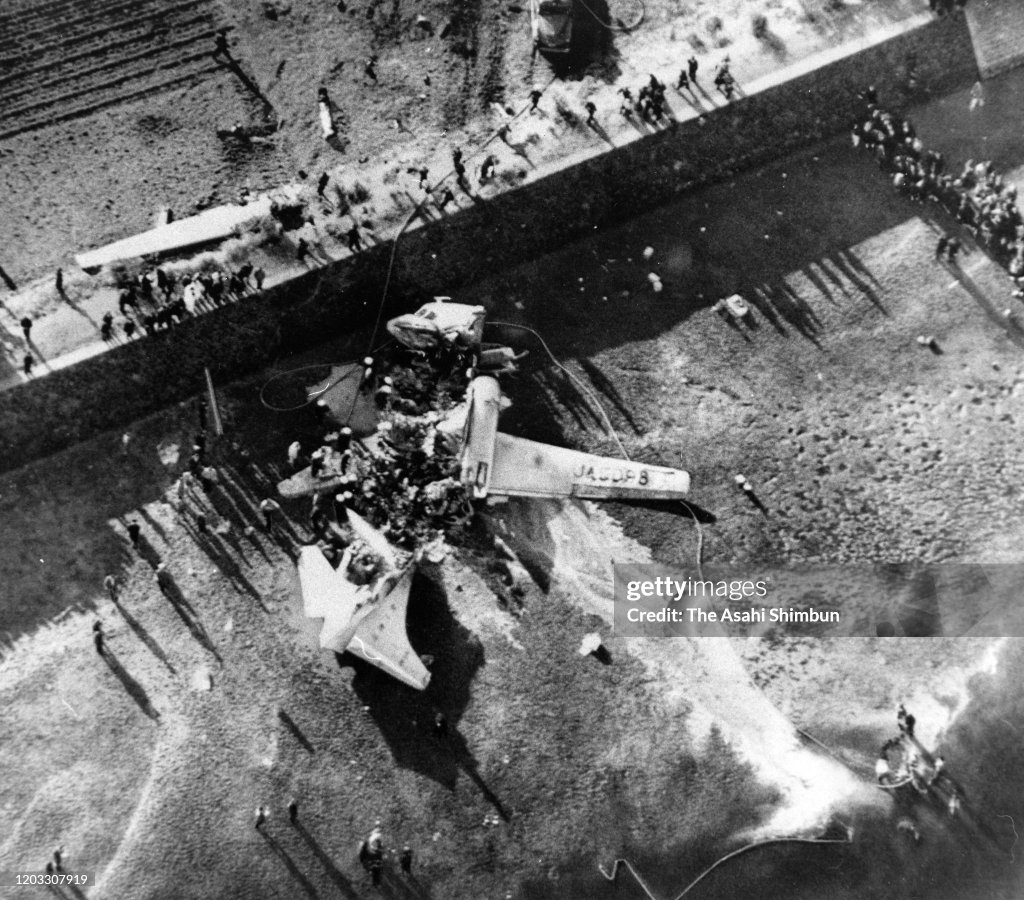
Twenty persons died today when a Japanese airliner overran a runway at Oita Airport, crashed into a retaining wall and burst into flame. There were 22 survivors. The accident occurred when the American‐made twin‐engine Convair 240 of the domestic Fuji Air Lines was attempting to land on its second approach to the airport. It was arriving at Oita from Kagoshima. Both cities are on Japan’s southernmost island of Kyushu. “I put on the emergency brake right after the plane landed on the runway but it had already overrun the runway,” Yoshimi Mishima, the chief pilot, told investigators of the Japanese Transport Ministry.
After the United States Secret Service received a tip of a plot to assassinate President Johnson during his two-day visit to Florida, “security measures rarely if ever seen in peacetime” were implemented to prevent the threat that a Cuban pilot on a suicide mission would attempt to crash an airplane into the President’s Boeing 707 jet, Air Force One. Rather than flying into Miami on his official aircraft, the President landed at West Palm Beach, Florida on one of three “executive transport jets” operated by the U.S. Air Force, with two identical planes making the journey so it would not be clear which one he was on. Upon landing, he boarded a helicopter that had been stripped of “all markings that might have identified the craft” as a presidential vehicle, and flew the 67 miles to Miami, landing without prior notice to the press.
President Johnson swung into the South today with the blunt warning that “full participation in our society can no longer be reserved to men of one color.” His Administration, he said, believes “the Constitution applies to every American, of every religion, of every region and of every race.” It is pledged, he continued, “to protect the constitutional rights of every American.” And it will “press forward,” he said, “with legislation, with education, and with action, until we have eliminated the last barrier of intolerance.”
“For as long as freedom is denied to some, the liberty of each of us is in danger,” the President said in a speech at a Democratic fund‐raising dinner. These were some of the most forthright statements on civil rights a President had ever addressed to a Southern audience. President Kennedy made somewhat similar remarks to an academic convocation at Vanderbilt University in Nashville, Tennessee, last spring. Delivered in Mr. Johnson’s accent, the President’s words were even more striking here tonight.
An effort by New York’s two Republican Senators to have the Senate take up the civil rights bill ahead of the cotton‐wheat farm measure was defeated overwhelmingly tonight. By a vote of 57 to 19, the Senate rejected a move made by Senators Kenneth B. Keating and Jacob K. Javits and supported the majority leader, Mike Mansfield of Montana. There was some mystification on Capitol Hill why Senators Keating and Javits should have made the attempt to upset a timetable that had been announced and generally agreed on. They had, it was generally agreed, no chance of getting the support of most of the staunchest civil rights supporters in both parties. After the Senate passed the $17 billion military procurement authorization bill late this afternoon, Mr. Mansfield moved to take up the farm bill. Mr. Keating and Mr. Javits rose in opposition. Mr. Keating said that many of those who were now pushing for action on the cotton bill were Southerners who in the past had filibustered against civil rights measures, and expected to filibuster against the one now on the calendar.
The Senate joined the House today in a demand that the Administration begin now to develop a new manned strategic bomber. Supporters of the proposed bomber won by a vote of 64 to 20 when the issue came up on an amendment to the $17 billion military authorization bill. Secretary of Defense Robert S. McNamara has resisted the proposal. In the debate today, Senator Barry Goldwater of Arizona, who is seeking the Republican Presidential nomination, repeated earlier warnings against placing too much reliance upon intercontinental missiles. The Senator did not use the same language of his charge in New Hampshire a few weeks ago that the United States’ missile forces were undependable. But he insisted that the missiles had not been sufficiently tested.
Several other Senators, in a debate that crossed party lines, joined in Senator Goldwater’s basic contention that failure to develop a new fleet of strategic bombers would be dangerous. “We better quit putting all our eggs in a missile basket, because there are a lot of holes in it,” Senator Goldwater asserted. The bomber program was the only controversial item in the authorization bill, totaling $17,040,140,000. Once the bomber issue was out of the way, the Senate passed the bill, 80 to 0. Several Senators who missed the vote said afterward that they would have voted for it.
An angry President Johnson called on the Federal Bureau of Investigation tonight to put its full force to work on the dynamite blasts on the Florida East Coast Railway. His action was brought on by two dynamite blasts on the railway today while he was in Florida. Thirty‐nine freight cars and locomotives were derailed, and the line’s Miami-to-Jacksonville route was cut. Pounding his fists on the lectern at a Democratic fund dinner here, Mr. Johnson shouted: “As leader and spokesman for this nation, I’m here to tell you, you cannot take the law into your own hands, and this criminal action must stop now.” The violence, he declared, “is appalling and without regard to who is right and who is wrong in this labor dispute.”
Joseph Francis Bryan, Jr. committed the first of five kidnappings (four of them murders) of young boys over a two-month period. The first victim was 7-year-old John Robinson, who disappeared while riding his bicycle in Mount Pleasant, South Carolina. Bryan would be arrested on April 28, in the parking lot of a mall in New Orleans, with an 8-year-old boy who had been vanished from his home in Humboldt, Tennessee a few days earlier.
Federal District Judge Frank Wilson sharply rebuked three defense lawyers who accused him today of siding against them at James R. Hoffa’s trial on charges of jury tampering. It was the first time since the trial began January 20 that Judge Wilson displayed anger during repeated exchanges with defense attorneys. The jury, trying Mr. Hoffa, president of the International Brotherhood of Teamsters, and five others on charges of having tried to bribe the Nashville jury that heard Mr. Hoffa’s 1962 conspiracy trial, was present for the start of the exchanges. Like most of the others, this one involved Edward G. Partin, a Baton Rouge teamsters official who testified against Mr. Hoffa.
Less than half of the 700,000 tons of wheat sold by Cargill, Inc., the Soviet Union has been booked in foreign and American vessels. Charter‐market sources said yesterday that the Minneapolis-based grain exporter had booked on a firm basis space for less than 200,000 tons in foreign flag ships and about 60,000 tons in American bottoms. The entire shipment, it was said, is scheduled to be delivered in two portions of 500,000 and 200,000 tons, respectively. The half‐million-ton installment is to be shipped from Gulf and Atlantic ports to Russian harbors between now and the end of March. The remainder is to be shipped in May.
The Senate Finance Committee concluded hearings today on a bill that would assure United States participation in the International Coffee Agreement for the next 18 months. Committee sources predicted approval of the measure, possibly during an executive session tomorrow, but “by a very, very thin margin.” The last of three days of hearings brought a strong defense of the measure from Senator J. W. Fulbright, Democrat of Arkansas and chairman of the Senate Foreign Relations Committee. He firmly rejected opposition arguments that the agreement was responsible for the recent rise in coffee prices. “There has been speculation on the market as the result of natural disasters to the coffee crop in Brazil,” he asserted. “This could have happened with or without the agreement.”
The fifth edition (and first since 1951) of The Concise Oxford Dictionary of Current English was released with an initial printing of 400,000 copies. Among the new words it had added were “beatnik”, rat race” (spelled “rat-race”), the now forgotten “admass” (referring to a demographic of people “influenced by mass methods of publicity”) and “ton-up boy” (a youth who has driven a motorcycle at more than 100 miles per hour).
Erwin Drake’s musical “What Makes Sammy Run?”, starring Steve Lawrence, Robert Alda, and Sally Ann Howes, opens at 54th St Theater, NYC; runs for 540 performances.
Violinist Efrem Zimbalist performed his last public concert, after 52 years of renowned appearances worldwide, then retired at the age of 73.
Dow Jones Industrial Average: 797.04 (-2.34).
Born:
David Grayson, NFL linebacker (Cleveland Browns, San Diego Chargers), in San Diego, California.
April Heinrichs, U.S. women’s soccer coach (Olympics, 1996), in Littleton, Colorado.
Died:
Anna Julia Cooper, 106, African-American educator and historian. Born as a slave in North Carolina, she would obtain a Ph.D. in history from the Sorbonne in Paris in 1924
Orry-Kelly, 66, Australian-born costume designer and three-time Academy Award winner


 History Diaries