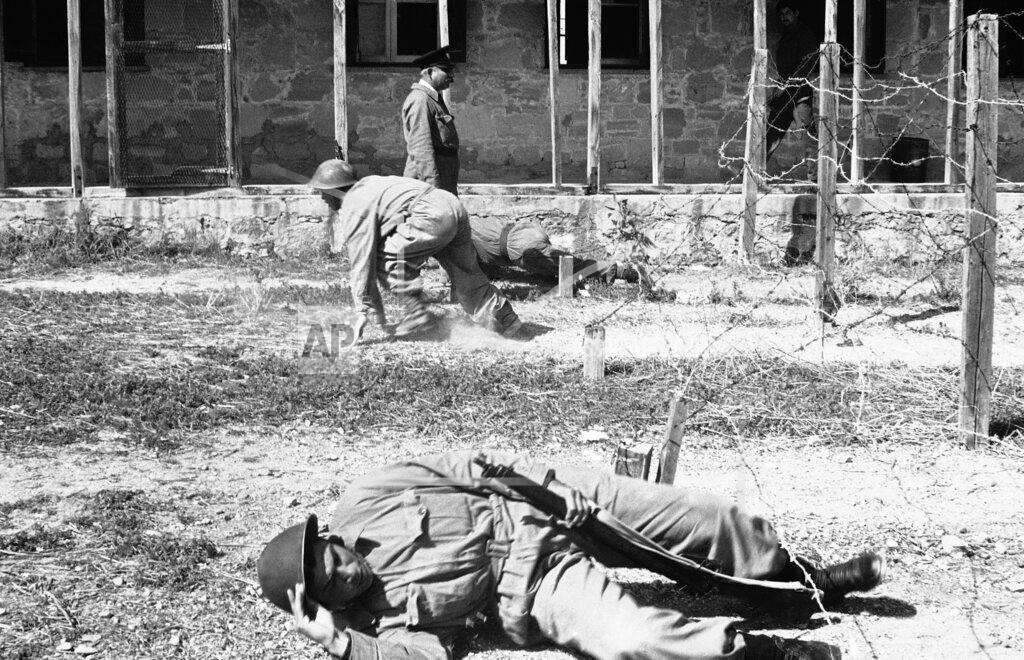
Although encircled by some 3,000 ARVN troops, 600 men of the Việt Cộng’s 514th Battalion fight their way out during an eight-hour battle near Long Định; the Việt Cộng lose 40 and only 16 ARVN troops are killed, but the ARVN forces had called in air and artillery strikes rather than engage the enemy directly. Major General Nguyễn Khánh is so angry that he dismisses three of his four corps commanders and five of his nine division commanders in an effort to make the ARVN more aggressive, but he only ends up demoralizing it.
Three South Vietnamese soldiers were killed and as many as 76 wounded late yesterday in a that followed an ambush by Việt Cộng forces 50 miles east of here in the Mekong River delta. The reports said 26 Communist guerrillas also were killed. The action was near National Route 4 at the town of Mỹ Tho. A Government force of several battalions unknowingly passed a Việt Cộng fortification. The Việt Cộng suddenly emerged from their hole and poured a hail of fire at the troops. The action was apparently broken off early today. Government authorities said they hoped to re‐establish contact and resume the battle.
A statement from Moscow and the resignation of Roger Hilsman Jr. as Assistant Secretary of State for Far Eastern Affairs have intruded upon, but not deflected, the Administration’s reappraisal of policy in Vietnam. The Soviet comment about the guerrilla war in South Vietnam was read here as a mild and predictable first response to Washington’s well‐advertised hints that the war may be carried into the Communist territory of North Vietnam. The Administration will keep dropping such hints while it weighs the risk of further action. The resignation of Mr. Hilsman gave many the impression that it resulted from a major policy dispute, but it appears to have been prompted more by personal considerations. Mr. Hilsman was said to have been troubled more by his loss of influence than by the loss of any particular argument. Officially, the Administration said nothing about either development.
A decision about future policy in Vietnam is believed to be at least several weeks away. Much will depend upon the report of Defense Robert S. McNamara, who will visit Saigon next week, and upon the recommendations of the United States Ambassador there, Henry Cabot Lodge. The Soviet Union’s statement on Vietnam, an “authorized” comment by Tass, the Soviet press agency, did not particularly disturb Washington. It was viewed here primarily as confirmation that Moscow would feel compelled to respond to Washington’s recent attempts at psychological warfare. The Administration has let it be known that it is again considering the organization of raids by South Vietnamese forces against North Vietnamese installations. It hopes in this way to encourage moderates in Moscow and in Hanoi, who are known to have been warning against excessive provocation of the United States.
France’s developing diplomatic relationship with Communist China and President de Gaulle’s interest neutrality for Laos, Cambodia and Vietnam have encouraged neutralists in South Vietnam, reliable sources reported tonight. The French policy is said to have two effects on opinion-making circles in Vietnam. By proposing neutrality as an alternative course, President de Gaulle has appealed to those who for economic or other reasons wish to see an end of the guerrilla war. There is some feeling, according to these reports, that since France and China have diplomatic relations, China may be deterred from taking an active role in a neutral South Vietnam. The other major effect of the French policy has been to reawaken thoughts of unity for the whole country. Until recently, unification has had no foreign supporters, although sources here say this is the wish of North and South Vietnam.
The Soviet Government announced tonight that it had asked Britain to join in calling an immediate international conference to guarantee Cambodia’s neutrality. The Government press agency, Tass, said the request was handed to the British Ambassador in Moscow, Sir Humphrey Trevelyan, last Friday. Britain and the Soviet Union were co‐chairmen of the 1954 conference that helped settle the war in what was then French Indochina.
The United States Ambassador, Fraser Wilkins, will fly to Washington tomorrow for consultations on the deadlock over the strife in Cyprus. He was summoned last night by Secretary of State Dean Rusk. It was not indicated how long he would be absent from Cyprus. A United States Embassy spokesman said Mr. Wilkins would return to Cyprus “directly following the Washington talks.” There have been rumors in the Greek Cypriote press that he was about to be transferred. It was believed that the consultations would take up the general situation in Cyprus. Despite the relative calm that has prevailed since the issue went before the United Nations Security Council on February 17, it ap pears that the situation could explode again at any moment.
The settlement of the seven-week-old Panama crisis was reported to be imminent tonight. The Johnson Administration was understood to be ready to accept in principle the latest compromise formula submitted by inter-American mediators. The situation was discussed at a 45‐minute meeting at the State Department between Thomas C. Mann, the Assistant Secretary of State for Inter-American Affairs, and a five-nation mediation subcommittee of the Organization of American States. The original proposal was submitted to the United States last Saturday and the Administration was expected to advise the O.A.S. group of its acceptance shortly. This formula was designed to allow the United States and Panama to resume diplomatic relations and then proceed to a review of the future of the Canal Zone treaty.
Generally speaking, the new formula for agreement sets the stage for an examination of the Canal treaty relationship between the United States and Panama, but removes language that Washington had resisted from the outset because it feared that the language implied an agreement in advance to another renegotiation of the 1903 pact. The treaty was last revised in 1955.
Panama’s primary concern had been to obtain assurances that negotiations on a new treaty would be held. But she had insisted that she was not setting forth any preconditions. It was believed that the problem of drafting the agreement may have been resolved with the use of wording that declares that after the resumption of diplomatic relations, which were broken by Panama subsequent to the bloody Canal Zone riots January 9, 10 and 11, the representatives of the United States and Panama would meet with “full powers” to review all the problems stemming from the treaty relationship.
Premier Chou En‐lai of Communist China had a narrow escape today when his car was nearly hit by an express train. Mr. Chou, on the second day of his visit to Ceylon, was en route to the tomb of the Prime Minister, S. W. R. D. Bandaranaike, 27 miles from Colombo. Five miles outside Colombo, the train disregarded signals and raced toward a grade crossing as Mr. Chou’s motorcade approached. A policeman saw the train coming and waved a red flag to halt the automobiles. Mr. Chou’s car and the others in the motorcade braked sharply to a halt as the train thundered by.
The keel of Britain’s first Polaris-firing submarine was laid today a few hours before the Minister of Defense, Peter Thorneycroft, announced that the Government had decided to build a fleet of five of the submarines. Opening a two‐day defense debate in the House of Commons, Mr. Thorneycroft also disclosed the Government’s decision to buy United States helicopters for the British Army and United States fighter‐bombers for the Royal Air Force. Denis Healey, Labor’s defense spokesman, said the impact that the purchase of American aircraft would have on the British aircraft industry “cannot be anything but disastrous, above all in design, where we have led the world in the past.”
Mr. Thorneycroft said the choice of helicopters would be made next week between the Hiller and Bell machines. Fifty are to be bought and Britain is to build 100 under license. The Royal Navy will be equipped with the F‐4A Phantom fighter‐bomber used by the United States Navy, Mr. Thorneycroft disclosed. The plane is built by the McDonnell Aircraft Corporation of St. Louis and the British version is to have a British‐made Rolls-Royce Spey engine.
The Revenue Act of 1964 was signed into law as the largest tax cut in American history, reducing individual income taxes by an average of 20 percent over a two-year period with the goal of stimulating economic growth and investments, and reducing unemployment. The top tax rate (of 91% for any amount over $200,000) was reduced to 65%, and the lowest bracket (20% for all amounts up to $2,000) dropped to 14%, while the corporate tax rate dropped from 52% to 47%. Initially, the growth of gross domestic product would increase, investments would double to 13%, and unemployment would drop from 5.2% to 3.8% over two years; however, the federal budget deficit would increase dramatically as the amount of spending during the Vietnam War went up higher than the amount of federal revenue. The signing came six hours after the U.S. Senate had approved the bill, 74-19, and a day after the House had approved it, 326-83 on Monday.
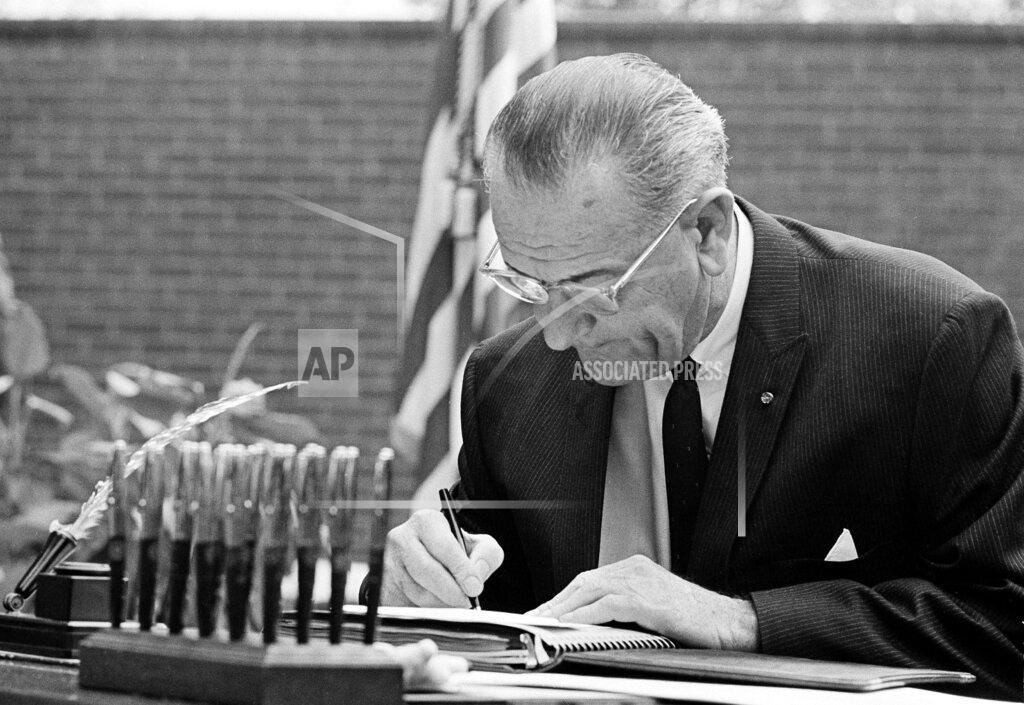
President Johnson signed the tax‐reduction bill tonight. He said that it would “strengthen our country and bring a better life to our citizens.” The Senate completed Congressional action on the measure at 12:30 P.M. and the President signed it at a White House ceremony six hours later. In his remarks on television and radio explaining the importance of the new law, Mr. Johnson said: “No one can bury us or bluff us or beat us so long as our economy remains strong.” He called the tax cut “the single most important step that we have taken to strengthen our economy since World War II.”
President Johnson marked the passage of the historic tax reduction bill tonight with a visit to Mrs. John F. Kennedy and her children. He and his wife went directly from the East Room of the White House, where he had spoken to a nationwide television audience, to Mrs. Kennedy’s house on N Street in Georgetown. There he presented to President Kennedy’s widow and his two children three of the pens he had used in the ceremonial signing of the tax bill — one of Mr. Kennedy’s highest priority legislative objectives.
The House of Representatives handed a major foreign aid defeat to President Johnson today. By a vote of 208 to 188, it rejected and returned to committee the Administration’s bill to increase the United States contribution to the International Development Association. The association is an affiliate of the International Bank for Reconstruction and Development, or World Bank. It has been administering what has been widely held to be one of the best foreign aid programs. Sixteen other countries were ready to join in supplying $750 million to finance interest‐free loans to poorer nations through the next three years. The United States’ share was to be $312 million, starting in 1966.
Secretary of Defense Robert S. McNamara publicly opposed today the move in Congress to provide the Administration with a great deal more money than it requested for a new manned strategic bomber. Secretary McNamara’s views were contained in a letter to Senator Gaylord A. Nelson, Democrat of Wisconsin, as the Senate prepared to act on the $17 billion military authorization bill passed by the House Armed Services Committee yesterday. The authorization measure covers the part of the total defense budget that deals with procurement of missiles, airplanes and ships and all military research and development. It sets the limits for which appropriations must be legislated separately.
If the Air Force should provide a “satisfactory concept” and a “specific plan” to develop, produce and use such a bomber, the Defense Secretary said, he would be willing to approve an expanded plan to develop it at a later date. Thus, far, he insisted, this “has not been done.” The Air Force had requested the Administration to seek $57 million for a speedy start in developing a “Follow‐on” strategic bomber to the existing B‐52’s and B‐58’s. But Secretary McNamara asked only for $5 million to conduct studies. The Air Force, however, won support in Congress. The House of Representatives appropriated the $52 million additional in its authorization bill last week. And yesterday the Senate Armed Services Committee voted to recommend similar Senate action.
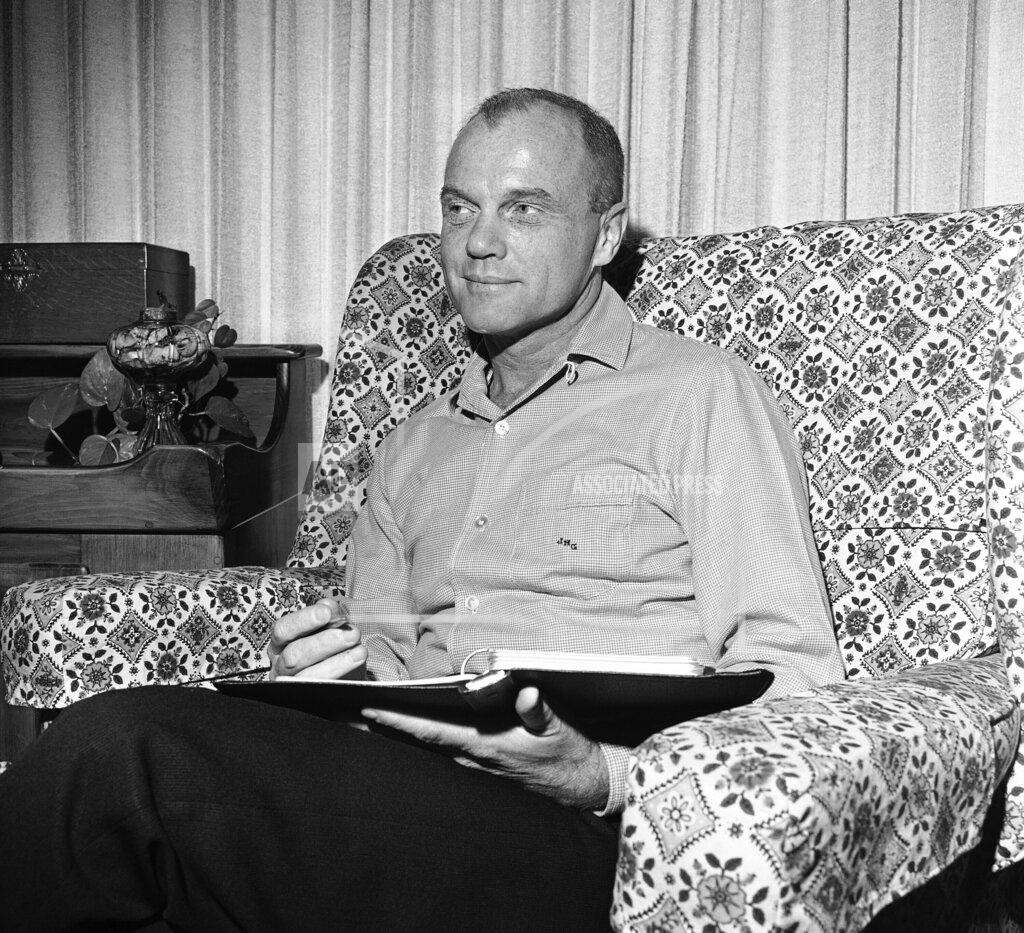
Former American astronaut John Glenn slipped on a bathroom rug in his Columbus, Ohio, apartment and hit his head on the bathtub, injuring his left inner ear. The next day, he announced that he would postpone the start of his campaign for the Democratic Party nomination for U.S. Senator for Ohio. A few days later, he would withdraw from the race completely.
Police dogs and fire hoses were used to disperse Black college students in two racial demonstrations today in Princess Anne, Maryland. The police said acid was thrown on a state trooper during one encounter. At least 20 demonstrators were taken to jail after they had sat down in the street and refused to move. A spokesman at Peninsula General Hospital in Salisbury said a trooper, Colin Macindae, had been released after treatment.
Between 250 and 300 students from Maryland State College demonstrated in the business district of this town of 1,300 residents. The police used the dogs to disperse them after 45 minutes. Later, 150 more students headed for town, but firemen stopped them two blocks from the campus with fire hoses. Two students were knocked from their feet by the water. This demonstration lasted about 30 minutes. Some of the demonstrators arrested were charged with disorderly conduct and with having refused to obey an officer’s command. Those arrested included John Wilson, 20‐year‐old leader of the Student Appeal for Equality, which called the demonstration after Mr. Wilson and two other leaders had been refused entrance to a segregated restaurant.
Nancy Carole Tyler, secretary to Robert G. Baker, followed his example today by refusing to tell the Senate Rules Committee what she knew about his social and business affairs. She based her refusal to talk on general constitutional guarantees of the citizen’s right to privacy and against self‐incrimination. To each of a score of questions posed by the committee counsel, L. P. McLendon, the 24‐year‐old witness repeated in a purring Tennessee accent a short, prepared statement asserting her claim to immunity. She was constantly advised by her lawyer, Myron G. Ehrlich, who sat at her side. Unlike Mr. Baker yesterday, Miss Tyler, a former beauty contest winner, and Mr. Ehrlich welcomed the presence of television cameras in the hearing room. She wore a heavy, dark make‐up well adapted to television lights, and turned smilingly this way and that at the request of cameramen.
President Johnson will stay overnight tomorrow at Miami Beach, Florida, after a speech to a Democratic fund‐raising dinner there. Mr. Johnson had originally planned to return to Washington after the address. The White House announced the change in plans today.
The three physicians attending former President Herbert Hoover reported last night that he continued to show improvement during the day but that he remained “seriously ill.” Mr. Hoover is 89 years old. On Sunday night his right kidney began bleeding and he developed a respiratory difficulty. A bulletin issued at 7:30 last night said: “Former President Herbert Hoover continues to make slight progress, but he remains seriously ill. His temperature is normal and there has been no further bleeding from the kidney. Respiratory distress, caused by his pulmonary infection, continues to be troublesome. Mr. Hoover has had a better day, remains alert and continues to take nourishment by mouth.”
Dow Jones Industrial Average: 799.38 (+2.79).
Born:
Tara Reade, Former Senate aide for Joe Biden, domestic violence advocate, and writer, in Monterey County, California.
Tony Furjanic, NFL linebacker (Buffalo Bills, Miami Dolphins), in Chicago, Illinois.
Victor Perry, NFL tackle (St. Louis Cardinals), in Fitzgerald, Georgia.
Ed Blount, NFL quarterback (San Francisco 49ers), in Los Angeles, California.
Mark Dacascos, American actor and martial artist, in Honolulu, Hawaii.



 History Diaries