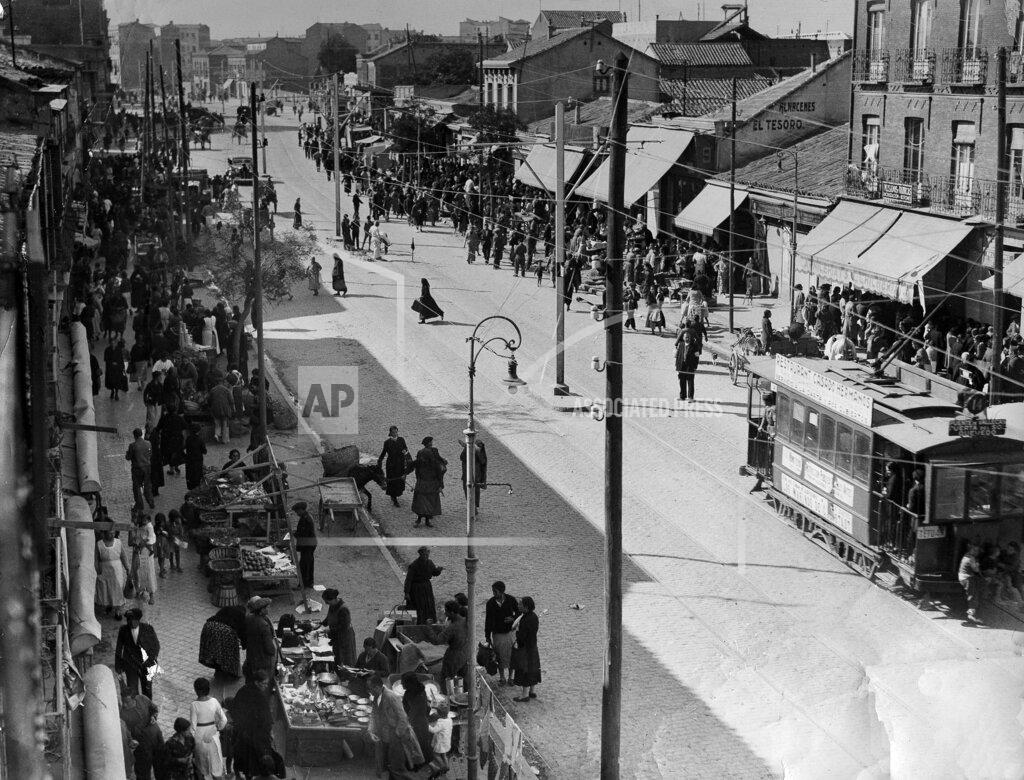
The end of the long Spanish civil war appeared to be only a matter of hours tonight. The Spanish Government, officials of the Madrid regime said, has agreed to offer its virtual surrender. The capitulation to the Insurgent government of Generalissimo Francisco Franco will be called an “armistice,” according to the officials, who declared it might go into effect late tonight or tomorrow. Only unforeseen resistance by government followers, they said, could postpone the end. The agreement to capitulate was said to have been given by Premier Juan Negrin after written guarantees had reached the British Government from General Franco.
These guarantees were said to be assurances that there would not be reprisals against Loyalist leaders. Insurgent authorities likewise would guarantee Spain’s freedom from German and Italian domination, it was stated. The assurances, largely meeting Premier Negrin’s terms for the surrender of the Loyalists, were said to have been given by General Franco apart from negotiations in Britain and France for recognition of the Insurgent regime, expected Monday. It was understood that the time for the “armistice” to become effective was being discussed between the British Government, the Spanish Ambassador to London and representatives of General Franco’s Cabinet. The peace was said to have been proposed by Britain.
Spanish Government officials in London disclaimed knowledge of any armistice move. A Spanish Embassy spokesman said negotiations looking toward an armistice must be preceded by a statement of terms on which the proposals were made. He professed ignorance of any such approach by the British Government. The battlefronts in Spain were as quiet as though an armistice had already been declared. Not even an air raid was reported.
A wave of intense indignation was aroused throughout Franco territory today by the publication of a detailed account of how the body of the Bishop of Teruel, who was taken prisoner when the Republicans (Loyalists) captured the capital of Lower Aragon a little more than a year ago, had been found in woods near the French frontier yesterday with forty-one other victims of summary vengeance carried out by the Republicans at the last moment before they abandoned Spanish soil. The other prisoners whom the Republicans apparently were unwilling to take with them into France, where their lives would have been spared, included Colonel Francisco Rey d’Harcourt, commander of the Nationalist (Insurgent) garrison in Teruel; twenty other high ranking Nationalist officers taken prisoner by the Republicans and four diocesan canons, as well as other lesser military officials and clergymen.
One hundred Jews must leave Germany daily. Berlin police ordered the city’s Jewish community to produce the names of 100 Jews per day, who would then be given notice to leave Germany within two weeks. It was not explained what would happen to those who did not comply.
An exodus of Italians from France begins by order from Rome. The motives include need for manpower in Italy. More than 1,200 of almost 1,000,000 Italians living in Continental France and the Island Department of Corsica answered today the Fascist Government’s first call for them to return to their homeland. Italy’s decision to repatriate her citizens was described as following the plan launched last November 17 to get back under the Italian flag as many as possible of the Italians living abroad. French Government officials accepted this reason. But the occurrence of the repatriation at a crucial moment in Italian-French relations was ascribed in responsible quarters to one of two things: either that Italy feared that war with France might come soon or that she wanted to make the French believe that she was preparing to back up agitation for colonial concessions from France with action.
A total of 1,242 Italians left or prepared to leave French soil as the vanguard of an exodus that an Italian Embassy spokesman said was only beginning. Although special trains were provided by Italian authorities, only 230 repatriates left Paris today. They were to be joined en route by 160 Italians at Dijon. One hundred left Marseille. Three hundred will leave Corsica for Leghorn aboard a special liner on Monday. Four hundred and forty will leave Nice the same day, picking up twelve more at Menton en route to Italy.
An Italian consular official in Nice asserted: “Foreign countries have been insulting Italy’s ability to take care of her own people. This will show them.” The exodus apparently was confined to France. There was no evidence that any of the 100,000 Italians in Tunisia, French North African protectorate which has figured in the territorial clamor in the Fascist press, had been called home. There were mostly old men, women and children in the group that left Paris.
Czecho-Slovakia exempts Germans from the army. Ernst Kundt, following his return from Berlin, apparently is meeting success in his demands for a German minority. Czecho-Slovak citizens of the German people in the future will be exempted from military service in the republic’s army; Germany has already exempted her Czech minority of 1,000,000 from military service, but it is pointed out that with a population of 80,000,000 she can better spare her Czechs than a country of 10,000,000 can spare its German minority of 450,000. The second success for Herr Kundt is that all German newspapers, periodicals and books will be free from censorship and allowed unrestricted circulation in Czecho-Slovakia.
Polish students smashed windows of the German Embassy in protest of Adolf Hitler. Italy and Premier Benito Mussolini were loudly cheered and Germany and Chancellor Adolf Hitler still more loudly booed by a student crowd when Count Galeazzo Ciano, Italian Foreign Minister, appeared on a balcony of the Italian Embassy in Warsaw this afternoon. By shouting, in turn, “Long live Italy,” and “Down with Germany,” the students protested against the maltreatment of their fellow Poles who were driven from the Danzig Technical College by Nazis yesterday. This demonstration was an accurate reflection of the majority of Polish opinion regarding the Italian guest, who arrived at noon. It showed a sincere friendliness with the Italian people but a distrust of the Rome-Berlin axis. During the day anti-German demonstrations occurred. A student delegation, after cheering outside the Italian Embassy, marched to the German Embassy, where several windows were smashed before the police could disperse the crowd. The demonstrators held a brief meeting in Pilsudski Square, where speakers hailed France and Italy and denounced Germany.
Up to tonight, sixty-seven persons had been sent to concentration camps in a nationwide drive against the Hungarian fascist movement (Arrow Cross Party). Eighty more persons were arrested today, of whom forty-seven were still being detained tonight. Hundreds of homes have been searched and literally tons of propaganda confiscated. All the party’s branches have been closed throughout the country, while “Heil” greetings and party slogans are forbidden. Premier Paul Teleki broadcast a message to the Hungarian nation tonight. He said that he had accepted the program of his predecessor, Bela Imredy, and that he would pursue policies along the lines of those applied in the last three years.
Foreign Minister Grigore Garfencu of Rumania will go to Warsaw, Poland, soon for conversations with Colonel Josef Beck, Polish Foreign Minister, following the visit of Count Galeazzo Ciano, Italian Foreign Minister. Among the questions discussed will be the Jewish problem as it affects Rumania and Poland. Well-informed circles in Bucharest declare Colonel Beck will raise this subject on his forthcoming London visit.
King Carol of Rumania today made two appointments regarded as agreeable to Germany. He made 82-year-old Professor Alexander Cuza, anti-Semitic leader, a member of the executive committee of the National Front, the country’s only legal political organization, and appointed Radu Crutzescu, a Foreign Office official, as Rumanian Ambassador to Germany. M. Cuza, who once boasted of having written books on anti-Semitism before Adolf Hitler was born, served as Minister without portfolio in the government of the late Octavian Goga last year and was the mainspring of its anti-Jewish drive.
The Cardinal from Boston is still under consideration for Pope.
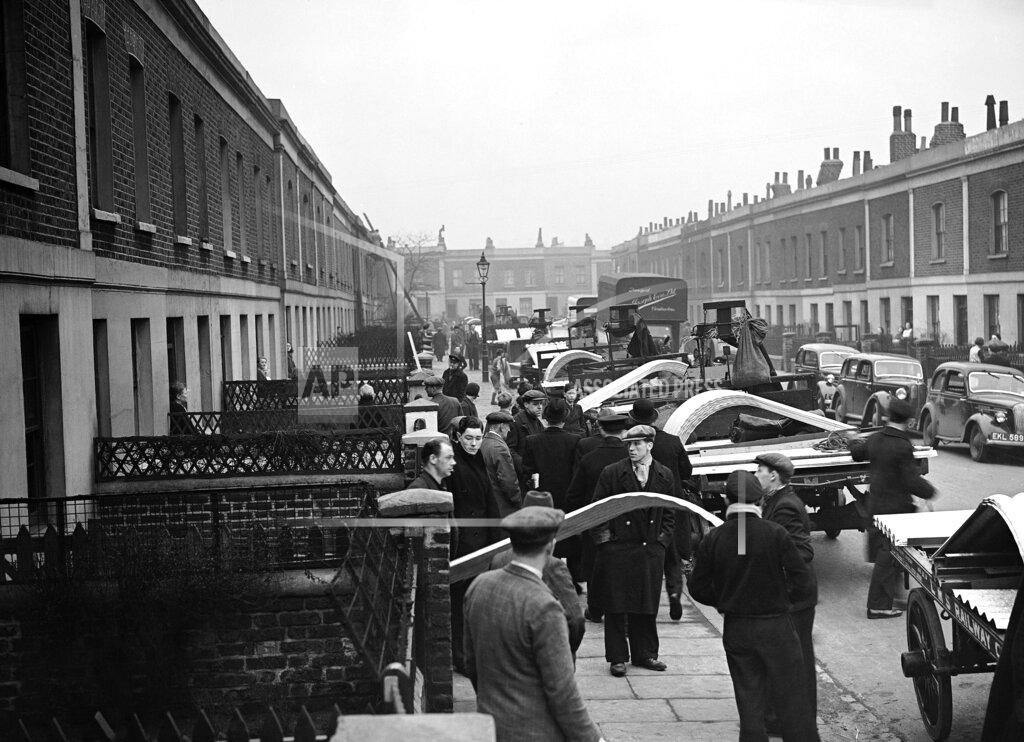
The first of 2.5 million Anderson air raid shelters appear in Islington, North London. They are corrugated iron huts, sunken into the ground and covered with earth.
President Roosevelt called on American labor today to “end the breach” which has divided it into the warring camps of the American Federation of Labor and the Congress of Industrial Organizations by negotiating “peace with honor” in the interest of a “united and vital labor movement.” In nearly identical letters to John L. Lewis, head of the new CIO, and William Green, president of the AFL, the President asked them to appoint committees “to negotiate the terms of peace” by which fundamental unity of purpose and program might be brought about.
Mr. Roosevelt asserted in giving his reasons for seeking to terminate the long-standing labor schism that the objective was “right,” that responsible officers of both groups seemed ready and capable of negotiating a just peace, that the membership of both ardently desired peace and unity, and that the government and people believed it to be a wise and almost necessary step “for the further development of cooperation between free men in a democratic society such as ours.”
For the first time since organized labor split into two factions three years ago, official and unofficial observers here were sufficiently optimistic today to predict that before another year passed there would be a reunited labor movement. Secretary Perkins, who was largely responsible for the preparatory work which led up to President Roosevelt’s peace plea of today to the American Federation of Labor and the Congress for Industrial Organizations, indicated that among the objects animating the Administration in the truce efforts was an urgent desire to have industry and a united labor organization cooperate for greater national productivity.
Some significance was seen in the timing of today’s announcement, following by one day the speech of Secretary Hopkins in Iowa conciliatory to business, by two days Secretary Morgenthau’s reassuring statement on taxes, and by eight days the President’s own reassurance to business just before embarking on his cruise. The Administration had also concluded that labor peace was urgent if the Democratic party were to have a possibility of winning the 1940 elections.
A House bill asks to add 43 air squadrons. Forty-three squadrons will be added to the Army Air Corps if the expansion bill passed by the House on February 15 becomes law, the Senate Military Affairs Committee stated in its formal report, made public today, recommending passage of the House measure. The committee urged that a top limit of 6,000 serviceable airplanes be placed in the bill instead of the 5,500 which the House approved. “This program,” the report said, “will give us a balanced air force, that is, balanced as to types and numbers of planes, as to personnel, as to equipment and ammunition; balanced as to provisions for instructing the additional pilots and mechanics required, and as to maintenance; balanced as to the minimum requirements for new construction to enable at least a beginning to be made on the new fields and air bases required both at home and in Panama, Puerto Rico and Alaska.” The committee emphasized that portion of President Roosevelt’s annual message, delivered on January 4, dealing with the need and desire of the United States to bear its full share in the protection of the entire Western Hemisphere “against storms from any quarter.”
Thomas Dewey successfully prosecutes James Hines. The court victory is thought to increase Dewey’s chances of receiving the Republican nomination for president in 1940. The verdict of guilty was pronounced thirteen times last night upon James J. Hines, Tammany district leader, by Leonard T. Hobert, foreman of a blue ribbon jury in General Sessions Court. Then Judge Charles C. Nott Jr. set March 13 as the day for sentence, the maximum being twenty-five years. Standing with his chin up, his blue eyes glittering and his lips pressed into a line that seemed to be a faint smile, the 63-year-old man whose power was great enough to make John F. Curry the leader of Tammany Hall took the verdict without a visible sign of emotion. Later he called it “a kick in the belly.” The man who made Mr. Curry in 1929 and broke him in 1934 by withdrawing support after having become the chief dispenser of New Deal patronage in New York County, stood convicted, on a second trial, of being the “crooked politician” who made crime safe for gangsters. Lloyd Paul Stryker, his attorney, who had made a losing fight to save his client with the plea that he had been framed by the members of the Arthur (Dutch Schultz) Flegenheimer policy racket, of which the conviction brands him as a participant, reached over at one point and patted him on the shoulder.
There was no disorder in the courtroom, but two messengers who got out while the jurors were being polled by Court Clerk James Monahan raced through crowded corridors of the old Criminal Court Building in Center Street yelling “Guilty!” and this was taken up by the waiting crowd who had misunderstood the cry and cheered in the belief that Hines had been freed. Back upon the court room through slightly open doors came the sounds of yelling-a volume of indistinguishable noise. And thus, for District Attorney Thomas E. Dewey ended a job that began in the latter part of 1935 when, as special prosecutor of rackets, he took up the policy game as a field of investigation and followed one lead after another until Hines was indicted as the Schultz court fixer and intimidator of police.
The third New York Supreme Court Justice dies within two months. Alonzo McLaughlin succumbs to pneumonia.
Schools will teach arithmetic, algebra, and geometry as one subject as an experiment.
Health Services estimates the lifespan of babies born in 1938 to be 62 years.
Assailing the Rev. Charles E. Coughlin as “a national menace” whose propaganda technique stamped him as “perpetrating the same gigantic hoax” that Chancellor Hitler did in his rise to power, the Rev. Leon M. Birkhead, national director of the Friends of Democracy, told members of the Progressive Education Association today that democratic nations “face the unpleasant task of re-defining and re-interpreting the civil liberties.”
A revised version of “Yes, My Darling Daughter” passes censorship.
“The Puritan” is banned for “solicitation on the street, lewd dance halls, indecent acts of prostitutes.”
An estimated 350,000 flee the Chinese capital of Chungking.
A Domei (Japanese News Agency) report today from Harbin, Manchukuo, said that Soviet Russian forces twice had invaded Manchukuo on Thursday and had clashed with Japanese near Manchuli. The first time, the dispatch said, fifty mounted Russians, repulsed in a two-hour battle, had left one dead. In the second clash there had been no casualties, the reports said.
In the past month Soviet Russians have engaged in minor fighting with Japanese and Manchukuoans in the area near the northwestern boundary between Manchukuo, a Japanese protectorate, and Siberia. On February 14 the Japanese Diet approved a resolution demanding a stronger stand against Russia.
An impregnable military and naval position, ‘from the extreme northern end of the Japanese islands through Manchukuo and China’ itself, with an arm extending southeastward to Japan’s mandated islands, which practically touch the equator, emerges as the basic aim of Japanese military-naval operations and policy in Eastern Asia. To this must be added as a fundamental corollary — the building up and maintenance of an army-navy air force sufficiently powerful to engage the Soviet Union in warfare and to emerge victorious.
Neither the Japanese Government nor the armed services have ever stated this policy clearly, yet it is perceptible to the naked eye as one follows the debates in the Japanese Diet, reads the Japanese press, listens to the public utterances of Japanese men of affairs and, far more important, observes the concrete acts and steps that Japan is taking. The Minister of War, General Seisniro Itagaki, has openly acknowledged that Japan’s military machine is designed for the ability to engage both China and Soviet Russia simultaneously on the field of battle.
Dow Jones Industrial Average: 146.82 (+1.38).
Born:
Jim Tyrer, AFL-NFL tackle (AFL Champions, 1962-Texans, 1969-Chiefs; Super Bowl IV, 1969; AFL All-Star/Pro Bowl, 1962-1966; 1968-1971, Dallas Texans-Kansas City Chiefs, Washington Redskins), in Newark, Ohio (d. 1980, suicide).
Jim Brewington, AFL defensive tackle (Oakland Raiders), in Greenville, North Carolina.
Denny Lemaster, MLB pitcher (All-Star, 1967; Milwaukee-Atlanta Braves, Houston Astros, Montreal Expos), in Corona, California.
Marisa Mell, Austrian actress (“Masquerade”, “Casanova ’70”), in Graz, Austria.
Naval Construction:
The Marine Nationale (French Navy) Élan-class Avisos dragueur de mines (minesweeping sloop) Commandant Delage is launched by At. & Ch de France (Dunkirk, France).
The Вое́нно-морско́й флот СССР (ВМФ) (Soviet Navy) Project 7U-class (Storozhevoy-class) destroyers Sovershenny (Совершенный, “Perfect”) and Svobodny (Свободный, “Free”) are launched by 61 Kommunara (Nikolajev, U.S.S.R.) / Yard 200; both ships are completed by Sergo Ordzhonikidze (Sevastopol, U.S.S.R.) / Yard 201.
The Nihon Kaigun (Imperial Japanese Navy) seaplane carrier HIJMS Mizuho (瑞穂, “Fresh Grain”), sole ship of her class (modification of the Chitose-class) is commissioned.
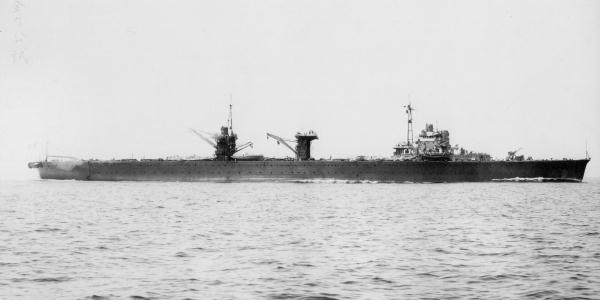
Mizuho participated in invasion support for much of her career; her first mission was with the Fourth Surprise Attack Force. On 1 March 1942, planes from Mizuho and Chitose damaged the American destroyer USS Pope, which was later sunk by aircraft from the aircraft carrier Ryūjō and gunfire from the heavy cruisers Ashigara and Myōkō.
The American submarine USS Drum torpedoed Mizuho at 23:03 hours on 1 May 1942, 40 nautical miles (74 km; 46 mi) off Omaezaki, Japan. She capsized and sank at 04:16 hours on 2 May 1942 with the loss of 101 lives. There were 472 survivors, of which 31 were wounded.
 History Diaries