Hungary joined the Anti-Comintern Pact. The new Hungarian government of Count Paul Teleki, after suppressing the leading Fascist organization (the Arrow Cross), changed policies mid-stream and Hungary joined the Anti-Comintern Pact with Germany, Italy, and Japan. Hungary today signed the anti-Comintern pact allying Hungary formally with Germany on the same day that Premier Paul Teleki smashed the largest party of Nazi sympathizers. Count Teleki, who took office February 16, banned the Hungarist party as a danger to public safety. In swift raids carrying out his order, police arrested more than 500 persons, ousted the party from its headquarters throughout the country and seized tons of documents and propaganda material. While the raids were in progress, Foreign Minister Stephen Csaky signed the anti-Comintern agreement that pledged Hungary to aid Germany, Italy and Japan in fighting communism throughout the world.
The body of the Bishop of Teruel is found among victims of the retreating Spanish Loyalist forces. The bodies of the Bishop of Teruel, Dr. Anselmo Polanco Fonseca, and those of Lieutenant Colonel Francisco Rey d’Harcourt and forty-two others have been found by Spanish Insurgents in a wood near the French frontier, according to a dispatch from Burgos tonight. The bodies are mostly those of priests or political prisoners, executed by the retreating Loyalists, the message asserts. In Burgos the Bishop of Teruel is regarded as a heroic figure. He is said to have resisted severe pressure while he was held prisoner, when Loyalists endeavored to force him to speak over the radio and declare he was receiving good treatment.
Dr. Anselmo Polanco Fonseca, Bishop of Teruel, was among the last of the 6,200 Spanish civilians and Insurgent soldiers who had been holding out in Teruel to surrender to General Juan Surabia, Loyalist commander, after a nineteen-day siege on January 7 and 8, 1938. He and a group of priests and scholastics, guarded by a beleaguered garrison of 800 men, had taken refuge underneath the ruins of the Teruel Seminary and the Santa Clara Convent. The surrender was negotiated by Lieutenant Colonel Francisco Rey d’Harcourt, military governor of Teruel. Franco partisans assailed Colonel Rey d’Harcourt as a traitor. General Garcia Valino of the Insurgent General Staff charged that he planned the surrender well in advance and only simulated resistance. Colonel Rey d’Harcourt complained that his appeals for reinforcements had not been heeded.
The Spanish (Loyalist) Government asserted at the time that all the 6,200 prisoners were being treated kindly and it was understood the bishop would be treated as a noncombatant. A communique on January 8 purported to give a “spontaneous” statement from him, declaring “I have been taken care of with every sort of consideration.” At first it was reported an exchange was likely for him, and he was held in San Miguel penitentiary. He was accused by the Loyalists of treason in the signing of the pastoral letter of the Spanish Bishops on the civil war which accused the Loyalists of anti-religious acts. Later, with three attendants, he was held in the Nineteenth of July Barracks in Barcelona. While he was there a report was spread that he had given the Loyalists evidence of Generalissimo Francisco Franco’s treatment of Catholics opposed to his regime, but this was denied.
Generalissimo Francisco Franco, having declared to the world that surrender of Loyalist Spain must be unconditional, set up today a court to try those persons held responsible politically for prolonging resistance to his regime. He appointed Enrique Suner Ordonez president of his newly created National Tribunal of Political Responsibility, with full power to impose broad economic penalties. A recent decree fixing responsibility for continuance of the “Red Revolution” since October 1, 1934, when a revolt broke out in Asturias, and covering the current civil war, which started July 18, 1936, gives the new tribunal power to exile Loyalist political leaders to Spanish overseas possessions. The tribunal also may prohibit persons from returning to places where they formerly lived or strip them of citizenship. The court has no jurisdiction, however, over persons accused of such crimes as murder or treason. These must face criminal courts, which have the power to impose death penalties.
The French vote on recognition of Franco is stormy, but passes, 323–261. Announcing that on Monday he would ask the French Cabinet to recognize General Francisco Franco’s government, Premier Édouard Daladier obtained in the Chamber of Deputies this afternoon what amounted to approval of that course in a vote of confidence of 323 to 261. Neither the debate, which was stormy, nor the vote was of the Premier’s seeking. It was forced on the chamber by a petition from fifty Left deputies who wanted to know what the intentions of the government were “while Italian and German troops remain in Spanish territory.” M. Daladier rejected the demand for a debate and it was on that issue that the vote was taken. Those opposed to the Premier’s decision, however, had their chance to develop their arguments.
Polish students at the Technical College in Danzig were attacked today by uniformed Nazis who drove them from the building. Several German officials looked on and the school’s director refused to call the police. Five Poles were injured and some eighty others were told never to reappear at the school. It is picketed by Nazis. This marked the climax of a fortnight’s clashes between Polish and German students. A few days ago, the Nazis displayed a placard in a cafe frequented by Polish students that said: “Poles and Dogs Not Admitted.”
The Poles appealed to Warsaw for protection and the issue was raised in the Sejm (Polish Parliament), where speakers pressed for retaliation against the Danzig citizens in Poland. Today Danzig’s Nazi Senate President sent the Polish Commissioner a note protesting against the Sejm’s intervention. The commissioner, in turn, protested against the expulsion of the students. This afternoon anti-Polish demonstrations were held in Danzig streets by uniformed Nazis.
Shouting “Down with Hitler,” several hundred students this afternoon marched to the German Embassy in a demonstration against the persecution of Polish students in the Danzig Technical College. The police dispersed the crowd, arresting seventeen. The students then went to the residence of Marshal Edward Smigly-Rydz shouting, “Let us march on Danzig under your leadership.”
The hunt for a torpedoed ship in the Atlantic ends in mystery; no such ship is ever found.
Hungary smashes a Nazi unit, dissolves the National Socialist organization, and arrests many leaders. Hungary also signs an anti-Communist pact. Nine members of the banned Iron Guard were sentenced to one to eight years in prison by a military court in Bucharest, Rumania today in connection with the frustrated “flamethrowers” plot last month. According to the police, the plotters planned to destroy public buildings by means of machines hurling blazing gasoline and tar a distance of a hundred yards.
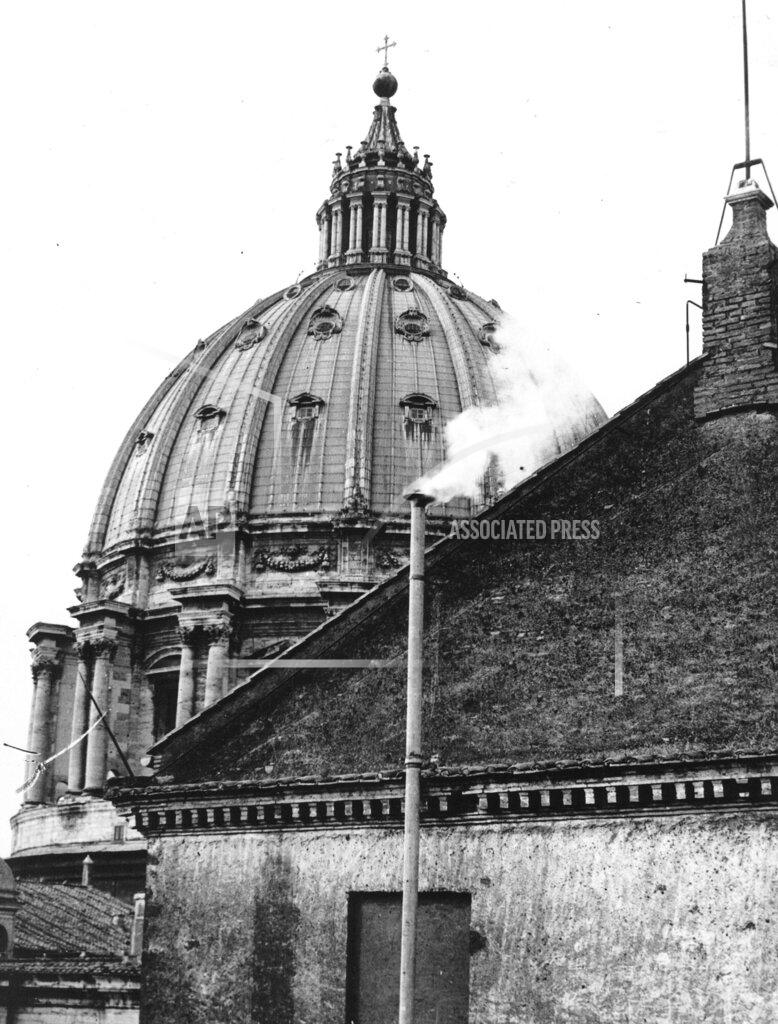
Cardinals seek a curb on the new pontiff, and want more independence.
The conclave cells closest to the chapel are set for the oldest and most infirm Cardinals.
An Italian’s arrest stirs Cardinals. The man is allegedly held for advocating a non-Italian Pope.
The Arabs still urge an independent Arab Palestine. Discussions with the Jews in London fail to find any basis for compromise. Another informal meeting between Jewish delegates to the Palestine conference and representatives of the Arab States of Egypt, Saudi Arabia and Iraq was held in St. James’s Palace today. This time the conference lasted less than half an hour. It ended when the Arabs, having heard compromise suggestions by the British Government, announced that they could not comment on them until they had consulted with the Palestinian Arabs. The latter refuse to come to these informal joint meetings because of their differences with the Jews.
From all that could be learned today, the conferences still did not bring the two sides any closer. All conferences, both formal and informal, have been suspended until next week. Meanwhile, it is expected the British delegates will be occupied in reducing to some sort of form their suggestions for solution of the Palestine problem. Although it is acknowledged that the British have made a step forward in getting the two sides to meet at all, there is still no change in the expectation here that the conference will end with the imposition of a British plan for the Holy Land.
The U.S. Senate was in recess today. The Military Affairs Committee approved a bill providing $102,000,000 for acquisition of strategic war materials. Majority Leader Barkley conferred on the legislative program with chairmen of major committees. The Agriculture Committee continued hearings on the Smith cotton bill. The special Unemployment and Relief Committee continued its investigation of unemployment compensation proposals, and a Rules subcommittee held a hearing on revision of rules governing the press gallery.
The House debated the $1,700,471,354 Treasury – Post Office Supply Bill, received a bill to authorize storage of $100,000,000 worth of strategic war materials, indulged in general debate and adjourned at 4:55 P. M. until noon Monday.
The Ways and Means Committee held a hearing on amendments to the Social Security Act. The Judiciary Committee studied the subject of deportations. The Agriculture Committee held a hearing on cost-of-production farm bills. The Labor Committee held a hearing on the Civilian Conservation Corps and the World War Veterans Committee studied war risk insurance expenditures.
The Secretary of Commerce says the new focus is no longer on reform but on private jobs. Harry L. Hopkins, Secretary of Commerce, mapped tonight a Federal program for business based on “a desire to create an environment in which private capital will be encouraged to invest.” In a speech before the Economic Club in Des Moines, Mr. Hopkins asserted that such an environment could become “a reality without compromising the great reforms which stand as hall-marks of this Administration’s enlightened program.” “With emphasis shifted from reform to recovery,” he said, “the Administration is now determined to promote that recovery with all the vigor and power at its command.” The Hopkins pronouncements on business-his first “policy” declarations since leaving the social welfare field of WPA-recommended these things:
- No “general rise” in Federal taxes this year and amendment of levies which “tend to freeze the necessary flow of capital.”
- Breaking the “log-jam of private investment in the field of utilities, railroads and housing.”
- “Tolerance and fairness” from labor in dealing with employers.
- An increased national income to provide jobs for the unemployed and to balance the budget.
- Assistance for small business.
- A larger share of the national income for the farmer.
The former national WPA administrator, a native Iowan, recognized lack of business confidence as a “hard, stubborn fact.” “It may be as real a deterrent to restored business health as any we have to deal with,” he said. “I do not propose to ignore it.” In his brief reference to the taxing structure, the Secretary suggested that levies which retard business could be replaced “by increasing other taxes which do not have the same deterring effect.” He indicated his concern over the condition of the railroads by suggesting that the carrier situation be explored immediately “in the interest of labor, the investor, management and the public.” Until the rail problem is solved, he said, “it is difficult to hope for anything like a complete recovery in America.”
President Franklin Roosevelt is still at sea with the U.S. Fleet as war games continue. In the admiral’s cabin aboard the cruiser USS Houston, President Roosevelt today scrutinized a large chart which vividly told of the progress of the big fleet problem. Following with him the official analysis of the “battles” fought thus far in the working out of “Fleet Problem XX” was Admiral William D. Leahy, chief of naval operations. To the temporary White House headquarters in Miami there came from the Houston only the crisp radio message that “there will be no bulletin from the President today.”
Secrecy was clamped on all operations in the war game, but it was believed that the “big battle” of the maneuvers had been fought to a conclusion by sundown tonight. According to plans made known before the President left Florida a week ago, this was the day on which Admiral Leahy, at the President’s side, was to point out any tactical blunders in the fleet movements which were noted in the report sent to the Houston by Admiral Claude C. Bloch, commander in chief of the fleet. Under established navy procedure, Admiral Bloch decides which vessels of the opposing fleets were sunk in the simulated warfare. On such things as the relative amount of hypothetical steel shells poured into ships of the “hostile” and defending forces depend “victory” in the maneuvers.
New York District Attorney Thomas E. Dewey told a blue ribbon jury in General Sessions Court that the conviction of James J. Hines, Tammany district leader, was a “duty” it must perform to end the “corrupt alliance of crime and politics” and remove a “cancer” from the heart of democratic government.
In Seattle, Washington, twenty Chinese-American children, whose parents are cannery workers, begin picketing a Japanese ship at Astoria, in protest at the Japanese aggression in China. Japan’s consul in Portland demands that the children be in school. When the school board so orders, their mothers replace the children. The International Longshore and Warehouse Union honors the pickets and refuses to load 21 rail wagons with steel scrap. The ship owners turn to a federal arbitrator, who rules that the workers are in violation of their contract. The workers ignore him.
Police watch Sally Rand’s fair display. So far, she has not been arrested for scarcity of costume, as occurred in Chicago.
Roy Harris’ Third Symphony premieres in Boston.
Chungking police are warning all women and children and men who are not essential to maintenance of the city’s government, military and commercial routine to evacuate before March 15. Evacuation by that time is considered necessary because Spring brings dissipation of the mists that enshroud Chungking most of the year. Frequent Japanese air raids are expected because Chungking is still an important government center. It is planned to reduce the population of 700,000 by one-half. Work is being rushed on fire precautions because it is feared the Japanese will follow their practice at other cities of using incendiary bombs. Every tenth building in heavily built-up districts is being torn down and fire walls are being repaired. Householders are required to maintain reservoirs of water and stores of sand.
The public bomb shelters can hold only several tens of thousands. The municipality is rushing shelters by tunneling through rock under the city, but the work without pneumatic tools is slow. It is estimated that by the year’s end there will be shelters for only 100,000. Several pontoon bridges across the Yangtze and Kialing Rivers, which flow on each side of the narrow neck of land upon which Chungking is built, will be completed by the end of March. These will enable the populace to flee when air raid alarms are sounded. The government is spending 5,000,000 Chinese dollars on bridges, houses for those fleeing to the countryside near Chungking and for other projects connected with evacuation.
On the strength of their report of having shot down or destroyed about fifty Chinese planes in an air raid yesterday on Lanchow, Japanese officials here asserted they had dealt a crushing blow to China’s efforts to rebuild her air strength. Reports of pilots who took part in the Lanchow raid, Japanese said, indicated that American-made planes made up part of the Chinese fleet. They quoted the pilots as reporting that Seversky fighting planes had made their first appearance at Lanchow and that they also had seen Curtiss Hawks and Douglas bombers and planes built in Russia.
The Japanese press says the decision by the U.S. House of Representatives not to fortify Guam will aid relations between the two countries, but China is disappointed.
The Japanese premier agrees that religions contrary to the “Way of the Gods” should not exist, and Christian shrines are neglected.
Japan agrees to compensate Britain for the bomb dropped on Kowloon and to punish the officer involved.
Dow Jones Industrial Average: 145.44 (+2.51).
Born:
Doric Wilson, playwright and theater critic, in Los Angeles, California (d. 2011).

 History Diaries