
A brief cease-fire in Lebanon was broken by heavy exchanges of tank and artillery fire across a broad front in Beirut. The fighting resumed after a cease-fire announced by a Saudi mediator. Shells reportedly landed at the Lebanese Army’s key position at Souq El Gharb, nine miles southeast of the center of Beirut, in the southern suburbs dominated by Shiite Muslims, and along the road to Beirut International Airport. The Lebanese Christian Phalangist radio said heavy fighting had broken out between the Lebanese Army and Shiite militia forces in the Galerie Samaan area along the green line that divides mostly Christian East Beirut from Muslim West Beirut.
Shells fell in both East and West Beirut, and the Phalangist radio said Baabda, the site of the presidential palace, and other Christian villages nearby had also come under fire. Anti- Government Druze positions at Aitat, near Souq El Gharb, were reportedly shelled as well. The fighting eased near midnight, hours before most of the 1,100 United States marines still at their compound at the Beirut airport were expected to begin leaving. They are being moved to ships of the Sixth Fleet off Lebanon. The transfer is expected to continue over the weekend. The renewed fighting came less than 24 hours after the Saudi mediator, Prince Bandar, announced in Damascus that a cease-fire agreement had been reached in talks between Lebanese and Syrian leaders. He said the accord covered only fighting and did not include any political points.
Assessment of the U.S. Marines’ mission in Beirut by military officers found that shelling by 16-inch guns on the battleship New Jersey was less effective than hoped, that a new device for spotting enemy artillery worked well and that the venerable C ration may be a thing of the past. Many officers also said that the biggest problem was that political leaders had not carefully defined the mission for the military, thus the mission was never fully understood down the chain of command and by the troops in the field.
Iran reported new gains yesterday in its offensive against Iraqi forces on the southern war front, but Iraq said its troops were “in firm and full command over the situation.” Battle reports from both sides seemed to give fewer details of military action than in the two previous days, when Iran reported surges into Iraq and Iraq said it had crushed such efforts. In Washington, the official view of the Iranian-Iraqi fighting continued to be one of concern but of doubt that any major changes in military position had occurred this week.
On Thursday, after Iraq announced that it had crushed an Iranian drive in the region of the southern Iraqi oil port of Basra, Pentagon officials said intelligence available to them indicated that both sides were building up to a major battle involving large forces but that such a battle had not yet occurred. At the State Department, one official privately characterized the situation around Basra as “a lot of huffing and puffing so far,” with no significant change in the battle positions.
The 8-day blockade of French roads was being lifted by truck drivers after they accepted, in some cases with bitter disappointment, their leaders’ statement that the government was ready to examine all of their demands.
Konstantin U. Chernenko’s selection as party chief has the “unanimous approval” of the Soviet armed forces, Defense Minister Dmitri F. Ustinov said in an address to what were termed “party activists” of the military.
The North Atlantic Treaty Organization named General Hans-Joachim Mack of West Germany today as deputy supreme commander in Europe in place of General Günter Kiessling, whose removal sparked a political scandal in Bonn. General Mack, the 55-year-old head of the Third West German Army Corps at Koblenz, will take up his post as joint deputy to General Bernard Rogers, an American, on April 2. The other deputy commander is Air Marshal Sir Peter Terry of Britain. Defense Minister Manfred Wörner ordered General Kiessling into early retirement in December on security grounds after allegations that he frequented homosexual bars. The Minister was later forced to admit that the allegations were unsubstantiated. General Kiessling was officially reinstated after weeks of controversy. But he did not return to his NATO post and is due to retire at the end of March.
An American effort to curb the flow of money from the United States to Irish republican guerrillas was announced today by the American Ambassador to Britain. In a speech to businessman during a visit to British-ruled Northern Ireland, the Ambassador, Charles Price, said United States Customs officers had begun using a currency reporting act to confiscate money used to buy arms. He said a principal target of the new action was Noraid, a New York-based group that supports the Irish Republican Army’s aim of ending British rule.
Mr. Price said a law that prohibits entering or leaving the United States with unreported sums over $5,000 had already been used against organized crime and narcotics gangs to seize millions of dollars. Now, he said, it was being used “against those who would cause violence in Northern Ireland.” “If it is not reported, the money is confiscated and jail terms handed out,” he said.
The Pentagon was told to clear in advance with the office of a senior Defense Department official any communication with Congress about American military activities in Central America. The order was issued by Fred C. Ikle, Under Secretary of Defense for Policy. Pentagon officials said the order reflected concern in the Reagan Administration about increasingly assertive efforts by Congress, particularly Democratic lawmakers, to examine whether the Pentagon has established a permanent military presence in Honduras without Congressional authorization. Administration officials, including Secretary of Defense Caspar W. Weinberger, have denied that the United States intends to establish a long-term military presence in Honduras.
President Reagan meets with Prime Minister Muldoon of New Zealand.
The Philippine defense minister warned the United States on Friday that any changes in a $900-million military bases agreement would force the government of President Ferdinand E. Marcos to renegotiate all its defense ties with Washington. The tough warning by Juan Ponce Enrile was in response to a proposal by a House subcommittee chairman Thursday to cut military aid to the Philippines in 1985 by $70 million and redirect it as economic aid. “If, for any reason, any member of the American Congress or any responsible authority in the American government feels there should be an alteration in the compensation package, it will be necessary to review all over again the whole mutual agreement,” Enrile said.
The United States has two major military agreements with the Philippines-a mutual defense treaty signed in 1951 and the military bases agreement of 1947, which allows American use of the Subic Bay Naval Base and Clark Air Base, both giant facilities that are linchpins of U.S. military power in the Pacific, as well as of four smaller installations. It was the first such threat since the two countries agreed in 1979 to renegotiate every five years the pact covering the two military installations. And it follows, also by one day, assurances by former Sen. Salvador Laurel, a major opposition leader now touring the United States, that maintaining the bases does not depend upon Marcos remaining in office. In July, 1983. Marcos told U.S. congressman that the Philippines might seek closer ties with the Soviet Union if Congress rejected the proposed aid. Marcos’ statement was followed by a Soviet overture, a letter from a high official of the Soviet Presidium of the Supreme Soviet. Ivan P. Kalin, suggesting closer ties between the two nations.
Hindu-Sikh violence in northern India took six lives today and prompted the Governor of Punjab state to form armed volunteer committees in districts where 24 Hindus have been slain this week. The authorities redeployed troops around the Golden Temple in Amritsar, according to reports from the sacred Sikh city. Sikh militants are demanding greater political and religious autonomy in Punjab. Four Sikh gunmen killed a Hindu and wounded four others outside Amritsar, and the police captured three of them in a gun battle, Punjab officials said. In Gurdaspur, militants shot and killed a villager, the police said. Four Hindus wounded in earlier clashes died in hospitals today, raising the 11-day death toll to 68, state officials said.
Right-wing guerrillas said today that they had kidnapped 77 foreigners in a raid on a diamond-mining area of northeastern Angola because the rebels had been excluded from a peace agreement between Angola and South Africa. The guerrillas of the National Union for the Total Independence of Angola said they had captured 46 Portuguese, 16 Britons and 15 Filipinos and destroyed 340 trucks in the attack on the town of Kafunfo on Thursday. A guerrilla communique issued here indicated that the hostages were being marched south, adding, “Any intervention by land or air against the column of hostages will have serious repercussions on the captives.”
President Reagan, who has made development of the nation’s energy resources a theme of his Administration, was told today that the Interior Department was considering leasing the Government-owned oil and gas rights to his California ranch. In a development surprising to White House and Interior officials here, the department’s Bureau of Land Management has been working on an offer for the mineral rights under Mr. Reagan’s mountaintop retreat. Also surprised were a father and son in Sacramento, who filed the application. They said they did not learn that the President’s ranch was part of the tract they want to lease until just a week ago.
“The White House has been informed of it and they said, ‘Go ahead,’ ” said Robert F. Burford, director of the Bureau of Land Management. “In this particular instance, the President considers himself to be a citizen and wants to be treated like any other citizen would be treated.”
The U.S. Air Force Chief of Staff announced that the F-15 would become the Air Force’s new dual-role fighter. During the competition, F‑15Bs modified for the air-to-ground attack role won out over the cranked arrow-wing F‑16XL in the Enhanced Tactical Fighter competition. This led to production orders for the F-15E Strike Eagle. The Pentagon said its decision would have an estimated value to McDonnell Douglas of $1.5 billion. A spokesman for the company said it would mean the continuation of about 7,000 jobs, with F-15 production lines staying open into the 1990’s. More than 800 of the aircraft have been assembled at the company’s St. Louis plant since 1975. Production of the modified F-15, to be designated F-15E, will begin in 1986 with the first delivery expected in 1988. Changes to the craft will include installation of advanced electronics and weapon-carrying equipment, as well as minor structural alterations.
Advancing food prices pushed the Consumer Price Index up six-tenths of 1 percent in January, the largest increase since April. The Labor Department said that much of the rise was caused by bad weather and that the January increase was not a sign of a broader, immediate resurgence of inflation.
The President and First Lady watch the movie “Unfaithfully Yours.”
Senator Pete V. Domenici’s proposal to cut President Reagan’s request for military spending authority next year from a 13 percent increase to 5 percent will be considered by Congressional negotiators. The new proposal from Senator Domenici of New Mexico, chairman of the Senate Budget Committee, was rejected in general terms by White House officials, but Republicans suggested it might eventually be accepted if the figure could be “fleshed out” with specifics. Democratic leaders praised Mr. Domenici’s suggestion but said next year’s rise in the military budget should be cut back even further.
Mr. Reagan is seeking $305 billion in spending authority in his proposed military budget for the fiscal year 1985, which will begin Oct. 1. Officials in Mr. Domenici’s office could not be reached for specific figures on his proposal. Mr. Domenici made his proposal at a meeting today of the White House and Congressional participants in the bipartisan effort to reduce the Federal deficit with a three-year, $100 billion “down payment.” Despite the negative reaction of the White House, participants and aides said they thought Mr. Domenici’s proposal gave some momentum to the deficit talks, which have mostly involved partisan positioning and wrangling for two weeks.
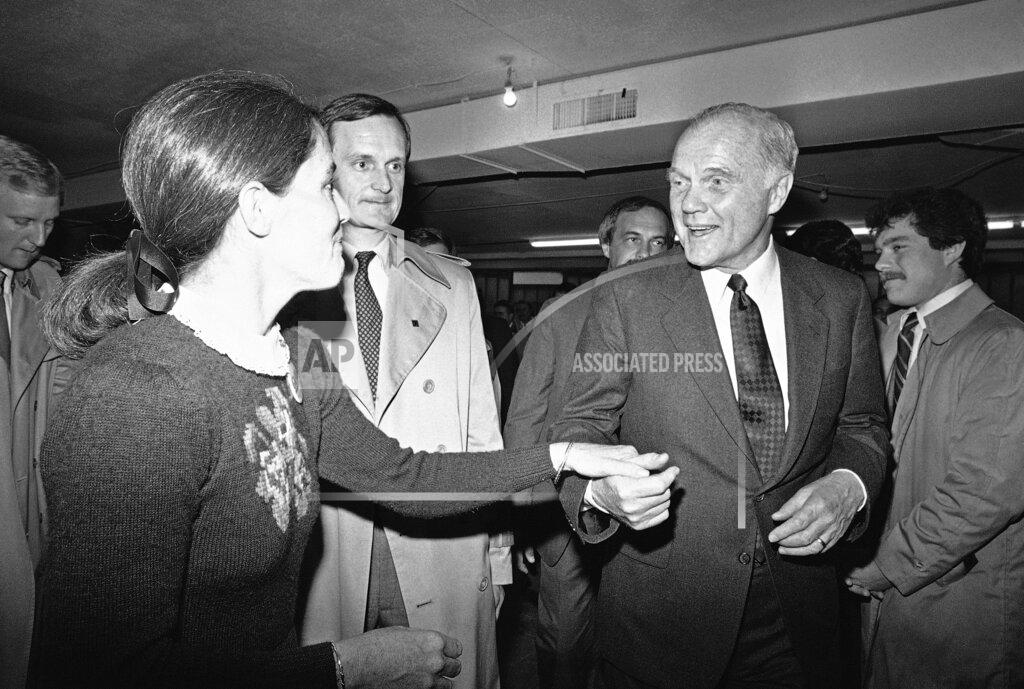
Senator John Glenn’s plan to upset Walter F. Mondale in the largely conservative South and rescue his campaign for the Presidential nomination will not work unless he scores strongly in the New Hampshire primary, independent politicians and poll takers say.
About 40 protesters were arrested today after they blocked a train which they said was carrying nuclear weapons from Texas to a submarine base in Washington State. The tracks at the Union Pacific railroad yard were blocked for about two and a half hours before the police cleared them at mid-afternoon. The 18-car train then headed north across the Columbia River into Washington. Those arrested were charged with criminal trespass. The train arrived after protesters along the route in Oregon held peaceful vigils and demonstrations as it passed through their communities.
A sniper in Los Angeles fired repeatedly into a crowded schoolyard, killing a 10-year-old girl and injuring at least 13 other people. Several hours later, members of a police paramilitary unit entering a house opposite the schoolyard found the body of a man they said was the sniper.
President Reagan, pledging to replace “red tape” with the “blue sky” of limitless opportunity, gave formal authorization today to what could evolve into a $10 billion-a-year commercial space industry. At a White House ceremony, he signed an executive order authorizing the Transportation Department to coordinate a program that will allow private corporations to launch their own satellites into space. Jennifer Dorn was named the head of a new office, the Commercial Space Transportation Office, to promote the effort.
“Private enterprise made America great,” Mr. Reagan said, “and if our efforts in space are to show the same energy, imagination and daring as those in our country, we must involve private enterprise to the fullest.” Standing before a photograph of the planets and models of rockets in the national space program, he said the Transportation Department would clear away what Transportation Secretary Elizabeth Hanford Dole has called “the thicket of clearances, licenses and regulations that keep industrial space vehicles tethered to their pads.”
A landslide and a ruptured water pipeline in the Feather River Canyon knocked out three power plants early today, cutting off electricity to 13,000 customers. The authorities said they did not know whether leaking water had caused the landslide or if the landslide had broken the pipeline. There were no injuries and no roads were closed. Power in Plumas and Lassen counties, about 130 miles north of Sacramento, was party restored after several hours, said Tom Owens, a spokesman for the Pacific Gas and Electric Company.
Three Federal grand juries on the West Coast today indicted 27 people as participants in the “Coronado Company,” which the Justice Department said was in fact an international drug ring responsible for smuggling 32 tons of marijuana. Attorney General William French Smith said the indictments, returned from February 10 to February 22, were unsealed today in Federal courts in San Diego, Seattle and San Francisco. Before today’s indictments, 57 defendants had been convicted in San Diego, Seattle and Bangor, Me., in connection with “Coronado Company” narcotics ventures. The case led to the Government’s seizure of numerous assets illegally accrued by the “Coronado Company” and related criminal organizations and their members.
Students’ nonacademic life is of increasing concern to American colleges and universities after more than a decade of giving their students as much social independence as possible. At institutions ranging from small liberal arts colleges in the Northeast to large Middle Western state universities, students are making increased demands for counseling. Faculty members are once again setting up residence in dormitories and fraternities, and students are working more closely with college officials on issues such as drinking. Many colleges are restructuring their social life to meet changing needs and demands of a new generation of students. Princeton University has a new system of “residential colleges” designed to increase the quality of social life of freshmen and sophomores. Dartmouth College is adding social facilities and seminar rooms to its dormitories to promote closer links between students’ academic and social lives.
Dow Jones Industrial Average: 1165.1 (+30.47).
Born:
Brandon Williams, NFL wide receiver (San Francisco 49ers, St. Louis Rams), in St. Louis, Missouri.







 History Diaries