Spanish moderate, Colonel Segismundo Casado, the temporary XVIII Corps commander at the Battle of Brunete, staged an uprising against communist power and formed the Council of National Defense, hoping that Francisco Franco would be prepared to discuss terms with a fellow officer. This resolved into a civil war within a civil war, with over 1,000 deaths before the Casado faction gained the upper hand.
Franco asks for aid for feeding the hungry in Madrid. Nationalist (Insurgent) relief organizations made newspaper appeals today for more contributions of food for the besieged thousands in Madrid. The appeal carried forward a drive by Generalissimo Francisco Franco’s relief agencies to be prepared with tons of foodstuffs for immediate distribution if peace should end Madrid’s resistance or it should fall to his troops. Recent reports have indicated that Madrid, again the capital of Loyalist Spain, still has a population of about 1,000,000, despite efforts to reduce it.
General Franco, having successfully met the problem of feeding more than 2,000,000 people in Barcelona and Catalonia when his troops conquered Northeastern Spain last month, expects that the food situation in Madrid and the surrounding area probably will be even more urgent. From the whole length of Insurgent Spain, particularly from rich agricultural sections, supplies of food are being gathered and stored to be loaded on army trucks, trains and ships at a moment’s notice. As in Barcelona, specially trained corps of thousands of men and women relief workers have been assigned to hand out rations. They have distributed bread to 2,000,000 persons within twenty-four hours in past instances. Reports of British physicians who recently have visited Madrid say that thousands there are near starvation. Relief agencies in Madrid are said to be meeting the demands of only one child in ten in urgent need and to have little or no milk available for children between the ages of 2 and 5 years. Shortages of bread, vegetables, meats and liquid foods also are reported.
Valencia is working against time in preparing her defenses for the expected Insurgent push down the seaboard. Military operations are at a standstill, except for daily air raids along the Mediterranean coast. In preparing the city against the expected enemy offensive 158 underground shelters have been constructed and large sums have been spent on first-aid hospitals and fortifications.
Agents of the Nationalist (Insurgent) Social Brigade arrested five persons accused of criminal activities during Loyalist control in Barcelona, it was announced today. A man named Lopez Alvarez, a member of the Loyalist Military Information Service and of a squad personally escorted by Police Commissioner Rodriguez Salas in Barcelona before the revolution, has also been detained. The gravest charges have been lodged against him by persons claiming to have been persecuted during his tenure of office. Two other persons said to have been under the orders of Manuel Marin, a militia patrol chief in the town of Molins de Rey, likewise were taken into custody by the military judicial authorities here. The militia patrol corps was organized to hunt down persons suspected of disaffection with the Loyalist regime in the early days of the civil war.
The Reich demands that Jews cede valuables. Under a decree that Field Marshal Hermann Göring, Commissioner for the Four-Year Plan, announced today, all German or Stateless Jews must surrender within a fortnight all jewels and other objects of gold, silver or platinum as well as all diamonds, pearls and other precious stones. These objects, which would Include silver knives, forks and other tableware, must be delivered to special agencies — mostly local public pawn shops — appointed for the purchase of Jewish property in return for compensation” whose size and nature will be fixed by Minister of Economics Walther Funk. Jews of foreign citizenship are exempted from this decree. Violation of the decree is punishable by fines or imprisonment with hard labor up to ten years, even if the offense is committed outside Germany, which would mean that technically Jews of German citizenship already outside Germany would likewise be expected to comply.
The new decree has caused surprise because it follows German pledges to George Rublee before he ended his task as director of the Intergovernmental Committee on Refugees that, while no anti-Jewish decrees would be withdrawn, nevertheless no further compulsory measures would be taken against the Jews.
Reich Transport Minister Julius Dorpmüller decreed that Jews were forbidden from using sleeping and dining cars on German railroads.
France and Britain began minor naval maneuvers in the Mediterranean.
The idea of a non-Italian Pope wins more favor. The Archbishop of Quebec is the leading non-Italian contender.
The Cardinals’ cells for the conclave are near completion. They vary significantly in comfort and appearance.
In London, Viscount Halifax, the Foreign Secretary, today delivered one of the sharpest of all the warnings that have been thrown out from London in recent weeks in the direction of the axis powers. The British people hated war, Lord Halifax, told the House of Lords, but it would be “disastrous to suppose that the people of Britain and France would on that account recoil from resisting by force any threat to their rights or to their independence or what they deemed to be their vital interests.”
The British parliament considers a flogging amendment for bombers.
The first pay-per-view sporting event in history took place when a live BBC Television broadcast of a boxing match between Eric Boon and Arthur Danahar was shown at three London cinemas. In 1939 only about 20,000 London households had television sets in a city of 8.6 million people, and the crowds at the cinemas were completely packed.
The construction in the Netherlands of two 8,350-ton cruisers included in yesterday’s armament budget will commence immediately. The orders were placed today with two Rotterdam shipyards — the Rotterdam Drydock Company and the Wilton Company. The cruisers will be the largest Netherland warships. They will have a speed of thirty-three knots and will carry ten 15-centimeter (5.9-inch) guns, twelve 40-millimeter machine guns and six torpedo tubes. Each will carry two planes. Their construction will take two years.
[Ed: A wonderful idea — for 1936. It’s too late for this now. De Ruyter and De Zeven Provinciën will barely be started before the Heer comes calling next year and work mostly stops. The ships will not enter service until the 1950s.]
Moscow claims to have launched a battleship, though foreign observers doubt the report. [Ed: It is actually the heavy cruiser Molotov.]
The House of Representatives threw out of one of the Administration’s national defense bills today the item of $5,000,000 for construction at the island of Guam. The House voted 205 to 168 to bar the Guam authorization. It acted largely on the ground that the item in the naval bases measure would be a start toward building a large advance fleet base at Guam and involved hazards in American relations with Japan. Japanese naval officials and the Tokyo press have asserted that the Guam project would be regarded as provocative. After the Guam controversy was disposed of, the House passed the bill by a standing vote, the result of which Speaker Bankhead announced as 368 to 4. The measure as sent to the Senate authorizes the expenditure of $48,800,000.
Administration forces doubtless will try to restore the Guam item in the Senate, either in the Naval Affairs Committee or on the floor. The authorization to dredge Guam Harbor, construct seaplane ramps and a few buildings in the course of the next three years, as covered in the defeated item, was recommended by the Navy Department in connection with President Roosevelt’s emergency national defense message of January 12. Throughout the three-day debate, the entire argument over the bill hinged on the foreign policy that might be involved in the construction of a naval establishment at Guam. Sixty-four Democrats joined with 138 Republicans, two Progressives and one Farmer-Labor member to assert that any step in that direction would be dangerous, by voting in favor of the amendment offered by Representative Sutphin, Democrat, of New Jersey, a World War veteran with overseas service. Voting against the amendment, and therefore in favor of retaining the Guam authorization were 152 Democrats, fifteen Republicans and one American Labor party member.
[Ed: In all honesty, it’s just as well. Anything we put on Guam in 1939-1941 is just going to be gobbled up by the Japanese and used against us. Guam, like the Philippines, will remain indefensible until the U.S. Navy becomes a lot stronger.]
A government reorganization measure shorn of some of the controversial titles of last year’s recommitted bill but retaining most of President Roosevelt’s ideas for, revamping the executive departments was introduced in the House today by Representatives Cochran and Warren, chairman and ranking member of the reconstituted Committee on Reorganization, respectively. Termed a “compromise” by its sponsors, the bill is designed to meet principally the objections voiced last year by seventy-seven Democrats who were returned to Congress. Messrs. Cochran and Warren predicted that it would be enacted, since they “streamlined” it to prevent a head-on assault by Republicans. “This bill is all that we need,” Mr. Warren said. “It will accomplish the major purposes of reorganization, and Republicans will have to think a long time before opposing it. This legislation meets all major objections to the bill last year and will permit a thorough job of reorganization of the government under a review by Congress.”
The measure would empower the President to prepare plans for transfer, consolidation or abolition of Federal agencies, except some specifically exempted. Presidential orders would become effective within sixty days after submission to Congress unless Congress by concurrent resolution (which does not have to be approved by the President) rejects such orders. The bill also amends rules of both houses to prevent filibustering on concurrent resolutions disapproving executive orders on reorganization. The bill does not include the Controller General’s office or the Civil Service Commission as agencies to be revamped. Last year’s bill called for revision of both these agencies, and strong opposition was met because of each. Mr. Cochran said that these features might be revived later in separate bills, but Mr. Warren indicated that if the new measure passed, he would not press for other reorganization legislation.
The Daughters of the American Revolution refuse to rent Constitution Hall to “noted Negro contralto” Marian Anderson. The American Union for Democracy protests.
Former President Herbert Hoover said tonight that a fifth horseman — Intolerant Ideologies — was riding with the four horsemen of War, Famine, Pestilence and Death over two-thirds of the people of the world. In an address urging national support of the smaller colleges, Mr. Hoover declared that “the failure of men to maintain and develop moral standards and spiritual inspiration in pace with their increase in knowledge and power” was responsible for a world “seething with malign forces and ferments. Man’s dependable knowledge increases daily,” he said. “Yet men still move from emotion and belief in fairies. And it is useless to rail at the five horsemen. It is useless to rail at the advancement of science and invention.”
The grandson of Theodore Roosevelt, Quentin, plans an expedition to China to seek rare scrolls and manuscripts.
The Yale University president avows academic freedom for those on campus.
Professor Percy W. Bridgman, premier physicist at Harvard University and one of the world’s highest ranking scientists, announces in the current issue of Science, official organ of the American Association for the Advancement of Science, that he has decided to close the doors of his famous research laboratory to visitors from the totalitarian States and to refuse to discuss his experiments with any citizen of those nations. Professor Bridgman, who is the world’s greatest authority on high pressure, made his announcement under the heading, “Manifesto’ by a Physicist.” He made it clear that the stand he had taken was “made entirely in my individual capacity and has no connection whatever with any policy of the university.”
After the death of the New York Senate Majority Leader, Perley Pitcher, two names rise for consideration: Arthur Wicks and Benjamin Feinberg.
The average fairgoer to the New York World’s Fair spends $2.40, which compares favorably to the $1.17 spent at the Chicago fair.
11th Academy Awards: “You Can’t Take It With You”, Spencer Tracy, and Bette Davis win.
Lou Thesz beats Everett Marshall in St Louis, to win the National Wrestling Association World Heavyweight Championship for a 2nd time.
Glenn Cunningham wins his 21st consecutive indoor race.
Pitcher Bob Feller re-signs with the Cleveland Indians at last year’s salary.
A Pan-American highway opens in El Salvador and Guatemala. Both are proud of the modern advancement that taps into primitive areas.
The former Indian president, Pandit Nehru, quits Congress.
In a sudden drive westward from Hankow the Japanese have captured the city of Tienmen.
Japanese planes continue their bombing and machine-gunning operations over the Chinese positions. Heavy damage was done and twenty casualties were caused when planes bombed Kingmen in Central Hupeh Province. A squadron of Japanese planes, planning to raid Chungking penetrated the Szechwan border this morning, but was turned back because of bad weather.
With the prospect that Spring will clear up the heavy mists that almost perpetually hang overhead, the Chungking municipality is pushing plans to thin out its populace. Two-thirds of the people are being asked to leave voluntarily by the middle of March and after that time stern measures will be taken to reduce the number of residents. The government and the banks are building shelters outside the city for those who must leave. Rickshamen, sedan-chair carriers and river boatmen are being organized to assist in the evacuation.
Japanese bombers, according to The Associated Press, were reported by the Japanese news agency Domei to have staged a mass attack on Lanchow, capital of Kansu Province and station on the Russian supply route. The report said that the fliers were able to bomb Chinese military establishments and an airfield on the outskirts of Lanchow after engaging twenty-six Chinese planes in combat.
A group of fighters flown by Soviet volunteers intercepted 57 Japanese bombers near Lanzhou, Gansu, China, shooting down 6 Japanese bombers and turning back the rest of the formation.
A “decided change” in the international situation in favor of China was emphasized by H. H. Kung, President of the Executive Yuan in a lengthy review of the foreign and domestic situation that he delivered to the just-concluded meeting of the People’s Political Council. The text was released today Premier Kung voiced his government’s gratitude to the Anglo-Saxon nations for their financial assistance. He mentioned particularly the American purchases of Chinese silver which, he said, “helped immeasurably in the stabilization of the Chinese national currency.” He also expressed appreciation of the British and American commercial credits. He pointed out that the Chinese Government was continuing to promote trade with the United States and Britain and was endeavoring “further to increase the economic and commercial relations between ourselves and friendly nations.”
Dow Jones Industrial Average: 142.93 (+0.29).
Born:
Robert Brown, NFL defensive tackle and defensive end (NFL Championship, and Super Bowl I and II champion, 1966, 1967; Pro Bowl, 1972; Green Bay Packers, San Diego Chargers, Cincinnati Bengals), in Bonita, Louisiana (d. 1998).
Doyle Schick, NFL defensive back (Washington Redskins), in Lawrence, Kansas (d. 2001).
Lee Shaffer, NBA small forward (NBA All-Star, 1963; Syracuse Nationals-Philadelphia 76ers), in Chicago, Illinois.
Josef Feistmantl, Austrian luger (Olympic gold men’s doubles 1964; World Championship gold singles 1969), in Absam, Austria (d. 2019).
Keith Fowler, actor, stage director and educator, in San Francisco, California.
Naval Construction:
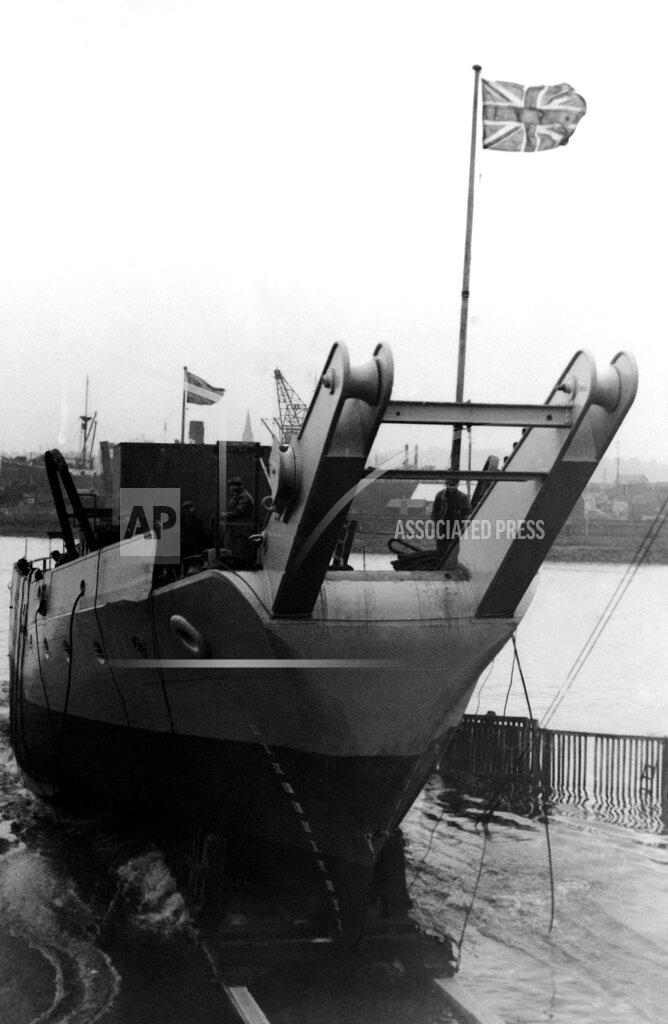
The Royal Navy Net-class boom defense vessel HMS Plantaganet is launched by Lobnitz & Co. Ltd. (Renfrew, Scotland).
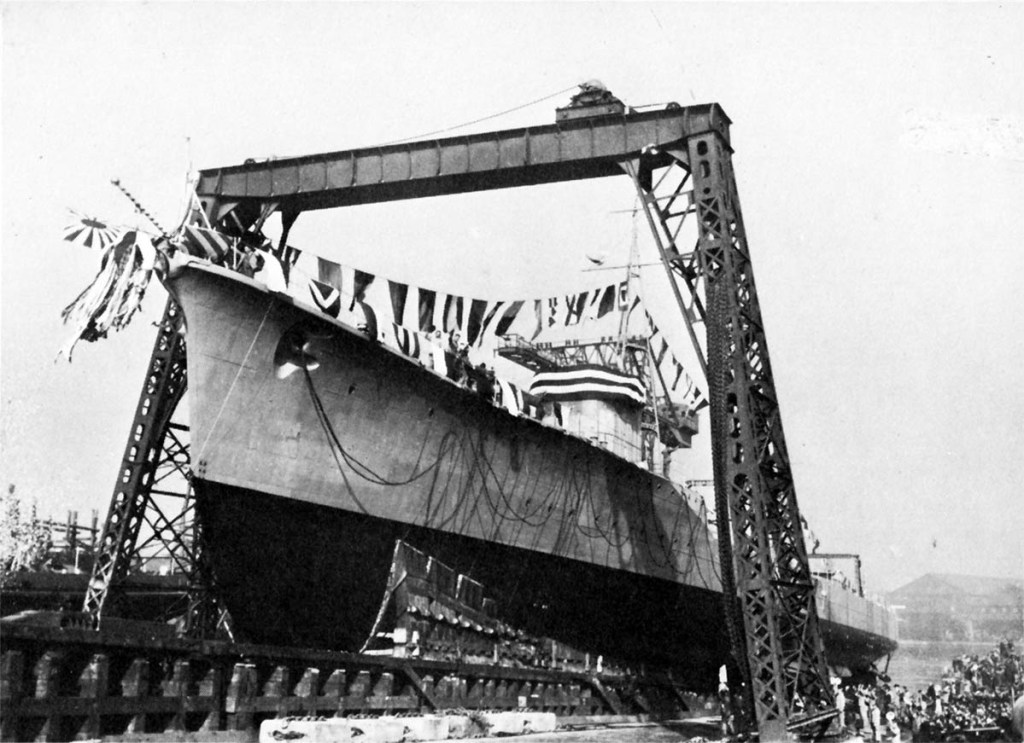
The Nihon Kaigun (Imperial Japanese Navy) Kagerō-class destroyer HIJMS Natsushio (夏潮, “Summer Tide”) is launched by the Fujinagata Shipyards (Osaka, Japan).
The Вое́нно-морско́й флот СССР (ВМФ) (Soviet Navy) Maxim Gorkiy (Project 26-bis)-class heavy cruiser Molotov is launched by the Marti South Yard (Nikolayev, U.S.S.R.).
The Royal Navy Halcyon-class (Third Group) minesweeper (completed as an unarmed survey ship) HMS Scott (J 79) is commissioned.
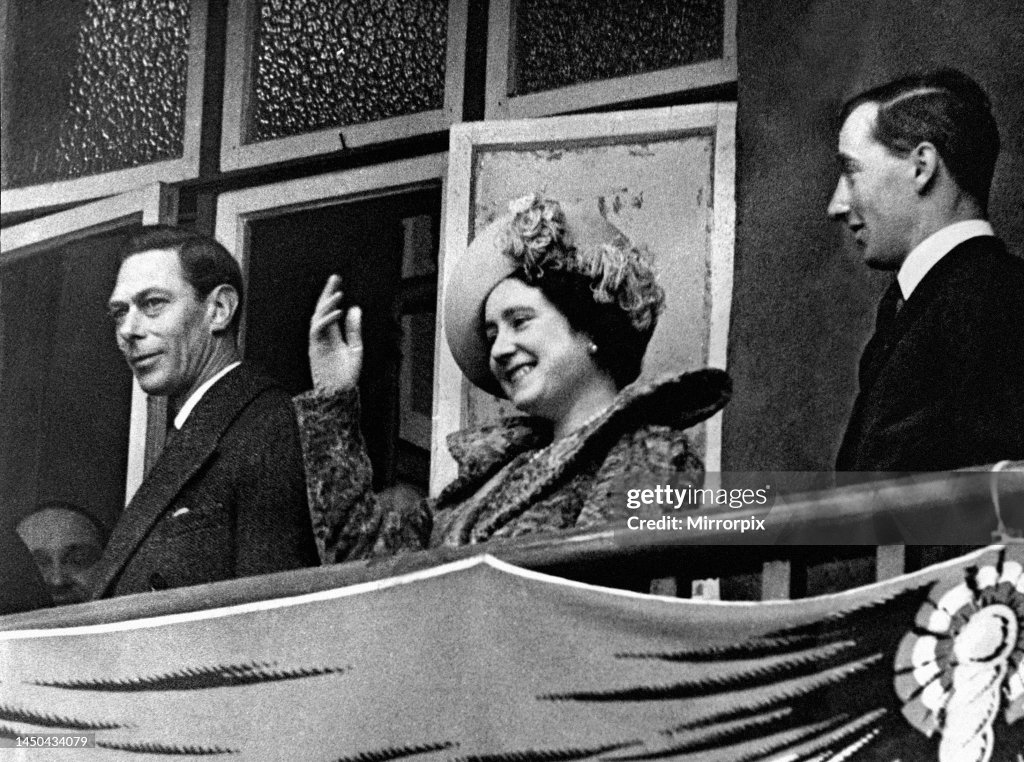

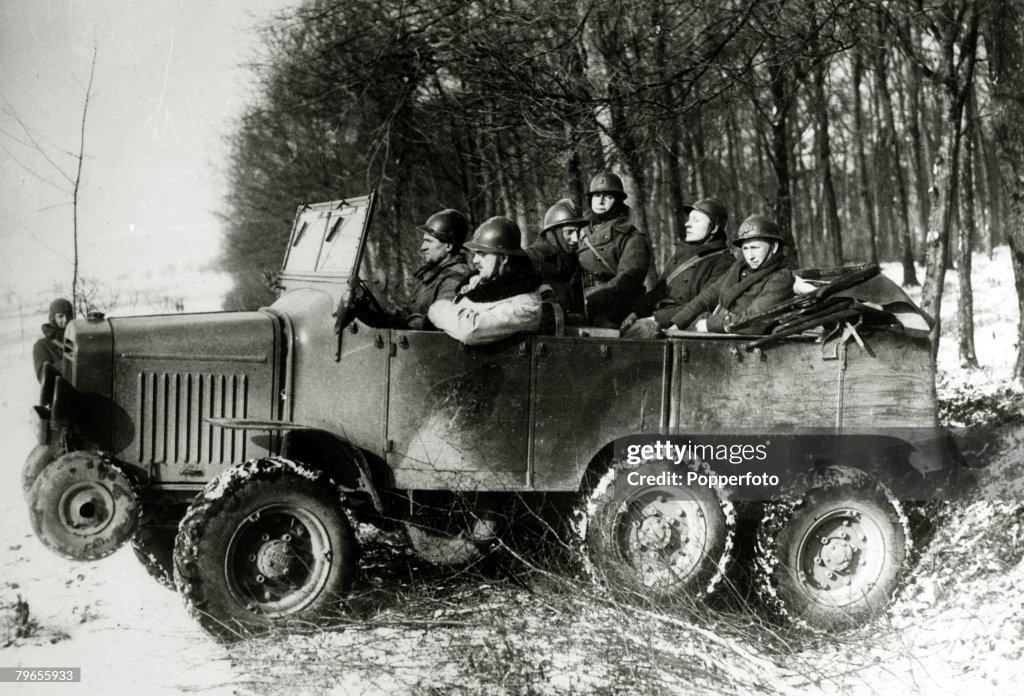
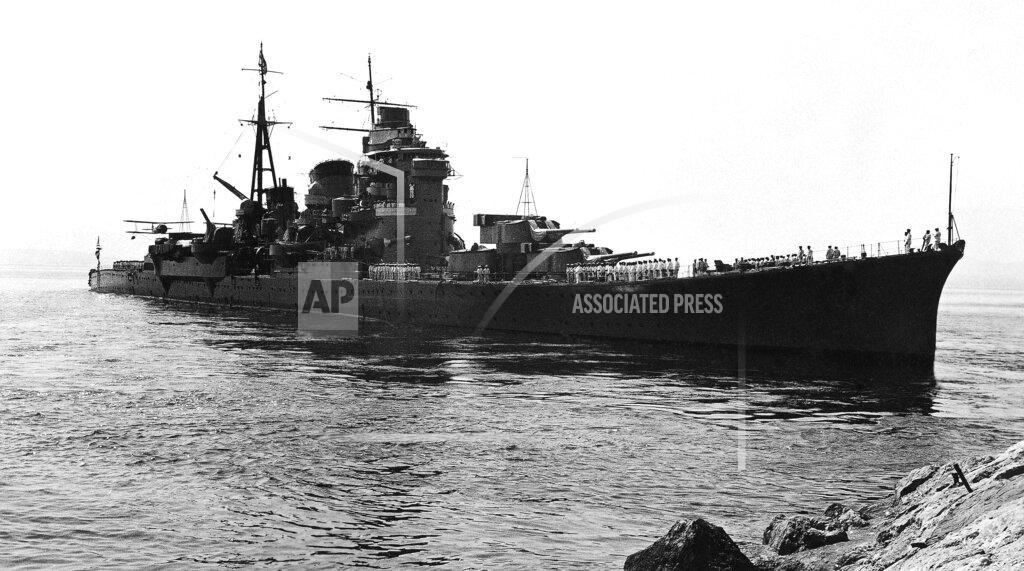
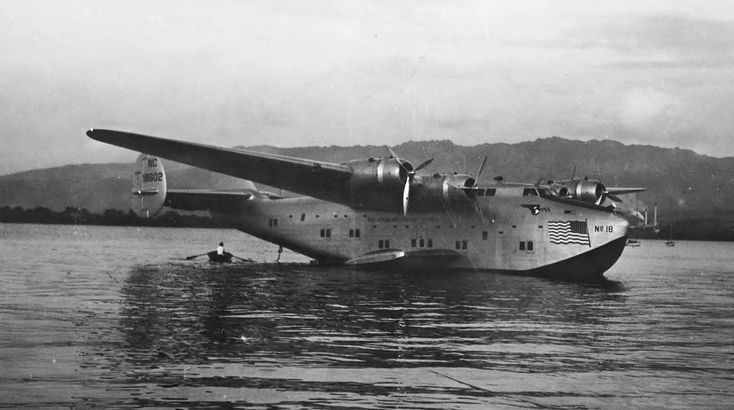


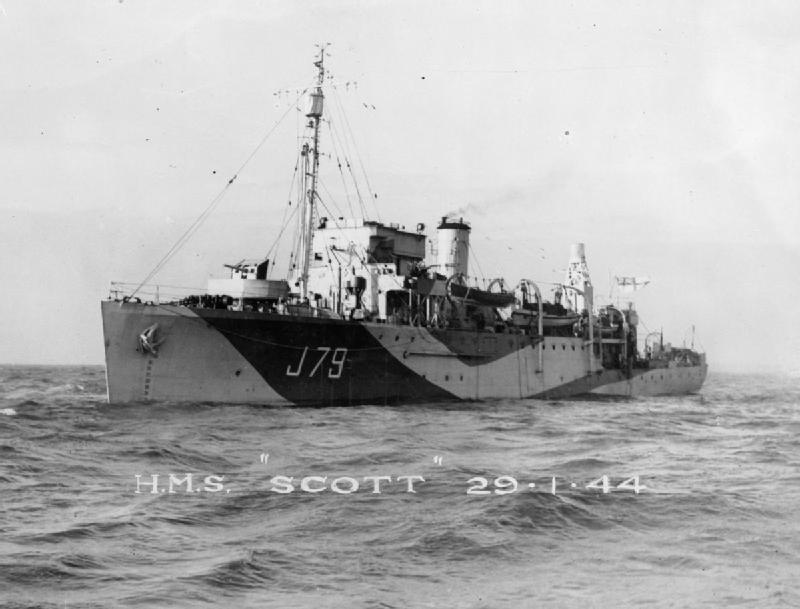
Scott surveyed the English Channel in 1939 in preparation for laying a Channel Mine Barrage, and directed minelayers laying the barrage immediately following declaration of war. She was equipped for anti-submarine escort assignments when the Channel minelaying was completed, but retained the chart room by sacrificing her mainmast to compensate for the additional topside weight of a QF 12 pounder 12 cwt naval gun on the forecastle. By the spring of 1940 her assignments were refocused on minelaying surveys rather than escort work. She measured depth of water with tidal fluctuations and currents to determine suitable minefield locations.
In May 1941 Scott narrowly avoided detection by the German battleship Bismarck while surveying Greenland pack ice in the Denmark Strait. She was damaged in a collision with HMS Arethusa in December 1941 while assisting the British Commando raid Operation Anklet on the Lofoten Islands.
After the collision damage was repaired, Scott focused on providing navigational information for the minelayers placing the Northern Barrage between Greenland and Scotland from the spring of 1942 until the project was abandoned in the autumn of 1943. She surveyed the minefields in advance, and then accompanied the minelayers while the fields were placed.
After testing the Decca Navigator System at Moray Firth in early 1944, Scott surveyed positions for the blockships and Phoenix breakwaters of the Mulberry harbor at Arromanches during the Invasion of Normandy. She then surveyed liberated harbors including Morlaix, Boulogne, Brest, Dunkirk and Antwerp; and surveyed locations for the cross-channel pipelines of Operation Pluto.
Scott was deployed in June 1960 to map shipwrecks from both World Wars in the English Channel after the arrival of giant tankers. The requirements of those ships changed the minimum of clearance between their hulls and the wrecks below.
Scott completed two decades of peacetime hydrographic duties in Home Waters before being decommissioned on 20 November 1964 and scrapped 30 June 1965. She located and swept many war-time wrecks while re-surveying coastal Great Britain.
 History Diaries