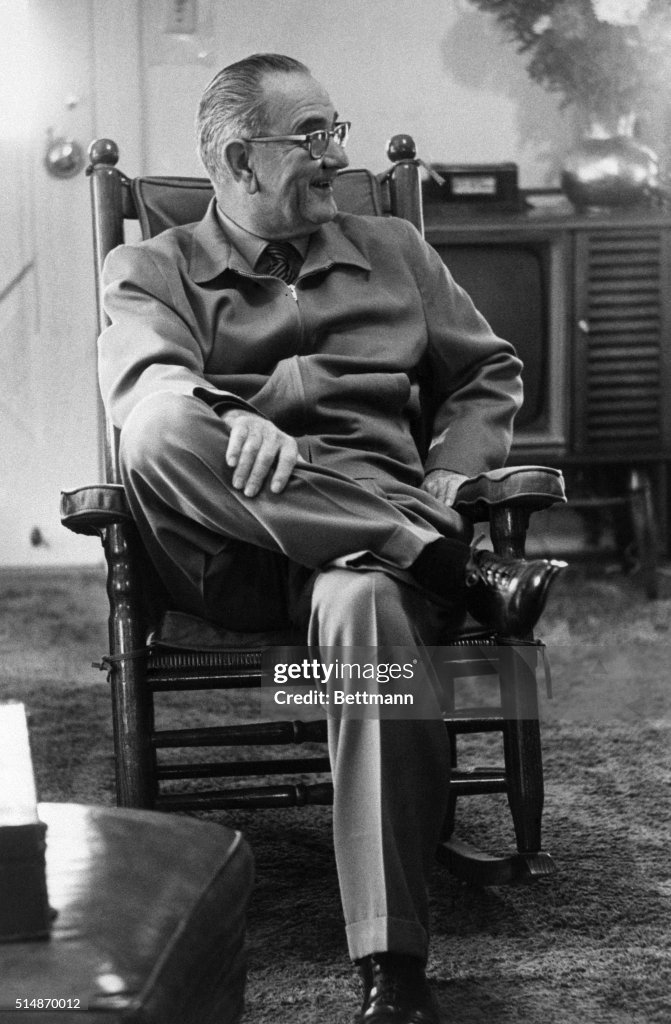
The United States has begun a campaign of psychological warfare against Communist North Vietnam by warning of possible attacks against its territory. Extending the anti‐guerrilla war from South Vietnam to North Vietnam is only one of several measures under consideration here to check Communist advances.
No decision has been made, but the Administration believes it may be able to influence the course of the war by hinting at greater United States involvement in South Vietnam, or even South Vietnamese raids north of the border. It was to call attention to these possibilities that President Johnson included a statement on Vietnam in his speech yesterday at the University of California. The contest in South Vietnam, he said, is “first and foremost” to be won by the South Vietnamese themselves. “But,” he added, “those engaged in external direction and supply would do well to be reminded and to remember that this type of aggression is a deeply dangerous game.”
This statement by the President was described here as a deliberate warning to the Communist Government of North Vietnam at Hanoi. The President’s comment was only one indication that the Administration is willing now to hint at possible policy changes. The importance of Mr. Johnson’s statement was readily acknowledged in private explanations of his remarks. Moreover, the possible need to expand the fighting has been mentioned to officials of Western Allied governments. Some officials at the State and Defense Departments have deliberately called attention to the current policy reappraisal. Strong words of caution against deeper involvement, such as those expressed last week by the Senate majority leader, Mike Mansfield, appeared to have been provoked by a sense of possible policy changes in Congress.
Four Cabinet ministers and another official of the ousted regime of the late President Ngô Đình Diệm were placed under house arrest by the new revolutionary Government yesterday pending an investigation of their financial affairs, a government source reported today. The four were identified as Bùi Văn Lượng, former Interior Minister; Nguyễn Lượng, former Finance Minister; Trần Đình Đệ, former Health Minister, and Huỳnh Hữu Nghĩa, former Labor Minister. Đinh Quang Chiều, a former high official in the Economic Ministry, also was placed under house arrest. The bank accounts of all five men were ordered frozen.
Ambassador Henry Cabot Lodge walks through a barricade of barbed wire these days to get to his office in the United States Embassy in Saigon. The servicemen’s U.S.O. is closed. Military police accompany American children on every school bus and escort them in small groups from the buses through bales of wire netting to the American dependents’ school entrance. The building is searched every night from top to bottom for concealed bombs or booby traps. The realities of war have come to the 1,800 American wives and children trying to live normal daily lives in this besieged capital. Two Americans were killed last week while watching a softball game between teams of the Second Air Division Cobras and the Army Support Group. Three more Americans were killed during a thriller movie that might otherwise have served only as escape literature. No one doubts that more incidents will come.
For American policymakers, this latest thrust against the effort to contain communism in South Vietnam is a cynical humiliation. It is humiliating because it gives the impression that two years of American military expertise here could not serve even to keep Saigon safe. It is cynical because it hits the morale of all Americans at just the soft spot where the least explosive can cause the greatest explosion. American and Vietnamese soldiers may die at war but now women and children are in danger from sabotage to the American community of Saigon. Justified or not, this kind of warfare is most likely to stir the American public and Congress to a decision of fish‐or‐cut‐bait in Vietnam.
Prince Norodom Sihanouk, the chief of state, says his Ambassador in Washington has been informed that the United States is agreeable to a proposed four‐party conference on Cambodian neutrality. The prince said in a speech yesterday that he was happy to hear the news. Participants would be Cambodia, the United States, South Vietnam and Thailand. The conference would also fix Cambodia’s frontiers. The prince said: “We will keep our positive hopes after being scalded by hypocritical and dilatory maneuvers of Great Britain. We have become mistrustful, and we will calmly await more precise and positive reactions to our position.”
Claude Chayet began his duties as France’s first diplomatic representative to the People’s Republic of China. The chargé d’affaires, not officially an ambassador, crossed from Hong Kong at the Lo Wu Control Point and was greeted at the Huanggang Port.
Turkey’s representative said today that efforts to make peace in Cyprus had taken a turn for the worse. Turgut Menemencioglu, Turkey’s Ambassador to the United States, charged the Cypriote Government with trying to delay effective action while continuing to arm the Greek community in Cyprus. Diplomatic sources voiced optimism yesterday and Thursday, but after long talks yesterday and today between the Cypriote Foreign Minister, Spyros Achilles Kyprianou, and the Secretary General, U Thant, there was a swing toward doubt of an early settlement. Mr. Kyprianou indicated today that he had given no ground on demands for a United Nations guarantee of his island’s Government, which is dominated by Greek Cypriotes. This indication, given after a two‐hour conference with Mr. Thant, cast doubt on the generally optimistic comments made by other diplomats in the last two days as consultations went on behind closed doors.
Mr. Kyprianou was reticent as he ended his talk with Mr. Thant here. But he said: “We are not here to compromise or bargain. We are having consultations, but we are not discussing what the other parties are saying.” Asked whether he foresaw a discussion of all the parties involved in the crisis in Cyprus, Mr. Kyprianou said: “A roundtable discussion would not help as long as nobody changes his views.” Mr. Thant’s private talks with delegations took up all of yesterday. Adlai E. Stevenson of the United States called on him this afternoon with Sir Patrick Dean of Britain. They also talked with him yesterday. After nearly an hour with Mr. Thant, Mr. Stevenson remarked, “We have made some progress, but not enough.”
Well‐informed sources said yesterday that there was general agreement “in principle” among the four countries directly involved—Britain, Cyprus, Greece and Turkey. They were referring to proposals by Mr. Thant on these points:
- A Security Council guarantee of the independence of Cyprus.
- An international force supervised by a group of members of the Security Council.
- A mediator appointed by the United Nations to try to reconcile the sides.
- An affirmation of the treaty that guarantees protection for the Turkish minority.
United Nations experts had originally estimated that 3,000 men would suffice for a peace‐keeping force, but now believed that it would take 10,000. With recent reinforcements, he added, British forces there amount to about 6,500.
Greek Cypriote security forces, which numbered about 1,500 men before violence broke out Christmas week, have grown into the tens of thousands. They are well armed, far better armed than the Turkish Cypriotes. This is evident to virtually anyone on the island. A Greek Cypriote official placed the number of armed Greeks at 40,000. He maintained that the vast majority were obedient to central authority. Neutral observers, admittedly handicapped in estimating the exact size of the security forces, believe that the 40,000 figure is exaggerated, perhaps by 50 per cent.
These observers also sharply question the degree of control exercised over the forces by Archbishop Makarios, the President of Cyprus, and his Minister of the Interior, Polycarpos Georghiades. The Greek Cypriote forces are referred to by their leaders as the “legal forces of the republic.” But the vast bulk of the armed men are irregulars who had no previous association with the country’s small police force. Nominally the security forces are responsible to the central Government. But their allegiance to the archbishop and to Mr. Georghiades, a former underground fighter, has not deterred them from acting independently in the warfare with the outnumbered Turkish Cypriotes.
President Adolfo López Mateos of Mexico repeated today his offer to use country’s “best efforts” to bring the United States and Panama together within the Organization of American States. But the Mexican leader, concluding two days of conferences with President Johnson, surprised United States officials by saying at a news conference that “since Cuba has been ousted from the O. A.S., I think that it is the United Nations to which the United States should turn to find a solution of its problems with Cuba.” The United States takes the position that the Cuban problem also should be handled within the Organization of American States since it regards the Communist regime of Premier Fidel Castro as a menace to the peace of the Western Hemisphere.
Waves of guerrillas are attacking the isolated Congolese garrison in Gungu, south of Kikwit, capital of Kwilu Province. The defenders’ situation was described as critical by a visitor today. Kikwit is a city of 60,000 inhabitants. It is garrisoned by more than 1,000 soldiers, but it is menaced on three sides by guerrilla bands. The only roads left open lead west. Midway between Kikwit and Gungu, at Makundjika, a Roman Catholic mission was reported in danger. Nine missionary priests, five Canadian and four Belgian, and four lay teachers are believed to be there. Earlier they refused offers to be evacuated. They managed to send a message yesterday to Kikwit, saying that guerrilla bands had encircled their isolated mission station. An airplane flying over the mission today saw a large “SOS” sign on the ground. “Hundreds of young toughs ran for cover when we flew over the mission,” said the Rev. Rene Barbier, a fellow missionary from Kikwit. Three of four villages nearby were aflame. Four truckloads of soldiers left Kikwit this afternoon to try to reach the mission.
In Gungu, 32 persons were killed yesterday during reported guerrilla attacks. All were civilian refugees living under the protection of 80 soldiers. They were killed with arrows and long bush knives. One soldier was wounded. The soldiers are holding only the airstrip, it was reported here. About 1000 civilians who have asked for protection from rebels are staying in Gungu. They also hold some prisoners. The number of prisoners was first reported as about 300. Today’s count revealed only 29, described as common criminals by the Congolese lieutenant commanding the garrison. He told a visitor that he would take no more prisoners.
The economic power of the West should be marshaled against Castro’s Cuba, Richard M. Nixon said tonight. Allies who refused to cooperate would be denied access to the United States markets, the former Vice President declared. His shout, “We have got to get Castro out of Cuba,” roused whistling applause. Demanding fast, tough action, Mr. Nixon declared that if President Johnson hesitated, Congress should act. He said the Johnson Administration was preparing the American people for retreat or defeat in Vietnam and that this would inevitably lead to the loss of all Southeast Asia to the Communists.
A “pre‐shrunk” foreign aid program of $3.4 billion in the fiscal year beginning July 1 will be outlined by President Johnson in a special message to Congress next week. The message will call for the smallest outlay of new money since the start of the Marshall Plan 16 years ago. It reflects the President’s demand that the money request be based on what recipient countries can be reasonably expected to achieve toward making themselves self-supporting. This is the one big departure in the first aid program submitted by Mr. Johnson. Past estimates of new money requirements have been based on optimistic forecasts of progress by underdeveloped countries toward such goals as monetary, fiscal and land reforms. While stressing the “realistic” basis for his estimate, the President is expected to leave the way open for a supplemental appropriation request if recipient countries do better than expected.
Senate Majority Leader Mike Mansfield emerged last Tuesday from President Johnson’ s weekly breakfast session with his Congressional leaders and predicted that the civil rights debate in the Senate would last months and not just weeks. It may very well, for the Southerners have the material, the organization, and the will to make the upcoming filibuster one of the longest on record. They also have the rule book, which is packed with devices to facilitate extensive debate. In 1960, the Southerners talked germanely for 37 days, including nine days of around-the‐clock sessions, and all they had to work with was a comparatively simple bill to perfect the 1957 measure on voting rights. This year’s bill has eleven titles, and seven of them are contentious enough to keep the Southerners going for months.
The popular image of a Senate filibuster derives from political folklore — the legendary one‐man stands of Huey Long of Louisiana and B. R. Tillman of South Carolina. In 1935, the Kingfish kept going for 15½ hours, regaling the galleries with descriptions of “pot likker” and other Southern culinary triumphs, and surrendered only when he was denied a gentleman’s quorum call to go and relieve himself. And “Pitchfork Ben” 25 years earlier made the Senate capitulate and restore in an appropriation bill a payment of South Carolina’s “war claims” when he threatened to read all of Lord Byron’s “Childe Harold.”
The filibuster the Southerners will open against the pending civil rights bill when it is called from the calendar in about a week or ten days will have none of this flavor and derring‐do. It will be a carefully planned and precisely executed operation under the direction of Generalissimo Richard Brevard Russell of Winder, Ga., whose 32 years in the Senate have made him the supreme parliamentary wizard of that body. The Southerners under his command will discuss the bill and not the sins of reconstruction. Senator Russell’s hard‐core strength numbers 18. He will use the same table of organization he first worked out in 1960. His little band of followers will be organized in three platoons of six.
The General Assembly of the U.S. state of Georgia extended is term by 25 minutes after the scheduled February 21 midnight adjournment, in order to revise its ten U.S. congressional districts to comply with the Wesberry ruling earlier in the week. For the first time in its history, metropolitan Atlanta had two U.S. representatives. Approval came after rural legislators attempted filibusters and other stalling tactics, and passed the state House 113-69 and the state Senate, 35-7.
Efforts to settle the dispute over shipment of wheat to the Soviet Union collapsed last night. Discussions between Secretary of Labor W. Willard Wirtz and maritime union leaders broke up shortly before midnight after intermittent talks throughout yesterday. A spokesman for Mr. Wirtz said it had been impossible to resolve the issues and that no further discussions were now planned. Mr. Wirtz had postponed his return to Washington three times to make further attempts to settle the dispute over the longshoremen’s ban on loading wheat for shipment to the Soviet. The Labor Secretary said he planned to return to the capital later this morning.
Whitney M. Young Jr., executive director of the National Urban League, has been offered the deputy command of President Johnson’s war on poverty, informed sources said yesterday. However, it was reported that Mr. Young had not yet decided whether to accept. The job would place him in one of the highest positions to be held by a Black in the national Administration. Sargent Shriver, director of the Peace Corps, has taken on the additional duty of organizing and directing the antipoverty campaign, with the title of Special Assistant to the President. It was understood that the post offered to Mr. Young would make him Mr. Shriver’s deputy in the poverty program.
The Executive Council of the American Federation of Labor and Congress of Industrial Organizations applauded President Johnson’s war on poverty today but urged that bolder measures and more substantial expenditures be added to his program. The President’s attack on poverty, the council said, has forced millions of more affluent Americans to face up to the fact that one‐fifth of the population still lives in poverty. The council expressed concern, however, because progress toward the eradication of poverty had slowed almost to a halt in the face of spreading unemployment and underemployment in the last decade. “President Johnson now must reverse nearly 10 years of stagnation in the effort to reduce the prevalence of poverty,” the council said in a statement. “Moreover, the Administration’s anti‐poverty campaign in 1964 must be viewed as hardly a first small step.”
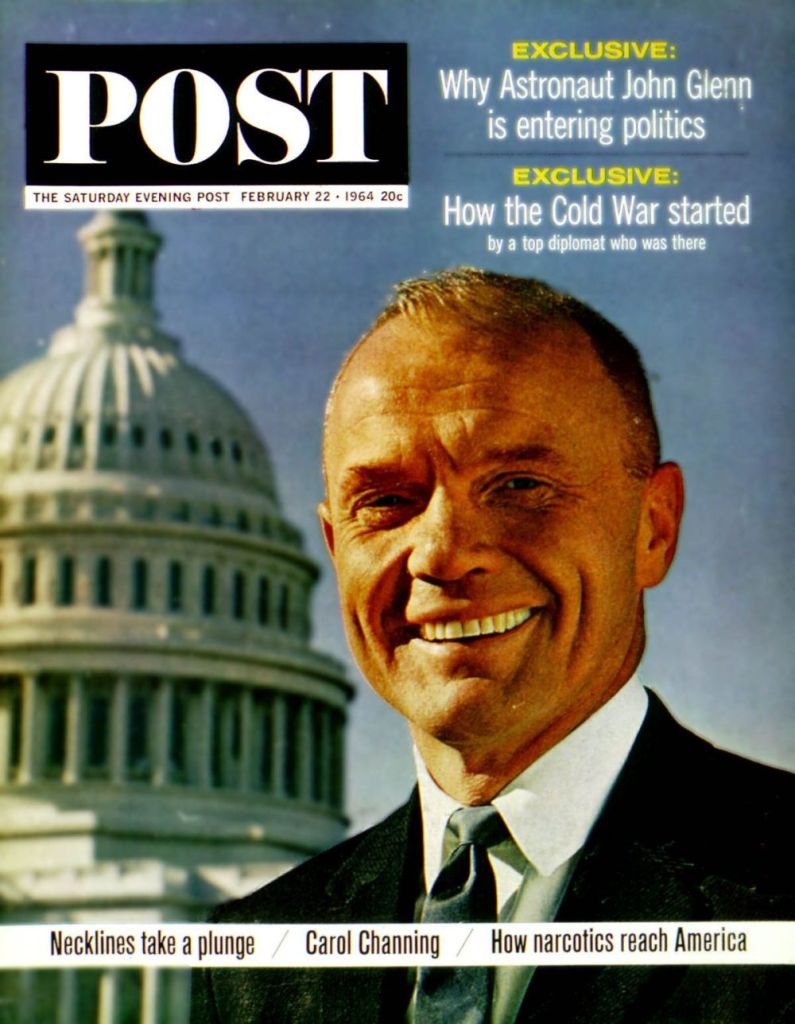
President Johnson writes that the Soviet Union’s head start in space exploration was due principally to “misjudgments by our political leadership, not deficiencies of our scientific community.” In an article in The Saturday Evening Post for February 29, Mr. Johnson does not identify the political leadership, but he deals largely with the period of the Eisenhower Administration. The article is an abridgement of a chapter from the forthcoming book, “Space: Its Impact on Man and Society,” edited by Lilliam Levy and to be published by W. W. Norton & Co. The President writes that the launching of Sputnik I in 1957 was a scientific feat, “but the worldwide impact and importance were essentially political.” Political systems and politicians serving human progress must never rest, he declares.
“In our domestic American politics this is the lesson learned from Sputnik I,” he writes. “After the sustained climb of our postwar ‘consumer‐goods’ boom, some of our political leadership elected to rest, as though a summit had been attained. In that moment of illusion, we were passed by — in the technology of space.” The reasons he gives include failure to establish adequate relationships between the scientific community and political community, the influence of the anti‐intellectualism of the early nineteen‐fifties and “devaluation of the first and hardest responsibility of elected representatives of the people in our system: the responsibility to lead.”
Competitors in the 1964 World Speed Skating Championships in Helsinki got a surprise in the men’s 500-meter event when ashes and soot caused at least five of the favorites “to tumble like tenpins”. Olympic gold medalist Ants Antson was the first to fall down on the first turn of the track, and Nils Aaness, Fred Maier, Hermann Strutz, and Elio Locatelli fell at the same location, before race officials realized that sparks and debris from a nearby factory had blown on to the ice. Keiichi Suzuki of Japan was the event winner.
Born:
Gigi Fernández, Puerto Rican/American professional tennis champion who won 14 Doubles titles in 14 Grand Slam tournaments between 1988 and 1997; in San Juan, Puerto Rico.
Tommie Agee, NFL fullback (NFL Champions, Super Bowl 27-Dallas, 1992; Seattle Seahawks, Kansas City Chiefs, Dallas Cowboys), in Chilton, Alabama.
Robert Logan, Canadian NHL right wing (Buffalo Sabres, Los Angeles Kings), in Montreal, Quebec, Canada.
Mark Paterson, Canadian NHL defenseman (Hartford Whalers), in Ottawa, Ontario, Canada.
William Tanui, Kenyan athlete and 1992 Olympic 800-meter gold medalist; in Terik, Kenya.
Jim Wicek, American actor (Ben-“Ryan’s Hope”), in New York, New York.
Died:
Verrier Elwin, 61, English-born Indian anthropologist

 History Diaries