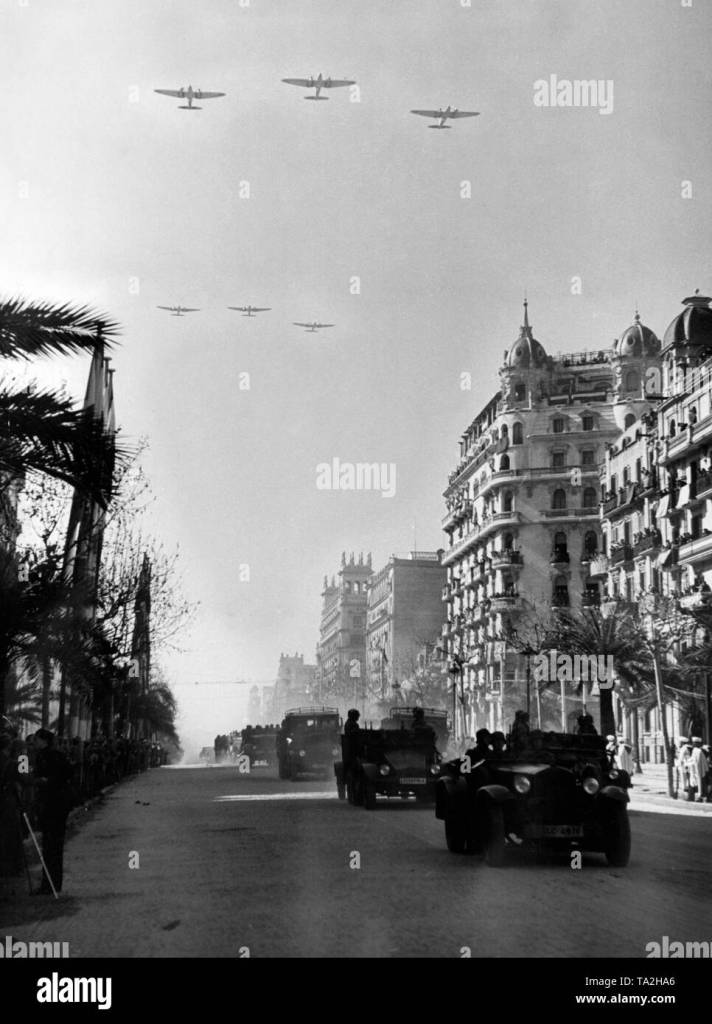
Spanish military dispatches today reported increasing activity on the central front. Generalissimo Francisco Franco was said to be rushing plans for an assault on the Madrid-Valencia lines to end the civil war.
At least seven persons were killed and thirty-six wounded today when five Italian-type planes bombed the central sections of Alicante, the Loyalist-held Mediterranean port. Twelve buildings were wrecked.
France and Britain plan recognition to guide the new Spain. Demands for mercy and a free regime are to be dropped, diplomats say. Unless some unexpected complication develops in the interim, it is expected in official circles here that by Monday both France and Great Britain will have recognized Generalissimo Francisco Franco’s Burgos regime as the official government of Spain. It is known the British Cabinet has decided on such action. Although there is still strong opposition in France, all those responsible for the conduct of this country’s affairs admit that in the still troubled times through which Spain must be expected to pass it is by far the wisest course to have an accredited representative there who may from time to time be able to influence events by making the French position clear.
It is fully recognized, however, that two elements are opposed to this course, although for very different reasons. The extreme Left parties in France, out of loyalty to the Spanish Republic and what they believe to be the cause of democracy, are still unwilling to sanction recognition of General Franco. Within Spain the Republican (Loyalist) Government is desperately hoping that some incident will occur to prevent such recognition. At the same time, it is obvious that in Rome there is anxiety lest France and Britain install their ambassadors and counteract Italian action. Rome seems to be still counting on General Franco’s refusal, while within Spain also there is a certain coterie that would prefer to exclude British and French influence for some time to come. Uncertainty continues to exist regarding General Franco’s final attitude and word, for until now he has stood firm on the position that he will accept only complete surrender of Loyalist Spain and that France must send a fully accredited Ambassador to Burgos.
Nationalist soldiers paraded in Barcelona. Franco reviews a parade of over 80,000. The military display is the greatest since Armada days. More than 80,000 men, representing at least one division and in some cases more than one division from each of the seven army corps that took part in his offensive in Catalonia, passed in review before the generalissimo down the broad, palm-lined avenue formerly known as the Via Diagonal but recently renamed Avenida del Caudillo (Avenue of the Chief).
Four hundred warplanes roared overhead as infantry, artillery, tanks, cavalry, ambulances and other modern military hospital services, such as blood-transfusion and X-ray trucks, as well as motorized wireless, telephone and telegraph equipment, marched past. It was the greatest display of war strength Spain had seen since the days of her famous armada and her colonial conquests in the New World.
Nazi Germany decreed that all Jews were to turn in their gold, silver and other valuables to the state without compensation. German Jews are ordered to surrender all gold and silver, except wedding rings.
The daughter of an exiled German novelist tells a group in the United States that 37 percent of German youth are flat-footed because of excessive marching.
Premier Mussolini is willing to meet with Hitler and Franco.
With only five dissenting votes, the House of Commons agreed tonight to double the British Government’s borrowing capacity to £800,000,000 to pay for the unprecedented defense expenditure of the coming year. Seldom since the critical days of the World War has Parliament shown itself so united on an issue of overwhelming national importance. It was a sign to all the world, especially to Germany and Italy, that, no matter what may be thought of Prime Minister Neville Chamberlain’s foreign policy, in this country there is no real difference of opinion about the need of making Britain strong and unassailable. Mr. Chamberlain warned the Commons that even these gigantic borrowings might have to be exceeded in 1940 if there was no limitation of armaments in the meantime, and he declared that there was not enough confidence in the world today to warrant a disarmament conference now.
Great Britain continues to pursue trade talks with the German Reich. Britain and Germany begin trade talks. Adolf Hitler links the colonies and other political issues with any commerce agreement.
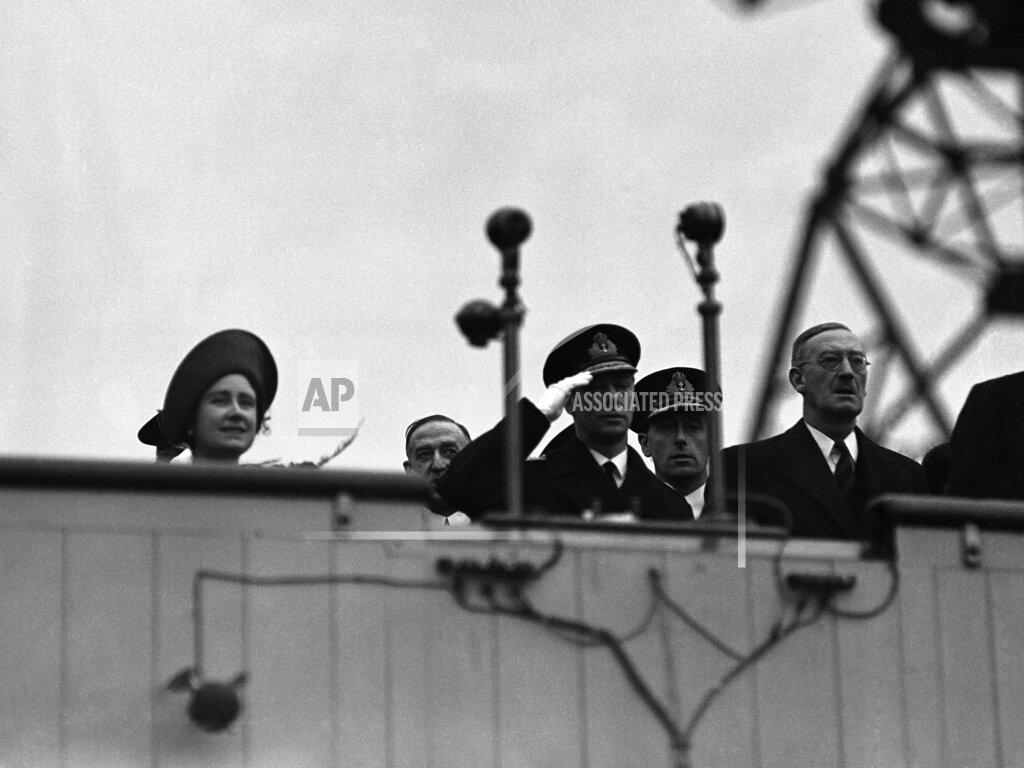
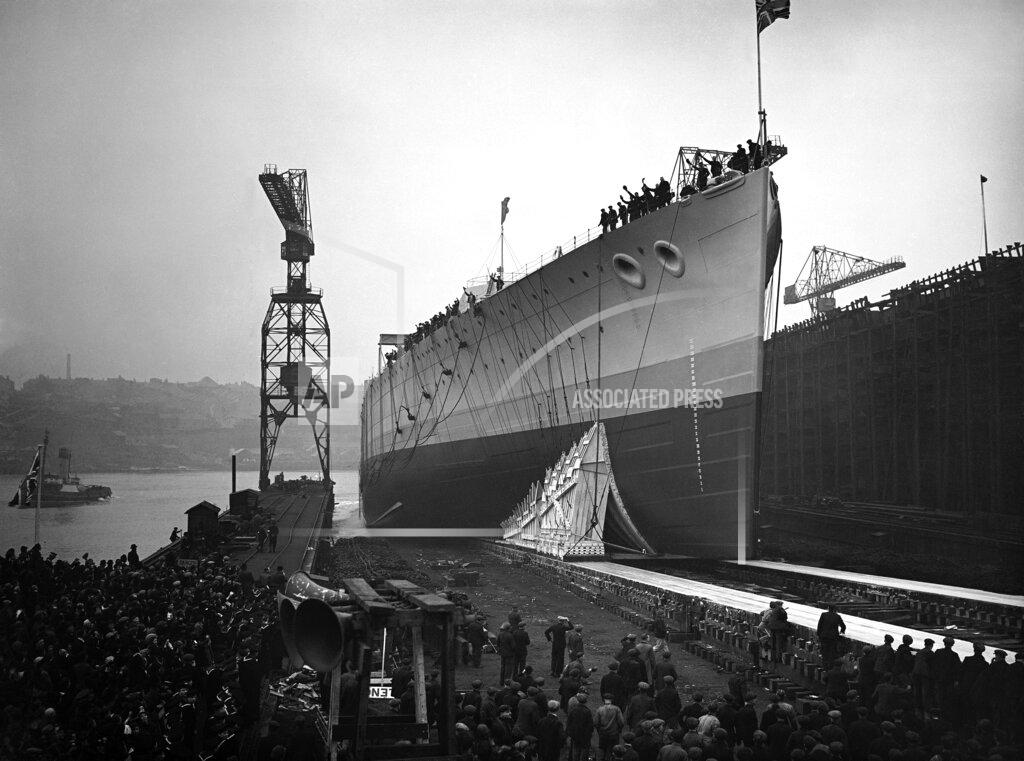
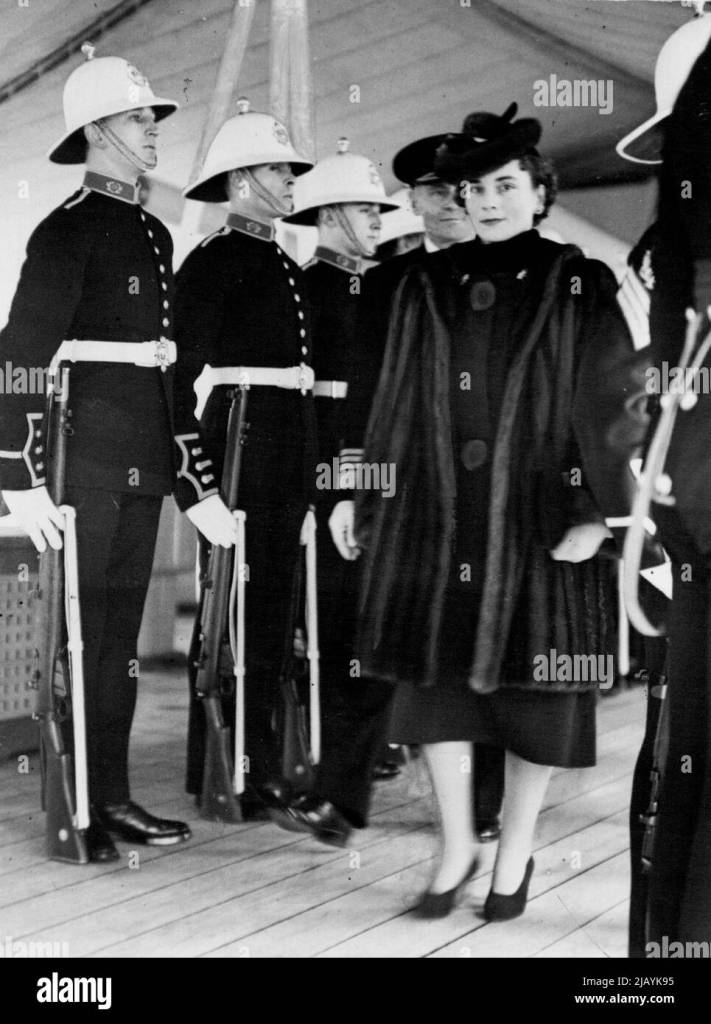
The battleship HMS King George V was launched. The 35,000-ton battleship King George V, the most impressive evidence the British people have yet had that this nation’s huge rearmament program is at last getting into its stride, was launched today by King George VI. The King, who himself served in the Royal Navy in his youth, seemed to share in the rejoicing of the workmen as he named the ship for his late father, who also was a sailor. “I name this ship King George V,” he said. “May God bless this ship and those who serve in her!” The King then pressed a button, which crashed a bottle of champagne against the bow of the new dreadnaught and simultaneously sent her down the ways into the River Tyne in exactly two minutes. While the band played “Rule, Britannia,” and sirens on every ship in the Tyne blared out, the King George V was gradually halted by her drag chains, and six tugs took her onto her fitting-out basin.
Hubert Pierlot, Belgian Premier, creates a Cabinet list to present to King Leopold. He stresses this is not a combination of Catholic and Socialist choices, as predicted.
A jeweled necklace given to Lola Montez by King Ludwig I of Bavaria does not sell at auction.
Britain drafts a plan for Palestinian peace. Proposals for both sides should be ready by next week. While the British proposals are indefinite and may change in the next few days the trend of British thought has been indicated. Immigration by Jews would not be stopped as the Arabs demand and would not be completely free as the Jews ask.
Instead, a maximum percentage of Jews to Arabs at some time in the future would be fixed, Jews would be allowed to immigrate up to that percentage. In return for this limit there would be a guarantee of political equality with the Arabs in the government of Palestine. The sale of Arab land to Jews would be limited but not abolished. Next week, according to forecasts, the British plan will be ready for submission to both sides. Soon thereafter, the conference is expected to end and the British will start putting their new policy into effect.
The U.S. House Naval Affairs Committee says that strong defense is the only answer, urging the fortification of Guam. In an outspoken address in the House today, Representative Carl Vinson of Georgia, chairman of the Naval Affairs Committee, ranged the United States on the side of Great Britain and France in what he regarded as an ultimate showdown against the world’s dictatorships. He said there could be no basis of discussion between a democracy and a dictatorship, except surrender by the former. Mr. Vinson was opening the general debate on the Naval Air and Submarine Base Bill, which would authorize the expenditure of $53,800,000 on the construction of more defense facilities on the mainland and in island possessions. The only item in the bill which aroused any controversy was the proposal to improve the harbor facilities of Guam by the expenditure of $5,000,000 over the next three years. Several members have Interpreted this as the opening step of a policy of fortifying Guam as an advance fleet base in the Western Pacific. Meanwhile, the House had voted to extend the life of the Export-Import Bank as an instrument for financing foreign trade. Mr. Vinson went far beyond the tenor of the bill under discussion to outline a national policy of strong rearmament.
“We must be prepared to stand alone,” he said. “National defense is of utmost importance to America and to the Western Hemisphere at this chaotic stage in human history. “Let no one think that, with the world being overrun by the dictator powers — Germany and Italy in Europe, and Japan in the Far East — that it is not of the utmost importance that we be forever vigilant in looking to our defenses. “It is not only necessary that we look to our own defenses, but it is to our advantage to furnish planes to those other two great democracies, France and England, in order that they may not be destroyed by the dictator powers. “Every right-thinking American approves the Administration’s decision in this case, for if England and France are unprepared, they will surely be destroyed and the last stand of the democracies will be in this hemisphere, with the United States carrying the load. “America now finds it necessary to answer the dictators in their own language. The world might just as well know that America is not going to submit to being destroyed with other unprepared democracies.
President Roosevelt widens war fleet games, with defense as the goal. President Roosevelt kept secret his whereabouts in the West Indies today as his flagship, the cruiser USS Houston, neared the zone of maneuvers in which, it was indicated for the first time, the fleet is testing the practicability of defending the Western Hemisphere from attack directed from across the Atlantic, instead of conducting war games centering in the Caribbean Sea and directed solely to defense of the Panama Canal, as the public had surmised. A brief radio message from Captain Daniel J. Callaghan, naval aide to the President, which revealed the broader purpose, was looked upon by the President’s staff at the temporary White House here as a significant communication. Mr. Roosevelt’s deletion of the Panama defense objective from the fleet problem brought no explanation, but it was assumed that he sought in this way to emphasize the importance of demonstrating the feasibility of defending the entire continent from attack on the Atlantic side.
Sent, as usual, with the President’s personal approval, the message from Captain Callaghan drew attention to Mr. Roosevelt’s recent assertion that North, South and Central America were joined in the determination to defend their continental shores against aggressors from overseas. The naval aide’s message emphasized that the Panama Canal was 1,500 miles west of the scene of Fleet Problem XX. The message, in explaining that the Houston would not disclose its position because it was approaching the zone of fleet operations, indicated that even such a fragmentary report would not be sent from the flagship as long as it remained with the “Black” defending fleet under Admiral Adolphus Andrews, unless, on orders from the Commander in Chief, it withdrew from the games. This eventuality was regarded as unlikely, however, since President Roosevelt indicated on leaving Key West last week that he would remain with the war games unless further disturbing reports regarding Europe indicated the need for his presence in Washington.
A revised anti-lynching bill is introduced in the Senate.
Major General “Hap” Arnold, the chief of the Army Air Corps warns that Germany could fly to the United States to attack if they establish bases in South America. General Arnold told the Senate Military Committee that the only way Germany could attack the United States through the air would be by establishing airdromes and accumulating supplies in South America. This was disclosed today when copies of the testimony taken by the committee on January 24 and 26 were obtained from confidential sources. The committee has not yet released this testimony. It was also disclosed that G. Grant Mason Jr., a member of the Civil Aeronautics Authority, told the committee on January 30 that if the Germans wished to fly to this country a military type of a four-engined passenger plane they now have in South America, they would have available “adequate supplies for military use.” General Arnold testified on January 26, it was disclosed, that Germany has approximately 1,700 planes capable of flying from the west coast of Africa to the east coast of South America and “may tomorrow be able to fly from the Cape Verde Islands to the United States.”
A majority of American voters believe that if there were a war in Europe tomorrow between Great Britain and France on one side and Germany and Italy on the other, the United States should do everything possible to help England and France win, except go to war herself, according to the American Institute of Public Opinion, of which Dr. George Gallup is the director. This fact, revealed yesterday in the final results of a survey on foreign policy, “may indicate an important trend of public opinion away from the traditional policy of isolation,” the institute said, adding: “American sympathy for the European democracies and dislike of the dictators has now apparently reached the point where the voters would want to find some way of sending aid to their biggest World War allies, short of actual military support, in time of war.”
The institute conducted its national survey of voters on the question: “If Germany and Italy go to war against England and France, do you think we should do everything possible to help England and France win, except go to war ourselves?” The vote was yes, 69 percent; no, 31 percent. Only 6 percent said they had not yet formed an opinion on the issue.
A Senate committee warns of danger if the United States opposes alteration of the Philippines Independence Act.
President Franklin Roosevelt’s ban on new taxes puzzles the Treasury.
Mrs. Roosevelt visits the Jewish Hospital of Brooklyn and spends time with the nurses and children in the Pediatric Ward.
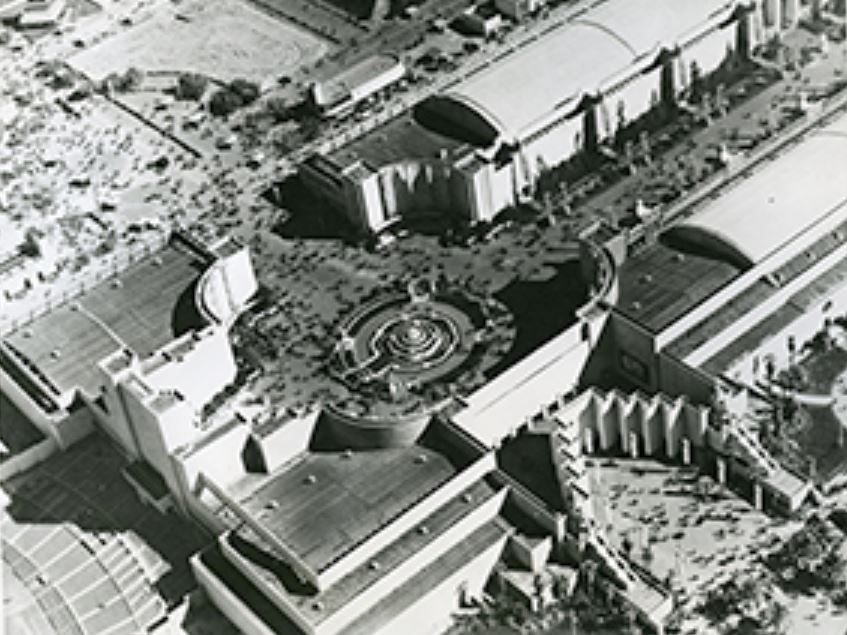
British monarchs plan to visit the World’s Fair in June.
Buddy Abbott, Jr., pickets after being fired by his uncle from the Abbott and Costello comedy team.
The New York Yankees president predicts the rest of the team will sign contracts by Saturday.
Japanese planes bomb the Lowu rail station just inside the border in the Hong Kong territories early this morning, killing one British Indian policeman and about a dozen Chinese civilians. Lowu is about 18 miles from Hong Kong proper.
Britain protests Japan’s attack of Hong Kong, believing the attack was a test to gauge British reaction.
Both Japanese and Chinese spokesmen report a big victory in an air battle at Lanchow.
China’s Chiang Kai-shek gives thanks for foreign aid, according to a U.S. missionary.
Japanese relations with third powers in China are believed by neutral observers to be rapidly nearing a showdown as the result of a tense situation in Shanghai and the bombing of a railroad station in British Hong Kong by Japanese airplanes today. In a two-hour emergency session, the Premier, Baron Kiichiro Hiranuma; Foreign Minister Hachiro Arita, the War Minister, Lieutenant General Seishiro Itagaki, and the Navy Minister, Admiral Mitsumasa Yonai, considered drastic action to check anti-Japanese terrorism in Shanghai, where the fifty-third political assassination in the past fifteen months occurred with the slaying of Marquis Li Kuo-chieh.
Replies given by the four Ministers to angry interpellations in the Japanese Diet showed they agreed that Japan must risk international complications to “restore order” in the International Settlement of Shanghai. Premier Hiranuma declared that the latest terrorist acts “compel Japan to take fundamental measures to maintain peace and order” in the International Settlement and the French Concession of Shanghai. Foreign Minister Arita said that “nothing could prevent Japan from exercising the right of self-defense where necessity demands.” Mr. Arita and other Ministers previously had expressed the opinion that all foreign settlements, concessions and leased territories in China must “come under the jurisdiction of China’s new government.”
Dow Jones Industrial Average: 142.64 (-0.10).
Born:
Richard Beymer, American stage actor and singer (“West Side Story”; “Diary of Anne Frank”), in Avoca, Iowa.
Faith Whittlesey (née Ryan), U.S. Ambassador to Switzerland (1981-1983, 1985-1988), in Jersey City, New Jersey (d. 2018).
Naval Construction:
The Royal Navy aircraft carrier HMS Implacable (86), lead ship of her class of 2, is laid down by the Fairfield Shipbuilding & Engineering Co. (Govan, Scotland).
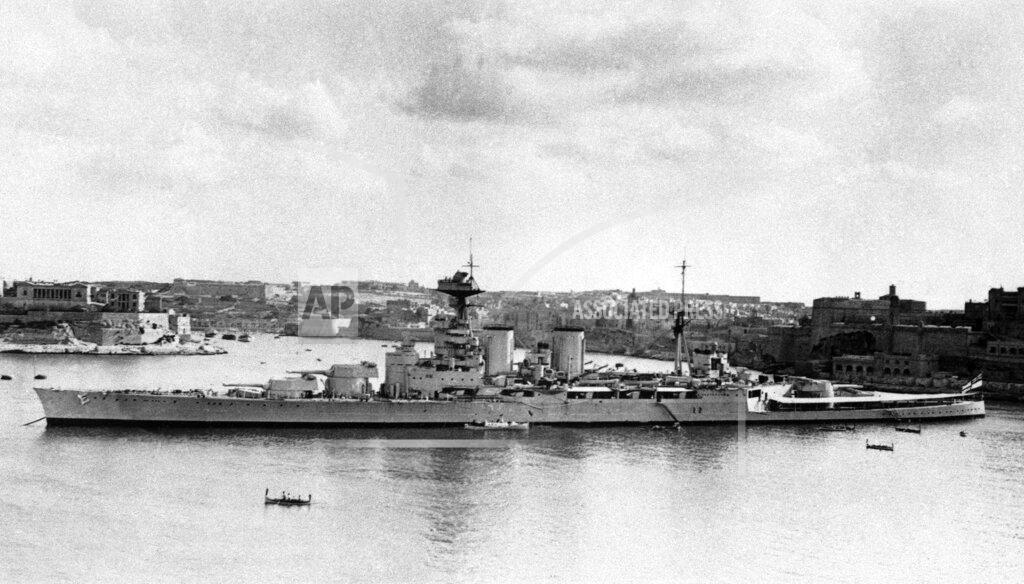
The Royal Navy battleship HMS King George V (41), lead ship of her class of 5, is launched by Vickers Armstrong (Newcastle-on-Tyne, U.K.).

 History Diaries