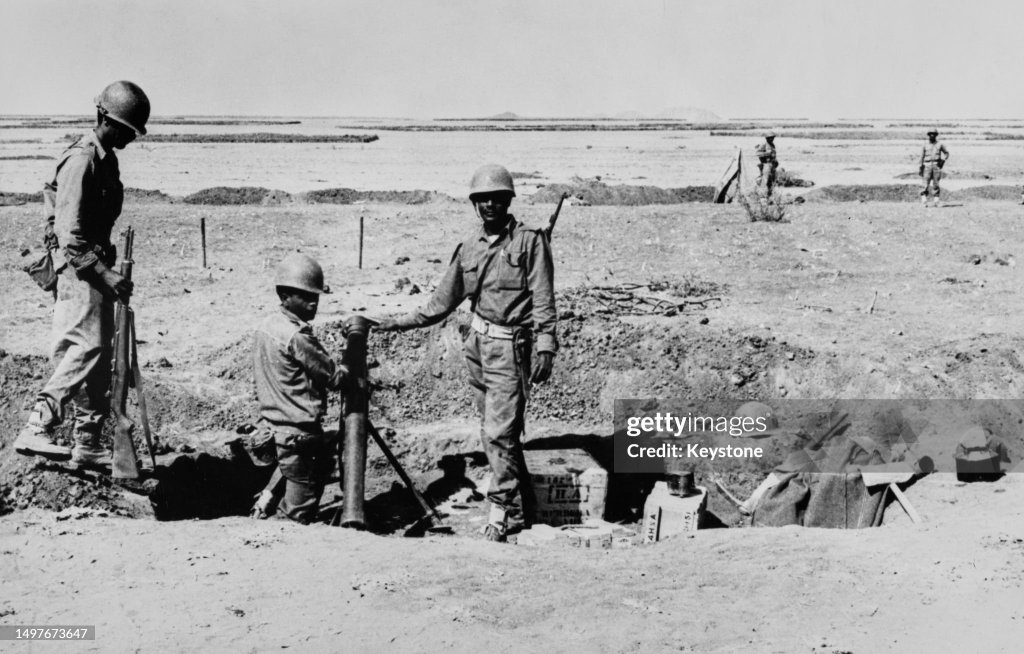
After a strategy meeting, U.S. President Lyndon Johnson orders that ‘contingency planning for pressures against North Vietnam should be speeded up.’
Crown Prince Constantine was named as the regent to the Greek throne after his father, King Paul, signed a decree. King Paul was seriously ill with what was reported to be “stomach ulcers” that would require surgery. In actuality, the King was terminally ill with stomach cancer, and would die two weeks later, on March 6. A bulletin signed by the King’s personal physicians and two British surgeons, who were flown to Athens from London tonight, said: “After a thorough clinical and laboratory examination of King Paul, we certify that the King is suffering from a narrowing of the pylorus due to an old ulcer. An operation is called for.” The pylorus is the opening from the stomach into the intestines. The British surgeons are Dr. Edward G. Muir and Sir Stanford Cade, who is also a specialist in the radium treatment of cancer.
A royal decree appointing Prince Constantine, who is 23 years old, as Regent during his father’s illness was drafted by the Government and sent to the King for signature. The King signed it late tonight and it will be promulgated in the official gazette. Constantine has acted for his father in the past during the monarch’s absence from Greece.
The U.N. Secretary General, U Thant, was reported today to have made progress in his efforts to win the consent of Cyprus and Turkey for the establishment of a United Nations peacekeeping force in Cyprus. According to reliable sources, Mr. Thant told delegates that he envisaged the following framework for the force: It would be authorized under a resolution of the Security Council. The states that were to supply contingents would be chosen later by agreement with Cyprus and with Britain, Greece and Turkey, the three parties to the 1960 treaty guaranteeing the Cypriote Constitution. The commander in chief, also to be chosen by agreement with the four interested parties, would be responsible to the Secretary General. The Secretary General would be assisted by representatives of three members of the Security Council.
Although each participant would pay its own expenses, Mr. Thant has in mind an appeal to other members to help provide transportation, supplies and possibly other assistance. Such an appeal would be directed primarily to the United States, and Adlai E. Stevenson, the United States representative, is discussing with Mr. Thant the question of Washington’s response. An initial stay of three months in Cyprus would be authorized for the force. The Secretary General would appoint a mediator, who would seek a permanent solution of the dispute between the Greek and Turkish Cypriote communities, which broke into violence Christmas week. According to reliable sources, the Secretary General obtained a generally favorable response when he detailed this program in separate talks with Spyros Achilles Kyprianou, the Cypriote Foreign Minister and Turgut Menemencioglu, the Turkish Ambassador to Washington.
President Léon Mba was formally reinstated today in Gabon and immediately threatened “total punishment” of everyone involved in the coup that overthrew him Tuesday, Authoritative diplomatic sources said his tough line violated an agreement he had made with the French forces who crushed the coup in bitter fighting yesterday. Gabonese troops under French command freed Mr. Mba in Lambaréné, where the revolutionary leaders had taken him. Before returning him to power, the French made Mr. Mba agree to permit opposition candidates to run in the National Assembly election scheduled for Sunday. The coup leaders said their main reason for having deposed Mr. Mba was his refusal to allow opposition candidates.
Eight of the ten ministers who made up the short‐lived provisional Government have been arrested. The provisional President, Jean‐Hilaire Aubame, and the Minister of State, Paul Gondjoud, are still at large. Mr. Aubame is head of an opposition party, the Gabonese Democratic and Social Union. Until last year he served as Mr. Mba’s Foreign Minister.
The French Embassy said today that 18 Gabonese soldiers and one French paratrooper were killed yesterday morning when French troops, airlifted into the country, stormed the Baraka military camp. More than 40 Gabonese were said to have been wounded. Unofficial French military sources said 25 Gabonese soldiers and two French soldiers had been killed and four Frenchmen wounded.
The State Department said today that the Government did not favor consumer boycotts against the goods of countries trading with Cuba. Thus, the department tried to withdraw whatever encouragement Secretary of State Dean Rusk might have given such boycotts. Republicans in Congress, however, suggested that a boycott would have their support as retaliation against allies who ignored the United States embargo of Cuba. The issue gained prominence as a result of an interview with Secretary Rusk over the Voice of America on February 18. Mr. Rusk was asked whether United States consumers might organize a boycott against the goods of companies selling to Cuba. An example was the sale of 400 buses by the Leyland Motor Corporation, Ltd., of Britain, which also manufactures the Triumph sports cars.
Mr. Rusk replied: “Well, we don’t ourselves plan to organize any boycott against the goods of countries that may be engaged in that trade. I think it is possible there may be some consumer reaction in this country, here and there, with respect to firms that specifically engage in that trade. But that’s something that is in the hands of private citizens; we have no part in that ourselves.” This was taken in some quarters as tacit approval of such a boycott.
Morocco and Algeria have agreed to end their border conflict, which reached a peak last October when their troops clashed in a desert frontier area. No details of the accord have been disclosed. It was announced in Algiers today by President Ahmed Ben Bella and confirmed by officials at the palace of King Hassan II here. It is understood that the agreement was signed in the presence of a cease‐fire commission composed of Ethiopian, Malian, Algerian and Moroccan officers. The commission was set up last October 30 in Bamako, Mali, where King Hassan and President Ben Bella met. The commission’s purpose was to ensure application of the cease‐fire, which has been effective since November, and to delimit a zone between the two North African neighbors from which troops on both sides would withdraw.
U Thant, congratulated Algeria and Morocco today on their agreement to end their border dispute. “The successful outcome of the dispute is an illustration of the effectiveness of peaceful negotiations and goodwill of the parties concerned,” a spokesman said.
Foreign Minister Galileo Solis of Panama said tonight that President Francisco J. Orlich Bomarcich of Costa Rica had made a formal offer to mediate Panama’s dispute with the United States and that the offer was being considered. Earlier in the day President Roberto F. Chiari of Panama and President Orlich met at the border village of Paso de Canoa. President Orlich said in San José, Costa Rica, that the United States and Panama had accepted his mediation offer in principle, the Associated Press reported. However, in a dispatch from Washington, the agency quoted State Department sources as saying that “there has been no agreement as to mediation as far as we are concerned.”
Foreign Minister Solis, who was at the meeting, said President Orlich had made a proposal and this had to be submitted to people who had to give an opinion. He did not identify these people. The possibility of success in any proposed mediation, however, was dimmed by Mr. Solis’ statement that such mediation would have to be predicated on United States assurances of negotiations toward a new Panama Canal treaty. The United States has steadfastly refused to talk of treaty negotiations under the present circumstances.
The House overwhelmingly passed today a bill calling for immediate substantial investment in developing a new manned bomber for use by the Air Force of the nineteen‐seventies. A large program of aircraft development had been requested by General Curtis E. LeMay, Air Force Chief of Staff, but rejected by Secretary of Defense Robert S. McNamara. The House Armed Services Committee sided with General LeMay, and today the House defeated, 121 to 29, an amendment to delete the bomber authorization from the committee’s bill. The bomber program is part of a bill setting a $16,914,800,000 limit on certain military appropriations that will be voted later in separate legislation.
The entire bill was easily passed, as expected, by a roll call vote of 336 to 0. Representative Robert F. Ellsworth, Republican of Kansas, expressed his dissatisfaction with the bill by shouting “present” without voting for or against it. Mr. Ellsworth previously explained that he believed the Defense Department was spending too much money on conventional weapons and not enough on technological advances.
The bill, which now goes to the Senate, provides $52 million for a start on designing and developing a new manned jet bomber to succeed existing B‐52 and B‐58 bombers, which are no longer in production. Mr. McNamara had proposed an authorization of $5 million to carry out studies. He argued that missiles could probably cope with any enemy targets for which the new bombers might be designed. The House also voted $40 million for a start on a new manned interceptor recommended by General LeMay. The Defense Secretary, in behalf of the Administration, did not request any money for such a plane. The vote on the bomber also retained the interceptor program.
The Senate Democratic leadership decided today to call up the farm bill tomorrow. This means that the opening of the expected long fight on civil rights will not begin for another week at least. Senator Mike Mansfield of Montana, the Democratic leader, announced the decision after President Johnson had given his approval. The President has urged speedy action on proposed wheat and cotton legislation because of the predicted sharp drop in farm income that may figure in this year’s Presidential and Congressional elections. If there is objection when the farm bill is brought up tomorrow, Mr. Mansfield said, he plans to try again Monday. He emphasized that the farm bill would be carried through to approval or defeat before the civil rights bill.
However, he said that if the farm bill was not completed before the tax bill comes from the House early next week it would be set aside temporarily in favor of the tax bill. The tax bill is scheduled to reach the Senate next Tuesday afternoon or Wednesday morning. The Senate has also the problem of dealing with the $16.9 billion military authorization measure. The House considered the measure today. Mr. Mansfield said he hoped to get the military bill to the floor also before the civil rights bill. The Democratic leadership hopes to complete the farm bill in two or three days but Republican leaders have calculated that four days is the minimum.
The maritime unions presented a bill of particulars to Secretary of Labor W. Willard Wirtz today in which they outlined a basis on which they believed the dispute over Russian wheat shipments could be settled. Mr. Wirtz, who flew here today as President Johnson’s personal representative in the controversy, said he would review the demands tonight and hold further discussions with the union leaders. At news conference earlier, Paul Hall, president of the Maritime Trades Department of the American Federation of Labor and Congress of Industrial Organizations, denounced Government agencies in Washington for permitting companies selling wheat to the Soviet Union to flout the original requirements that 50 per cent of the grain be shipped on American vessels. “We’re sick and tired of the President of this country enunciating certain programs and policies and giving assurances and then having them negated by some irresponsible heads of [government] agencies,” Mr. Hall said.
Governor Rockefeller dealt a blow today at one of his chief unannounced opponents for the Republican Presidential nomination, Henry Cabot Lodge. During a 13‐hour campaign swing he was asked whether Mr. Lodge, as Ambassador to Vietnam, should be blamed partly for the “mess” in Vietnam. Mr. Rockefeller indicated that Mr. Lodge could not be completely exonerated. An ambassador carries out the policy of the President and Secretary of State, or, if he does not believe in it, resigns, the Governor told 135 persons at the town hall in nearby Goffstown. “He has not resigned and come back and told us what he thinks is wrong,” said the Governor, who has criticized American policy in Vietnam as indecisive. Mr. Lodge has said that his work in Vietnam is too important for him to return to the United States to try for the nomination.
George Meany said today there was room for substantial wage increases this year that would not contribute to inflation. The president of the American Federation of Labor and Congress of Industrial Organizations asserted that unions, if they considered their wage demands justified, would not be held back by any so‐called economic guidelines. Noting the high level of business indexes and record profits in some industries, such as automobiles, Mr. Meany said he expected sizable wage rises would be negotiated by some unions during the year. His comments were in line with growing evidence that wage increases would have top priority in many labor‐management negotiations. Labor circles feel that increases in recent years have lagged behind rising productivity, and that this is the time to make important gains.
Lee H. Oswald’s brother, Robert, brought to the Warren Commission today about 20 letters sent to him by Lee Oswald from the Soviet Union. Sources at the commission, which is investigating the assassination of President Kennedy, said the letters and other material shed new light on Lee Oswald’s character and early years. Lee Oswald was shot in Dallas while under arrest as the suspected killer of the President. Neither Chief Justice Earl Warren nor any other commission member or official would comment on the testimony today. Nor would Mr. Oswald, who said not a word to the waiting press. His lawyer, William A. McKenzie of Dallas, said it “would not be appropriate’” for Mr. Oswald to say anything publicly about the matter until the Warren commission makes its report. No one knows when that will be.
An Atlanta jury found a young white coed guilty today of violating Georgia’s anti‐trespass law during a restaurant sit‐in demonstration. Judge Durwood Pye fined the co‐ed, Mardon Walker of East Greenwich, Rhode Island, $1,000 and sentenced her to 6 months in jail and 12 months in a public works camp. He set her appeal bond at $15,000. An African American restaurant owner, Mr. Frazier, offered his property as bond. Walker was released on February 22 and later returned to Georgia for appeals. Miss Walker, 18 years old, was arrested January 13 when she and a group of Blacks entered a downtown restaurant that has been a favorite target of integrationists. Miss Walker, a Connecticut college student, attends Atlanta’s predominantly Black Spelman College as an exchange student.
Walker’s case would be appealed, and the verdict upheld by the Georgia Supreme Court. The U.S. Supreme Court reversed her conviction in May of 1965. “We are glad Miss Walker’s long ordeal is over,” rejoiced the Atlanta Constitution in an editorial slap at Segregationist Judge Pye. “We only wish she had not had to go to Washington to get justice.” Judge Pye then brought new charges against her which resulted in a second U.S. Supreme Court Case. She won that one, too.
The National League Houston Colts (later the Astros) trade in cacti for grapefruits as they begin their first spring training in Cocoa, Florida. The new facility is hailed as “state-of-the-art” but soon becomes disparaged because of poor drainage, snakes, and a spartan dormitory where the players are housed. Prankster Turk Farrell livens things up by purchasing a young alligator and slipping him into the clubhouse whirlpool.
Dow Jones Industrial Average: 796.99 (+2.08).
Born:
French Stewart, American actor (Harry Solomon-“3rd Rock from the Sun”), in Albuquerque, New Mexico.
Christian Ruuttu, National Team and NHL hockey centre (Team Finland; NHL All-Star, 1988; Buffalo Sabres, Chicago Blackhawks, Vancouver Canucks), in Lappeenranta, Finland.
Taylor Hall, Canadian NHL left wing (Vancouver Canucks, Boston Bruins), in Regina, Saskatchewan, Canada.
Rodney Tweet, NFL wide receiver (Cincinnati Bengals), in Madison, South Dakota.
Jeff Maggert, American golfer (US Senior Open, Tradition 2015), in Columbia, Missouri.
Died:
Verena Holmes, 74, English mechanical engineer and inventor, the first woman member elected to the Institution of Mechanical Engineers (1924).




 History Diaries