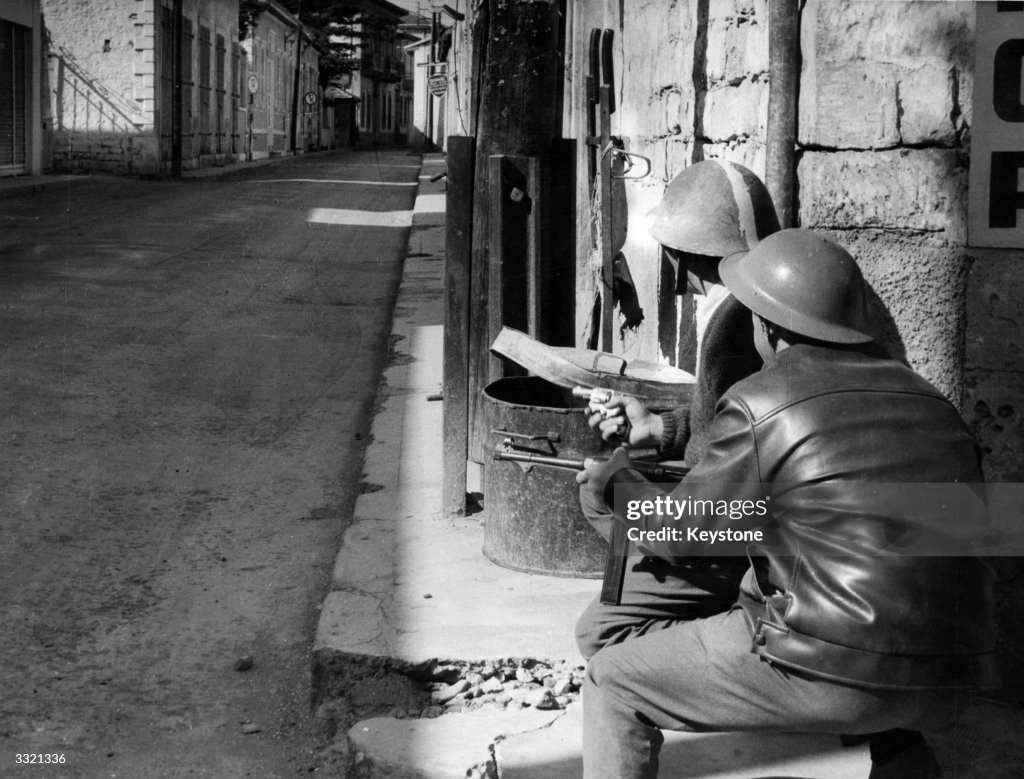
The U.N. Secretary General, U Thant, proposed today the formation of an international peacekeeping force in Cyprus by agreement between Britain, Greece, Turkey and Cyprus. If agreement were reached, the Secretary General would report the formation of the force to the Security Council, which would then adopt a resolution formally taking note of this action. According to reliable sources, Mr. Thant also suggested the appointment of a mediator, who would be given two weeks to try to reach a settlement in the event that the four Governments did not agree on a peacekeeping force. These suggestions were contained in a memorandum submitted by Mr. Thant to the four interested parties after the Security Council met but postponed the opening of the Cyprus debate until tomorrow to give the Secretary General time to seek an agreement.
The four Governments and the United States and the Soviet Union consented to the 24‐hour postponement. The Council adjourned before hearing scheduled statements by Sir Patrick Dean, the British representative, and Spyros Achilles Kyprianou, Foreign Minister of Cyprus. According to reliable sources, Sivert A. Nielsen, the Norwegian representative, proposed the adjournment because he was afraid that public statements made by the British and Cypriote representatives, before consultations with Mr. Thant had been completed, would make it more difficult to reach a settlement. A copy of Mr. Thant’s memorandum was also given to George W. Ball, Under Secretary of State, who presented the revised British‐American plan for a peace‐keeping force to Archbishop Makarios, President of Cyprus, last week.
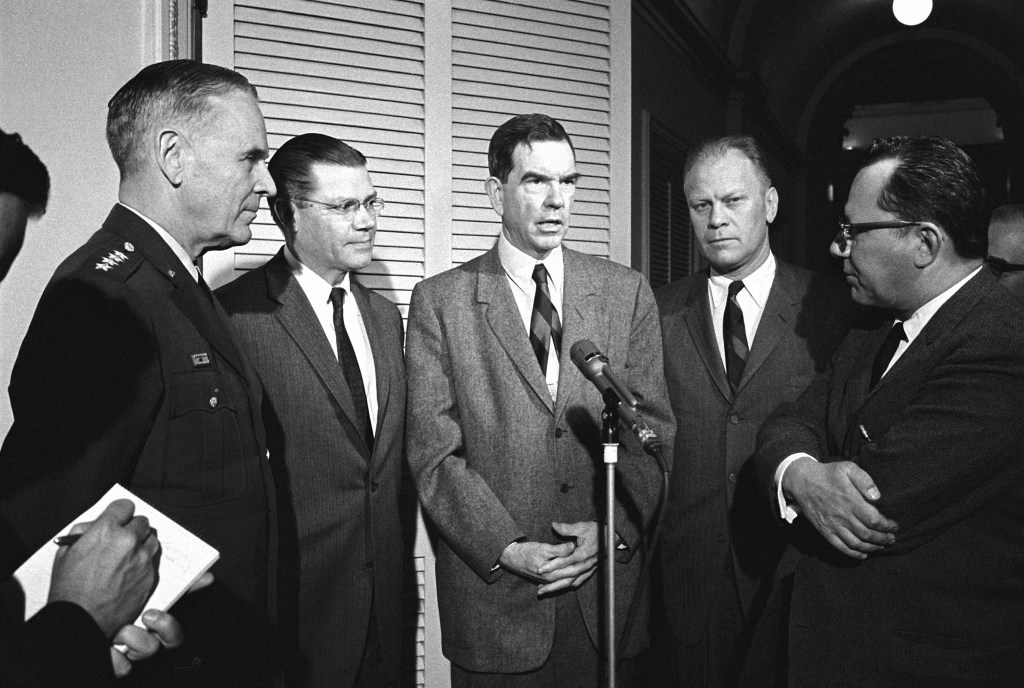
Under Secretary of State George W. Ball said today that he and President Johnson had agreed that a settlement in Cyprus was “essential to the peace of the world.” Rather, he said, it is “to help bring about the conditions under which all of the parties affected can design a solution which will serve all of their interests.” Mr. Ball, just back from an eight‐day trip to Britain, Greece, Turkey and Cyprus, reported to the President on the failure of his efforts to get agreement on a United States-British peacekeeping force for the island. The Under Secretary said later that Mr. Johnson “fully shared” his view that in Cyprus “we are faced with a situation of considerable gravity.” There was agreement also, Mr. Ball said, that it was “imperative that we take the necessary measures to restore peace and order” between the Greek and Turkish Cypriotes. “The killing that is going on on that tormented island must be brought to a stop,” Mr. Ball added. He called the restoration of law and order “the first order of business.”
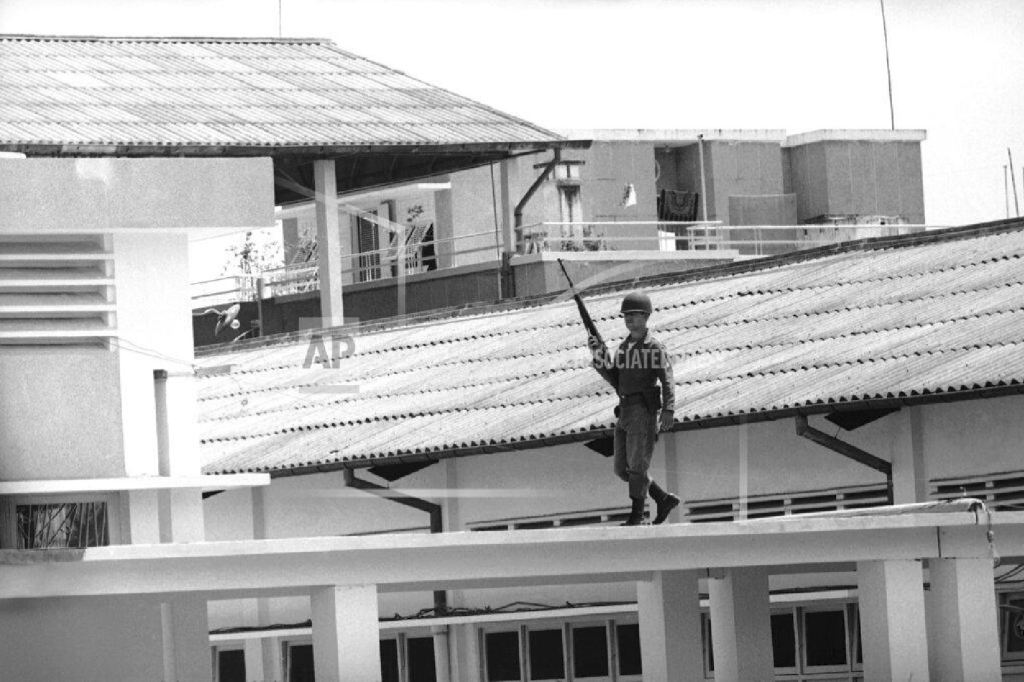
United States officials believe the Viet Cong leadership has decided to carry out a continuous terrorist campaign in this capital, aimed at forcing a face‐losing evacuation of American dependents. This evaluation was given by David G. Nes, United States chargé d’affaires, to Premier Nguyễn Khánh today in a half-hour discussion of urgent measures to protect the American community in Saigon, where two terrorist bombings in the last week have taken five American lives. Thick wood and wire barricades were stretched tonight around the United States Embassy, military billets and the American dependents’ school, with American and Vietnamese soldiers standing guard.
The South Vietnamese Government announced today that is planned to drop four million safe‐conduct passes over territory held by the Communist Viet Cong guerrillas. The passes, aimed at encouraging the guerrillas to return to families are printed to look life bills worth about 6 cents.
At least 156 persons have died of cholera in Saigon and neighboring Cholon since an epidemic broke out in January, the Health Ministry reported today.
Diplomatic circles expressed concern today about Cambodia’s decision to build two jet bases near the borders of Thailand and South Vietnam with Communist China’s help. One base would be at Svay Rieng, about 60 miles southeast of the capital of Phnom Penh and a little more than 60 miles west of Saigon, South Vietnam’s capital. Svay Rieng is about three miles from the border. The other would be at Battambang, 160 miles northwest of Phnom Penh and about 50 miles from Thailand’s southwestern frontier.
The Soviet leadership, in a new move in the ideological conflict with Communist China, sent a long message to Peking last Friday, reliable sources reported tonight. The message is believed to be a reply to a statement published by Peking two weeks ago containing a sharp attack on the Soviet leadership and on Premier Khrushchev personally. The Soviet note was sent on the day Mr. Khrushchev addressed the Central Committee of the Soviet Communist party. The meeting was attended by several thousand specialists on Communist ideology.
Yuri I. Nosenko told a Soviet Embassy official at their confrontation last Friday that he left Switzerland on the way to the United States 28 hours before his defection was reported by the Russians to the Swiss authorities. This statement by the former staff officer of the Soviet Committee of State Security, the secret police, appeared to amount to a denial of the Soviet charge that the Swiss authorities had been negligent in preventing his defection. Mr. Nosenko, who quit as a member of the Soviet delegation to the Geneva disarmament conference February 4, was allowed to meet with a Soviet diplomat here in the presence of United States officials.
Bertrand Russell, the 91‐year‐old British philosopher and left‐wing intellectual, has appealed to Premier Khrushchev for better treatment of Jews in the Soviet Union. The appeal was in the form of a letter to the Soviet leader dated December 2 and made public today. It was written by Lord Russell and signed by him and 11 other persons, most of them famous in science, literature, philosophy or Socialist politics. Five, in addition to Lord Russell. are Nobel Prize winners. The 10-paragraph letter expressed “concern” over restrictions in Jewish religious freedom and other forms of hostility against Jews.
The United States commander at the Guantánamo Bay naval base cut the pipelines today that had brought water to the base for two decades. The action followed reports from Cuba that the base had been accepting the limited amounts of water that the Cuban Government had promised for family needs. Premier Fidel Castro cut off the regular water supply from the Yateras River February 6 in retaliation for the United States seizure of four Cuban fishing boats off Key West four days earlier. The United States said the boats were in its territorial waters. The United States Navy, after the water supply was cut, refused to take even limited amounts of water and closed the pipeline valves on the United States side of the fence that borders Cuban territory. Today’s report from Cuba implied not only that the United States had been accepting the limited flow of water but also had used special equipment to tap the pipelines for additional supplies.
Rear Admiral John D. Bulkeley, commander of the Guantánamo base, decided that the best way to reply to the report was to cut the lines that used to bring the water into the installation. “Castro’s called me a liar and I’m mad,” he said. Admiral Bulkeley, who wears the Medal of Honor for his PT boat operations in the Philippines in World War II, said there was “absolutely no truth” to the Cuban report. The admiral explained in detail how the water used to flow along a pipeline from the Yateras River, four miles away, into the United States base. He said the pressure had to reach 65 to 70 pounds per square inch in the pipeline to push the water up the hill to the United States storage tanks on the base. Since the cutoff by Cuba the water pressure has not gone above 40 pounds per square inch he said.
Israeli and Syrian troops exchanged fire today near Shamir, a village in the Huleh Valley, an Israeli announcement said in Tel Aviv. The announcement said that an Israeli patrol fired two waring shots at a boy and two soldiers moving into Israeli territory, and that a Syrian post then opened fire on the patrol.
Chancellor Ludwig Erhard and Mayor Willy Brandt of West Berlin agreed today to keep trying for an acceptable agreement to permit West Berliners again to cross the Communist‐built wall. They reaffirmed their rejection last week of an East German offer of a new pass arrangement for the Easter and Whitsun holiday weeks, patterned after the one that ran for 18 days in the Christmas season. Whitsuntide, the week beginning with the seventh Sunday after Easter — May 17 this year — is a spring festival widely observed on the Continent and in England. Under that agreement East German postal officials established offices in West Berlin to handle applications of West Berliners to visit relatives in the Communist half of the divided city. A Government spokesman said Dr. Erhard and Mr. Brandt agreed to support further negotiations with East Germany, but only on the basis of a Western proposal put forward January 24.
Gabon’s president Leon M’ba was toppled by a military coup and his archrival, Jean-Hilaire Aubame, was installed in his place. M’ba, who had dissolved Parliament on January 21 and ordered new elections for February 23 with only his own party’s candidates, announced his resignation after the 600-man Gabonese Army seized power, and was then placed under house arrest.
Gaibnasar Pallayev became Chairman of the Presidium of the Supreme Soviet of Tajikistan.
In the case of Wesberry v. Sanders (376 US 1 1964), the Supreme Court of the United States ruled that congressional districts had to be approximately equal in population. The case arose from a challenge to the state of Georgia’s failure to change its congressional districts since the 1930 U.S. census. In an opinion authored by Hugo L. Black, the 6-3 majority held that the district court had jurisdiction because debasement of the right to vote as a result of a state congressional apportionment law was justiciable and not subject to dismissal for “want of equity.” The Court further held that the apportionment statute was invalid because it abridged the requirement of Article 1, section 2 of the Constitution that The House of Representatives shall be composed of members chosen every second year by the people of the several states, and the electors in each state shall have the qualifications requisite for electors of the most numerous branch of the state legislature.
Justice Clark concurred in part and dissented in part. He agreed with the majority that the trial court erred in dismissing the case for nonjusticiability and want of equity, but stated further that Article 1, section 2, does not forbid disproportionate congressional districts and that the case should be remanded for a hearing to determine whether the apportionment statute violated the Equal Protection Clause of the Fourteenth Amendment.
Justice Harlan dissented on the ground that the Constitution expressly provides that state legislatures and Congress have exclusive jurisdiction over problems of congressional apportionment of the type involved in the case. Justice Stewart stated that he joined with Mr. Justice Harlan’s dissent except insofar as there might be implied in that dissent the view that the issues were not justiciable.
Senator Everett McKinley Dirksen said today that the public accommodations section of the civil rights bill passed by the House last week was “much more acceptable” to him than the original version. Nevertheless, the Illinois Republican, who is minority leader, indicated he still had strong reservations about giving the courts authority to enforce compliance with the ban on racial discrimination in hotels, motels, restaurants, theaters and sports arenas. He did not say positively that he would oppose such Federal authority. But he did say he would offer an amendment to make compliance voluntary, at least for a trial period, to see how much could be achieved by persuasion. Meanwhile, Senator Mike Mansfield of Montana denied with some heat Republican suggestions yesterday of an Administration “deal” with the Southerners to water clown the bill in return for their support on the tax bill.
Robert G. Baker has been subpoenaed to appear with some of his business records before the Senate Rules Committee at 10 AM Wednesday. Mr. Baker, former secretary to the Senate Democratic majority, whose outside business affairs have been under scrutiny for four months, had previously refused to answer questions of committee investigators or to make his files available for their inspection. Over the weekend, a subpoena was issued for Mr. Baker, placing him under a legal obligation to appear at the appointed time with his records. His attorney, Edward Bennett Williams, said this afternoon, however, that he was uncertain whether he would favor Mr. Baker’s responding to the order. Mr. Baker is a defendant in a $300,000 civil damage suit growing out of his operations in the vending‐machine business. This is an aspect of his affairs in which the committee is particularly interested.
Four House Armed Service Committee Democrats, including two New Yorkers, opened their own fight today against the committee’s drive to force a new manned bomber and interceptor on the Pentagon. Representative Samuel S. Stratton of Amsterdam was joined by Representatives Otis G. Pike of Riverhead; Jeffery Cohelan of California, and Lucian N. Nedzi of Michigan in denouncing the move as premature and uneconomical. They cited previous experiences with making unrequested appropriations authorizations. Representative Carl Vinson, the Georgia Democrat who heads the Armed Services Committee, released the decision last week. It calls for $92 million extra for a manned bomber and an improved manned interceptor. The Pentagon already had cut its fund requests deeply and the committee had cut them further. The funds for the new aircraft, however, were put back into the fund requests.
President Johnson joined Federal officials today in seeking a formula to end a longshoreman’s union ban on loading ships with wheat destined for the Soviet Union. James J, Reynolds, Assistant Secretary of Labor, flew here from Washington to deal directly with the emergency caused by a wheat‐loading boycott put into effect this morning by the International Longshoreman’s Association. George Meany, president of the American Federation of Labor and Congress of Industrial Organizations, said that Mr. Johnson had telephoned him to ask for his cooperation in stopping the threat to the Administration’s wheat‐shipment program. Mr. Meany, who is attending the midwinter meeting of the AFL-CIO’s Executive Council here, said that he had agreed to try to help.
The Administration ran into heavy criticism from both sides of the political aisle today as it opened its campaign for a broad, new program of Federal assistance for housing and community development. Robert C. Weaver, Federal housing administrator, told the House housing subcommittee that the new legislation “would deal with the unfinished business of the present and the impending needs of the future.” The ranking Republican member of the committee, Representative William D. Widnall of New Jersey, protested that the program would cost more than $6.5 billion over a period of years and do little to house poor families.
President Johnson is expected to ask, as a key weapon in his war on poverty, that Federal aid be given to certain public schools for work‐study programs and remedial classes. Details of the educational portion of the Administration’s anti‐poverty program began taking shape over the weekend, following conferences between Sargent Shriver and officials of the Department of Health, Education and Welfare.
Pro football’s major and minor league commissioners joined today in urging special antitrust exemptions for all professional team sports, but some players voiced doubts. Commissioners Pete Rozelle of the National Football League and Joe Foss of the American Football League strongly endorsed legislation to give pro football, basketball and hockey the same exemption now enjoyed only by professional baseball. They were supported by George Gareff, the commissioner of the United Football League, which has nine teams ranging from Joliet, Illinois, to Montreal. A lawyer, Creighton Miller of Cleveland, and two players representing the NFL Players Association said, however, that they feared the exemption “would be too broad.” They said it would curtail the players’ right to change clubs by playing out their options and negotiating for themselves.
A co‐defendant of James R. Hoffa denied today statements by three Government witnesses who had linked him to alleged attempts to bribe a jury. Nicholas Tweel, one of Mr. Hoffa’s five co‐defendants in the teamster union president’s jury‐tampering case, appeared as the first defense witness and contradicted testimony given earlier in the trial. Mr. Hoffa, Mr. Tweel and the other defendants are charged with having attempted to bribe and “corruptly influence” jurors in Mr. Hoffa’s conspiracy trial in Nashville in 1962. The conspiracy trial ended in a mistrial after the jury, which had voted 7 to 5 for acquittal, failed to agree on a verdict. Mr. Hoffa could be sentenced to 15 years in prison if convicted of the jury‐tampering charges. He also is expected to testify for the defense.
Mr. Tweel, a Huntington, West Virginia, business man, contradicted the testimony of Edward Partin, Mrs. Hazel Fulton and Dallas Hall, all prosecution witnesses. Mr. Partin, a Baton Rouge teamster official, testified that he had spent a great deal of time with Mr. Hoffa during the Nashville trial. He said Mr. Tweel had once told him in a hotel room that he was in town to “help get to the jury.” Mrs. Fulton testified that she was employed as Mr. Tweel’s bookkeeper. She said Mr. Tweel once received a phone call from Allen Dorfman, another co‐defendant. She said Mr. Dorfman gave her a list that the Government contends contained names of jurors. Mr. Hall, a Nashville bartender, testified that Mr. Tweel had once called him and given him names of jurors. He said Mr. Tweel asked him to “check out” the list.
U.S. Postmaster General John A. Gronouski ordered that all letter carriers be provided with pepper spray in order to cut down the incidence of dog bites. “While the dog-bite problem has often been treated more or less as a joke,” he said, “it is no laughing matter for our carriers and their families.” There had been 7,000 dog bites in 1963. The Post Office Department purchased 115,000 “spray bombs” containing 15% pepper extract, with orders that the spray was not to be shot into a dogs face.
Former White Sox shortstop Luke Appling is voted into the Hall of Fame by a special vote. In 1953, Appling’s first year of eligibility for Cooperstown, the Sox great received just 2 votes.
The Houston Colts trade outfielder Carl Warwick to the St. Louis Cardinals for outfielder Jim Beauchamp and pitcher Chuck Taylor. Beauchamp would hit .164 and .189 as an Houston reserve. The 21-year-old Taylor was sent back to St. Louis where he saw his first big league action in 1969 and became a quality reliever.
Dow Jones Industrial Average: 796.19 (+1.63).
Born:
Jim Jordan, American politician (Rep-R-Ohio 2007-; Chair of the House Judiciary Committee), in Troy, Ohio.
Mike Campbell, MLB pitcher (Seattle Mariners, Texas Rangers, San Diego Padres, Chicago Cubs), in Seattle, Washington.
Eric Fairs, NFL linebacker (Houston Oilers, Atlanta Falcons), in Memphis, Tennessee.
Darren Pang, Canadian NHL goalie (Chicago Blackhawks), in Meaford, Ontario, Canada.





 History Diaries