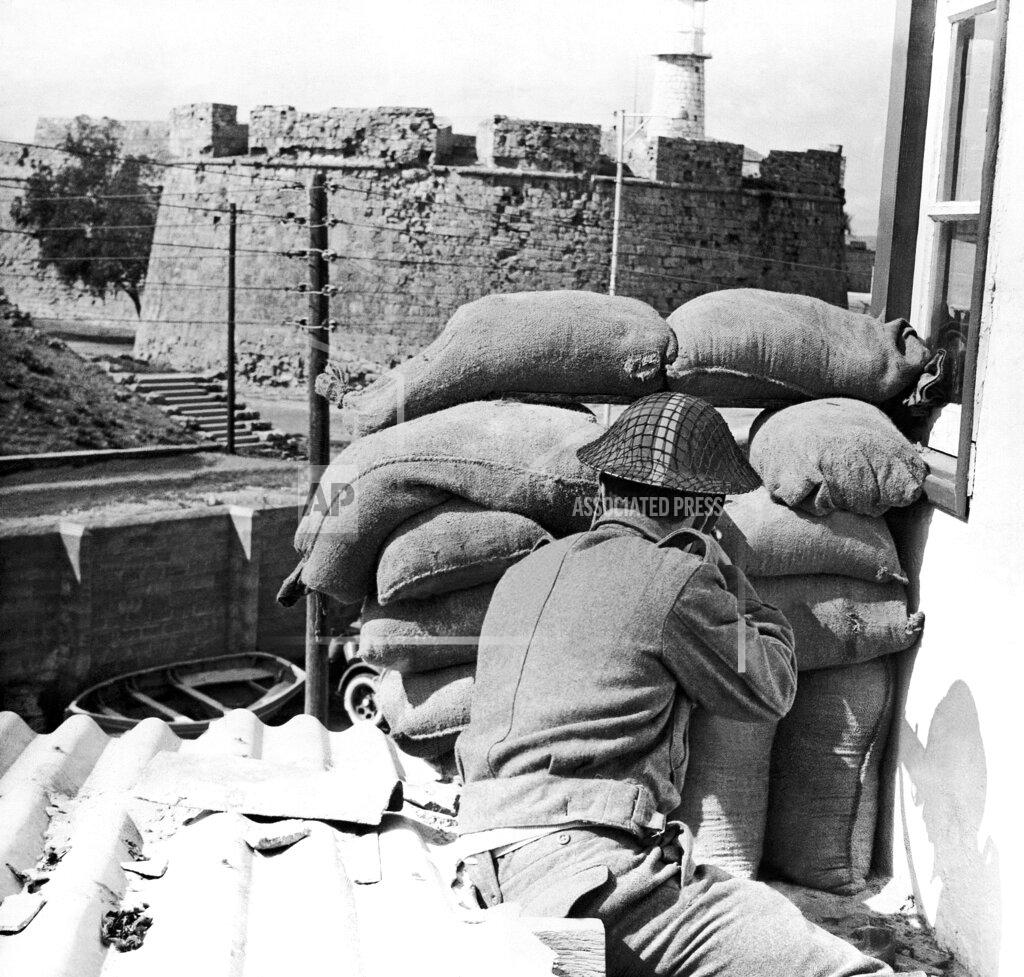
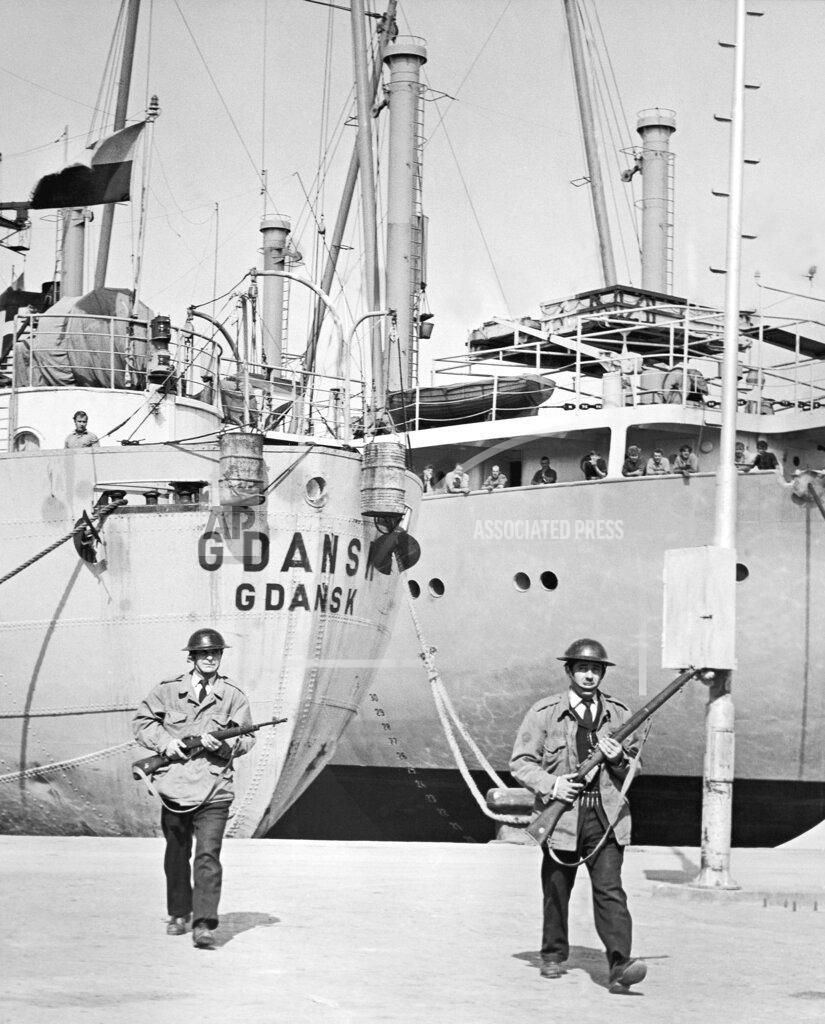
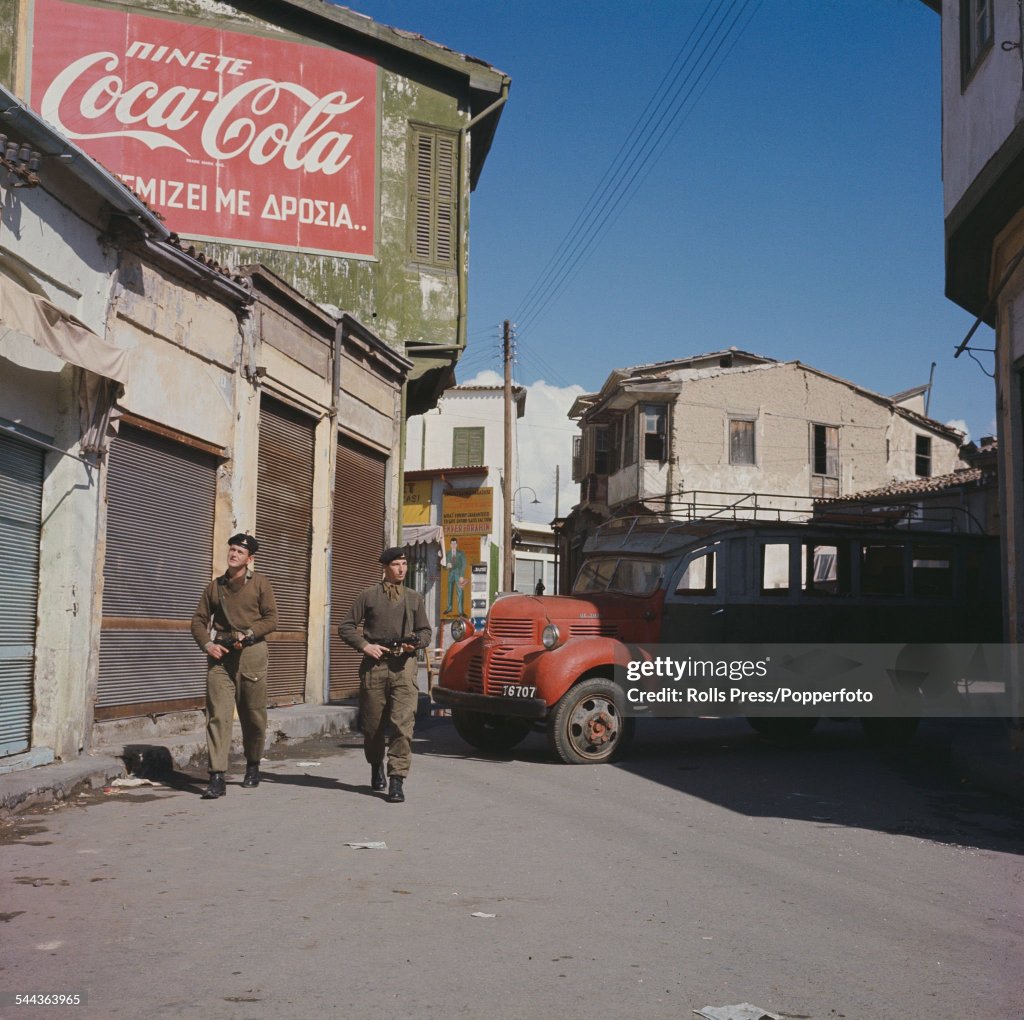
The United Kingdom and Cyprus requested urgent action by the United Nations Security Council to send UN peacekeeping troops to bring a halt to fighting between the Greek Cypriot and Turkish Cypriot minorities. The move came as warships from Turkey were preparing to invade the Mediterranean island republic. Britain and Cyprus asked today for an early meeting of the Security Council on the Cyprus crisis. No meeting time was set, but the 11 members agreed to be available on short notice. The British made their request first, in a surprise change of policy. Their delegate, Sir Patrick Dean, asked for an attempt to solve the difficulties over setting up an international force to halt violence between the Greek and Turkish Cypriotes. Then Zenon Rossides, the delegate from Cyprus, asked for an emergency meeting on the ground that there was imminent danger of a Turkish invasion of Cyprus.
Turkey was reliably reported today to have assured the United States and Britain that she would hold off any military intervention in Cyprus pending new efforts to settle the conflict there. The assurances were qualified, reliable sources indicated, by a warning that intervention would follow if the Greek Cypriote majority and the Turkish Cypriote minority renewed heavy fighting. George W. Ball, the American Under Secretary of State, returned to London today. He arrived from meetings in Ankara and Athens after the collapse of talks in Nicosia yesterday. On his arrival, Mr. Ball conferred with R. A. Butler, the Foreign Secretary; Lord Carrington, Mr. Butler’ deputy, and Duncan Sandys, the Secretary of State for Commonwealth Relations.
A reliable source said tonight that Archbishop Makarios President of Cyprus, had expressed opposition to the participation of the United States in a peacekeeping force and that Washington would respect his wish. Under a precedent fixed when the late Secretary General Dag Hammarskjold organized the United Nations Middle Eastern force, a country that is “host” to a force established by the United Nations can bar the troops of any government to which it objects. The United States had agreed with considerable reluctance to contribute troops to a force drawn from North Atlantic Treaty Organization members, as originally envisioned by Britain.
The reasons for Archbishop Makarios’s objection to the United States were not disclosed. It was understood, however, that he felt from the start of the crisis that both the United States and Britain favored Turkey and the Turkish Cypriotes. Britain, Greece and Turkey already have troops in Cyprus as guarantors of the Constitution under which Cyprus became independent in 1960. It is assumed, therefore, that if Archbishop Makarios objected to British participation, he would not be able to prevent it.
South Vietnam’s moment of truth appears to be at hand. The four-month dry season, when counter-guerrilla operations are easier, has started, but against a dismal military and political background. Another military coup d’état in Saigon has shaken both South Vietnam and Washington. The French recognition of Communist China and Communist or neutralist gains in bordering Laos and Cambodia have made the position of a strong anti-Communist South Vietnamese Government far more difficult. The Viet Cong, the Communist-led guerrillas, have increased the tempo of their attacks and clearly have the initiative in the important Mekong Delta region and in some other areas of the country. And last week the Communists opened a new campaign of terrorism against the 16,000 United States military and civilian personnel in South Vietnam and brought the war of stealth and assassination, of ambush and subversion, to the homes and playgrounds of Americans in Saigon. President Johnson said that “we are not pulling out of Southeast Asia, because we are not willing to yield that part of the world to… Communism.” Nevertheless, more and more people in Washington and abroad were asking: Is victory possible in South Vietnam?
General Phoumi Nosavan, the neutralist Deputy Premier of Laos, charged today that North Vietnam had sent new battalions into Laos. “The Viet Minh (North Vietnamese) are trying to reach the Mekong River (Laos’ border with pro‐Western Thailand) but they are being resisted by neutralists and rightists, General Phoumi said.
Premier Khrushchev has called for the establishment of a top‐level agency that would keep track of “great scientific and economic problems” and promptly utilize technological changes in the Soviet economy. In a major speech published today, the Soviet leader said such a body, made up of prominent scientists and political figures, would be expected to make sure that Soviet industry did not again lag because of bureaucratic inertia. This, he said, is what happened to the chemical industry, which is now to be expanded under a multi‐billion dollar, seven‐year emergency program. Mr. Khrushchev spoke yesterday at the agricultural meeting of the Communist party’s Central Committee, which ended a six‐day session today.
The Soviet leadership went out of its way today to make the Soviet public believe that the ideological conflict with Communist China was not discussed in yesterday’s session of the meeting of the Communist Party’s Central Committee. A sharp if indirect attack on the Chinese leaders by Premier Khrushchev was deleted from the text of his speech as published today by Soviet newspapers. The Premier had vowed that the Soviet Communist party would continue its fight against “the newly baked Trotskyites” who were making “high‐sounding phrases” about revolution and anti‐imperialism while in fact undermining the Communist movement with their “splitting activities.” The terms “splitters” and “Trotskyites” are among those normally applied here to the Chinese Communist leaders.
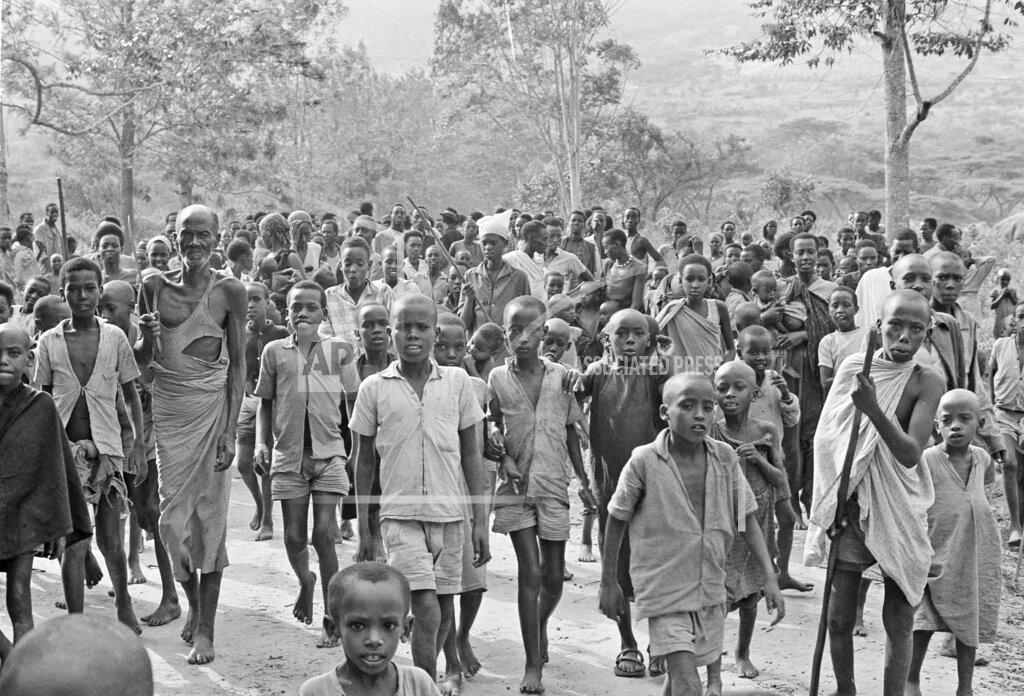
A truce to halt border fighting between Ethiopia and Somalia will go into effect at noon tomorrow, it was announced today. An exchange of messages by President Ibrahim Abboud of the Sudan, acting as intermediary, and Emperor Haile Selassie of Ethiopia provided for the cease‐fire. The fighting, which erupted last week, has aroused international concern. The Council of Ministers of the Organization of African Unity, meeting in an emergency session at Dar es Salaam, Tanganyika, called on both sides yesterday to end the shooting. The group also urged peace in a similar frontier dispute between Somalia and Kenya. President Abboud notified Emperor Selassie that the Somali Government of Premier Abdirashid Ali Shermarke had accepted the truce for Sunday and had also agreed to end its propaganda attacks on Ethiopia
“In the name of African unity and in a keen desire to save African lives, I appeal to Your Majesty to give a favorable response,” President Abboud said. The Emperor replied that his troops had been under orders for several days to shoot only if shot at. “We shall continue to exercise the utmost restraint,” he declared. The agreement came as Ethiopian demonstrators, urged on by government propagandists marched in towns and villages throughout Ethiopia demanding war. They carried banners declaring, “We will march to Mogadishu,” the Somali capital. Somalia claims the arid Ogaden plateau region of eastern Ethiopia on the ground that most of its inhabitants — largely nomadic herders of camels, sheep and goats—are Somalis. The Somalis are Moslems; the Ethiopians are divided between the Islamic and Christian religions.
The French and West German Governments agreed today to coordinate their economic aid for Latin America. The announcement was made at the close of a two‐day conference here between President de Gaulle and Chancellor Ludwig Erhard. The French President apparently had little difficulty in enlisting German cooperation in the extensive trade drive planned by France in Latin America. Chancellor Erhard had feared that the United States would object. But today, apparently on the basis of his recent talks with President Johnson, he told the French leader that Washington welcomed such cooperation. The agreement calls for the exchange of information to improve planning and avoid duplication of economic assistance. It is hoped that a system of common support for private investment in Latin America can be arranged. There are no plans for a joint aid agency, however.
Voting began in the first elections for the new House of Assembly of Papua and New Guinea were conducted under United Nations supervision, with more than 300 candidates “ranging from white planters and patrol officers to primitive natives” standing for the 54 legislative seats. The UN hired 10,000 guards in the Australian-administered territory to protect election officials from hostile tribes. Voting would continue until March 18 and the Assembly would open at Port Moresby on June 8. On New Hanover Island, however, at a polling station in the villages of Ranmelek, the voters expressed their preference for President Lyndon Johnson of the United States; the “Johnson cult” would be seen days later at the villages of Meteran and Taskul, and at Nonovul in the Tigak Islands.
If the party in power in Washington is presiding over a prosperous economy, how does the “out” party persuade the country to make a political change? The obvious experiment is to take a big stick to foreign policy. Republican candidates and potential candidates took that course almost as a group this week. The most emphatic man in the group, and the man who probably has the most to gain from this stratagem, was Richard M. Nixon. Mr. Nixon is not wholly abandoning the domestic front, as his discussion of civil rights Wednesday in Cincinnati plainly showed. Nevertheless, he evidently believes that President Johnson’s weakness is Cuba, Vietnam, Panama and other points abroad where the United States is encountering difficulties. “If President Johnson does not act, the issue of 1964 will be clear‐cut,” the 1960 Republican Presidential nominee declared.
Mr. Nixon’s stratagem seems to be not only to raise foreign policy questions but also to exploit the President’s sensitivity to criticism. “The United States can’t settle in 1964 for a man, no matter how competent in wheeling and dealing and political maneuvering, who lacks foresight and vision,” Mr. Nixon said to a Philadelphia audience. He rubbed it in with high praise for Mr. Johnson’s immediate predecessor, President Kennedy, as a conductor of United States foreign policy. Mr. Nixon achieved the response he apparently desired. President Johnson snapped that such critics were aligning themselves with the nation’s enemies.
President Johnson was pleased with his reception in St. Louis yesterday, the chief White House spokesman said today after the President’s first trip to the Midwest since assuming office. Pierre Salinger, press secretary, said the President did not regard as small the estimated total of 100,000 persons who came out to see him on the motorcade routes between scheduled speeches. Mr. Salinger reported the President’s reaction in answer to newsmen covering the trip who suggested that the crowds had seemed small. The President returned last night after participating in the St. Louis 200th anniversary celebration.
The arrests of 80 civil rights demonstrators who sought to march on the hotel where the President stayed was not mentioned during Mr. Salinger’s meeting with newsmen. Mr. Salinger emphasized in answer to a question, however, that he had “never heard discussed” at the White House a purported willingness on the part of the President to make major concessions on the civil rights bill being considered in Congress. The concessions were said in a radio report broadcast by the Columbia Broadcasting System to include limitation of the public accommodations section of the bill. The report said that President Johnson had told two Southern Senators that he was willing to make the compromise. It was in reference to this report that Mr. Salinger said he had never heard the subject discussed.
n his special health message to Congress last Monday President Johnson urged adoption of a program of hospital and nursing home care for the aged financed through Social Security. This was expected, for the President had said he would seek passage of such legislation in his State of the Union Message in January. President Johnson’s hopes rest in the King-Anderson bi1l, a holdover from the Kennedy Administration, which is now pending. Under the proposed legislation, protection would be provided against the cost of inpatient hospital, outpatient hospital diagnostic, nursing home and home health services for persons aged 65 and over who are covered by Social Security or the Railroad Retirement system.
President Johnson’ program for medical aid for the aged — identical to the one pushed by the late President Kennedy — calls for covering hospital and nursing‐home care for persons 65 years of age and over. Physicians’ and surgeons’ fees would not be covered. To finance the program known as Medicare, Social Security taxes would be increased by one‐fourth of 1 percent for employer and employee, and the maximum yearly earnings taxed would be increased from the present $4,800 to $5,200. The cost to the worker would be about $12.50 a year. His employer would pay an equal amount. This, then, is what President Kennedy proposed last year and what President Johnson is now proposing — a program embodied in the King-Anderson bill now pending in the House Ways and Means Committee.
But it is not the program that is likely to be passed — if, indeed, any program of health care for the aged manages to limp through Congress this year.
The key to whether any program — even a compromise one — gets through Congress is held by one man: Representative Wilbur D. Mills, an Arkansas Democrat who, as chairman of the Ways and Means Committee, is one of the most powerful men on Capitol Hill. “This is a one‐man ball game with Wilbur Mills,” one strong advocate of the medical‐care program commented recently. “Without him, there’ not much of a chance of getting a bill through Congress.” Representative Mills’ views on the King‐Anderson bill are no secret. He is definitely against it. Thus, the only way to win him over would be through a compromise program — and even then, he might not go along with it.
Senator Barry Goldwater came to Nogales on the Mexican border today and strolled across the line separating American and Mexican Nogales, seeking to take a couple of hours off from weeks of campaigning. But it was no use. The Republican Presidential aspirant found himself handshaking with friendly residents of the State of Sonora. As he ate enchiladas and tacos in a restaurant in an old cavern, some Mexican admirers unfurled a huge banner that read: “Viva Goldwater.” A mariachi band serenaded the Arizona Senator’s party. Mr. Goldwater strolled around the restaurant exchanging abrazos (embraces) with old Mexican friends, shaking hands with American tourists and autographing photographs. Drinking Mexican beer, he exchanged toasts in Spanish with Mexican friends who wished him well in his campaign for the Republican nomination.
The Air Force is pressing for vigorous research programs that could pave the way for at least four aircraft able to deal with a wide variety of limited conflicts in the nineteen‐seventies. In a report based on almost a year of study, the Air Force envisages the need for:
- A transport with a range up to 10,000 miles that could carry troops and equipment to the most primitive trouble areas, unload without landing and return home, all on the original load of fuel.
- A strike craft with intercontinental range able to deliver precise nuclear or conventional blows just devastating enough to destroy military targets without inflicting collateral damage that would run the danger of escalating the conflict into a larger war.
- A vertical take‐off and landing (VTOL) attack‐reconnaissance plane for direct support of troops in the field.
- A limited-range VTOL transport for direct support of front‐line operations.
An intensive program to obtain 400 additional sea‐experienced officers for the U.S. Navy’s nuclear‐power program has been encountering difficulty. Volunteers have failed to meet the need. The compulsory assignments to the program made in the last few months have assumed an emergency nature and have had a disruptive effect on other training programs. They have also caused dislocations and resentment in other branches, and brought complaints from surface commanders that some of their best officers are being taken from them. For the first time since the nuclear‐training program started in 1950, the entire Navy list, except for aviators, who were exempted because of their long training and special qualifications, has been combed for officers who could meet the required rank and other qualifications. Yet, at the year’s end, about 365 of the 400 had been selected. Some, assigned against their will have submitted resignation.
Beatles’ “Meet the Beatles!” album goes #1 & stays #1 for 11 weeks.
Basketball star and future U.S. Senator Bill Bradley scores 51 points for Princeton.
The body of Chicago Cubs star Ken Hubbs is found after the crash of his private plane near Provo, Utah. The 22-year-old Hubbs, a newly licensed pilot, was at the controls of the Cessna 172 when it crashed on an ice-covered lake, killing him and his 23-year-old friend, Dennis Doyle. The Civil Aeronautics Board later rules that “faulty judgment” by Hubbs caused the crash. In 1962, Hubbs won the National League’s Rookie of the Year Award and set a record by playing 78 consecutive errorless games.
Born:
Chris Farley, American comedian and actor (“Saturday Night Live”, “Wayne’s World”, “Coneheads”), in Madison, Wisconsin (died of drug overdose, 1997)
Leland D. Melvin, U.S. astronaut (NASA Group 17, 1998; STS-122, STS-129), in Lynchburg, Virginia.
Mark Price, NBA point guard (NBA All-Star, 1989, 1992-1994; Cleveland Cavaliers, Washington Bullets, Golden State Warriors, Orlando Magic), in Bartlesville, Oklahoma.
Daniel Poudrier, Canadian NHL defenseman (Quebec Nordiques), in Thetford Mines, Quebec, Canada.
George Swarn, NFL running back (Cleveland Browns), in Cincinnati, Ohio.
Paul Dufault, NFL center (Los Angeles Raiders), in Bridgeport, Connecticut.
Died:
William Snyder Webb, 82, American anthropologist, archaeologist and physicist.



 History Diaries