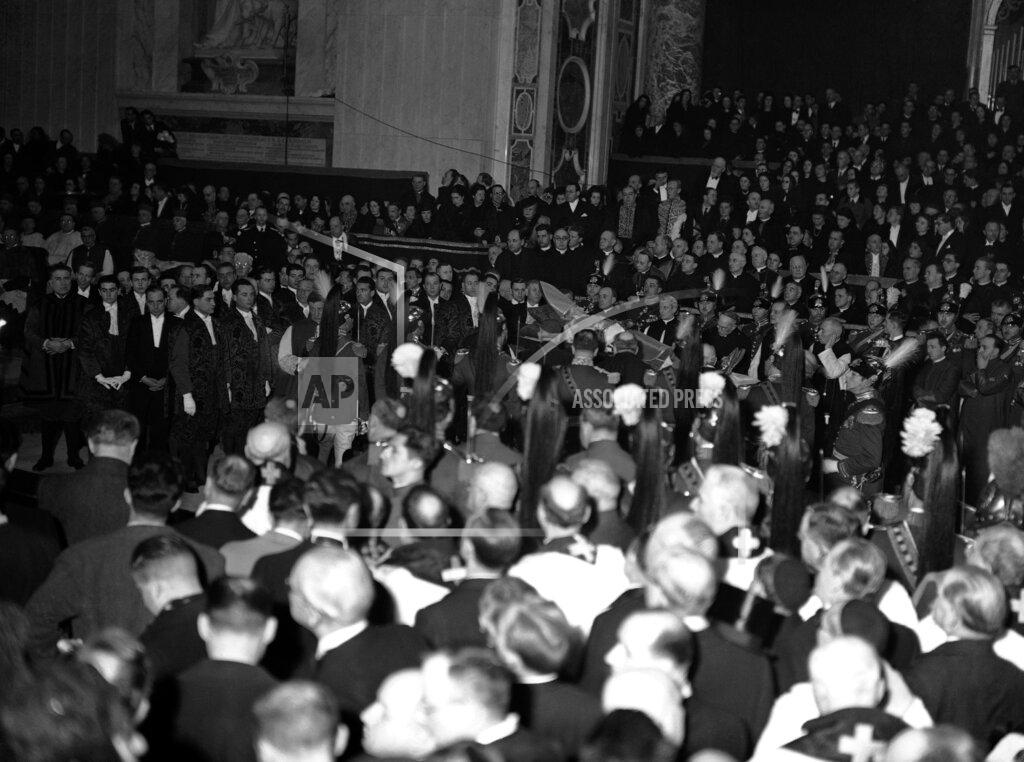
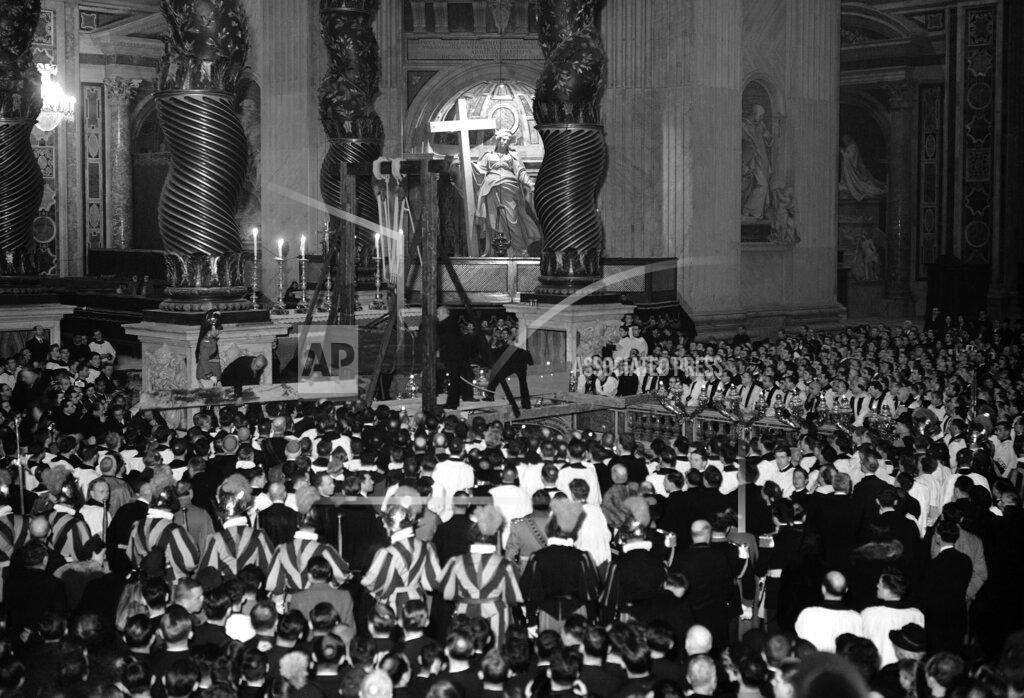
Pope Pius XI was laid to rest in St. Peter’s Basilica. Pope Pius XI reached the end of his journey on this earth late this afternoon when he found peace in his last resting place in the crypt of St. Peter’s. He lies in a dark, unadorned vault — so low that it is scarcely possible to stand in it without stooping — many feet below the floor of the basilica in which during his long pontificate he repeatedly received the homage of the multitude. Three Popes — Pius VI, Pius X and Benedict XV — and one Cardinal — Merry del Val, who was Papal Secretary of State — are his only companions. He was buried with the splendid pomp and impressive ceremonial appropriate to the Supreme Pontiff of the Holy Roman Church but with extreme simplicity of liturgical ritual. The prayers and the responses sung in St. Peter’s this afternoon for the 261st Vicar of Christ on Earth and the invocations that God might rest his soul would be recited without change in the world’s humblest church for the lowest of sinners.
Enclosed in a triple coffin weighing more than half a ton, the body of Pius was placed at 6:49 P. M. in the vault where it may remain until the end of time. Thirty-seven Cardinals were present in the crypt to pay their last homage to the Pontiff whom they had acknowledged as master during his life. A crowd of several thousand, including all the members of the diplomatic corps accredited to the Vatican, the Roman nobility, large numbers of priests, nuns, monks and seminarists and a good number of laymen, had taken their leave of the dead Pope a few minutes before in the basilica. The ceremony was private. The attendance was not anywhere large enough to fill St. Peter’s, but it was sufficient to create a warm and vibrant atmosphere. The men were mostly in full evening dress, but wearing black ties as a sign of mourning, while all the women wore the usual costume for Vatican ceremonies — a black dress down to the ankles, with long sleeves, high collar and a lace mantilla worn over the hair.
Workers digging the grave for Pius XI discovered that it already contained the body of an archbishop.
The Vatican prepares to house the conclave, and must create simple accommodations for 400 people.
An attempt by the Spanish Government’s fleet to challenge Insurgent control of the sea in a naval battle was seen by some observers today as a possible aftermath of a proclamation issued by Republican (Loyalist) naval chiefs. With the Madrid government’s contact with the outer world depending on sea communications, men of the government fleet were admonished to do their duty “to the death if necessary.” It was apparent, however, that the Insurgents definitely planned to cripple the government’s fleet beyond use if they could. A night Insurgent communiqué said two destroyers were damaged in an air raid on Cartagena, the government naval base, today.
The Republicans’ naval proclamation said the government might order “what it deems fit with assurance that the fleet will remain loyal and carry out the orders, whatever they may be.” It directed all sailors to stay at their posts, warned them that “cowards” would be dealt with implacably and announced that “if misfortune compels us to take a definite solution, the fleet, led by its officers, will fulfill its duty, even if it means death.” Although military operations have yet to start in the central zone, presumably awaiting the transfer of Insurgent armies from Catalonia, General Franco’s bombers were active today over the port of Alicante. Five Savoia (Italian type) bombers dumped enough projectiles on the city to destroy fifty houses. Four persons were killed and twenty-five wounded.
From French concentration camps established near the Catalan frontier, trainloads of wounded former Republican soldiers were dispatched to hospitals in the interior. More than 500 wounded men were taken to Marseille, to be embarked upon the liners Patria and Providence, which were turned into floating hospitals. Official estimates issued at Perpignan were that more than 70,000 Spaniards of fighting age who fled Catalonia with or as part of the Spanish Republican Army had elected to go to Insurgent Spain. Most of them were Catalans. In some Catalonian battalions, the number choosing to go to the Insurgent side was said to have been more than 80 percent. At noon today, following authorization from Burgos, French troops escorted several hundred Spaniards into Insurgent Spain via the neutral bridge and road at Lluvia, near Bourg-Madame.
In a few more days the Spanish Civil War may be expected to end in complete victory for Generalissimo Francisco Franco. This morning President Manuel Azaña of the Spanish Republic declared to a French official that peace was inevitable and further resistance impossible. Anyway, as far as he was concerned, he added, he did not think that his Ministers, deliberating in Madrid while their Chief Executive was in Paris, could really contemplate engaging in a new fight with any chance of success. The Madrid-Valencia-Alicante triangle has enough supplies to hold out in the event the Nationalists (Insurgents) besiege without attacking them. On the other hand, they can no longer obtain munitions.
The small section of seacoast still in the hands of the Republicans can easily be blockaded. And one has only to glance at a map of the front to realize that the 200,000 demoralized soldiers still obeying orders from Madrid can easily be split into several sections by various attacks executed with troops that are immensely superior and better armed. So General Franco has the choice of reducing his enemies or splitting their forces. Under those conditions this morning’s Council of Ministers here rejected the idea of sending back to Madrid Ambassador Jules Henry, previously accredited to Barcelona. On the other hand, Senator Léon Bérard is being sent back to Burgos (capital of the Insurgent regime), where his mission will be to obtain confirmation from General Franco himself of assurances of neutrality and independence already given. Investigation of his statement that preparations for a war against France have been made in the Pyrenees district is being carried out by a group of French officers. They have found neither airfields nor artillery emplacements nor any other preparation for a hostile enterprise against France. M. Bérard will inform the Burgos Government that it is France’s intention to recognize. Nationalist Spain.
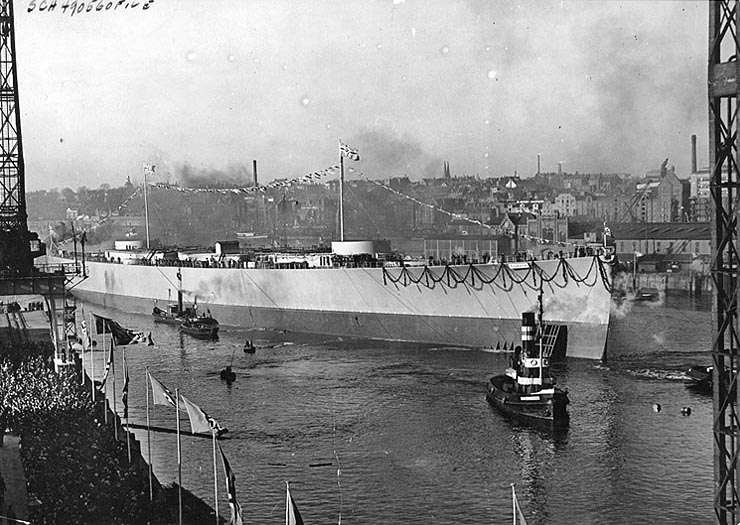
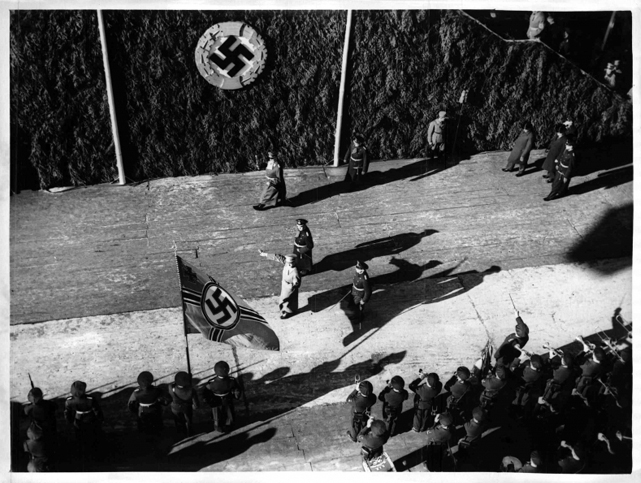
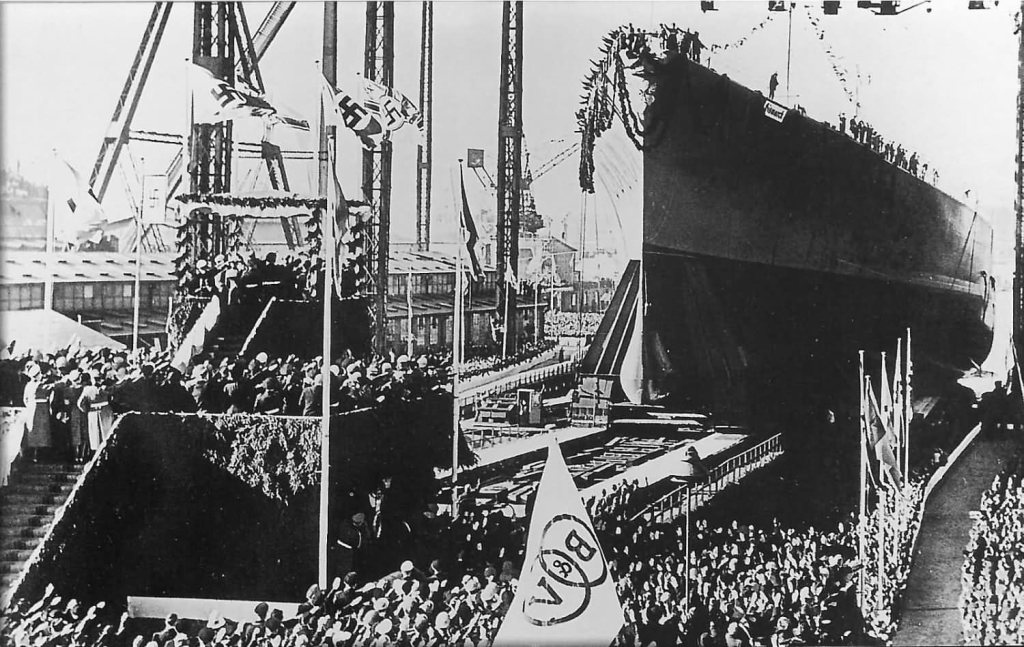
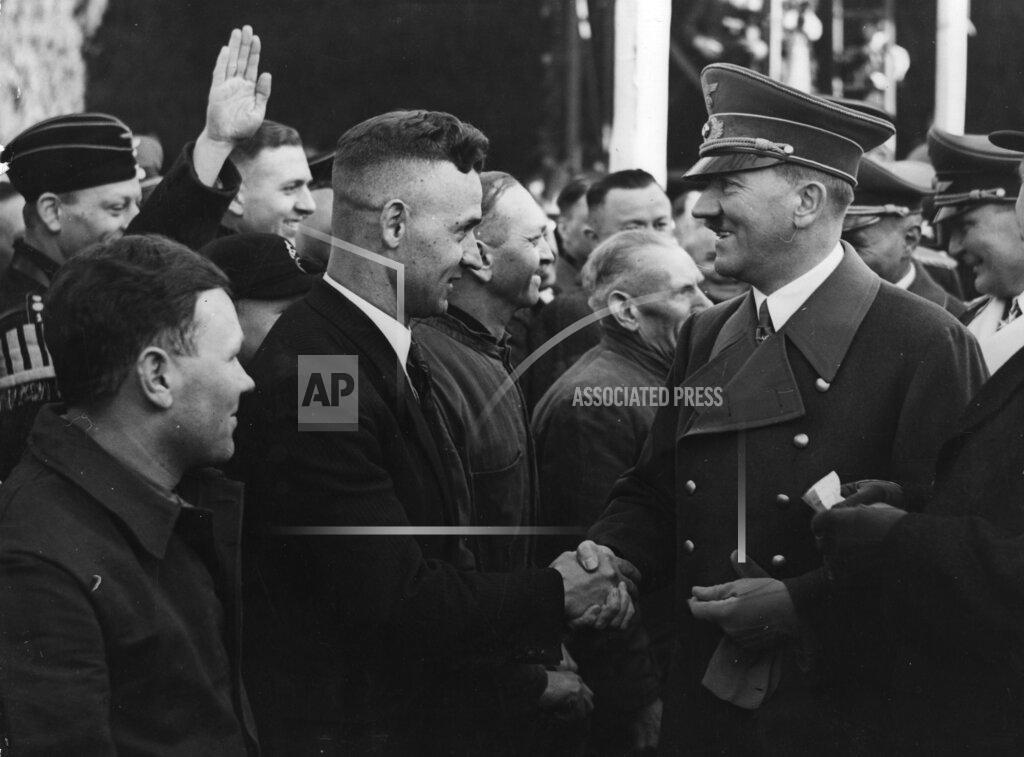
The German Kriegsmarine 41,700-ton (standard) battleship Bismarck was launched. Laid down after the signing of the Anglo-German Naval Agreement of 1935, Bismarck and her sister Tirpitz were nominally within the 35,000-long-ton (36,000 t) limit imposed by the Washington Naval Treaty that governed battleship construction in the interwar period. The ships secretly exceeded the figure by a wide margin, though before either vessel was completed, the international treaty system had fallen apart following Japan’s withdrawal in 1937, allowing signatories to invoke an “escalator clause” that permitted displacements as high as 45,000 long tons (46,000 t). At full load, Bismarck came in at 50,300 tons.
The Reich seeks 800,000 to work on farms and forbids laborers from changing assigned jobs.
The possibility of Hungarian Premier Bela Imredy’s resignation was widely rumored today as a result of strong opposition to his anti-Jewish legislation among Conservative members of the upper house as well as in influential economic circles. Moreover, according to rumor, he is losing the support of many members of the Government party — hence his resignation would ease the political tension. The Premier had a long audience with Regent Nicholas Horthy today, despite his reported illness, after which Admiral Horthy received many leading politicians, among whom were Count Stephen Bethlen and Count Pal Teleki. Late tonight it was learned the crisis might be solved by Premier Imredy’s taking a long “sick leave.” There is, however, a possibility that he will resign and that Koloman Daranyi will be asked to form a new Cabinet.
The internal political situation in Hungary is overshadowed by the constant threat that the German-supported Hungarian National Socialists may overthrow the present regime and establish a Fascist dictatorship. It is believed Premier Imredy’s intention was to steal the Nazi thunder by carrying out anti-Jewish measures and initiating radical land reforms. Conservative politicians under Count Bethlen and Tibor Eckhardt, however, strongly opposed that place. The fate of the anti-Jewish bill, discussions of which will begin tomorrow, depends largely on the outcome of the present crisis.
The British House of Commons keeps the ban on women in the stock exchange despite argument that females would not get “jitters” in a crisis.
France contracts to buy 500 warplanes from American manufacturers. France buys 500 more warplanes from the United States, for a total of 615. “The French Air Mission, which arrived in the United States last December to continue purchases of planes already started last Summer, has concluded its work,” the embassy said. “During its stay the mission has placed with the following American firms, Douglas, Curtiss, Glenn Martin and North American, a new series of orders for over 500 planes.” Acquisition of planes in the United States is part of a two-year plan by the French to stiffen their air defenses in view of the troubled European situation. Announcement of this program was made early last May, and soon afterward the French Air Ministry stated that 100 planes had been ordered from American manufacturers.
Democrats ask President Franklin Roosevelt to solidify the party for 1940 by working with Congress. A warning that dissension in Democratic ranks would lead to defeat in 1940 was delivered today to House Democrats by their leaders, whose alarm over the possibility of a split has spread to the Senate and to Democrats elsewhere in the capital. The “harmony” meeting probably will have at least a temporary benefit, a consensus showed, but expressions of House “moderates” indicated that they would await some show of cooperation from the White House rather than, in the words of one member, be called upon to do “all the cooperating.”
Meanwhile, it was revealed that self-appointed agents of party peace, some of them officials high in the Administration, had been sounding out Democratic Senators of the moderate faction to see how far they would go toward healing the breach between them and the White House. They made it clear that they were not yet speaking for President Roosevelt in their peace overtures. In fact, the Senators were told, it was not known whether the President would even consider at this time the principle which the peacemakers had in mind. They were acting on their own volition and as Democratic leaders from various States on duty in Washington who were becoming rapidly convinced that if the schism in the party is not closed the Presidency and the Congress will be handed over to the Republicans on a silver platter in 1940.
These intermediaries found a responsive note among the leading “moderates” in the Senate, particularly to their suggestion that the party peace would have to be reached through mutual concessions. Reciprocity, however, was the one thing they could not yet guarantee from the wing of the party which controls the executive branch of the government. “The President holds the key to the whole problem,” was the way one Senator put it. The same sentiment was expressed in the House caucus by several members of the moderate group, and, inferentially, by some of the Administration supporters.
Congress halts in homage to Pope Pius XI, the first such tribute to a spiritual leader.
President Roosevelt recovers from a brief illness and is set for a trip to the Caribbean. Speculation exists that William O. Douglas, SEC chairman, may replace the retired Louis Brandeis as Supreme Court Justice. While President Roosevelt may name a successor to Associate Justice Brandeis of the United States Supreme Court before he leaves the White House for a Caribbean cruise on Thursday, Administration circles consider that he will hold announcement of his choice in abeyance. Having expected, for several months, the retirement of Mr. Brandeis, the President has been considering potential candidates for the vacancy. Prominent among those mentioned in capital discussion of those on whom the President’s choice might fall is William O. Douglas, chairman of the Securities and Exchange Commission.
Mr. Douglas, formerly a Yale professor and identified with that group in the legal profession which the President calls liberal, was one of four persons on the White House visiting list today. He spent nearly half an hour in the private quarters of Mr. Roosevelt. While the possibility of the retirement of Justice Brandeis has been discussed for several months and speculation has been current as to who might succeed him, Mr. Douglas has hitherto not been considered as a candidate. But, in view of the prevailing belief that the President desires to name a jurist from the West, the fact that Mr. Douglas was born and educated in the State of Washington, is now considered important in Washington. Western state politicians have been pressing for representation on the high court.
First Lady Eleanor Roosevelt displays Goya etchings, a gift from Spain, despite protests.
A New York City mother of two unsuccessfully attempts a holdup with a children’s toy pistol.
New York Mayor Fiorello La Guardia orders police to assist bar owners who wish to close early.
Explorer Lincoln Ellsworth believes that the U.S.-Australia dispute over the Antarctic territory is good, since it generates interest in the region.
Victor Fleming replaces George Cukor as director of film “Gone with the Wind.”
The championship horse Seabiscuit is lame after a race defeat. The horse has a damaged ligament in his left leg.
Japan’s House of Representatives votes approval of armed occupation of Siberian islands and fishing grounds. Armed occupation of the Japanese fishing grounds off Soviet Kamchatka or the seizure of the Russian half of Sakhalin Island were advocated in the lower chamber of the Japanese Diet today during the debate on the fisheries problem. The debate was prearranged and culminated in a unanimous resolution demanding “swift, appropriate action, not stopping at the use of force to protect Japanese rights and interests.” Foreign Minister Hachiro Arita replied that the government would do its utmost but added the saving clause, “in existing conditions.” The debate was staged as a method of strengthening the government’s hands in its negotiations with the Soviet Union. The speeches were entrusted to renowned party orators whose eloquence rose to the opportunity. Their proposals for armed action were not taken too literally except, perhaps, in the galleries. Asahi’s political writer reflected lobby opinion when he wrote that the government’s determination will have to be quite strong if it is to satisfy the introducers of the resolution.
All responsible Japanese hope the debate will duly impress Moscow and then be forgotten. But the parties today were the spokesmen of the fishing interests and the difficulty they are up against is that nothing short of armed action can effectively maintain their rights in the last resort. The industry has built up a trade worth 50,000,000 yen yearly, mainly canning for export, and the canneries are shore plants on Russian territory. The “free fishing” so frequently threatened is consequently idle talk unless access is obtained to the shore canneries. Despite the Diet’s cheers today, most Japanese do not believe the Japanese Government would risk an armed invasion of Russian soil at this moment. It is now obvious the Russians intend to exploit Japan’s difficulties fully. But officials do not believe Moscow will force the issue to the extremity of armed action. Both sides know the fisheries are not worth a war. Past disputes have always been nothing more than the clamor incident to Oriental haggling. An eventual settlement therefore remains Japanese officialdom’s firm hope, but there is a secret underlying fear that Japan may have to sacrifice some prestige.
Border clashes between Soviet and Manchukuoan troops were reported today while the Lower House of the Diet demanded a stronger policy against Russia. A news agency dispatch from Hsinking, the capital of Manchukuo, said the clashes occurred Sunday and Monday near the scene of recent skirmishes. It was admitted that Manchukuoan forces were being reinforced in the area.
Japan completes seizure of Hainan. The island is to serve as a stronghold for Japan. Japanese forces moved quickly today toward complete occupation of Hainan, 750 miles west of the Philippine Islands. Japanese naval units, with aviation support, landed at Yulinkan, on Hainan’s southernmost tip, and in six hours penetrated fifteen miles inland. The occupation of Northern Hainan began Friday and brought prompt action by France, Great Britain and the United States. The rapidity of the landing parties’ advance was taken to indicate the absence of Chinese resistance to the invaders’ occupation of Hainan’s southern Sama Bay area. That zone is considered among the best deep harbors in the Far East, although it is not developed.
Neutral observers said they saw no connection between the penetration of Southern Hainan and the Chinese-Japanese war. They pointed out that Yulinkan is more than 200 sea miles from China proper. Yulinkan, however, commands Tonkin Gulf, which heretofore has been considered in the French sphere of influence. If the Japanese Navy strengthens its hold in Northern and Southern Hainan, another link would be forged in the 3,000-mile island chain stretching from Sakhalin southward through the Japanese archipelago to Hainan. Sakhalin is an island in the northern Pacific. Japan owns the southern part of it.
Foreign Minister Hachiro Arita today told Sir Robert Craigie, the British Ambassador, that Japan probably would hold Hainan Island until the end of the Chinese war and possibly indefinitely on grounds of military necessity. This was virtually the same reply Mr. Arita gave the French Ambassador, Charles Arsene Henry, yesterday when M. Henry asked for information on Japan’s plans with regard to the island, which is near French Indo-China and the British colony at Hong Kong. Sources close to the French Embassy predicted that France would not be satisfied with Mr. Arita’s reply but it was doubted that she would attempt any action to oust the Japanese.
Dow Jones Industrial Average: 144.13 (-0.48).
Born:
John McGeever, AFL cornerback and safety (Denver Broncos, Miami Dolphins), in Bogalusa, Louisiana (d. 2022).
Chris Pyne, British jazz, touring, and session trombonist (Mike Gibbs; Ronnie Scott; Humphrey Lyttelton), born in Bridlington, East Riding of Yorkshire, England, United Kingdom (d. 1995).
Michael Rudman, American theater director and producer working in the U.K. (“Death of the Salesman”, “Donkeys’ Years”), in Tyler, Texas (d. 2023).
Naval Construction:
The Nihon Kaigun (Imperial Japanese Navy) Kagerō-class destroyer Amatsukaze (天津風, “Heavenly Wind”) is laid down by the Maizuru Naval Arsenal (Maizuru, Kyoto Prefecture, Japan).
The Kriegsmarine (German Navy) battleship Bismarck is launched by Blohm & Voss, Hamburg (werk 509).
The Regia Marina (Royal Italian Navy) Foca-class submarine minelayer Atropo is commissioned.

 History Diaries