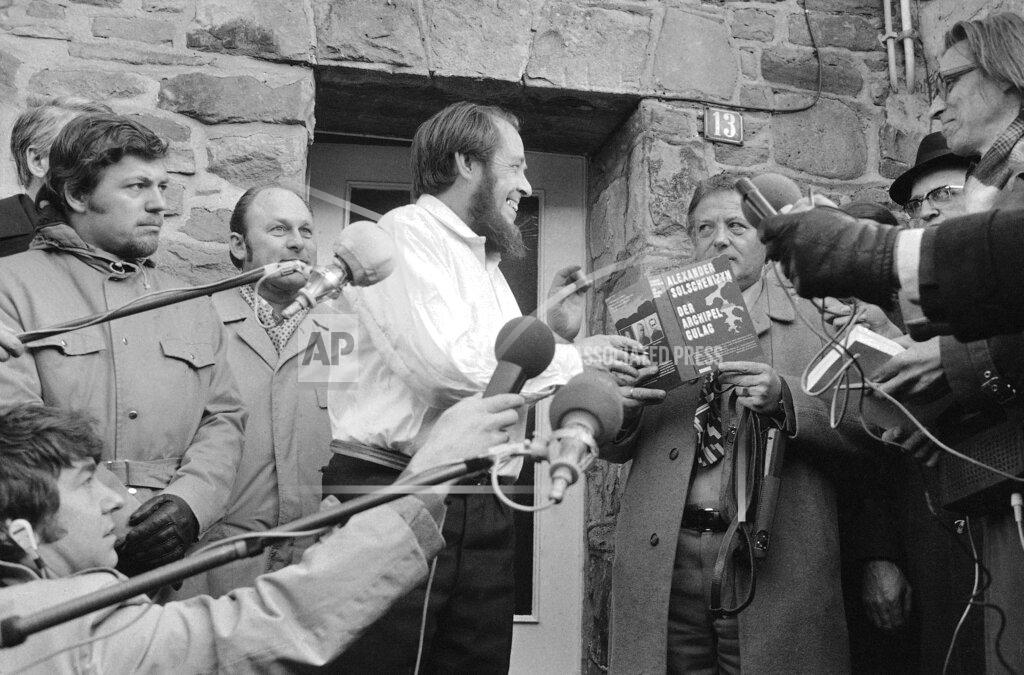
Exiled Russian author Aleksandr Solzhenitsyn remains in West Germany. Self-exiled Russian writer Dmitri Panin flew from Paris to be with Solzhenitsyn. Panin reported that Solzhenitsyn is very worried about his family. Many countries have offered Solzhenitsyn a new homeland, but the Russian author refuses to comment about his future plans.
Soviet prosecutors reportedly presented Aleksandr I. Solzhenitsyn with a formal indictment charging him with treason, an offense that could be punished by death, the day before he was deported to West Germany. According to friends of the Soviet author in Moscow, Mr. Solzhenitsyn refused to acknowledge the charge and did not speak again until he was read the decree stripping him of his citizenship and ordering his immediate deportation.
Solzhenitsyn’s lawyer announced that the author will go to Zurich, Switzerland, tomorrow for reasons unknown. Russian nuclear physicist Andrei Sakharov appealed to the outside world for an international investigation of the crimes committed by the Soviet secret police as described in Solzhenitsyn’s “The Gulag Archipelago.” Another Russian scientist, a member of the Soviet Academy of Sciences, agreed with Sakharov.
The Soviet Union today stepped up pressure on the United States to moderate its position for the next round of negotiations aimed at imposing further limits on Soviet and American arsenals of strategic offensive weapons. The talks will begin in five days in Geneva. An authoritative commentary in Pravda today charged that the United States Secretary of Defense James R. Schlesinger, was trying to whip up the arms race by speaking of threats of future Soviet arms superiority. It contended that his argument for increased American defense spending “contradict the spirit of détente and normalization.” The authoritative Communist party newspaper also contended that to exclude American forward‐based air units in Europe, the Mediterranean and Pacific areas, would be tantamount to granting the United States a unilateral advantage unacceptable to the Soviet Union. This is the most forceful language Moscow has used on this point in public.
Ever since the strategic arms talks began in November, 1969, in Helsinki, the Soviet Union and the United States have clashed over the role of these forces and their place in the strategic arms talks. The issue is still at the heart of the negotiating deadlock between Washington and Moscow. The United States considers these air units, consisting of some nuclear‐armed planes in Europe and others aboard aircraft carriers in the Mediterranean and Pacific, as tactical rather than strategic because it counts on them in the defense of Europe to offset Soviet medium- and intermediate-range missiles. But Moscow asserts that they should be considered strategic forces because their planes are capable of launching attacks on the Soviet Union.
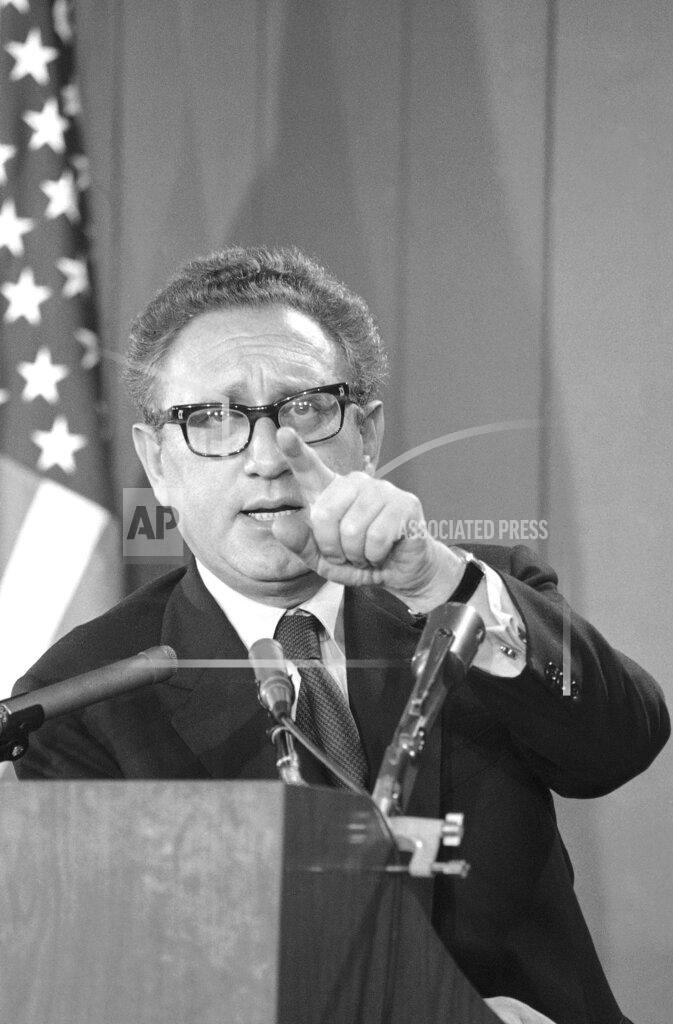
Secretary of State Kissinger is to confer tomorrow night or Saturday with the Foreign Ministers of Egypt and Saudi Arabia, who are flying here on a special mission. They reportedly want to discuss the possibility of opening talks on troop separation between Syria and Israel. Senior State Department officials said that Foreign Minister Ismail Fahmy of Egypt. and Foreign Minister Omar Saqqaf of Saudi Arabia made the request to meet with Mr. Kissinger at the close of a meeting of four Arab nations in Algiers today. Also participating in the meeting were officials from Syria and Algeria. Mr. Kissinger, who originally planned to fly to Key Biscayne, Florida, tomorrow afternoon to join President Nixon, agreed to the urgent request, the American officials added.
The State Department said that the United States would move with a “sense of urgency” to carry out the decisions made at the 13‐nation Washington energy conference this week. Citing the need to maintain momentum, senior officials said that the first step would be to convene the high‐level “coordinating group,” charged with preparing for a meeting between oil‐producing and oil-consuming nations to discuss a new price structure for oil.
Efforts to reach joint European policies have been paralyzed by the split between France and the eight other Common Market countries at the Washington energy conference. Among the decisions that have been affected by the, split and the uncertainty of the upcoming British elections are policies on relations with the Arabs, regional aid, farm prices and monetary matters.
Madrid police announced the arrest of 14 alleged members of a Basque terrorist organization that has claimed responsibility for the December 20 slayings of Spanish Prime Minister Luis Carrero Blanco. Police said those detained were involved in recent “terrorist acts” in Spain’s northern Basque provinces, but did not directly link them with the fatal bombing of Carrero. The arrests, police added, led them to newly formed groups of the Basque homeland and liberty movement (ETA) on Spanish campuses.
The blast of a massive Northern Ireland guerrilla bomb, estimated to have contained 500 pounds of explosives, rocked the town of Dungannon, shattering dozens of buildings. No one was injured by the explosion, which police blamed on the Irish Republican Army. They said gunmen hijacked a post office truck in the town, about 30 miles southwest of Belfast, loaded it with sacks of explosives and ordered the driver to park it between Dungannon’s police station and post office. But the driver abandoned the truck in the market square and sounded the alarm. The area was evacuated and three hours later the bomb went off.
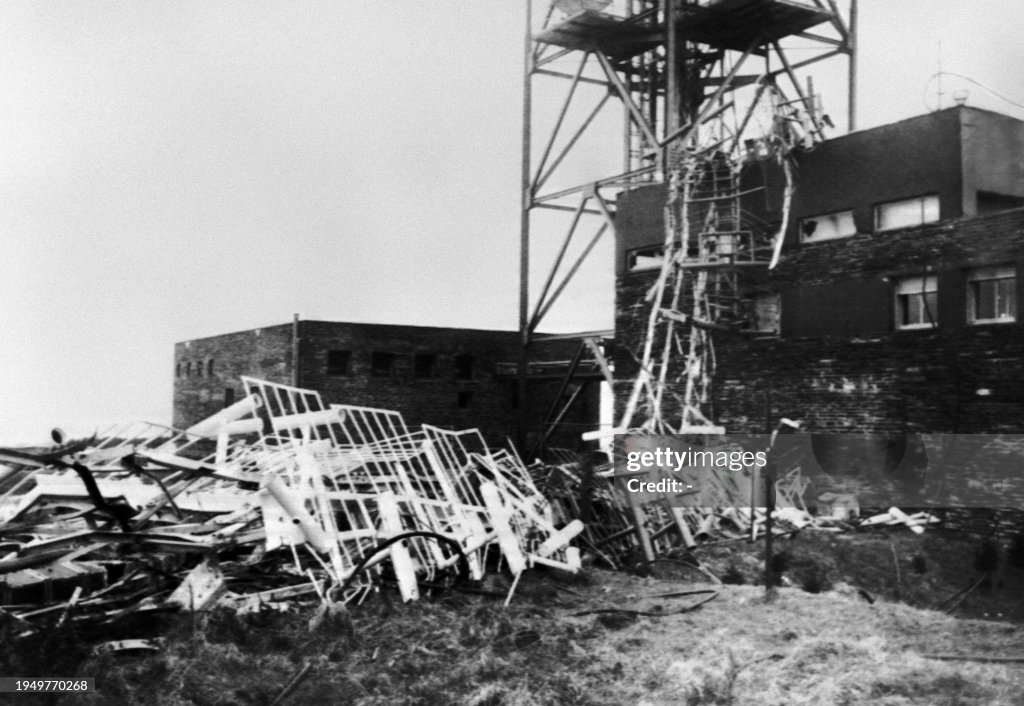
Saboteurs of the Brittany Liberation Front blew up a 630-foot transmitting tower in northwest France and a technician at the site died of a heart attack, police reported. Yann Goulet, a leader of the separatists, claimed responsibility for the attack, and said it was meant to draw the world’s attention to the “disdain shown by the authorities for the Breton language.”
The U.N. Security Council will hear the complaint of Iraq against alleged Iranian border incursions, council President Louis de Guiringaud of France announced. Iraq said that although fighting had stopped, Iranian forces remained three miles inside the country and “every element for the resumption of fighting is there.”
South Vietnam said today that it intended to recapture all islands of the Paracel and Spratly groups in the South China Sea even if it meant war with China, Taiwan or the Philippines. “Vietnam deems it necessary to solemnly declare before world opinion, to friends and foes alike, that the Paracel and Spratly archipelagos are an indivisible part of the Republic of Vietnam,” the Government declared in a statement. “As long as one single island is forcibly occupied by another country, the Government and the people of the republic will continue their struggle to recover their legitimate rights.” South Vietnam lost the Paracel Islands to China in a two-day battle nearly a month ago and then asserted control over the Spratlys, a chain of reefs and shoals 600 miles to the south.
Secessionist Muslim rebels in the Philippines shelled the besieged provincial capital of Jolo with 81-mm. mortars, hitting a hospital housing refugees and killing at least 30 civilians and two soldiers. The guns had been captured from government forces in earlier fighting. In a move apparently aimed at averting displeasure of Muslim oil producers, Foreign Secretary Carlos P. Romulo explained the fighting in diplomatic notes to Saudi Arabia and Kuwait, which supply most of the Philippines’ fuel needs. He said Manila had taken a restrained posture in dealing with the rebels.
The North Korean navy shelled two South Korean trawlers off the west coast of the Korean peninsula, leaving one vessel sinking and the other wrecked, the Defense Ministry said in Seoul. The ministry did not say whether there were any South Korean casualties or specify the number of North Korean ships involved in the attack, the first sea clash between the two countries since 1972. South Korean navy ships, meanwhile, were rushing to the rescue of the two embattled trawlers which reportedly were operating in the open sea off the South Korean-held island of Paengnyong-do when they came under attack.
In Buenos Aires, Argentina, 19-year-old middleweight boxer Ruben Loyola collapsed in the dressing room after losing his third professional bout and never regained consciousness. He would die of a cerebral hemorrhage the following day. Loyola had been fighting against Roque Roldan in the city of Pergamino and lost in a decision after going 15 rounds.
A 2,000-ton Liberian cargo ship, the Penyou Fares, sank in the Caribbean but the captain and 12 crew members landed safely in a single lifeboat on the British island of Montserrat, the U.S. Coast Guard reported in San Juan, Puerto Rico. The ship, en route from North Carolina to Trinidad with general cargo, went down off the northeast point of Guadeloupe, near Montserrat.
Almost unnoticed by a distant world, a cataclysm struck Ethiopia last year as famine swept at least two million farmers and herdsmen, killing uncounted thousands. The famine, centered north of Addis Ababa in the provinces of Wallo and Tigre, was caused primarily by a prolonged and withering drought. The deaths have diminished dramatically, but officials of the Government and of foreign relief agencies estimate that at least 1.7 million people in the original famine area will have to be fed for much of 1974 to prevent renewed starvation. Important obstacles to this vast effort have yet to be overcome.
While it is not yet known how many new drought victims might need assistance, some estimates are that the total will be more than a million — perhaps as many as 1.7 million. This would double an already monumental national problem. The problem seemed to materialize with frightening speed in Wallo and Tigre Provinces last year. What actually happened was that people who had always existed precariously near hunger were gradually pushed by natural and social misfortunes toward — and then over — the edge of disaster.
President Nixon has refused to release a large number of tape recordings and documents needed for the Watergate investigations, the special prosecutor told the Senate Judiciary committee. Fulfilling a pledge to inform the committee of any lack of cooperation by the President, Leon Jaworski sent a letter citing the President’s refusal to give him recordings of 27 Presidential conversations and related documents. Sources close to the investigation indicated that the prosecutor planned to begin seeking indictments later this month and to go to court in March to subpoena the additional material.
Special Watergate prosecutor Leon Jaworski revealed that the White House is refusing to supply more White House tapes or documents to him. Jaworski sent a letter to Senate Judiciary Committee chairman James Eastland about the matter, after White House attorney James St. Clair refused to give more evidence to Jaworski. Asked by a reporter if more evidence is needed to obtain indictments, Jaworski declined to comment.
House Judiciary Committee lawyers conferred with White House lawyer James St. Clair. St. Clair is concerned about the confidentiality of any evidence turned over to the committee for its impeachment probe. Committee counsel John Doar said the meeting with St. Clair went well; committee chairman Peter Rodino declared that the committee will make the final decision, not the White House. Minority counsel Albert Jenner insisted that no confrontation is brewing between the White House and the House Judiciary Committee.
Congressional sources have reported that at least $200,000 in contributions to the Nixon re-election campaign were funneled through committees set up to support congressional candidates in an elaborate scheme to “launder” donations from the milk industry to Mr. Nixon’s campaign. The sources said the information came from the Senate Watergate Committee.
Attorney General William Saxbe stirred up controversy in the Patricia Hearst kidnapping case, stating that the FBI should rescue Miss Hearst if her location can be determined. The FBI rejected Saxbe’s statement, and Randolph Hearst was visibly upset by such talk. Hearst said that the statement was antagonistic and “damn near irresponsible.” Saxbe later clarified himself by saying that Miss Hearst’s life is more important than apprehending the kidnappers.
The Hearsts have received sympathy cards and checks to help meet the ransom demands, though Randolph Hearst explained that he is not soliciting funds. The FBI and Hearst are continuing to work on an alternate ransom plan acceptable to the kidnappers. Health, Education and Welfare Secretary Caspar Weinberger called the kidnappers’ demands “absurd”.
As a chorus of hecklers shouted, “Impeach Nixon now!”, President Nixon dedicated a Miami hospital with a 17-minute speech that he managed to finish by turning away from the demonstrators directly in front of the platform. Though most of the 3,000 cheered his remarks, the heckling was the most distracting the President has faced since his re-election.
Service station operators are angry over limits on price increases and the recent order keeping operators from selling gasoline to regular customers only. The National Congress of Petroleum Retailers urged station owners to make no rash decisions until after their meeting with federal energy czar William Simon.
The Federal Energy Office said that it was sending teams of experts to New York and 19 other states with serious gasoline problems to consider revisions in the allocation system of the fuel.
Plans for a worldwide religious attack on Islam for its alleged “theological anti-Semitism” were announced in Miami Beach by leaders of American Judaism. The unprecedented decision to act against another faith was disclosed by Irwin M. Blank, president of the Synagogue Council of America, an umbrella organization for all branches of Judaism. “It is one thing for Muslim theologians to say that theirs is the only true faith and another for them to have contempt for Judaism,” explained Rabbi Henry Seigman, executive vice president of the council. The group will launch an international campaign to pressure Arab leaders to stop spreading anti-Jewish propaganda that attempts to turn the world against Israel.
The nation’s four largest can producers and the United Steelworkers agreed on a new three-year contract, affecting about 38,000 employees, just hours before a midnight deadline. The four companies were American Can, Continental Can, Crown Cork & Seal, Inc., and National Can. A union spokesman said the new contract would bring a fringe benefit and a general wage increase of 28 cents an hour in the first year, 16 cents an hour the second year and 17 cents the third year. The present hourly wage is about $5.
The Federal Drug Enforcement Administration announced its agents seized 42 ounces of heroin and arrested four persons believed to have been conducting a $10 million “mail order” smuggling operation. DEA agents intercepted 11 envelopes containing 42 ounces of the drug. An ounce of heroin brings about $12,600 on the street after it is cut in strength by the addition of fillers. An agent said the seizures and arrests in the Washington area came after a February 1 raid by American and Thai agents in Bangkok. The 11 airmail letters sent from Thailand were later followed by postal authorities.
The National Aeronautics and Space Administration has made tentative plans for space exploration over the next two decades that include landing a television camera on one of the moons of Jupiter, another on one of the moons of Saturn and a rendezvous with Halley’s comet when it returns in 1985. NASA also is planning to resume exploration of the moon, this time with robot explorers instead of men. It is considering eight moon robot flights starting in 1979 and ending in 1991.
[Ed: NASA will find its plans to be fiscally constrained.]
Dow Jones Industrial Average: 809.92 (+3.05, +0.38%).
Born:
Valentina Vezzali, Italian Olympic champion fencer with six gold medals in five consecutive Olympic Games (1996, 2000, 2004, 2008 and 2012) and politician; in Iesi, Province of Ancona, Italy.
Alexander Wurz, Austrian racing driver, winner of two 24 Hours of Le Mans events; in Waidhofen an der Thaya, Lower Austria.
Michael Lowery, NFL linebacker (Chicago Bears), in McComb, Mississippi.
Matt Redman, English gospel music singer and songwriter, twice a Grammy Award winner; in Watford, Hertfordshire, England, United Kingdom.
Garik Martirosyan, Armenian-Russian comedian and TV host known for Komedi Klub and the satirical talk show Prozhektorperiskhilton on Russian television; in Yerevan, Armenian SSR, Soviet Union.

 History Diaries