Generalissimo Francisco Franco promulgated a decree providing for dissolution of all parties associated with the Popular Front and penalties of loss of citizenship and exile for those deemed hostile to the Nationalist cause. From Burgos, Franco publishes his Ley de Responsabilidades Políticas (Law of Political Responsibilities). The law states that anyone who opposed the Nationalist rebellion and coup in July 1936, and anyone a member of any Republican party from October 1934, is guilty of military rebellion. As the law is backdated to 1 October 1934, all Republican sympathizers and members can be prosecuted for aiding the Republican rebellion.
The Ley de Responsabilidades Políticas punishes people with fines ranging from 1000 pesetas through to confiscations of all assets. Anyone prosecuted could also be punished with restriction of movement and activities, forced to live where appointed and possible loss of Spanish citizenship, depending on their level of Republican association. Anyone dead or disappeared (either as refugees in France or those killed and dumped in the war) will have their remaining family members prosecuted on their behalf.
Between 1939 and 1945, 500,000 people, dead or alive, will be prosecuted, some two percent of the population.
Following last week’s influx of Loyalist troops and civilians into France, a reflux to Insurgent Spain was well underway today. It is reported from Toulouse that of 150,000 soldiers and civilians checked through that city since the refugee invasion began, 53,500 soldiers have opted for the territory of Generalissimo Francisco Franco. The Insurgents have thrown the Catalonian frontier open to relieve the pressure on the border at Irun. The many converts to the Franco cause are thus being handled with comparative ease, but those remaining loyal to the Spanish Government provide a more difficult problem. These men are being held in camps pending a decision as to whether they can be shipped by sea to the central Spanish zone held by the Loyalists.
A contingent of 1,300 militiamen who had succeeded in escaping from the Andorra region after having been cut off opted 100 percent for the Madrid Government. The crews of nineteen Spanish commercial planes who flew to Toulouse after the Catalonian collapse are staying there, and, unlike other refugees, enjoy complete liberty of movement, but their planes have been interned. Roads leading from France into Catalonia were blocked today by sheep and cattle being driven back. In the Cerdagne sector alone more than 60,000 sheep were led back.
While Spanish Insurgent Generalissimo Francisco Franco is holding up his offensive against the Madrid and Valencia area until it becomes known whether the Republicans (Loyalists) will heed his appeals to surrender, the unanimity of the British and French Governments on early recognition of his regime apparently has been made more complicated by a curious reversal of positions in the past week. The French, who last week seemed eager to accord immediate recognition to General Franco, are now drawing back lightly, and the British are taking the lead in a policy intended to appease General Franco and weaken the influence of Germany and Italy at Burgos, the capital of the Franco regime. The question of recognition will be considered by the French Cabinet tomorrow and by the British Cabinet Wednesday.
Although it was reported from Paris tonight that French enthusiasm had cooled off so much that only recognition “in principle” would be accorded to the Spanish Insurgents at the moment, no doubts of this nature were apparent when Prime Minister Neville Chamberlain faced angry Laborites in the House of Commons today. The Prime Minister flatly refused to review “a situation which is changing very rapidly” or to give assurance that the British Government was not contemplating de jure or de facto recognition of the Insurgents or that he would consult the House of Commons before taking action. Although otherwise uncommunicative, the Prime Minister threw some light on the circumstances under which Great Britain provided the cruiser Devonshire to take a Spanish Insurgent envoy to negotiate for the surrender of the Balearic Island of Menorca. The British Government, he said, had protested to General Franco against bombing raids carried out on Menorca during the negotiations, and the senior officer in charge of the Insurgent naval forces at Palma, Majorca, had informed the British consul that these attacks were “in disobedience of orders and very much regretted.”
The Irish Government officially recognizes the government of Franco.
Papal colors fly throughout Germany. The swastika, which must normally fly next to all other symbols, is not flown in this instance.
The German Government’s proposals toward helping the orderly emigration of refugees from the Reich were submitted today to the delegates of thirty-two countries at the most encouraging meeting ever held by the Evian Intergovernmental Committee. It was encouraging because for the first time since 1933 Germany has offered large-scale cooperation in solving the refugee problem forced on the outside world by the advent of the Hitler regime. In some respects, the German scheme foreshadows a checking, if not a reversing, of the increasingly ruthless pressure applied to Jews and others in the past six years. As submitted to the committee today by George Rublee, American director, the plan provides for the emigration of about 150,000 able-bodied wage-earners between the ages of 15 and 45 over a period of three to five years. As soon as these pioneers are established in new homes overseas, they can be followed by their wives, children and other dependents to the number of about 250,000. This, as Mr. Rublee reminded the committee, fulfills the first aim of his discussions with the Germans, which was to obtain time for a regulated emigration instead of a panic-stricken flight.
Moreover, the Germans have promised reasonably decent conditions, including the right to work, for those awaiting emigration or those who will be unable to leave Germany. This satisfies Mr. Rublee’s second condition, and although the German assurances are vague and qualified, they at least give promise of less suffering for more than half a million persons now cut off from virtually all German life under the Nuremberg laws. Finally, the Germans have suggested the creation of a trust fund out of one-quarter or more of the Jewish property still left in Germany, to be used for traveling expenses for refugees inside Germany and for necessary equipment for their new homes.
[Ed: “over a period of three to five years.” But Hitler knows full well that he is not going to wait that long to begin his war.]
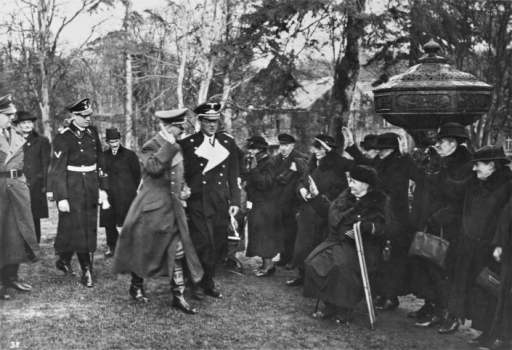
Adolf Hitler puts a wreath on Otto von Bismarck’s tomb. The founder of the second Reich is a personal hero of Hitler’s. Chancellor Adolf Hitler visited Bismarck’s memorial estate at Friedrichsruhe today and placed a laurel wreath on the tomb of the founder of the Second Reich. It was Herr Hitler’s first visit to the mausoleum of the “Iron Chancellor,” one of his political idols, and it served as a prelude to tomorrow’s launching of Nazi Germany’s first 35,000-ton battleship, which is to bear the name Bismarck. The occasion will be a reminder to the world, says the press, that the Third Reich will soon command a navy commensurate with its newly won status as a world power. Herr Hitler was accompanied by Foreign Minister Joachim von Ribbentrop, Admiral General Erich Raeder and other government officials. The party was entertained at a luncheon in the old Friedrichsruhe Palace by Prince Otto von Bismarck, grandson and only male survivor of the old chancellor.
The Soviet press criticizes Pius XI for defending capitalism.
Five Cardinals lead the Vatican contest.
England’s only Cardinal leaves for Rome to participate in the conclave.
An IRA incendiary balloon device set fire to the steam ship St. David.
Supreme Court Justice Louis Brandeis retires amid rumors of ill health. Louis Brandeis, the first Jew to sit on the U.S. Supreme Court, retires. Justice Louis D. Brandeis retired today from regular active service on the Supreme Court in the twenty-third year of his tenure. In a letter of notification to President Roosevelt, the 82-year-old jurist required only a single sentence to make known the decision which the Chief Executive promptly accepted as “inevitable.” The retirement came as no surprise to the capital. Justice Brandeis has been in frail health for several years. About a month ago he was confined to his home with a severe case of grippe and did not make his reappearance on the bench until last Monday. Today he sat with his colleagues, as usual, and there was nothing during the brief decision session to show that anything unusual was in the offing. However, it had long been intimated by old friends that Mr. Brandeis wanted to step down before the end of the present court term and it was said by many that he desired to remain only long enough to see his friend and admirer, Felix Frankfurter, ascend the bench, a development which came two weeks ago.
President Roosevelt, still confined to the White House with the grippe, but whose condition was improved today, conferred with Secretary Hull and Under-Secretary Welles and received Representative Rayburn, majority leader, for a short conference. He announced receipt of Justice Brandeis’s notice of retirement from the Supreme Court.
The Senate adopted a resolution expressing sorrow at the death of Pope Pius XI, approved several nominations, received the Wheeler bill to give the Interstate Commerce Commission jurisdiction over investments of railroads and their subsidiaries and adjourned at 12:35 P. M. until noon Thursday.
The House adopted a resolution eulogizing Pope Plus and adjourned at 12:08 P. M. until tomorrow. Its Ways and Means Committee continued hearings on amendments to the Social Security Act.
An attack upon the legality of the law to prevent picketing of foreign embassies failed today when the Supreme Court refused to review the sentences of four men convicted for that offense last year. The law, passed by Congress after demonstrations outside the German and Italian Embassies, provides a $100 fine and sixty days’ imprisonment for displaying, within 500 feet of an embassy or legation, banners or placards “designed or adapted to bring into public odium any foreign government, party or organization or any of the officers thereof.” The legislation was urged by Secretary Hull, who said that, under the comity of nations, representatives of foreign governments were entitled to “freedom from any attempted coercion.”
Air defense plans will go to House debate this week. Attacks on Roosevelt are expected, but the funds bill is anticipated to pass.
Assailing the Roosevelt New Deal as a mixture of coercion, collectivism and a lust for personal power, Herbert Hoover, former President of the United States, declared last night that the three great missions of the Republican party were the preservation of personal, intellectual and economic freedom, economic restoration and peace for America by avoiding entanglement in another world war. Mr. Hoover, who spoke at the annual Lincoln dinner of the National Republican Club at the Waldorf-Astoria Hotel, characterized the Roosevelt spending policy as an “economic hallucination” and an obstacle to prosperity. “Mr. Roosevelt says ‘this generation has a rendezvous with destiny,’ ” his predecessor in the White House declared. “The most probable spot for that rendezvous today is inflation. When this generation has gone up that alley, it will find freedom has gone and our rendezvous will be with a full-sized dictator.”
John F. Kennedy, the 21-year-old son of a U.S. Ambassador, will have a six-month trial period as an office boy at the London and Paris embassies.
George R. Holmes, the Washington bureau chief of the International News Service, dies of a heart attack. President Roosevelt pays tribute.
The wife of John D. Rockefeller, Jr., sells two rare pieces of Buddhist art to the Metropolitan Museum of Art. There is no room in her new apartment to display the art.
Japanese in Hong Kong assert that following the occupation of Hoikow (today Haikkou), on Hainan, they took over the customs service “with the consent” of Commissioner Groff Smith, the American in charge of customs there. It is believed that the Japanese at present do not intend to occupy more than a portion of the island, including the principal harbors. It is increasingly believed in informed circles that the invasion is largely to ensure a bargaining position for the Berlin-Rome-Tokyo triangle if the threatened international crisis involving Russia, and also perhaps France and Britain, materializes in the Spring.
The Japanese House of Representatives is set to approve the largest budget in the country’s history, though at 3.7 million yen it is seen only as a first installment.
Prime Minister Joseph A. Lyons said in a statement today that Australia’s Air Force expansion program was ahead of schedule. The government has decided to raise the first-line strength of the force to 212 craft. Mr. Lyons said it would not be wise to disclose the total number of planes in production or the capacity of Australian industry and, therefore, he was discussing the Commonwealth’s air strength only in general terms except for the first line. The first of 100 Wirraways ordered from the Commonwealth Aircraft Corporation will be ready this month, the Prime Minister said, and thereafter output will be increased progressively. He explained that the establishment of this factory had tremendously altered the supply problem. Australian industry will be able to meet the whole requirements of the Air Force for two-seater, single-engined planes, he said, adding that difficulties in the delivery of improved Bristol Blenheim planes ordered from Britain were being overcome. Avro Ansons were being delivered from Britain, and fifty Lockheed general reconnaissance planes were awaited from the United States, he said.
Born:
Beate Klarsfeld [née Künzel], Franco-German journalist and Nazi hunter, in Berlin, Germany.
Valery Rozhdestvensky, Soviet cosmonaut (Soyuz 23), born in Leningrad, Soviet Union (d. 2011).
Chuck Marshall, AFL defensive back (Denver Broncos), in Hickory, Mississippi.



 History Diaries