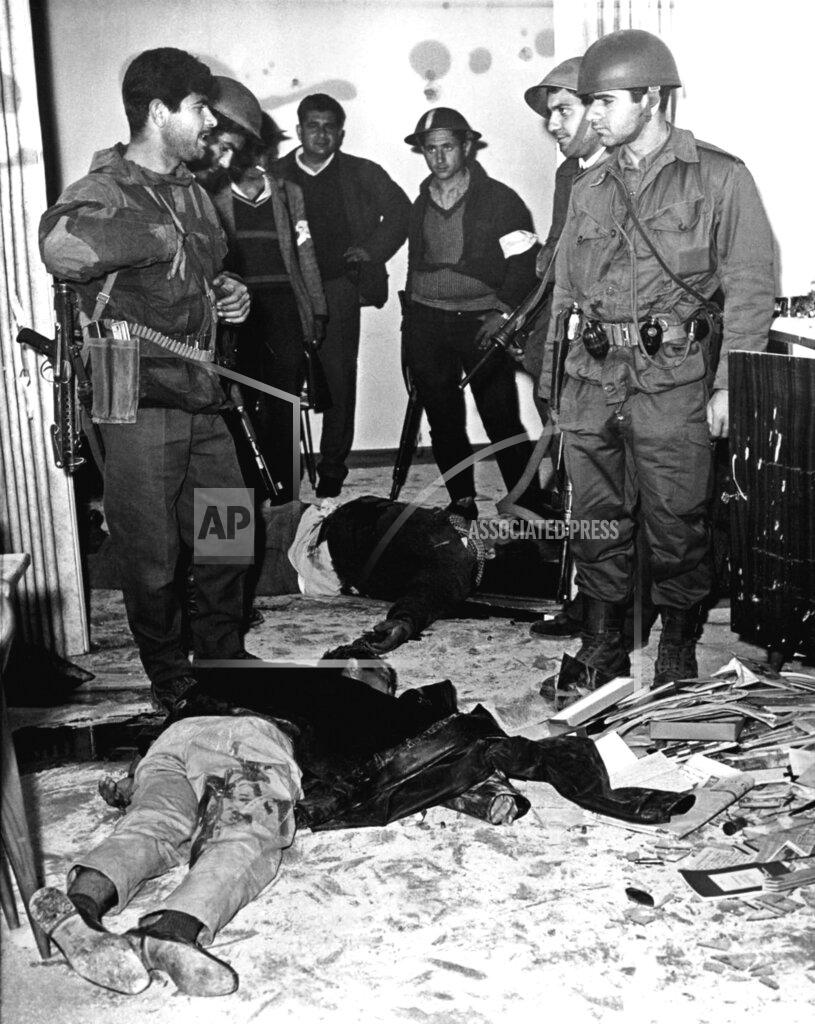
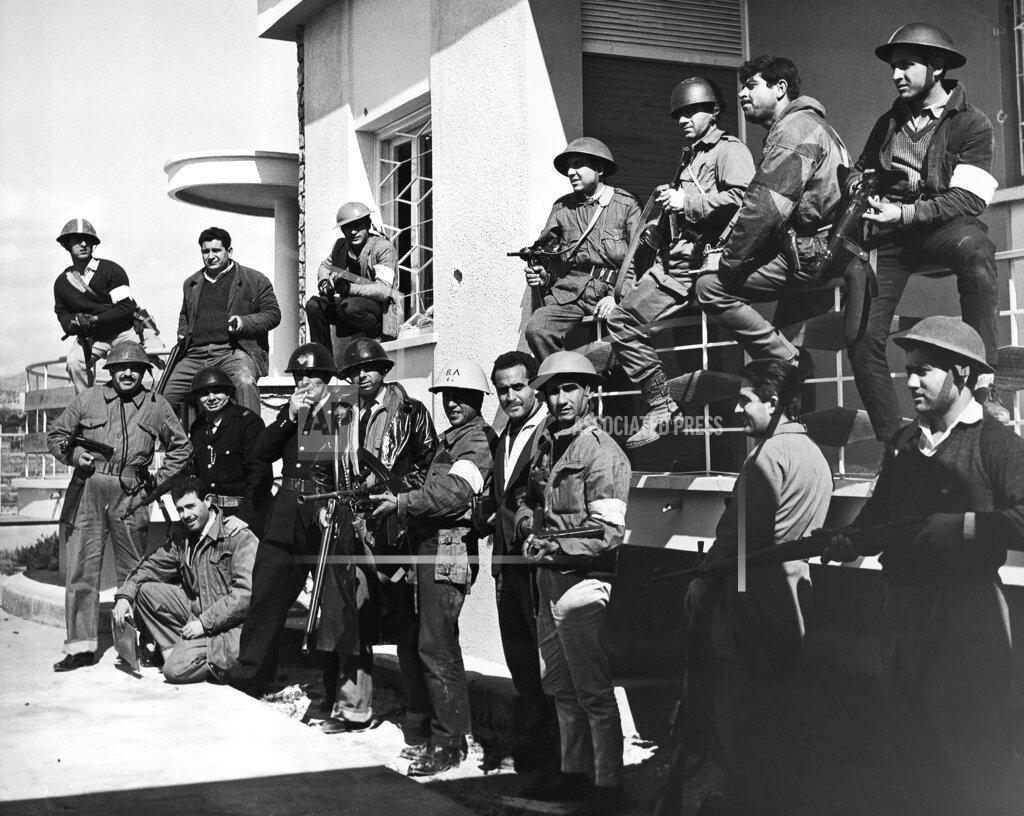
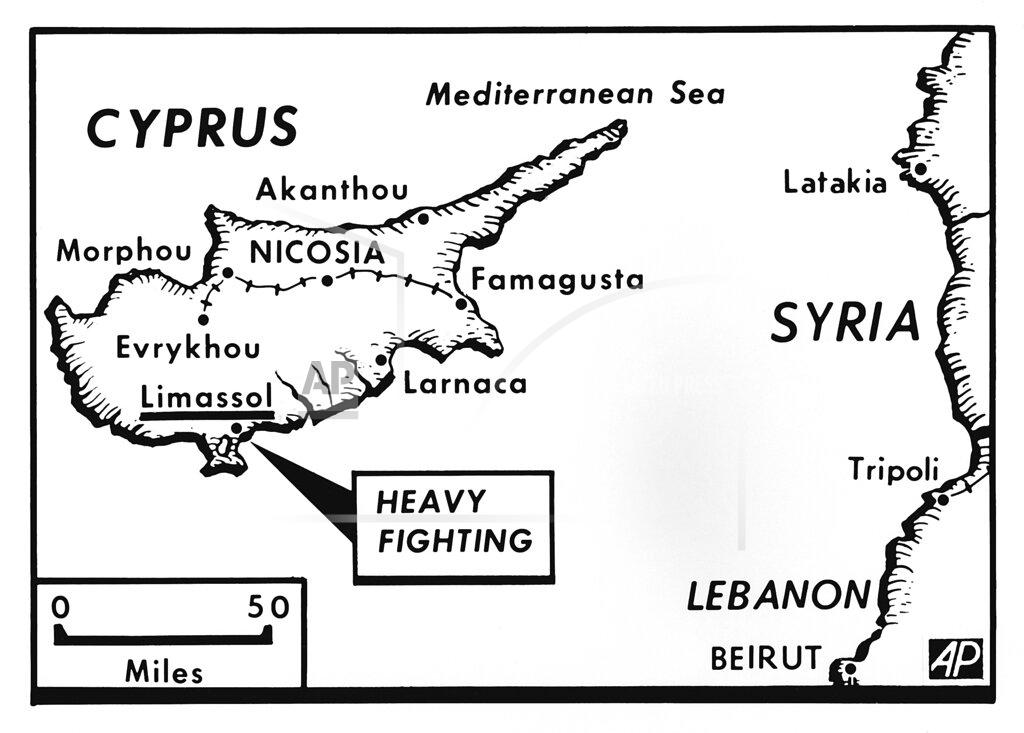
Archbishop Makarios, the President of Cyprus, indicated today that he would rather have a British Commonwealth force maintain peace on the island than troops contributed by members of the North Atlantic Treaty Organization. The archbishop made this one of several counterproposals to United States and British plans for keeping order on the island while mediators seek a new accord between the feuding Greek and Turkish Cypriote communities. Negotiations will continue tomorrow, but the total package proposed by the archbishop raised no hopes in Washington for an early accord. As the diplomatic impasse continued, fighting between the Greek and Turkish communities increased on Cyprus. At the southern port city of Limassol, the toll after two days of renewed strife was at least 50 dead and 100 injured.
British troops patrol the streets of Limassol, the second largest city in Cyprus, to enforce the new cease-fire agreement after 50 persons are killed in a resumption of heavy fighting between Greek and Turkish Cypriots. In Nicosia, the capital, Undersecretary of State George Ball continues to confer with President Makarios on a plan for an international force to keep the peace on the island.
General Nguyễn Khánh visits ARVN troops in the field as part of the Vietnamese New Year observances and announces a 20 percent pay increase for all servicemen up to and including the rank of corporal. Two weeks after he had seized power in Saigon through a bloodless coup d’état, the 36‐year‐old Premier set off on his second tour to meet the people and troops in the countryside.
As on his first trip, a three-hour visit to a garrison town near the capital, the amiable general made an energetic attempt to make his government a vivid reality in the eyes of the populace. Throughout the country during this holiday period military sources report a lull in Viet Cong activity. The Communists had announced that they would honor a seven‐day truce for New Year festivities.
A right‐wing military communiqué said today that pro‐Communist Pathet Lao and North Vietnamese guns were heavily shelling right‐wing positions in north‐central Laos, and that “an attack is imminent.” The fighting is in the area of Xiengkhouang, chief town in the province of the same name, east of the Plaine des Jarres. It was one time jointly held by Pathet Lao and neutralist forces. Last April the Pathet Lao pushed the neutralists from the town, and right-wing forces went to the neutralists aid. Since last December it has been the scene of sharp fighting.
Walt Rostow writes a memo to Secretary of State Rusk in which he argues that the United States should seriously consider bombing Hanoi; Rostow also suggests that President Johnson obtain a Congressional resolution to give him authority to wage war evidently the first time this has been put into writing by an administration official.
The Communist Government of North Vietnam has vowed a vigorous, if protracted, guerrilla war to “liberate” South Vietnam. Siding openly with Communist China against an implied Soviet counsel of moderation, the Hanoi Government warned that Peking would intervene if North Vietnam were attacked. It ridiculed suggestions that all Vietnam be neutralized. The Hanoi assertions, together with detailed tactical advice to the guerrillas, appear in two major policy declarations by the North Vietnam Workers (Communist) party. Their publication coincides with the end of the unsuccessful negotiations between Soviet and North Vietnamese Communists and the arrival of the Hanoi delegation in Peking.
Together, the statements constitute Hanoi’s most extensive in more than a year about the war in South Vietnam. The comment was written as a polemic against persons in Moscow and Hanoi itself — who fear the outbreak of a major conventional war, or even a nuclear war. It also anticipates a major offensive by the United States‐supported forces, of South Vietnam and displays some concern about the morale of the guerrillas. The North Vietnamese concede the superiority of the United States and South Vietnam in men and modern weapons and grant them the “initiative” in the first stages of most battles. They argue, however, that political agitation, the favor of South Vietnam’s peasants and shrewd maneuver can bring victory despite these odds, especially because “the enemy” must keep his forces scattered over too large an area.
Greater involvement in a guerrilla war will fail in South Vietnam, the statement continued, just as it failed in Laos and as it failed for the French in Vietnam and in Algeria. It also argued against speculation by unidentified persons that the United States would or could use tactical nuclear weapons against the guerrillas. Finally, the statement declared, if the United States attacks North Vietnam to win the war in South Vietnam it would have to cope also with China or “eventually with the Socialist camp as a whole.” Hanoi apparently was unable to obtain a definite commitment of support from Moscow. The promise of Chinese intervention is the most explicit ever claimed by Hanoi and the first reference to its possibility since 1961. It North Vietnam were attacked with conventional weapons, the statement said, the United States would be outnumbered and would lose more in Asia than South Vietnam. If it employed tactical or strategic nuclear weapons, it adds, “that might directly lead to retaliation with the same weapons.”
British Prime Minister Alec Douglas-Home, visiting President Johnson, reaffirms his nation’s support for the U.S. defense of South Vietnam and attacks the statements by Britons who have been urging that the United States withdraw. They expressed hope for successful East‐West negotiations on arms control measures, but foresaw no early breakthrough to justify a summit conference with Premier Khrushchev. They disagreed, vigorously, about British trade with the Soviet Union and Cuba and engaged in good‐natured debate about that trade long after the formal meetings. They commiserated on their separate involvements in efforts to keep the peace in Africa and checked hourly on the negotiations to send an international peace force to Cyprus.
The British Government announced today a record peacetime defense budget for the coming year and reaffirmed its policy of maintaining an independent nuclear deterrent. Spending will be increased by £160 million to £1.998 million ($5.6 billion) for 1964–65. In a White Paper that is almost certain to make defense planning a major election issue. the Government said the deterrent strengthened the defense of Europe. It made this major point: the British deterrent prevents a potential enemy from being “tempted” to attack Europe. “If there were no power in Europe capable of inflicting unacceptable damage on a potential enemy,” the White Paper said, the enemy might be tempted “to attack in the mistaken belief that the United States would not act unless America herself were attacked.” The opposition Labor party has termed Britain’s quest for an independent nuclear force “futile.” If Labor wins the general election, which must be called before November, the party would not scrap the existing force, but would stop efforts to extend it.
The United States urged the Soviet Union today to join in the “immediate future” in a reduction in the output and stockpiling of fissionable materials for nuclear bombs. William C. Foster, head of the United States delegation. stressed at the 17‐nation disarmament conference Washington’s “flexibility” regarding details of the proposal. the substance of which has been offered before. In his State of the Union Message last month, President Johnson announced that the United States was shutting down reactors to reduce the production of enriched uranium for nuclear weapons by 25 percent. The United States delegate said that Washington was “flexible” also regarding the amounts of the stockpiled fissionable materials that the two major nuclear powers would transfer to peaceful uses.
There was no immediate reply from Semyon K. Tsarapkin, the Soviet delegate. Instead, he asked the conference to give priority to Moscow’s proposal for a 10 to 15 percent cut in military budgets.
The East German government has proposed an Easter pass agreement under which West Berliners could visit East German families as they did at Christmas time. East German officials would man the pass offices in the western sector as early as February 25, a month before Easter. The East Germans also suggest the extension of the pass agreement to the Whitsun holiday May 17.
Five days before his trial as a war criminal was due to begin, German psychiatrist Werner Heyde hanged himself in prison at Butzbach. His suicide brought to three the number of accused war criminals who have escaped trial by death in the last two weeks. Yesterday, Friedrich Tiliman, a former associate of Heyde who was to have been tried with him, was killed when he fell from an eighth‐floor office‐building window in Cologne. On February 2, Ewald Peters, Chancellor Ludwig Erhard’s personal security guard, hanged himself in a Bonn detention cell. Peters had been arrested on suspicion of participation in the mass murder of Jews in World War II.
The deaths of Heyde and Tillmann made it uncertain whether the trial would open next week in Limburg, 30 miles east of Koblenz. Only one of the four originally accused remains to face trial. He is Dr. Hans Hefelmann, who is charged with having aided in the murder of 73,000 people. Dr. Bernhard Bohne, charged with complicity in the murder of 15.000 people, fled last August while free on bail. He is believed to be in Latin America. The 61‐year‐old Heyde, left unguarded for 10 minutes this morning, hanged himself with a belt from a radiator. He was taken to Butzbach, about 20 miles north of Frankfurt, last fall after an attempt to escape from the Limburg prison had been foiled.
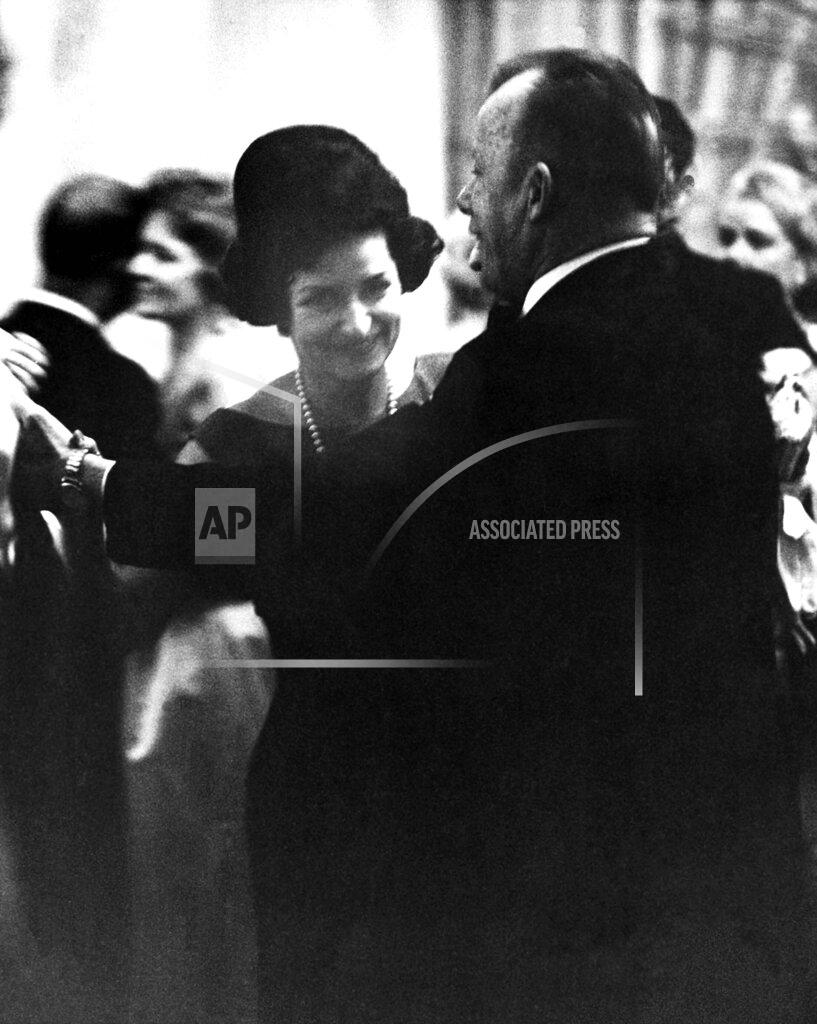
The president today met a group of Boy Scouts celebrating the 54th anniversary of the Boy Scouts of America; and gave a White House state dinner for the British Prime Minister.
Satirically referring to President Johnson as “the Great Compromiser,” Senator Barry Goldwater said today that the President had “no stomach” to face difficult problems at home and abroad. Mr. Goldwater told an audience in the gambling town of Las Vegas that in his handling of foreign affairs Mr. Johnson was in the position of a man at the dice table who had “just crapped out six times.” Mr. Goldwater, a candidate for the Republican Presidential nomination, was on the sixth day of an eight‐day Western swing. The Arizona Senator continued an attack against the President and the Democratic party that began last week in New Hampshire when Cuba cut off water supplies to the Guantanamo naval base. The vehemence and repetitive intensity of the attack have mounted daily since then. Until last week, Mr. Goldwater had been somewhat off‐handed in his foreign policy criticism and had supported the President on Panama and South Vietnam.
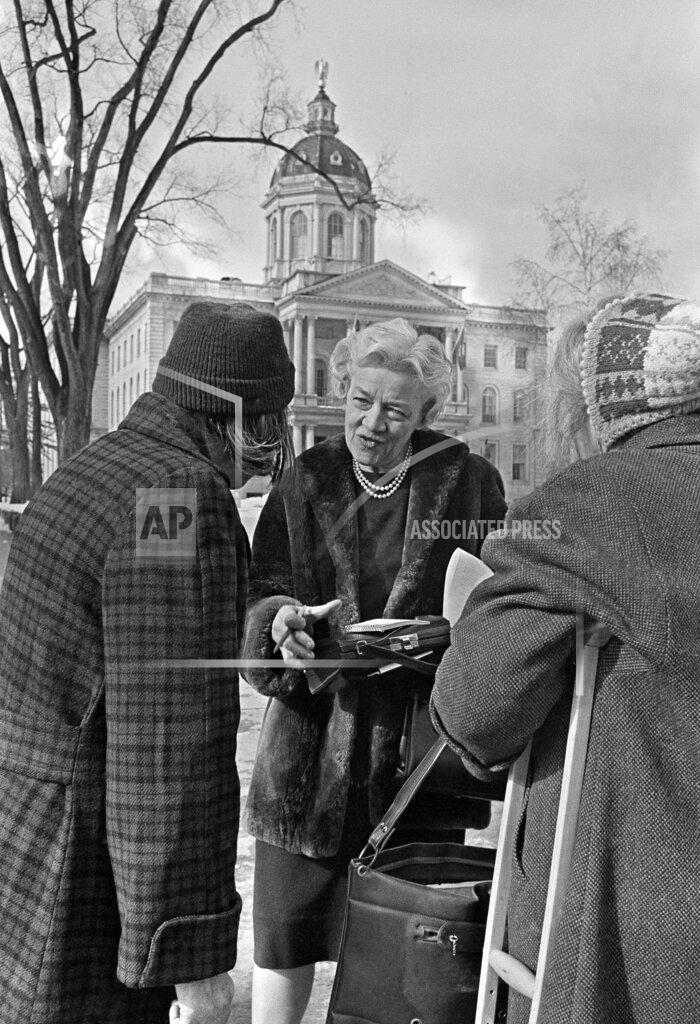
Governor Rockefeller expressed doubt today about the Administration’s plan to land a man on the moon by 1970. The New York aspirant for the Republican Presidential nomination said there was a “very serious question” whether the United States should pull out on the moon race. Even if a man is landed on the moon, he said to 100 factory workers at Contoocook, the feat may be a “hollow gesture.” About 95 per cent of the information that can be obtained from putting a man on the moon “for a half an hour” could be gathered by instruments in satellites, he said. Besides, he went on, the Russians might be first to the moon, anyway.
The Governor told about 100 workers at the Kingsbury & Davis plant, which manufactures box‐making machinery, that President Johnson, when he was Vice President, “suddenly” pressed for the moon program after the failure of the Bay of Pigs invasion of Cuba. He quoted Mr. Johnson as saying, “We’ve got to have something that’s dramatic.” Mr. Rockefeller proposed reconsidering the plan advocated by President Dwight D. Eisenhower for a slower, less expensive “scientific” space program.
Frank Sinatra Jr. testifies that he offered no resistance to the men who kidnapped him and made no effort to escape from them because he feared for his life. The 20-year-old singer says he thought, at first, that the invasion of his motel room was a “very bad joke.” Young Sinatra takes the stand in the trial of three men accused of abducting him and collecting a ransom.
Billy Sol Estes, bankrupt Texas wheeler-dealer, sent cases of melons to prominent persons and saved the thank-you notes he received, a House subcommittee reports. Gifts of Estes’ melons were received in 1961 by the then Vice President Lyndon Johnson and the late President Kennedy.
Senator Hugh Scott (R-Pennsylvania) calls upon Secretary of Defense Robert S. McNamara and Federal Bureau of Investigation Director J. Edgar Hoover to explain the leak of secret government information used to smear Don B. Reynolds, a witness who has cast reflections upon President Johnson in the Bobby Baker scandal. In the House, Rep. H. R. Gross (R-Iowa) says there is an administration conspiracy to discredit Reynolds, and that the White House knows it.
Attorney General Robert F. Kennedy received a firsthand briefing in New York yesterday on the Federal grand jury investigation into the Cosa Nostra. Mr. Kennedy was met at La Guardia Airport by United States Attorney Robert M. Morgentau as he arrived for a two‐day stay. The two rode together to Midtown. Mr. Morgenthau is believed to have brought the Attorney General up to date on the appearances of a number of Cosa Nostra underworld figures before the grand jury hearing evidence here of a purported criminal conspiracy. The Government is concentrating on five Cosa Nostra, or Mafia, “families” that control the rackets throughout the metropolitan area. The Federal Bureau of Investigation is in charge of the investigation and receiving cooperation from the Internal Revenue Service and the Narcotics Bureau.
District Judge Joe B. Brown abruptly recesses the hearing for a change of venue in the Jack Ruby trial for the murder of President Kennedy’s accused assassin. He announces that he will give his decision today on whether Ruby will be tried in Dallas or another Texas city.
A Nashville insurance man tells of reporting a bribe offer he said he had received as a juror in the conspiracy trial in 1962 of James Hoffa, teamster president. Hoffa’s attorneys object repeatedly to the testimony given by James C. Tippens, the agent, at Hoffa’s trial for jury-rigging.
Mrs. John F. Kennedy met here yesterday with New Yorkers interested in the proposed John F. Kennedy Memorial Library. The President’s widow did not comment on her visit to the city, but it was understood that she and her brother‐in‐law. Attorney General Robert F. Kennedy, had held at least one meeting with interested persons. Last October Mr. Kennedy approved the site for the library in Cambridge, at Harvad University. After the President’s assassination last Nov. 22, Mrs. Kennedy and the Attorney General joined others in planning the construction of a library to house not only the President’s personal papers but also the records of his Administration.
The State Department informs Rep. Michael A. Feighan (D-Ohio) that it finds no legal justification for barring Richard Burton, actor-companion of Elizabeth Taylor, from the United States. However, Burton, now in Canada, will be questioned at the border on his way to Boston about his travels with Miss Taylor. Feighan has demanded that Burton’s visa be revoked on moral grounds.
A drug used in helping X-ray the gallbladder, and which has been a possible link in some 17 deaths, has been removed from the market, the Food and Drug administration reports. Senator Hubert Humphrey (D-Minnesota) calls the FDA’s handling of the drug. Orabilex, “distressing” and says a Senate subcommittee he heads will look into it.
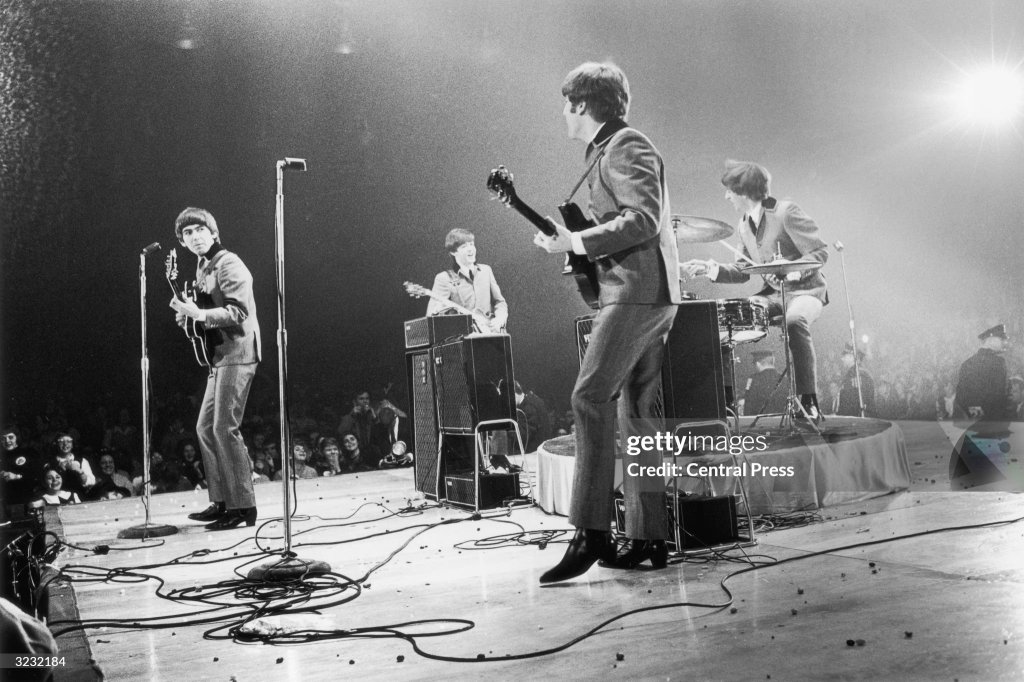
The Beatles arrived in Miami today and were greeted by an exterminating truck and 4,000 squealing teenagers. The British rock ‘n’ roll quartet flew here for a brief rest and a television appearance following two concerts in Carnegie Hall in New York last night. Despite the crush of the thousands of screaming and singing fans, the Beatles made it through the airport unmolested and were rushed to Miami Beach in a limousine, flanked by police escorts. The exterminating truck had signs that read: “Beatle Burger Truck” and “We Welcome the Beatles But We Have Bugs.”
Chicago Cubs second baseman Ken Hubbs, 22, dies when his private plane crashes near Provo, Utah, while en route to Colton, California. As a rookie in 1962, Hubbs had played in 78 consecutive games without making an error.
Dow Jones Industrial Average: 794.42 (-0.40).
Born:
Stephen Bowen, U.S. Navy submariner and astronaut (NASA Group 18, 2000; STS-126, STS-132, STS-133, SpaceX Crew-6 [Expedition 68/69]), in Cohasset, Massachusetts.
Mark Patton, U.S. interior designer and actor (“A Nightmare on Elm Street”, “Come back to the Five and Dime”), in Kansas City, Missouri.
Dann Howitt, MLB outfielder and first baseman (Oakland A’s, Seattle Mariners, Chicago White Sox), in Battle Creek, Michigan.
Grant Sasser, NHL centre (Pittsburgh Penguins), in Portland, Oregon.
Don Fairbanks, NFL defensive end (Seattle Seahawks), in Lakewood, Colorado.
Wade Lockett, NFL wide receiver (Los Angeles Raiders), in San Diego, California.
Died:
Ken Hubbs, 22, American major league baseball second baseman for the Chicago Cubs and winner of the National League Rookie of the Year award for 1962, was killed along with a passenger when the plane he was piloting crashed during bad weather. Hubbs had departed from Provo, Utah, to return to his home in Colton, California, when his Cessna 172 went down. The wreckage was found in a lake near Provo, where it went down three minutes after takeoff.
Werner Heyde, 61, German psychiatrist, one of the main organizers of Nazi Germany’s T-4 Euthanasia Program.
Arthur Upfield, 73, Australian crime novelist and author of the “Bony” Bonaparte mystery series

 History Diaries