The 10:30 am train arrives in Xàtiva Railway Station, sixty kilometers south from Valencia, carrying the 49th mixed brigade of the Republican army, to be transferred north. The station was also filled with family and friends of the troops when five Italian Savoia-Marchetti SM.79 bombers arrive from Mallorca and drop twenty 250kg bombs from 13,800 feet. The bombing makes a direct hit on the train, killing 129 people, 109 instantly. Most are troops, though 14 women and three children are also killed. A few surviving troops are still sent on to join other brigades, as the 49th was too decimated to continue with any plans. Another 200 people are injured in the attack.
The Spanish Government appealed tonight for united resistance against the Insurgents “pending the arrival of peace in an atmosphere of independence, safety and liberty.” The proclamation was broadcast to all the people in what is left of government territory after Premier Juan Negrín had called his Cabinet together for a meeting under the roar of an Insurgent shelling of Madrid. After having removed to Valencia and then to Barcelona in the course of the war, the Spanish Government again was back in Madrid, the traditional capital of Spain. “Either we shall all save ourselves or sink ourselves in extermination and opprobrium,” the proclamation said. The appeal indicated that the government intended to fight until Generalissimo Francisco Franco offered peace terms acceptable to Premier Negrín, who has asked for the removal of Italian and German influence from Spain and amnesty for government leaders. General Franco thus far has insisted upon an unconditional surrender, and today he continued his air raids on government cities.
One hundred persons were reported killed and scores wounded at Xàtiva, forty miles south of Valencia. Sixteen were killed and twenty-three wounded in the Madrid shelling. Twenty were reported killed and fifty-five wounded in air raids at Alicante. Valencia also was bombed. The government proclamation said “our fate is at stake and it depends entirely upon ourselves to come out successfully from the present situation through our own will power and determination.” Acknowledging that it was facing an immense task, the government appealed for “impassionate cooperation” in order to form “a compact heroic national front.” The appeal added: “There is no room for other discussion than absolute identification with the government, as the latter is preparing the defense of uninvaded Spain pending the arrival of peace in an atmosphere of independence, safety and liberty.”
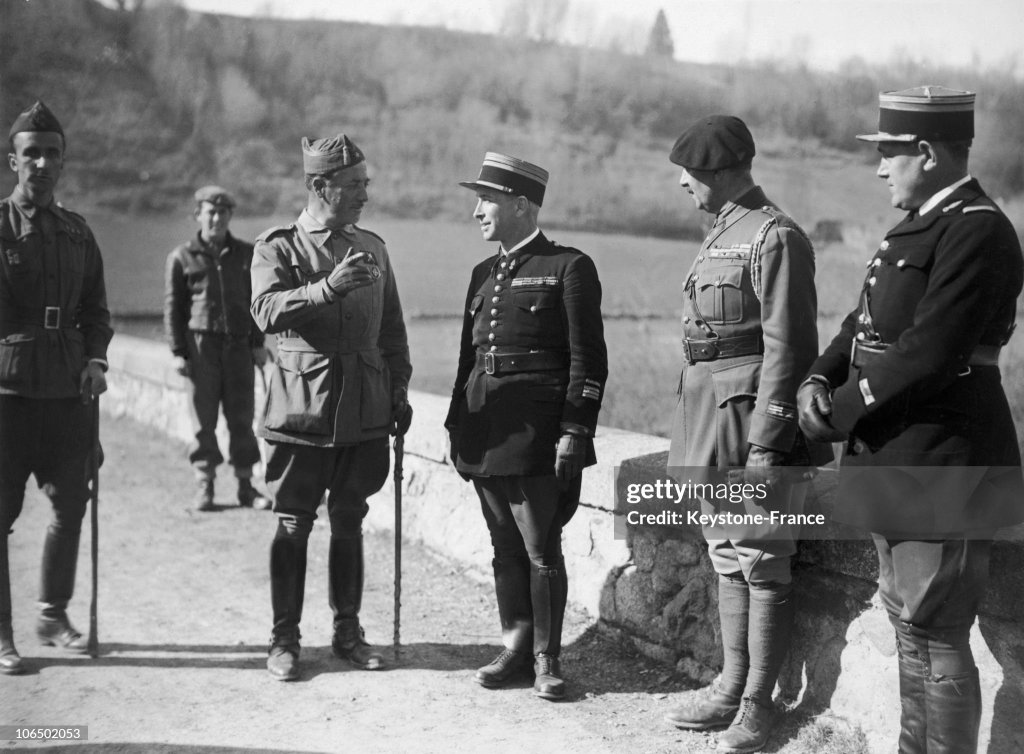
French authorities today obtained the opening of the frontier of Catalonia after Spanish refugees, expressing a desire to return to Insurgent territory, had been blocked at the border at Irún. The Bayonne prefect, who had conferred with Generalissimo Francisco Franco’s military governor of Irún, today announced that the refugees, beginning tomorrow, could be sent back through Catalonia. The first refugees will probably be admitted through Le Perthus. This will relieve the congestion at Hendaye, where more than 4,000 are stranded today, while more are arriving hourly. Authorities at Irún closed the frontier because they were not equipped to handle the numbers of refugees pouring over the international bridge for the past twenty-four hours.
Border officials here have been informed that out of 106,000 soldier refugees, 46,000 already have made an application for repatriation. The Franco authorities have made only one stipulation with regard to returning militiamen. None of Lieutenant Colonel Enrique Lister’s battalion will be permitted to re-enter Spain. Soldiers of all other units will be accepted. Tonight the Irún authorities said that the frontier would be reopened in the morning for the women, children and wounded, but able-bodied ex-soldiers would have to wait until Tuesday.
Eduardo Barriobero, former Deputy in the Spanish Parliament, who was accused of having helped doom more than 100 Rightists as a Loyalist judge, was sentenced to death by a court-martial in Barcelona last Tuesday and was shot Friday. He was 63 years old. Journalists in Barcelona were forbidden to make any mention of the sentence.
France sees a general European war as loyalists’ only chance to hold on to Spain.
The first of nine funeral masses in as many days was held for Pius XI. 200,000 Catholics began streaming into Vatican City to take part. All faiths unite in praising the late Pope Pius XI. His body rests in St. Peter’s Basilica after a solemn procession. Two of three American Cardinals sail to Rome to participate in the election of the new Pope. While hundreds of thousands filed through the Chapel of the Sacrament in St. Peter’s to pay their last homage to Pope Pius XI and attended the first of the impressive funeral services this morning, the Congregation of Cardinals met in the Consistorial Hall and set the Pope’s interment date for Tuesday. On that day the body will be sealed in a coffin and placed in its permanent resting place in the crypt of St. Peter’s where Pius XI himself chose a vault between those of Pius X and Benedict XV.
Last night an enormous and elaborate “tumulus,” or symbolic representation of Pius’s body, was erected in the nave between the crypt of St. Peter and the Altar of the Cathedral. It consisted of a marble base about ten feet high and about ten feet square at the bottom, narrowing in two steps to about seven feet by three at the top. In tall candelabras of iron standing on the floor and others of gilt wood standing on the two steps of the base were ninety-four candles. A symbolic coffin placed on this base was not visible because it was draped with a cover of yellow silk with a deep black edge on which were embroidered various devices, prominent among them a skull and crossbones. Atop the coffin, resting on a white silk cushion embroidered in brown and having tassels of the same color hanging from the corners was the triregnum, or triple-crown emblem of papal authority.
Insurgent Spanish forces halt their victory celebration to mourn the Pope.
Slovakian nationalist leader Vojtech Tuka met with Adolf Hitler in Berlin, Germany, seeking support for Slovakian independence. Hitler answered in the affirmative.
Premier Augustin Volosin’s party wins a large majority in the election in Carpatho-Ukraine.
The body of London night club singer Georgina Hoffman is found in her flat in Dover Street. ‘The Black Butterfly’ had been stabbed to death.
Megan Taylor of the United Kingdom won the women’s competition of the World Figure Skating Championships in Prague.
The Society for the Protection of Ancient Buildings struggles with a bat problem in old British churches.
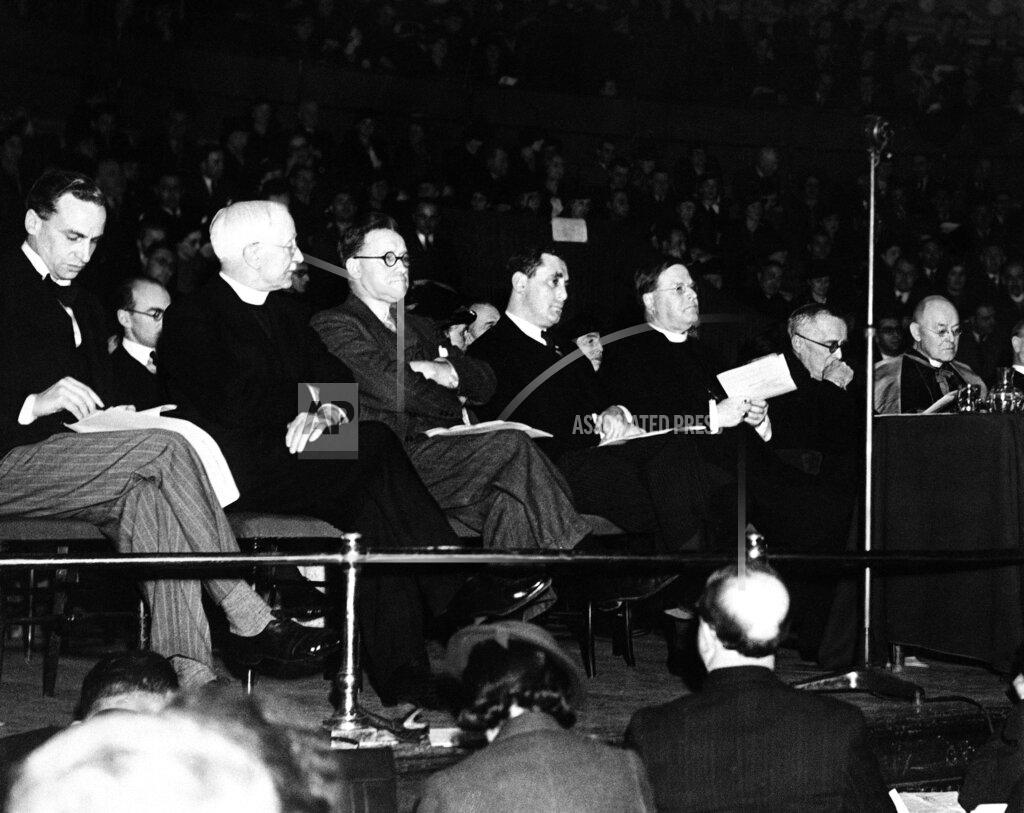
The Palestine conference makes little headway; the refusal of Arab delegates to meet with Jewish delegates suggests a deadlock.
The Institute of Public Opinion finds growing resistance to President Roosevelt’s liberal policies. Conservatives fare better.
The New York League of Women Voters prepares materials against an Equal Rights Amendment.
A Congressional subcommittee opposes favors for small business. A monopoly study suggests that business size should not affect penalties given.
President Roosevelt will not place the traditional Lincoln wreath today because he is ill. President Roosevelt remained in bed today for the third day since he contracted a light attack of grippe on Friday. A statement issued at the White House said that, although the President’s condition was materially improved, he still had a slight temperature, less than 1 degree, and the White House physician, Rear Admiral Ross T. McIntire, considered it best for him to remain in bed and effect a complete recovery. There has been nothing serious about Mr. Roosevelt’s condition at any time. Friday morning, when he normally has a press conference, he remained in bed on the advice of Dr. McIntire and canceled all appointments, as he did yesterday when his temperature had gone down. Today, with no routine calling list anyhow, the President stayed in seclusion again as a purely precautionary measure.
Senator Robert La Follette notes parallels to the current situation and 1917. He urges Congressional participation in foreign policy to keep the United States out of war.
While appealing for peace in a World’s Fair broadcast last night, Secretary of State Cordell Hull warned the world that the United States could “offer no other reply but determined defense and resistance” to any attack by another nation on our “most vital and cherished interests.” He spoke from Washington in one of the weekly broadcasts designed to acquaint the public with the Federal Government’s $3,000,000 exhibit at the New York World’s Fair of 1939. The Secretary’s plea for peace followed a similar radio appeal made by King Carol II of Rumania, who spoke from Bucharest in the afternoon in the seventh of the Fair’s “Salute of Nations.” Secretary Hull broadcast over an NBC network and King Carol spoke over networks of the Columbia, Mutual and National Broadcasting systems. After asserting that it was of the utmost importance for citizens to have a full knowledge of the work of their government, Secretary Hull said that the government’s exhibit at the Fair would make an important contribution in that respect, and added: “The first and most basic of the problems confronting the government in the field of foreign relations is that of the preservation of peace for our nation. In times like the present, when the specter of a new major armed conflict haunts the world, the issue of war and peace becomes an intensely personal one. It touches every one of us. It is ever present in our homes, in our places of work and recreation, in the cities and on the farms.
Conferences between the American Federation of Labor and Homer Martin, who insists that he is still president of the United Automobile Workers of America, looking toward the entrance of the Martin adherents into the federation, are expected to be under way in a few weeks, it was learned today on reliable authority. Responsible A. F. of L. leaders are confident that Mr. Martin and a large bloc of his followers will rejoin the A. F. of L. if that opportunity is afforded to them. No obstacles will be placed in their way, for it is believed by those close to the A. F. of L.’s executive council that Mr. Martin’s followers will be unable to exist as a separate entity and must have “a home.”
Eighteen new U.S. Navy destroyers of the Benham-class are delayed by engineering defects revealed in the turbines.
Aviation experts look to a light beryllium alloy for aircraft construction.
The first flight of the XF4F-3, the much modified prototype of the Grumman G-36 Wildcat fighter, is made. Compared to its original XF4F-2 form, it now has larger and more angular wing and tail surfaces.
The Postmaster General announces a new stamp to commemorate baseball’s centennial.
A court decrees that a bar bouncer cannot eject a man who is holding his liquor and is able to pay for drinks until the 4 a.m. closing time.
Glenn Cunningham wins a mile race by a two-foot margin.
Margaret Fishback publishes the etiquette guide “When to Behave — and Why” and takes jibes at Emily Post.
Canada won gold at the World Ice Hockey Championships in Switzerland.
The South American Championship of football was won by host country Peru, defeating Uruguay 2-1 in the deciding match.
Tokyo attempts to calm France, while also taking over customs duty on the seized island of Hainan. French Ambassador Arsene Henry visited Foreign Minister Hachiro Arita at 11:30 this morning in reference to the Japanese occupation of Hainan Island. The Foreign Office declined to make any statement regarding the future of the island, but the spokesman’s remarks this morning seemed intended to allay foreign apprehensions without giving concrete assurances. He quoted Generalissimo Chiang Kai-shek’s remark that Japan’s occupation of Hainan was a menace to the peace of the Pacific. “Japan’s occupation of Hainan,” said Tatsuo Kawai, chief of the information section, “has no connection with the peace of the Pacific.” When asked if it was correct to say that Japan had declined to give any assurance regarding the future of Hainan, Mr. Kawai replied that it was premature to say anything about the future, but added: “Our declaration that Japan has no territorial ambitions in China applies also to Hainan.”
In Burma, police fire on a procession of twenty thousand people. Two dozen are killed. In Delhi, 20 are killed and 200 injured in fighting between Hindus and Muslims objecting to music being played outside a Mosque. Five hundred are arrested. Police fired six times on the rioters and the situation remains tense.
Born:
Ray Manzarek, keyboardist (The Doors- “Light My Fire”; “Love Her Madly”), in Chicago, Illinois (d. 2013).
Jerry Walker, MLB pitcher (All-Star, 1959; Baltimore Orioles, Kansas City A’s, Cleveland Indians), in Ada, Oklahoma.
Jim Lawrence, Canadian MLB catcher (Cleveland Indians), in Hamilton, Ontario, Canada.
John D Hancock, American actor and director (“Black Marble”, “Traxx”, “Houston Knights”), in Kansas City, Missouri
Yael Dayan, politician and author, in Nahalal, British Mandatory Palestine.
Died:
S. P. L. Sørensen, 71, Danish chemist.
 History Diaries