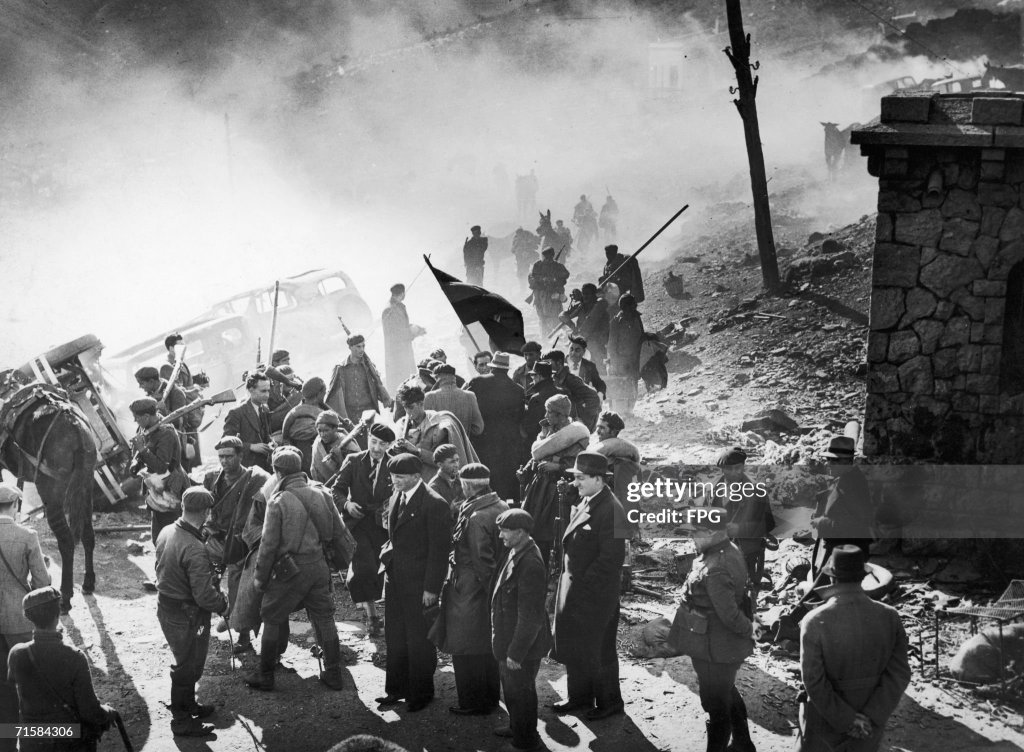
Puigcerda in Catalonia was fully captured by the Spanish Insurgents only today because a “suicide” company of anarchists, resolved to die for their cause, continued to hold their enemy at bay up to noon. In the process about 150 men of the Twenty-sixth (Durruti) Division sacrificed themselves, but they had taken a heavy toll among the Insurgent ranks while holding down machine-gun nests in various houses. The Insurgents had to take these houses singly, either by mining them or by throwing hand grenades. During the night and all this morning Bourg-Madame was rocked by terrific explosions as the Insurgents set off mines blowing up anarchist strongholds or mines that the anarchists themselves had set before the Franco troops came in.
Every explosion meant that some house had gone up and that some men had died. The explosions continued until the last anarchist had died, for surrender they would not. At first it had been believed that the group had been trapped by the rapid encircling movement of the Franco troops when they captured the frontier zone yesterday. But friends of the doomed men told how they had elected to remain behind and die rather than surrender. Their slogan was “Death sooner than defeat; in death let us take ten Fascists for every one of us.” Their comrades tried to dissuade them, but they clung to their plans. There was, of course, no escape for them.
The extent of the casualties that the Insurgents suffered in subduing the anarchists is impossible to ascertain, for their officers will not tell, but the explosions and the rattling of machine-gun fire told their own tale. When the Insurgents entered the town yesterday, they numbered only 1,000, and 500 yards away their erstwhile adversary was almost 40,000 strong. But the adversary was disarmed and the international border and French troops were in between. Now that Generalissimo Francisco Franco has had time to bring up his rear his garrison is considerably reinforced.
The German Government has offered to let Jews and other unwanted “non-Aryans” re-enter trade and industry inside the Reich while they are awaiting emigration overseas, it became known tonight. The German offer — supposedly the most important relaxation of anti-Jewish pressure since 1933 — forms part of the detailed German memorandum that will be submitted in London tomorrow night to officers of the Evian Committee and Monday to the delegates of all thirty-two governments concerned. It was brought to London by George Rublee, director of the refugee committee. last week after discussions with Field Marshal Hermann Goering, Dr. Hjalmar Schacht, Dr. Helmuth Wohlthat and other German Government leaders. Although the details of the plan are still known to only a few officials, the German offer at least appears to promise the cooperation of Nazi authorities so that enforced emigration of several hundred thousand persons can take place in an orderly manner.
At the first meeting of the Reich Central Office for Jewish Emigration, Heydrich orders officials to proceed as if an agreement with the intergovernmental committee does not exist.
German students in North America are to send back information to the Reich about the political and economic situation there.
The Reich is preparing to launch a 35,000-ton battleship, the largest in the history of the German navy.
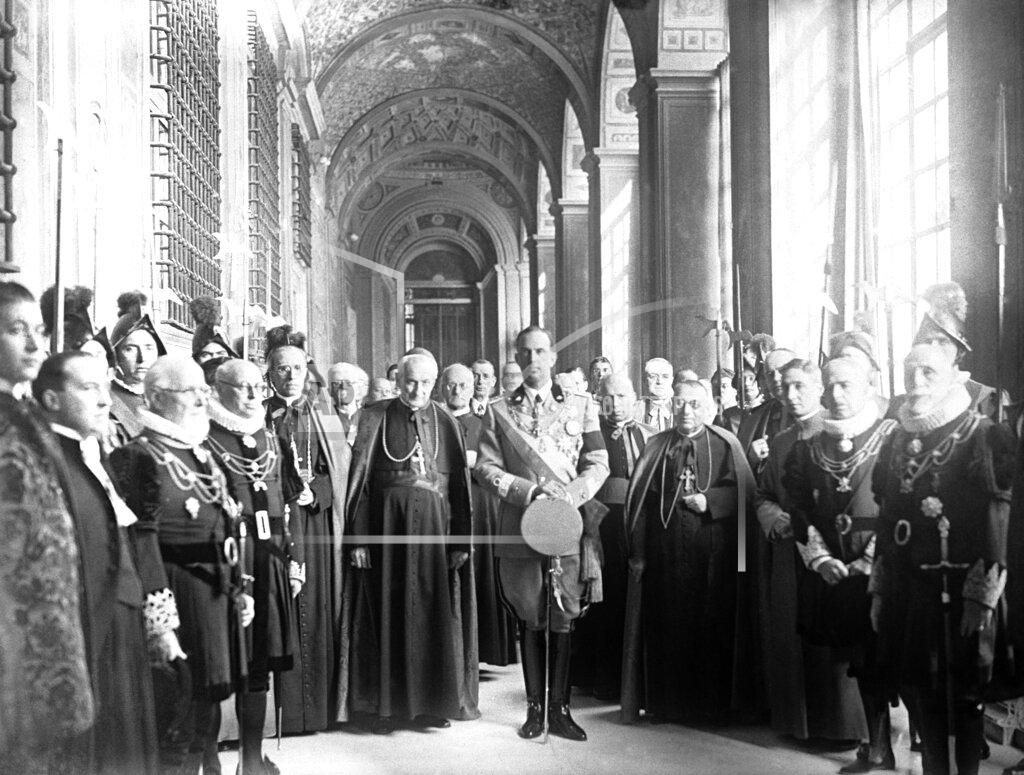
The body of Pope Pius XI lies in state, as world leaders pay homage. Adolf Hitler sends a message that the next Pope should be political, and should understand the laws of the times.
This morning the body of Pope Pius XI, still surrounded by the warm glow of Michelangelo’s stupendous frescoes in the Sistine Chapel, received the homage of Crown Prince Humbert of Italy, the presidents of the Senate and the Chamber of Corporations and other representatives of Italian officialdom. Late this afternoon it was carried in procession with much pomp and circumstance into the cold majesty of St. Peter’s, where it is now lying in state in readiness for the funeral ceremonies that will begin tomorrow, and where it will receive, beginning tomorrow, the last salute of the common people in their hundreds of thousands. St. Peter’s is now plunged in darkness and deserted. Only the Chapel of the Blessed Sacrament — the third chapel in the right aisle — is aglow with the light of twenty-six enormous candles arranged around the sides of a rectangle, at the center of which is the body.
The papal conclave is postponed to March 1.
Today is the tenth anniversary of the Lateran Treaty.
Democratic leaders of the House, faced with the best-organized Republican opposition that has confronted them since their party gained control of the lower chamber in 1930, called a party caucus today to meet on Tuesday morning for what was described in the call as “a general discussion.” Influential members of the party organization were at little pains to conceal the fact that the real object to be discussed would be ways and means of combating Republican tactics by a more closely knit organization on their own side of the aisle.
Representative McCormack of Massachusetts, chairman of the Democratic caucus, could not be reached today, but it was understood he convoked the party gathering only after consultation with the principal officials of the Democratic House organization and with their full approval. Under the leadership of Representative Martin of Massachusetts, who succeeded Representative Snell of New York, the House Republicans have been using the tactics of “divide and conquer” to the utmost advantage this session. They have obeyed, almost to a man, their whips’ instructions, voting practically solidly on all important issues which might be embarrassing to the Administration.
The prosecution’s case against Tammany District Leader James J. Hines was completed yesterday with the testimony of two witnesses who furnished corroborative links between the politician and the Arthur (Dutch Schultz) Flegenheimer policy racketeers. The witnesses were James D. C. Murray, lawyer, and Cornelius J. Casey, Democratic County Chairman of Rensselaer County, who lives in Troy. They repeated testimony they gave at the first trial of Hines, which ended in a mistrial last September 13. District Attorney Thomas E. Dewey’s second case against Hines required forty-five witnesses, twelve of whom had not been called at the first trial. The record of the testimony ran to about 4,000 typewritten pages, or about equal to that of the first trial.
The Assistant Attorney General of New York sifts through bribery charges against high-level police officers.
President Roosevelt was improving today from his attack of grippe, but he remained in bed and probably will stay there tomorrow also as a precautionary measure. “The President is better,” Dr. Ross T. McIntire, his personal physician, said. “His temperature is down a little bit to 99.2 degrees, and he feels much better. I will keep him in bed today and probably tomorrow. I would not consider letting him go outside tomorrow. It would be very foolish. He is coming along as well as could be expected from the grippe, and his sinus is all right.”
Film financier Jules Brulatour pays a $500 fine for a weapons charge to avoid 30 days in a workhouse.
First Lady Eleanor Roosevelt hails female reporters. She presents four prizes of $100 each.
Secretary of the Interior Harold Ickes stands by his statement that the press is not as free as it should be in a democracy.
The United States celebrates the 130th birthday of Abraham Lincoln.
Oswaldo Aranha, the Brazilian minister of foreign affairs visits Washington D.C., bringing with him experts in trade and banking.
The ancestral home of Ralph Waldo Emerson, which later became the home of Nathaniel Hawthorne, is slated to become a public shrine.
The Federal Trade Commission orders the manufacturer of D. Gosewich’s Garlic Tablets to stop claiming the product ‘lowers blood pressure, removes bloodstream impurities, and strengthens intestines,’ among other claims.
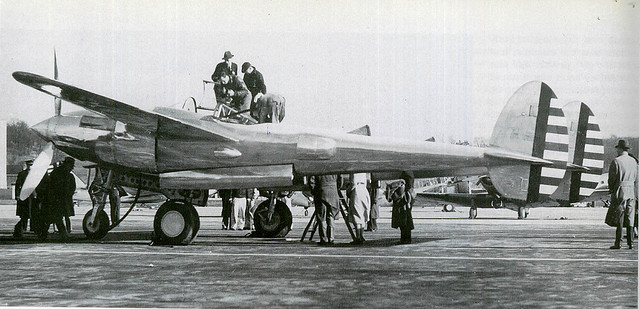
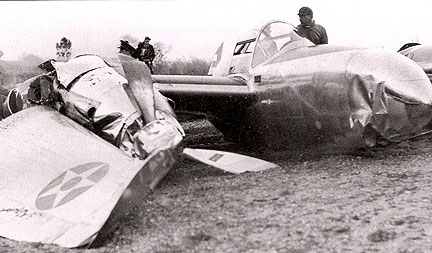
The prototype Lockheed P-38 Lightning flies across the Nation from California in 7 hours and 2 minutes, to a crash landing at Mitchel Field, Long Island. Lieutenant Ben Kelsey was the pilot. Benjamin S. Kelsey flew an experimental Lockheed P-38 Lightning from March Field in California to Mitchel Field in New York. The plane crashed short of the runway due to engine failure from carburetor ice, but Kelsey was not injured. Kelsey was overhead Mitchel Field, New York at 4:55 p.m., Eastern Standard Time, but his landing was delayed by other airplanes in the traffic pattern. On approach, the XP-38 was behind several slower training planes, so Lieutenant Kelsey throttled back the engines. When he tried to throttle up, the carburetor venturis iced and the engines would not accelerate, remaining at idle. The airplane crashed on a golf course short of the airport.
An article appears in the science journal Nature, Vol. 143, No. 3615, 11 February 1939, by Lise Meitner and Otto Frisch: “Disintegration of uranium by neutrons: a new type of nuclear reaction.”
The question whether Japan is seriously intending to precipitate a clash with Russia is holding the attention of foreign military experts in the Far East, who are unable otherwise to explain the present situation and military moves. It is authoritatively known that Japan has more than 600,000 soldiers in Manchukuo, Chahar and Suiyuan and is continuing to remove troops from various occupied zones of China. This enormous concentration northward, where the armies cannot be used against Generalissimo Chiang Kai-shek, increases suspicions that Japan intends to precipitate a clash with the Soviet Union.
Military sources in Shanghai say Central China and the Yangtze Valley areas are lightly held by only 200,000 troops in the entire Shanghai-Hanchow-Nanking-Wuhu-Hankow-Yochow zone. This precludes the possibility of any large-scale advances westward from Hankow or any push southward aiming at linking the captured sections of the Canton-Hankow Railway. The Hangchow, Nanking and Hankow districts are being fortified strongly by the Japanese. Apparently, they intend to settle there and repel Chinese attacks while transferring their main mobile strength elsewhere.
The closing of the Pearl River at Canton for a ten-day period beginning Wednesday was explained when it was learned the entire Japanese Fifth Division was boarding transports at Canton preparatory to sailing to an undisclosed port to the north. This leaves barely 25,000 Japanese soldiers at Canton and in the surrounding areas, so there can be no important pushes to the west or north. From Shantung Province and occupied areas along the Yellow River, Japanese troops have been shifted northward. Foreign military and diplomatic observers here are convinced that Russia is not planning to attack Japan and also believe Japan would not contemplate attacking the Soviet unless she was reasonably certain that the growing tension in Europe will immobilize at least half the Soviet armies along Russia’s western borders.
Japan defends its seizure of Hainan.
Japanese troops landed at Sanya on the southern coast of Hainan island in southern China.
Dow Jones Industrial Average: 144.61 (+0.93).
Born:
Gerry Goffin, American pop and rock lyricist (“Will You Love Me Tomorrow”; “Up on the Roof”; “Pleasant Valley Sunday”), married to Carole King, 1959-69, in Queens, New York, New York (d. 2014).
Jane Yolen, American sci-fi and children’s literature author and poet (“Spider Jane”; “Heart’s Blood”), in Manhattan, New York, New York.
Willie Smith, MLB leftfielder, pinch hitter, and first baseman (Detroit Tigers, Los Angeles-California Angels, Cleveland Indians, Chicago Cubs, Cincinnati Reds), in Anniston, Alabama (d. 2006).
Died:
Franz Schmidt, 64, Austrian composer, cellist and pianist.
Naval Construction:
The Kriegsmarine (German Navy) Type IX U-boat U-40 is commissioned. Her first commanding officer is Kapitänleutnant Werner von Schmidt.




 History Diaries